


Ask anyone what their favorite James Bond car is, and the list likely includes a lot of Aston Martins, Lotuses and BMWs before a Saab comes up, if it ever does. Yes, a Saab wasn’t just a background vehicle in a Bond film, but the actual hero car for 007 – albeit in book form. That didn’t prevent Saab from building actual Bond cars in collaboration with the film studio.
Two James Bond Saab Turbos were built to go on the promotional circuit, and they arrived at the height of Saab’s turbo era. While 007 only had 175 horsepower to work with, that was a good power figure in the early 1980s. Besides, the Turbo Esprit had already familiarized him with four-cylinder turbo power, so why not a Saab?


The original creator of James Bond, Ian Fleming, passed away in 1964 after a final heart attack. Fleming had been in poor health for the preceding few years, which is also said to have contributed to the tone of the last books he wrote. The other, well-publicized thing is that while the 007 film series had finally gotten off the ground, it was dogged by court action. Fleming’s Thunderball novel was partially based on a film script he had written together with Kevin McClory, an Irish writer, and the original plan was to film Thunderball as the first film in the 007 series.
After McClory got Fleming’s Thunderball novelization in his hands, he took Fleming to court over it, likely stressing Fleming enough to give him his first heart attack in 1961, even if Fleming’s smoking habit also did a lot of work. In any case, Dr. No was filmed first in 1962, followed by From Russia With Love, then Goldfinger, with Thunderball eventually following with enough credit for McClory. In this time, Fleming also wrote the children’s book Chitty-Chitty-Bang-Bang and finished The Man With The Golden Gun, which was published eight months after his death.
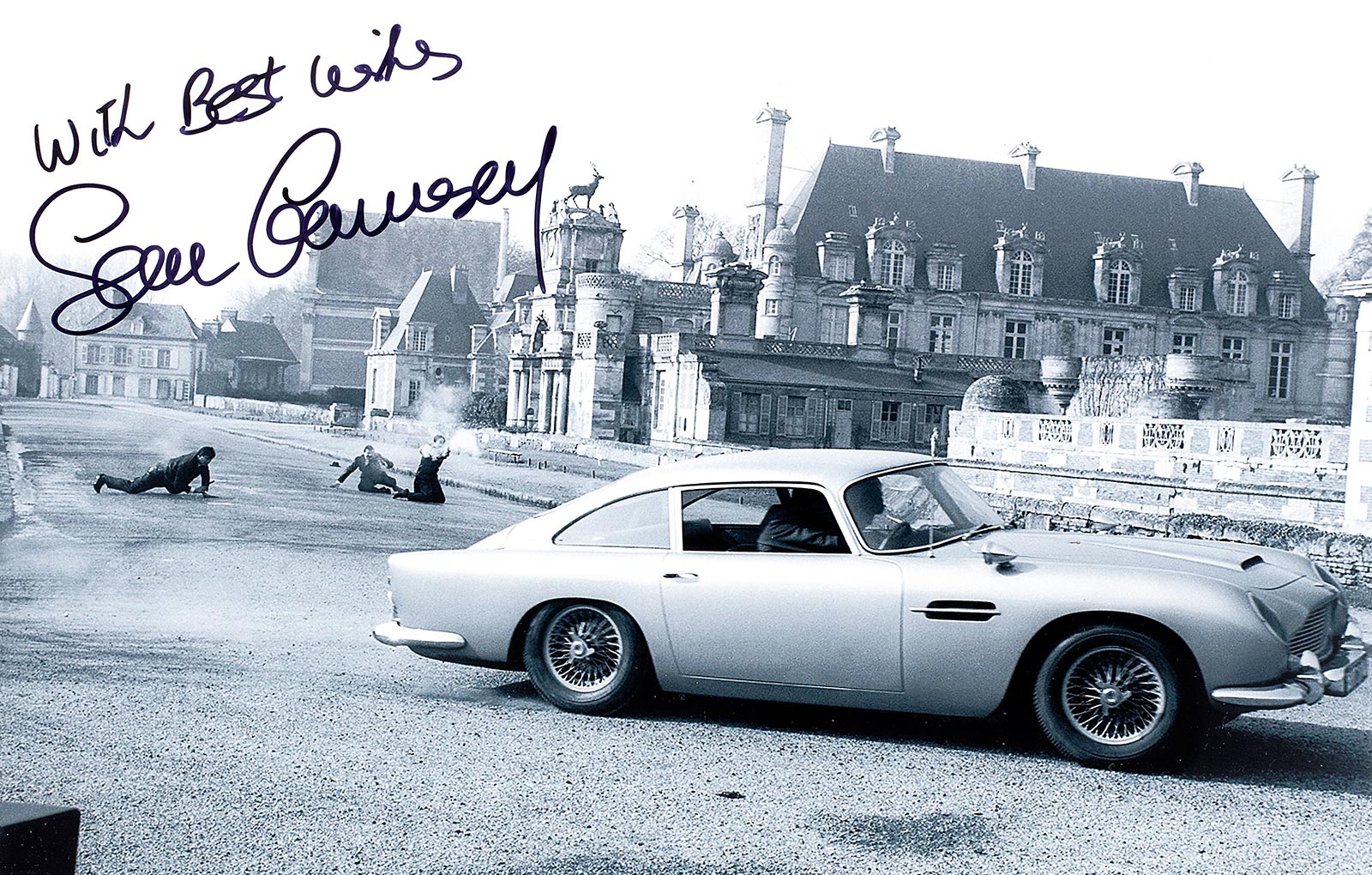
It took quite a while for new Bond books to be published after Golden Gun, which arrived in bookstores in April 1965. Eventually, Glidrose Publications, Fleming’s former production company, approached John Gardner to write continuation novels. The Bond film series had flourished during this time, with Sean Connery’s silver-screen Bond followed by portrayals from George Lazenby and Roger Moore. The movie Bond industry chugged on, working with the stories they could use from Fleming’s bibliography, but there wasn’t any new material being published. Eventually, this would become a problem, and some Bond movies only really use old titles and build almost everything else from the ground up.
Gardner, an English writer known for his earlier spy novels, started his 007 work in 1979 and wrote fourteen Bond books between 1981 and 1996. This includes the novelization of two Bond movie scripts, Licence to Kill and GoldenEye. While Gardner’s work included turning film scripts into books and not producing material the other way around, he kept the ball rolling. Raymond Benson would pick up the baton after Gardner retired in 1996.
Even so, a new James Bond book was a big deal in the early 1980s. By then, Roger Moore had played Bond for a decade, sometimes turning in his best work and sometimes not. My personal favorite from him is For Your Eyes Only, which is a touch more serious than some of his other Bond films and contains no trace of Sheriff Pepper. It was released in 1981, the same year as Licence Renewed, Gardner’s first Bond novel.

Gardner had been eager to bring the book Bond in line with the movie Bond, when it came to utilizing gadgets. Fleming’s Bond only drove an older Bentley Continental in the 1950s-1960s spy story reality, and Moore’s Bond was given a sharp-looking Lotus Esprit in two movies.
For some reason, perhaps for blending the gadgetry with real-world tech, Gardner chose to give his Bond a freshly launched Saab 900 Turbo as a hero car, after test-driving cars from several competitors. In Icebreaker (1983), Bond visits Finland and takes his specially equipped Saab through the snowy routes, having received winter driving training from the Swedish rally driver, Erik Carlsson.
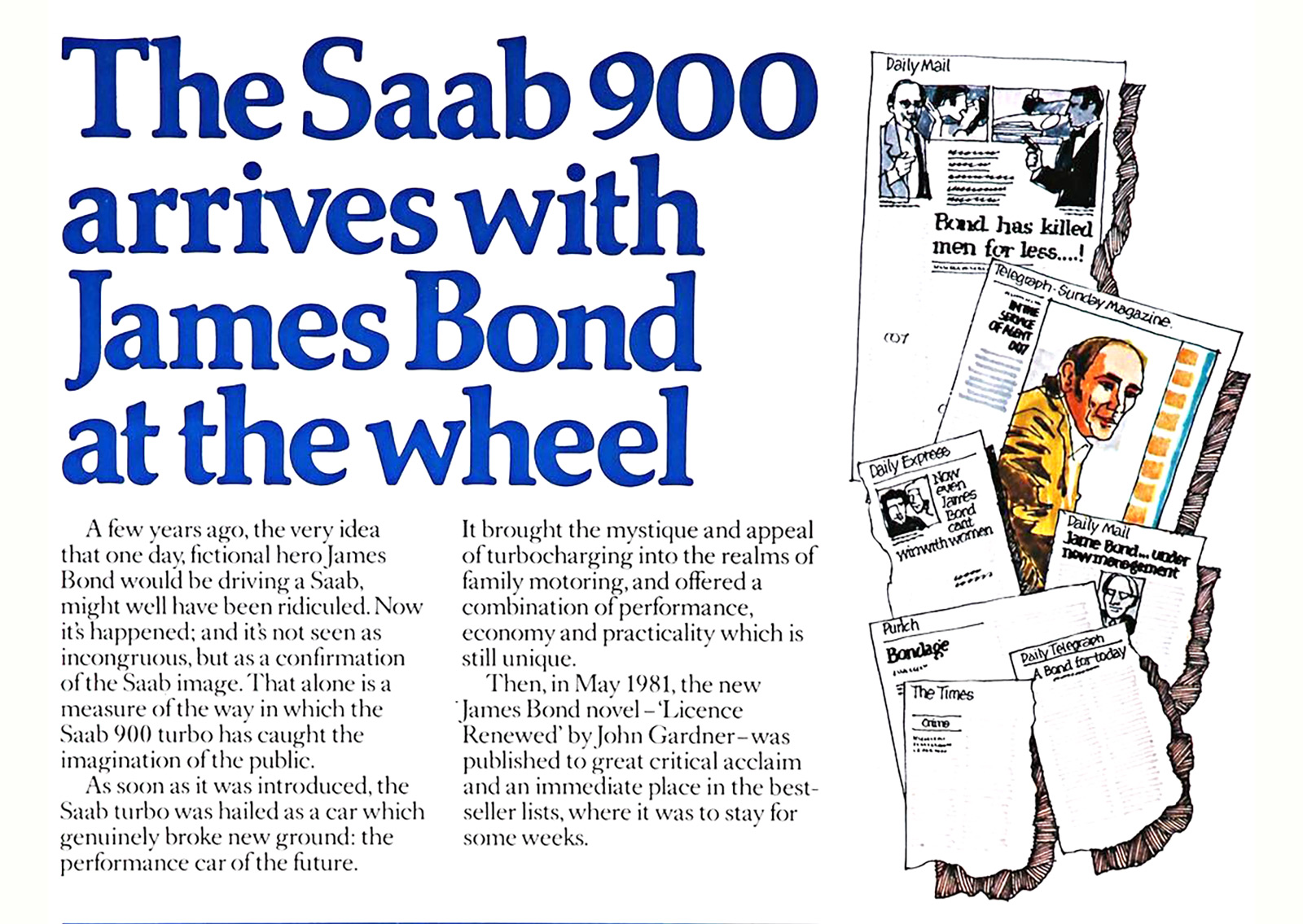
Saab obviously jumped at the chance at turning this into a promotional event, contacting Pinewood Studios to create a real-life car based on the books. In them, Gardner describes the Saab in great detail down to its turbo power, and in the early 1980s Saab displayed two specially built 900 Turbos as Bond cars. One of them was shipped to America for promotional duties, while the other toured Europe, including Finland. As well as Erik Carlsson, the car was shown to the press by Simo Lampinen, a well-known Finnish Saab rally driver who was especially adept in left-foot braking.
The 1981 press release, coinciding with the release of Licence Renewed, features drawings depicting Bond as a Saab driver.
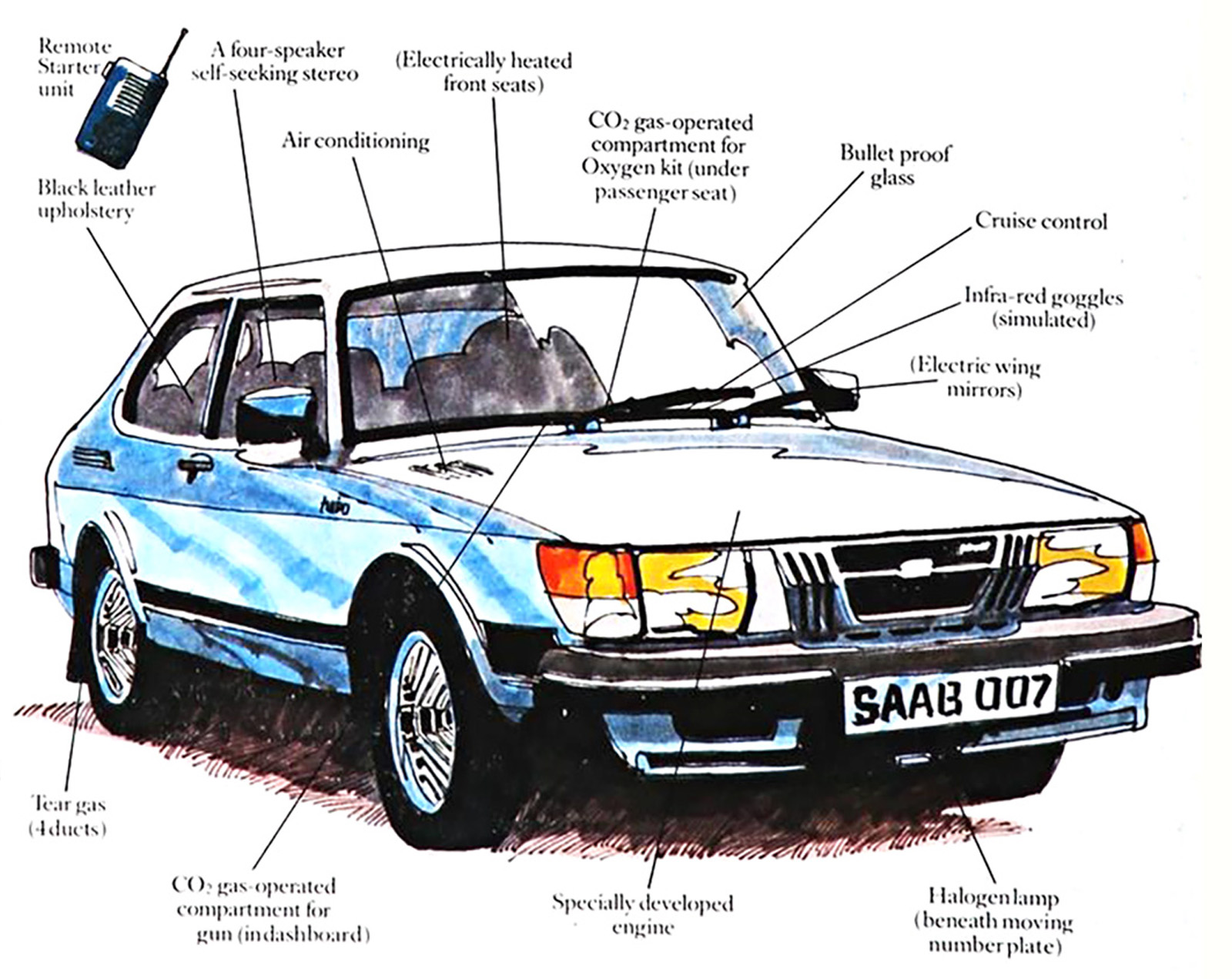
“The West’s favourite secret agent, James Bond, is back in ‘Licence Renewed’ by John Gardner. However, the legendary hero, created by the late Ian Fleming, has undergone a few changes since he last appeared in ‘Octopussy and the Living Daylights’. Bond jogs regularly to keep fit, drinks less hard alcohol and has switched to low-tar cigarettes – though they are still specially made for him. While his beloved, but thirsty Bentley Continental has made way for a Saab 900 Turbo.
Despite its normal external appearance, Bond’s car bristles with the latest in security technology. Beneath the sleek silver coachwork the car is armour-plated while the glass is bullet-proof and the wheels shod with special run-flat tyres.
No Bond car would be complete without the engine being tuned; in this case, the Saab’s 145 Bhp turbocharged engine is fitted with water-injection to boost power up to 175 Bhp. For increased range, the car also features an LPG conversion facility.
On getting into the car, the first thing a passenger would notice is the black Connolly leather upholstery. Beneath the passenger’s seat an oxygen bottle and two face masks are located in case the car is subjected to a tear-gas attack. There are also secret compartments for Bond’s second gun, a Ruger Super Blackhawk 44 Magnum, and infra-red driving goggles. To deter likely attackers Bond can operate tear-gas ducts located in each of the wheel arches and if the Saab’s headlights are shot out, extra lights are hidden beneath the front number plate.
Other electronic niceties which set the Bond Saab apart from others is, a remote control starting device and the very latest in stereo/radio cassette players and speakers.”
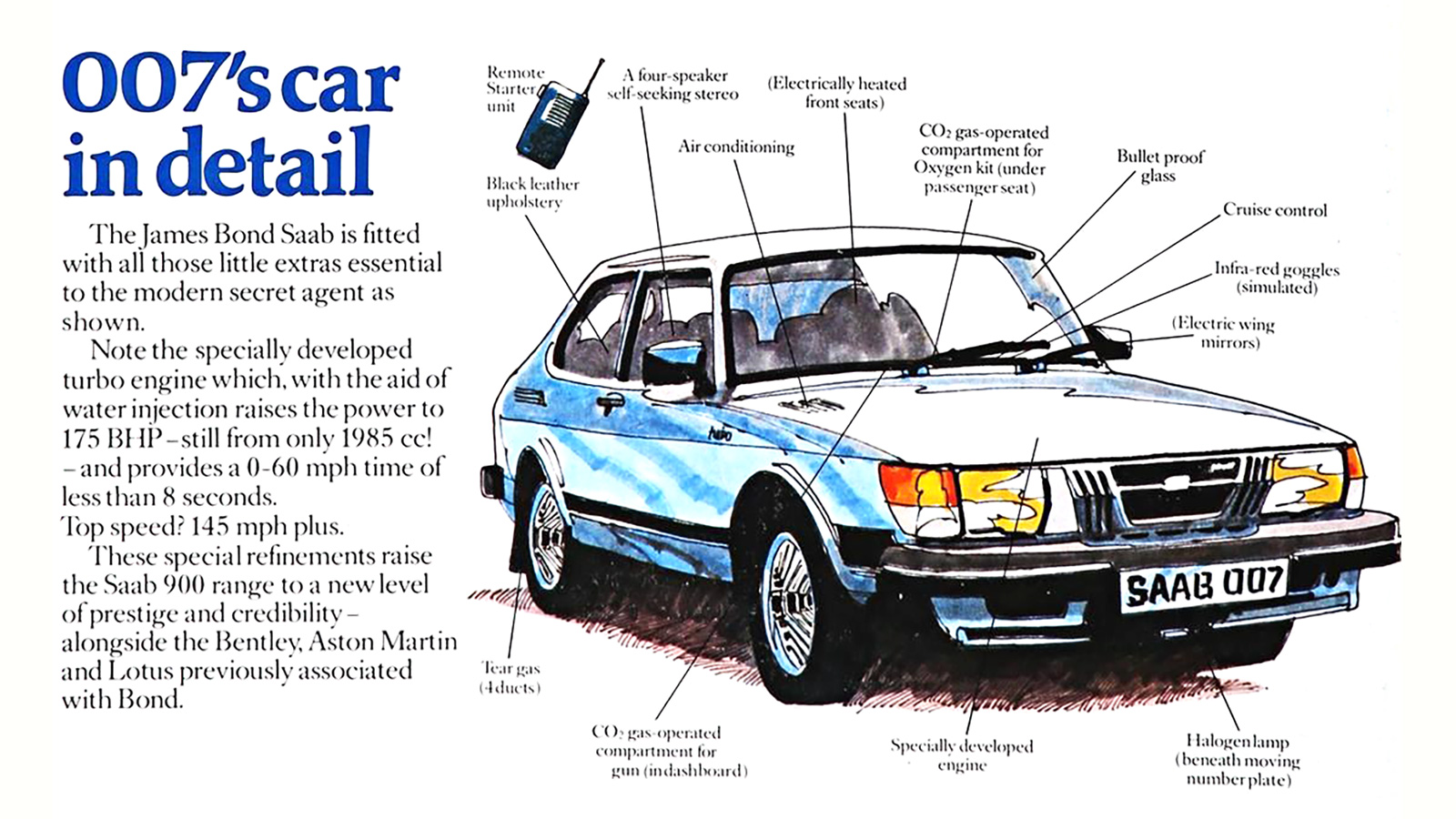
In addition to those features, the Saab was by 1983 fitted with enormous Viggen-style head-up displays as described in Icebreaker. They are shown in magazine features of the time, and as they are bolted in the middle of the dashboard, they look a little awkward. As well as Icebreaker, the Saab was featured in For Special Services (1982).
Converting a single Saab to 007 specs is said to have cost £15,000 in the early 1980s. In today’s money, that’s nearly $100k, a staggering sum, which shows that Pinewood Studios weren’t kidding when they took on the work.
View this post on Instagram
In the years following the Saabs’ promotional rounds, 007 has remained the sort of movie hero he always was, no matter what he drove. The series has been rebooted numerous times, with Moore’s Bond followed by a more serious approach from Timothy Dalton, a change that in my opinion did the movies a favor. The Living Daylights showed Dalton’s Bond behind the wheel of an Aston Martin again, a V8 Vantage that combined the cool of both the DBS in On Her Majesty’s Secret Service and the Goldfinger DB5, and in Licence to Kill he ended up driving a rental Lincoln. Brosnan’s Bond drove BMWs at first, and the less said about Die Another Day the better. Daniel Craig, after another series reboot, was back in Aston Martins.
One amusing thing is that while Saab is traditionally said to be born from jets, Christopher Lee’s Scaramanga bolted some aircraft parts on his AMC Matador in The Golden Gun and flew away.
In the early 1980s, McClory’s Thunderball story was filmed again as Never Say Never Again, with Sean Connery returning to the role. While he seemed old by 1983, he was around the same age as Daniel Craig in No Time To Die. In Never Say Never Again, Connery’s Bond drove an old Bentley to the Shrublands sanatorium.
Gardner’s books have been viewed as the sort of pulp fiction they tended to be, and the Bond Saab has remained a curiosity, largely perhaps because it was never seen on screen. The European promotion car has survived, and it’s back on display at the Saab Museum in Trollhättan, Sweden, the brand’s historical home. Meanwhile, the one entity that used its licence to kill was General Motors, which blocked Chinese candidates from buying any GM-related technology or production rights from Spyker, which was trying to move Saab on before it went bankrupt.
View this post on Instagram
If I ever get to visit the museum, the Bond Saab is surely one of the museum’s must-see display cars, as I remember reading about it as a kid, leafing through the endless stack of car magazines we had at home. And at heart, Bond cars are always for the children, much like Wu-Tang.
Top graphic images: Saab; Propstore Auctions


Bond’s second gun, a Ruger Super Blackhawk 44 Magnum
Shot with deadly accuracy one handed with minimal kickback because you know, Bond.
The Gardner books did have one great line from one of Bond’s lady companions channeling the spiritof Simo Häyhä. “I’m a Finn, I can recognize a Russian at 300 meters over open sights”
Another cool detail to note: the Saab wasn’t a “company car” outfitted by Q, it was Bond’s personal car modified by a private security company.
Unavailable yesterday so I missed this. Obviously this is the best article ever on this site.
I imagine an early 80s Saab was a much better drive than a mid-60s Aston Martin.
I got a test ride in a ’77 Saab 99 after stopping in at a VW/Saab dealership in Southern California to test drive a diesel Rabbit/Golf. The salesman let me drive around the block in the VW. Then he took me on a much longer drive in a 99. Through rutted dirt roads and up to 90 MPH, the 99 was amazing.
I didn’t have the money to buy either (they were about the same price due to that gas crisis), but I ended up telling my IBM Engineer friend he should check the 99 out.
He ended up buying a 99 (so, I guess I didn’t totally waste the salesman’s time) and I saw him take it to 110 on the speedometer on the 91 freeway. I’ve lost touch, but back then, he thanked me profusely for making the introduction.
I loved my ’88 9000T.