


I’ve always felt that, however counterintuitive it sounds, it’s restrictions that breed the most creativity. Give a kid a box of 64 crayons and tell them to draw something, and they’ll be stuck figuring out what to draw. But give them three crayons, and those colors will inform a direction, giving creativity a chance to bloom. Red, orange, and black? Something’s on fire. Blue, yellow, brown? A flying cheeseburger. You get the idea. And I think that’s at the root of why microcars are so spectacular.
The real crucible for microcars was postwar Europe; the war was brutal for everyone, and the infrastructure of so many countries was a mess after the years of nonstop destruction. After the war, everyone was rebuilding, economies were getting back on their feet, and things were happening. But everyone was pretty broke. But they still needed ways to get people and stuff around. And that’s where this first generation of midcentury microcars came in, with designs and solutions that were anything but scaled-down full-sized cars. You had the Isettas with their front refrigerator-style doors, bubble-like Gogomobils, strange teardrop Fuldamobils, and, yes, the Messerschmitt Kabinroller.


The way Messerschmitt conceived of a microcar wasn’t like anyone else’s because Messerschmitt wasn’t actually a carmaker. Messerschmitt made airplanes. And, during the war, they made all kinds of fighter aircraft, including one of the first jet-powered fighter aircraft ever, the Me 262. Of course, Messerschmitt was on the wrong side of the war, and Germany absolutely F’d around and found out, so after the war, a very defeated Messerschmitt was not even allowed to make airplanes.
So they built a microcar that felt kind of like a plane.
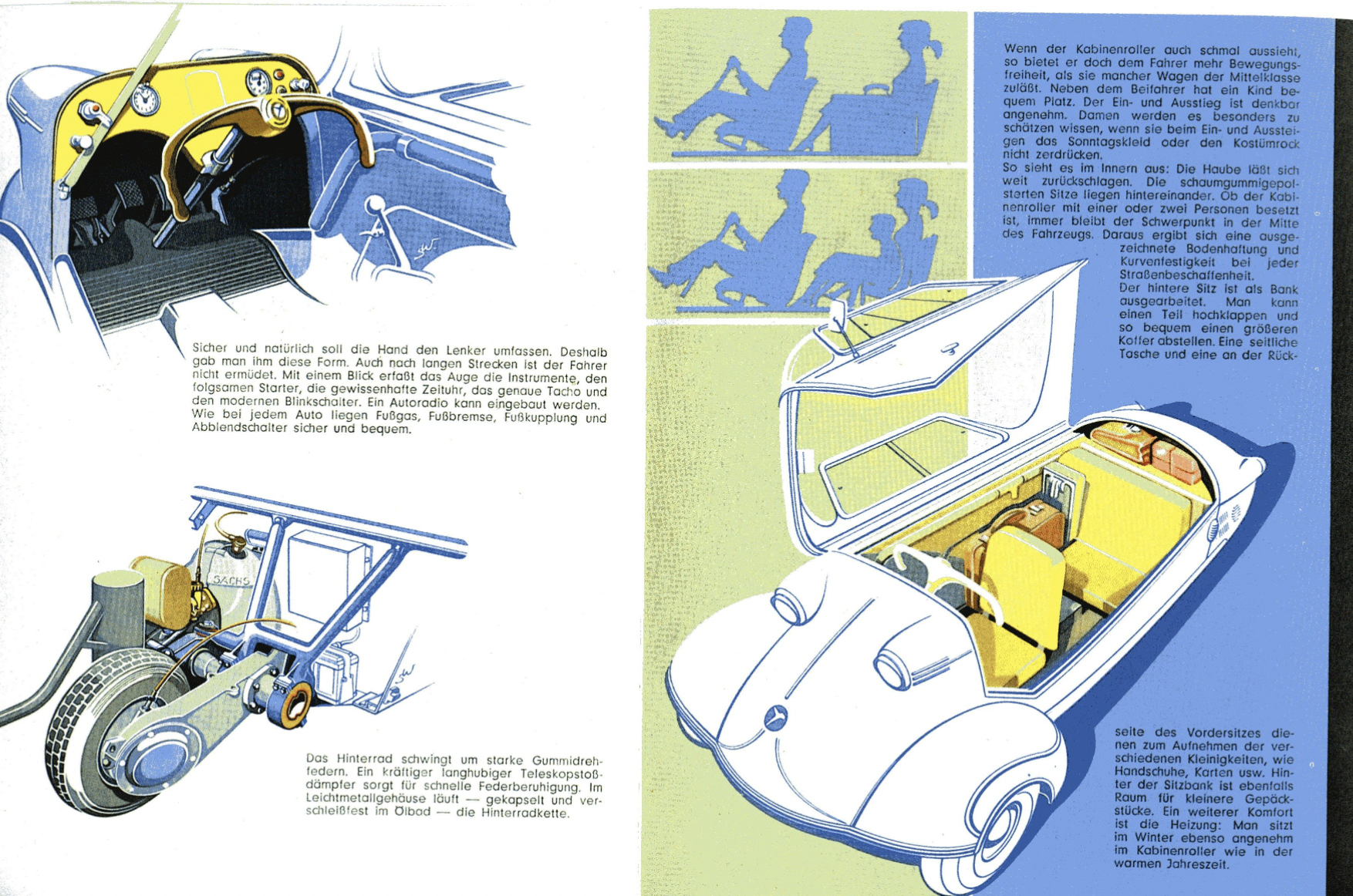
Just look at that design – tapered lines, tandem seating, lightweight construction, and, most notably, that side-opening plexiglass canopy, just like what you’d find on a fighter plane.
While Messerschmitt’s microcar – known as the KR175 or KR200 depending on engine size – had many aircraft hallmarks, it actually started life as a small car for disabled war veterans, something then known as an “invalid car.” This was the Fend Flitzer.
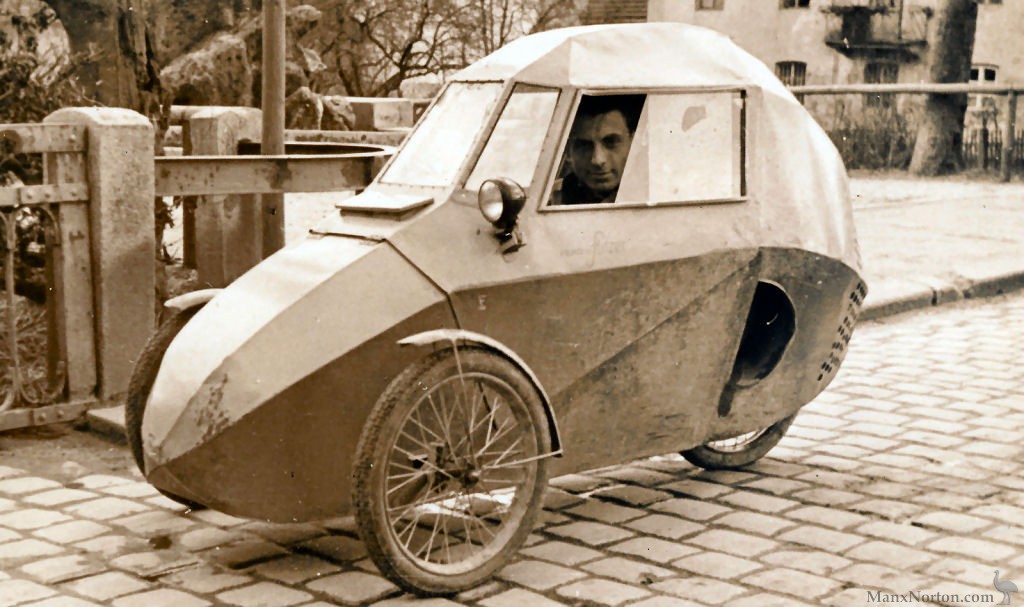
Some of these early Flitzers even used an odd little egg-shaped a 4.5 hp Riedel engine, which was actually used in the Me 262 jet fighter as a starter motor for the jet engine. As Germany continued to recover and industrialization began to pick up, Fend developed the one-seat Flitzer into the two-seat KR175 and the rest is microcar history.
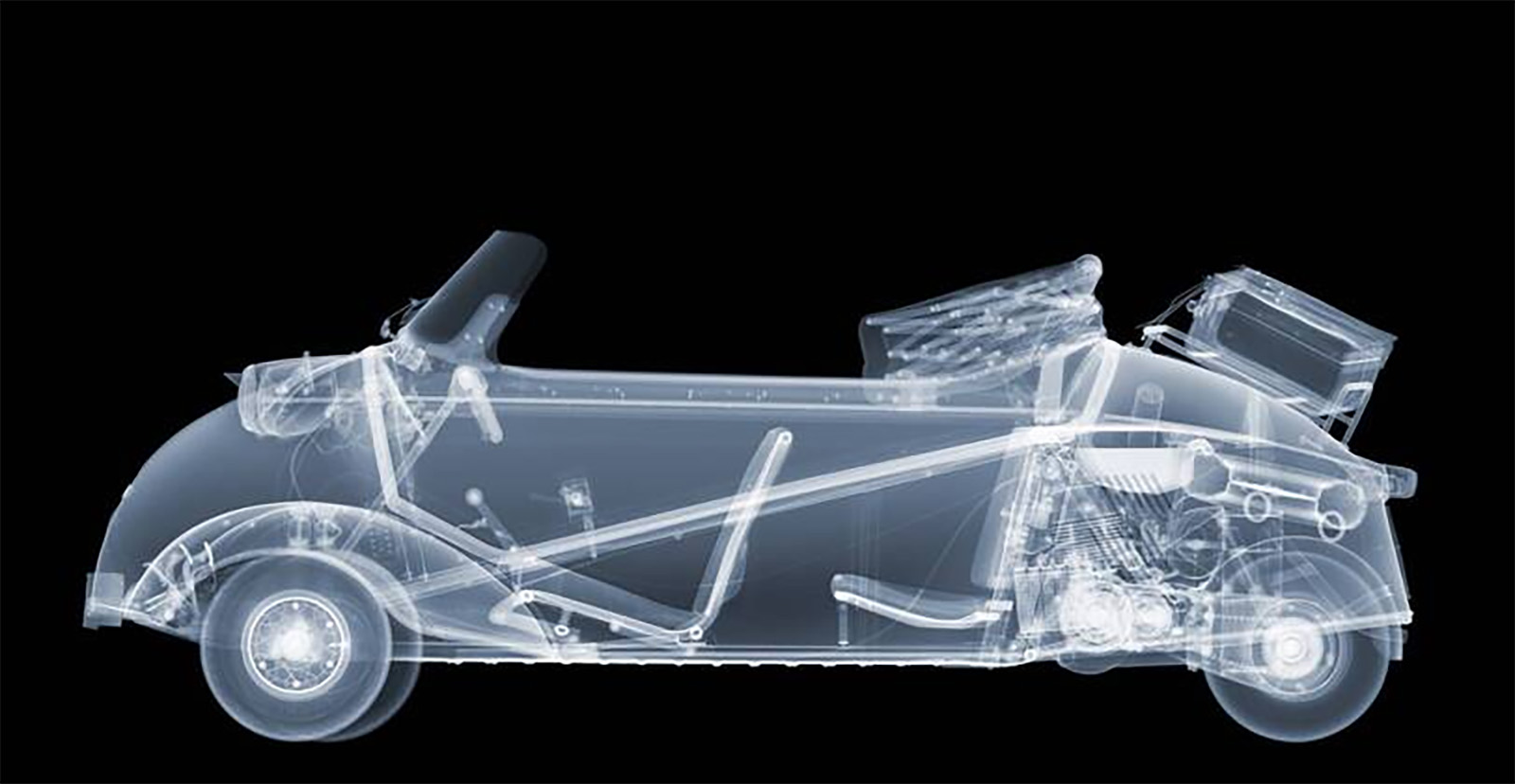
You can see how clever and minimal these things were in this amazing X-ray image from British artist Nick Veasey:
There was also an amazing four-wheeled version known as the TG500, which had a 493cc engine making a ravenous 20 hp, along with hydraulic (as opposed to cable) operated brakes. This thing was raced! People took these things to the track and went head-to-head against, you know, real cars!

The point is that these are incredible little cars, and have a design and driving experience like almost nothing else. And Beau has four of them.
He has a KR175, a KR200 and a KR200 cabriolet, along with one of the amazing TG500s. It’s the whole set of Messerschmitts! And he wants to sell some or all of them!
Beau let me drive the black KR200 years ago, and I’ll admit, I loved it:
Among microcars, these KR-series cars feel like the supercars of the microcar world, with their low, sleek looks and dramatically-opening door. I mean, I get that Beau needs to sell some of these cars, but who else has the whole set of Messerschmitts? I think he should keep them all. But that’s me, a career idiot. If he has to just keep one, I think it has to be the Tiger, though.
This is a tough one: what do you think?


I can’t see one of these without the theme from Brazil popping into my head.
(o) Who cares?
My grandfather had a KR200 in post war Sweden as the family truckster. I have a picture of him, my mother and her two sisters in it.
So forgive me for laughing when someone insists they MUST HAVE a giant truck or SUV to take little Billy to soccer.
This got me wondering what Mitsubishi made after Japan was defeated and they stopped making the Zero.
Looking around a bit I saw the little three wheeled Leo. It’s named after a character from Kimba the White Lion.
https://www.klassiekerweb.nl/en/merken/mitsubishi/mitsubishi-leo/
They also made a pretty cool scooter. I dragged one home (paid $25) but never got it running, alas.
https://en.wikipedia.org/wiki/Mitsubishi_Silver_Pigeon
KabinENroller. Interestingly, the Fend Flitzer started as a hand pedal-powered vehicle made bespoke for disabled veterans. One of them requested an engine so Fritz Fend, the inventor, started offering them that way. Once people caught on that these were the cheapest self-propelled things on wheels, Fend realized he had something, so he sold the idea to Messerschmitt who needed something to manufacture since they were forbidden from building anything that could be militarized. The fact that they looked like a cockpit was kind of coincidental. Messerschmitt didn’t actually build them for that long before they were allowed to build airplanes again so they sold manufacturing rights to a new company called FMR. That company did want to built a “real” car, but lacked the funds to develop it which is where the TG500 (Tiger) came from.
I’d keep the convertible and one of the others.
But which one? The Tiger seems like the obvious choice. It’s far quicker than the others and drives much more like a car. OTOH, the market for Tg500s is still completely insane and Beau could use the additional money elsewhere. Plus, a four-wheel Kabinenroller is much less idiosyncratic than a three-wheeler.
Bonus points to the black KR 200 for having the classic Messerschmitt logo instead of the FMR squares, too. Yet I would probably pick the KR 175 for the even more complete Plexiglass experience (the glass windshield is much smaller) and for being much more like a bike in general. If I wanted to max out at 55 mph instead of 50, I’d use the convertible.
I was in Cape May, NJ a few weeks ago and saw a fleet (a flight? Not sure of appropriate Army Air Corps terminology) of these on the road! Three were rolling in formation, along with two original Fiat 500s, an MG Midget, a Nash Metropolitan, and some other small classics that I did not get a look at (no Isettas unfortunately). Never seen anything quite like that grouping, it was a joy to behold in the wild, on public roads.
A squadron?
A SQUATron maybe?
You must’ve been there at the same time as me. I got in at the tail end of that event. I thought it was wildly weird and cool to see an AZ-1 turn in front of me. Then he turned off at a motel and there were a bunch of KRs, a couple Isettas, at least one Metropolitan, a few other things I didn’t catch (I had somewhere to be or I’d have stopped) and there was even a kei van painted up like the Mystery Machine from Scooby Doo.
Looked it up later and it’s an annual microcar meetup. Might have to schedule another trip to Cape May one of these years.
Nice find, thanks for the info! We quite enjoyed the post-labor day weather and smaller crowds. Might be planning another trip there at the same time, especially if microcars are involved.
I still think about what a stroke of luck it was that Europe had a postwar spell of dry weather that let it develop a scooter industry that fed right into microcars when the rains returned.
Another fighter jet maker also made cars smaller than that. Subaru 😛
Sort of. Nakajimi got broken up after the war and bits of it got absorbed by Fuji Heavy Industries which later renamed itself Subaru.
And they never made a fighter jet – they had some prototypes in 1945 but for obvious reasons, they never became operational.
Keep the drop top and sell the rest.
There used to be a brand of velomobiles made in Denmark called Leitra, and that Flitzer looks remarkably similar. I guess it’s not too surprising—there are only so many ways you can efficiently enclose a person on a trike. The company shut down some years ago (it was a one-man shop, and he was old).
The Leitra is a more “practical” velomobile, giving up ultimate aerodynamics in exhange for easily servicable wheels/brakes/tires/steering with the outboard wheels, and also in exchange for ride-height that puts one level with a hatchback car of the time period.
CdA of the Leitra is 0.20 m^2. Cd isn’t that impressive, around 0.35.
Also, Steintrikes out in Australia used to sell a replica of the Leitra’s body specifically suited to its “Mad Max” full-suspension trike called the “Interceptor Fairing”. It was very expensive.
Messerschmitt: made fighter planes.
Messerschmitt car: looks like airplane cockpit and canopy.
Iso: made refrigerators:
Isetta car: door opens like refrigerator.
It’s a good thing Kohler and American Standard kept out of the car business.
Imagine Ricardo Montelban selling this instead of a Chrysler
KHAAAAAAAAAAAN!
Sorry, I got carried away…
Tattoo: “De Plane! De Plane! Oh, no, wait. No wings…”
When I lived in Havana a few years ago (I was with the US Embassy there, it was all legit) there was somebody who must’ve lived in the same neighborhood who daily’d one of these. Used to see it regularly, thing was really cute and apparently remarkably rugged to still be mobile after seventy or so years on the streets of Havana.
Someone’s going to suggest putting an LS in this, I just know it.
…basically you’d have to chop the back off and hang the engine, a dog box gearbox, and rear suspension off what’s left like it’s a ’60s F1 car.
…if you’re gonna go to that trouble, forget an LS, use a DFV.
For display purposes only.
https://www.enginediyshop.com/products/cison-ls-52-v8-engine-model-kit-1-5-scale-working-4-stroke-gasoline-internal-combustion-engine
Sure, why not?
I used to be obsessed with these as a kid; sadly the price has outpaced my ability to afford one for the last 30 years.
Well, Vespas was designed with small wheels because Piaggio had to use their remaining stock of aircraft wheels somewhere, no?
Also, shoutout to the Velorex 16/250 & 350. The clothed vehicle.
I mean, it’s not like they take up a lot of room. Keep ’em all!
Here’s Cousin It rolling up in one:
https://www.youtube.com/watch?v=TTNWPOIhKHM
A modern EV version with the CdA of a velomobile(say, a Milan GT or Bulk Urban) would be a single-digit Wh/mile vehicle in the city, and maybe only need 25-30 Wh/mile to do 70 mph on the highway, when loaded with two people and assuming 700 lbs loaded weight. You’d have a 200+ mile highway range on a $500 battery if it were mass produced. It also wouldn’t take a lot of power to make it accelerate like a fast motorcycle, and you could use e-bike parts.
The Messerschmidt is really an inspirational vehicle if one wants to build something that maximizes efficiency, even though that vehicle’s aerodynamics are horrible for what it is. It has the layout correct and overall philosophy correct. Keeping the same ICE engine, but improving the aerodynamics and reducing weight with modern composite materials, I think 250+ mpg is possible on regular unleaded. Upgrade the engine with modern technology to improve effiiency and power on top of that, and you might get over 500 mpg. Use a diesel engine, and you might get 4-digit fuel economy.
Why has no passing billionaire not given you a few million to make amazingly efficient yet very fast cars?
If you need an ex-Lotus Head of Powertrain Design (it was only for 14 weeks, and I was on leave for the last 12 of them) on board to hook an investor I’m your man. I also did the exterior body design for the Lotus Type 119c, which I’m hesitant to mention in case you hate it.
For starters, I don’t have any auto industry experience. My only experience working on cars is mostly my own personal projects. My custom designs are basically college-level proof of concepts at best. But they did meet the expectations I had, and had thus proven the concept.
That is so awesome that I got feedback from a Lotus designer. Holy shit. If there is anywhere I’d have loved to be able to get my foot in the door out of college, THAT place would have been it. I’ve been stuck designing circuits for the power grid for the last 15+ years instead, when I wasn’t unemployed working some menial low-wage job(and commuting to it in my custom-built electric microcar disguised as a bicycle).
The idea behind my philosophy is to allow people to spend a small fraction of the money/resources for the same utility. Most billionaires would not be into that sort of thing being an option to consumers, because that cuts the money spigot from the lower classes to themselves. They’re generally pushing for a paradigm of endless growth, on a planet with limited resources. We are beginning to brush up against those limits. We’re soon going to find that a broad, thriving middle class, and an unelected aristocracy hoarding all of the world’s wealth, simply cannot co-exist on the same planet due to resource limitations. Pick one.
Oh, and i absolutely adore the Type 119C, even if it is a gravity racer. It’s a great shape for something along the lines that I describe. A Leafbike 1500W 3T-wind PMDC motor in each wheel with an ASI BAC2000 feeding each, and an 86.4V nominal pack of Molicel P60C set up to deliver 50 kW peak would be absolutely NUTS in that thing. The entire cost of that electric drive system and battery at retail cost for a one-off would be like $4k, and the thing would probably do 0-60 mph in under 3 seconds. Top speed would be somewhere north of 90 mph on a fully-charged battery, and it would reach it as quickly as a $1 million hypercar.
The way Lotus used to work was finding people like you and me who were enthusiastic enough to work for a pittance and then letting us try to make every tiny thing exceptional. I’d only designed bottle tops and oil rigs before I started at Lotus.
All the engineering is done in China now, by Geely. Shame.
I grew up in a ghetto in St. Louis or surrounding working class suburbs depending on the year, and simply didn’t know anyone. I designed my first EV conversion, a Triumph GT6, when I was a teenager, but due to student loans and having to pay them off, I didn’t first drive it until I was 27. I’m 41 now.
The opportunity cost of not having money and/or connections at a young age is massive. I had a rare skillset that I didn’t get to capitalize upon, a skillset which has become a lot more common as time has gone on.
Oh well.
That’s roughly Elio or Aptera territory right? Saw an Elio in a small town south of Portland the other day.
Aptera would be much closer to the mark, and is a much larger vehicle due to having a side-by-side seating layout, as opposed to tandem seating. Tandem seating reduces frontal area. The Aptera was also meant to be comfortable, but something sized like a Messerschmidt, not so much.
The Elio just doesn’t have good aerodynamics. It’s Cd is probably not a major improvement over the Messerschmidt, and given its size, the CdA might be worse.
I’m thinking something along the lines of a scaled-up Milan velomobile, except with more ground clearance, 4 wheels, and tandem seating for two occupants. Imagine doing 70 mph down the highway on 2 horsepower. You’d be able to have a finished vehicle weighing around 300 lbs, with a payload around 500 lbs, so 800-ish lb GVWR, and then using switched reluctance motor technology(AMZ Technologies has 7 lb geared hub motors that make 50 horsepower peak, but they are not for sale), you could have 200 horsepower peak in this vehicle with AWD.
Or build a 1-seater version made for someone weighing up to 250 lbs, where the lack of an extra passenger allows you to cut a lot of corners on the vehicle mass, ending with maybe a 150-ish lb unladen weight for the entire vehicle. But still the same 200 horsepower and AWD.
Keep the Tiger. The rest are “common,” the Tiger is the crown jewel.