

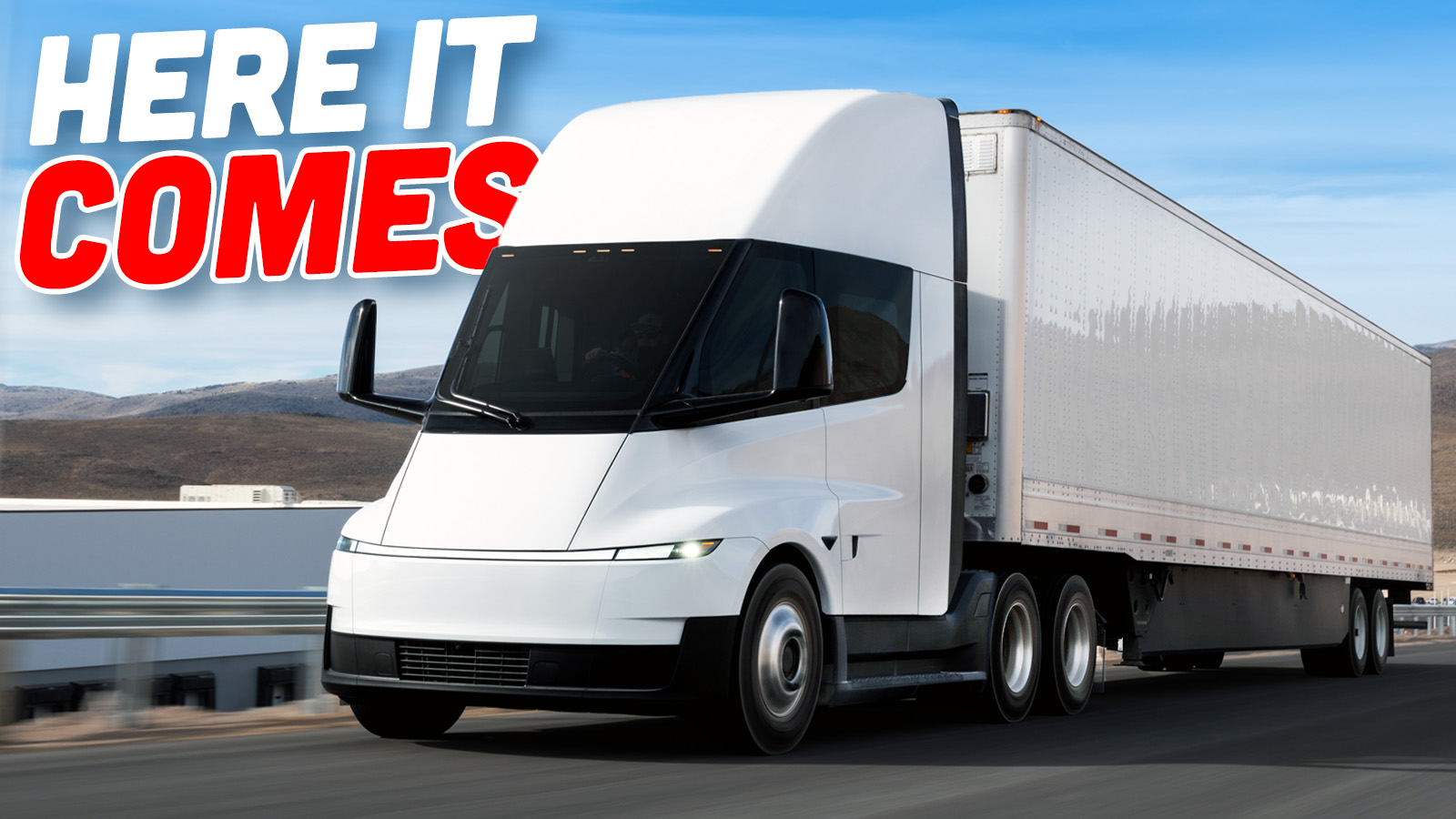
Nine years ago, Tesla promised the trucking world a game-changing innovation. It announced its first foray into the highly competitive Class 8 semi-tractor market with a truck that was rather aptly named the Semi. Now, some seven years after the Tesla Semi was supposed to reach series production, it finally has, and it’s a surprisingly impressive rig. Just the fact that it can pull enough power to juice up a neighborhood is a bit crazy.
This week, Tesla unveiled the production Semi at its factory in Sparks, Nevada, which assembled its first Tesla Semi back in April. It’s been a long road to get to this point. The idea for a Tesla semi-tractor was first mentioned in the Tesla 2016 Master Plan, where Tesla CEO Elon Musk called for a future of electric trucks and buses. In 2017, the Semi became more than just a footnote. Musk said that Tesla’s new truck would be cheaper to operate than a diesel while still carrying a full load for 500 miles on a single charge. He also suggested that production was only right around the corner because prototype Tesla Semis used tons of parts, including motors, from the Model 3.


The trucking industry establishment couldn’t believe it. The Semi was supposed to launch in 2019 after only a couple of years of development. Daimler’s head of trucks, Martin Daum, spoke to Bloomberg, where he went as far as to suggest that if Tesla actually put the truck into production with the spec sheet that Elon promised, it would break the laws of physics. Daimler claimed that battery technology just wasn’t there yet to permit the mass production that Elon claimed. At the time, the Mercedes-Benz eActros had a range of just 124 miles, and Daimler had no idea what the batteries would look like after years of heavy-hauling.

As it turned out, Daimler was right back then. Tesla would find out that there was more to building a semi-tractor than just piling Model 3 parts into a beefy chassis with a fifth wheel on it. The 2019 launch date came and passed. A subsequent 2021 launch date was also missed. Finally, on December 1, 2022, a handful of early hand-built examples were delivered to PepsiCo to haul Pepsi and Frito-Lay products. Another launch date in 2023 was also missed. However, development continued with Walmart, Costco, DHL, Sysco, Martin Brower, NFI, and US Foods each getting a Tesla Semi to test. Nearly 200 trucks were out there delivering real cargo.
They were working hard, too. As InsideEVs reported, about half of the trucks had driven about 4.6 million miles by late 2024. One unit in particular put in 248,000 miles in a year and a half, or more miles than many truck drivers put in over the same time. Tesla also reported a 95 percent uptime for the Semi fleet in 2024.

I got to see one of these early rigs up close (above) and was impressed, even though I was not a fan of the truck’s central seating position or its minivan-like pop-out windows. I still think the central position is a miss, and not even particularly useful for a commercial vehicle. It’s not a McLaren!
There were other headwinds, too. As Wired writes, some 30 percent of China’s heavy truck sales go to electric rigs, but electric Class 8s are merely a few drops in the large ocean of the American truck market, where diesel rules supreme. The problems are large in scale. Diesel semis can go well over 1,000 miles on their drums of fuel, and diesel is available everywhere.
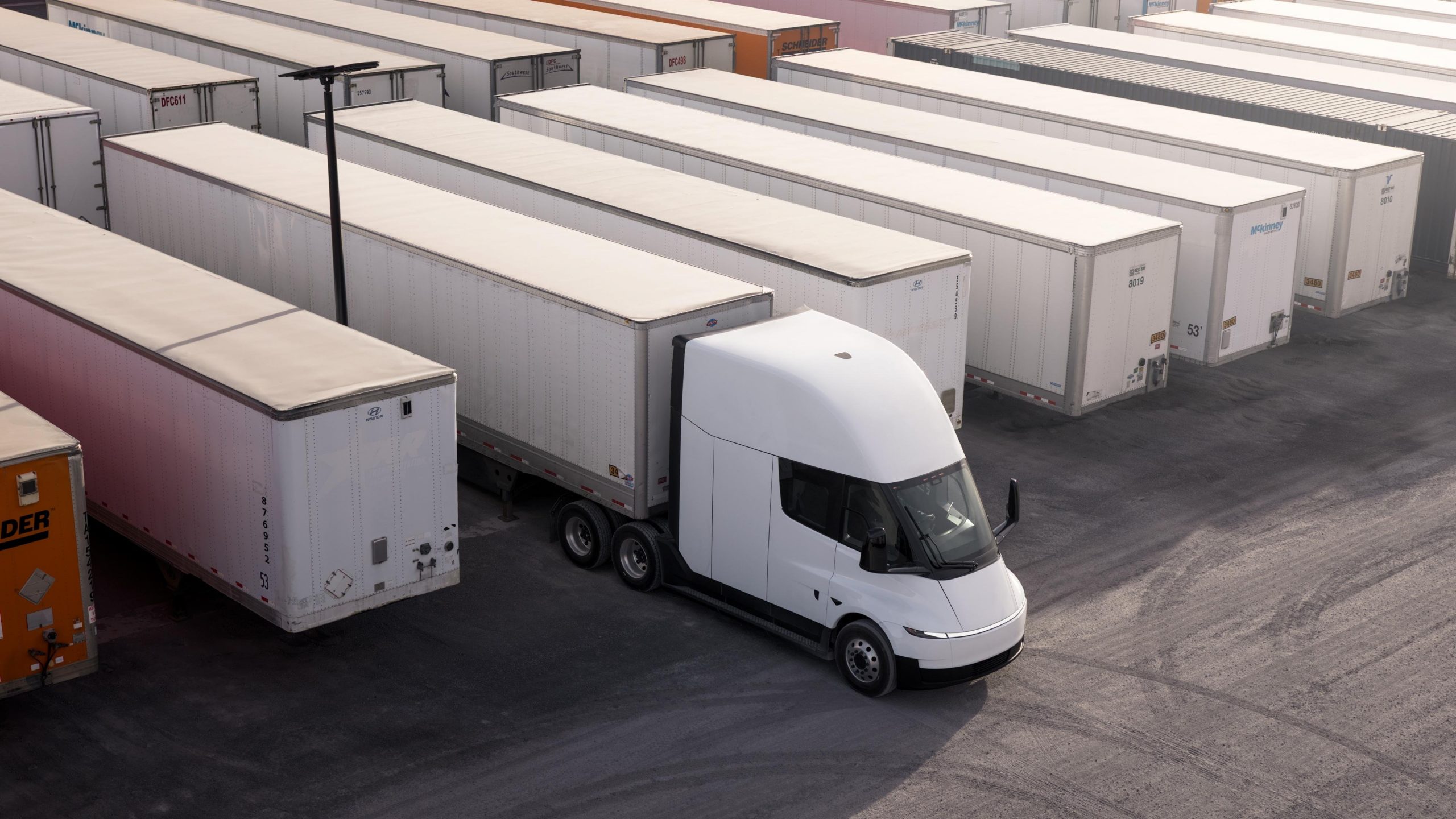
Historically, electric semis have struggled to reach more than 300 miles of range and have little charging infrastructure. They also came with estimated purchase prices that were two or three times higher than diesels, too. Weight was another worry, as a tractor with a gigantic battery pack could be too heavy to pull a practical amount of cargo.
So, Tesla had a lot of problems to solve. To Tesla’s credit, it finally reached the finish line. The Semi is finally entering mass production, and so long as there are no surprises, I could see it actually making a difference in some parts of trucking.
What Came Before

Let’s start with the latest prototype. Here’s what I wrote back in February of this year, when Tesla announced a facelift for the Semi:
Much of the core of the truck is still the same. The Tesla Semi uses a frame developed in-house and three independent electric motors that drive the rear wheels. One motor works continuously while the others can use a clutch to couple into the drivetrain to provide assistance for hill climbs or acceleration. Total drive power is 800 kW, or about 1,072 horsepower.
[…]
Efficiency is rated at 1.7 kWh per mile, and that’s with the truck loaded to 82,000 pounds, the legal limit for electric semis. In 2024, DHL said it loaded up a Tesla Semi to 75,000 pounds and then drove it 388 miles on a single charge, averaging 1.72 kWh per mile. DHL notes that in its testing of the Semi, the trucks moved at speeds above 50 mph for almost half of the time. Logistics provider NFI Industries scored 1.64 kWh per mile in its testing. In other words, Tesla’s claims about efficiency and around a 500-mile range do seem to be realistic.
[…]
Tesla also equipped the truck with a slightly smaller battery system that weighs less, but still hits the target range figures. Charging is handled through a V-shaped Megawatt Charging System port, which allows for 1.2 MW peak charging speed. That can replenish 60 percent of the truck’s range in just 30 minutes.
[…]
Another change in the updates is an electric power take-off with 25 kW of capacity. This can be used to power equipment in the semi-trailer behind the Tesla Semi. The idea is that maybe there will be a refrigerated trailer that can be powered by the EPTO rather than a diesel engine.

We also learned that the Semi weighs under 20,000 pounds for the Standard Range version and 23,000 pounds for the Long Range model. If you compare a Tesla Semi to a diesel tractor with a sleeper, which is something Tesla wants to put in its Semi’s huge cab one day, it’s not too far off the competition. A Volvo VNL 860 with lots of options, for example, weighs around 20,560 pounds. The federal government allows electric semi-trucks to roll around at a gross weight (truck, trailer, and cargo) of 82,000 pounds rather than 80,000 pounds, which helps the Tesla make up the difference from having a heavier tractor.
Then there’s the price. In 2017, Musk said that the Semi would cost $150,000 for the Standard Range model and $180,000 for the Long Range variant. In 2026, Tesla revised the price to $260,000 for the Standard Range and $290,000 for the Long Range. This does make the Tesla Semi almost twice the price of a semi with a sleeper, and substantially more expensive than day cab trucks, but also nearly half the price of some other Class 8 electric trucks. Electrek and Forbes reported that other electric semis can cost well over $400,000.
Now, months later, the production truck seems to improve in key areas.
The Production Tesla Semi
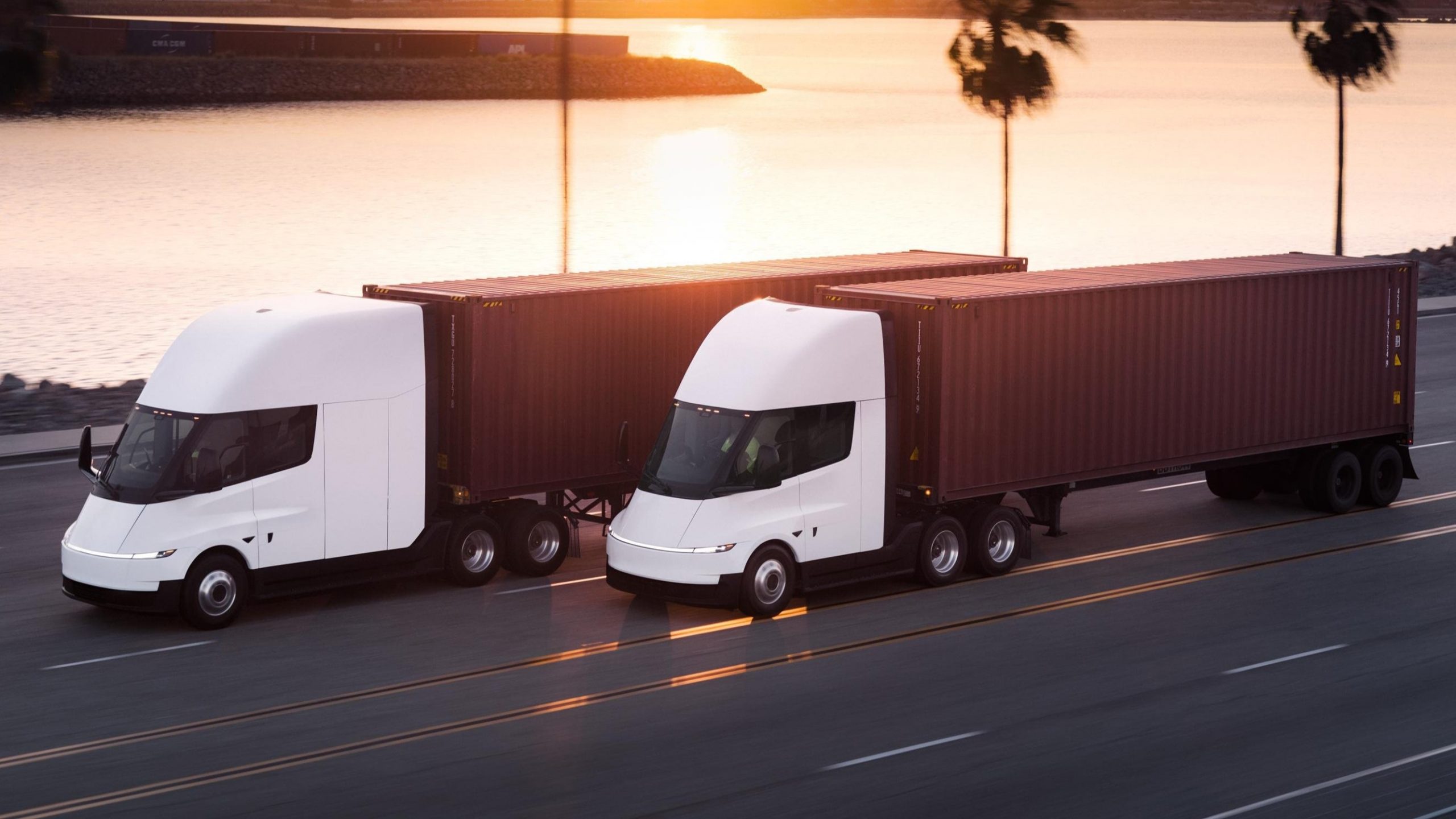
The biggest change is the battery. Tesla transitioned from using 2170 cells to the 4680 cells it makes in-house for the Cybertruck. Specs remain the same at 325 miles for the Semi Standard Range and 500 miles for the Semi Long Range, with 1.7 kWh per mile efficiency. Tesla says that the new packs weigh less and do the same work while having a smaller capacity. The standard truck gets two packs, while the 500-mile model has three packs. Each of these packs features eight groups of 28 cells. The Semi Long Range has a Gross Vehicle Weight Rating of 48,800 pounds by itself. Tesla now claims that a Semi carrying a light load may actually be able to exceed 600 miles on a single charge.
Tesla says that these batteries, which have a usable 822 kWh capacity, are rated for a million miles. The 1.2-megawatt charging has stuck around and has been demonstrated to charge the truck to 60 percent in 30 minutes. Tesla also claims pretty low maintenance for all of this. The truck uses redundant electric power steering and only one common oil in the gearbox. Supposedly, this oil should last over 250,000 miles between changes. As The Verge notes, the electric power steering system can also turn the truck so sharply that its turn radius isn’t much more than a Tesla Model Y. Tesla claims that the existing Tesla semi fleet had 98 percent uptime in 2026, compared to an average uptime of 90 percent to 95 percent for diesels.
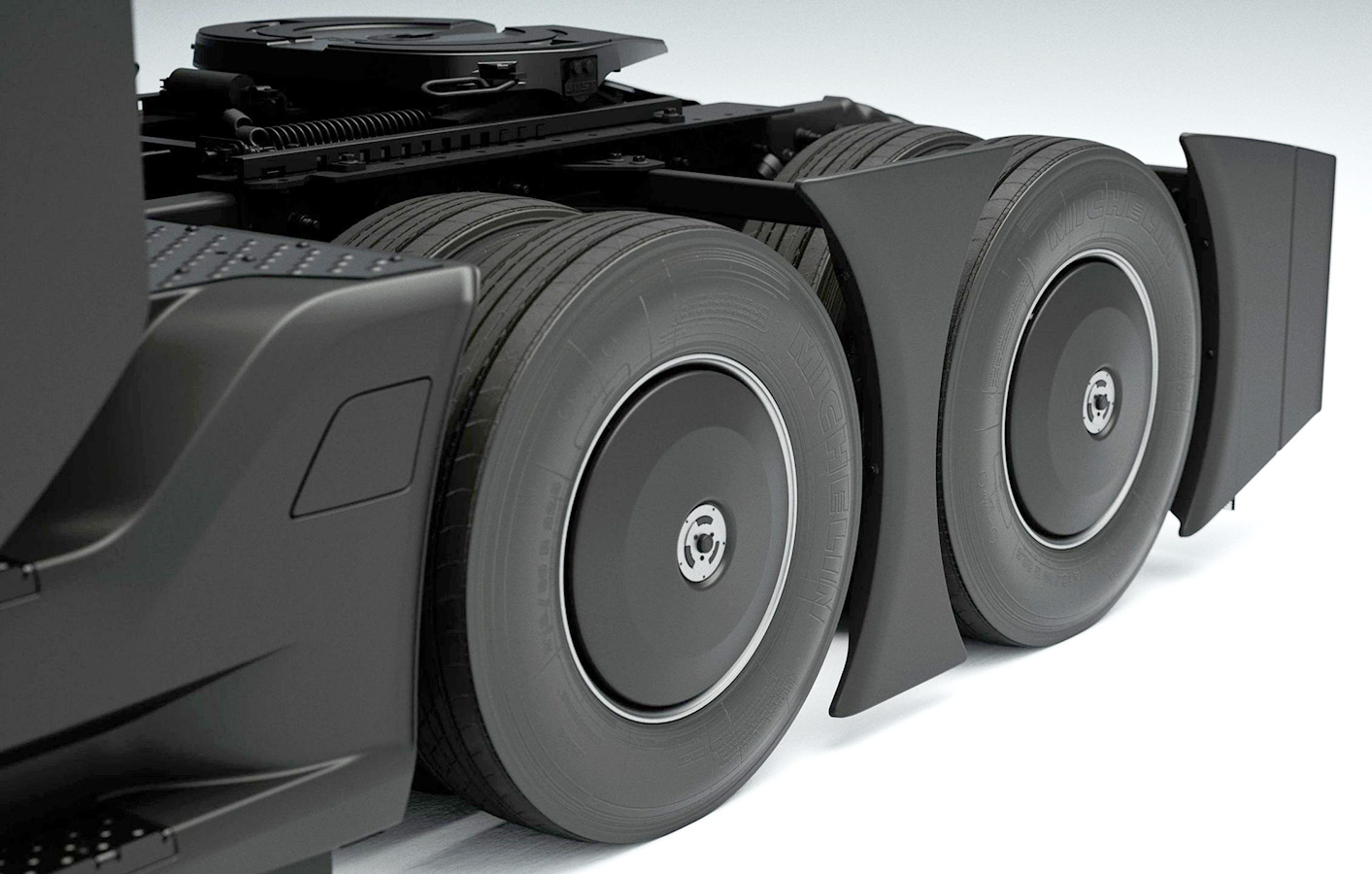
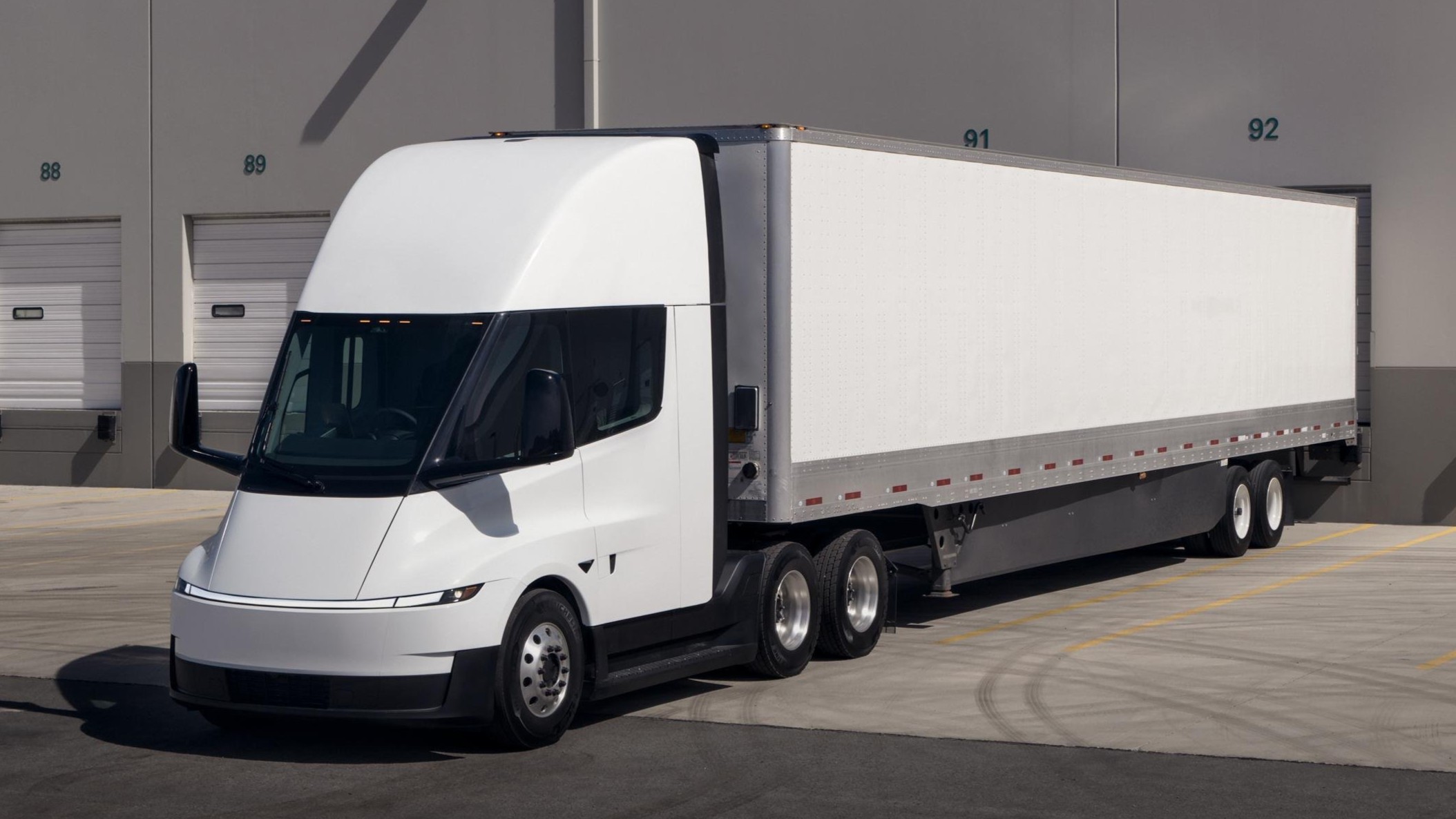
The truck is arranged in a classic 6×4 configuration, which features two steer tires and two rear axles fitted with wheels. Only the two rearmost axles are powered, getting energy from three motors derived from Tesla Plaid and Cybertruck models. The third axle, which has one motor, is powered all the time. Meanwhile, the second, central axle has two motors, and they fire up when the truck needs to accelerate or climb hills. But on a flat highway, the center axle disconnects to reduce drag. Tesla isn’t being exactly clear about pricing for the actual production version, but did tell MotorTrend “it won’t cost more than a diesel truck.”
That’s incredibly vague and probably contains asterisks, but suggests that Tesla figured out how to get the price lower. Tesla says the secret sauce is its vertical integration. The company makes the Semi’s axles, batteries, cooling, high-voltage equipment, seats, and stampings all in-house. It further claims that other electric truck builders are not doing this.
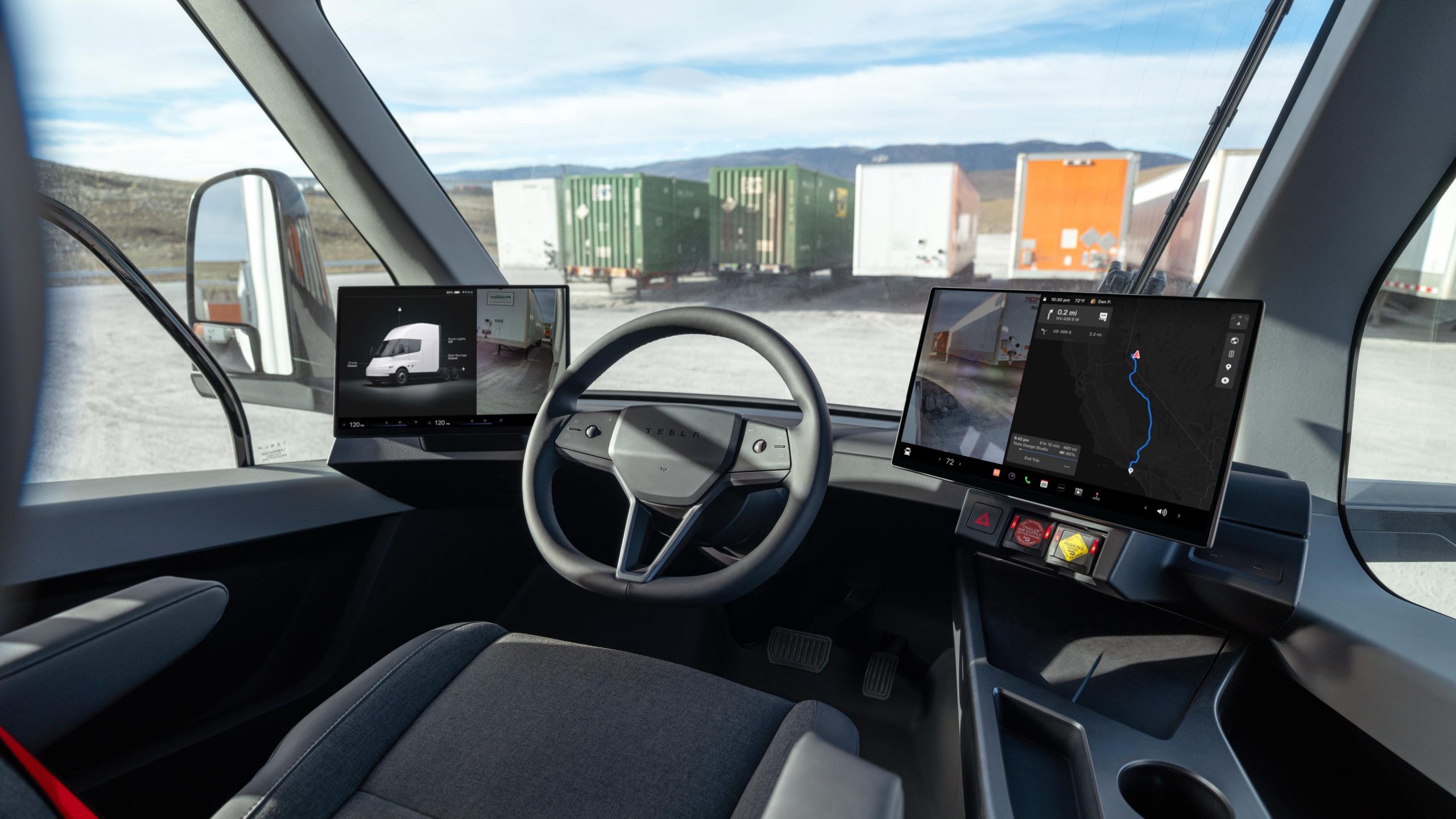
Tesla has also made the driving experience a little better. The production Semi is persistent with its central driving layout that forces the driver to walk through a corridor to leave their truck. The passenger also still has to sit in a weird seat to the rear and right of the driver. Tesla didn’t seem to be thinking about team drivers there. The interior is also standard Tesla, which means very few actual buttons and giant screens. Mercifully, Tesla left the yoke shenanigans for its other products.
But it did finally give the Semi windows that roll down. Unfortunately, the goofy seating position means that the previous complaints about drivers not being able to conduct outside business without leaving the cab will remain the case. At the very least, Tesla is also supposedly working on giving the truck driver profiles and a range estimate that changes based on cargo.
Tesla says that it is also building out a nationwide service and repair solution that will be Semi-specific. Trucks can’t spend too long out of service and not making their operators money, so this part has to be quick and effective. It’s also unclear how much of the truck can be repaired outside of Tesla’s network, or by the operator.
A Review From A Truck Driver
As for how it drives, MotorTrend teamed up with Adam Wingfield, the editorial director of FreightWaves and an actual trucker, to take it for a spin. Here’s Wingfield’s review:
Wingfield estimates he spent about 25 minutes behind the wheel of a Semi connected to a trailer with about 37,000 pounds of payload. He estimates the total weight of the Tesla tractor and trailer to be about 74,000 pounds or roughly 90 percent of the 82,000-pound maximum GCWR.
Wingfield, who had never driven any Tesla before this afternoon, said he was surprised at how smooth the Semi drove, and how quickly he got accustomed to the central driving position. But the biggest surprise was when he drove the Semi as a bobtail (without a trailer connected) and then with 37,000 pounds of payload.
“I was very surprised. It didn’t feel like I was towing anything at all,” said Wingfield. He was equally surprised at the performance of Semi while climbing an incline he guessed to be a 7 to 8 percent grade. “I got it to a standstill and then whomped on the throttle. And it pulled like there was nothing behind it at all,” said Wingfield, who estimated that he got up to a maximum speed of 50-55 mph. I also asked for his thoughts about the tight turning radius. “You know in the majority of conventional American tractors, you’re sitting well back from the front axle. But in the Semi, you’re sitting much closer, almost on top of it, which gives you the turning feel of a cabover, but the axles turn a whole lot sharper,” said Wingfield. And that rough patch of road I felt in the bobtail Semi? Wingfield nodded knowingly. “That’s because you weren’t towing any weight. You were riding at the top of the air suspension, with no compression on it, so of course it felt very stiff. If you had a heavy trailer behind you, it would have felt cushy, like a Cadillac,” said Wingfield, demonstrating why it’s always a good idea to seek out the insights of an experienced professional.
So, what happens now? Tesla will start cranking out Semis for its customers. Arkansas Best Freight (ABF), HMD Trucking, IMC Logistics, WattEV, DHL, OK Produce, Einride, US Foods, Nevoya, Lincoln Trucking Systems (LTS) and PepsiCo all have orders for production Semis. Einride’s order is for 500 trucks. ZET SCALE, a coalition including PepsiCo, Microsoft, and others, wants 2,500 zero-emission semis to put on the road, of which most are supposed to be Teslas.
Tesla also wants to expand its Megacharger network so Tesla Semis can do more than local and regional deliveries in select areas.

I bet more companies that fit into the Semi’s currently limited use case will line up to order one of these trucks, given the impacts of high diesel prices on shipping. I could see Tesla Semis easily fulfilling local and regional hauls; basically the kind of work that day cab diesel trucks do today. Those trucks might not even need to use a Megacharger often, as they usually return to a depot every day.
That said, I think it’s too early to say if this is a Model S or a Cybertruck moment in terms of market penetration.
The lack of a sleeper, the current lack of charging infrastructure, and the total disregard for a passenger will make the Semi unattractive for long-haul operators, and some fleets will probably wait for more reliability data before plunking down the investment. The weird hallway built into the strangely huge day cab also doesn’t make sense. Of course, electric semis are also not immune to changing political climates, too. Also, Elon Musk’s inability to keep his mouth shut about far too many subjects may make some companies unwilling to slap their name on a Tesla vehicle. So, I won’t make any predictions.
But regardless of what happens, I have to give credit where credit is due. Tesla’s engineers have pulled off something amazing. Maybe one day a trucking company will let me take one of these things for a spin.
Top graphic image: Tesla


I’m surprised they’re in production, since Tesla isn’t a car company anymore.
The circle of life will be complete when we see one hauling gasoline.
For the money the windrose seems to make more sense. They are keeping the $180k price. They also are egging people in to buying 120kw dcfc. Other tricks have onboard three phase chargers. Docks and depots already have three phase so maybe less infrastructure needs to change. The whole Tesla apple thing where they have a way to do things take it or leave it and integration is questionable might not be the right fit for business around hauling other people trailers.
crazy to think about : “okay let your microwave run for 1 hour … thats how much energy it takes to drive 1 mile in this semi. just an absurd thought experiment!
It’s in line with Americans’ using football fields as units of distance.
Who needs a driver? FSD and a Robbie, problem solved. What could go wrong?
They also need a Tesla robot to change tires and disconnect the trailer.
And service the truck and charging stations! We’re gonna be rich I tell yah, rich!
how long does it take to charge on a supercharger. Are model 3 and Y owners going to battle with tesla semis for the charger? lol
Holy carp. 1.2 MW is a LOT of power. That’s not something you’re just going to install at your truck depot. If you’ve got a fleet of these things, we’re taking about running an entire new high-voltage infrastructure to your depot. That ain’t cheap.
At least with an electric car, you can very feasibly charge a car or two with most houses’ existing 240-V circuits. For these election-guzzling trucks? You’re looking at a pretty massive outlay of capital–and possibly a multi-month lead time just to get all the new power infrastructure installed.
yeah how much diesel does that much land/rent/copper/ labor/ concrete / rebar / in house electrician you now need to hire on staff buy instead. fairly unobtainable for all but the largest fleets.
I’m wondering about the “V-shaped Megawatt Charging System” that can supposedly deliver 1.2 MW of power.
Am I right in assuming that because the Semi has 2 battery packs (3 as an option), that these are “just” two 600kW chargers operating independently?
Good for the engineers involved, but I can’t stop from thinking all those batteries from a single semi could have made a bunch of passenger hybrids or EV’s.
I’d argue this is better utilization: semis drive hundreds of miles a day, consuming tens of thousands of gallons of diesel a year. If the goal is to reduce fossil fuel use, this is more efficient.
sure .. but where is the extra energy going to come from? if trucking companies are willing to pay more for power that will raise energy cost for homes.
I’m crunching the numbers, using a Toyota Sienna so feel free to try it with a different car.
They hybrid sienna is 36mpg (combined) whereas the gas one was 22, a savings of 14mpg.
The sienna requires 1.9kwh of battery so you could theoretically make +411, the average car drives 35 miles per day but let’s round down to 30. Those siennas would save about 220 gallons per day.
As other Commenters have pointed out a new diesel semi gets 7-8mpg. To save as much as the siennas they would need to travel 1540-1760 miles per day. Which they aren’t. Probably 3 times less than that or more.
Looks like hybrids are more efficient.
Maybe, but is there a large enough buyer pool for those?
1.7 kWh/mi works out to nearly 20 MPGe!
If that were to swap the giant battery for the latest Toyota hybrid system one might expect 8.2 mpg out of it, perhaps up to 9.6 mpg using the more efficient BYD/Chery/Geely hybrid engines running regular gasoline rather than diesel.
Efficiency is rated at 1.7 kWh per mile, and that’s with the truck loaded to 82,000 pounds
A Silverado EV is rated for 2 kWh per mile, and thats with no cargo. Pretty impressive for Tesla to achieve those numbers for a Semi Truck pulling that much.
Silverado EV is rated at 2 miles per kWh or 0.5 kWh per mile.
Other way around: kwh per mile is equivalent to gallons per mile. The usual metric is miles per kwh (of which most vehicles will get between 2 and 3, allowing you to get a range/weight depending on heft of batteries).
Ok, so: 1.7 kWh/mi consumption. 25 kW ePTO.
So, imagine a Semi stranded 100 miles from a charger, due to whatever combination of software mis-estimation, road was closed and had to detour, and driver neglect or poor judgement. There’s a charged up Semi at the charging station, with the adapter cable that is hopefully supplied with the truck, and it’s sent out to rescue the stranded Semi.
6.8 hours to charge the exact 100 miles, or 7.8 hours to charge for 115 miles for some margin of safety. And that’s assuming a 100% charging efficiency, which is not the case.
Nice edge case.
You forgot to imagine the driver stranded from fuel starvation due to a faulty gas gauge, road was closed and had to detour, and driver neglect or poor judgement.
(I don’t think these are common issues for diesel rigs, which leads me to think drivers of electric rigs will be able to figure it out).
I hear the objections, but
(minor comeback) I have great trust in gas gauges newer than, say, fifty years old. OTOH I have often read of EVs misoverestimating range. So I think the likelihoods of the two events happening are not equal.(more to the point I was trying to make) an ICE vehicle that runs out of fuel can be gassed up in minutes. Even pumping 115 miles worth of diesel to a big rig from some rescue truck shouldn’t take much time. 7-8 hours lost to charging is a lot to Costco or Pepsico. So the expenses to business are not equal.
This is impressive stuff. However, I’m looking at the map and just thinking “why not better trains and make smaller local delivery vehicles that are electrified?” It’s a start, I guess.
A lot of Class 8 trucks are only used “locally”, more than many people realize. Moving things between warehouses, or between warehouses and train depot or air/seaport. With the lack of a sleeper cab at the moment that is clearly the market Tesla is currently targeting, and the mega chargers locations seem to be largely located around major distribution hubs that have a lot of local trucker traffic.
Well from what I hear our rail infrastructure is way worse off than our road infrastructure, and getting access to the rail as a new company is a big ole PITA.
As far as smaller local delivery vehicles are concerned, I agree, however today’s “smaller” local delivery vehicles are High Roof Full Size Cargo Vans, and while if Tesla could pull off their usual Tesla thing and get more miles of range out of a van than any of their competition they’d do well, it would definitely be a new market for them.
That being said it would make a ton more sense for a lot of people and cargo deliveries.
Though in my little town we had 3 of the Rivian Vans show up to our J1772 Chargers in town that max out at 19.2 kWh, the people in the vans had no clue how long it would take them to charge, I had to inform them it would be a long while.
These aren’t going to be used for long haul. The current uses for electric trucks are drayage (taking containers between ports and rail yards), local deliveries (think sysco truck delivering food to restaurants or beverage trucks), and dedicated regional routes. (Pepsi delivering product from one warehouse to another).
None of these are a good application for trains.
Excellent observation. There’s room for both is my takeaway now.
Building new rail lines is near impossible.
I hope these things get popular so when I’m driving on 5 I’m not stuck behind a semi struggling to do 55.5mph passing a semi doing 55mph.
Elephant racing!
Tesla’s famed precision will let you watch a truck driving 55.1 mph pass a truck driving 55 mph!
A lot of fleet operators govern speed to increase efficiency and reduce liability. So, I don’t think it’s going to make much difference.
I’ve been seeing lots of Tesla semi’s on the road around here for the past few months, but come to think of it. There is a big PepsiCo warehouse along with about 27 million square feet of other warehouses so I thought they were everywhere. They seem to have quite perky performance, although I would imagine that there’s a considerable difference in acceleration of a semi trailer full of Doritos versus a semi trailer full of Pepsi.
Pretty impressive! Nice work Tesla
There’s so many reasons this is too little, too late.
First off, this truck was never built or designed to be competitive in an actual trucking market. It was designed to make those who are not in the trucking space THINK that Tesla has it all together. However from an actual design perspective, it’s not a very useful truck.
This is a day cab, which means it generally leaves and returns to the same home base every day. These types of trucks generally pull “ltl” or “less then full truck-load” loads; that means a load that does not take up all available space in the trailer. Max range is generally not as important in these vehicles as they are usually tailored for very specific runs (think Starbucks delivering coffee to their stores.)
Next is the price, electric truck subsidies have completely dried up in the current administration, as have incentives to install charging stations. Coupled with the fact that these vehicles often cost 2x the amount of their ICE counterparts, the return on investment is pretty low, even with diesel being so expensive.
Then you have to talk about maintenance; most OEMS design their trucks to have a usable lifespan of 500k miles or more. Who is going to maintain all these Tesla trucks? OEMS maintain massive part delivery networks with hundreds of thousands of parts to keep trucks rolling. Tesla does not have that established network for heavy vehicles.
In the long run, it’s just another PR stunt by Herr Elon that is meant to inflate Tesla stock so he can keep buying elections.
Also I’m honestly disappointed with Mercedes for this article; lines like “the Tesla Semi is looking like Tesla’s coolest product on the market right now” read more like a Tesla PR release then legitimate journalism.
Maintenance will be key. Fleet owners expect warranty repairs within 24 hours and Tesla is not known for the speed of their service centers. Every day a truck isn’t rolling costs the owner about $1500 in lost revenue.
There are plenty of actual trucks doing stuff like delivering Pepsi and all of the other logistical stuff there the customer is at one end or the other. In any case that market will absorb a lot of production, and those trucks seem to be out doing truck stuff 24/7.
I don’t see how that doesn’t count as diesel trucks replaced by electric.
The long distance efficient freight problem already has a solution, it’s spelled trains.
Nah, you’re wrong in every particular.
Full capacity trailers right when diesel prices have never been higher? Seems right on time actually.
AKA the ideal use case for an EV, where the operating economics make even more sense than diesel.
Which, uh, is why it has like half the range of sleeper-cab diesel.
2-4 year payback period for the price premium vs diesel. Average age of a semi in the US is roughly 12-13 years. That’s a very good return on investment actually.
Yes, lets. By far the biggest maintenance expense in a diesel tractor’s life is engine overhauls. Followed by emissions control equipment. Neither of which exist in a BEV. I have warehouses of parts for our fleet F-450 engines, but none for the lightnings because they really don’t need it. Is this thing going to have zero maintenance costs? Of course not, but compared to the big, complicated, emissions controlled diesels that we use now it will be a huge improvement.
LOL, LMAO even. Mercedes is probably the last person I would accuse of carrying water for Musk, but she also isn’t suffering from late-stage MDS and can recognize good ideas, regardless of the source.
My only quibble is Tesla isn’t known for reliability. Yes the powertrain will probably be fine, but I can see these getting stranded with weird software bugs, plus dumb shit like accelerator pedals not being glued on good enough.
Also, note the wording: it’s “Tesla’s coolest product on the market right now.” Compare that to, what, the tired Model 3, the also-tired Model Y, and the Cybertruck? By those standards, hell yes it’s going to be cool.
I have decided to remove that line, as it appears it was taken the wrong way.
I am no fan of Musk in any way. I am also acutely aware of what he thinks of people like me, and of the misinformation and disinformation he spreads in that regard. I generally stay away from Tesla subjects because of my feelings towards the guy.
The fact that I thought a Tesla product was cool (not necessarily great, just cool) was pretty surprising to me. Remember, I think the Nissan Murano CrossCabriolet and Smart Fortwo were cool, and both of those were total flops.
I do mention the price and the likely use case of local deliveries. Good point about the maintenance part, though! That slipped my mind, unfortunately.
Only 7 years late! Any regular manufacturer would have already lost all contracts for that, yet somehow Tesla keeps getting away with it.
It is important to note that the 2,500 order is from a company that intends to lease these trucks to fleets. They also say the majority of the trucks will come from Tesla that number is a mix of multiple manufacturers. They will be used at 10 hubs across the USA.
Who else is making an electric semi that is this viable?
In a competitive environment, you’re right, Tesla would have lost those contracts to other companies.
If a company is interested in an electric semi, it’s Tesla or nothing at this point, so yes, they will wait until the product is ready.
does the tesla have 1.21 gigawatts? Asking for an old professor friend of mine. He has a capacitor that can handle it
Let’s just say that its power rating for that capacitor is in flux
is that gigawatts or jigawatts? I confuse the two sometimes. Take a smiley face!
Sure, a semi can go a 1000 miles, if you fill up those 300 gallon tanks with $2000 of diesel. Electric commercial trucking is here, especially with current fuel prices. Of course I’d rather see someone else other than Elon doing it.
Most other OEMS have been offering electric trucks for years, no one is buying them due to a combination of costs and politics.
To be honest, they still won’t, they’ll just jack up the prices of shipping.
8 to 12 mpg is realistic for a Class 8 on-highway today.
Is it?
“The Average MPG for Semi Trucks in 2025
Modern semi-trucks typically achieve between 6.5 and 7.5 miles per gallon (MPG). Newer models, especially those with advanced aerodynamic designs, efficient drivetrains, and optimized engines, occasionally push above 8 MPG, but these figures are usually seen under optimal conditions—steady highway speeds, moderate loads, and favorable weather. In real-world use, especially with loaded trailers, frequent stops, and mixed terrains, most fleets will average closer to 6.5–7.5 MPG.”
https://www.drivewli.com/post/how-many-miles-per-gallon-does-a-semi-truck-get
More specifically I was talking about long-haul on highway trucks.
Every time Freightliner releases a new Cascadia they do a fuel economy run from Detroit Diesel to the engineering center in Portland. Loaded to 76,000 lbs and cruise set to 65 mph. The Gen 5 Cascadia averaged a bit above 12 mpg.
For reference the fuel economy from a production truck off the assembly line bettered the Freightliner technology demonstrator for DOE’s Supertruck 1 program back in 2014.
That may be true for the latest and greatest under optimal conditions but the average truck sees closer to 6.5–7.5 MPG in real on-highway use. This (apparently) includes the Cascadia:
“Freightliner Cascadia Review: 8.2 MPG Real-World + $47K Hidden Costs
….
Real-World MPG Numbers
Owner-operators report getting 7.2 to 8.5 MPG with the Cascadia, depending on driving conditions and types. Highway-heavy routes with consistent speeds see the higher end. City delivery and frequent stops drop you toward 6.5 MPG.”
https://rockytransportinc.com/blog/freightliner-cascadia-review-owner-operators/
Owner / Operators aren’t where you look for fuel efficient fleets.
The typical driver also isn’t driving 65 mph. Just like any vehicle the easiest way to boost fuel economy is to slow down. Also don’t put a huge grill guard on the front and destroy the aero.
Speed is one of the key conflicts between a driver being paid by the mile and the truck owner that is looking to control costs.
I dunno where you live but here in California those trucks are limited to 55 mph by law. Sure there are some speeders but most stick pretty close to that limit.
“Owner / Operators aren’t where you look for fuel efficient fleets.”
Except the ones that require speed governors and drivers who already have points on their record of course.
California is the only state that has a 55 speed limit for trucks.
2 States allow 60 mph
12 States allow 65 mph
21 States allow 70 mph
10 States allow 75 mph
4 States allow 80 mph
I live in Oregon. Here trucks are legally limited to 65 mph but routinely drive 5 to 10 mph over the limit.
According to this that speed limit is itself limited:
In Oregon, the statutory speed limit for a loaded semi (a motor truck over 10,000 pounds or a truck tractor over 8,000 pounds) is 55 mph on most highways unless a higher speed is posted.
The Oregon Department of Transportation posts many rural interstate stretches at 60 mph for these trucks.
The fastest a semi can legally travel in Oregon is 65 mph, and only on designated eastern Oregon segments like I-84 east of The Dalles and I-82.
https://www.metierlaw.com/post/how-fast-can-semi-trucks-go-in-oregon-why-speed-limits-matter
So in reality 55-60mph is more common than 65mph.
I may or may not have seen these on a test track and the 0-60 on these even with a full load is crazy to see. I can be in my normal diesel semi putzing along going 45-50mph in the center lane and pass the Tesla that is at a complete stop and it will catch up to me well before the turn in the oval (it is a 3 mile oval so it catches up in about a half to to a quarter mile). The main complain I have heard of these though is that center seating as it makes pulling up to guard shacks or badge readers a pita (most times you have to get out of the truck then)
I’ve not driven a Tesla Semi but I have driven an electric Class 8 loaded to 76,000 lbs. They are SO much nicer to drive than a diesel so I can see why drivers love them.
Yes, the middle seating is a design flaw made by people that didn’t think about how trucks are actually used. It also doesn’t solve the problem of blind spots.
Remember when the Cybertruck was supposed to look like this instead of the edgy vehicle it became?
I was just going to reply, “no,” but that seemed rude. I really don’t remember that though.
The only thing I remember about the Cybertruck reveal was the bullet proof windows breaking. Ah, the good old days when the national debt was only 22 Trillion.
Some early renders of the Tesla Truck (before it was the papercraft thing we got) were of a bullet-nosed thing that more closely resembled the Semi. They might have been non-official artists impressions. I think they even predated the Model 3 release.