


The radio-controlled airplane is one of the most accessible ways to get into aviation. It’s deeply satisfying to build your own scale aircraft and fly it. Most RC planes are relatively small, but there’s no limit to where your imagination or skill can take you. A perfect example is this, the world’s largest RC version of the world’s largest passenger airliner, the Airbus A380. This RC plane was built by YouTuber Ramy RC, and the 29-foot-long, 800-pound beast of an RC plane gets better the longer you look at it. This thing is longer than some real planes!
A couple of months ago, I came across a handful of videos showing some ultra-large RC airliners. There’s just something so impressive about taking the design of something like a Boeing 747 or an Airbus A380, scaling it down, and still making it work. These scale planes also seemed so realistic, too.


Right when I thought I was going to write about these mammoth-scale creations, I found the teeny tiny disclaimers that they were made by AI, and calling that disappointing would be a massive understatement. Even worse, search engine AIs believe the AI-slop RC planes are legitimate. Thankfully, there is a real world of large-scale model planes out there, and some of them are even powered by real pint-size jet engines!
Yesterday, I stumbled upon an RC plane that reeled me in, hook, line, and sinker. YouTuber Ramy RC (above) says he’s built the world’s largest RV Airbus A380, and I see no other RC plane that can even come close. But the size of the plane is only the start of it. The level of detail here is mind-blowing. AI has ruined things so much that I thought this RC plane was just more garbage, but this is the real deal.
Dreaming Big
The host of the channel, Ramy, has one of those heartwarming life stories. He was born and raised in Syria, where he fell in love with all things aviation. Ramy would learn aircraft design, move to Germany, and hone his art before coming to America. Ramy is especially known for his knowledge of composites, which allows him to craft increasingly large RC planes. He’s also known for collaborating with filmmaker and RC plane fanatic Tyler Perry, who flies Ramy’s impressive builds from his runway.

For this latest Airbus A380 build, Ramy says he started with the Airbus A380-800 that he built a few years ago. That one had a wingspan of 13 feet and was pretty famous in its own right. Ramy’s planes were already big, but in recent times, he’s been challenging himself to make them even bigger and more complex.
One of Ramy’s recent builds is a 1/7 scale Boeing 777-9. This RC airliner has a wingspan of 33 feet and a weight of 630 pounds. Just gaze at the beauty of the machine.
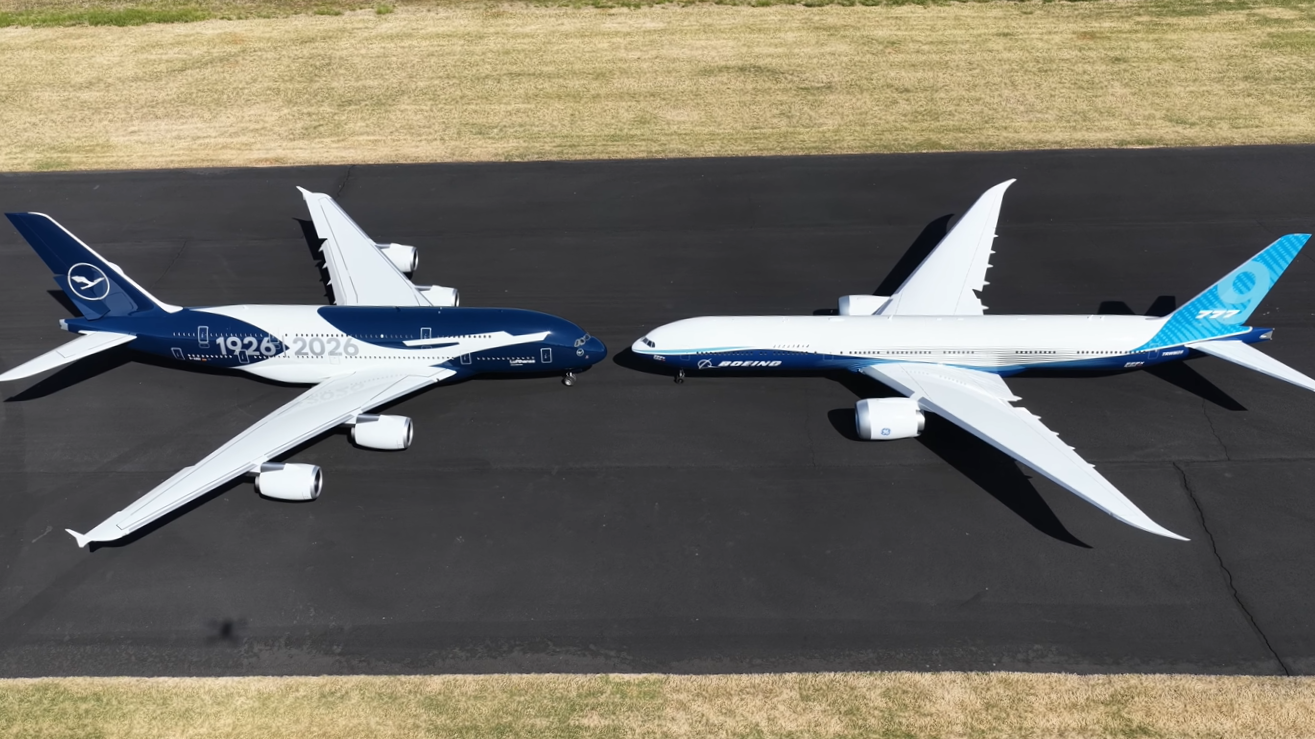
In his build video about the Airbus A380, Ramy stated that he wanted to bring his A380-800 to the same scale as the Boeing. That meant going back to the workshop, scaling up the old A380 RC plane, and getting to work.
Building Up
(Click here if you don’t see the video.)
Ramy explains that, to build the new A380, he started with EPS foam for the fuselage. This foam, which was broken up into four sections due to its large size, was cut by a CNC machine. Then, he covered the foam with fiberglass for the fuselage’s outside skin and carbon fiber for reinforcement on the inside. The stabilizers are wrapped in carbon fiber on the outside as they’ll need to handle heavy aerodynamic loads and need the extra strength.

Assembling the fuselage involved gluing the foam sections together, cutting out the interior support structures, and laying down both the fiberglass and the carbon fiber. The support structures ensured the foam kept its shape while being formed, but when the fuselage was put together, it largely supported itself.
The thing that gets me here is that the fuselage is so thick that Ramy fits inside of it with room to spare.
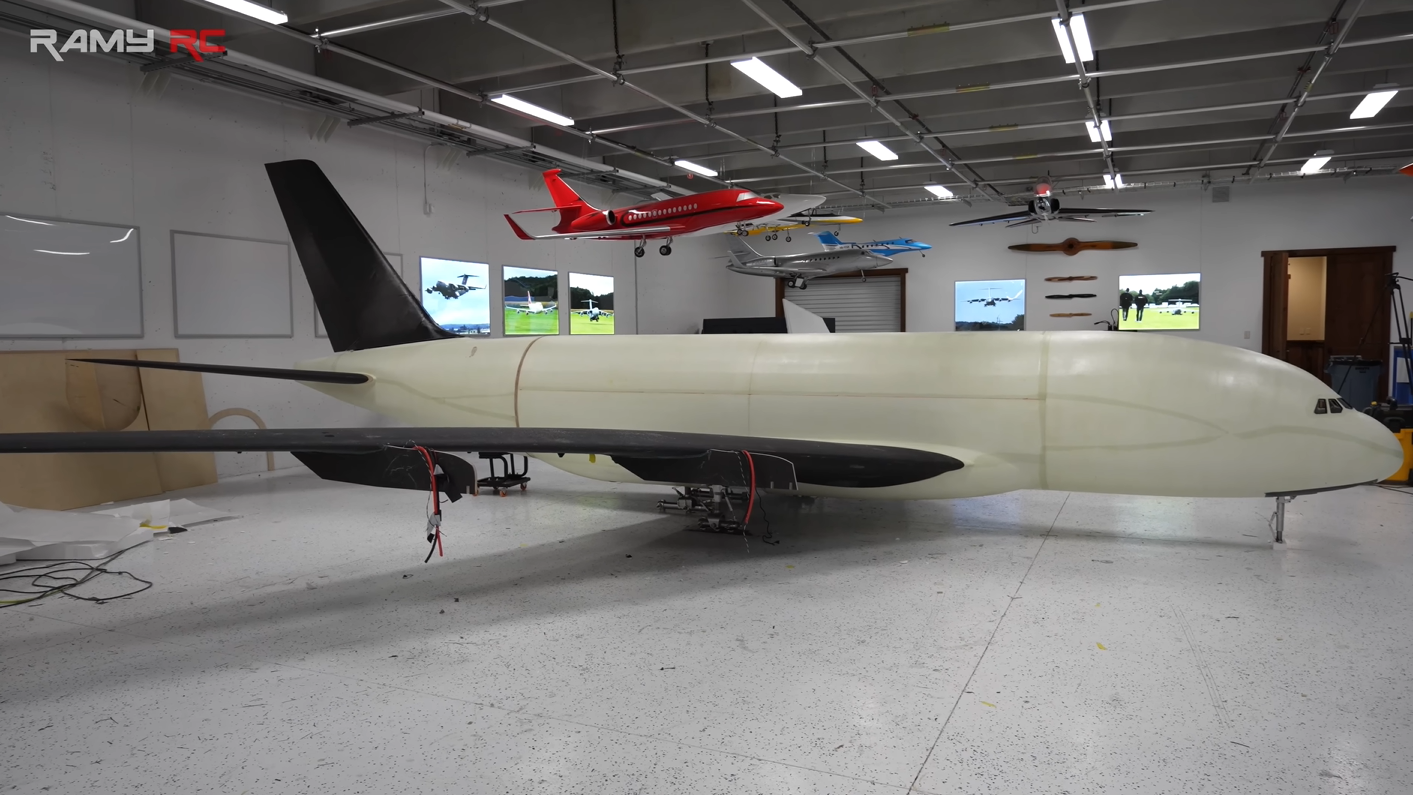
Things got crazy pretty quickly. Ramy wanted this plane to be realistic, and that meant going the extra mile. He cut out over 200 holes for the plane’s windows and had an MLSA 3D printer punch out resin window frames for the whole fuselage. Acrylic was later used to fill in the frames for accurate-looking windows.
In the next video (click here if you can’t see it below), Ramy covered building the wings, and there was a lot of work that went into them. Ramy said that the wing box and wing spars, which are the load-carrying structures of the wings, are attached to the fuselage through thick 50mm tubes, brackets, and braces of solid carbon with wooden structures for additional support. Creating the carbon structures inside the foam parts of one wing took an entire day.
Then another day was spent sanding it down, tracing cutouts for the slats, spoilers, and flaps, then laying down the carbon wrap. Ramy said that he and his team laid down three layers of carbon on the outside of the wing until the engines, then two layers after. Apparently, the giant Airbus RC required an extra layer compared to the Boeing due to the loads and surface area that the Airbus will face.
The landing gear is another work of art. Ramy says that the landing gear is made out of aluminum, and making it took three months of design and fabrication from a collaborator in Germany. Ramy then says that even the plane’s wheels and tires are all custom.
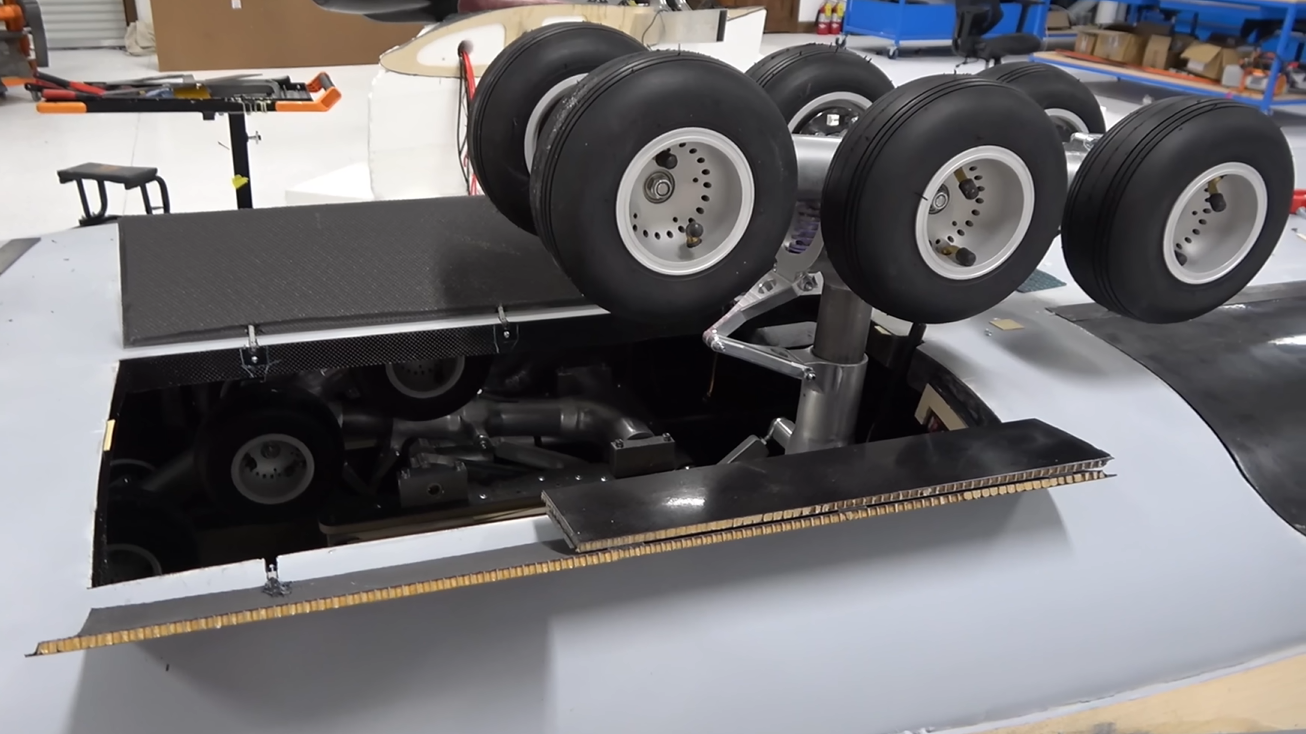
The impressive level of detail includes the moving parts of the wings. Ramy says there are two motors on each wing, spoilers, flaps, but no slats. Each spoiler and flap is individual, like they are on the real plane, and uses 3D-printed hinges.
The control surfaces and the landing gear move using an armada of servos. A set of 88 kg torque servos handles lighter tasks while 130 kg servos work the control surfaces on the wings. Huge 190 kg servos work the rudder and elevator.
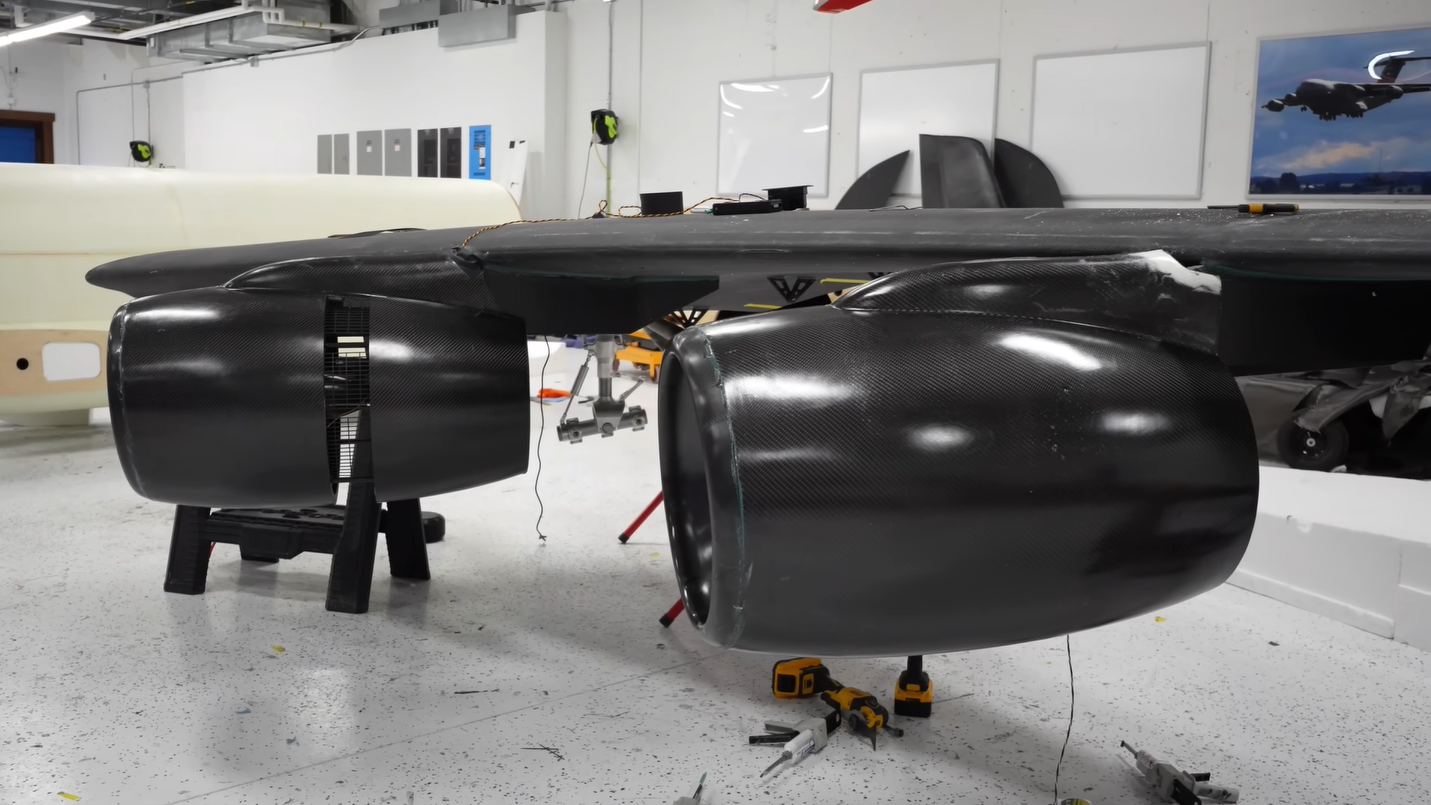
Ramy also talked about adding mock thrust reversers. He explained that an actual thrust reverser would be complicated, time-consuming, and not really practical since the scale plane has great brakes. But since Ramy strives for realism, the model plane has reversers on the inner engines that pull back on landing, just like a real A380.
To build these, Ramy says, he cut the nacelles of the inner engines in half, mounted 3D printed rings on them, and then had them run on a linear bearing. A servo handles the opening and closing function.
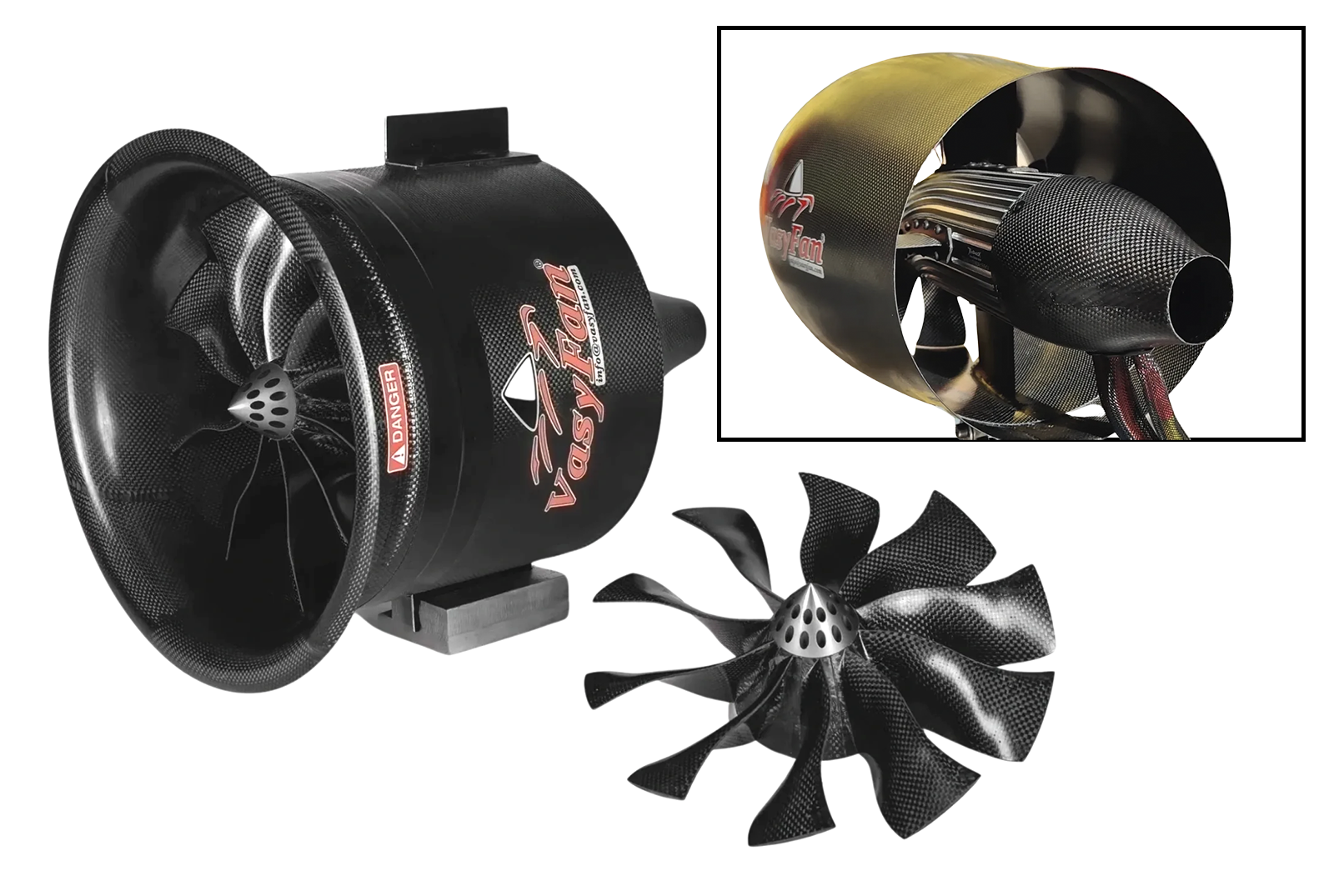
In the third video (click here if you don’t see it above), we see that the windows were cut out and the fuselage primed for paint. Even more exciting is the quartet of VasyFan VF-250 electric ducted fan jets (EDF) mounted into their pylons and wearing beautiful carbon nacelles.
Four of these EDFs (below) are good for a total of 450 pounds of thrust.
The landing gear doors were another fascinating part of the project. Ramy couldn’t make the doors the same way he made the fuselage because the doors need to be thin for both realism and space reasons. The landing gear doors were made out of gelcoat, carbon, and a honeycomb layer vacuumed together. Sadly, due to space restrictions and complexity reasons, Ramy could not fully replicate the operation of the A380’s landing gear. On the real plane, the landing gear doors close after the gear comes down, but there was only enough space on the scale version to get the outside doors to close with the gear down.

Once the structure was complete, moving, and connected to their servos, Ramy had to make it all work. This meant running the wiring to power and run 39 servos, 12 brakes, and five landing gear actuators. Then there’s a whole main board where everything meets up. A Jeti DC24 controller operates the plane:

Ramy says that there were so many individual bits and pieces that had fine control that 24 channels from one board were not nearly enough to control the plane. The landing gear sequence had to be programmed, and all of the parts tested, too.
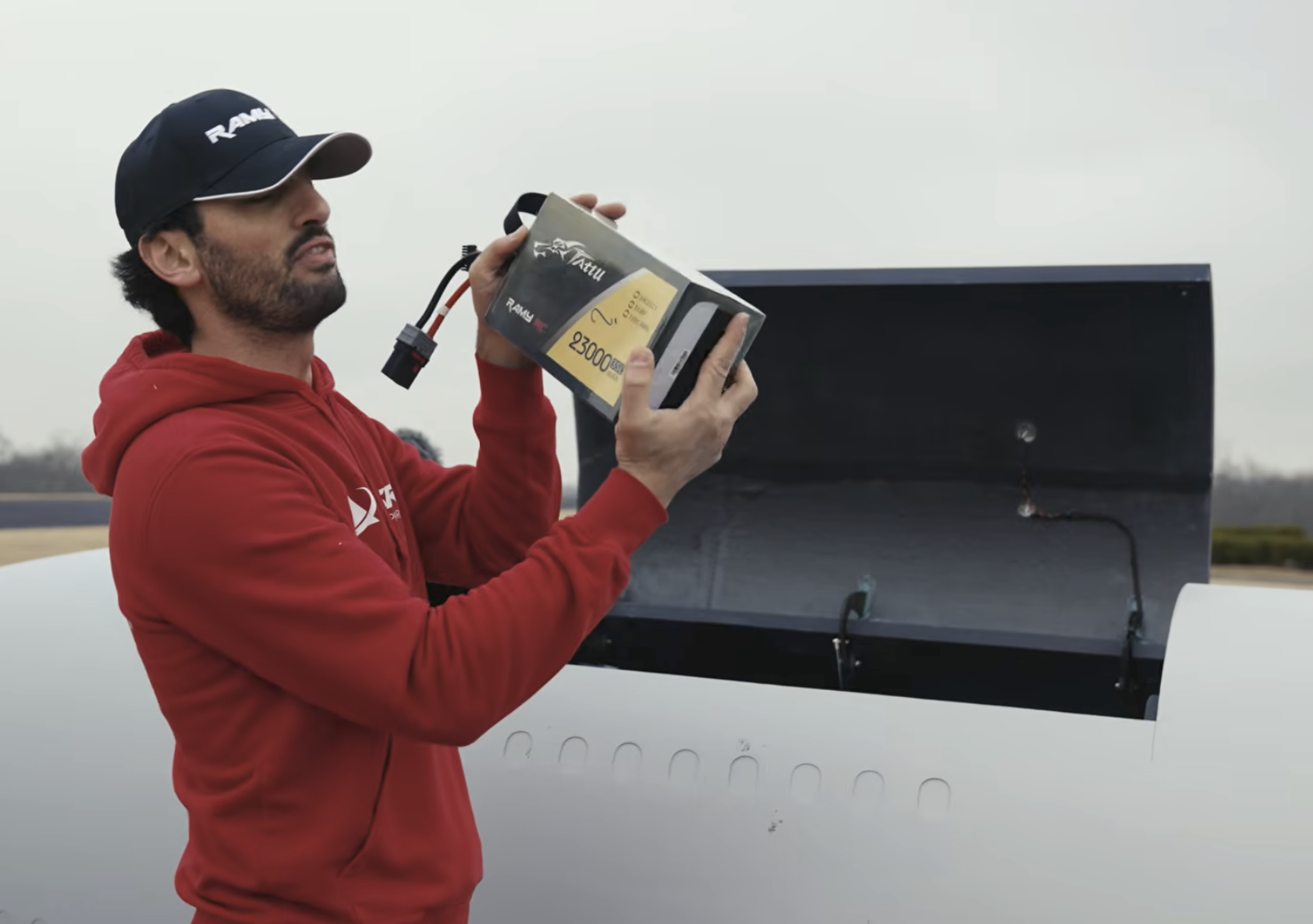
A set of eight Tattu 22.8V 23000mAh LiPo batteries (above) powers the whole thing. Of course, Tyler Perry got to fly the Airbus on its first flight.
A Work Of Scale Art

The finishing touch was giving the RC plane a Lufthansa 100th Anniversary livery, which took a team a month and a half to do. Ramy said that this jet was his team’s best work yet in terms of size, difficulty, and the paint job. The result is mind-boggling. If it weren’t for having cars and people for scale, I would have thought that this was a real Airbus A380-800. It even seems to fly like the real deal.
Ramy says that the final plane is 29 feet long, has a wingspan of 32 feet, is 10 feet tall at the tip of the vertical stabilizer, and weighs 800 pounds. For comparison, a Cessna 150 is 23 feet long and has a wingspan of 33 feet. Even a Cessna 172 is only 27 feet long with a 36-foot wingspan. This RC plane is bigger than a common trainer plane! The Airbus RC is so big that it has to sleep in a hangar.

I also love how Ramy presents his videos. His videos aren’t an hour long, and he doesn’t waste viewers’ time messing around and doing nothing. Instead, you get to watch the RC planes get built piece by piece with only a few interruptions here and there for Ramy to explain what he’s doing. It’s basically RC plane ASMR. I barely scratched the surface of Ramy’s art, and I highly recommend giving these videos a watch to learn more.
There is a lot of AI slop out there in the world, and it’s a shame because you don’t have to look at the result of a writing prompt and a cold computer. There are real people out there doing awesome things, and Ramy is one of them. He built a giant RC plane that looks fake, but is not only real, but was built with some incredible engineering. I feel like I have to visit a model aviation club now, because the world of RC planes is far more exciting than I expected. For now, I’m just going to watch more of these videos.




Great story, as usual, Mercedes.
As a kid, I had a couple of nice “U-control” planes. A Piper Cherokee and a Cessna 172.
A couple of friends and I made wire control planes out of cardboard and screw a Cox .049 engine and a fuel tank to the front and then dog fight them to destruction. And then put the engine on to the next iteration and do it again the next day. Maybe with a new prop if it got chewed up in the mayhem. It was a lot of fun.
Years later, I got my pilot’s license and owned a share of a Cessna 150. The cardboard planes were a lot cheaper to own and fly.
All I can say is thanks and JFC!
I know a few guys in China who fly RC jets with those mini jet turbines, they’re pretty well off but the planes (and turbines) aren’t as expensive as one might think. An 8KG turbine costs ~1300USD, a complete plane starts at 2500USD, and they actually run on pump diesel! Just mix in some Shell turbine oil like a two-stroke bike. Jet-A’s the best for flight time (smells less sooty too) but apparently hard to come by for Chinese civilians.
I’m surprised they haven’t switched to electric ducted fans like this plane. But also, a model-scale high-bypass turbine jet would be a ton of fun if it wasn’t too loud.
I’ve seen RC-scale turbojets and turboshafts (for RC helis), turbofans probably exist? Or you could just add a styrofoam shroud over the turbine housing lol
If I was in the position to spend 3000+ on an RC jet it would probably have an EDF, I’ve seen those single turbine jets stall out mid-flight, and it takes 10+ seconds to restart at a minimum. (theres a tiny brushless starter motor coupled to the turbine shaft) The startup process is real cool though, the motor kicks in and spins the turbine up to 200,000 rpm (IIRC), you hear a sudden woosh and the turbine comes to life! You get a tiny OLED screen with buttons inside the fuselage to control the turbine ECU, or bind everything to the RC receiver to do it remotely
That sounds frickin’ wild. Some day when I make it over there I’ll have to see if there’s a turbine model scene near Shenzhen or something.
I don’t know about small turbines, but to me, the coolest sound I have ever heard is light up of an Alison/RR Model 250 in a Bell 206 JetRanger. I worked for two TV stations that had 206s and I loved every minute I got to spend in them.
That is pretty cool.
Any estimates on how much this costs to build?
Seems a bit absurd from that perspective; to me.
That’s wild! I recently saw this as a reel and immediately scrolled past it because I assumed it was AI.
At what point does the FAA get involved in something like this? If we need a license to fly a quadcopter to take pictures of real estate, and this thing is on the scale of a military drone, what are the requirements here?
I like the work and the effort involved – great job and impressive results, though I’d pick something more interesting than an airliner. To each their own.
But can I ride it?
If he got some youtube clicks out of it, good for him.
But that size isn’t going to fly legally anywhere as an RC plane, imagine the million dollar lawsuit if it landed in someone’s face 🙁
Contolled in an airport or somewhere with proper security: Maybe.
Ramy RC is def next level – I’ve seen a few of his YT builds and they show in my feed every so often. Seen a few crashes as well, which sucks, coz you know how much time and effort has gone into the builds.
That’s awesome! Now do the Mirya.
I know nothing about RC planes but Airbus A380s are awesome and this level of dedication and passion into something so specific is awesome. Hats off to this dude
I love that the world is full of people with this level of obsession in a hobby.
On a side note, i think the Lufthansa 100 year anniversary livery looks best on the 747-8. Perhaps he’ll build that next?
https://newsroom.lufthansagroup.com/en/queen-of-the-skies-now-also-features-xxl-crane-for-100th-founding-anniversary/
This is legendary level work. There’s only thing crazier are the people who fly RC planes from RC aircraft carriers.
There’s also an organization that has naval battles with RC battleships shooting ball bearings at each other.
I’ve been asking the question for a few years now, and no one seems to have an answer:
How long before someone stows away aboard one of these giant-scale RC planes and goes for a joy ride? Because yes it’s an RC airplane but at the core it is an airplane that works in all the ways airplanes do. And at 800 pounds ramp weight, we’re not asking whether there’s sufficient power to get a human off the ground anymore, are we?
Yes, crashes are a serious risk and there have been more than a few captured for our video enjoyment. But Peter Sripol, on his eponymous YouTube channel, built what amounts to an electric-powered RC plane, climbed into and flew around. It’s a far less impressive taildragger with a giant drone motor turning a regular prop, but as for the rest of it, it’s just a basic plane with basic controls that he built in his shop with some friends and then just, you know…flew it. Because he could.
I’m just waiting for the day when one of these big boys lands and someone clambers out of it to the horrified and delighted gasps of the onlookers.
Very cool!
Too bad he didn’t do a POV camera from where a pilot would be sitting 🙂
DUDE that would be dope especialy if you could program the yoke and throttles and guages to read acurately.
Very nice story fun read. I actually avoided the videos as they are just 4 half hour videos that will convince me how stupid I am. The people who do this are just so awesome. Maybe not the equivalent of geniuses of yore but clearly amazingly talented people just the same. I was wondering if rc planes this large required special licenses or areas to fly or can they have a live passenger?
Would it make you feel better to hear he had a team of people working on this? Definitely not a lone person
A little bit
How long of a runway does this thing need for takeoff and landing…?
Yeah, I was wondering what Vr and V2 were.
Been following Ramy RC for a while. Tyler Perry has a 1,000 ft paved runway and an FAA exemption to operate fixed wing RC aircraft below 250 ft AGL with a drone pilot’s license. Even though that A380 is enormous, the thrust-to-weight ratio is well over 2:1, so it gets airborne pretty quick. On the other hand, watching the videos of the first flights, the stopping distance looked pretty spicy. I think they were still working out braking issues though. Once RC gets to that scale, it just starts to look like a real plane – I think they even smoked the tires on the first landing.
That’s really cool. One of my favorite childhood memories is from an annual event our local RC plane club used to hold. I was shocked by how big and seemingly real a lot of those model planes were. They were truly impressive to the point that they often looked and sounded real when they flew overhead. But lo, they developed the area around their runway, banning their flights and ruining a lot of people’s fun for a bunch of crappy plastic cookie cutter homes with overbearing HOAs.
Does Farmers have you covered if this crashes into to your car when driving past an RC plane park? How would that call go hello farmers a airbus a380 crashed into my car am I covered? No no it wasn’t full of people it was only 1/8th the scale. It could have been filled with kittens or puppies though I don’t know.
A car would be one thing but if one hit your house the home owners insurance people definitely won’t be covering that, at least from what I know of those assholes.
bum-ba-dum, bum-bum-bum-bum
Anyone flying anything over 250 grams probably has a membership in the Academy of Model Aeronautics. They offer pilot liability insurance for just that scenario. The club has its own liability insurance too. Knowing the club members around me they may just pass the hat to settle with the car owner and not involve insurance. Guaranteed the pilot has insurance on the plane too. The electronics and propulsion likely made up more than half the cost. $200 a servo is cheap for dead nuts reliable gear at this scale.
May be better to call Jake from State Farm…ha ha
I initially thought the couple lines about Tyler Perry were a joke that I wasn’t in on. Unexpected benefactor.
This is awesome. The trend of moving away from real jet engines in these builds saddens me.
There are plenty of turbine models, and in the cases of these large builds they are expensive enough that using EDF is not to save cost. Tyler Perry has stated that he uses electric due to risk. If a large turbine were to crash on his property and cause a forest fire or other damage, the risk to his reputation and career is huge.
Its a model of a large plane the size of a small plane
…there comes a point where I think to myself “that’s super cool, but why not make one you can actually fly from inside it?” I know there’s the mini-B-17, which I think is actually smaller…
It’s probably less difficult to get a license for one of these though.
Agreed. Love the attention to detail and ingenuity, but at a certain point the only difference is the risk involved to your health if something fails. At least you’d be able to fly this massive plane outside of visual range. Get a parachute I guess.
Honestly, that’s one of my dreams. Fly a GA aircraft that’s basically a scale version of a big airliner. A 747 that’s the size of a Cessna!
I could see technical and piloting challenges (airliners are fast things with swept wings and jet engines, easy to get behind the plane on approach) but that would be awesome to see: a scale Queen of the Skies coming in on short final on the green dot at Oshkosh.
This is USA specific, although other countries have similar rules.
For a private pilots certificate you have to have an FAA medical exam, and then spend months and months of training, pass written and practical exams, and then be-reassessed every two years. That’s just for private pilot VFR (there are some new alternatives to the medical certificate) It costs tens of thousands.
Flying RC models requires none of that.
Yep! I’m currently in a holding pattern (ha) regarding my own medical certificate. As it turns out, the feds are rather concerned about why I’m on HRT, something my AME did not warn me about, and thus I didn’t prepare for. Oof.
That’s scary- Next thing they’ll be revoking trans folks CDLs.
They already won’t let people pass medical if they’ve been on anti-depressants or any other meds, so it’s already a shit-show.
Someone call Power Wheels and let’s make Power Wings happen. Make mine an A-10 Warthog. Low and slow baby.
With an Orbeez gun!
You can fly a tube frame with canvas wings without a license, and they cost a small fraction of what this cost to build.
Rich people toys make less and less sense to me, and I’m an aviation nut.
A lot of these massive scale airliner builds come out of Germany for some reason. I imagine the FAA would have fits with a “drone” this big.
The FAA doesn’t care how big it is, as long as you’re properly licensed. Unmanned aircraft controlled remotely are all considered drones. Under 250g you don’t need a license. If it’s over 250g, you do.
If you want to fly this behemoth for fun, all you need is $5 and 20 minutes of your time to pass a written drone safety exam. If you want to fly it to make money, it’s $150 and an online safety course.
Now, to fully comply with safety regs, there are additional expenses in the form of RC club membership dues so you can fly at a FAA designated site, transponders that report altitude, airspeed, and your pilot ID, and other fun expenses no one wants to mention so they don’t turn you away from the RC hobby.
It’s a hobby aimed squarely at rich retired old men. I tried it last year and I learned I don’t have the income to support it, and that was before the trade war and the war in Iran ruined evening. Upside is that there’s no AI slop to be seen and it gets you outdoors. There’s certainly fun to be had, but it’s very expensive.
I’m not rich or retired and it’s my favorite hobby. Then again I’ve purchased almost everything except batteries used. And repaired some jigsaw puzzles more than once. It’s not inexpensive but sure cheaper than a project car.
RC hobby is all about miniature versions of big things. That’s the whole appeal whether it’s land, sea, or air.
It’s not about going flying, it’s about flying a scale model of something you love.
It’s not my thing, but I love the craftsmanship and dedication that goes into these things.
Actually, that’s a partial lie, I’d love to play with some RC earth moving equipment in a large sandbox.
That is unbelievably cool.
I was actually a bit nervous watching the video of this thing flying, mostly because my own experience with model airplanes has been inauspicious. My one attempt – using a model airplane built by a friend over several weeks – ended with the plane doing its best lawn dart impression maybe 7 seconds after it took off on its maiden voyage.
That model airplane was basically a child’s toy (I think we were 10 years old at the time; I could probably build the same thing in a few hours today), but watching it crash sucked. I would hate to see something as amazing as this scale model A380 meet a similar fate.
I know how you feel. My first and only RC plane survived maybe two flights or so. Then I charged it up one more time and promptly flew it into a tree, maybe 40 feet above the ground. It stayed up there for months before finally falling down in several pieces.
I got to fly an R/C Millennium Falcon once and even though it was in an open field, it took mere moments to almost loose it entirely.
Years ago, my dad took me to an RC airfield to watch the planes fly.
There was on guy who was just absolutely showing off. He’d make the plane taxi down the runway while talking to someone. Just showing how he was so good, he didn’t have to pay attention. When it got to the end of the concrete, he had it turn around and taxi back toward him.
The whole vibe in the group was “Just take off already!!”
Once the plane taxied back to the other end of the runway, he turned it around again, spun up the engines, and it took flight!
It was actually pretty impressive.
For about 30 seconds.
I can remember clear as day seeing the left wing suddenly fold to 90 degrees and the plane did a lawn dart impression. Right into the concrete.
It looked like it reduced itself to pieces no larger than a quarter.
I went to an open house type event hosted by a large RC manufacturer, and they had a large scale, jet powered model fighter up. Every time the damn thing was pointed right at me I shrank back a bit instinctively. Certainly didn’t want to catch that to the face! I imagine with an 800 lb airliner the size of a car, I’d be watching from well back of the flightline!
Crashes are a risk of the hobby, I guess. I also went to the local flying clubs open house on a windy day, and the only guy I saw go up without damage on landing had a stunt heli. I imagine this thing is a bit more resistant to a strong breeze, but it’s also not what I’d want to land with a crosswind.
Wind can be fun. With the right model and attitude. I have a few planes that slice through wind like butter. Learning to land in wind was a process.
I have never gotten into RC aircraft, but I was into buggies for a while in the late 80’s (Losi JRX2 and Team Associated RC10). The only time I tried aerial pursuits was with Estes rockets. Fully 75% of them were eaten by the same tree that eats Charlie Brown’s kites on their maiden flight.
The Estes rockets were fun ways to give your children access to explosives. I enjoyed building them and was heartbroken when one would inevitably crash due to parachute failure or would come back to earth seemingly OK, only for one of the balsa wood fins to break with no real replacements. Estes must’ve made a mint with those things given the materials cost had to be next to nothing.