


Motorhomes are among the last vehicles that you would expect anything resembling a pleasurable driving experience from. Most of them are gigantic bricks that are slow, lumbering, and maybe terrifying to turn at high speed. I recently drove a motorhome that might be as close to what you can call a “Driver’s RV.” This is the Wingamm Oasi 540.1, and it’s a motorhome that’s smaller than a pickup truck and handles like a car, a perfect combination for me to perform hot laps on a racetrack in it.
I have been writing about the Wingamm Oasi 540.1 for most of my auto writer career thus far. I first wrote about this motorhome back in June 2021 when I worked for Jalopnik! Part of the reason this motorhome has been on my mind for so long is that the Wingamm brand as a whole is something completely different for America. The company’s debut coach in America, the 540.1, is shorter than a camper van, yet feels as roomy as a Class C motorhome. But it’s also more than just tons of space, as the coaches appear to be built well and have insanely comfortable interiors.


The Wingamm Oasi 540.1 came at just the right time in America. There now exists a kind of motorhome buyer who wants a motorhome, but doesn’t want the hassle of learning how to drive a bus, doesn’t like not being able to fit into parking spaces, and doesn’t want to maintain such a massive beast. Many Americans have been discovering that European RVers get to drive smaller and more fuel-efficient motorhomes with classy interiors. But these motorhomes have been forbidden fruit to those in the U.S. of A. The solution? Some companies have been injecting Euro flavor into their RVs. Some, like Wingamm, have simply decided to bring the forbidden fruit to America.
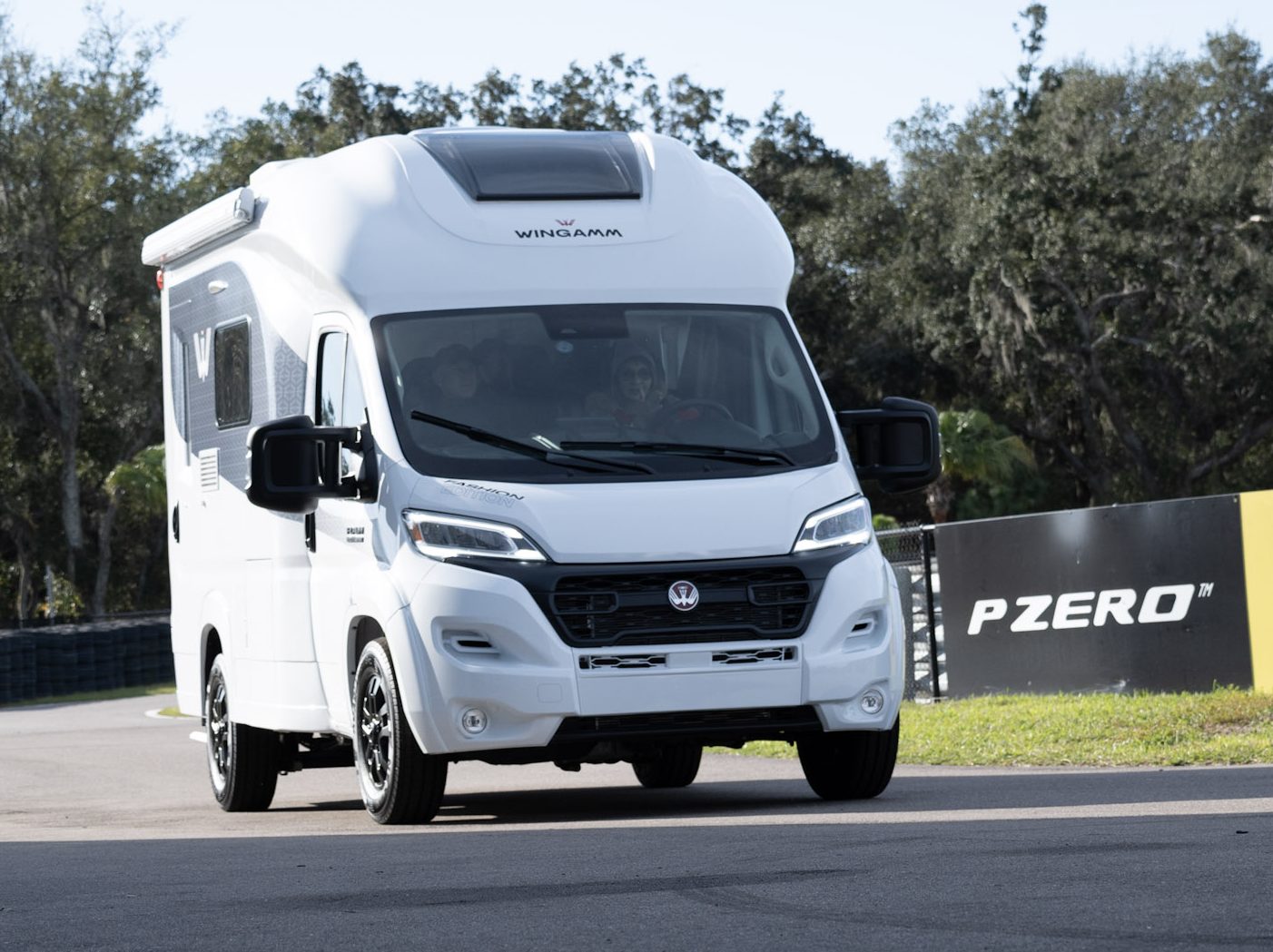
Wingamm says the 540.1 drives like a car, and it has the right bones for the task. The fiberglass monocoque RV body is attached to a front-wheel-drive Ram ProMaster platform. But does the Wingamm Oasi 540.1 live up to the promise? I was given the weirdest possible opportunity to find out. Not only did I get to drive the Oasi 540.1 and its larger siblings, but I got to absolutely hoon one on a racetrack.
(Full Disclosure: Wingamm USA invited me to the Motor Enclave outside of Tampa, Florida, to experience the launch of its new Oasi 610 and Oasi 690 models in America. I paid for my travel, lodging, and rental car. Wingamm paid for a delicious dinner and a whole bottle of wine.)
Forbidden Fruit In America
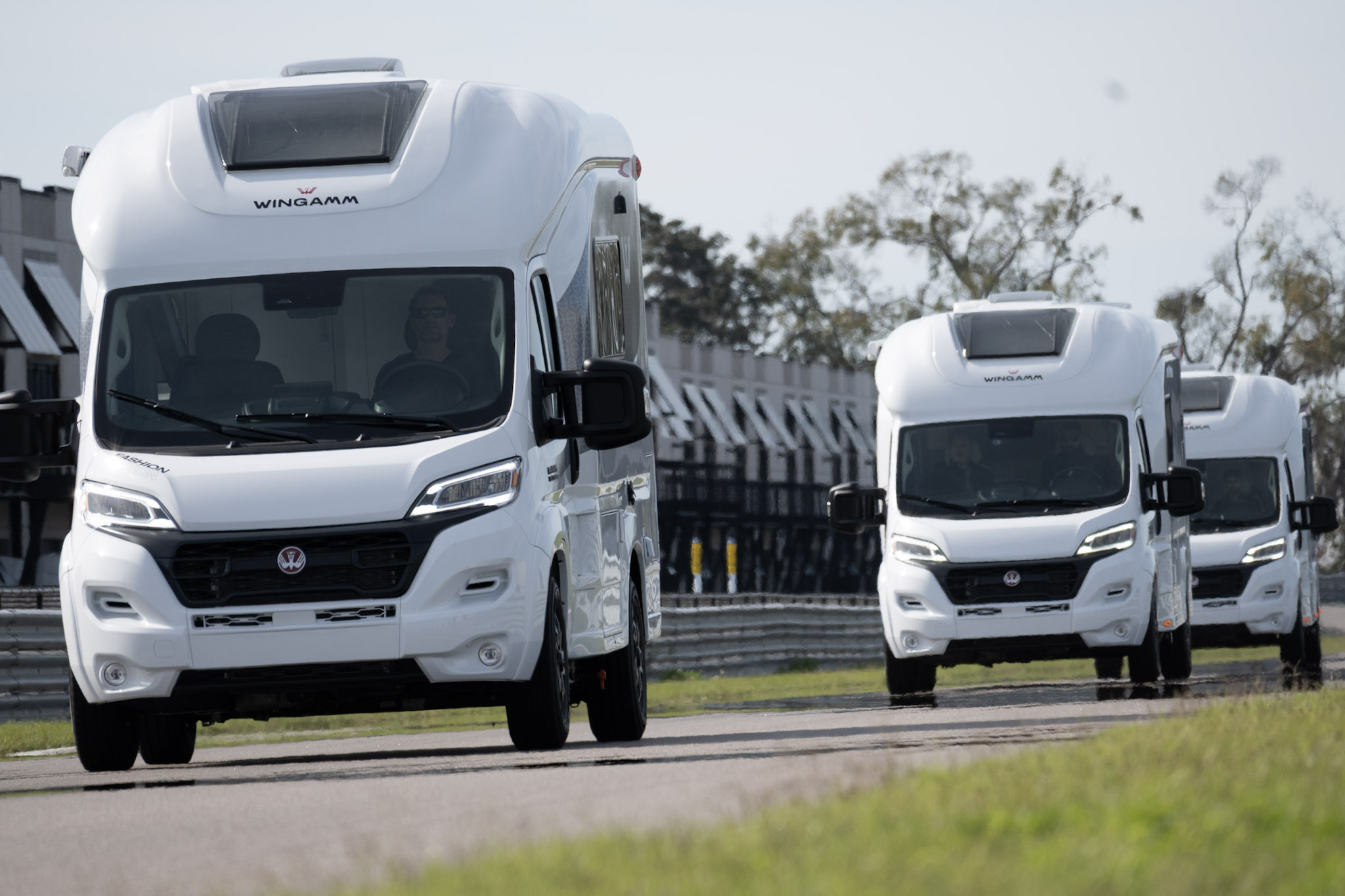
Wingamm’s American arm has had a long journey to where it is today. The Italian RV builder found a distributor and announced its entry into America in 2021. I first saw the Wingamm 540 in 2023 at the Florida RV SuperShow in Tampa. Then, I watched as the 540 evolved into the Americanized 540.1. Unfortunately, Wingamm slipped on its expected launch dates as it juggled COVID-19 pandemic supply chain struggles and delays in certifying the coach with U.S. authorities.
But everything eventually fell into place and deliveries officially commenced in January 2025. Apparently, Wingamm has gotten so much interest in its tiny motorhome that it’s now beginning to import the larger Oasi 610 and the Oasi 690 to America. There are now three sizes and countless flavors to choose from.

If this is your first time reading my Wingamm coverage, here’s a quick rundown of the company’s history:
Wingamm opened its doors in Italy in 1977. Its founders, the Turri brothers, were initially builders of furniture. Eventually, the pair fell in love with RVs, and decided to use their experience in the furniture business to create their own RVs. The Turri brothers founded Wingamm, drawing inspiration from the peregrine falcon. Like the bird of prey, Wingamm sees its campers as robust, nimble vehicles capable of getting you to your destination in comfort.
Wingamm started off small, by taking vans supplied by customers, chopping off their roofs and fitting a fiberglass camper shell in their place. In 1982, the company evolved its campers into the design that is still used today.

One of Wingamm’s longest-running nameplates is the Oasis, or Oasi. Back in the early 1980s, Wingamm took Fiat Ducatos, slapped a fiberglass monocoque on them, and shipped them out as a motorhome that’s wider and more spacious than a camper van, but still substantially smaller than what Americans would call a Class C motorhome.
Wingamm’s trick to adding more space within its tiny fiberglass box is its bed. The main bed hinges down from the ceiling of the coach. During the day, the front of the coach has a living room, dining room, and a kitchen. Then, when the sun goes down, and it’s time to sleep, the bed comes down and gives you a great cozy place to saw some logs.
Wingamm has continued to refine this recipe into the modern day, and the motorhomes are still based on the Fiat Ducato, just like they were in the ’80s. The Oasi 540.1 that we get here in America is a fresh derivative of a design that launched in 2010. Bringing the Oasi to America was possible thanks to the fact that America does get the Fiat Ducato, only with a Ram ProMaster badge and a Pentastar V6 rather than an Iveco diesel.
Blue Collar Bones

Wingamm’s American lineup consists of the 540.1, which measures in at 17 feet and 10 inches long, the 610, which is 20 feet long, and the 690, which is 22.5 feet long. All of these coaches are built on a Ram ProMaster 3500 cutaway chassis, which features a 3.6-liter Pentastar V6 good for 276 horsepower and 250 lb-ft of torque. This is backed by a nine-speed automatic transmission and front-wheel drive.
The motorhome portion of the build consists of a one-piece fiberglass body that is molded into shape and then lowered onto the ProMaster as a single unit. Wingamm then fills out the interior. Wingamm believes that in building its motorhomes out of a single piece of fiberglass, you’ll get a unit that will be leak-free and sturdy for a long time to come. The other good news is that Wingamm is also proud that it doesn’t use an ounce of lauan tropical plywood anywhere in the build.

One of Wingamm’s selling points is that it makes its interiors better than those of the companies from Indiana. What I wrote in the past is still relevant:
Go ahead, spread your arms out like wings! They won’t hit the walls. Then, walk down the aisle. Camper vans often force bigger people like me to walk sideways, and I still end up dragging my butt up against a cabinet or door. That’s not a problem in the Oasi 540.1. It feels like you’re walking inside of a Class C coach. Funny enough, Wingamm originally marketed the Oasi as a Class C motorhome but has since realized that it doesn’t perfectly fit into that category. Likewise, it’s not a camper van either. It’s more like something between the two.

The biggest change in the interior happened at the counter. The cooktop has been swapped out for a different unit while the sink is now more elegant than the previous version. The stereo speakers have also been moved elsewhere for a cleaner look. Everything else is exactly as Wingamm had it when I saw it in 2023. In terms of materials, you’re getting Rubelli fabrics for the seating areas and curtains, Brivio Italian poplar plywood for counter surfaces, Arpa Ker Laminates, and Kaindl Optimatt laminates for the cabinetry and walls. Further detail comes from Zamak alloy hinges, and the furniture is bonded to the fiberglass structure rather than screwed in place. Wingamm says the latter maintains the structure’s strength while eliminating squeaks and rattles.

Personally, I love this interior. The fit and finish are phenomenal, and it’s clear that someone actually thought about everything that you touch in here. The counter is sturdy and smooth, the leather is supple, and the meaty cabinet doors close with confidence. If the RV builders in Indiana had quality like this, I don’t think anyone would complain.

The process to construct a Wingamm for America is pretty convoluted. Wingamm gets the ProMaster cutaways from the Stellantis factory in Mexico. These are shipped to Italy, where they are mated to their fiberglass RV body and are filled out. The completed units then head back to North America, where they are finally sold to a customer. Your Wingamm will have traveled several thousand miles before you even put a single mile on it!
Wingamm’s American arm is looking to streamline this process and build the bodies here in the states, but that won’t happen until Wingamm can find a producer that can make the fiberglass to the exacting standards of Wingamm in Italy.
Finally Getting To Drive A Wingamm

If you’ve been reading my Wingamm coverage, a lot of this is review. What is new is that, finally, after years of writing about these things, I got to drive all of them. Wingamm invited me out to the Motor Enclave just outside of Tampa Bay, where the company launched its larger 610 and 690 models. This event was built largely around allowing owners to drive a Wingamm for the first time, but a small flock of media were also invited.
The venue for this event was wild for a motorhome launch. The Motor Enclave calls itself the world’s largest private garage community, and all of the garage condos surround a 1.72-mile racetrack.

I’m told that this track was designed by German engineer and racing driver Hermann Tilke. He’s particularly famous for his Formula One track designs. His portfolio includes overhauls of Circuit de Catalunya, Hockenheimring, and Nürburgring, as well as completely new designs, including the Bahrain International Circuit, Circuit of the Americas, and Buddh International Circuit.
In other words, the Motor Enclave is a fun place to stretch out a car’s legs. There’s even an off-road park next to the paved track. I bet nobody expected some crazed journalists to send a motorhome around the circuit.
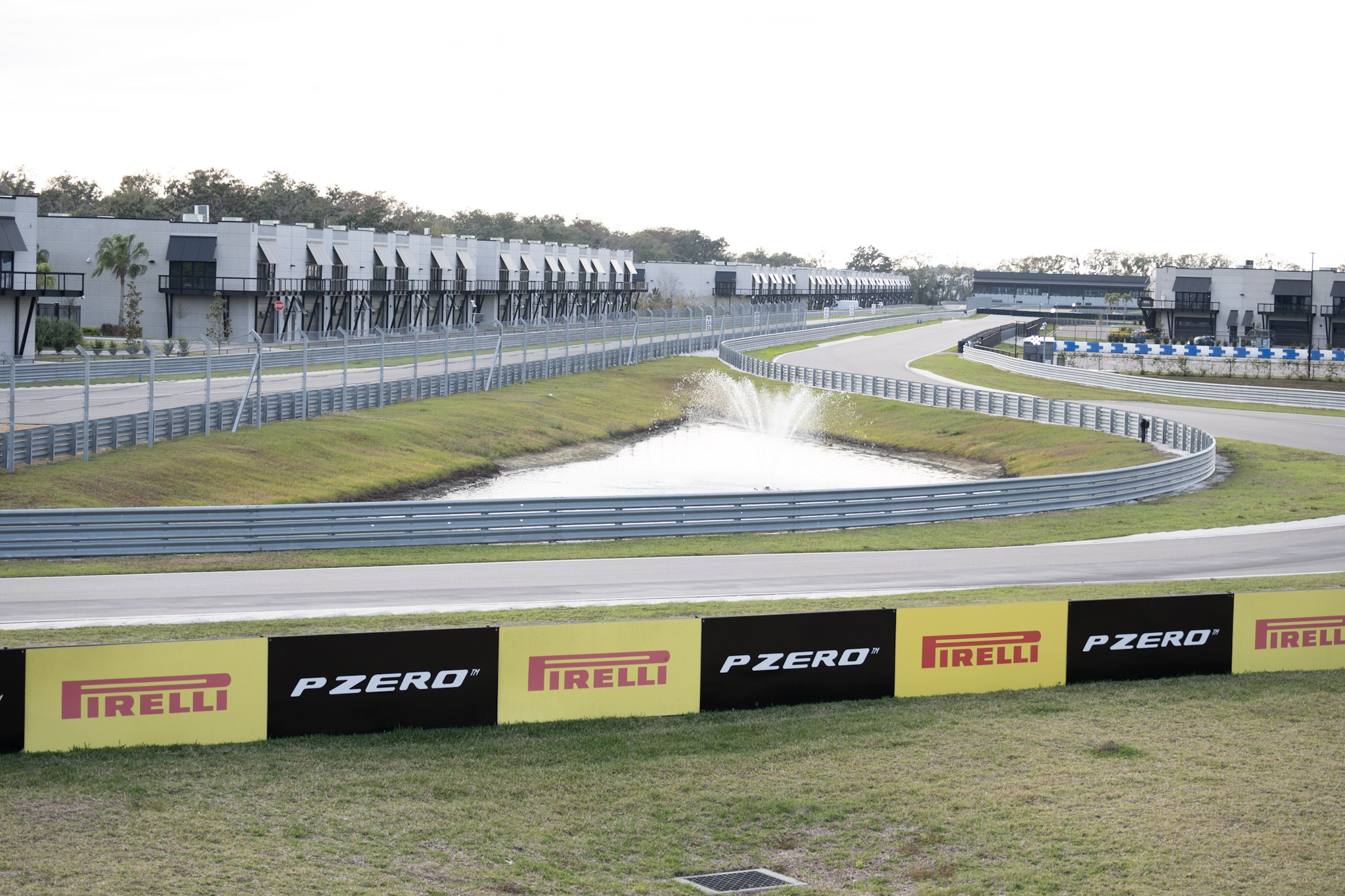
I wasn’t alone on this day, and joined Aaron Gold from Motor Trend and Benny Kirk from Autoevolution. Amusingly, when we read the invites to the drive event, the invites said that there would be hot laps and track time. When we got there, we were told that our drives around the track would actually be very cold rather than hot.
This actually made a ton of sense. If the people who appeared at the event represent the average Wingamm buyer, then none of these people were exactly performance drivers. We watched as the buyers got to drive the 540.1, 610, and 690 before we got to drive them, and it was fascinating to see part of why these people wanted a Wingamm. Some of these people struggle with parking, maneuvering, and generally handling a bigger rig. Driving a Wingamm felt closer to driving the car that they have at home.

Still, Aaron and I are weird car people and felt it would have been a travesty to come to a track like this and not actually do hot laps. So, after some sweet-talking to track officials and the lovely Wingamm people, they cleared us to have some fun after everyone had finished driving for the day.
The only limitation was that, since we wouldn’t be wearing helmets and since the track officials had no idea how motorhomes would perform on the track, we were not allowed to intentionally send it so hard that the tires would be screaming in pain. This was also for insurance reasons. Basically, we were allowed to go maybe 7/10 or 8/10 for the motorhome. As it turned out, that wouldn’t be a problem.
On The Track

Aaron and I chose the 540.1 as our steed. We felt this one, given its lower weight and smaller size, would be the best fit for hot laps. That said, it’s not like we’re talking about a Mazda Miata here. The 540.1 weighs 7,716 pounds empty, has a high ground clearance, and Nexen Roadian CT8 HL all-season van tires. The suspension isn’t particularly impressive either, being struts up front, a solid axle in the rear, and rear leaf springs. Of course, then there’s the front-wheel-drive.
These hot laps would also mark a first for me. I’ve done a lot of rallycross, but I have never driven a car on a paved track before. In fact, my very first time ever on a paved track was doing hot laps on a Harley-Davidson Street Glide and a Harley-Davidson Road Glide. Driving the Wingamms on the track was my second-ever time being on a paved track in real life. I wonder how many non-cars I’m going to do hot laps in before I actually get to take a car on a track?
The hot laps were hilarious right from the start. The three of us manic journalists did an informal 60 mph acceleration test and found that the coach was able to do the deed in roughly 8.5 to 9 seconds or so. That’s not quick by car standards, but properly brisk for something with a toilet, a stove, and a couple of beds in it. A video of our first lap is below (or click here). I was in the passenger seat and was told not to show who was driving:
What we found out relatively quickly was that, thanks to the lightweight fiberglass RV body, the Oasi 540.1’s weight is down low. When we chucked the RV into corners, there was a lot of body roll, but at some point, that roll would simply cease to increase, and the motorhome would carry itself through the curve.
Handling was shockingly predictable. It was easy to hit apexes, and going too hot led to gentle understeer. The Wingamm Oasi 540.1 tackled curves in a way that felt similar to a minivan or a crossover. It was stable and the suspension didn’t become unsettled through the curves. All of this was amazing for a motorhome. I expected a chaotic drive closer to that of a truck, but true to the marketing, this felt darn close to something built on a car platform.
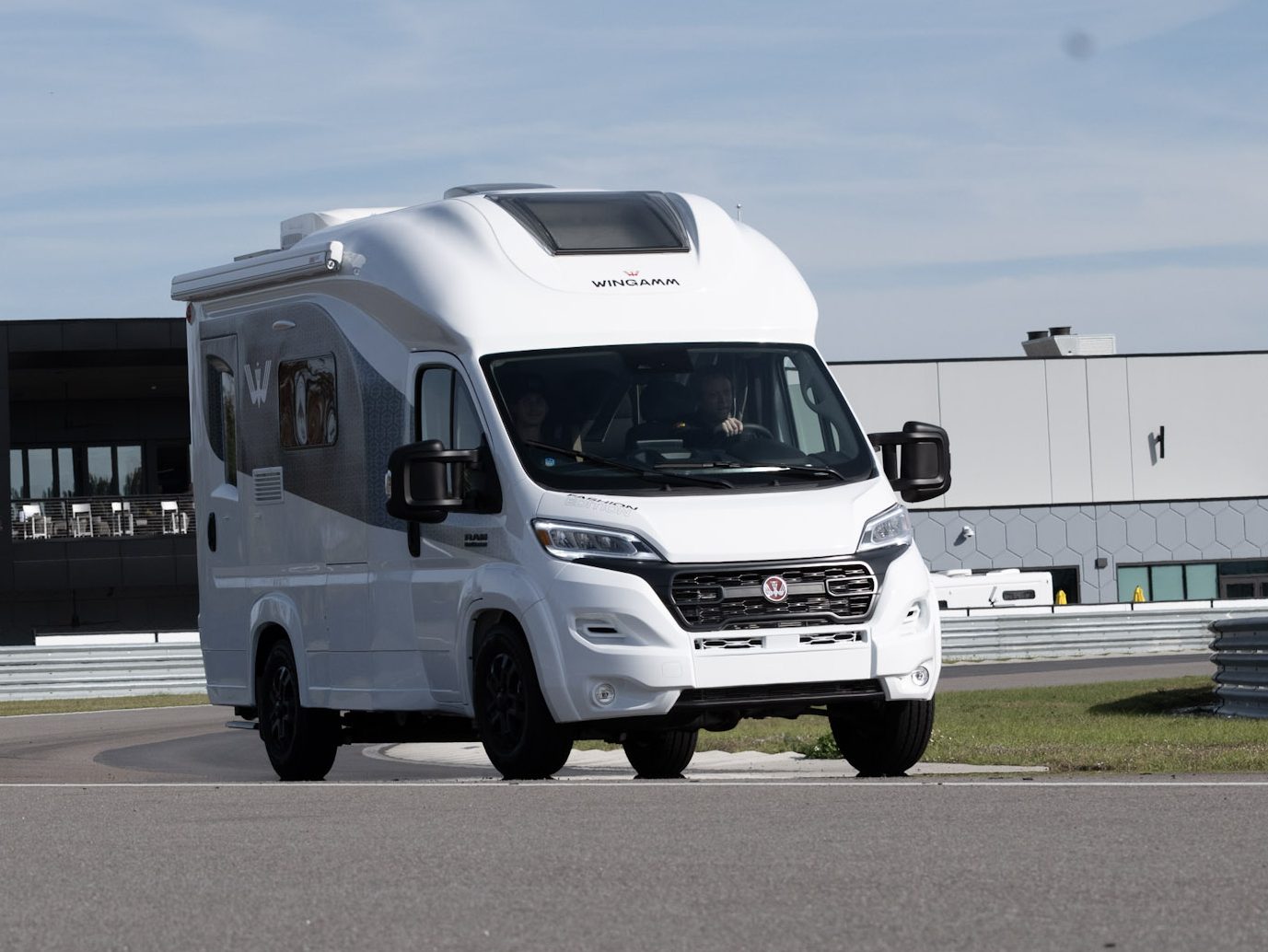
We really only had a handful of reminders that we were, in fact, not driving a big car.
The biggest reminder was the stability control system, which freaked out from the start to the end of each and every lap. The stability control light cried in pain, and the safety systems had a tendency to cut power about halfway into a curve. Power would not return until I finally straightened out the wheels. I briefly turned off stability control, which did allow me to keep on the power through a turn. However, this technically broke the rules of not going too hard, so I had to turn it back on.

The transmission also showed some signs of not being particularly happy with being pushed in a track environment. At times, it would not downshift after a full throttle input, and sometimes when it did downshift, it would do so with a heavy thunk. We found that with fine metering of the throttle, we could get the transmission to comply with requested downshifts. Using manual mode also amplified the experience a bit and removed the computer’s guessing from the scenario entirely.
There were other, more visible signs of calamity from our laps. The body roll was enough that both the track authorities and Wingamm’s reps thought we came close to rolling the coach. But the beautiful part was that, due to the stability control system and the non-performance tires, the motorhome breaks traction before it increases body roll. We pulled some insane – for a motorhome – stunts, and the body roll never really exceeded a safe margin. I think you’d actually have to try hard to get one of these to roll.

Since we did these laps with three journalists in the motorhome, someone had to sit in the back. Amusingly, every time we hit a curve, this poor person had to brace themselves on the kitchen counter or the sink to stay in place, and I just couldn’t stop laughing. If you’re a fan of Top Gear and The Grand Tour, you might remember the crew’s motorhome racing segments, and this was just like that.
Sadly, the track staff decided not to time our laps. This was a safety measure. The idea was that if we actually knew our lap times, we’d probably drive even more like maniacs. That’s how fun the Wingamm was to absolutely tear around the track. The other awesome thing is that the handling seems to scale appropriately. We didn’t get to take the 610 or 690 at track speed, but we did find that as the coach gains a little bit of length and weight, handling gets only slightly worse.
A Driver’s RV?

As silly as all of this sounds, it isn’t unheard of. RV history has a few moments when designers sought to create a better-driving RV because motorhomes tend to drive like buses and box trucks. One of those was the Champion Ultrastar Class A motorhome, and another was the iconic GMC MotorHome.
Perhaps the most famous RV that was built to handle is the Vixen 21 TD, which was designed by one of the engineers of the DMC DeLorean. In fact, the Vixen’s marketing imagery even shows someone absolutely sending one. It wasn’t just marketing, either, as the original Vixens sported a rear-mounted BMW diesel engine, a low-slung body, independent suspension, and even a manual transmission. It’s a coach that’s been called the “sports car of motorhomes” more than once, including by me.

The Wingamm Oasi 540.1 doesn’t go that hard, of course. It’s based on a commercial van chassis and has a body that’s more than tall enough to stand in. The suspension and drivetrain aren’t exactly sporty, either. Personally, I think that if you lowered the suspension and wrapped the wheels in grippy tires, this darn thing could be a real driver’s RV.
While driving the 540.1 around a track at speed was fun, I think it actually demonstrated a really important part of why people love this motorhome. It’s easy to drive, comfortable, and has enough nannies to reel in even the craziest driver. I don’t suspect the 540.1 will become the motorhome of sports car owners. Instead, I see these driving characteristics making road trips easier.
As I noted earlier, while I didn’t get to take the 610 and the 690 on hot laps, I did get to drive them. I will write about that experience, as well as my in-depth review of the interiors and what I think Wingamm can do better, in a separate piece. But my 540.1 drive is pretty applicable to the larger siblings. That’s to say that I was impressed with how they drive.

If you’re interested in one of these units, the Wingamm Oasi 540.1 currently has a starting price of $192,500. Of that cost, $56,785 is the Ram ProMaster that’s underneath. Yes, that is a metric ton of money. You can buy a 20-foot Class C from Thor Industries for around $70,000. However, the interiors of these Wingamms feel leagues better built than any of those Thors and are also appropriately luxurious. They’re also cheaper than camper vans from the likes of Airstream and Winnebago. So, they cost a bunch of money, but a good portion of the American small motorhome market somehow costs even more. I think Wingamm will find its niche. Wingamm also tells me that it’s running a crowdfunding campaign for folks who might want to invest. The minimum buy-in is $240 through Wingamm’s StartEngine campaign.
Pricing aside, I still think these motorhomes are an absolutely stellar idea. It can fit in a parking space, and is so easy to drive that you can feel comfortable handling it without a CDL.
It also just so happens to be a blast on a track. I won’t say that the Wingamm 540.1 is the rebirth of the ol’ Vixen 21 TD, but the Wingamm is far more fun on a track than any motorhome has a right to be. Dare I say? Wingamm should make a Superleggera version or something. I’d love to see a spec motorhome series using 540.1s!
Top graphic image: Mercedes Streeter


That’s not a mini camper, *this* is a mini camper https://youtu.be/BNplm3Zevk4?si=NZlGJ_mnvRsVgea2
I’ve written about one that’s even smaller than that one!
https://www.theautopian.com/some-genius-turned-a-geo-tracker-into-the-tiniest-truck-camper-and-its-surprisingly-usable/
I’m slightly annoyed as the same guy recently hired/was given a slightly larger, newer, fancier one. Not sure if it’s Fancy Mercedes fancy though. Why slightly annoyed? Because I’m going to Japan in March and I forgot that this could’ve been an option. Aaaargh!
A number of years ago, my wife and I did a tour of New Zealand’s north island in an excellent Australian Winnebago camper. The camper itself was quite similar to the Wingamm, built on a Fiat Ducato chassis. Overall it was excellent throughout, and really felt like driving a big car. At the time, a very good friend of hours was responsible for the Taupo racetrack, and we went there as he had promised that we would be able to drive around the track.
At the time, I thought we would get to borrow some race car to do this, but when the time came he told me to drive out on the track. I was like “with this campervan??”. He just laughed and said “sure!!”.
So, out I went, and it was actually quite a lot of fun. The handling was not bad, and I had a similar feeling as you with the sliding tacking over before the van reached a tipover point. Everything was great, and my only real issue was that the brakes were really not up for this punishment. Having some racing experience, I would come too fast to the corners, and obviously brake too late for what I was driving at the time. It did get a bit scary at times. Still we had a blast, and the campervan was just excellent for our trip.
https://imgur.com/5tXaeoR
“It was stable and remained relatively unsettled through the curves.”
Settled or unsettled?
The uncontrollable giggling Mercedes was doing in the video just brought back fun memories of hooning my friend’s John Deere tractor (I don’t remember the model, but it wasn’t a big one) in his acreage before burn season. We knew it was risky, we knew it was mostly pointless, but seeing it do things it really wasn’t meant to do was simultaneously hilarious and scary and gave us the gigglefits. You have made us Autopians proud, Mercedes!
The giggling was fun to hear.
See RV industry? Mercedes will totally write a positive article about an RV show, especially one that includes track time!
Out of sheer perversity I’d like to put Citroën Jumper badges on the ProMaster.
If they weren’t so expensive I’d be interested. There has to be cheaper way than building a Cadillac Allante you can live in
3 auto journalists in a vehicle doing hot laps and nobody is keeping lap times? I smell pants on fire.
I was too busy laughing too hard, no matter which seat I sat in, and the poor guy in the back just held on for dear life.
What I really like about these is that I could park it in my driveway.
Yeah, I personally prefer trailers over motorhomes, so as not to have an extra, infrequently run drivetrain sitting around to worry about maintaining, and so you don’t have to pack up the campsite to run out for an errand, but if I was going to do a motorhome, it would have to be something like this that can easily fit at home or in a normal parking spot.
I always really liked those RoadTrek vans, the ones that aren’t really any bigger in all dimensions than an ordinary high roof work van, but still pack in a functional kitchen and bathroom, but, good lord, do they seem to hold their value even when really old
For a similar van build, check out GTRV https://gtrv.com/
Apples and oranges and all, but that’s faster than malaise-era Corvettes, Camaros, and Mustangs and just a second slower that 911s of that time. How far we’ve come!
Like other commenters here, I would much rather spend the money on something well designed and assembled like a Wingamm or one of the two-piece fiberglass trailers than the stick-built products we see from Elkhart.
Is the Ducato chassis really as bad as commenters here say it is?
I saw that number and immediately though “damn, my old ’97 Econoline and my Prius v are both slower than that.”
That’s also faster than most ordinary drivers accelerate in real world traffic, even if they’re in cars that can theoretically get to 60 in a fraction of the that time. Which means, if you’re someone who doesn’t sit at a red light playing with your phone, an 8.5 second 0-60 time will allow you to get halfway to the next intersection while the distracted driver behind you in the Model S Plaid is just barely getting through the last one.
I am constantly shocked at the slow speed Teslas drive in my area. So highway I understand, but around town? I almost feel like I’m behind a first gen Leaf. I know you got torque! The base Model 3 is still a sub 6 second sprint.
I’m so happy you got to really hit the track and give it the onions!
But now, knowing it was RIGHT THERE, I’m disappointed you didn’t get to run it on the off road park.
Still, you. Are. AWESOME!!
Prices of these have gone up a lot. A quick search found an Oasi 540.1 Black Edition could be had for $140,000 (at today’s exchange rate) in July 2024. That was in the UK. Tariffs and transportation could be part of that increase. Not that I’m in the market at any price.
I owned a 1992 Miata for 27 years and a 1970 VW Microbus for a few years as well. Now I’m imagining my 540.1 – due in March – will be a fun mashup of the two.
I want to see some pictures of the mold; that is not an especially small piece of fiberglass!
Also, the fact that this was only your 2nd time on a paved course is nuts to me, considering everything else you’ve done.
I assume that realization happened when the camper van market exploded and they wanted in on some of that sweet, sweet van life money. I don’t see what about this makes it not a class C. They take a bare chassis and drop a custom camper body on it, exactly like a class C. There’s no van body to be found here, so it’s not in any meaningful way a van.
Your comparison to the Thor is the right one. This is a higher quality small class C. Which is totally fine! I’d much rather pay $200k for this than $200k for one of those cramped camper vans with severely limited facilities.
I’m just commenting to suggest the Ram Promaster front end refresh as being “the most improved refresh” of all time. The previous gen ProMasters were legit offensive looking.
I was trying to figure out what it was before she told me, and I never would’ve guessed. Glow-up of the decade for sure.
This. I am sure there was a reason they designed the Promaster to be as ugly as it was, but the new design is a massive improvement.
“He’s particularly famous for his Formula One track designs”
You misspelled “infamous”, Mercedes…
I was trying to work out why they don’t send the bodies from Italy to the USA, but I guess that’s probably quite difficult, because they’re too big to fit in a standard container, and without the chassis and wheels underneath, probably a bit of a pain to move.
Probably because it’s an Italian company, making RV’s for meant for Europe, and then exporting some to the US?
They save a lot of money just shipping the van chassis from Mexico to the US rather than Italy, plus I assume they’d save on a lot of tariffs and taxes by assembling the vehicle in the US.
Sure, they’d have to set up a US manufacturing plant, but there’s plenty of grants and tax breaks for that sort of thing, and with the right lobbyist they’d almost make a profit on that part.
The market size has to be there to support that kind of investment. If they’re expecting the US to be sort of a low-volume, incremental addition to their main market in Europe, it isn’t justifiable to open a second production facility. Build where the majority of sales are, export to the minority, for the most part
They can just drive them across the future land bridge, with Greenland in between, connecting Europe to North America.
wonder if AWD has more draw than FWD in this mini camper segment? Certainly I could see the benefit of a diesel motor if the small diesels in say the Transit or Sprinter last longer these days than Gassers?
AWD or 4WD would be my choice, but maybe I’m a target market of one.
We take my namesake vehicle on forest service trails and the like, and camp in every season. 4WD is an absolute requirement, and a feature we’ve used often.
Agree that it would be nice to see AWD. However, the space in this compared to a normal van is a great selling point and I love the drop down bed design. I am looking for a “mobile office” and this seems to fit the bill. Even if its a hefty bill at that.
And I assume it has the cargo space for the giant set of balls required to drive this thing at full tilt on a track?
Any insight into how they crash test those back seats? Those presumably will be mostly occupied by children. I suspect the front seats are adequate, but how about those back ones?
“How”? Just like with typical full-size vans (Transits, Expresses, etc.), RVs aren’t really required to test that stuff.
Even today, you can go to the Express configurator and the back seats still won’t have headrests.
I feel like the goal of an RV and crash safety are just two diametrically opposed goals, short of whatever safety gets carried over from the chassis in front.
A motor home that doesn’t require a dozen longshoremen to aid it in making a u-turn, whilst blocking traffic for ten minutes.
I was very happy with how my Promaster drove (when it was driving and not parked at the shop for expensive repairs) and once you got used to the high seating position it was totally stress free. The FWD was good in the winter, and it never felt too slow.
I’ve driven a high-roof Transit, which was pretty close – both being far more refined than an Express/Savanna.
Not surprised this handles well, though it probably falls a little short of my 17mpg average even with the new transmission. But I’m not touching another Stellantis made product, and even with a warranty I feel like this is going to be a pain to get serviced .
If you think the price is high, you’re looking at it wrong. This isn’t intended as competition to other van-based Class C motorhomes. Rather, it’s intended as a quality and compact alternative for folks who are already shopping in the $200k class. If you don’t want a huge Class A pusher of questionable quality, and if you don’t need the hauling/towing capability of a Super C, this might fit your $200k desires.
I’m pretty sure if you took anything from Thor to a track and drove it even 5/10 the camper body would tear off the frame and explode into particle board confetti.
I’ll only believe it when I see it!!!
And I’m only saying that because I want to see it happen… not because I don’t believe you.
LOL
Holy $*!7. I got all the way to the end to find out that this thing costs as much as a decent house. Good luck to them selling any until they can figure out how to build here in the US and avoid the multiple cross-Atlantic transits. Not to mention higher tariffs when coming from the EU.
Amazingly, most of the units Wingamm USA put on display for the RV show were already sold. They tend to get scooped up not long after they get off the boat. Some RV buyers are rolling in dough like that.
Thankfully, the 540.1 I hooned was a demo unit that wasn’t sold to anyone. Though, now I’m giggling at the idea of a motorhome ad saying “never been raced.” lol
Thanks for allowing yourself to giggle around the track. I was amused and happy to hear something other than (waves hands in the air at all the insane national and international news).
Bravo!