

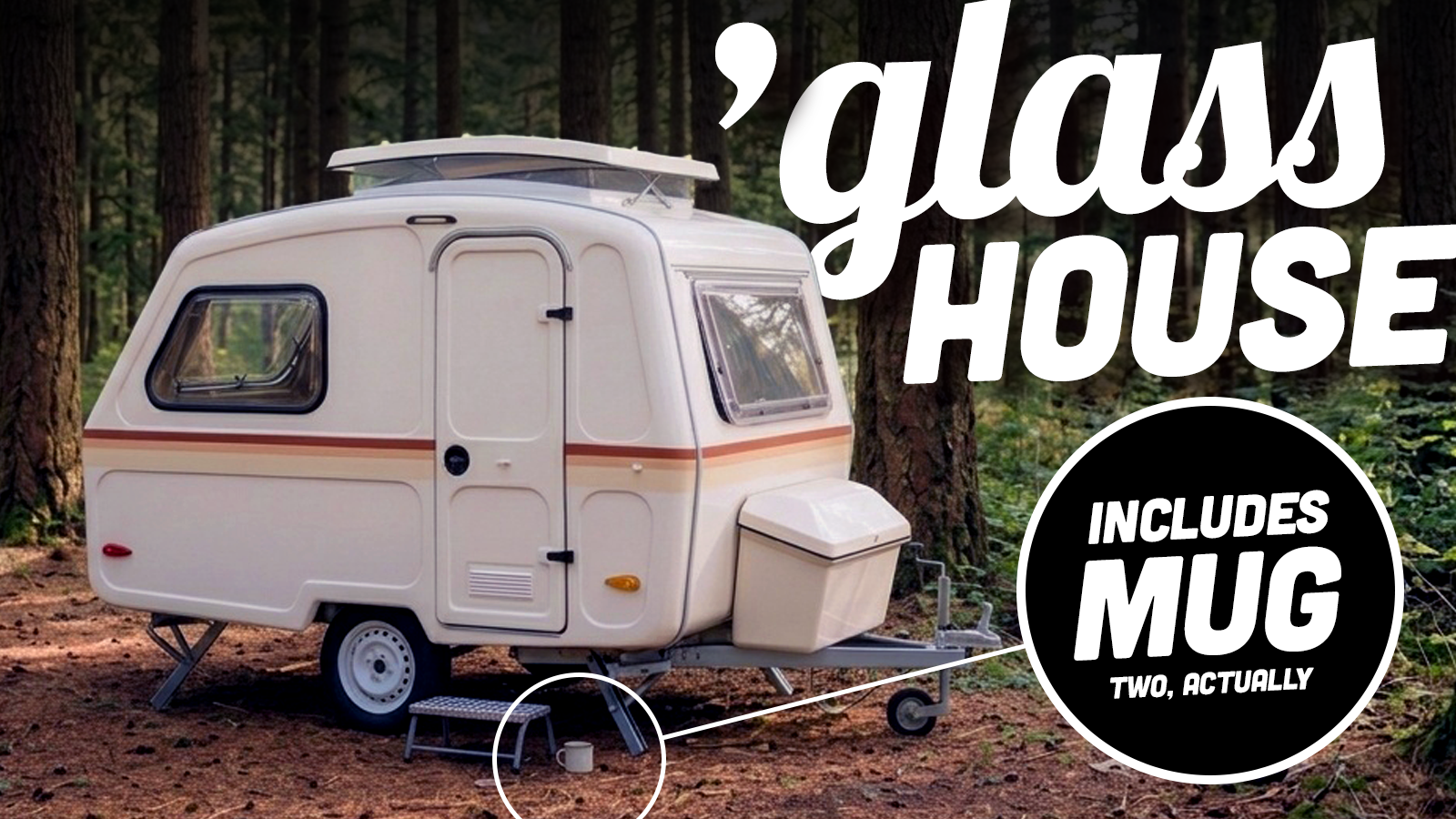
In my experience reporting on RVs for the past six years, the modern RV buyer tends to have at least three great concerns. An increasing number of people don’t want to pay six figures for a camper, don’t want to drive a big truck, and are tired of things breaking all the time. There have been so many companies coming out of the woodwork with lightweight, affordable designs, and I think I found one of the cutest yet. This is the Clasica, a fiberglass camper that’s technically affordable and maybe even light enough to be towed by the regular car you have right now.
It’s no secret that I’m a huge fan of fiberglass as a primary building material for an RV. History has shown that fiberglass has a fantastic ability to withstand the elements, potentially for decades. Fiberglass doesn’t rot like wood or rust like steel. It’s also lightweight and can be molded into exciting shapes. Many fiberglass campers also have far fewer seals and holes than the typical RV. Add fiberglass’s DIY repairability, and you have a great backbone for an enjoyable camper.


Here in America, brands like Scamp, Casita, Oliver, and Escape are the leaders in fiberglass campers, and all of them make trailers that seem to last. What’s so awesome is that, with every passing year, more brands are getting into this space, which means that buyers have even more choice. One of these new faces is Clasica. Like many fiberglass brands, it’s slapping modern building techniques on a classic design. But unlike most fiberglass camper companies, this isn’t another revival of the Canadian Boler.
A Couple Who Discovered The Wonders Of Fiberglass
The Clasica story begins a few years ago in Eugene, Oregon, with wife and husband duo Rachel and Gerson Miranda.
In their garage, the Mirandas started a lifestyle RV restoration company where the pair would take derelict campers and rebuild them to modern specifications. Clasica’s early restorations were old-school stick-built campers, and the Mirandas took note that all of these old campers had suffered from terrible, structurally-compromising rot. Later, the Mirandas found their first Boler, and were blown away by the fact that the Boler was just as old as those stick-built campers, but had no rot to deal with. From Clasica:
Clasica began in our garage in Eugene, Oregon. It started as something we wanted to build together. We didn’t want our days to be spent apart, so we looked for a way to create side by side. His handyman skill, her design instinct, and our shared love for the outdoors became the foundation. We wanted to make something beautiful—something shaped by care and intention—and something that reflected our value of connection: to each other, to the places we travel, and to the people we share those spaces with. That desire became the foundation of Clasica.

Our first years were hands-on. We spent years remodeling and restoring older campers—learning their strengths, uncovering their flaws, and understanding how people actually live in small spaces over time. Those projects taught us more than any blueprint could: how weight changes the experience of towing, how materials age, how design decisions feel after hundreds of miles on the road. Just as importantly, they taught us restraint—what to leave out as much as what to include. This period shaped our eye, our standards, and our respect for the craft.
As our ideas matured, we wanted to go deeper—to test assumptions and explore what a modern interpretation of this kind of travel could be. That led us to work with Oregon State University’s engineering department, where we worked to develop an early prototype. It was a season of refinement: studying proportion, structure, and how form influences feeling. Through that process, something became clear. The shape we were drawn to already had a history. The Clasica shape traces its roots to a beloved European design language from the 1970s—an era when lightweight fiberglass caravans were built to move easily, last a long time, and feel calm on the road. We didn’t want to erase that history. We wanted to honor it. As we searched for the right way to bring this form to life, we realized it required an approach to lightweight fiberglass craftsmanship that no longer exists at scale in the United States. That search led us to a European factory with decades of experience working in this tradition.

At some point in this journey, the couple purchased a vintage Niewiadów N126, a Polish fiberglass camper that has been in continuous production since 1973. The N126, which is built by Niewiadów Precision, used to weigh as little as 617 pounds, and its name is a nod to the car it was designed to be pulled by. Niewiadów wanted its trailer to be pulled by a Polski Fiat 126p. The N126 might also be familiar to our Canadian readers, as some shells were shipped to Canada and finished as Cadet travel trailers.
When exploring the idea to make their own camper, the Mirandas apparently scored the molds used to make the 1970s versions of the N126. Now, the old N126 is technically back in production, but now with an American twist.
An Americanized Polish Camper

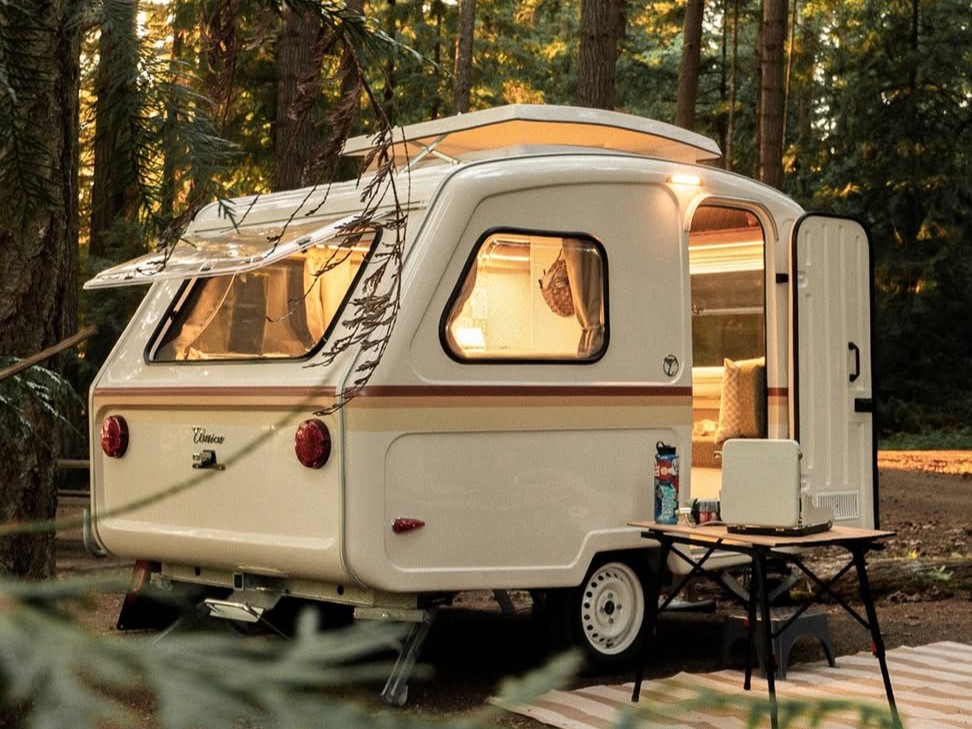
The Clasica trailer starts off with a body that is pretty much a direct copy of the N126. The Mirandas say that the trailer has a one-piece fiberglass design from the floor to the ceiling. There’s no wood at all used in the structural bits, which means that the trailer won’t rot.
Now, your eyes may spot what appears to be a metal seam along the roof of the camper, which would betray the claim that the camper is a single piece. The Mirandas say that those rails are there purely for style and that underneath is uninterrupted fiberglass.

The couple didn’t merely nab a European mold, either, as they have committed to making the camper as Euro as possible. It rides on a German Al-Ko torsion axle, and the frame is galvanized. Even the wheel bearings are a bit different, and the trailer sports swappable sealed bearings that are said to last for 62,000 miles without maintenance.
The Mirandas say that the Clasica isn’t really about glamping. Instead, it’s pretty minimalist like a teardrop camper, but one that you can stand up. Inside, you won’t find a television, a bathroom, or even a built-in stove. Like the campers of old, you either have to bring your own cassette toilet or camp in a place where toilets and showers are provided. The trailer doesn’t even have a motorized jack or motorized stabilizers, so you’ll have to break out the hand cranks and get that old-school camper experience.

The Mirandas say that this was intentional. Not having these features keeps the trailer’s weight and price down, but it also means less equipment to break or to maintain. That said, there are some features onboard. Inside the fiberglass sits a Dometic mini fridge, a Dometic sink, a Goal Zero Yeti 1500 6G power station, a 3-gallon water tank, LED lighting, a solar panel connector, and electrical outlets for household gadgets and USB devices. That’s it. The features list is so short that “two Clasica coffee mugs” is noted as a standard feature. As for the electrical system, it routes through the power station.
Clasica Campers is quick to note that the Clasica does not have a heater or an air-conditioner, and you cannot even order either as options. It’s the same deal with the bathroom and the lack of cooking appliances. In regard to cooking, Clasica Campers says, “There’s no built-in interior cooking by design, keeping the inside clean, minimal, and free from lingering smells, grease, or heat — while making meals part of the outdoor experience.”

Thankfully, a portable propane stove comes with the trailer.
But, if you want heating, cooling, or something to defecate in, you’re on your own there. The Clasica also has a rail for an awning, but no awning is available yet.

The Clasica may be light on features, but it makes up for it on the spec sheet. The trailer weighs “under 1,200 pounds” with a tongue weight of 148 pounds. It’s also only 12 feet long in total with a height of 7’3″ when the pop-top is closed. When the pop-top is open, it offers 6’1″ of standing room. While that’s not as good as a standard travel trailer — or even as good as a Scamp 13 — it’s better than the teardrop campers that Clasica seems to consider as its competitors.
That weight is so low that Clasica notes that you can tow this thing with a variety of small crossovers, Toyota RAV4s, and Subarus. But really, if you have a vehicle that’s capable of towing a U-Haul rental trailer, it can probably tow a Clasica.
Technically Affordable, But The Competition Is Still Cheaper

Clasica Campers says you get all of that for the price of $28,500. That seems like a high price for the near total lack of features, but I think it’s still in the affordable bracket. But there’s another huge catch.
The Clasica’s stiffest competition will probably be from Scamp. If you go to the Scamp configurator right now, you can spec out a Scamp 13 Standard that has more features than the Clasica for $23,040. That’s a trailer that’s a foot longer, has a stove, has solar panels, and still has a lithium battery. A Scamp also sleeps four rather than three. Toss in an air conditioner, furnace, and a propane tank, and you’re still at $24,556. If you don’t want to play with the configurator, Scamp will sell you one of these campers pre-built for $26,500. On the other hand, a Scamp 13 weighs 1,600 pounds once you start adding features like that air conditioner, furnace, and propane.

If all you care about is weight, well, a Scamp 13 Lite weighs only 1,250 pounds and costs $17,295 with close to the same features as a $10,000 more expensive Clasica. So, from a pure dollars-to-features perspective, I think the Clasica could be a tough sell.
To me, the biggest reasons to get a Clasica will be for its European style and low weight. Basically, it’s for the person who might otherwise get a teardrop, but wants to stand in their camper and won’t want a Scamp for some reason. It’s also for the person who more or less uses their camper as not much more than a base station. If that sounds like you, Clasica says that the next batch of units is in production now and the estimated wait time to get one is going to be at least three months. The first 50 trailers get a special numbered plaque.
While I would want a lot more features for the asking price, I do like what Clasica Campers has done here. It’s a ’70s camper brought back and given a little bit of a modern touch. I also like how it’s not just yet another reboot of a Boler. I adore how longevity was one of the core ideas behind this camper, too. So, if you can stomach bringing your own stove and maybe a portable air conditioner, I bet spending a weekend in a Clasica would be pretty fun.
Top graphic image: Clasica


What are the prices of these in Europe?
Seems a decent rig but just like the bare bones Slate you can’t just go by the price of the trailer when you are going to need to buy much more after the purchase for your needs which will also add weight if even just to transport everything to the camp site and home
The Clasica does have one significant advantage over the Scamp in construction. The floor/underbody on the Scamp is plywood, and can really be a weak point. Looks like the Clasica is fiberglass all around. Combined with the more corrosion-resistant frame it should generally outlast a Scamp. Especially in more humid areas.
This is beyond cool. I never thought I will see Niewiadow here. Just so you know, Polski fiat 126 has the whole 23 HP and was pulling this trailer. The price… Not cool.
I love these campers….cool to know they are her in North America, but they are still produced in Poland and over there, there ARE models even with a bathroom!
https://niewiadow.pl/pl/produkty/przyczepy-kempingowe/n126/n126et/
I should import one for the Polish-built 126 I imported in January to here in Nova Scotia! 😀