

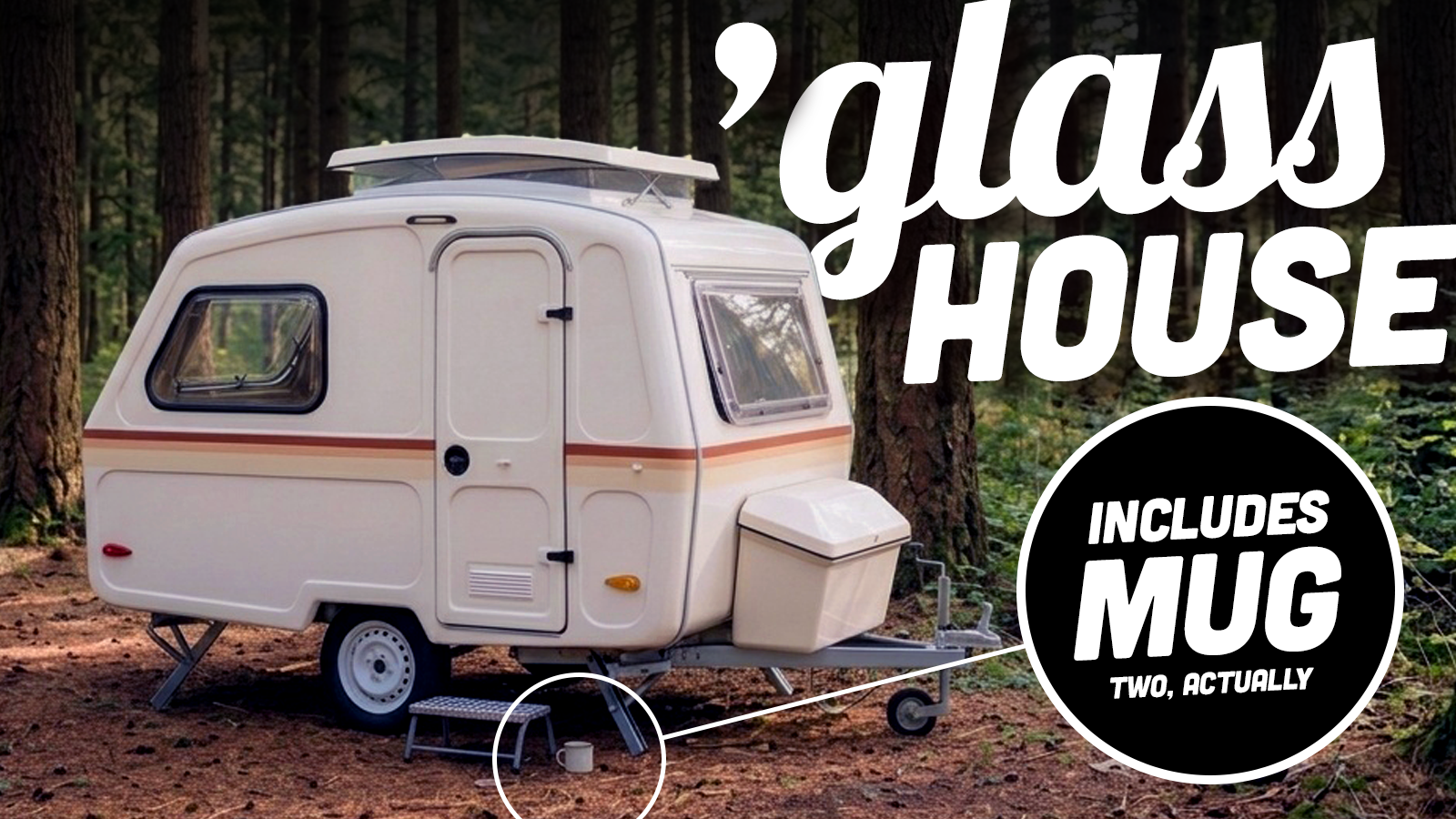
In my experience reporting on RVs for the past six years, the modern RV buyer tends to have at least three great concerns. An increasing number of people don’t want to pay six figures for a camper, don’t want to drive a big truck, and are tired of things breaking all the time. There have been so many companies coming out of the woodwork with lightweight, affordable designs, and I think I found one of the cutest yet. This is the Clasica, a fiberglass camper that’s technically affordable and maybe even light enough to be towed by the regular car you have right now.
It’s no secret that I’m a huge fan of fiberglass as a primary building material for an RV. History has shown that fiberglass has a fantastic ability to withstand the elements, potentially for decades. Fiberglass doesn’t rot like wood or rust like steel. It’s also lightweight and can be molded into exciting shapes. Many fiberglass campers also have far fewer seals and holes than the typical RV. Add fiberglass’s DIY repairability, and you have a great backbone for an enjoyable camper.


Here in America, brands like Scamp, Casita, Oliver, and Escape are the leaders in fiberglass campers, and all of them make trailers that seem to last. What’s so awesome is that, with every passing year, more brands are getting into this space, which means that buyers have even more choice. One of these new faces is Clasica. Like many fiberglass brands, it’s slapping modern building techniques on a classic design. But unlike most fiberglass camper companies, this isn’t another revival of the Canadian Boler.
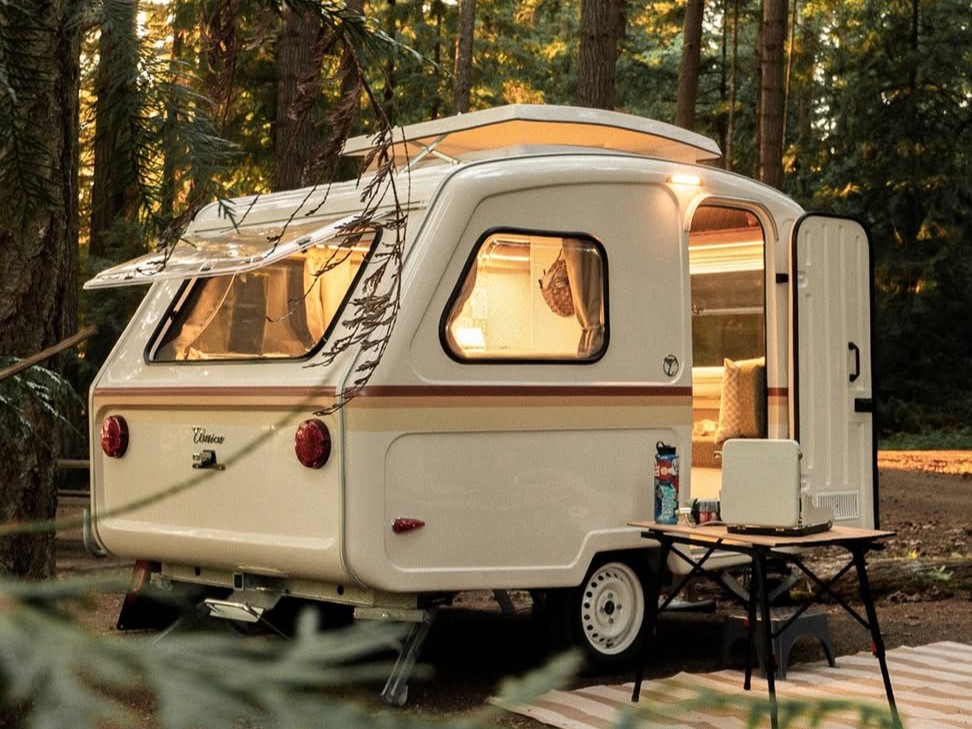
A Couple Who Discovered The Wonders Of Fiberglass
The Clasica story begins a few years ago in Eugene, Oregon, with wife and husband duo Rachel and Gerson Miranda.
In their garage, the Mirandas started a lifestyle RV restoration company where the pair would take derelict campers and rebuild them to modern specifications. Clasica’s early restorations were old-school stick-built campers, and the Mirandas took note that all of these old campers had suffered from terrible, structurally-compromising rot. Later, the Mirandas found their first Boler, and were blown away by the fact that the Boler was just as old as those stick-built campers, but had no rot to deal with. From Clasica:
Clasica began in our garage in Eugene, Oregon. It started as something we wanted to build together. We didn’t want our days to be spent apart, so we looked for a way to create side by side. His handyman skill, her design instinct, and our shared love for the outdoors became the foundation. We wanted to make something beautiful—something shaped by care and intention—and something that reflected our value of connection: to each other, to the places we travel, and to the people we share those spaces with. That desire became the foundation of Clasica.

Our first years were hands-on. We spent years remodeling and restoring older campers—learning their strengths, uncovering their flaws, and understanding how people actually live in small spaces over time. Those projects taught us more than any blueprint could: how weight changes the experience of towing, how materials age, how design decisions feel after hundreds of miles on the road. Just as importantly, they taught us restraint—what to leave out as much as what to include. This period shaped our eye, our standards, and our respect for the craft.
As our ideas matured, we wanted to go deeper—to test assumptions and explore what a modern interpretation of this kind of travel could be. That led us to work with Oregon State University’s engineering department, where we worked to develop an early prototype. It was a season of refinement: studying proportion, structure, and how form influences feeling. Through that process, something became clear. The shape we were drawn to already had a history. The Clasica shape traces its roots to a beloved European design language from the 1970s—an era when lightweight fiberglass caravans were built to move easily, last a long time, and feel calm on the road. We didn’t want to erase that history. We wanted to honor it. As we searched for the right way to bring this form to life, we realized it required an approach to lightweight fiberglass craftsmanship that no longer exists at scale in the United States. That search led us to a European factory with decades of experience working in this tradition.

At some point in this journey, the couple purchased a vintage Niewiadów N126, a Polish fiberglass camper that has been in continuous production since 1973. The N126, which is built by Niewiadów Precision, used to weigh as little as 617 pounds, and its name is a nod to the car it was designed to be pulled by. Niewiadów wanted its trailer to be pulled by a Polski Fiat 126p. The N126 might also be familiar to our Canadian readers, as some shells were shipped to Canada and finished as Cadet travel trailers.
When exploring the idea to make their own camper, the Mirandas apparently scored the molds used to make the 1970s versions of the N126. Now, the old N126 is technically back in production, but now with an American twist.
An Americanized Polish Camper

The Clasica trailer starts off with a body that is pretty much a direct copy of the N126. The Mirandas say that the trailer has a one-piece fiberglass design from the floor to the ceiling. There’s no wood at all used in the structural bits, which means that the trailer won’t rot.
Now, your eyes may spot what appears to be a metal seam along the roof of the camper, which would betray the claim that the camper is a single piece. The Mirandas say that those rails are there purely for style and that underneath is uninterrupted fiberglass.

The couple didn’t merely nab a European mold, either, as they have committed to making the camper as Euro as possible. It rides on a German Al-Ko torsion axle, and the frame is galvanized. Even the wheel bearings are a bit different, and the trailer sports swappable sealed bearings that are said to last for 62,000 miles without maintenance.
The Mirandas say that the Clasica isn’t really about glamping. Instead, it’s pretty minimalist like a teardrop camper, but one that you can stand up. Inside, you won’t find a television, a bathroom, or even a built-in stove. Like the campers of old, you either have to bring your own cassette toilet or camp in a place where toilets and showers are provided. The trailer doesn’t even have a motorized jack or motorized stabilizers, so you’ll have to break out the hand cranks and get that old-school camper experience.

The Mirandas say that this was intentional. Not having these features keeps the trailer’s weight and price down, but it also means less equipment to break or to maintain. That said, there are some features onboard. Inside the fiberglass sits a Dometic mini fridge, a Dometic sink, a Goal Zero Yeti 1500 6G power station, a 3-gallon water tank, LED lighting, a solar panel connector, and electrical outlets for household gadgets and USB devices. That’s it. The features list is so short that “two Clasica coffee mugs” is noted as a standard feature. As for the electrical system, it routes through the power station.
Clasica Campers is quick to note that the Clasica does not have a heater or an air-conditioner, and you cannot even order either as options. It’s the same deal with the bathroom and the lack of cooking appliances. In regard to cooking, Clasica Campers says, “There’s no built-in interior cooking by design, keeping the inside clean, minimal, and free from lingering smells, grease, or heat — while making meals part of the outdoor experience.”

Thankfully, a portable propane stove comes with the trailer.
But, if you want heating, cooling, or something to defecate in, you’re on your own there. The Clasica also has a rail for an awning, but no awning is available yet.

The Clasica may be light on features, but it makes up for it on the spec sheet. The trailer weighs “under 1,200 pounds” with a tongue weight of 148 pounds. It’s also only 12 feet long in total with a height of 7’3″ when the pop-top is closed. When the pop-top is open, it offers 6’1″ of standing room. While that’s not as good as a standard travel trailer — or even as good as a Scamp 13 — it’s better than the teardrop campers that Clasica seems to consider as its competitors.
That weight is so low that Clasica notes that you can tow this thing with a variety of small crossovers, Toyota RAV4s, and Subarus. But really, if you have a vehicle that’s capable of towing a U-Haul rental trailer, it can probably tow a Clasica.
Technically Affordable, But The Competition Is Still Cheaper

Clasica Campers says you get all of that for the price of $28,500. That seems like a high price for the near total lack of features, but I think it’s still in the affordable bracket. But there’s another huge catch.
The Clasica’s stiffest competition will probably be from Scamp. If you go to the Scamp configurator right now, you can spec out a Scamp 13 Standard that has more features than the Clasica for $23,040. That’s a trailer that’s a foot longer, has a stove, has solar panels, and still has a lithium battery. A Scamp also sleeps four rather than three. Toss in an air conditioner, furnace, and a propane tank, and you’re still at $24,556. If you don’t want to play with the configurator, Scamp will sell you one of these campers pre-built for $26,500. On the other hand, a Scamp 13 weighs 1,600 pounds once you start adding features like that air conditioner, furnace, and propane.

If all you care about is weight, well, a Scamp 13 Lite weighs only 1,250 pounds and costs $17,295 with close to the same features as a $10,000 more expensive Clasica. So, from a pure dollars-to-features perspective, I think the Clasica could be a tough sell.
To me, the biggest reasons to get a Clasica will be for its European style and low weight. Basically, it’s for the person who might otherwise get a teardrop, but wants to stand in their camper and won’t want a Scamp for some reason. It’s also for the person who more or less uses their camper as not much more than a base station. If that sounds like you, Clasica says that the next batch of units is in production now and the estimated wait time to get one is going to be at least three months. The first 50 trailers get a special numbered plaque.
While I would want a lot more features for the asking price, I do like what Clasica Campers has done here. It’s a ’70s camper brought back and given a little bit of a modern touch. I also like how it’s not just yet another reboot of a Boler. I adore how longevity was one of the core ideas behind this camper, too. So, if you can stomach bringing your own stove and maybe a portable air conditioner, I bet spending a weekend in a Clasica would be pretty fun.
Top graphic image: Clasica





I think I could go to Poland, find an old N126, ship it back to the States, and refit it for less.
They still sell them new in Poland!
Not only is the feature list too small, but they want Scamp money for a brand new manufacturer where customers have no way of knowing if there will be support or actual warranty coverage.
Or they could get a Scamp from a manufacturer that has been awesome longer than most of us have been alive, and is nicer to boot.
Plus, there’s no giant hole in the roof to support that pop-top and leak.
I know which one I’d buy…
Every time I click on one of these articles, I think “Affordable” cool, lets read about it!
Then BAM, it smacks you right in the face. This fiberglass box with some foam cushions is $28k because it looks Euro.
Here’s what I do before all of these articles. Consider what I think would be a reasonable price for what I’m looking at, and double it. I’ve been surprisingly accurate. This one was dead on, until I read how little it had. It’s even more than double what I think is reasonable.
29 grand. 29 fuh-reakin’ grand, for that? That’s a no for me, dawg.
I like the concept of simple small campers such as this one, however with this price, this will be another entry of rare campers made for a few years and few hundred units. IMHO this shouldn’t cost more than $15k in order to be competitive.
Oh yes, please! I do my own bearings and it’s not that big a deal, but if I never again had to tear apart a greasy hub, clean it off, re-grease everything, reinstall (hoping that I got the preload right and the seal didn’t get damaged), and then keep checking my hubs with an IR thermometer to make sure they’re not overheating from 65 MPH driving (a perfect match with the Nissan CVT, apparently), I’d be totally okay with that.
Oof, just a skosh too tall to fit in many people’s garages.
This is definitely not for me and the rationalization about not having any kitchen inside is silly. One of the nice things about having a trailer is having a warm, dry place to eat and sleep no matter what the weather is like. Having to run to the outdoor kitchen during the massive thunderstorm that hit the last campground I was in (they kicked everyone out because both the campground and the road in were flooding) does not sound like a $30000 good time to me.
On the other hand, you see a surprising number of very expensive teardrops driving around so maybe there’s a market.
Neat. But, a hard sell against an Aliner. I love my little Aliner Ranger 12. Even loaded up it weighs just under a ton. And it tows beautifully. It has the same Dometic fridge, a propane stove, propane furnace and a 5k BTU window air conditioner glued into the wall. I’ve towed it with an AWD RAV4 and an AWD Model Y. The RAV4 notices it a little but the MY doesn’t notice it at all except for the range. I mainly stay at electric sites with bathrooms nearby so the lack of a sh*tcase isn’t an issue. The stove is wonderful on those nights when it’s too nasty to cook outside. Or an induction hob for the summer so the stove doesn’t make the inside an inferno. The one nice thing about this is no setting up a popup.
Yeah, you can get a 15′ Aliner Scout for probably around 17k? And yes, weight is one thing, but the profile of a pop-up always wins when it comes to towing.
The interior of this fiberglass camper is a bit nicer, but yeah, I’d probably go for an Aliner in this price range. They have a pretty good reputation.
My Aliner is one of the heavier versions at about a ton, but has a lot of standup space.
It has water damage to one of the roof panels and other areas from that leak that are wood.
Airstream helps owners doing their own repairs, Aliner does NOT.
They actually can produce replacement panels, but the cost is extravagant and shipping costs are cinematic unless you pick it up yourself.
I think the roof design is the issue with too many holes cut in it for skylights, and low quality sealants used.
My repair will eliminate holes in the roof.
Probably cover with an aluminum panel.
Seals on the folding joints may need better gaskets too.
I have the European variant of this in Sweden. It is called “Fritidsvagnen” (leisure camper) and it is perfect for two persons and a dog. We have heating, very effective, and a solar panel on the roof – both installed at the factory in Poland. The metal seam is for fastening a small or big original tent on the side. The price for the complete set was approximately 15 000 dollars a few years ago.
Tjena Calle! Gammal Teknikens Värld läsare här… Vad drar du den med?
I applaud the effort but it’s a hard sell at 29 grand against the Scamp that’s a known entity or the stouter looking A-liners.
Unsure about the pop the roof in this. A big advantage of a solid shell hardside is not having a hole or hingepoint in the roof.
Sounds good in theory and decently executed but damn, not for that price
I keep looking at the price of utility trailers and fibreglass septic tanks
There was a fibreglass utility trailer, I believe made in California, with an internal tube frame.
Standup height, I’ve seen larger ones used for camping.
Nice design, basic suspension.
This thing is going to look awesome on Insta! There is a disturbingly large market for expensive versions of things that a subset love to buy and ramble on about on social media. The price probably includes building half a dozen to give to the right influencers to start a trend so the rest of the influencers buy them in the hopes of becoming the group that get shit for free.
I wish all these folks the best and look forward to buying one of these in 10 years for next to nothing because the business went under and parts are unobtainable.
I’m loving the 70’s design and the steelies.
But I think it would have been a good idea to put in at least an induction burner to make some soup when it’s raining out.
I could see it for $14k. I get paying extra for a thoughtful design, but this is ridiculous.
Cool design, but aside from aesthetics, what makes this better than the aforementioned Scamp Lite for $10k less? Personally, I don’t want AC on a camper (especially not roof-mounted), but a heater can be nice sometimes.
Well, anything with electric essentially has heat, since you can just plug in a space heater. Doesn’t give you the off the grid flexibility of propane, but works if you stick to campgrounds with utility hookups
I suppose you could always do a/c the same way, portable floor unit with the vent tube out a window, or a window unit with one of those tubular metal stands people use to hook window a/cs up to motorcycle tent campers
If there’s hookups, a space heater works and takes up basically no space when not in use. But I’ve never camped in a spot with hookups.
I’ve also never camped with heat, but if I was dropping $30k I’d want a propane furnace option.
My ac hookup is a Honda EU parked outside
Takes up no space when not in use? I still think you have to have space to store the space heater. Do they make a similar sized heat pump where one unit can do heat, cool, and dehumidifier?
That’s a good point that I hadn’t considered. I used to sleep in the back of my suburban but never used it at a campsite with an electrical hook-up because it was cheaper to just reserve a tent spot if I had to stay in a designated site. I always wanted to add a small diesel heater but ultimately sold the suburban for something more practical.
Compared to the Scamp here you’re paying for the development and startup costs for a company that isn’t in an industry where investment money gets thrown around like candy on Halloween. From a product development perspective I understand why all these campers cost what they do, but they are a tough sell. It’s like buying a new boat.
If they can get some volume moving and finesse that price a little bit, I think it’s got some potential. Certainly a hard sell against a cheaper established brand like scamp, and if you start getting up close to $30k there’s the nicer trailers from Escape to contend with as well.
I was excited until I got to the price. I would much rather have the way cheaper Scamp, thanks.
Yeah I’m not seeing it. Way too much for too little amenities. Also not interested in a euro style axle and bearings, it will just make it more expensive and difficult to get parts as needed.
It says in the article that it doesn’t come with jacks but in the one picture it has the fold up stabilizers installed, and 4 of them no less when 2 is just perfect for a trailer this small and that makes it easier to level out and be stable while makes it easy to make a rocker that isn’t quite level.
That sentence was supposed to note the lack of motorized stabilizers. Hence the following sentence that speaks of breaking out manual cranks. I just added an extra word for clarification.
Ain’t it just a pretty basic torsion axle set up? Is it really that hard to find replacement parts for that? Heck, didn’t Dexter (American company) buy Al-Ko?
Yes they did merge but when I go to the Al-Ko site to find a retailer there are none in north America.
A quick google search comes up with numerous websites that supply Al-Ko parts (which apparently many are directly interchangeable with Dexter and Hayes).
It’s a torsion axle. They aren’t that unique; it’s basically two square tubes with some rubber rods in them, and then some wheel bearings attached to the end. What parts do you envision will be hard to find and won’t have an alternative direct fit part?
For parts, I’d be most worried about any Clasica (and Niewiadów) parts more than anything else. The parts that make it a trailer seem easy to source or at least replace with an alternative. The things that make it a camper on the other hand seem like they’d be a lot harder to come by. Rock kicks up and busts a window? How long do you have to live with duct tape and trash bags before the replacement part is available? Maybe the door gasket can be replaced with something close on McMaster… maybe it’s some dumb design and isn’t stocked in North America…
I agree those other things would definitely be a pain to source but they won’t leave you immobile like a wheel bearing that needs to be shipped.
Why they wouldn’t use something made here like a small car rear axle is beyond me. Cheaper, local, easier access and cheaper shipping. Does anyone use rechargeable batteries that can be charged from friction of the wheels spinning like the or bicycle headlights?
There are more than one type of torsion axles
Oh wow. That brings actual childhood memories.
I think this is a really cool addition to the camper market; I really like its styling. I really like how they didn’t waste complexity, and more importantly, interior space, on cooking and bathroom facilities. However, forgoing heat and AC even as options is a bit of a head-scratcher. Electric-only campsites are pretty common, so a heater or an AC would make this a much more versatile camper.
Also, why’d they make the door look like it came off a porta-potty?
Way too 70s looking, I think it’s that paint strip. Absolutely agree about the one piece molded fiberglass units a few companies make are the way to go. There’s no seam or entry points at the roof, short of someone drilling a hole up there or a meteorite impact.
I’m just struggling with this thing. Sure, it’s lightweight, but $30K just to get a bed and a table? And I’m sure the mattress is basically couch cushions. Three gallons of water for what? Cleaning dishes? They make some pretty nice tents that you can stand up in for not a lot of money these days. Sure, you don’t get a mini-fridge, but a good cooler and some ice does that job. Maybe it keeps the mountain lions out better than a tent, I guess. Sure, this thing isn’t my cup of tea (even if it does come with two mugs), but its competition costs thousands less, even without going the tent route.
Welcome to 2020s America. Everything is expensive, and you get less for your money.
I get that’s the reality we live in, but even by those standards, this thing doesn’t live up to the competition (Scamp).
You can be like me and search the sales. You hope that some other person with too much money and not enough time, buys it, and then sells it.
I’d like to hear about any cheap standup tents that are decent.
Chinese knockoffs worth having get close to a thousand.
Two mugs for what? No way to make coffee in the AM or Cocoa in the PM.
Is that really affordable, to spend so much to get so little? It doesn’t even seem worth 10k.
This is nice, would fit my future 10-15 years from now (health permitting). But, man it would just seem a Scamp is a better buy. I don’t particularly want a full-featured camper ever, and I don’t want to own something that can tow a full-featured camper. This sort of nails the brief. But it’s just a bit too expensive, at a little under 20k and directly competing with Scamp I could make more sense of it. Mid-20s sort of kills it sadly.
And high 20s really kills it
The second I saw this thing I got flashbacks from the thousands of Polish, East German, Czechoslovakian and Hungarian tourists that used to change our automotive landscape come summer, to migrate back at the end of the summer.
Never seen one on a Polski 126, but plenty on Wartburgs. Prrrummm-prum-prum-prummm-pummm 🙂
“This New Affordable Fiberglass Camper Looks Like It Came From 1970 And Can Be Towed By A Regular Car”
What’s a ‘regular car’?
So this camper is made in America to be towed by a ‘car’, but the American car companies stopped making cars with which to tow a camper.
We have a 2024 Chevrolet Trax LS but it is not rated to tow anything at all. Even the Trailblazer is only rated to tow 1000 lbs. Stepping up to the Equinox only gets you 1,500 lbs. if you opt for the AWD version. 800 lbs. if you get FWD. You have to step up to the Blazer or the Traverse to get towing capacity with a GM ‘car’ nowadays.
If you want to tow something, GM is insistent than you step up to the Silverado 9500CountryTrailLTHighBossCustom. Anything less is for communists who want “European-Style” campers.
In the spirit of American economic exceptionalism I too can take out a 30 year loan to pay for the fuel for that monstrosity.
I dunno about the made in America part… to me it looks like an import from Poland. We can buy nearly the identical caravan, only the striping and interior is a bit different. It cost around €13.800 (~$15.785) here in the Netherlands.
The owners of the company hasn’t been totally clear on where the shell comes from or where it’s built. It’s entirely possible that Niewiadów makes the shells and they’re only finished in Oregon. I only figured out it was a Niewiadów because I did some research on the shell. All of Clasica’s marketing materials just say that the shell is “European.”
“Clasica began in our garage in Eugene, Oregon. It started as something we wanted to build together. We didn’t want our days to be spent apart, so we looked for a way to create side by side. His handyman skill, her design instinct, and our shared love for the outdoors became the foundation. We wanted to make something beautiful—something shaped by care and intention—and something that reflected our value of connection: to each other, to the places we travel, and to the people we share those spaces with. That desire became the foundation of Clasica.”
“When exploring the idea to make their own camper, the Mirandas apparently scored the molds used to make the 1970s versions of the N126. Now, the old N126 is technically back in production, but now with an American twist.“
If I compare the exterior photo’s of the 2026 Clasica and the 2026 Niewiadow N126 I don’t see any difference, except for the striping. It also hasn’t changed much in all these years, but fact is that they are still being made in Europe. It could be that there are more copies of the molds, but given the many european parts and that the interior finish looks equal to the Niewiadow version my guess is that they are imported. I could be wrong of course.
If they’re importing the shells, I’m guessing import tariffs did a number on consumer cost.
So if it weighs less than that, no problem, right? That Fiat 126 pictured above has about 70 hp and likely never had a tow rating assigned at birth. It does just fine.
Maybe once the warranty is up… But then again we got a lifetime powertrain warranty on our little wet-timing-belt 1.2L turbo 3-cylinder so we probably won’t be towing with our Trax.
I have a regular-cab, 5-speed GMC Canyon for the times I need to tow our little utility trailer, and a 2003 GMC Envoy SLT for the times I would have to tow a larger trailer.
That’s kind of a shame. Both our Outback and our Odyssey are/were rated up to 3500# (not that I think I’d dare get close to that with either of them) and it was awfully handy for borrowing a trailer to help somebody move or take a load of yard debris to the compost place.
The Outback is still rated for 2700-3500 depending on powertrain. I think all of the available vans are still rated for 3500 or so? I know the Pacifica is.
Use your best judgment, I pulled a 600 lb hard sided popup with a Hyundai that had a 0 lb tow rating for the US market, but a 1650 lb rating for the same model overseas. Serviced the transmission more frequently than recommended, and put over 120,000 miles on it with absolutely zero issues beyond an occasional infotainment glitch and needing shocks and struts around 100k, neither of which was really towing related. It was even still on its original brakes at trade in, which outlasted two sets of tires
I showed up to a quarry to get a load of gravel with my Outback and a 4×10 utility trailer. The guy working the front-end loader was like, “You sure you want a full yard? It’s more than you can probably tow.”
“Yes, I’m only going a very short distance.”
He responds, “It’s always some dude in a Subaru…”
Getting out of the quarry required all the hamsters going full bore. But I made it out. They also let me buy full yards but take half at a time for the remaining two yards I needed.
~126,000 miles on it now and the CVT seems fine.
The Gen-2 Trax has the same powertrain (1.2L, 6AT) as some of the Trailblazers and Encores GX. which have a 1000 lb. tow rating. I considered adding a receiver hitch (which is available) for a bike hauler or a cargo tray, but I was afraid if anything went wrong with the powertrain they would deny my lifetime warranty claim, claiming I must have used it for towing if I installed a receiver hitch.