

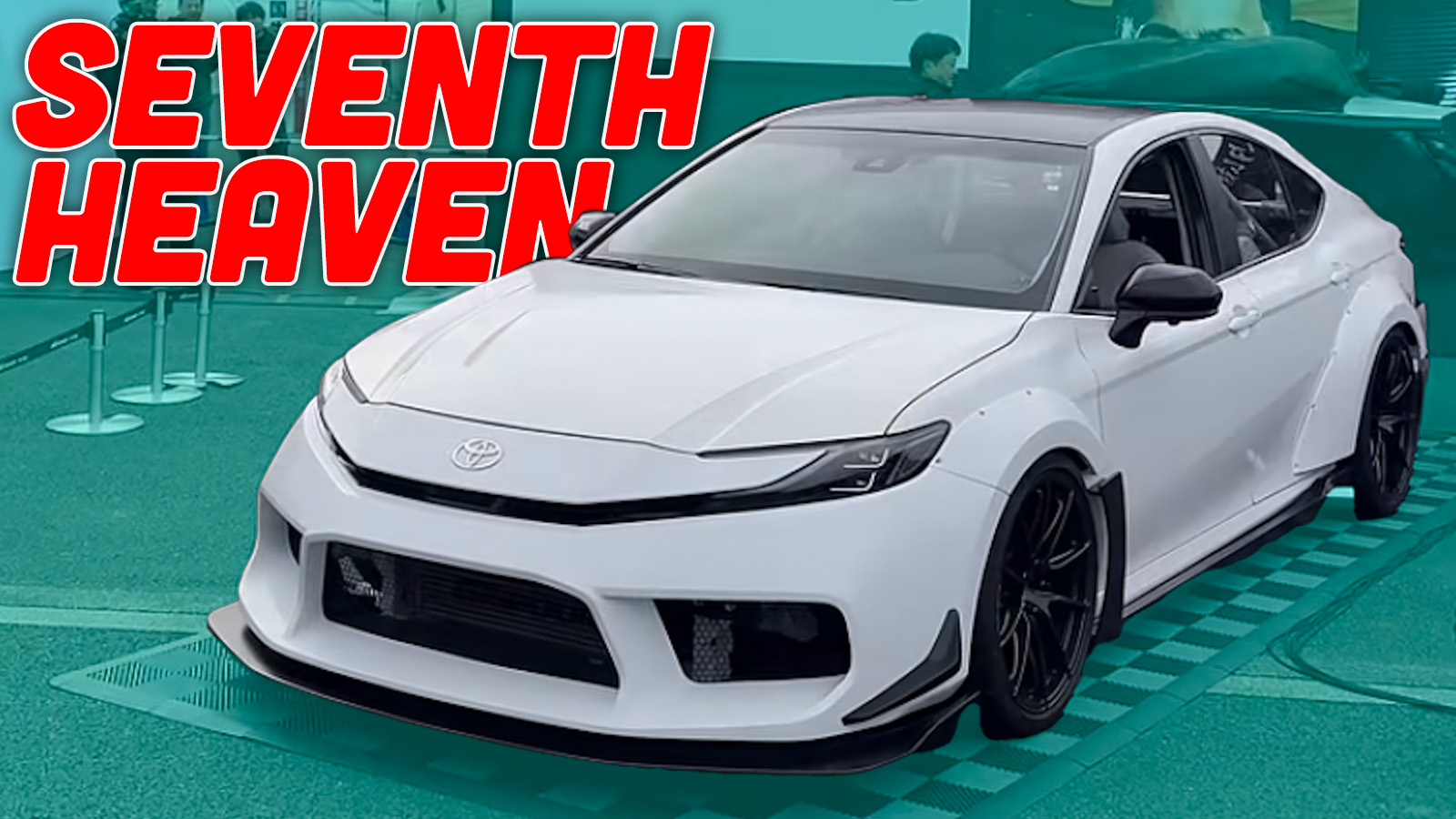
It’s been two years since we lost the option of V6 power in the Toyota Camry, and the midsize sedan world is worse-off for it. Sure, it wasn’t the most efficient engine option, but it was smooth and powerful and weirdly nostalgic. These days, you can’t get a V6 in any regular retail-brand midsize sedan, but someone at Toyota clearly has a yearning for more than mere inline-four power. The marque’s just churned out a one-off Camry with seven cylinders. Yep, seven.
In this world, there are engine configurations that make sense. A straight-six has perfect primary and secondary balance, giving it the inherent smoothness of hot butter on toast. On a similar note, a cross-plane 90-degree V8 has evenly-spaced crank journals that add up to 360 degrees and a combustion event for every 90 degrees of crankshaft rotation, but primary balance is sorted out using crankshaft counterweights. Fortunately, these crankshafts are generally short enough to be fine at moderate-to-high rotational speeds, so they don’t go all wobbly when tasked with passenger car duty.


However, a seven-cylinder engine has its pitfalls. For one, the uneven firing order means you’re going to get some fore-aft rocking. Likewise, if you want to have evenly-spaced crank throws, dividing 360 degrees of rotation by seven results in a figure of 51.42857143. Not the easiest interval to make crank journals at. Oh, and then you get the sheer length of the thing. Because the crankshaft is usually rather long and you have these imbalances going on, seven-cylinder engines don’t like to rev very high at all. That’s why they’re generally used in things like diesel submarines and farming equipment.

It turns out Toyota avoided this problem by not using a seven-cylinder engine. Instead, a YouTube video shows that the Camry Gazoo Racing concept gets the 300-horsepower 1.6-liter turbocharged inline-three from a GR Corolla up front and a two-liter turbocharged four-cylinder engine where you’d expect to find rear seats. Officially called the G20, this four-banger’s expected to produce around 400 horsepower. Add it all up and you get nearly-Hellcat horsepower and all-wheel-drive in a Camry with seven cylinders and two transmissions. Is it less mad than an inline-seven? Slightly, but any car with two engines is properly out there.
So why do this? It’s Toyota’s way of announcing that the Camry is back on sale in Japan. While the midsize sedan remains popular in America, Toyota pulled the plug on it in Japan three years ago because—as Car And Driver reported—local sales in 2022 totalled roughly 6,000 units. That’s it. As such, Toyota still makes Camry sedans in Aichi, just not for domestic sale. For a couple of years, the Camry appeared to have reached the end of the road in Japan, until a trade war happened. With the current U.S. administration kvetching about American-made cars not being sold in Japan, Toyota decided upon two notable reverse-imports. The first is the full-size Tundra pickup truck. Try parking that in Tokyo. The second is the Camry, built in Kentucky for Japan. On the surface, it mostly seems like a savvy trade play, but that hasn’t stopped Toyota from doing two cool things with it.
That’s right, there’s a second Camry concept and it’s possibly even wilder than the twin-engined car. Instead of drawing from contemporary tuner culture, Daihatsu and Toyota Racing took a page from the past and went full kaido racer. In a way, finding modified Camry inspiration in ’70s family cars dressed up as exaggerated super silhouette racers is rather respectful.

However, this midsizer doesn’t just stop at a cartoonish sharknose, a splitter the size of a dining room table, and pipes that point to the sky. It also gets the engine from a GR Yaris and, as this YouTube video from nenkatsu shows, a gear knob that’s full of what looks like whiskey. No comment.

Needless to say, we aren’t going to see production Camrys like this anytime soon, but it’s nice to know that Toyota can still go completely, utterly “Here’s Johnny!” bonkers. If a smidgen of this insanity makes it to the long-rumored Celica and MR2, they’d be very entertaining indeed.
Top graphic image: YouTube/Nikolai Aksenov


Both the Camry V6 and the then competing Accord V6 have more power than the front wheels know what to do with.
I hope this makes an appearance in Forza Horizon 6. Hell, I wish I could just modify a regular Camry in FH6 to look like this. It’s a fantastic game, but the lack of custom modification parts for cars is the biggest drawback
It’s more surprising to me that the famously conservative Toyota management authorized building a kaido racer (-esque) show car. I don’t know if that’s an indication that things have drastically changed within, or kaido racers have begun to enter the mainstream.
You do not need uneven firing order on a seven cilinder. And even the front aft rocking need not be a problem. This was all solved some time ago in this engine:
https://en.wikipedia.org/wiki/Gnome_Lambda
Now I want to see this thing in a car!
I see your
radialrotary engine and raise you the nine cylinder Napier DelticHow about an opposed-piston Fairbanks-Morse engine? Modern pickups have about enough hood height to accommodate a baby one! Make use of all that airspace.
Kinda surprised VW in thier fever-dream era never came up with a VR7 and matching W14. Because why not?
Cool!
But the Commer_TS3 actually made it into a truck.
The sideways version of the same general idea. Also a very cool engine with that crazy rocker arm/single crank connection setup. The Deltic is kind of in a class by itself though with three crankshafts and that crazy geartrain connecting them. Definitely not suitable for a small vehicle, but they worked pretty good in locomotives and ships for the day.
The Fairbanks Morse engines are still produced for shipboard and stationary power use. The US Navy loves them.
Wait, Toyota is coming out with a 2.0Liter turbo 4 banger that makes 396 HP? What??
That has been anounced for quite some time now. If I am not mistaken it was tested in the back of a Yaris GR (potentially previewing the new MR2). I am guessing it will be available in “other” states of tune, though.
For some reason this made me think of this:
“Marty. You’re not thinking fourth dimensionally!”
I have alcohol fever dreams that tell me you can get any number of cylinders to fire off evenly as long as you design the properly shaped engine block. I originally got this idea when designing computer chips for increased processing speed and then realized it would work with other things like cylinders in a motor.
Off course it is! Seven is not even that weird.
https://en.wikipedia.org/wiki/Gnome_Lambda
I suppose the odd number of cylinders in the front are somewhat mitigated by the even number in the rear, but I still think it’s wrong – odd number cylinders=bad.
Actually, I’m more interested in how they matched up the power to the front and rear to make it driveable.
Per my previous post I think 8 cylinders would be more efficient if the block was octagonal shaped with a cylinder coming out of each edge. Figure the firing controlled by a spinning ball instead of a marching order.
I’ve owned cars with an I-3 (Chevy via Suzuki) and and I-5 (Mercedes OM617).
There’s nothing inherently wrong with either.
Eh, it’s more of a religious objection than an objective one. I owned a 3 cylinder Geo Metro. No more odd number cylinders.
The two transmissions are synchronised via tarmac.
As long as you aren’t spinning one of the wheels.
So kind of like a freewheel situation where if one is getting less power it can be pushed or pulled along by the other? Does this run the risk of over revving one of the engines?
With a bit of clever calibration they could have both engines pretty much matched all of the time, except during full power acceleration/Vmax.
Assuming auto gearboxes then over-reving is a software issue.
With manual gearboxes, well, unless they have the same ratios it’s going to get really busy in the driver’s seat.
Thanks! I guess I wasn’t thinking about automatic transmissions and computer control. Sometimes I’m stuck 30 years ago.
They act like two dogs pulling a sled, if one stops pulling it just gets pulled along by the other, so assuming they have different transmissions with different ratios/shift points, they can act separately without much trouble because while one shifts, the other is still accelerating. Even with manuals, if they had sufficiently different ratios or redlines, you’d be able to shift one at its redline while the other continues to accelerate, then shift the other at its redline, and it’d be fine.
The issue with synchronization happens when the engines both feed one transmission (Like the Hot Wheels Twin Mill) or when one engine is mated to two different transmissions (like the Ferrari FF).
VW made a VR5 and a VR6. I’m sure they could have made a VR7 if they really wanted to.
This is exactly where I was expecting this to head. Staid Toyota doing a twin engined monster versus some arcane engineer masterpiece?
Cmon Toyota. Bring back Japanese bubble economy madness in cars again.
There was more than a hint of 70’s Citroen quirk in 80’s Toyotas – but with reliability.
We need a new Previa with AWD mid engine hybrid for starters.
And they didn’t just install two of the GR three cylinders for what reason???
Looks like for another 100hp
And to make me dream of one day buying a mk4 MR2 2.0 turbo.
You and me both!
I’ve had at least one of each MR2, I’d really like to have a non-Porsche option for my next mid-engined car.
Unless you are stuck on a mid-engine option (like me), your best alternative is probably a new Z or Supra.
But if you can keep the Porsche maintained, I’d highly recommend a Cayman – it is a far better car than any MR-2.
I’m currently on my second small modern Lotus, and when I can’t get in and out of that anymore a Cayman is the default solution. They just feel a bit normal unless you drive faster than I’m allowed to.
Now, take it to Pikes Peak and bring Tajima to race it.
Usually when something has 7 cylinders, it flies in a more literal sense than this thing probably does. And it’s a radial engine. Or maybe a rotary piston engine if if it’s really old.
That said, I do often enjoy Toyota’s unhinged Camry concepts, and this sure is that!
You need think radially. They are always odd numbers of cylinders for *scientific reasons*.
For the curious: most are 4-stroke, so every other piston fires: 1-3-5-7-2-4-6. An even number would end up skipping half the cylinders (even number radial engines are multi-row, eg, a 14 cylinder is 2 rows of 7). A 2-stroke radial could have an even number and the Monaco Trossi did this with a weird 16-cylinder in an 8-cylinder layout with the rear row in synch and sharing a combustion chamber. I’m sure there are others, but I don’t know of any other 2-stroke radials.
My pistons fire at 8-6-7-5-3-0-9, Jenny I got your number…
I’m never sure whether to count common crankpin V-twins as ‘radial’; or those weird “twingle” engines where one piston is a pre-compressor for the other, but they do have a common connecting rod.
Frankly I think transmissions are where the radial set up would work best.
I was hoping radial engine here
I thought they were going to count the brake master cylinder.
A GR Camry wagon would be the ultimate dad-mobile. Dear Toyota, you should make one.
With three wipers on the back.
One million percent!