


Unless it’s exclusively a weekend toy, one of the big concerns with any car purchase is usability. Buying something on a whim is cool until you consider whether it will fit in the compact space at work, or whether U-turns will be almost entirely replaced by three-point turns. But what if you didn’t have to break out the tape measure? I’ve stumbled upon a car footprint visualizer tool called Car Chomper, and it’s a pretty fun thing to play around with.
The maker of Car Chomper pulled specifications for a lot of cars. More than 70,000 of them, to give you a sense of scale. From there, figures are used to compare things like power and economy, but the coolest function involves using the general dimensions to create box forms that allow you to visualize rough vehicle footprint, height, width, turning radius, and even how well specific cars fit in commonly-sized parking spots and garages. Think of it almost like a spiritual sibling to CarSized, only with lower resolution and a whole lot more data.


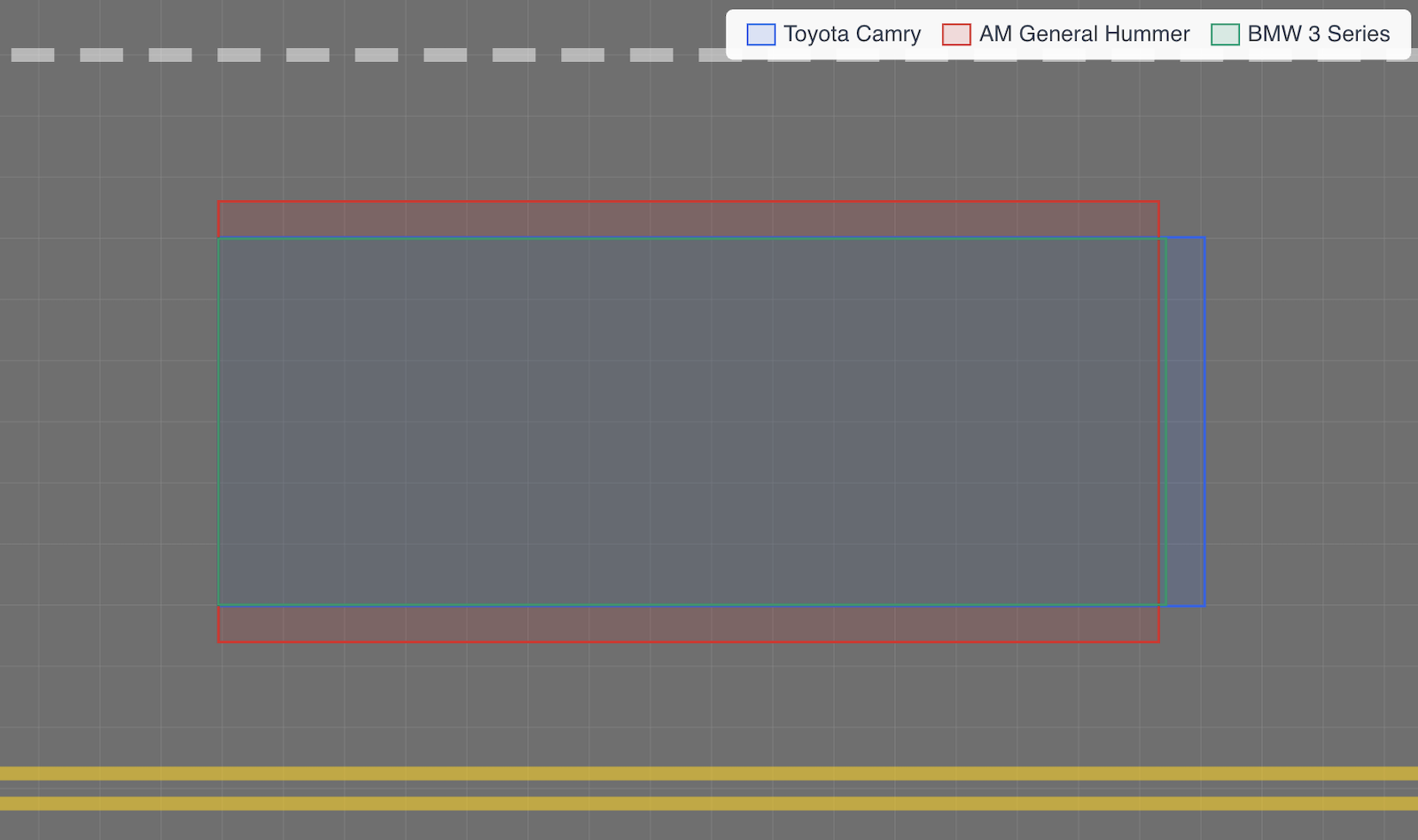
You know how a Hummer is the yardstick for massiveness? Well, if we’re talking the old-school AM General wagon, maybe not anymore. While the civilian Humvee is certifiably wide, it’s not massively long. In this visualization, the red box is the Hummer, the blue box is a 2024 Toyota Camry, and the green box is a 2024 BMW 330i. Wild, right?
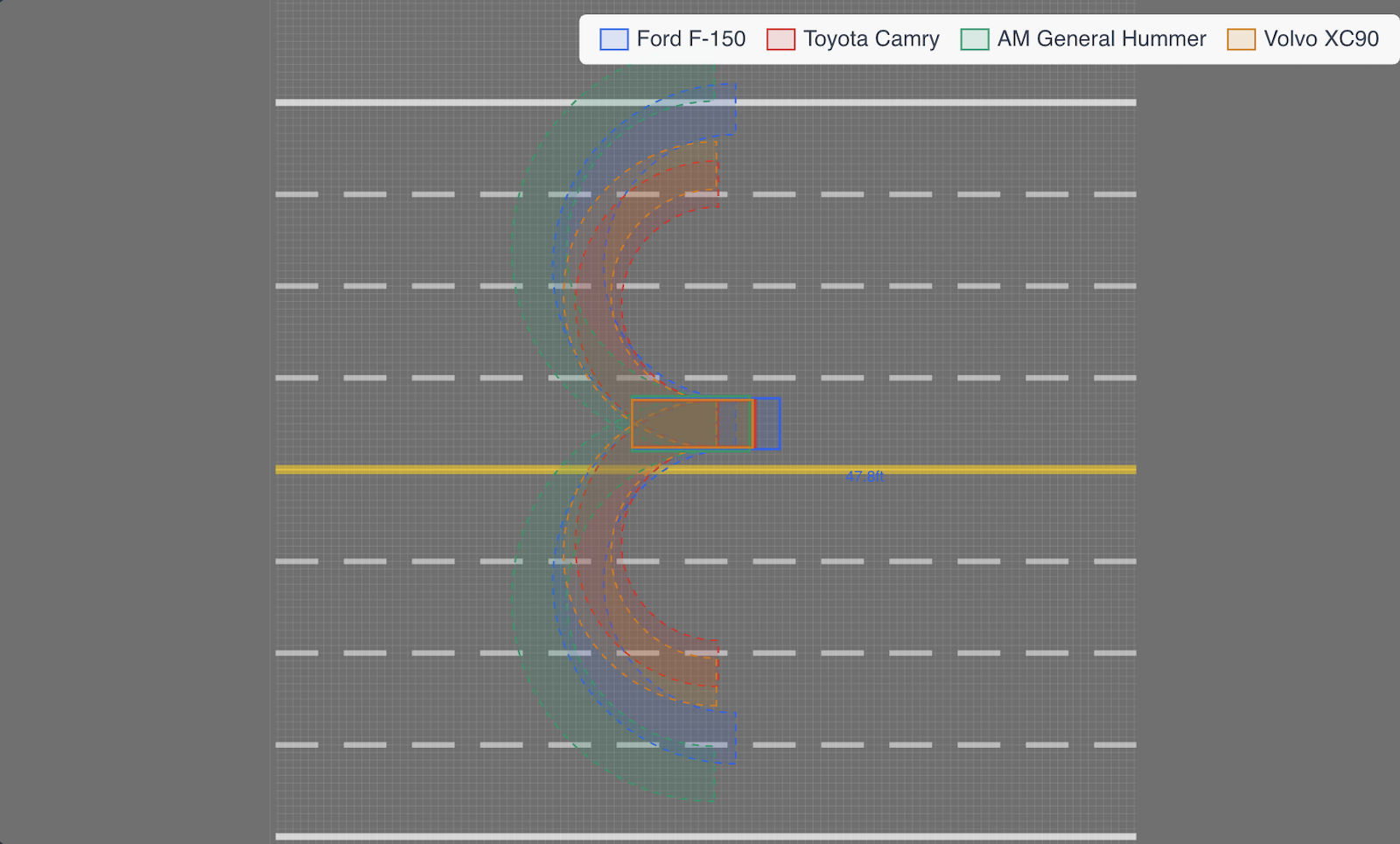
Actually, a more appropriate joke is saying a car has the turning radius of a Hummer, because the amount of space needed to pull a U-turn in one of those demilitarized troop carriers truly is appalling. Officially, the Hummer has a turning radius of 53 feet, and if we line that up against an F-150 King Ranch, the famously wide turning radius of an original Volvo XC90, and the turning radius of a current Camry, we can see that the Hummer is just on a different level.
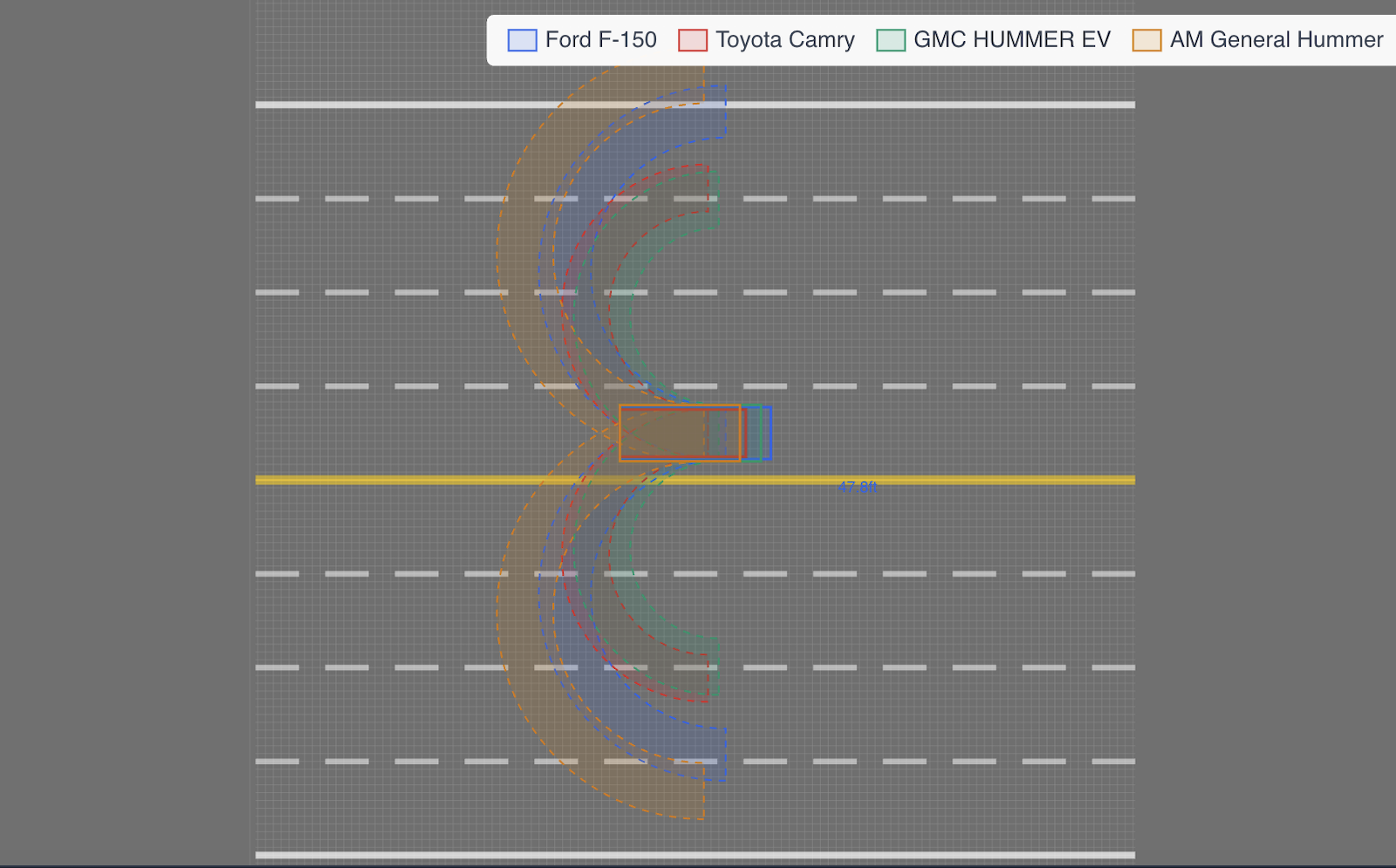
Conversely, the GMC Hummer EV 3X actually has a pretty good turning radius of 37.1 feet, thanks to the presence of four-wheel steering and the clearance to really swing those rear wheels. As a result, it needs less space to pull a U-turn than a new Toyota Camry, as the tool shows below. How’s that for modern technology at work?
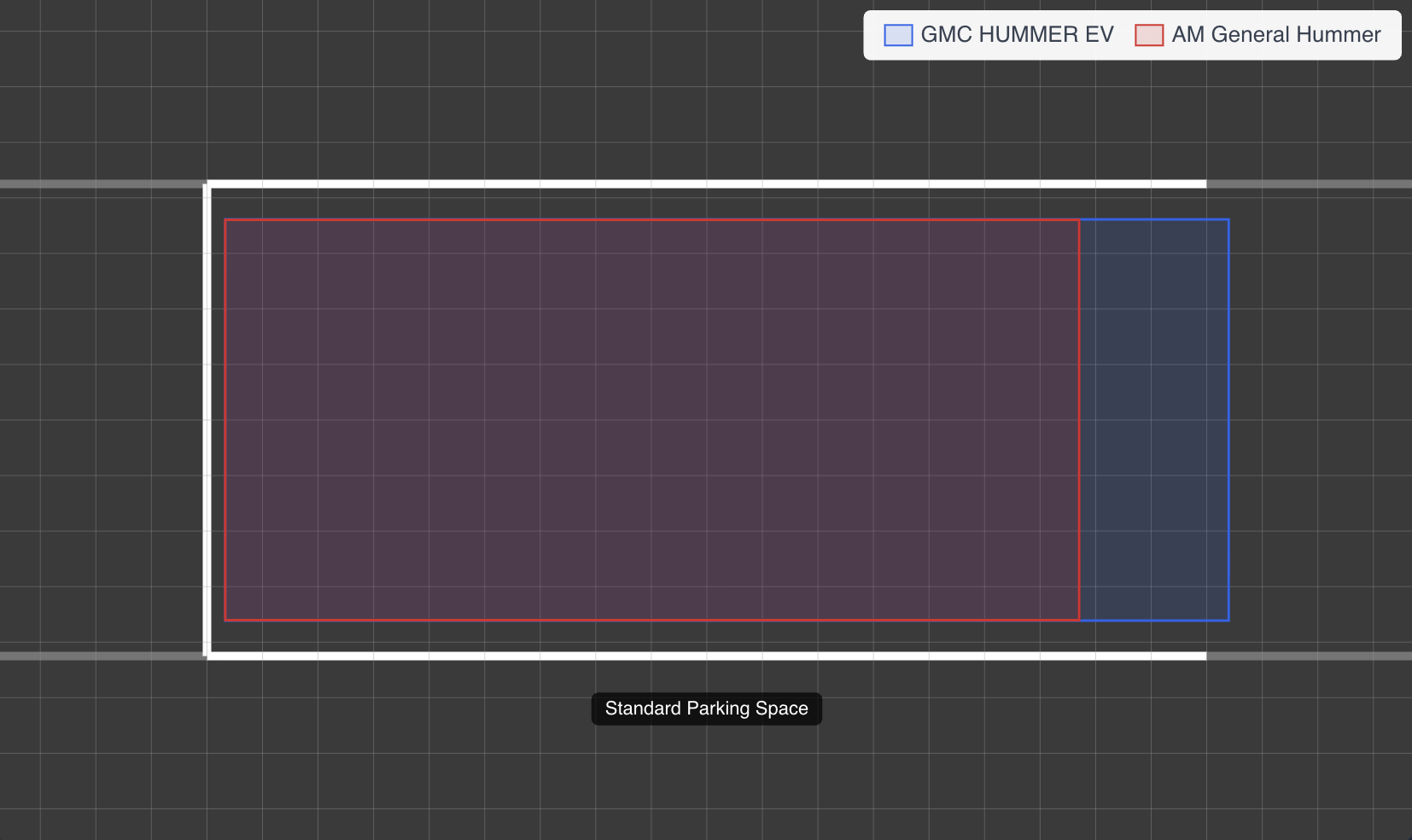
Of course, thanks to a length disparity of 32.3 inches, an AM General Hummer won’t stick out of a 216-inch by 102-inch parking space into the aisle, whereas the GMC Hummer EV will. Remember, even though the original Hummer has horrific space inefficiency and the width of a mobile home, it’s not all that long by modern standards.
Before you go playing around with Car Chomper, be warned that not every graphical depiction in the tool will be accurate. Here, I’ve stacked up a 1992 Porsche 911 of the 964 generation, a 2000 Porsche 911 of the 996 generation, a 2015 Porsche 911 of the 991 generation, and a 2024 Porsche 911 of the 992 generation. Despite the red-outlined 996 standing six-tenths of an inch lower to the ground than the 964, graphics depict it as the tallest of the grouping. I reckon that’s because it’s the only one shown with ground clearance, so remember to double-check before you take a screenshot and hit send to your buddies.
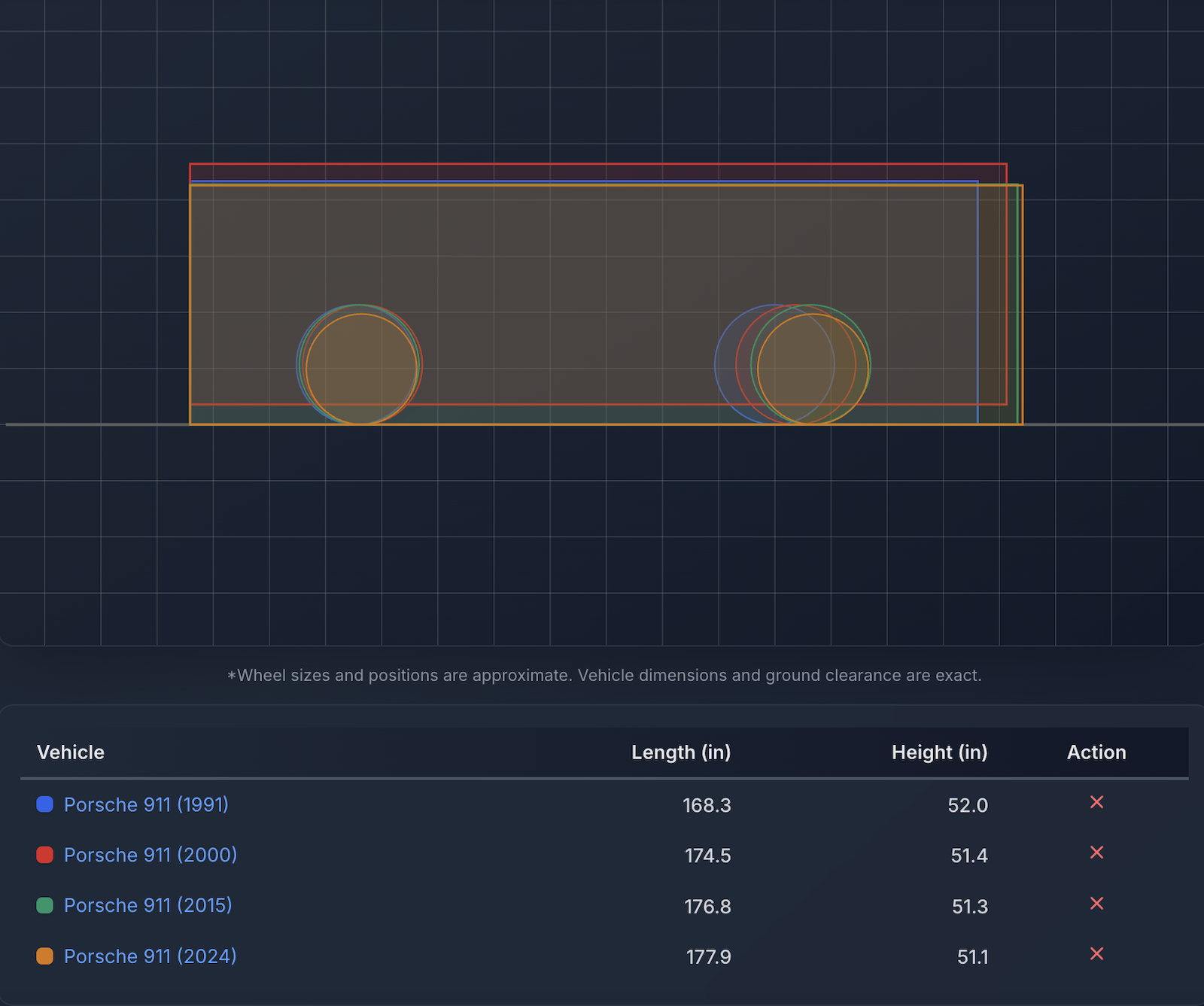
Still, the fact that a tool like this is out there is encouraging, because it has an air of the old internet. It’s hard not to get the sense that someone decided to build it because it was cool, not because it was a place to pack with ad and juice income. In any case … it’s Tuesday afternoon, your boss probably isn’t looking super closely, go nuts.
Top graphic images: GM; Fiat; Toyota; depositphotos.com
Support our mission of championing car culture by becoming an Official Autopian Member.





Most cars and trucks have a steering angle between 36° and 45°. The HMMWV meanwhile has a steering angle of 30°, with some variations having up to 32° and some being as bad as 29°. This is because the HMMWV has the bizarrely wide tires hocked onto a suspension that has to have a high amount of travel but needs to fit below a very low body. The Dodge M37 has a better turning circle at 24′ versus the HMMWV’s 25′ and it’s longer, wider, and has solid axles on both ends.
Any turning radius comparison needs to include a ’92 F350 longbed dually. It takes at least three lanes to make a U-turn. Parking lots are a challenge. Even without the slide-in camper I park way out and find a spot where I can take up four parking spots.
This is purely anecdotal, but it seems Ford’s always have a terrible turning radius relative to similar vehicles. My ’14 F150 had noticeably worse turning radius than my current Silverado. My MIL used to have a S197 Mustang and the turning radius was embarrassingly bad.
The Focus RS definitely keeps with this tradition. It’s astonishingly bad for a little hatchback.
We need answers!
In Ford’s defense, there’s an actual explanation for their FWD cars. Their performance cars have a modified McPherson that shrinks scrub radius and camber change during turns. But it eats up space that’s already at a premium on an economy car with bigger wheels and tires.
The F-150’s is terrible because it’s a truck. Wheelbase is wheelbase, unless you go crazy with rear wheel steering. Independent front suspension and big wheels don’t help.
No idea what the excuse is for the S197 though.
And then you have drift cars. But since they modified, they don’t really count.
Perfect for those moments when your co-pilot says “Just pull a U-ey!”
The grey background of the graphics do them such a serious disservice as far making their point goes. Good grief! Go vivid, saturated on the colors and do it over white so we can see it!
And for WIW, both my ’01 Jetta and my ’17 Accord have a turning diameter of around 38′ or 11.6 meters. The Accord is longer, so I guess its wheels turn a little more. Unfortunately, it’s also wider which causes its own problems.
I used to land Cessnas on runways a lot narrower than that.
“Hummer: It’s Smaller Than You Think” seems like an appropriate marketing slogan.
Lol!
Wow. The aforementioned Hummer is pretty much the same length as my ’02 Mustang.
Once you add the stock F-150 to the comparisons, it definitely seems to bear out something I’ve thought for awhile – that in the last two decades, we were seeing a replay of the 70s, just in height instead of length, but now, we’ve added length back into the mix.
I took a look at my 03 Yukon XL vs the 2025, and the boxes are almost identical. In real life the belt line and hood are both 6-8 inches taller than my 03, so you can add shrinking windows to the discussion.
Two spring to mind, the FX4, hooray my one is almost done, (it has been almost done for ten years) amd yhe Triumph Herald. both have the same sort of turning circle as a hopped up Jack Russell but otherwise they are ordinary old things. The taxi has wierd reasons for this, and it is a taxi. The Herald? no reason at all, it is a very standard sort of car.
Heralds, and the Spitfire that is based on them, have a very tight turning circle simply because they have a VERY narrow chassis relative to their width, which allows tons of room for the wheels to turn.
I wonder if it has data on a standard Fiat 500 versus an Abarth? The regular 500 has the tight turning radius you would expect from a small city car, but the Abarth has different steering rack and a surprisingly large turning radius
You’re supposed to use weight transfer & occasional e-brake to reduce the Abarth turning radius. Had ~40k miles testing all methods.
It’s not like you are turning the wheel to full lock for anything other than slowly navigating a parking lot.
Just chiming in because I’ve been meaning to mention that the ’89 Volvo 240 wagon I bought earlier in the summer has one of the most shockingly tight turning radiuses (radii?) of any car I’ve owned/driven lately, with the possible exception of my NA Miata.
According to DuckDuckGo’s AI, the 240 wagon’s turning radius is 9.8 meters, which is about 30 feet I guess. I honestly don’t know if the four and six cylinder versions of the car have different numbers (I’d assume the six has a larger turning radius) but in any case, I can turn so sharply and pull right into my driveway in the 240, instead of making a 3-5 point turn as has been necessary with other cars I’ve parked there in the past, including my Volvo XC90 which I never thought of as having a famously wide circle, but what do I know?
Anyway, if you ever get to pilot a 240, give it a try. It’s really quite shocking how tightly the car can turn.
Once, years ago, I was test-driving an ’86 740 GLE wagon. Driving down the Pacific Coast Highway, I took a look at the instrument cluster and asked the seller, “Does the gas gauge work?” He said, “I think so,” and I realized that we needed to turn around or we were going to run out of gas, so I pulled into the parking lot at Swami’s in Encinitas, which has an insanely tight turnaround at the end. Here I am in this big wagon, so I crank the wheel—and almost drive into the bushes because the turning radius was so much tighter than I was expecting. That thing just pivoted.
I didn’t buy it, and I never have owned a RWD Volvo, but I’ve promised my spouse that they one day have to drive one, because it must be experienced to be believed. Also the incredible outward visibility.
Yes, the over-the-shoulder rearward visibility on the 240 wagon (aka 245) is pretty amazing too. I always wonder a bit how they could make the pillars (that hold up the roof) so slender and still famously drop the car upside down in tests/commercials. I assume it’s due to the use of high strength steel and some diligent engineering, but I dunno… I’d still rather not have a building land on top of my wagon the next time Godzilla comes to town.
There is no difference between four and six cylinder 240s, but the turbos have a slightly worse turning circle because of the wider tires limiting steering lock a bit. But it’s only a foot or so difference.
Thanks for this Kevin. I sort of assumed the block for the six was enough biggerer than the four, and thus less room left for tight steering angles. I don’t want a six, but was just curious. 🙂
Happy to help! Good thing you don’t want a 6-cyl 240 – those are the rarest of the rare at this point. Both the 2.7l PRV V6 and the VW I6 diesel were not exactly renowned for longevity (compared to Volvo’s own engines not much is). Both tended to die rather young.
The interesting thing about the 240 is that Volvo actually designed it around a v8 that they were developing, than the early 70’s fuel crisis killed off. So the engine bay was designed around that, and is relatively large. So slotting in the v6 was a cakewalk – and also sundry American V8s by various folks!
As I’m sure I mentioned elsewhere, my 240 came with a wonky cam installed, so to some, it sounds like it’s got an LS V8 or something installed. I don’t drive all that much, yet despite this and the short time I’ve owned it, I’ve been asked about it three times. They always seem disappointed when I say it’s just the stock 2.3 liter 4 cylinder motor w/a cam and new stainless exhaust, so maybe I just ought to lie? To make guys happy? Probably not I guess.
Also, I know we’ve discussed this elsewhere too, but the joys of having a less-than-perfect car are myriad. It drizzled last night (super rare for LA in the summer) and because the silver paint on my wagon is so old, I happily put the wet dog beds on it this morning to dry. Try that with a new car’s pristine clear coat! 😉
LOL – for sure I love my “shabby chic” ancient Land Rover Disco – it very much has a “don’t mess with me, you will lose” look about it.
Volvo singlehandedly went from the best turning radius ever on the FR I4 cars to the single worst in any regular car with the transverse I5 cars. It was a rude awakening the day my dad gave up his 740 for a V70.
My dad’s S60R was about on par with our farm truck, an F-350 king cab long bed. Truly abysmal.
I’ve got an ’04 XC90 (5 cyl. 2.5L light-presure turbo FWD) and honestly, I’ve never thought of it’s turning circle as particularly awful, but maybe I’m wrong. It was my daily for years before I got the 240 wagon (which turns much tighter, but it’s kind of remarkable that way). I live way up in the hills, so there are multiple very tight turns to get home, including a couple of tight hairpins… of course in the XC90, you kind of have to hook the turn (like a question mark) in advance to make it in one go. In the 240, you needn’t bother, and still wind up in the closer lane. 😉
The V70 is made worse by the fact that the larger wheel options will scrub from factory at full-lock, so you really feel like you’re forcing the car to turn against its will.
Can confirm, I had a Volvo 245 (back before it was simplified to the 240) and despite it being a long-ass wagon it could u-turn in a lane and half.
Wheel cut angle makes a surprising difference. That’s why my 20′ long 2WD pickup has a tighter turning radius than our FWD Buick LeSabre. It also explains the Triumph Herald’s famously tight turning.
Most claimed turning radius by manufacturers are 5.4 – 5.8 meters.
DuckDuckGo’s AI, like every other AI, is misinterpreting some figures translated from imperial to metric multiple times and then presenting it as facts.
I don’t know about the 240 but my educated guess would be that any RWD car with narrow front tires (older cars tend to have narrower tires) would naturally have impressive turning radius.
Yes, 10 meters feels like WAY too much. The alley where I turn into my driveway is less than 15′ wide, even counting the dirt shoulder. I ought to be more discerning in my use of AI, but I’m so lazy.
Saving this to glovebox for when I go to bed so I can fall asleep immediately.
For fun, I put in the 2025 Camry, the 2025 Accord, and my 2003 GMC Envoy SLT 4X4.
Guess which one has the better turning radius?
I can verify it checks out. That thing has a better turning radius than my 2wd GMC Canyon.
Well that’s one joke down.
Now fix its other jokes:
“pedestrian crusher”
“snowflake male ego booster”
“parking spaces hog”
“mall crawler”
“pavement princess”
Etc.
First no power steering kit for the Mondial, now I can’t even demonstrate why I want one.
The horrifying turning radii of the P2 platform cars was such a boof on Volvo’s part when the old RWD 200/700/900 cars had miraculously tight steering for their size. It wasn’t just a FWD/transverse thing, since the FWD 850 didn’t suffer too badly in this regard; it was trying to stuff a big inline six sideways between the turning wheels that doomed them.
It was almost as bad as it would be if Volvo stopped making their iconic wagons, or sacrificed their decades-old reputation as the safest of the safe on the altar of crappy all-touchscreen ergonomics or something…
I see what you did there…
I had a conversation last night with my wife that someone should make a way to compare turning radii of different cars and such. Now to see what she thinks about this
Is it really a conversation if she replied “Uh huh”? 😉
Cool – TIL that my A6 Allroad despite being slightly larger in every dimension has a 20″ smaller turning diameter than the A4 it replaced. Not one of the stats I compared when shopping I guess.
Give me 40 acres and I’ll turn this rig around…
Neat! I like that I can overlay wheelbases to figure out donors for chassis swaps.