

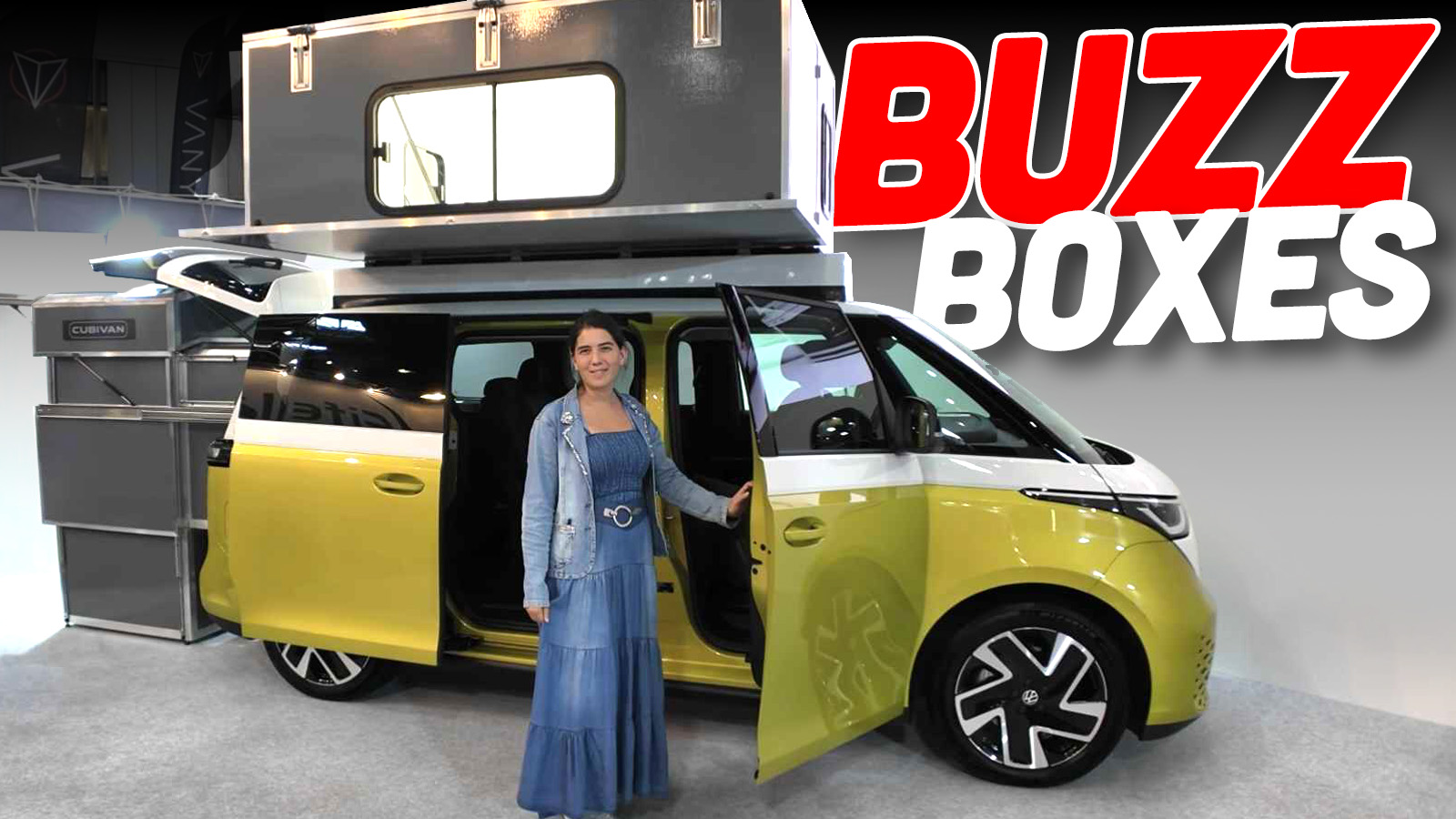
For several decades, the humble camping box has allowed van owners around the world to quickly convert their vehicles into small RVs. Usually, camping boxes are small, affordable, and universal. But one company has a different take on the idea. Vanna Camp wants to fill your Volkswagen ID. Buzz with the Cubivan Camping System, a giant box that, when opened, uses a series of folding mechanisms, struts, and cranks to turn your van into a sizable RV. That’s just the start of the weirdness of this thing.
When the Volkswagen ID. Buzz finally went on sale in America a couple of years ago, some folks naturally wondered if or when a camper version was coming. The last official Volkswagen camper van in America was the EuroVan MV, which was last on the market more than 20 years ago. Volkswagen waited until June of this year to finally make a sort of official camper version of the ID. Buzz. The Tourer comes with a bed, curtains, a table, and chairs, and not much else.


Thankfully, the aftermarket has been offering camping boxes for the ID. Buzz for a while now. Between them and some do-it-yourself work, you can make the ID. Buzz into a cozy place for a weekend getaway. But most camping boxes are relatively simple affairs that pack the absolute basics of an RV into a small box that fits in a passenger van’s trunk. Italy’s Vanna Camp is taking that to the extreme. The Cubivan Camping System is essentially an entire camper van in a gray folding box, and it’s so complex and so weird that it looks like a Rube Goldberg contraption stuck into the back of a van.
A Camping Box, Supercharged
The concept of the camping box is usually pretty simple. Usually, a camping box will have the bare minimum essentials to convert a passenger van into an RV, like a sink, a stove, a small refrigerator, some storage, and a water tank. All of this will fit into a large box that you just lift into the trunk of your van when you want to go camping. A bed usually joins the camping box on a trip.
One of the pioneers of the camping box is Westfalia, which offered one in 1951 for the Volkswagen Type 2. If you want to see an example of a modern camping box, back in 2022, I wrote about the Ququq BusBox 4, which converted the Volkswagen ID. Buzz and other vans into campers for about $3,000.

The Cubivan Camping System, which is supposed to work like a camping box on steroids, is the work of Vanna Camp GmbH, a startup firm located in Passeier, South Tyrol, Italy, and founded by Florian Haller.
Vanna Camp says that Haller brings 20 years of automotive supplier experience to his company, and it was his career of developing body components and parts for the automotive industry that inspired him to start his own company. Vanna Camp’s debut product, the Cubivan Camping System, or CCS for short, was built with the idea of giving a van owner every convenience of a full camper van conversion, but in the smallest possible space that doesn’t ruin the van’s comfort or look.
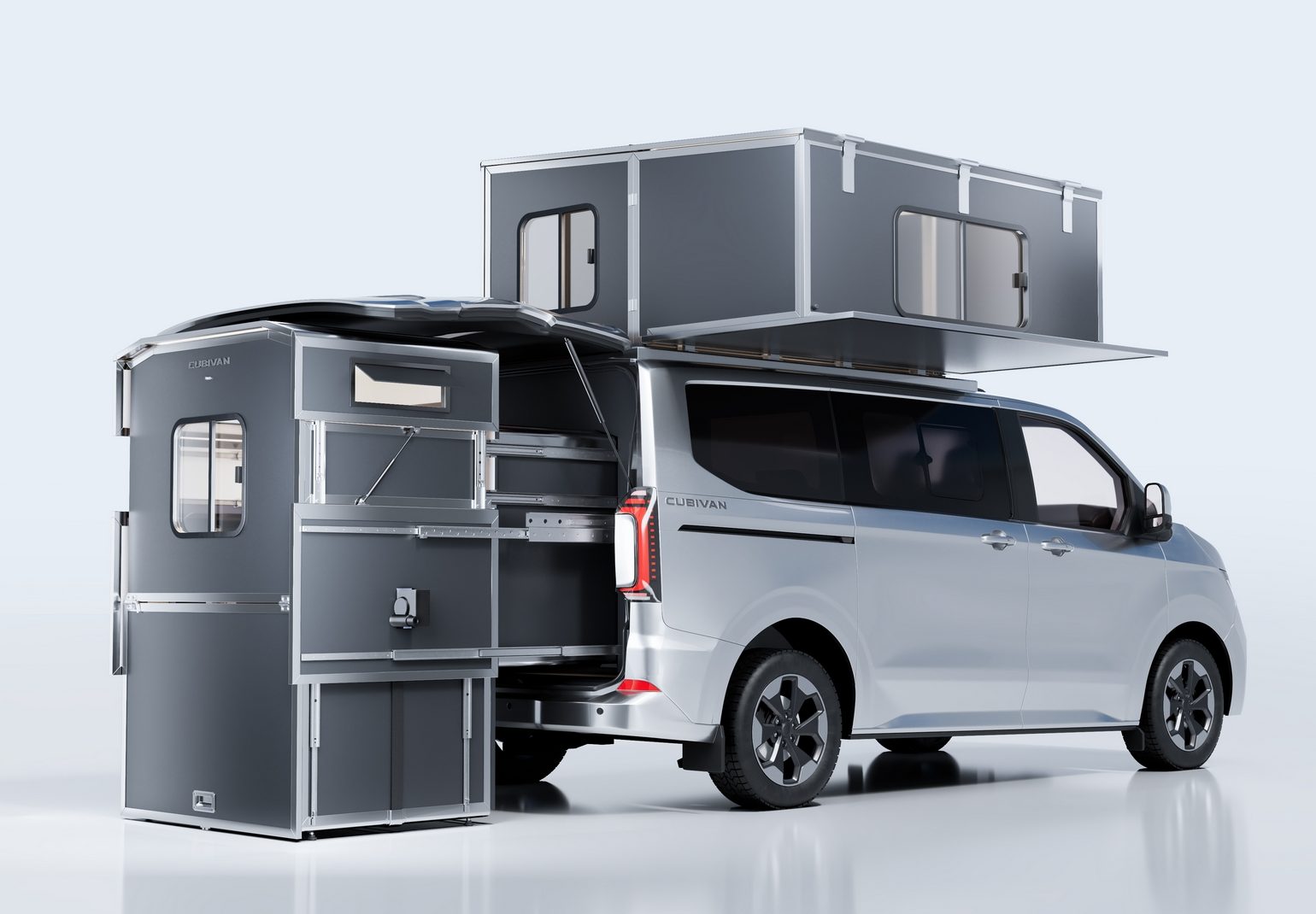
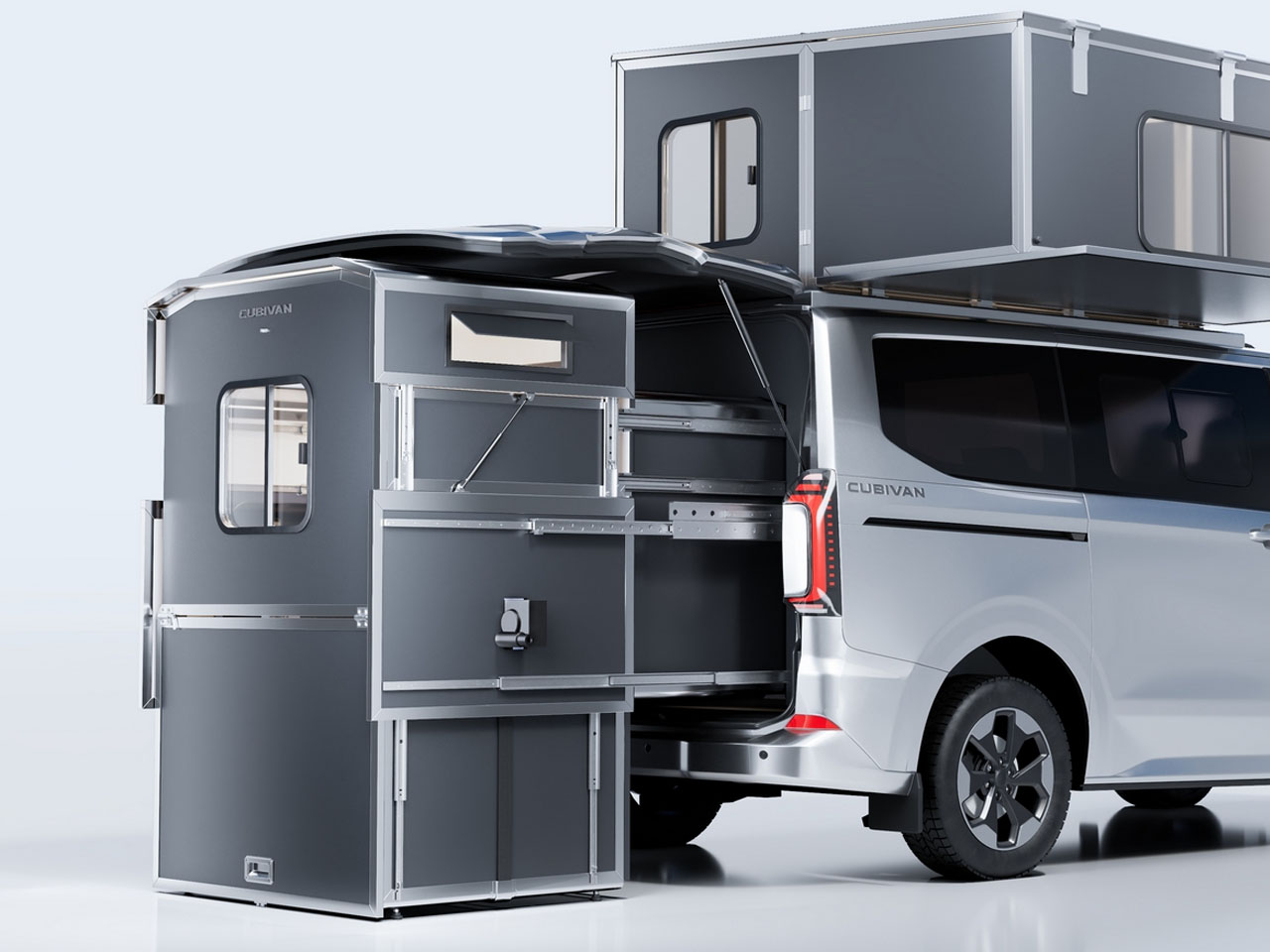
The CCS, which made its public debut at the Düsseldorf Caravan Salon in Germany earlier this month, achieves this by packing the essentials of an RV into a box that extends out of the rear end and up from the roof of the donor van.
Haller’s idea is not particularly unique. Camper vans with interiors that extend out beyond the footprint of the van itself sometimes show up on the European RV show circuit. European brands like Overlander Motorhomes, Beauer, and Westfalia have all teased concept or prototype camper vans that have extending interiors. The Overlander Doubleback, for example, dates back to 2012.

What makes the CCS different is the extreme way it expands the donor van. It doesn’t just stretch back, but extends up and down, too. Vanna Camp says that the Cubivan is made out of an insulated fiber-reinforced plastic shell with a metal perimeter frame. These bits attach to a patent-pending folding system.
In its closed form, the CCS is a giant brick that lives in the back of the van.

When the van parks, the owner can activate a series of struts and hand cranks to slide the CCS out of the back of the van, and then extend its floor down and push its roof up. Supposedly, while the deployment process is all manual and mechanical, it’s low-effort and requires no heavy lifting.
Once open, the rear 35-inch by 37-inch room contains a kitchen module with a stove and a sink. In a cabinet under the sink is a cassette toilet that slides out. This room also has a shower in it.
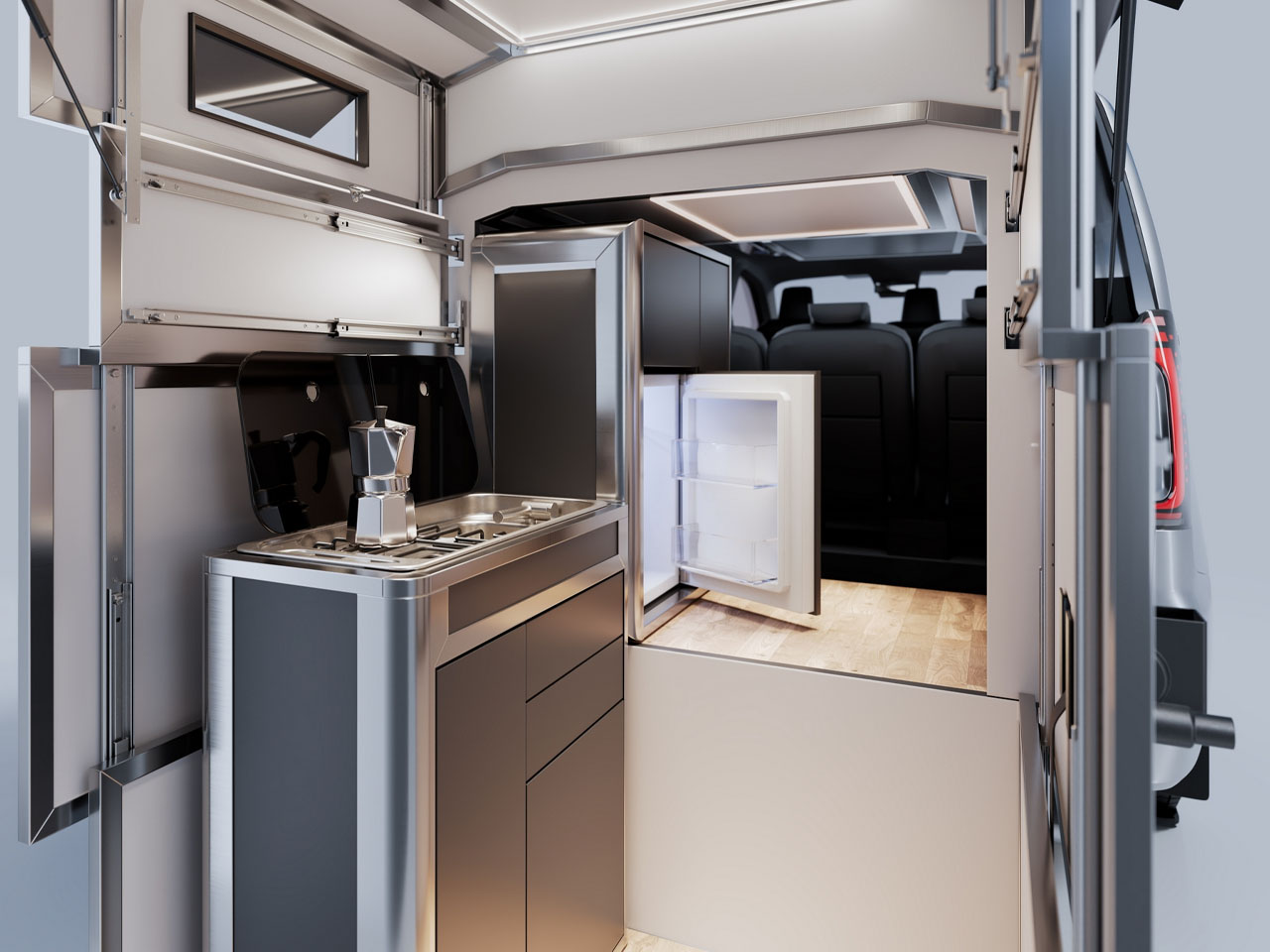
Yes, technically that means you can both defecate and shower in the same place you cook in. I guess that makes this a “wet bathroom-kitchen.” Thankfully, Vanna Camp does realize how unattractive this sounds, and says you can lift the kitchen module out of the way when you’re showering.
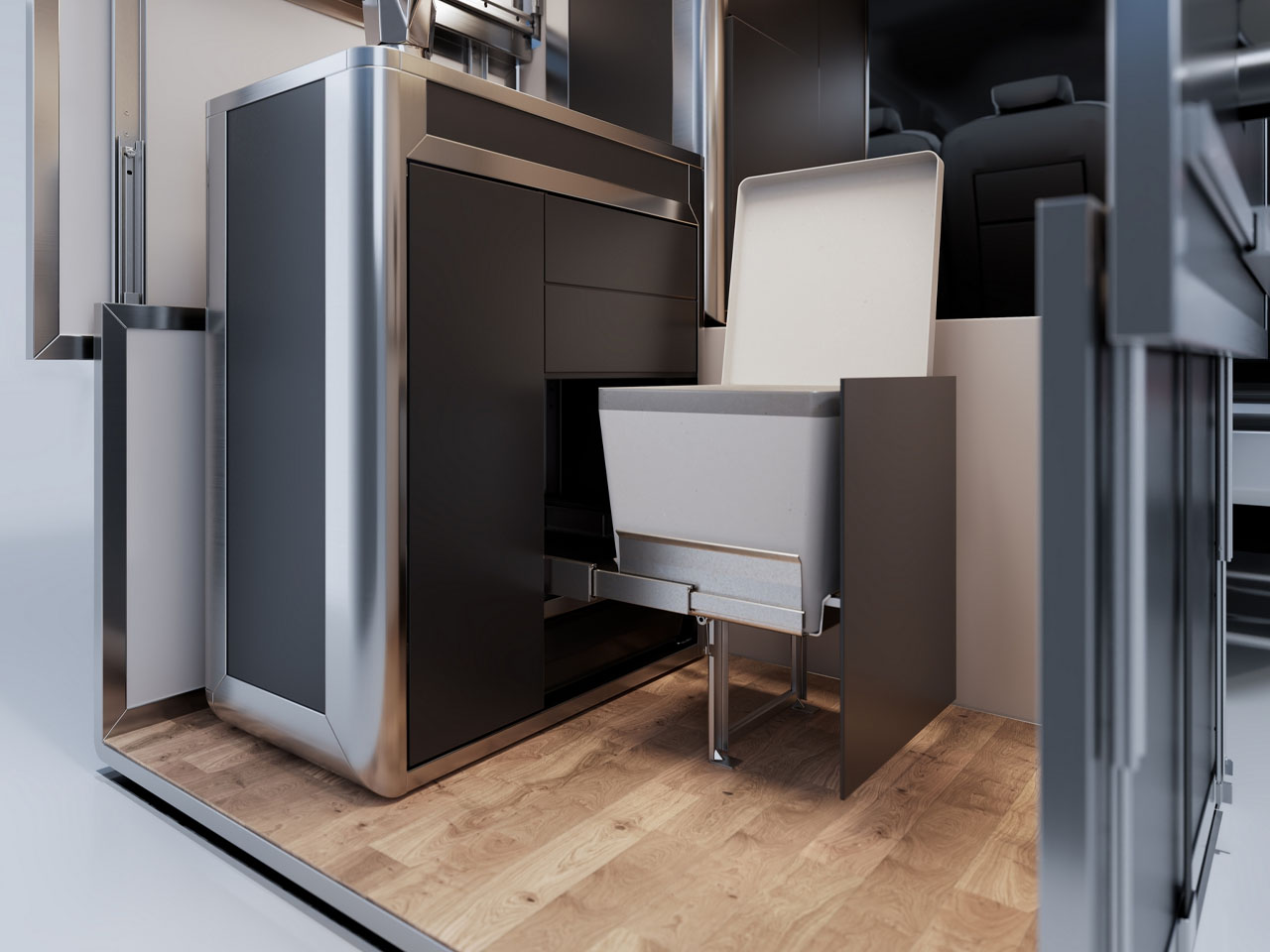
The other good news is that the rear room has a standing height of 6.2 feet. While not the most headroom, it’s better than what you’d get in a typical camping box setup.
The rest of the interior portion of the camper doesn’t have much going on. Forward of the rear room is another box that contains the refrigerator. Hard walls and flooring are also found throughout the CCS cube.

Then there’s the roof. The CCS is designed with a custom rooftop camper that replaces the roof of the donor van. When it’s closed, the rooftop camper makes the roof only 3.9 inches taller. It then uses its own folding mechanisms to pop out into a large bedroom that features windows and a bed that measures 79 inches by 79 inches.
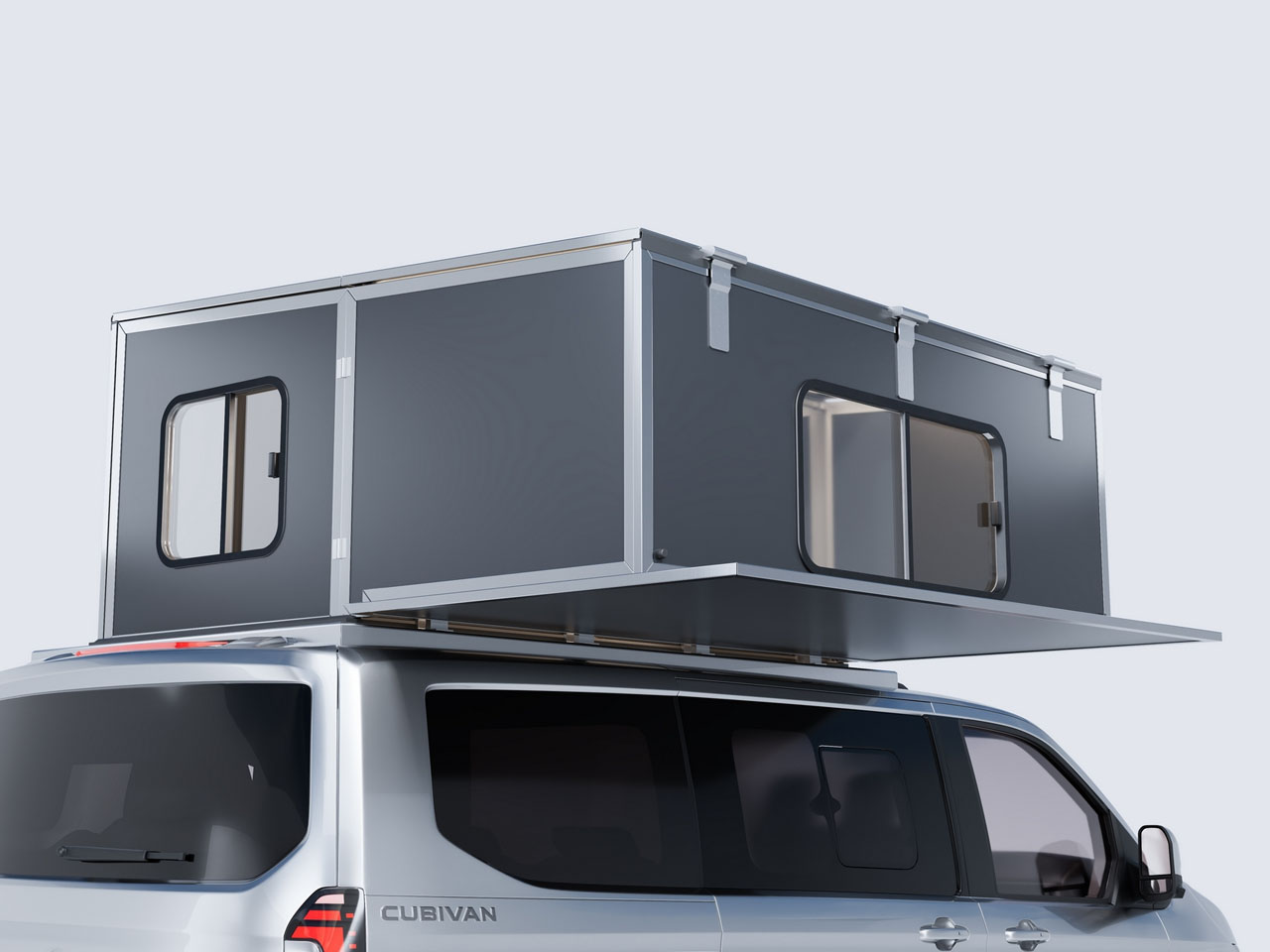
The production version will have a hole in the custom roof so that you can access the bed without going outside.
All of this, except for the roof, retracts back into a cube that lives in the back of the van. In its closed state, the CCS takes up the trunk and the third row of seats. Vanna Camp says that the cube is removable, too, so you can return the van to a regular passenger vehicle at will. Technically, if you wanted to, you could also move the CCS to a different van.

I love this crazy, out-of-the-box concept. The CCS gives you a big-ish camper van without actually forcing you to drive a bigger vehicle. I also like how it has a toilet and shower, unlike many camping boxes. Vanna Camp proudly proclaims that the CCS makes for an expandable camper van without any tent fabric to worry about.
But then there are the catches, and there are many.
The Opposite Of Simple

One problem I see is with the complexity of the thing. A series of cranks, struts, and folding mechanisms adds a lot of potential failure points and possible entry points for water. Camping boxes are supposed to be simple, but this is the exact opposite.
Speaking of water, when extended, the CCS requires the hatch of the van to remain open. This will expose the inside of the hatch to whatever weather you’re camping in. I also hope that the production CCS has a good weather seal around its sides, or the van’s interior stands a chance of getting ruined.
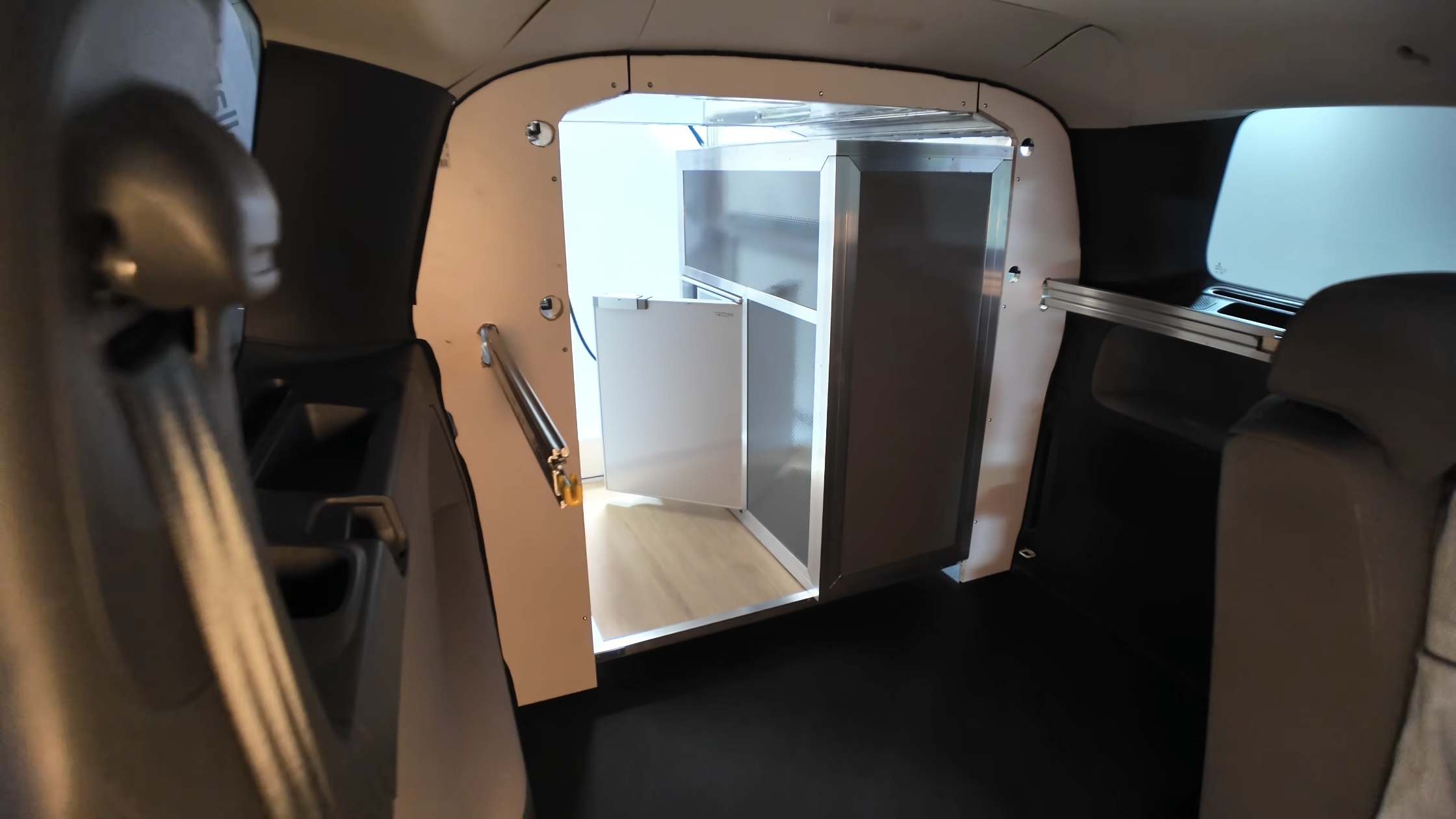
Then there’s the portability of it all, or, specifically, the lack of it. The roof portion is permanent, so returning to stock or transferring to another van won’t be easy. The cube portion of the CCS is too large for a single person to carry. A weight isn’t listed.
Vanna Camp also says that the cube can be easily moved to another van, but that’s only partially the case. As of right now, the CCS fits only in the Volkswagen ID. Buzz, the Volkswagen Caravelle, the Ford Tourneo Custom, and the Mercedes-Benz Vito. Only one of those is currently sold in America.

Finally, the largest curveball of all is the price. The CCS is expected to cost somewhere between €22,000 and €25,000 when it enters production sometime next year. For those of you counting, that’s $25,550 to $29,050. Alternatively, just the cube will cost around €16,000 to €17,000 ($18,600 to $19,750) or €7,000 to €8,000 ($8,150 to $9,300) for just the roof portion.
Yikes. You can buy normal camping boxes for you and your friends for that money. You could convert a van into an RV for well less than that price. You can buy an entire used factory-built camper van for that price.
Check out the video below for a tour of a short-wheelbase ID. Buzz with the CCS:
Vanna Camp hasn’t announced which markets the unit will be sold in, and it doesn’t even have an English version of its website. But if you’re German, you can pre-order it now.
As cool as I think the Vanna Camp Cubivan Camping System is, I don’t really see it as a revolution in camper vans. It’s a clever idea that asks a whole lot of the buyer.
But if you can look past the downsides and have nearly $30,000 burning a hole in your pocket (before importation costs), you could turn your Volkswagen ID. Buzz into a really creative camper van. I’m not sure I see a lot of people doing that. But at the very least, the CCS makes for a neat technology demonstration of what’s possible.
Top graphic image: Screenshot, German Television


That’s an awful lot of work and complexity for a “living” space that seems about the size of a pop up tent I could throw in the back of my Elise.
For that matter, it honestly appears like there is less space in that contraption than if you just slept in the back of the van you already had.
35-inch by 37-inch room
That’s 1/3 smaller than the area of a standard shipping pallet, and the kitchen sink / shitter combo appears to take up 1/3 of that.
They are really aiming for a niche within a niche with this product. People who like pooping while cooking and also own an ID Buzz. (Weirdly, the last part is probably the smallest circle on the Venn diagram
Good luck using this contraption on anything more than a 2 degree slope in any direction.
Us (pulling into a campsite): “OK honey, we’ve found a beautiful spot. Just give me a minute while I set up camp!
Fifteen minutes later: “Hmmm. Should I have cranked that before I pulled this?”
Half hour later: “Let’s see, I think I can get the roof up now. Oh, maybe not.”
Hour later: “Dammit! I just put the groceries in the toilet!’
Hour and a half later: Wife strangles me.
We’ll leave a light on for you.
Can it go 900 miles on a charge?
Looks like the IDBuzz pooped out a port-a-potty.
Chemical toilet pulled out of a kitchen always puts me off. I don’t know who thinks that’s a good idea. Can occupy same area but pull it out of something else. It’s not like it has plumbing. It seems very German. Very complicated and expensive not doing much. Some kind of flat pack thing on the roof would be far more interesting.
I’m having trouble seeing how this is better than just packing a camping stove and water jug. hang a damn shower curtain from the liftgate if you feel the need to cook in private.
1.) Watching the lady sit on the toilet and mess with the stove like she is cooking is hilarious. I almost spit green tea out of my nose.
2.) I’ll keep my bay window Westfalia thank you.
Listening/watching the video, the interviewer asked if there was a motor setting it up and seemed a bit taken aback that it was all done with cranks and the like. If it had electric motors where you could push a button and it would unfold and do its thing, it would be a lot cooler.
However, it still wouldn’t be cool. It’s basically a pop-up porta-potty that sticks out the back and a box that deploys on the top. I would think it would be better to put the porta-potty on a trailer behind it, and use the interior as a 2 person RV with a bed and a small kitchen with a more traditional pop-up roof for head room.
I used to work on touring theater and music shows. Folded out, this looks like a stack of the road cases that we used to transport lighting and sound equipment.
https://fiascocases.com/cdn/shop/files/fiascoroadcasecadicomboDSC00114-Edit_1800x1800.jpg
Trying. Too. Hard.
Either get a bigger van/RV OR travel far lighter. The old VW Westphalias offered similar accomodations, minus the toilet, with just a pop-up roof and a fold-down back seat.
Vanna Camp sounds like Vanna White’s outdoorsy cousin.
Maybe the RV industry has broken me, but I was surprised this isn’t more expensive. I don’t think comparing it to a traditional camp box is really fair. A camp box doesn’t give you any more space, while this is extending both the roof and the hatch. This is basically a way to add slideouts to your camper van.
Whether that’s a good idea is a whole other question. I share your concerns about leaving the hatch open the whole time. Having tried (and mostly failed) to sleep through major thunderstorms on a couple of camping trips this year, leaving the interior open is kind of a non-starter unless they have some clever solution. Which is possible. They make those tailgate tents that wrap around the vehicle body and allow you to leave your tailgate open, so maybe they’ll do something similar here.
I am surprisingly less negative on this than most of the other commenters. This might be a first on a camper article.
That is simply trying too hard. WAY too hard.
For some people, the thought of pubes and feces in the kitchen is horrifying.
For others, it’s a revolution in shower spaghetti.
I’ve tried cooking in the shower, the vegetables kept clogging the drain
Need a garbage disposal in the drain, Seinfeld covered this
Like a Clarkman or something?
C’mon, people, Inspector Gadget has been doing this for 40+ years!! So, the technology exists!
As someone who is very vocal about being unwilling to tent camp any more, I’ll just use a fuckin tent if this is my only alternative.
This seems overly complicated for a solution that youre going to want to upgrade from after 1 use.
That was my thought as well. How many times are you going to use it before you go “I should just buy a class B RV”? Once? Twice?
I feel like one setup in less than ideal weather and/or campground situations and you’ll be packing it back up to get rid of.
If for some insane reason I paid 25K or so for this thing there is no way in hell I’m not going to make this thing work.
Since I’m not dumb enough to buy this thing I guess I’m fairly safe from my family hating forever.
https://youtu.be/YT0S71Sk88Q?t=15 Same energy.
Whelp, that one is going in the movie queue!
I believe I still have a pair of Independent jeans I ordered from CCS, they’re old enough that they’ve cycled around to being back in style
Wait, the Metris (Vito) is no longer available? Shame.
I think it’s brilliant that you can have some cool and trendy vanlife while at the charging station!
How can we lower the range of the Buzz? Add more weight!
And a thing on the roof!
I have a better joke, it’s a Buzzkill.
The model in the lead photo’s alias is IVanna CampALot.
Ever wanted to live out of a regional jet galley? Now you can!
That’s an accurate description of what it reminds me of. Then again, those things are built to survive a lot of use, and I worry about all the sliders and attachments on this thing.
Ever wanted to live out of a regional jet galley made by VEVOR?
A collapsible regional jet galley made by VEVOR.