

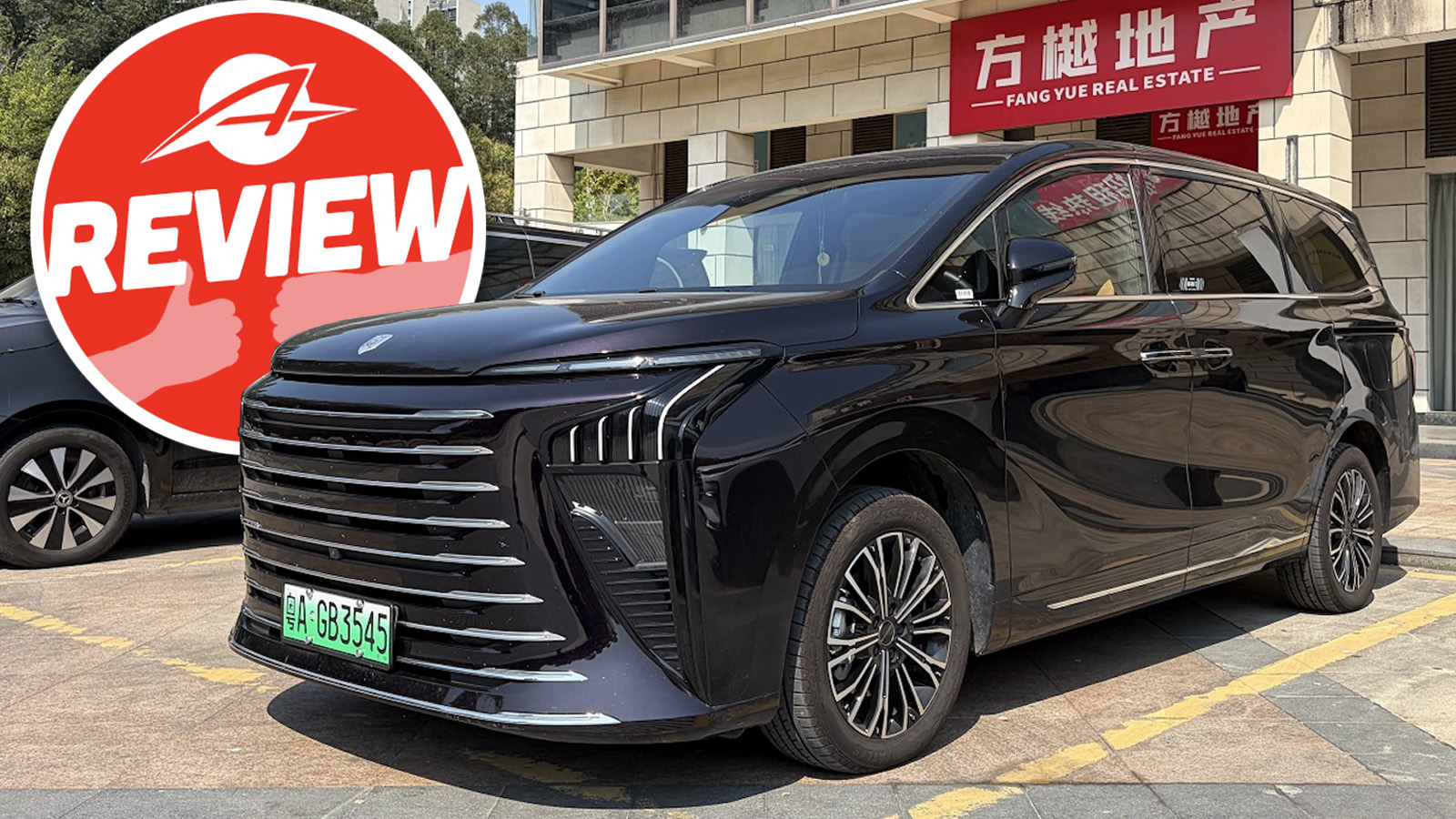
It is not controversial to say that the modern minivan is one of the most versatile vehicles on sale today. Nothing else can transport eight full-grown adults in comfort on Monday while being reconfigured to swallow an entire college dorm’s worth of furniture on Tuesday, all while still fitting into a standard parking spot.
However, despite MSRPs that have soared into the $60k range for the generally agreed upon apogee of US minivans, the Toyota Sienna, US minivans still do a poor job of posing as luxury vehicles. In contrast to dedicated VIP people-mover vans like the Toyota Alphard, US minivans still seem to be designed first and foremost for family duty, where luxury trimmings are just a target for a thrown juice box or tiny kick. In the land of freedom, transporting eight passengers in the lap of luxury is mostly the job of luxury SUVs.


Meanwhile, in China, the currently trendy land of automotive forbidden fruit, approximately $23,000 (189,900 yuan) will get you into a PHEV luxury minivan whose main purpose is to haul people in luxury-car-like accouterments while offering an astounding (to Americans) 125-mile (200-kilometer) rated electric-only range (CLTC). But is it actually worthy of being considered a luxury vehicle, or is it just pretending to be one? Is it better than the Toyota kings of minivans, the Sienna and the Alphard? And at that low initial starting price, does it even matter whether it is or not?
The Basics
Engine: Turbocharged 1.5-liter inline-four
Battery Pack: 34.9 kWh liquid-cooled lithium-ion
Charging: DC fast charging, 7 kW Level 2 AC charging, Level 1 AC charging
Transmission: Single-motor/generator single speed “Dedicated Hybrid Transmission”
Drive: Front-wheel drive
Output: 310 horsepower
Rated Electric Range: 125 miles (200 km) CLTC, 100 miles (160 km) WLTC
Fuel Economy: 5.27L / 100 km (45 mpg) with a depleted battery (CLTC)
Body Style: Minivan
Starting Price: RMB 189,900 or $23k – in China
What Is It?
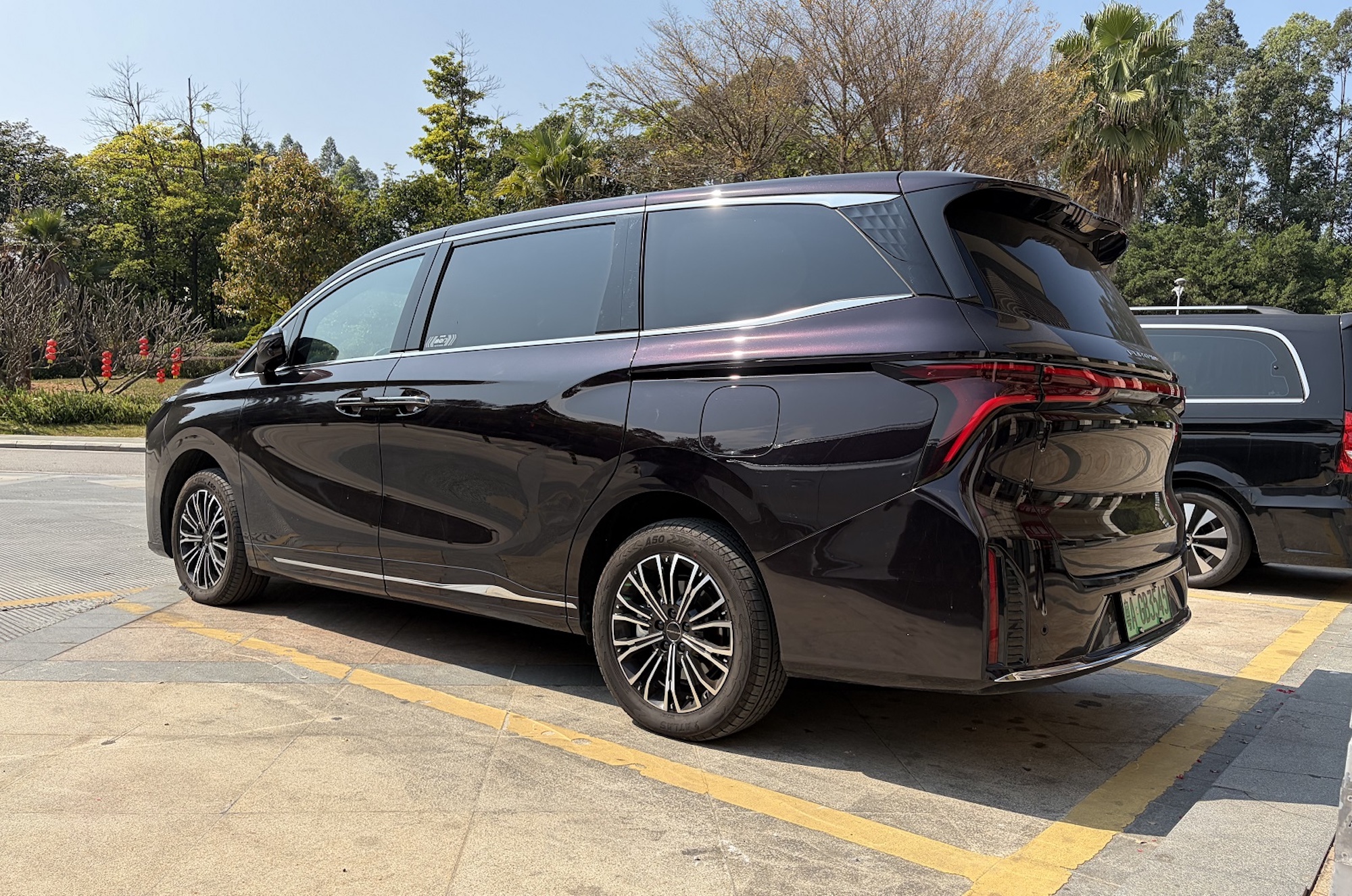
You’re looking at a 2026 Forthing Xinghai V9. Forthing is a division of Dongfeng, one of the OGs of the Chinese auto industry. I primarily remember Dongfeng for producing very robust heavy-duty trucks. While Forthing has been around for a while, the Xinghai subbrand is relatively new. I honestly cannot tell you what Dongfeng is trying to accomplish with the Xinghai subbrand; it’s all very early 1990s JDM feeling to me, when (for example) a vehicle known as a Mazda to Americans might have been branded one of five different ways in Japan.
Why Does It Exist?
The luxury van has been a stalwart segment in Asia for years. These vans, of which the Alphard is the poster child, are designed to shuttle important people in luxury from, for example, the airport where they just disembarked a business-class flight, to a tall skyscraper for a business meeting. Such a use case is not just a Japan-only thing, though; a similar philosophy that VIPs should be shuttled in the back seat exists in other parts of Asia, such as China. China has also been a worldwide leader, perhaps the worldwide leader, in electrified powertrains. PHEV powertrains fit the use case of VIP vans perfectly, where one day’s driving might be crawling in a congested city, but the next might be a long-distance round trip from Guangzhou to Zhuhai. Long-distance luxury PHEV vans like the V9 just make intuitive sense for Asian luxury fleet vans.
How Does It Look?
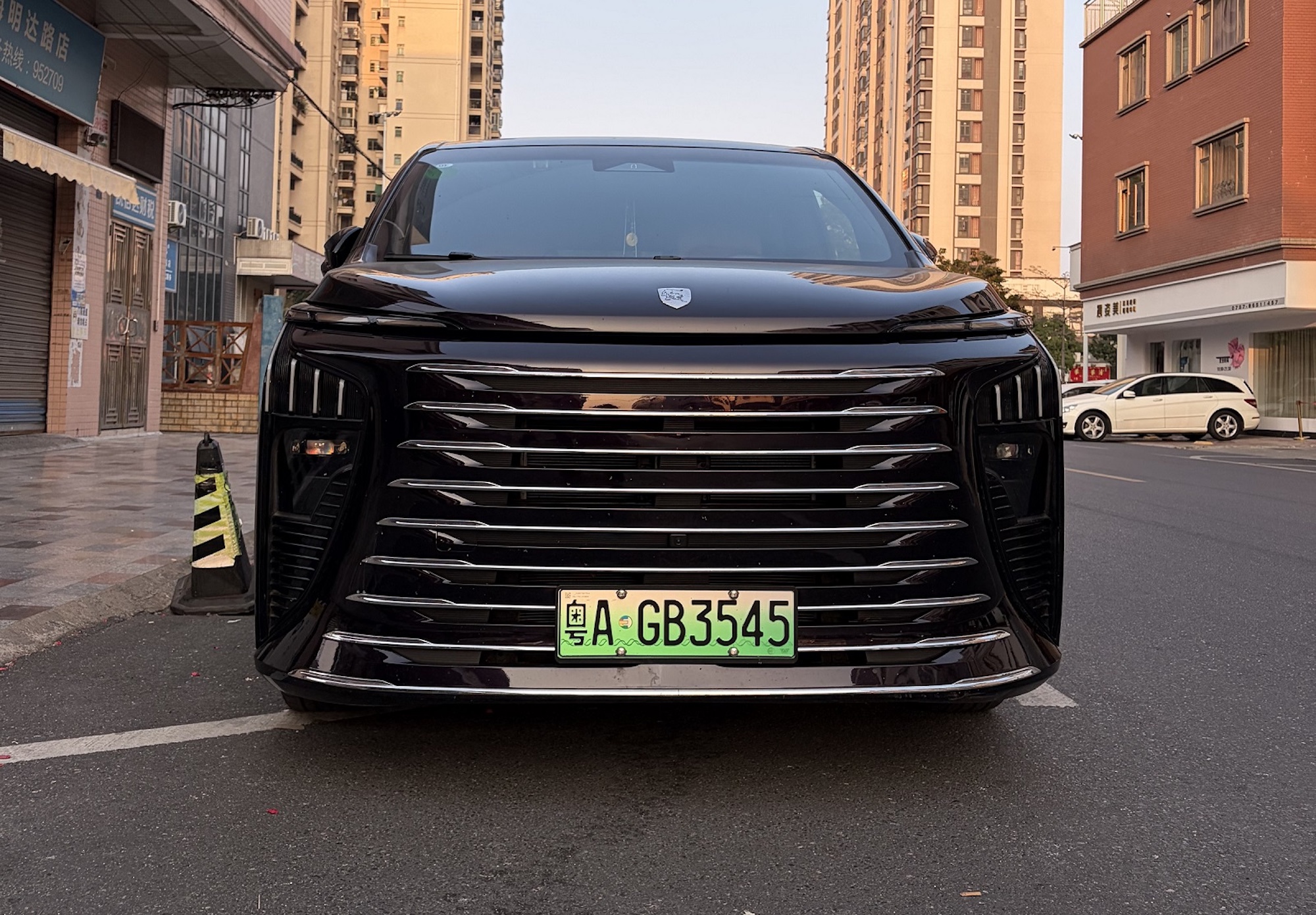
Like a Gillette executive’s dream. Forget 5 blades, let’s go for 6, 7, no 8 blades! That gigantic grille will likely be the first, last, and probably only thing that leaves an impression, but damn, it will be an indelible one.
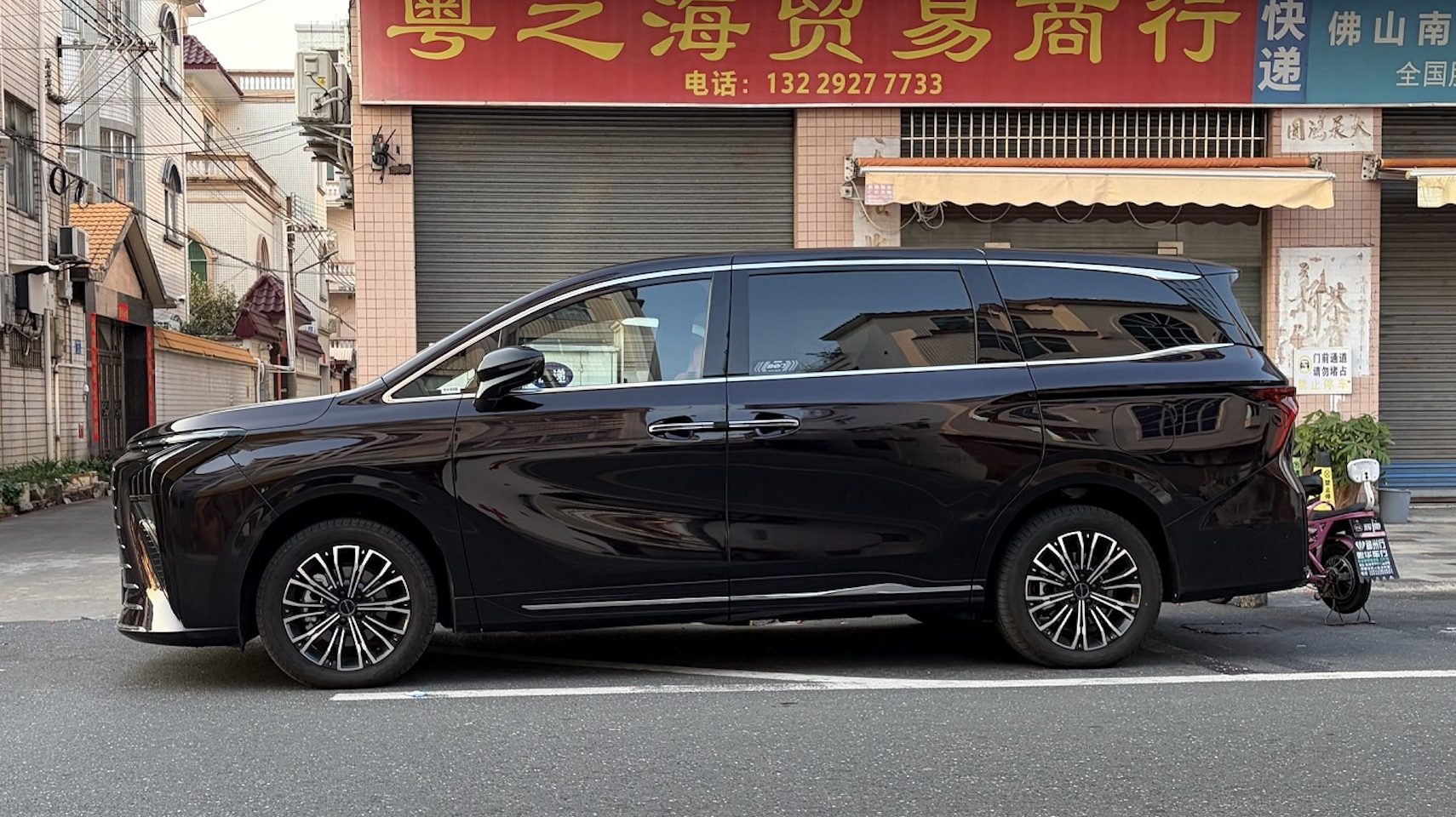
Besides the grille, the profile is basically what you would expect from a van. It’s not unattractive, although the rolling diameter of the tires feels a little small to someone used to the ever larger meats that US cars are rolling on. And the color choices may raise some eyebrows; The V9 is only available in black, white, and dark purple exterior colors.
How About The Inside?
For better or worse, modern Chinese New Energy Vehicles (NEVs) generally leave a great first impression, but interact with a few of them, and there starts to be a banal sameness to most of their designs. All of them seem to be chasing the feeling of driving the future, and most of them do it with very simple and clean designs and massive screens.
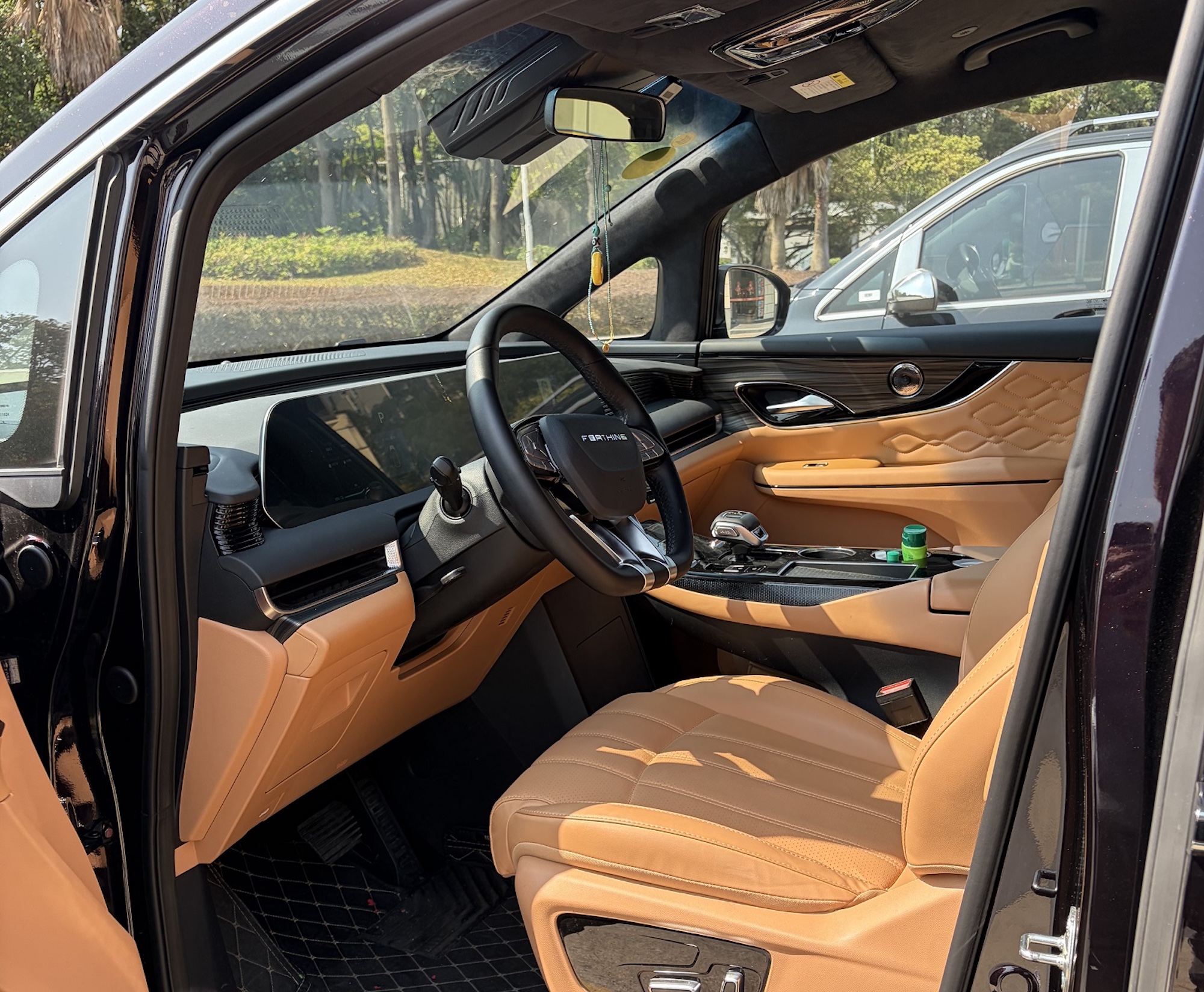
In some ways, this is true for the V9 as well. Nonetheless, if you were just looking at the V9, it certainly appears more luxurious and futuristic than, say, a Sienna Platinum. The seats and leather-appearance plastics have interesting textures and an expensive-looking, low-sheen surface. The interior plastics do look more expensive than they feel, but there are pleasant soft-touch surfaces where you would expect. The console being a gigantic piece of piano black probably looks great in renderings, but will likely look terrible in a couple of years. In terms of textures and designs, the V9 certainly has more going on than a typical NEV.

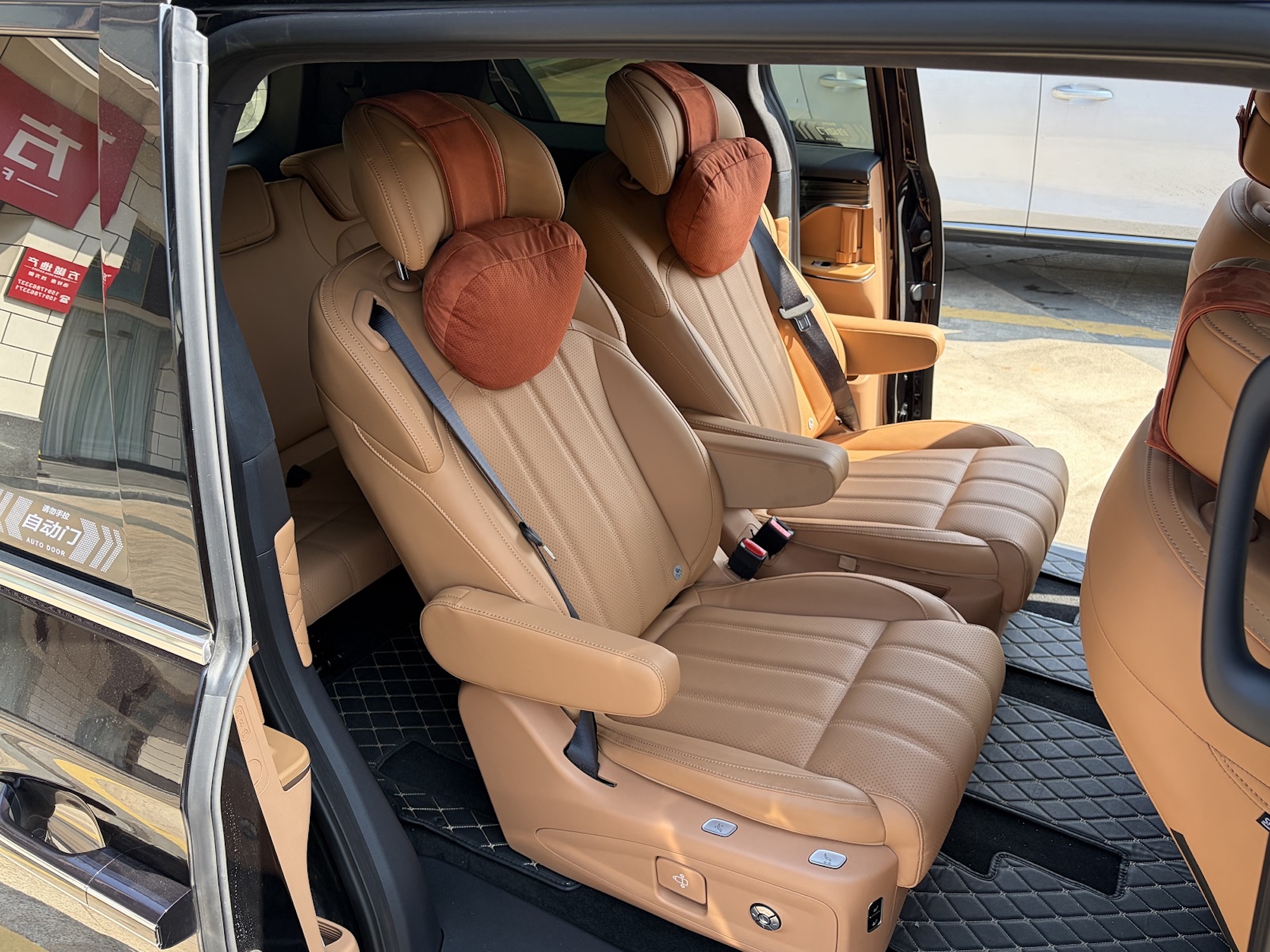
Both the front- and second-row seats are throne-like and very comfortable. The V9 I drove was a mid-tier model missing a lot of the high-end luxury features, but the second-row captain chairs were still power-adjustable, heated, cooled, and equipped with armrests and USB-C ports. Higher trim levels offer panoramic moonroofs, massaging seats, second-row tray tables and foldable leg rests, and even additional second-row screens.

The third row isn’t strictly for kids, but occupants are clearly second-class. Cargo space is acceptable with the third row up, but I assume the second row will limit the ability to haul very large loads.
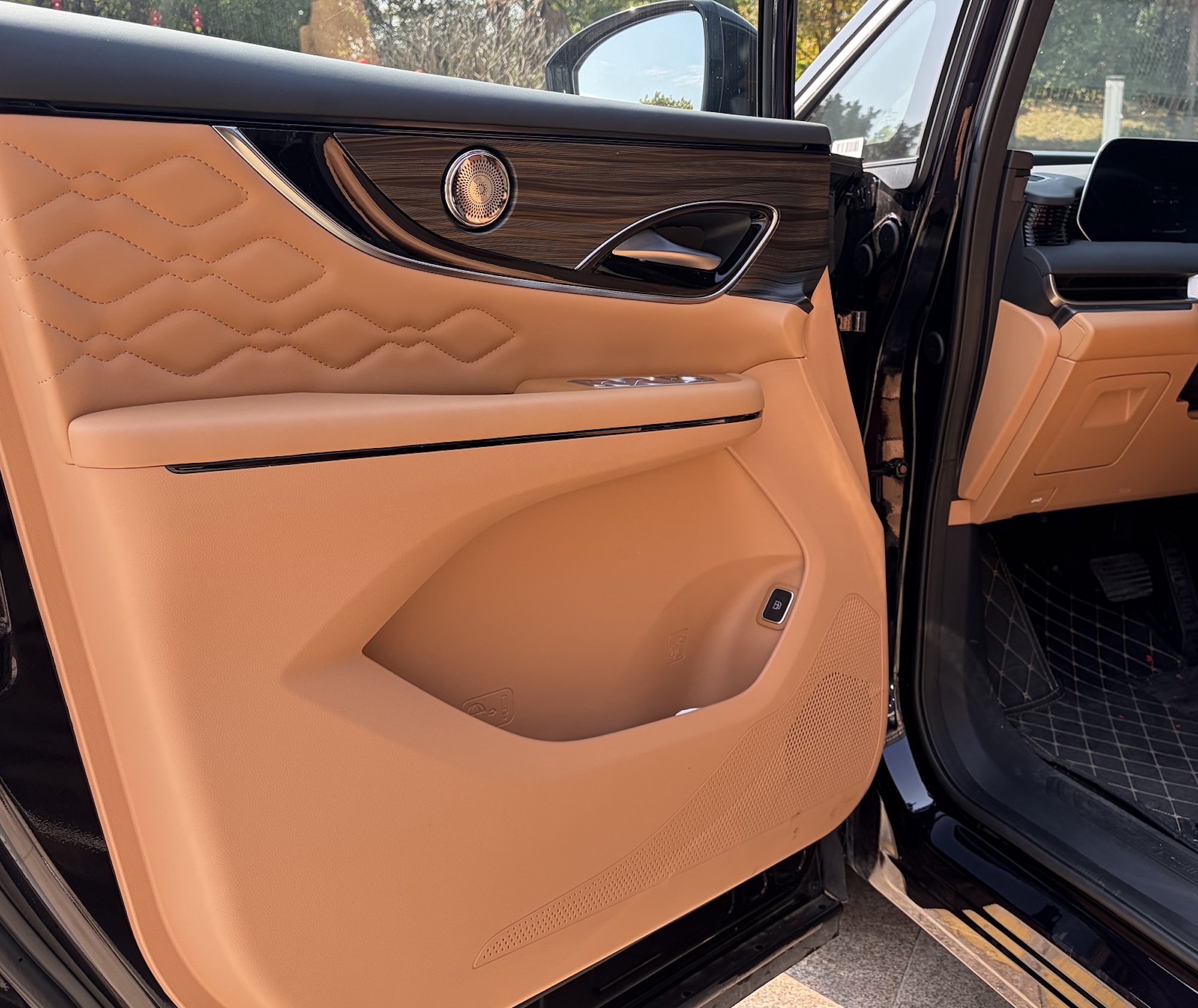
Storage is strictly inferior to most American minivans. While there are storage pockets and the console has a lower storage level, the solutions are fairly rudimentary. The second-row seats move laterally, but each seat is confined to only moving within its own half. (I cannot imagine how this is useful – unless your second row VIPs really want to cuddle?) Besides the items that exude luxury, a lot of the interior feels very much like someone wrote a checklist of features that was then implemented without much thought put into the execution.
While the interior in general is not as nice as that of an Alphard, it leaves a good first impression, and VIPs in that second row will be coddled. To keep with the theme of limited color choices, the interior is only available in white and saddle tan.
How Does It Drive?
The party trick of the V9 is that it offers extremely long electric-only range. In electric mode, it feels like any electric vehicle. Electric power is adequate, but not overwhelming. The CLTC standard has a reputation for generating extremely generous, bordering on ridiculous, range estimates, and this is also the case here. In actual use, I experienced around 70-80 miles of range instead of the rated 125 miles. Still, even 70-80 miles of all electric range would be an absolute game-changer in the US.
Once the engine kicks on, the experience continues to be relatively smooth, though the engine being connected to the wheels via a single-speed direct drive (think current Honda Accord configuration where the motor mostly acts as a generator) makes the van feel slower than its rated 310 total system horsepower.
Past the powertrain, things take a turn for the worse. Possibly to discourage shenanigans, grip limits are low, and the van is softly sprung. The steering feel is rather synthetic when effort seems to fluctuate during a sweep of the steering wheel, even in moderate cornering. It almost feels like the electric power steering cannot make up its mind as to how much assist to provide. And while the suspension is generally soft and tuned for ride quality, the rear is significantly bouncier than the front even with every seat occupied and luggage in the back. On the positive side, there’s no weirdness with the brake pedal and stopping power is, to continue with the theme, fine.
How Are The Electronics?
Get into the V9, and the first thing you notice is there is no start button. The vehicle is programmed to detect the presence of the key and automatically turn itself and leave itself on. It’s not bad when getting in, but I never got over not turning off the vehicle before walking away.
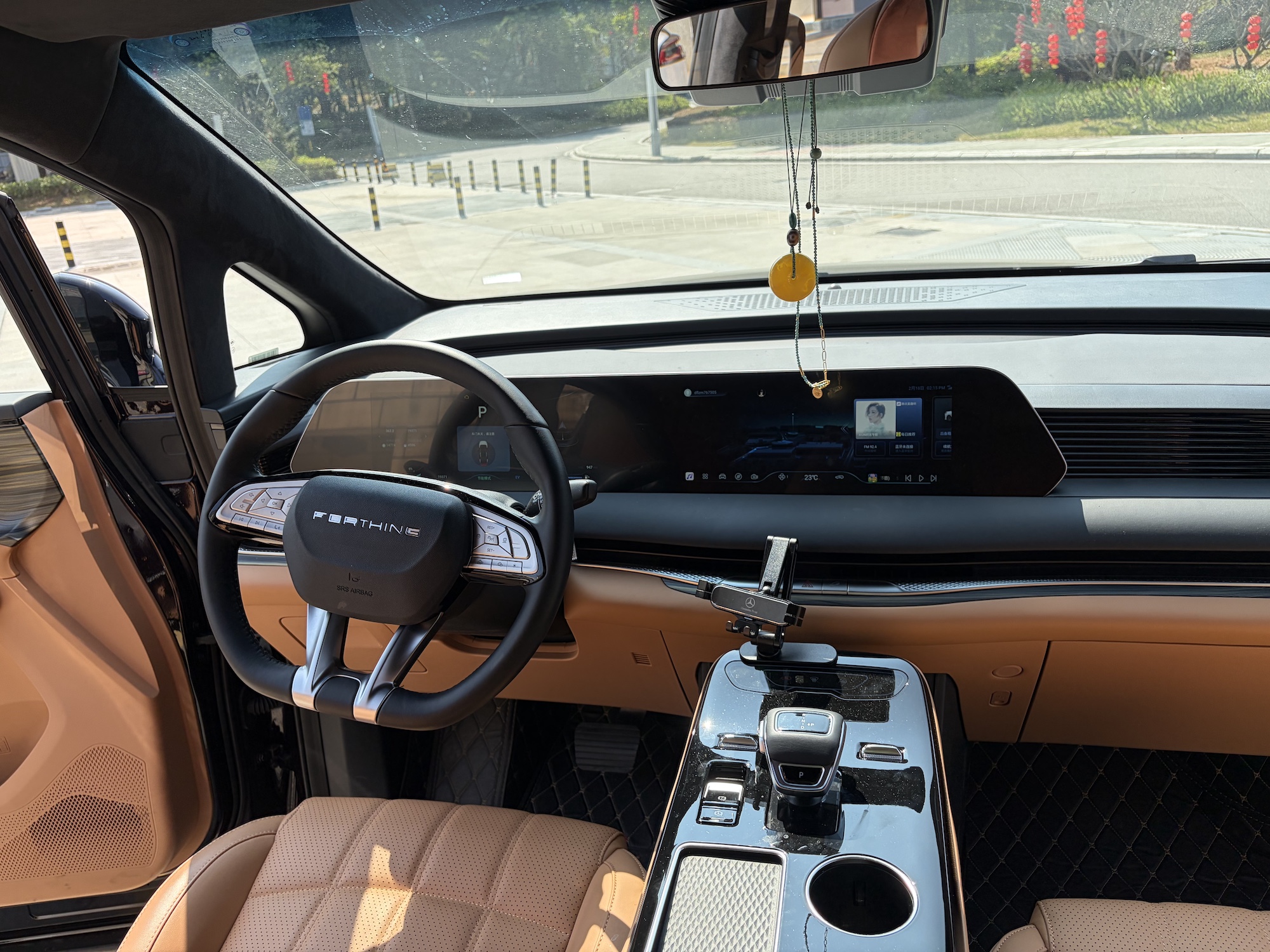
The infotainment has two 12.3-inch screens, and I hope you enjoy interacting with them, because there are basically no buttons at all. There is a shifter, a parking brake button, and steering wheel buttons. A third screen for the front passenger seat is available, but not present on my test car and, honestly, I find passenger screens extremely gimmicky. There is an additional screen in the form of a fold-down television in the second row, but luckily my kids did not discover its existence.
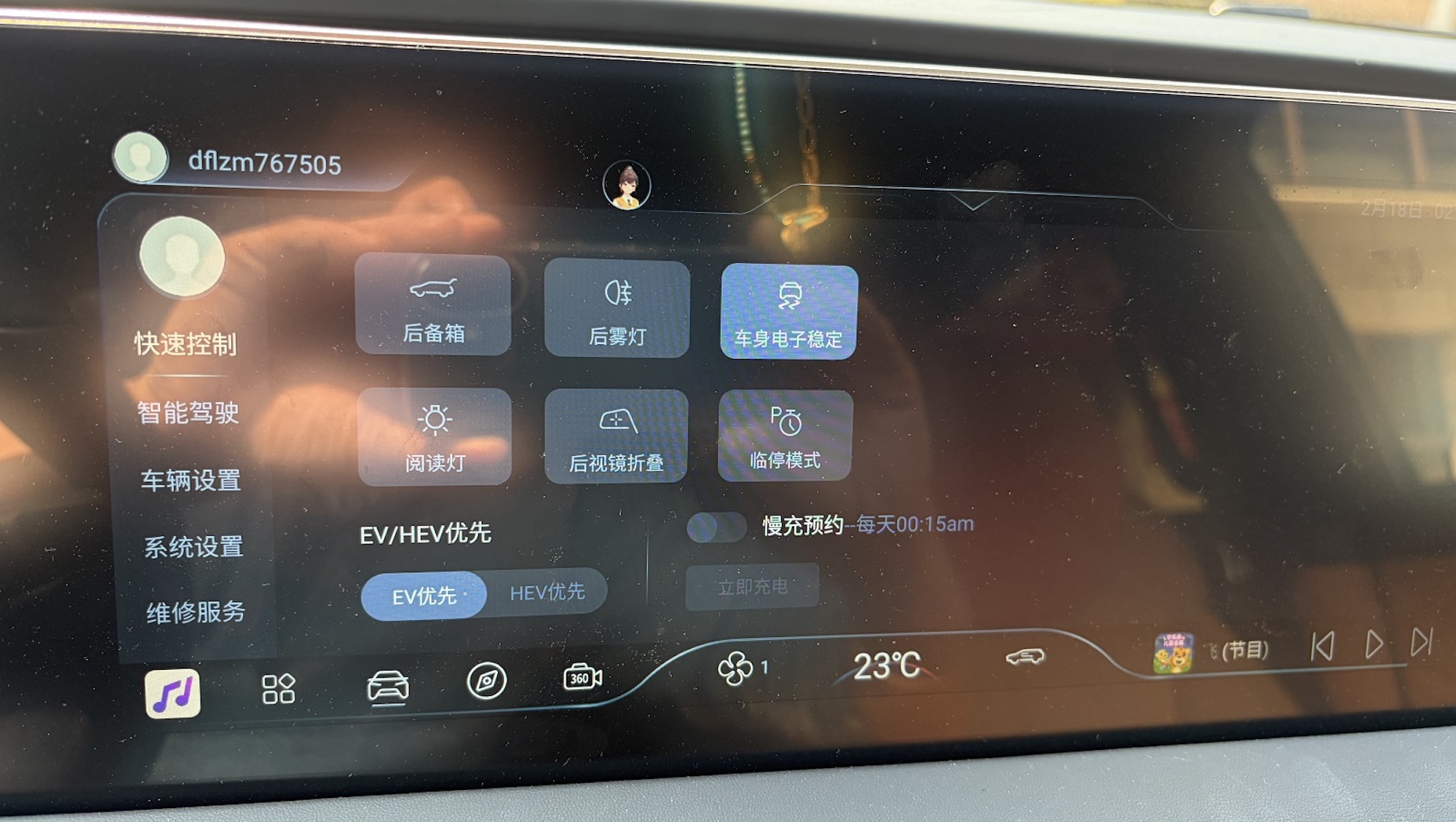
The infotainment is the standard Tencent interface that seems to be present in all Chinese NEVs. There’s a strip on the bottom for HVAC controls and a multifunctional area that displays infotainment, vehicle functions, AI assistant, and various other screens. Instead of Apple CarPlay and Android Auto, phone mirroring is offered for Chinese mobile operating systems. Per my conversations with Chinese drivers, though, phone mirroring does not seem to be as important of a feature as in America, and most people keep their infotainment in the native interface.
While the general infotainment experience was smooth and lag-free, there were some quirks. The infotainment would default to camera views of your front wheels when turning in tight quarters, but the view is too laggy when the speed is above a crawl, and the camera angle points too far downward to allow for any idea of what is actually coming up on the sides. Also, the turn signal sounds are loudly piped through the speakers. I guess so your rear occupants can really know when you intend to turn?
Does The Forthing V9 Fulfill Its Purpose?
With its long (if overrated) electric-only range, very comfortable captains’ chairs, soft ride quality, and a bargain-basement price, this is one vehicle that would absolutely sell like hotcakes if it were imported into the US. Even taking into account the Chinese price being, umm, subsidized, the Forthing V9 would make an interesting choice priced at $45,000 in the American market.
Obviously, $23,000 is not an amount of money that would get you into a new minivan in the US, but the $45k figure is the price for a Sienna XLE. The Sienna XLE has a fairly similar level of features, but lacks the V9’s electric-only range and the throne-like second row seats. However, the Sienna does the practical things better, is nicer to drive, and has physical buttons.
Confirming previous Autopian findings that Chinese cars are pretty good, the V9 does most things acceptably, offers electric-only range that would astound Americans, and leaves a luxurious first impression, but has its quirks and areas for improvement.
Would I be tempted to buy a Forthing V9 if it were available here, say for the aforementioned $45k? Absolutely, if I owned a business that required regular transport of VIPs. And as a family vehicle? Also yes, but I’m a sucker for PHEVs. If the electric-only range were not as big of a deal, I’d probably go for the Sienna.
Top graphic image: author




There are a ton of these Chinese luxury vans out there. The most dramatically styled one is the Xpeng X9, which looks like a spaceship. Also, the vast majority of them have ‘9’ in their names, which is supposedly a status thing?
I’ve seen it compared head to head with Alphard in markets where that’s a thing and they have both. It’s amazing how many more features you get for less money. You are buying something like that for multi generational comfort and by most accounts it does that well and at a value. I think the only thing that gives some people pause is not knowing the longevity.
Of course in sinophone counties dongfeng is getting influcers to tell people how it’s an not a new company and they know what they are doing along with being stable.
I could see the Chinese bringing luxury vans to the us. Just to start with something different. Carnival did ok and it wasn’t all that luxury. Nor really marketed.
“Per my conversations with Chinese drivers, though, phone mirroring does not seem to be as important of a feature as in America”
Huh, I wonder why. I mean, I know why we prefer phone mirroring since all of our info and entertainment is already on our phone. But I wonder why Chinese consumers maybe don’t trend that way (though I’d need to see more rigorous data on it to know if it’s true).
I have a hypothesis that revolves around the Chinese tendency towards mega apps.
To wit, Western apps tend to be standalone items that each tend to be fairly focused applications that mostly do one thing (a payment app, a map app, a news app, etc.). But if you’ve ever used Chinese apps, you’ll know that their apps basically try to cram every function you ever need into a single umbrella app. So, for example, WeChat is not just a messaging app; it also has virtual currency and payment functions, mapping, ride sharing, etc. functionalities.
In such an ecosystem, where you mostly are in one “app” be it WeChat, Alipay, etc., phone mirroring on your vehicle infotainment is less of an advantage as the native vehicle infotainment may actually be easier to use. For example, you may not need to do multiple “clicks” to access music on the car infotainment, while you do on your phone app. Pair that with the fact that typing in Chinese in a moving vehicle is actually much harder than typing in English, and you also have a bigger embrace of voice commands, which, again, takes away one of the key interface familiarity advantages of phone mirroring.
Finally, Tencent is also the developer of Weixin (WeChat), which is definitely the most popular Chinese app. So there’s already a degree of interface familiarity and data sharing between your car and phone by that fact alone.
I will say I did not see a single instance of a driver using phone mirroring in China. I’m sure some do, but the trend is fairly consistent towards not using phone mirroring. So much so I asked.
Ah thank you! I’ve not used any Chinese apps but I was vaguely aware of the “mega app” aspect. I know that was a partial inspiration for whatever the hell Elon is trying to do with X, the “everything app”. Thank you as always, really enjoyed your couple articles.
After a few views of “Bald and Bankrupt” on YouTube in China, I was quite shocked at how China is so far ahead of the rest of the world when it comes to tech (and infrastructure). Everything Bald did was on his phone. Zero paper.
Thank you for the insightful comment.
Good article.
I sometimes think the differences have to do with experience and time. The PRC went though rapid technological changes in the 2010s. Certain things are viewed differently just because of the time it was introduced vs what was normal in the west. I don’t doubt the universal apps have to play a part. But I’ve always been met with a sort of why would I want to do that when it comes to screen mirroring when talking to mainland Chinese. Like it’s a backwards idea.
They had the screen mirroring in cheap head units in the early to mid 2010s. Way before it was common place in the west. Likely many of their first experience with in car gps was with mirrolink. For westerns in car navigation was pushed on them they probably had or know someone that had it, saw it fail and not update. Phone mirroring fixes all of that and seems newer then just in car navigation because it was introduced to them at a later date.
Where the mainland Chinese phone mirroring seems like an old stop gap. A similar if not the same reason people cheer for manuals transmissions and windows in the us and the Chinese go why would you want that. They just away from that.
At least you can just use that grille to shave really good and not need to buy a razor. I will never understand, but what is the deal w/ these grilles?
The Alphard looks like it was made by Hannibal Lector. This has no creativity at all either. “Ok, get this: a smashed front end that’s all razor! Throw some more lines on the lights and call it good. Oh, and just make the front a rectangle and not even try to design anything. Alright, it’s 5 o’clock somewhere! Let’s get wasted.”
A Sienna certainly is less opulent than this Xinghai V9, in absolute terms. But luxury itself is relative. I wouldn’t call myself a Toyota fanboy (I frequently get bored with them and sell them on)…but here’s what you get with the Sienna:
The luxury of a bulletproof powertrain. Seriously…Toyota’s transverse-FWD hybrid system is about as tried-and-tested as a modern powertrain gets…and the switch from NiMH to Li-ion hasn’t made things any worseThe luxury of high resale value. These cars are keepers, for sure, but you can definitely buy one and know it’s going to be worth a substantial portion of what you paid, years laterThe luxury of a dense and widespread dealership network. In the event that something does go wrong or you just feel more comfortable having the car serviced at a Toyota dealership, you’re likely within 50 miles of one as long as you’re not in remote Montana or Death Valley.
Mostly, the Sienna is just a low-risk, consistent experience…and that’s of great value and luxury to a lot of people. Even if its interior appointments aren’t super impressive…although, given that a lot of Siennas end up doing ride-share or kid-hauling duty, perhaps durable is better? Should Toyota make a version of the Sienna with Lexus materials? Maybe. Would anybody buy it? Perhaps.
The steering feel of the V9 was honestly the weirdest thing. The effort will increase, decrease, increase, decrease, etc. as you progressively feed in more lock.
Do you think that was by design, or a glitch? And was it something you could turn on or off?
Just seemed to be tuned that way. I have no idea why. Honestly think they just kind of messed up the EPS tuning.
Ask a billionaire luxury is never having to call for a tow, never having to smell another persons farts, never have to ask yourself how did fidos squeaky toy get in here only to realize you never owned a dog. Never having to ask another car driver for grey Poupon because you have a refrigerator full of it.
A Lexus minivan like this would be very cool but back seat VIP treatment here just isn’t quite as big a deal as in Asia, but I could see it eating into the black car market. Typical the “black SUV” here is going to be a Suburban/Long Denali or Escalade; I sometimes see Navigators, but nothing else. The “black car” market could definitely be eaten into. I see a mix of everything from fancy brand sedans to fancy brand three-row crossovers. I know I’d rather be in a Lexus Sienna with those second row seats.
It’ll cost a hell of a lot more than the price listed here, but if they could sell them in the US, they’ll cost MAYBE 20% less than the Lexus. They’d either need to be built here or they’d be tariffed into space. I predict they’ll never get actual China-built cars in the US, if they want to sell them here they’ll have to build them here.
I think there is absolutely a market for a Lexus version of the Sienna. In any event, it seems like Toyota is deliberately keeping the Sienna in short supply. I have a neighbor who bought one, and he said he had to wait for quite a while for one to even become available. All of them were bought and paid for before they even arrive in the showroom.
Toyota has absolutely been artificially constraining production of its most popular vehicles. Lexus, too; there are still waiting lists for the GX 550.
Toyota and Lexus purposely keep cars in short supply, which they can do to due to their ‘desirability’ which to me is chiefly reliability/longevity. A really good generalist, though not the best at anything beyond reliability, beyond a couple of exceptions do exist.
https://www.theautopian.com/chrysler-dealers-are-sitting-on-a-giant-oversupply-of-minivans-so-it-might-be-a-good-time-to-get-a-deal/
I’m sorry, Not interested and I love Minivans.
My problem is the name V9.I want to hear the rumble of a cammed out engine that’s half Viper, Half Mustang depending on which side pipe you listen to.
Other than the name, I like it.
They need to sell the V9, the Alphard, and the GL8 over here.
Too bad Mercedes never sold the luxury V-Class/Viano over here, just the stripper Metris/Vito. If MB sold the nicer passenger van here, they would’ve been more successful.
Supposedly, the EV V class is coming stateside. I really want the Sienta or the Zeekr Mix myself. Modern vans here aren’t mini anymore.
The GL8 is a wonderful van.
“Yo, I heard you like grilles. We got you a grille for your grille so you can grille while you grille!”
Remember the old 80’s cartoon Turbo Teen where a guy and his car were fused in an accident and he would transform back and forth between person and car? Surely this is where a baleen whale and a minivan were fused for a live action reboot.
I’d kill for a 70-80 mile range 45mpg PHEV van, I think my household could probably go down to a single car if that was available here.
I’m also willing to forgive a lot for serious electric range.
Heck I’ve been tempted by a PHEV pacifica and that thing only gets like 30 miles
I really like the license plate. The colours really make it stand out against the grey-blaaaaaaaaaaaah-white of everything on the road these days
This is the Chinese green vehicle plate. PHEVs and BEVs get this cool plate while ICE vehicles get a generic blue plate.
No kidding, turn the headlights on and the vibe has got to be pure Lo Pan
hell yeah, another lionzoo article!
have you gotten to drive any LSEVs? I’d love to see someone review those
I haven’t. Unfortunately my next trip to China might not be for awhile. I did a bunch this past year, but since my grandmother passed I really don’t have as much reason to go anymore.
If I had license to photocopy anyone’s design language seemingly without consequence, I’m not sure I’d pick the Sienna’s posterior and the Lexus LX’s mouth.
1.5 liter turbo in a PHEV this heavy? No wonder it doesn’t feel like 310hp.
That’s a good line.
This van can make you a first rate professional businessman
I thought of this while reading the article, actually, but in my head it was early-nineties SNL. So that’s a good pull.
https://theonion.com/fuck-everything-were-doing-five-blades-1819584036/
I rode in a few Alphards in Japan recently and damn they’re nice.
Those wheels are way too small for the huge grill and slab styling. It looks like a monster truck with it’s trailer wheels on.
Thank you for the review, and if you get the chance I would love to see reviews on some of the competitors in this segment!
I’m concerned about parking in front of “Fang Yue Real Estate”.
I’d feel the need to have some garlic on me while we’re out looking at houses.
Gah.. I just want that powertrain here. I don’t love the exterior look, nor the screens, but that powertrain is what I want.
These vans, of which the Alphard is the poster child, are designed to shuttle important people in luxury from, for example, the airport where they just disembarked a business-class flight
Business class is for important people? I thought that was where they threw the lowly sales and marketing reps while the actually important people took the company luxury jet, served champagne and blow by top tier hookers.
Eh it’s China. Maybe its a communist thing.
The important people have to get from the airport to their office buildings somehow. And I noticed that this particular van omits the optional pole and platinum trays in front of the 2nd row – gotta maintain the pretense.
This was a base level van.
“The important people have to get from the airport to their office buildings somehow.”
That’s what luxury helicopters are for!
What, did you expect them to be on the ground mingling with their lessers? And where dirt is?
It depends on the airline, I know northwest used to brand its first class as World Business Class back in the day
I think 45mpg with-depleted-battery is a little optimistic for an aerodynamic brick.
The average speed of the CLTC cycle is 18 mph.
I mean if it was optimistic for electric range why not for fuel economy too…
So how is it that the Chinese can deliver this kind of opulence at this price point? Leather everywhere, intricate stitching designs, etc. At face value, it seems appealing.
Is it a veneer, a coverup of cheap manufacturing? Is it slave/child labor? Is the view on profits and revenue different there?
I’m genuinely curious here, I’m not looking to start a xenophobic war in the comments.
I think the technical answer is boiled down into something about USD being worth way more than RMB, so a dollar just goes way further in China.
As to why that is, I think it’s kind of like asking why the Omaha housing market can offer extravagant mansion-like homes for the same price you’d pay for an old, tiny house on the California coast somewhere. Even though the materials and labor involved to build an opulent house in Omaha aren’t much different than what’s required to do the same in CA, there are a whole host of intangibles that make the CA house cost way more.
There’s a lot more to consider than just the cost of the materials/manufacturing/labor and profit situation.
“…there are a whole host of intangibles that make the CA house cost way more.”
Such as location.
And weather.
The general consensus is that they can’t, sort of. These prices are the result of price deflation that’s causing these companies to lose a ton of money, even with the direct and indirect subsidies that exist for the Chinese domestic market. Most of these companies will not survive.
Also, keep in mind that, in China, $25,000 represents about a couple YEARS median income.
Fair point, I think I forgot about the conversion rate.
Don’t get me wrong though. Once they back all the subsidies out and charge a price that makes money, they can still undercut the “legacy” automakers, who are profligate as all hell and gave up on cost control a decade ago.
One can get an idea from the GDP PPP data.
Going by nominal, US GDP is $32T and China is $21T.
Going by PPP; US is $32T and China is $44T.
This means that the same international dollar goes more than twice as far in China.
In other words, this $25K car would cost an equivalent of $52K here, assuming zero tariff, transportation, etc.
That sounds about right in line with minivans here.
That makes sense. In my head, this would sell for $50k here.
This Xinghai V9 may not be as nice as it looks. Check out a mid-spec Buick or Kia for great examples of cars that look fancy, but are definitely built to a price point. At a glance, the leather looks kind of cheap here with sparse perforations, the wood trim appears very plasticky, the stitching on the door cards is chintzy, the upper door speakers themselves are shameless copies of the Mercedes-Benz Burmester speaker grilles…and all that shiny black plastic is definitely going to get scratched.
That’s not to say that Forthing or even Chinese automakers are unique in trying to dress up a mainstream car for pennies and make it look like something it isn’t (again, see Buick and Kia…but it’s starting to get old and I think there’s honesty in allowing a car to be pleasant without trying to turn it into a pastiche of a luxury car at a 40% discount (Volkswagen was very good at this until recently). It appears to be more premium than luxury-grade, to me…and I wouldn’t be drawn in by this particular car until I put physical eyes and hands upon it.
CCP subsidies,heavy government control of Chinese manufacturers and cheap (slave-level?) labor surely contribute.
For the same reason China can produce everything cheaper. From tupperware to underwear to high speed trains.
That is a lot of grill for one man.
It’s definitely a family-sized grille.
You could fit at least two generations on that thing.
Does this van come with some King of the Grill aprons?
Only if it were propane-powered.
I am not a fan of some Chinese-market idiosyncrasies (long wheel base saloons of compact executive cars), but I am absolutely for the triumph of the MPV.
In pure transportation terms they are much better than SUVs.
I guess the closest European equivalent is the Mercedes-Benz V-Class. But even though it can be quite nicely appointed its humble commercial van underpinnings can still betray it.