

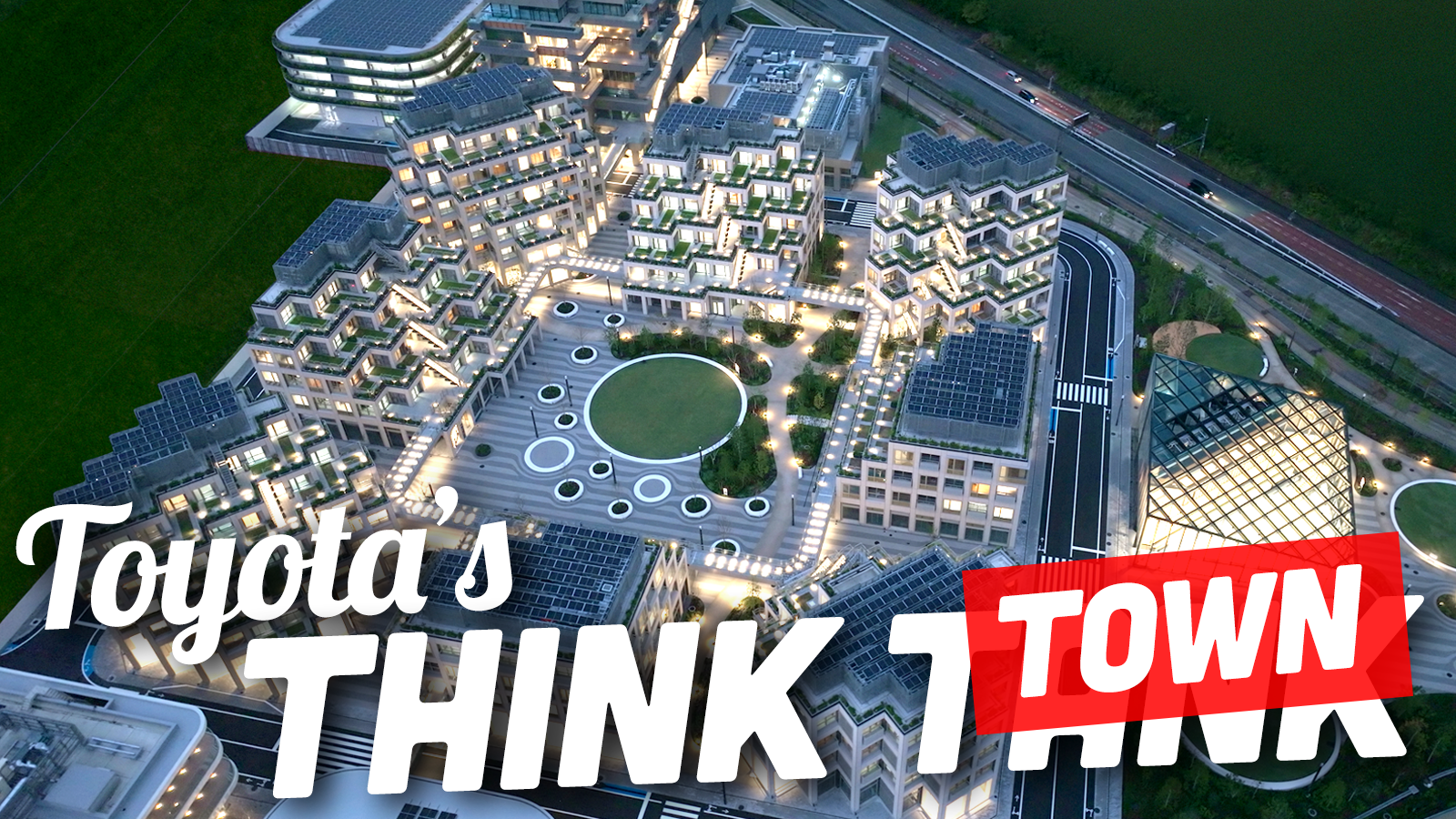
Tucked away in the shadow of Mount Fuji about 70 miles southwest of Tokyo is Woven City. No, this is not a community made from fibers, but a living company town where Toyota and its partners are assembling a range of technologies and testing them on the residents. Woven City was initially announced at CES in 2020 on the eve of a global pandemic and phase one was completed five years later. Last week, Toyota flew us across the Pacific to find out just what they were stitching up in Woven City.
The name of this new community is both a callback to the company’s origins as the Toyoda Automatic Loomworks and reference to what the automaker is trying to do. The place is multiple things at once, a town, a technological and psychographic proving ground, and an incubator for new ideas. One of the themes of Woven City is “kakezan,” a Japanese word meaning multiplication. All aspects of the city are being woven together into an ecosystem for what communities of the future might look like, attempting to multiply and create a whole that is more than the sum of its parts.


The big unanswered question at this point is whether that whole will be a bold vision of what future safer, more convenient communities could become; a dystopian nightmare that Alex Karp could only dream of; or just Akio’s folly. Let’s take a look at what Woven City looks like.
What is Woven City?
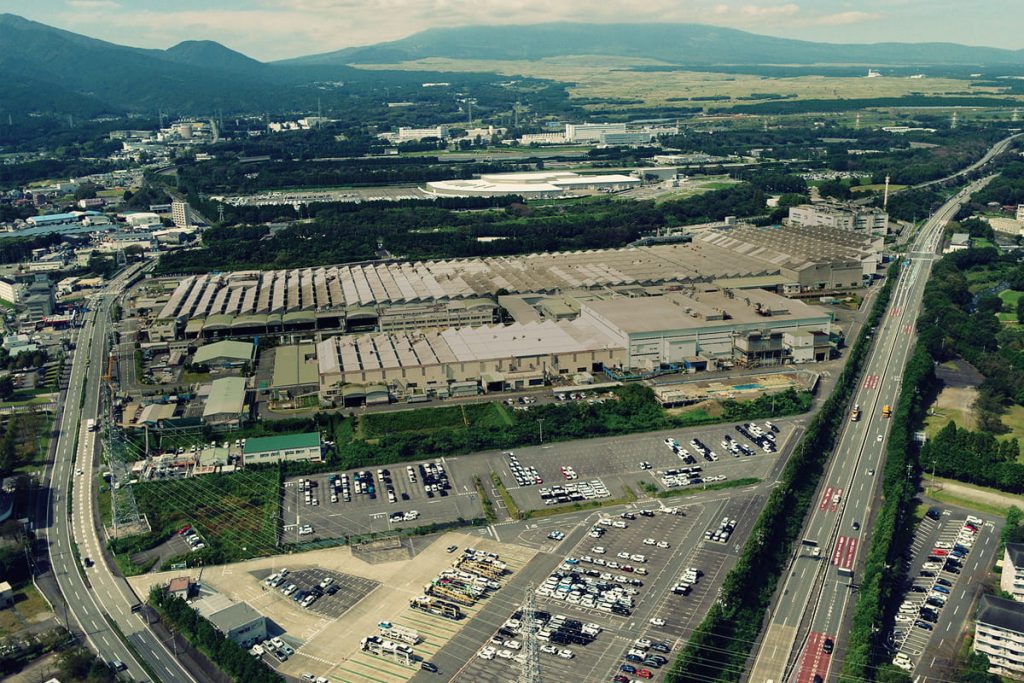
Woven City sits on the site of the former Toyota Motor East Japan Higashi-Fuji factory. Between 1967 and its closing in 2020, the plant produced more than 7.5 million vehicles including the tiny Sports 800 sports car, Corollas and the Century luxury sedan. Of the original factory buildings, only the stamping plant survives which has been transformed into the ‘inventor’s garage.’ The rest of the site has been turned into a test area called ‘inventor’s field’ and two phases of the residential portion where the weavers live. The inventors and weavers are the two core groups of people at Woven City.
There is much about Woven City that is not entirely new, but Toyota has combined several aspects that normally don’t co-exist – the creator community (aka the inventors) and a residential group (the weavers) so that they can interact and create a feedback loop.

The Inventor’s Garage
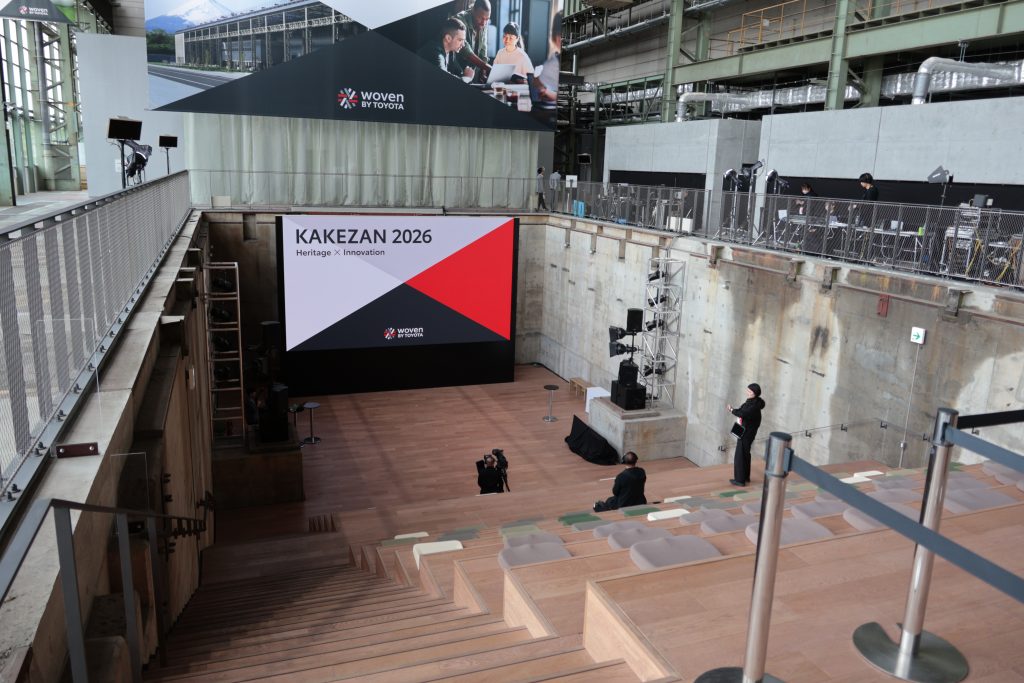
The core of the stamping plant was preserved in a way that invokes its heavy industrial past and looks to the future. All of the stamping presses were removed, apart from one small prototyping press that was kept in its pit with a glass floor above it. Next to that is the pit where a giant press that knocked out body sides used to sit. It has been transformed into a 200-seat theater for presentations. The concrete sides remain, cleaned up as much as the crews could, but still stained by decades worth of die lubricant that soaked into the concrete. Up above, the old skylights and ceiling cranes that moved the multi-ton dies in and out of the presses are still there.
Other parts of the building have been transformed into maker spaces, test labs, design studios and collaborative workspaces. In many respects, the Inventor’s Garage is very similar to other facilities such as NewLab Detroit that Ford created in the old school book depository that sits next door to Michigan Central Station. NewLab now has over 100 startups in residence working on a wide variety of projects from urban EV charging, to drones and electric RVs. Since it opened last fall, the Woven Inventors Garage has become home to 20 groups of inventors with four more announced on the day we visited.
Many of the initial inventor groups are from within various parts of the Toyota Group, but there are an increasing number of outside partners that were announced during our visit including the AI Robot Association, Dai Ichikosho (a commercial karaoke services supplier), Joby Aviation, and Toyota Financial Services, bringing the total to 24 partners so far.
The other main group at Woven City are the weavers. These are the residents living in the community. At the moment there are about 100 people living in 55 households made up of Toyota Group employees and their families, including some children. The eventual goal is to have about 2,000 weavers in the community. They are called weavers, because they are integrating the products and services of the inventor group and into the ecosystem they live in, ultimately with the whole of multiplying it all into something greater than the sum of the parts.
During the week of our visit, Woven City held the Kakezan 2026 event where the inventors were showing off what they were working on, several of which have come out of Woven by Toyota (WbyT). This is a business unit of the group that is responsible for much of the advanced technology development including the development of the city. One of the key parts of WbyT is Arene, the software development team.
Arene is responsible for developing the platform that powers new software defined vehicles from Toyota as well as all of the tools and processes to make this a reality. The first products of Arene’s efforts have already reached production in the form of the new infotainment software and Toyota Safety System 4 driver assists that launched on the 2026 RAV4. Both of these systems were developed in-house by Arene and support full over-the-air software update capability.
According to Jean-Francois Campeau, SVP of Woven and head of Arene, the group does much more than just the software development. They’ve observed the challenges that most legacy automakers have had with modern software development and worked to implement an entirely new organization and processes as well as tools that facilitate agile development. While it’s too early to tell how successful Arene has been, so far we’re not hearing of any of the sort of catastrophic issues that other automakers have had in recent years. Over time, future vehicles will continue to transition to a full Arene-developed software platform that abstracts all of the functions away from the underlying hardware.
The Woven AI Vision Engine
But Arene is doing much more than just the in-vehicle software. It’s also responsible for much of the software at Woven City. This includes the new Woven AI Vision Engine, which is a full vision language model based on an internally developed foundation model. While this is based on similar transformer technology to the chat bots we’ve become familiar with in the last few years, it’s trained on sensor data rather than just the internet’s body of text.

It’s designed to absorb data from cameras and other sensors and try to make sense of the world and make decisions based on the context and behavior of the actors it “sees.” As expected, this is going to be powering the next generation of assisted and automated driving systems on Toyota and Lexus vehicles, but Arene has designed it to do far more.
As we walked around phase 1 of Woven City, the first thing we noticed was some really interesting architecture with nice details, especially using wood and lots of greenery. But looking closer, you also start to see cameras – a lot of cameras, everywhere. Some of this is because this is both a place where people are living and working, but it’s also a testing ground.

For example, Toyota is testing collaborative perception systems which use infrastructure based sensing to expand situational awareness for vehicles and drivers. No matter how many sensors you put on a vehicle, those sensors are inherently limited to line of sight. They can’t see around corners of buildings or even past the vehicle in front.
The National Transportation Safety Board recently issued its investigation report into a pair of fatal crashes of Ford vehicles with BlueCruise. In one case the Mach-E in hands-free mode struck a stopped vehicle in the same lane after another vehicle that had been between them pulled over into the adjacent lane. The Ford never braked, but also may not have had enough time to respond because it wasn’t aware of the stopped vehicle.
Another recent incident involved a Waymo robotaxi striking a young child who ran out from behind a parked car. The Waymo detected the girl when she became visible, but by then it was too close to come to a full stop.
Both of these situations might (emphasizing might) have been avoided if infrastructure based sensing had provided information to the vehicles about hazards that were initially out of line of sight. That’s one of the things that Arene is evaluating at Woven City. Similarly, external sensing might detect other hazards or blockages and automatically reroute transit or automated vehicles to avoid gridlock or pre-emptively control traffic signals to aid emergency vehicles.
But there’s also a dark side to all of this that I’ll come back to later.
AI That Pauses Itself With Integrated ANZEN
The Japanese word for security or safety is Anzen and the Arene team has incorporated AI in an interesting way to enhance safety – specifically to make the driver safer by avoiding distractions from AI. The integrated Anzen system is using in-vehicle sensing help detect the driver’s mental and physiological state of mind. Many Toyota vehicles already include an infrared driver monitor camera mounted on the steering column and some also have capacitive sensors in the steering wheel. Pretty much all new vehicles also have torque sensors on the steering column.

With these sensors the Anzen system develops a baseline model of each driver over time and then tries to detect the driver’s state in real time based on where they are looking, eye gaze, head position as well as what they are doing with their hands. As the driver’s mental/physical state score increases, such as when they need to make a difficult turn or merge onto a highway, it may eventually cross a threshold. When that happens, the in-vehicle interactions with the driver such as navigation prompts or other voice interactions are automatically paused until the driver’s score drops back below the threshold.

Toyota demonstrated this with a vehicle in a simulation environment. As the driver approached certain situations and the score spiked, the voice system in the vehicle automatically paused until that situation passed. It’s unclear how reliable this system will be in the real world with many drivers that have different responses to stimuli, but there are many companies using in-vehicle sensors to provide a more robust detection of the driver’s state of mind and some of those could be integrated by Toyota to give a more reliable system. In the previously mentioned NTSB BlueCruise report, one of the key recommendations was to improve the reliability of driver attention monitoring so this may be a step in that direction.
Shared Vehicles and Virtual Power Plants
Another benefit of a planned community like this, where enhancing mobility is a target, is that you can build around ideas that hopefully lead to better outcomes for everyone. Toyota is providing the entire community with a shared fleet of bZ electric crossovers and e-Palette shuttles. Since the residences are all apartment style buildings more like what you’ll find in most urban Japanese and Asian cities, parking needs to be somewhat remote. The Woven City team has built a parking garage that incorporates rooftop solar charging, bidirectional charging and a software platform that transforms it all into a virtual power plant (VPP).
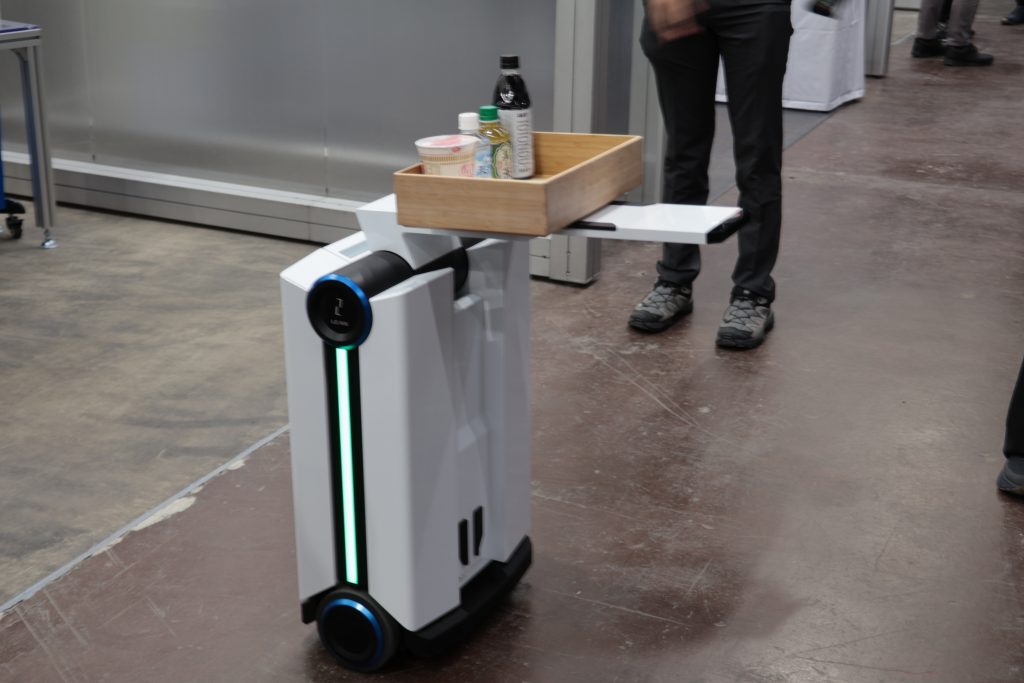
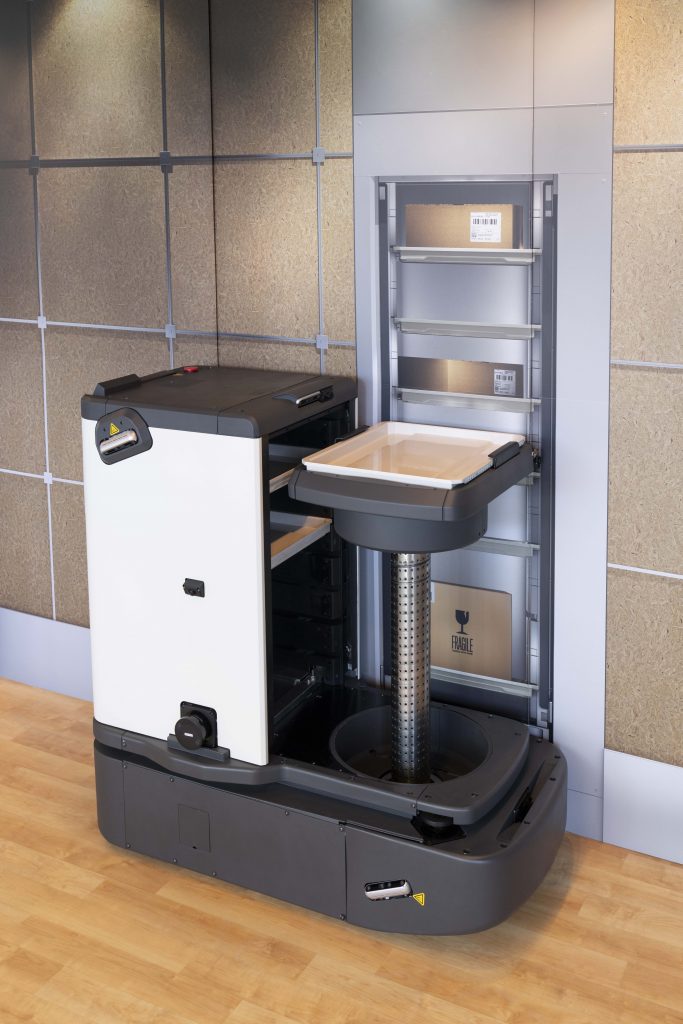
When someone needs a vehicle to go somewhere, they can use the Woven City app and request a car. An autonomous tow vehicle–called the Guide Mobi–then brings the vehicle to the driver’s location. The Guide Mobi is designed to be used for a variety of applications including being a general utility vehicle for making deliveries, use by grounds keepers and more. But the summon capability is particularly interesting.
The Guide Mobi is equipped with cameras, radar and lidar to help ensure safe operation in all conditions. The lidar in particular is obviously not on most vehicles today and adds cost. The Guide Mobi stops in proximity to the vehicle about to be delivered and connects via wifi. It then acts as a wireless tow vehicle, using its sensors to safely “tow” the bZ to the location of the driver. When a driver returns from their trip, they can exit by their building and another Guide Mobi will arrive to “tow” the vehicle back to the parking garage.
The virtual towing idea is far from a new one. I got a demonstration of the same idea from Honda at the ITS World Congress in 2014, although in that case the tow vehicle was being driven by a human.
Once parked and plugged in, the fleet of vehicles are charged at least partially from the solar array. They also act as an energy storage system for the whole community. These can help reduce peak loads on the grid and provide some stored solar power during the night. When coordinated with the utility, the VPP can even provide power back to the grid to help maintain balance at peak load times. The entire energy management system has been developed internally at Toyota and it’s currently targeted toward fleet operators. However, it could also be scaled, eventually enabling individual households to participate in providing grid support.
Swake and e-Palette
The bZ fleet is primarily targeted at transportation needs outside of Woven City. Within the community, there are the e-Palette shuttles which can accommodate up to 17-passengers. These were first shown as concepts at the 2019 CES and can be used for more than just moving people. In the early stages of Woven City, the e-Palettes are manually driven, but Toyota and its partners such as May Mobility are also testing automated versions and these will eventually be deployed here as well.

Toyota is also testing e-Palette as a service where the shuttles can be equipped with a variety of interior upfits. We saw one that was a mobile coffee shop, another set up as a convenience store, and a third was a mobile office space with a work table and a large screen for presentations. Inside the inventors hub building in phase 1, there was a full-size mockup that can be used to test various upfit combinations and system integration.
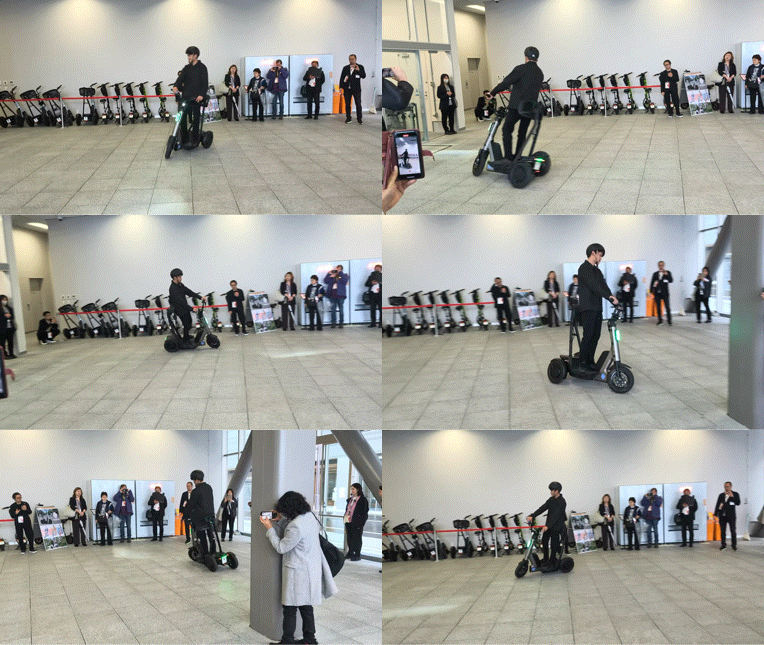
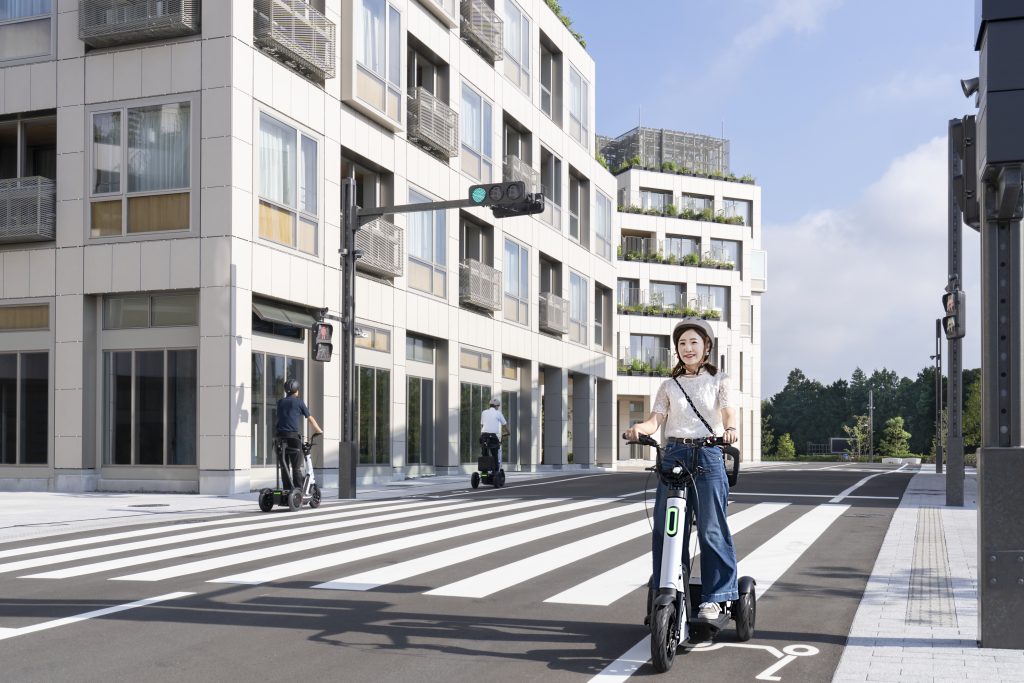
The other primary method of getting around besides walking is the Swake. This is a personal mobility device designed by Toyota. It’s basically a stand-up three-wheeled scooter, but it leans into turns and has a backrest that riders can lean on for added support. The batteries are swappable and provide about 20 miles of range. It’s not an entirely new concept, Toyota seems to have executed it quite well and while we didn’t have a chance to ride one on the rainy afternoon we spent touring the city, the employees who demo’d the Swake seemed to be having a good time.
During the construction of Woven City, the crews also built an underground tunnel network that can be used for pickups and deliveries as well as maintenance access. The Guide Mobi vehicles are the primary means for moving items through the tunnels.
Fully Monitored UCC Coffee Shop
One of the fascinating aspects of Japan is the prevalence of vending machines almost everywhere. Walk around Tokyo or other cities and you’ll find banks of vending machines that dispense almost anything. Among those, many sell coffee in cans, a concept that was pioneered by the Ueshima Coffee Company or UCC in 1969. UCC also has a chain of more traditional coffee shops throughout Japan. UCC is one of the inventor partners for Woven City.
One slightly less traditional UCC coffee shop exists in Woven City. Walking in, it all looks pretty normal, you walk up to the counter, order your drink and/or snacks and then sit down. However, if you sit in the back part of the shop, and you look up at the ceiling, you’ll see more of those tell-tale half domes that contain the cameras. But these aren’t just there for security to keep tabs on over-caffeinated teen hooligans that might be looking to cause some trouble.

The cameras at the UCC shop are there to monitor the behavior of customers as they drink their coffee or tea and are backed up by the aforementioned AI Vision Engine. To me, this is one of the first real instances where I see Woven City’s use of AI perhaps steering into the nefarious zone. Once a customer sits down with a drink, the type of drink is known and the behavior of the customer is recorded and analyzed. Is the customer just sitting there resting? Do they seem tired? Are they going to work on a laptop? How much are they seeming to concentrate? How long do they stick around? UCC wants to know what the response is as part of their market research.
Weavers in Woven City know they are being tracked and they have given their consent before moving in. But this is all something that might not go over as well in another location. And given potential for bias from a self-selected group of participants, it’s not clear how useful the results will actually be. Only time will tell.
The City Itself
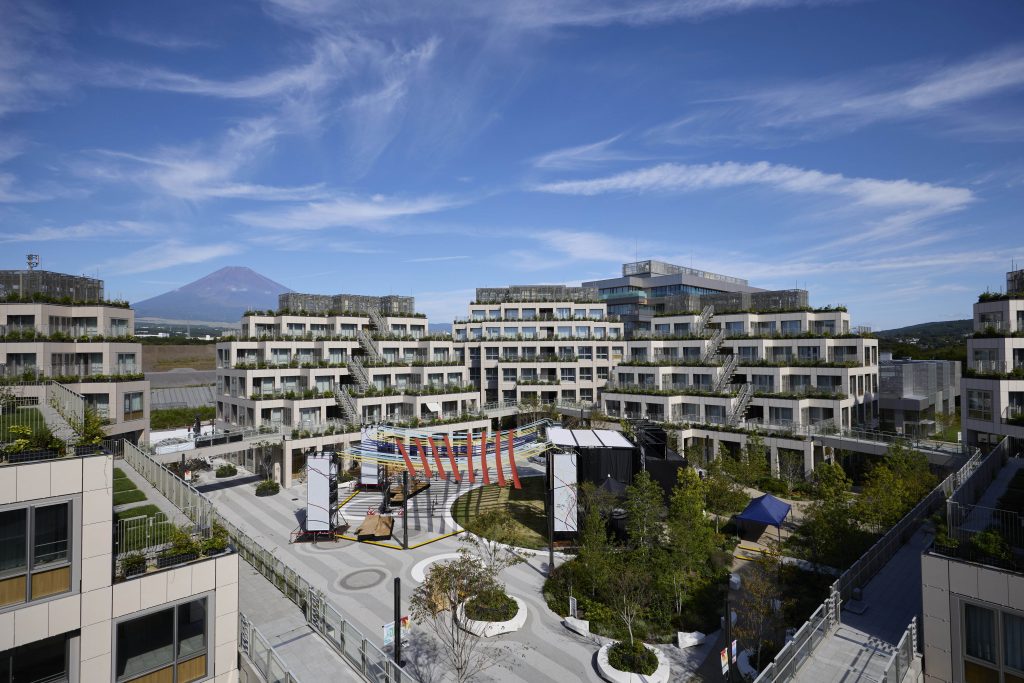
There are going to be countless experiments run at Woven City in the coming months and years. But what does the town itself look like? From an architectural perspective, it’s actually quite attractive and modern. There are no single-family homes, but the apartment buildings are all about four to six stories tall and each level is terraced back and features some green space that gives it an inviting feel. In phase 1, the residential buildings are arranged around a central courtyard with common space for people to gather and children to play. The buildings are primarily concrete and glass, but there are other materials worked in, including wood.
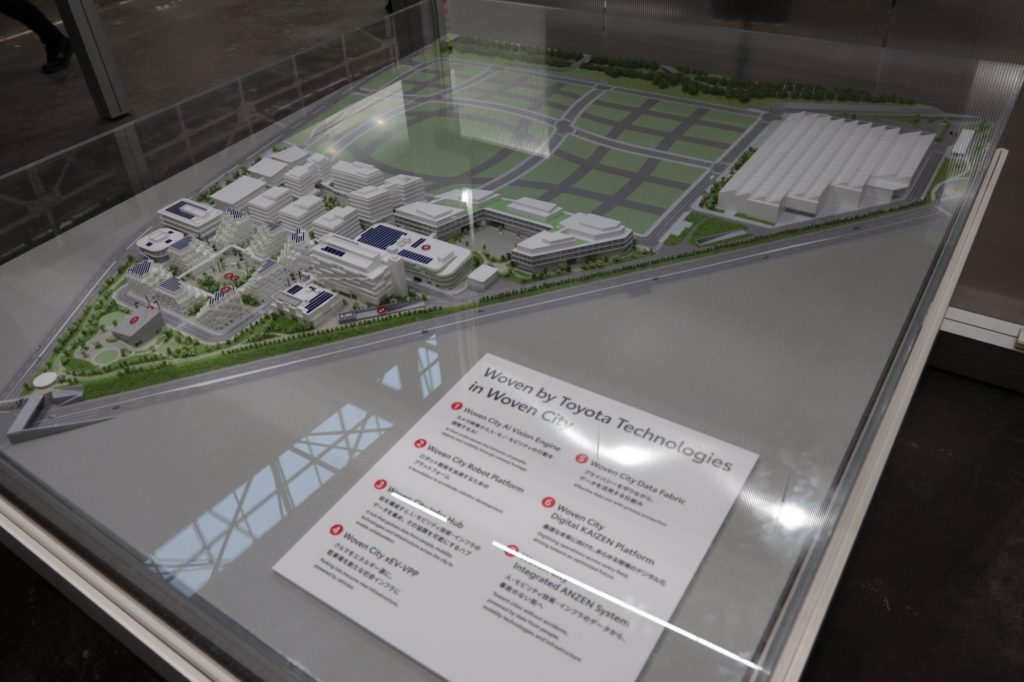
The first hundred residents are all employees of Toyota group companies and their families. Going forward, WbyT wants to bring in more people from partner companies and even outsiders to eventually get to about 2,000 residents. There are other buildings including a welcome center, some commercial space and the inventors hub. The hub is separate from the inventor’s garage and is a space where inventors can interact with the weavers and get direct feedback on projects they are working on. One of the four new inventors, Joby has already installed a simulator for its upcoming e-VTOL aircraft.

Another is a prototype vending machine from DyDo, a manufacturer of many of the machines already in use across Japan. However, unlike traditional machines, this has no indications of what it contains, or a window to see what products are on offer. There is just a bare white front with a dispensing slot at the bottom. Is it tied in to the Vision AI Engine to detect who is approaching and dispense their usual items automatically? No one present was quite sure how it worked. The unit in the inventor’s hub was covered in post-it notes from weavers providing feedback and while I don’t read Japanese, apparently they were not all praising the new design.

Say Hello to Akio-Bot
One of the most questionable demonstrations we saw was the Akio AI. Three years ago, Toyoda stepped down as company president and is now chairman of the company his grandfather started. As he approaches his 70th birthday, there was a desire to provide a way for employees to ask questions and get responses that reflect Akio-san’s views and approach to leadership. Thus a team created a retrieval augmented generation (RAG) system based on a large language model.
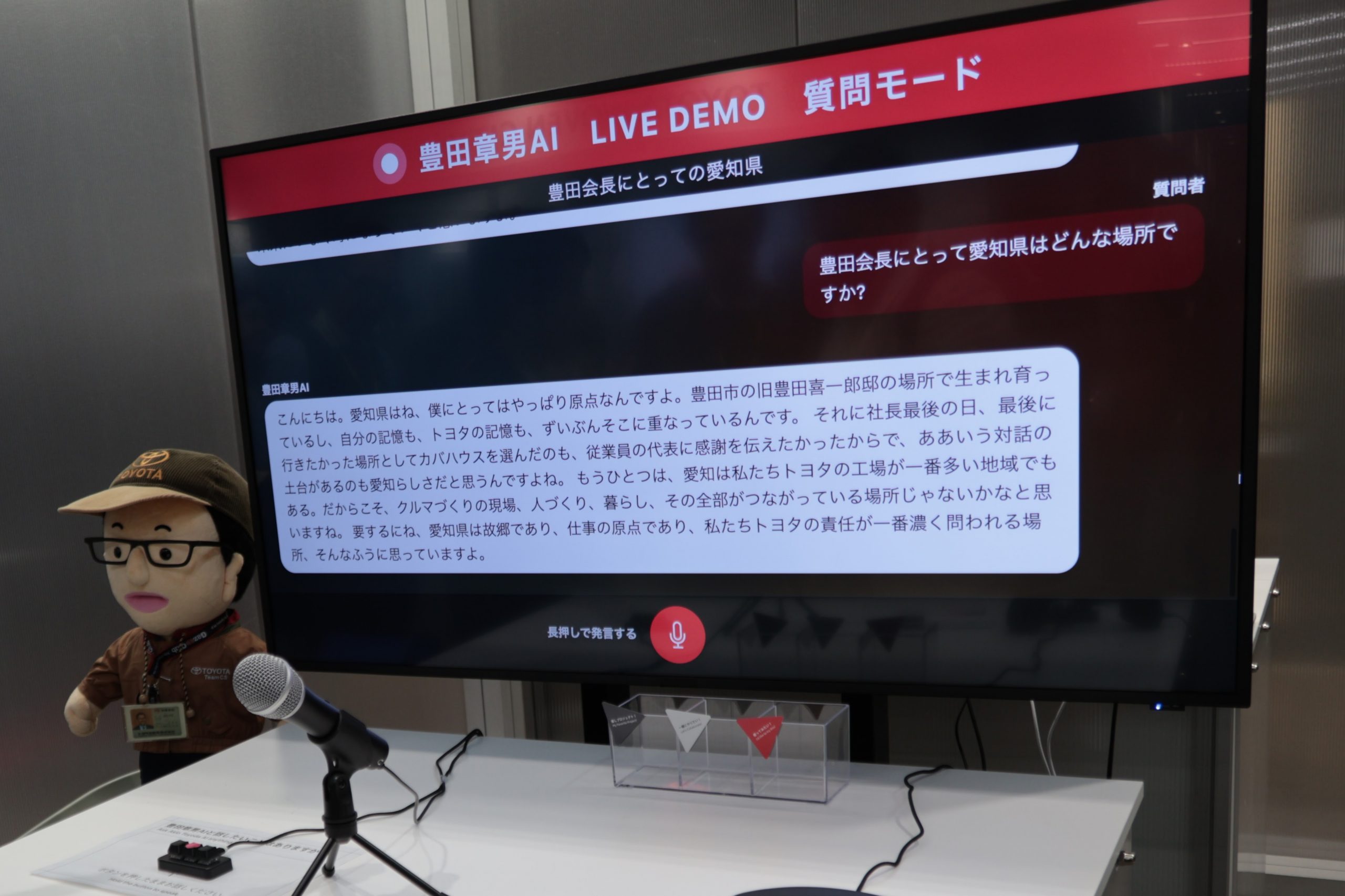
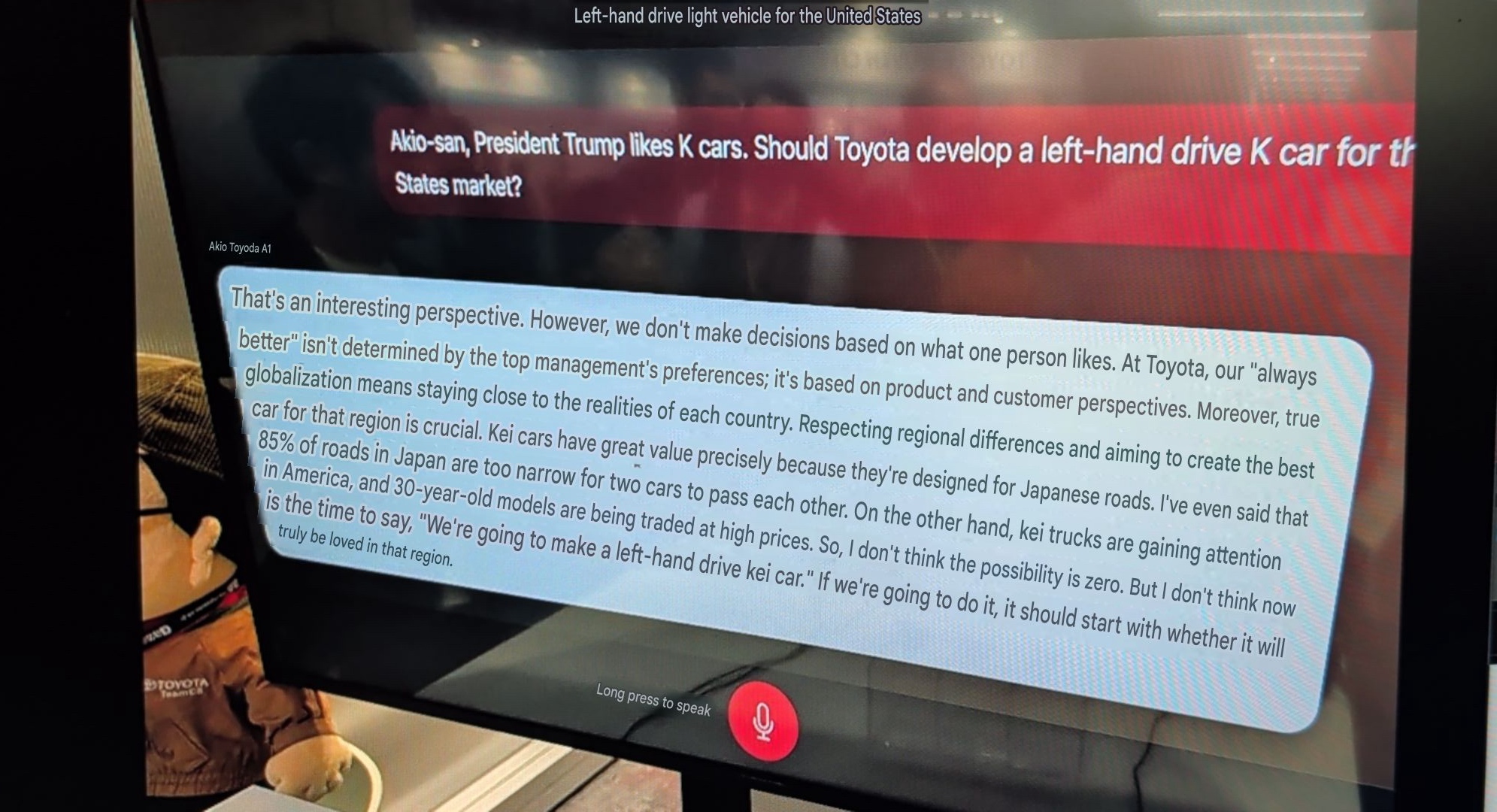
They fed the RAG system all of the writings and speeches given by Akio-san for over a decade and began testing it. The goal of RAG is to only provide answers based on the corpus of data provided without making anything up. The system is designed to work with either text or voice input and for a demonstration they had a microphone set up that allowed users to ask questions of the Akio-bot. My friend Tim Stevens asked that since the president recently acknowledged being such a fan of Kei-cars would Toyota bring these little machines to America. The Akio AI gave a mostly non-commital answer that said it would not be easy and it wouldn’t be done because of one person, but only if Toyota felt there was a sufficient market to justify the investment.
Currently the Akio AI is accessible to Toyota employees through the company Slack although they are also working on a web app. Akio-san has been involved in evaluating the system and providing feedback on the responses so the development team can fine tune it. It’s unclear if the Akio AI will ever be made available to the general public.
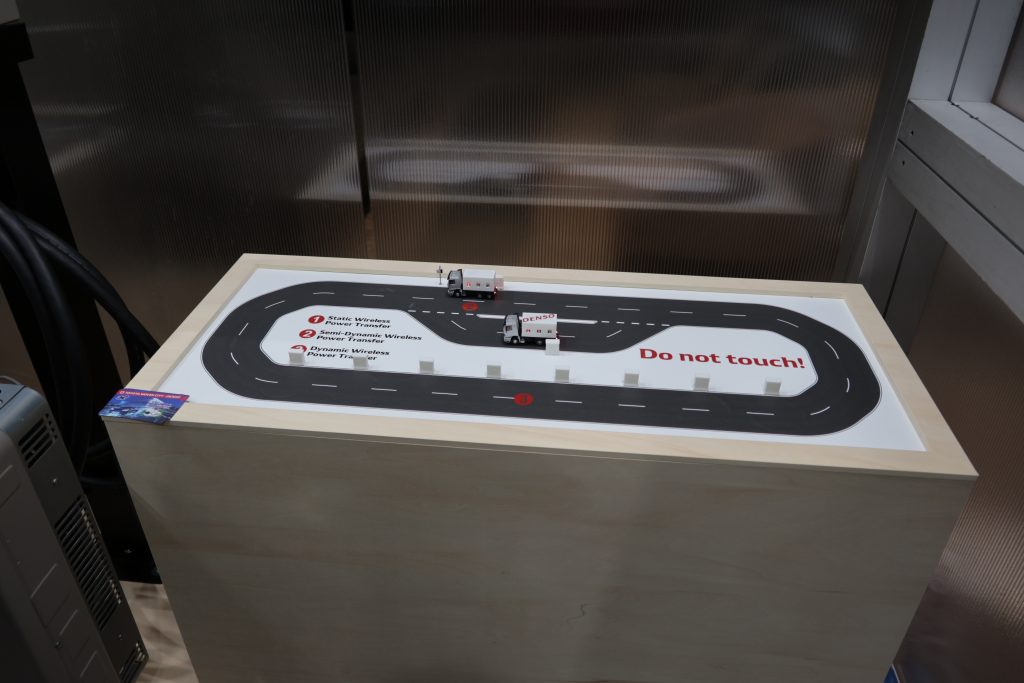
There are a variety of other projects happening at Woven City including sidewalk delivery bots, a dynamic wireless charging system from Denso and an automated karaoke playlist generator, but the ones I’ve described here give you a pretty good picture of what WbyT is up to.
The Bottom Line
In the end, what is Woven City really all about? A lot depends on your perspective and whether you’re a glass-half-full or ⅞ empty type of a person. If we grant that Toyota only has the best intentions to make society better, safer and easier to get around, it’s a really fascinating approach to a proving ground for new technologies. There’s pretty much nowhere else that you’ll find an automaker test facility where people are actually living there with their families. At least everyone involved is a willing participant with informed consent (at least the adults are if not the children).
This is unlike what Tesla has done for the past decade with AutoPilot/FSD where they are putting beta safety critical software into the hands of untrained customers and seeing how it does on roads with hundreds of millions of people who gave no consent to being part of CEO Elon Musk’s experiment.
The darker side is that we also live in a world where entities like Palantir, Meta, ICE and Chinese government authorities all exist. If the infrastructure for continuous monitoring is there for positive reasons, there’s a good chance it may be utilized by less noble actors to try to control the populace. That’s the glass 7/8th empty scenario. [Ed note: See also: The Dark Knight – MH]
So far, at least in Asia, residents may be somewhat more willing to give up some information about their movements in exchange for the potential benefits of a safer environment. It’s always been apparent that powerful technologies in the hands of those with nefarious intentions can lead to very bad results. Coffee shops full of cameras with AI that detects how people are responding to coffee or what they are doing or a community with cameras and other sensors everywhere, just seems ripe for abuse.
WbyT CTO John Absmeier acknowledges that the group of weavers in Woven City are a somewhat self-selected group that are enthusiastic about the prospect of trying new things which may in turn lead to a bias about their feedback. That’s a prospect that Toyota is going to have to find a way to address so that the results of the testing are more valid.
There’s no guarantee how much if anything that we saw at Woven City will ever pass beyond its perimeter. There are some really cool elements like the parking garage VPP and the Guide Mobi system that are at worst benign but mostly really good. In a better world, this will make communities better places to live. But as I told Ford’s former futurist Sheryl Connelly in a conversation several years ago about my personal view of the world, “I’m hopeful, but not optimistic.”
As I’ve gotten older, my view has definitely skewed toward the not optimistic end of that statement. Hopefully, time will prove me wrong.


Sometimes I think big tech companies watch Black Mirror for the ideas rather than the warnings.
These are solutions in search of a problem. A barista who forms relationships with their customers knows their habits and what sells. “Automated” transit exists in busses and light rail, but really cities should be built to be walked anyway. Short travel needs can be addressed by walking or biking. Vending machine are perfectly fine. I’m so tired of engineers doing stuff just to do it and then sales and marketing trying to pitch it as an iPhone moment.
So, I’m an engineer, with a deep hate for innovation for the sake of it.
Some stuff here does seems a little dystopic (AI coffee shop for exemple), but automating vehicle delivery to allow real world “vehicle as a service” while also adding energy storage to the grid? That’s not marketing BS. Especially as every layman I’ve tried explaining this to has answered “so the GOVERNMENT is going to use up my car and degrade its battery?!”.
I am not even hopefully for the future, but there seems to be some good stuff in that Toyota experiment. (Which will be irrelevant since we’ll anihilate ourselved over our home made envoronmental collapse).
I don’t disagree with some solutions here. And I suppose looking at the entire thing as a lab to test things isn’t a bad way to go. But most tech development in the automotive space (particularly in regards to automation) is a solved problem for most individuals in the form of mass transit.
I do think automation of vehicles has a market in industrial uses, but mass market self driving cars are a waste.
The issue with mass transit is that it’s not as quick or comfortable as car ownership.
I do love our TGV in France but getting to the train station is a bitch as I live on the country side. We don’t even get busses here, so I wouldn’t mind renting an EV to go to the train or work from time to time.
“These are solutions in search of a problem. A barista who forms relationships with their customers knows their habits and what sells.”
And then expects a tip. There’s your problem.
In the US, not other parts of the world.
Till it spreads.
If only they were paid enough to begin with.
Well it’s certainly not for lack of the amount on the bill!
While I understand all the concerns, I find this super interesting and wouldn’t mind being part of it.
“I will not be pushed, filed, stamped, indexed, briefed, debriefed, or numbered. My life is my own.”
Be seeing you…
I like reading about the same event from different publications. For instance, ArsTechnica covered it and had the subheader of it being “a privacy nightmare but could be helpful to an OEM despearte to be more.” They also pointed out that Swakes and various other robots were unavailable due to all the rain. Good thing rain never happens /s
These from the ground up “smart cities” are always sort of interesting to me. But I always see them as sort of a company town you volunteer to be a part of. Even when you buy in to them and might not work for the companies involved they leave their mark. But could be some innovations if you don’t have the restrictions of a normal city or town. Along with people who choose to live with all the innovation and possible problems that might be encountered.
This is why philosophy is important to these projects and companies as they dont have any morals themselves. The problem is so many are looking to theology for morals and they aren’t exactly connected. In Japan where you have a homogeneous society and sort of morals built in with a belief system that is sort of around but maybe not practiced or believed fully but the traditions are mainly embracing might foster this sort of thing well. Just like in China were you sort of have a similar situation just with a much more tyrannical government.
In most Asian countries its not all that strange to live in a rented space that is owned or affiliated with your employer. The whole “sold my soul to the company store” thing has long been sited a problem for these type of cities in the west. Hard to shake those problems. Though guess Ford was able to somewhat. But he would himself show up at people’s houses to make sure they were living the way he thought they should.
Panasonic is involved in a smart city by the Denver airport that is being built after a big showcase maybe a decade ago. There is that one that keeps falling on its face in Arizona because they didn’t want people to have cars in the middle of the desert. Several planned in Texas that sort have gone nowhere. Ironically ross perot made Plano a hub for business just by buying land and building his headquarters there. Alot of these other planned cities in the west sort of fall on their face and get absorbed by the communities / cities around them. Maybe with the whole rebuild every 20 years thing the Japanese often have it’s more of ideal situation for a “smart city”.
“As the driver’s mental/physical state score increases, such as when they need to make a difficult turn or merge onto a highway, it may eventually cross a threshold. When that happens, the in-vehicle interactions with the driver such as navigation prompts or other voice interactions are automatically paused until the driver’s score drops back below the threshold.”
“Leave me alone, I know what I’m doing.”
Kimi?
The fact that they start out dividing people into two different groups or factions tells me already that this will fail.
What could you possibly mean by that?
Oh I don’t know….
Sounds like a fresh hell nightmare!
The Mobi “tow” vehicle is a neat idea, but it just sounds like a fancy valet. The only one of these ideas I actually like is the blind spot communication system. Self driving cars should be able to communicate with infrastructure as well as other vehicles. There had to be a car ahead of the Mach E that noticed the stalled car and could report the hazard before the sensors could “see” it.
This is getting WAYYYY too close to “Torment Nexus” territory.
It might be non-committal, but as someone who works for a Japanese company, that’s also a very Japanese answer to such an open-ended question.
I thought Company towns died 100 or so years ago…
they’re really all in on hydrogen, huh
US companies are obsessed with the Toyota way. One of the things that I’ve seen that pissed off employees is step tracking.
Let’s say I have a process to do something. To follow the Toyota Way, I would put a camera (or set of cameras) in the area that that process is taking place and trace the most common path that the workers take.
Once I see how people move to do their job, I can optimize it. Perhaps moving this tool from there to here. Perhaps getting a cart that you can load up with stuff so you can do one trip instead of five. Perhaps a second set of tools so that you don’t have to lug them from place to place all the time. There’s an entire process optimization thing that can make huge differences in not just how efficient things go, but how safe as well.
HOWEVER… A lot of companies use CCTV as a tool for catching employees not working instead of finding ways to improve how efficient they work. I see 8 people working and 2 people farting around, let’s fire 2 of them! We can do the work of 10 with 8, a 20% improvement, and never get a cart or a second set of tools or any of that Toyota BSery.
Within Toyota, workers seem to accept the idea of step-tracking via CCTV. So, the creepy coffeeshop is just Toyota finding ways to be more efficient and to make their jobs easier in the future. With other companies, this would be seen as a way for a company to fire you and replace you with a robot.
There’s a fundamental difference in the employee-management relationship between the US and Japan, and it’s not just a business cultural difference. It’s a basic social cultural difference. It directly informs US workers’ reticence to accepting those kinds of monitoring for efficiency.
It the US, it can work, but typically only if it’s a bottom-up presentation to management. Not a top-down imposition from management. Meanwhile, in Japan, if management implements such a system, it’s viewed as management being conscientious and informing themselves so as not to lose touch with worker’s needs and the needs of the company as a whole. Completely different cultural viewpoints.
The downside in Japan, is, of course, the all-consuming team work culture that spills heavily into life outside of the workplace. Work/life guardrails are a good thing, and something Japanese culture is slow to adopt.
You articulated this better than I ever could have.
Yeah, this is why it’s so important to contextualize Japanese culture with articles like this. As someone who frequently visits Japan for work and vacation, I see many elements of Japanese culture built around lessening individualism and strengthening social cooperation: most of the Japanese population lives and works in extremely close proximity to each other, so let’s all be polite and make that situation as pleasant and harmonious as possible. It’s not socialism in the economic or political sense, it’s simply not offending those around you and treating others as you would want to be treated.
Take Tokyo subways: you will be cramped shoulder to shoulder with literally 1000 other people during rush hours, but in most cases, you could hear a pin drop. Everyone keeps quiet, nobody is playing loud music, etc. It doesn’t smell, and despite the fact that hundreds of thousands of people walk through that station every day, it’s extremely clean.
Pivoting back to the AI cameras, I genuinely believe they only see them as tools for cooperating together better as a society. That seems hopelessly optimistic to most western cultures, where individualism reigns supreme.
I was very much involved in the design of the machine vision and tracking approaches you speak of around 30 years ago. You are totally spot on. For Toyota it was a continuous improvement of the workplace, with the attendant benefits in productivity. For the US corporations it was a continuous friction with the workforce and incitement to game or sabotage the system.
My work is far from production line, but there has been a push to do step tracing and the like. It is not being looked upon favorably by workers.
It’s like 30 years ago, someone started a rumor where I worked that the company was timing how long people spent in the bathroom and there was nearly a strike.
I’m sure this will totally not worsen Japan’s already insanely unhealthy work culture.
I work for a Japanese company, and I’d say Japanese corporate culture is much different than it was pre-COVID. Talking with my colleagues, many actually work from home most of the week, and while late nights in the office can still happen, it’s much less of the expectation. Of course it depends on the industry, but I’ve been traveling to Japan for over 15 years, and the stereotypical “salaryman” work culture has been getting more balanced.
The nice thing is that if my computer ever blows up, I can ring the NSA and get a backup. But I think that personal service is only available by being arrested for federal crimes.
On a more serious note, the amount of data held by Google, Apple, your ISP, and all your mobile phone apps track you – for the ability of ANY government entity to pull that data from you should disturb you just as much as any “China” commentary.
Palantir, otoh, that should be terrifying for everyone.
Some people say a man is made out of mud
A poor man’s made out of muscle and blood
Muscle and blood and skin and bones
A mind that’s weak and a back that’s strong
You load sixteen toyotas worth of coal, what do you get?
Another day older and deeper in debt
Saint Peter, don’t you call me ’cause I can’t go
I owe my soul to the company store
I was born one morning when the sun didn’t shine
I picked up my wrench and I walked to the mine
I loaded sixteen toyotas of number nine coal
And the AI boss said, “Well, a-bless my soul”
You load sixteen toyotas, what do you get?
Another day older and deeper in debt
Saint Peter, don’t you call me ’cause I can’t go
I owe my soul to the company store
Honda needs to drop everything and create an AI version of Soichiro.
That’s a terrible idea. What if someone is holding a stack of dishes and they do what you say? I’ll tell you… there’s gonna be a big CRASH and a big mess… especially if there was food on those plates???
Who’s gonna clean up that mess??? Not me I’m telling you right now…
And you have to clean up that mess fast or you’re gonna attract ANTS!!! And you don’t want to have ANTS!!!
Now if you said “Honda needs to safely and carefully put things down and create a Soichiro AI”, that I can get on board with since there will be no mess to clean up!