

The most fortunate buyers in the car market right now are those with a reasonably nice trade-in–like a 2019 Honda Accord–who want a reasonably nice new car. The least fortunate might be those looking to buy anything under three years old in decent condition.
Politics guides the car market, and the industry is going through a dramatic switch from an administration that believed consumers would quickly embrace EVs to an administration that believes it can both stoke job creation while also making it more expensive to build cars in the United States. A big sticking point between the USA and Canada is cars, and it won’t seem to unstick.


Making it more expensive to build cars outside the United States doesn’t magically create more jobs inside the United States, and the result of the current president’s policies might mean fewer jobs than under the last guy. What’s going on there?
And, finally, one of the best racing magazines will be no more, as magazines continue to be less of a thing.
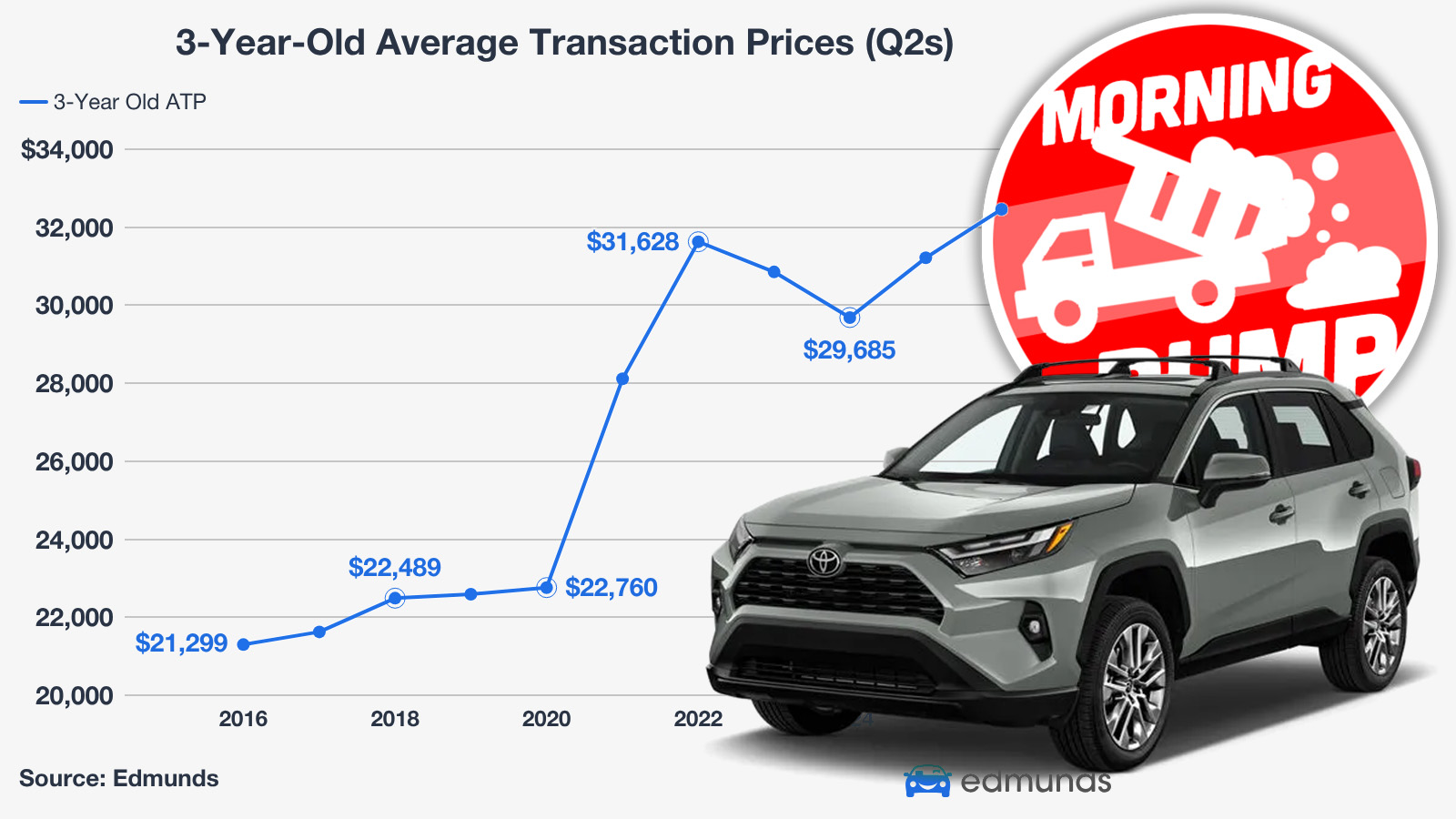
The Average Transaction Price For A 3-Year-Old Used Car Is A Record $32,461
Before I get into The Morning Dump, a big thanks to Thomas for covering for me last week so I could spend my week covering Monterey Car Week. Most of the cars sold there were older than three years and the average price was probably $200,000, depending on the auction you visited.
Prices aren’t that high right now outside of Monterey, but you can see how bad it’s gotten in the chart below.

This comes from Edmunds, which reports that the 3-year-old transaction price in Q2 rose to $32,461, which is a record, and even worse than the pandemic surge. The vehicle shortage that resulted from the pandemic semiconductor shortage seems to have permanently repriced the used car market.
While progress was beginning to be made as more inventory came online, the 3-year-old used car market is, by definition, on a lag. The cars that were too expensive in 2023 are now still quite expensive in 2026, and new cars are also way more expensive. Can I blame trimflation for this? It’s definitely a factor. With limited ability to build cars, automakers prioritized making higher trim models.
Automakers are offering more base models now, and 2023 might be the absolute peak of trimflation. In addition to trim-level limitations, model preference plays a huge factor. People are buying fewer small sedans new, which means there are fewer small sedans on the used market. All of these factors drive up the price simply because of the inventory mix available.

As Edmunds points out, the worst result for affordability is the lack of lower-priced options:
In Q2 2026, the average vehicle sold in the $10,000-$15,000 range was 8.7 years old and carried 98,222 miles. In Q2 2019, that same budget bought a 4.7-year-old vehicle with 58,250 miles. In other words, a $10,000-15,000 budget now buys a vehicle that’s four years older and has roughly 40,000 additional miles on the odometer.
The trend extends across every affordable price range in the used market. In the $15,000-$20,000 price range, the average vehicle age has climbed from 3.4 years to 6 years, while the average mileage has climbed from 41,851 to 71,192. Even vehicles priced between $5,000 and $10,000 are getting older, with the average age rising from 8.1 years to 10.7 years and typical mileage now exceeding 120,000 miles.
That sucks for used car buyers, and all this goes to explain how Americans managed to add $211 billion in new auto loans in Q2. For new car buyers, it’s a little better and Cox Automotive data shows that affordability for new cars stayed roughly static this summer.
As I wrote last month, the flip side of this is that someone with a reasonably nice trade-in has a lot more power to reduce the cost of a new (or used) car purchase.
Canada And The United States Square Off Over More Than Hockey

I’ve already written ad nauseam about the importance of Canada and Mexico to carmakers and consumers in the United States. The linchpin of the whole thing is the USMCA, which is an imperfect yet completely operable set of rules that allows for reasonably free trade of cars and components between the countries.
If there’s one thing this current White House hates it’s an imperfect yet completely operable set of conditions, though its ability to improve upon imperfection has been questionable at best. For carmakers (and car buyers), the weird result has been that it’s suddenly more efficient for some to build cars outside the United States than inside.
An interim set of exemptions was granted to try to cover for this, but President Trump has proposed new rules that go into effect at midnight tonight.
Negotiators have been working for days to try to craft an agreement that would avert 50% duties on a range of US imports from Canada, including milk, beer, plywood and hockey equipment. Both sides are also seeking to reduce existing tariffs and trade barriers they have on each other.
[…]
Trump put a 25% tariff on foreign cars and trucks last year, but offered Canada and Mexico a partial break based on US parts in the supply chain. A vehicle assembled in Ontario with half US content would have an effective tariff rate of 12.5%, for example.
Canada has pushed to reduce the headline tariff rate on autos to 10% or expand the exemption, according to people with knowledge of the discussions who spoke on condition of anonymity. But the Trump administration has held firm to a minimum 15% rate, the people said.
I’ll have an update in the morning.
Where Are The Jobs?
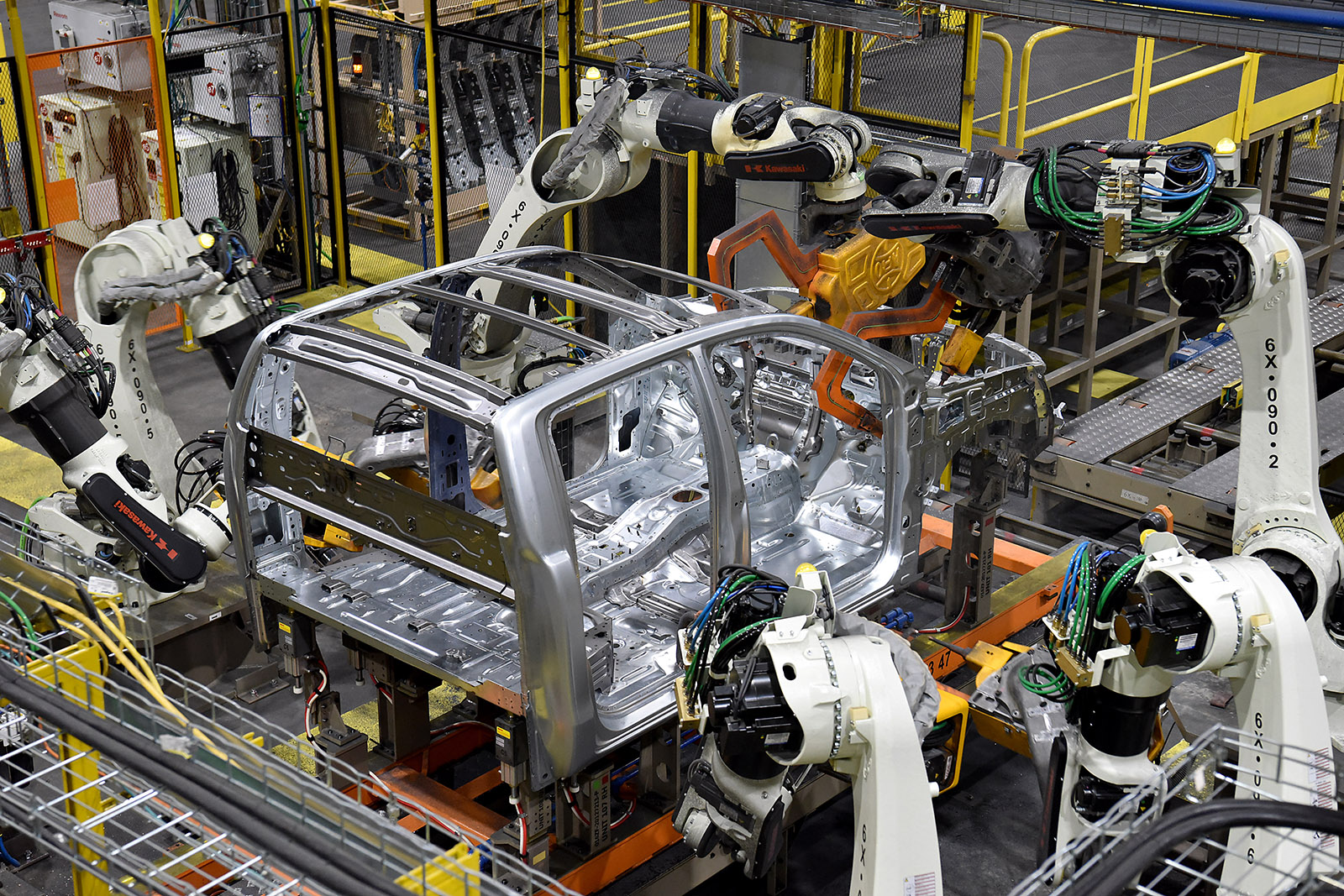
For all the talk from this White House about bringing back manufacturing jobs, the reality is that under President Biden there were more people employed at motor vehicle and parts facilities in the United States.
Why is this happening? Some of it is the EV headfake, as plants that were being built or being planned are suddenly not needed. Some of this is the trade war, which has left automakers and parts suppliers to deal with huge tariff bills and a need to save money.
Assuming those costs stay high, this might have the knock-on effect of driving the industry towards automation even faster as Automotive News reports:
A closely watched index from the Institute for Supply Management shows economic activity in the manufacturing sector expanding in July for the seventh consecutive month. July also saw the index’s highest reading since May 2022.
But more manufacturing activity has not translated to more jobs.
That indicates the growing use of automation for auto suppliers. The artificial intelligence boom is driving record gains in the stock market, but it’s also made it easier for manufacturers to turn to robots on the line to drive output.
The article goes on to point out that re-shoring will maybe, eventually bring more jobs to the United States, and I assume that’s what will happen. I’m just not sure it’ll be as many jobs as in the past and I wonder what happens if we have a new administration that gets rid of a lot of the trade barriers.
RIP Racer Magazine

After 34 years and 341 issues, the print edition of Racer magazine has been “axed with immediate effect” according to the magazine’s now-former EIC David Malsher-Lopez.
This is an unfortunate trend in the industry, with most of the major print car magazines either eliminating or reducing the number of print issues.
It seems like the digital version of the publication will continue.
What I’m Listening To While Writing TMD
Edgar Wright is out doing showings of Scott Pilgrim v. The World and I just rewatched it on a plane, so here’s Sex Bob-Omb with “Garbage Truck.” When you listen to it you can definitely hear that Beck wrote it.
The Big Question
What’s the best used car deal these days?
Photo: Edmunds/Toyota


TBQ: The paid off one in your driveway or the one grandma gifts to you because she can’t drive it anymore.
I still think the best used car for value is a 05 -09 Toyota hybrid for under $5k. The model 3’s for under $10k can be a decent deal. Or the various e gmp cars from about $15k to $23k. The sleeper deal might be the Vinfast vf8 low miles and pretty well equip for under $17k some even have some free dcfc.
Trucks have been hit worse stupid features and pricing if you can’t get a fleet truck from an auction. It’s pretty much a gen 2 ram or for something newer a Nissian frontier or Titan.
Don’t those ’00s Toyota hybrids have multi-thousand-dollar head gasket and stroke simulator problems?
What I wouldn’t give for a multi-thousand-dollar stroke simulator.
That’s mainly the next gen. ’10+. Tons of the 04 to 09 reach 450k mi without any real issues. Might need some cells in the hybrid battery from time to time. They are true cockroachs. You still see them almost everywhere. The earlier Prius 01 to 03 also have various issues.
Automation is a tricky game. I’ve been automating industrial facilities and factories for a few decades now, both as a contract engineer and as an owner-operator.
Automation is an easy answer in known, limited-complexity manufacturing processes, where the price to implement it is straightforward and relatively low. But the more complex the process is, the more the cost increases and the more difficult it becomes to implement effectively.
I have many times been the boogeyman accused of coming to take people’s jobs, and in some cases that was true, but more often I have been automating out the tasks that are low-value for humans to do (such as opening/closing a valve or carrying a product from one conveyor to another) so that the human operators can focus on more important things that add more value (like figuring out how to make the process more efficient). By and large, the folks that kept their jobs learned to adapt to their new roles and think in a different, more technical fashion than their pre-automation roles had them doing.
All of that is to say, the implication is that tariffs will force manufacturing to return to the USA, which will bring a vast amount of blue-collar jobs back. The unfortunate reality is it will create a lot of short-term demand for white-collar folks like me (of which there are not nearly enough) to automate these new manufacturing lines and then a smaller pool of permanent, highly-technical blue-collar and white-collar roles to maintain the automation. Labor is expensive, especially American labor, so it makes the differential for the cost of automation lower, and automation can theoretically run 24/7/365 and for far cheaper than its human equivalent over the long-term, so from a business perspective it is going to be the first (and maybe only) choice.
I get why people are excited by the idea of bringing the US back to the heyday of manufacturing 60+ years ago, but unfortunately that would also require ignoring the advances in technology and techniques we’ve developed over all the intervening years, so the revived heyday people are dreaming of is never going to happen the way they want it to.
I spend at least a few days a week walking around my house picking up every little speck of dust, fluff or errant crumb by hand. Vacuum cleaners are evil. Those robot ones are the devil incarnate.
Don’t get me started on ATMs or automated car washes.
And screw those light bulbs powered by some “electric company” and their automation. Mine are only powered by a hand crank or by a goat on a treadmill.
I prefer to refer to people like us as “Blue Collar Adjacent.” Technically a white-collar role, but I tend to leave work fairly filthy and use my hands for turning wrenches a good bit.
I agree with your assumption that bringing more manufacturing back won’t lead to the heyday we had 60 years ago. However, I do think it is still extremely critical for national defense as well as the general population of the US.
I think it is important for national security as well, but I simply don’t see it being a sudden boom where a factory opens and a town is built around it because of all of the permanent, high-paying jobs it has created. It will instead be more like the data centers, where there are a lot of temporary jobs to build the place and then a moderate number of good paying jobs to keep it running.
I think that’s exactly it. The high paying jobs will be the ones build and set up. Then just a small skeleton crew maybe making ok money. As well as some skilled contractors fixing and maintaining equipment probably making good money.
I had a disturbing conversation with an ai bro a few years ago. Who was arguing ai data centers should be called foundries because they allegly make things. Many smaller towns don’t want what the ai bros are selling. If the factories aren’t good steward’s I can imagine a similar thing could happen at least for certain industries. Many companies in various alternate energy manufacturing already have already had a tough time with small towns.
I think the smokescreen around data centers is starting to fade. Many promised to bring copious high-paying jobs to the region, neglecting to mention that it was only during construction and most of them are for traveling construction workers and other contracted skilled labor. Then when everything is finished, they bring in technical expertise with previous data center experience instead of hiring from the local work pool.
Unfortunately, new manufacturing facilities will do the same, as existing manufacturing facilities are the ones who taught that strategy to the data center folks over the last several decades.
Of course, all of that glosses over all the hurdles to even get to the point where a data center or manufacturing facility can even start construction, not to mention the time to get a manufacturing facility commissioned and supply chain and distribution setup. In many cases, expanding existing manufacturing facilities to make more domestic product takes years to accomplish, so we may not see results from this manufacturing on-shoring effort for quite some time, if ever.
The AI bros have definitely done damage. It’s likey going to be harder to get large industrial projects approved in areas close to any residential properties. People are going to show up to meeting ask questions about resources, utilities, jobs, noise. Before it might only be a traffic study and some pay information.
Some of these micro to small factories as they are sometimes called where they use a existing industrial building with little modification might be the way to go for a while. Defense industry is moving that way. Other sectors have too. Once people are used to the company and they haven’t proven to be a problem they will likely be more lax but still alert.
We are already at the point of no return on losing institutional knowledge. That’s likely going to take decades to get back. Calling retired guys back in will only go so far. The guys that set up the systems and have a lot of the answers are dead. They are praying the guys still alive asked enough questions and have a relatively complete understanding.
Absolute truth on the institutional knowledge. I have a coworker re-retiring next week after un-retiring to come back and help fix things. He wanted to teach and mentor a younger generation, but none of my coworkers but me have been open to listening (and I’m a principal-level guy like he is), so his knowledge gained over nearly half a century disappears from the industry in a little over a week.
Tragically, the days where the USA was a net exporter to the rest of the world of manufacturing expertise and knowledge are rapidly coming to a close.
I know some guys that retired, starting consulting and teaching. They get to travel for free and make a decent amount. They sort of laugh at the whole situation but are also very disturbed. They spent their final decade in the industries they were in explaining there was no one to back them up.
Engineering departments in academia have been in trouble for decades. I’ve had several engineers that can’t get their PE license after several attempts tell me engineering is just math. No the guy that also couldn’t get his PE that was working in academia told you that.
It’s the reason alot of the tech companies started hiring people that didn’t go through that. I’m seeing it spread to other industries. One PE I know with a growing firm only hires older engineers or kids straight out of highschool. Trains them and pays for them to take online classes but make sure they have a working understanding. I think engineering needs to be kicked back down to apprenticeships as well as many other fields.
The guys actually working in field need to be the ones teaching. That’s the only way we will see am actual transfer of knowledge.
I’m inclined to agree that engineering needs to shift from simple internships to something more apprentice-like. My company has historically run really lean on experienced (read: expensive) engineers in favor of cheap, entry-level kids thrown into the crucible straight out of college. It was one of the reasons I and my soon-to-be-retired-again coworker were hired – too many junior EITs with no senior mentors or PEs to work under. Yet here we are and we can’t get people to listen because these kids think engineering is just doing math with defined equations with no concept of how to troubleshoot, or even approach really, a real-world problem. In fact, it’s one of the reasons the company, and lots of companies, are promoting technicians into “specialist” or “engineering technician” roles to leverage experience over textbook education. A better balance of education and hands-on experience would go a long way to closing the technical knowledge gap that is growing larger by the day.
Looking at my company’s technicians versus straight out of college EIT’s I will say. technicians with years of experience are way more important than someone who just graduated and passed their FE.
I would argue that years of experience should be an alternative to a BS degree. Unfortunately many states have moved away from allowing that. A civil PE I was working with told me there was talk of requiring a master’s degree to get a PE in his state. Smells like a conspiracy to bolster “big college”.
How would one get in to this type of work? Right now, I’m automating processes in software but I love working with my hands.
There are two primary paths: 1) become and engineer or 2) become a technician.
If you are already a software engineer it can be a bit of a lift to move over to the “digital controls of physical objects” realm, but I’ve known quite a few that have done it.
The technician side has multiple paths, the most common being apprenticeships and technical/vocational schools. Folks often start out as electrician apprentices and then veer into the controls side, becoming technicians for electrical control equipment and programmable logic controllers (PLC). The school route is often an associates certificate or degree in something like electronics, automation, or mechatronics.
If you have technical skills and interest in it, the jobs are definitely out there – especially in the building automation space due to all of the datacenters and renewable energy (solar, mostly) integration.
Seems like part of the problem is car buyers enabled by 84 month car loans buying more vehicle than they can afford. The result is a market void of new subcompact cars and used lots full of $32k used SUVs. The people are getting what they want.
Banks want money, dealers want money, manufacturers want money, the government wants its tax money, oil companies want gas money. This creates a system that exploits people who need cheap wheels but can’t (or willingly refuse to) get just that.
Sure, people should buy what they can afford, but more and more people simply can’t afford ANYTHING, and the fact is that manufacturers don’t make de-contented, cheap, reliable transportation anymore.
Everything’s gotta have auto-braking, cameras everywhere, airbags galore, colored LEDs on every surface, giant touch screens, 500 speakers, heated, cooled, massaging seats, electric door handles, enough room to fit Goliath and carry a massive Costco haul at the same time, and have 50,000 horsepower too. Where did the cheap, economical rides go? They stopped making them because they don’t make enough profit. Because it’s cheaper for them to fill cars up with useless crap and sell that to everybody for a huge margin than provide buyers with actual options.
Yes, people buy cars with emotions instead of financial senses, but they’re encouraged to do that from the moment they think about a new car, and that’s wrong.
And yet, there are still lots of really good cars out there that cost less than the average used vehicle price. A Corolla and Civic start around $24k, K5 or Elantra at $23k. These are all vehicles that are bigger and nicer than the the Accord that my my parents used to haul me and the brother around in the late 80s through 90s.
Consumers don’t have to purchase a $45k SUV. They want it because it makes life easy. This is still a choice, not an imperative.
I fully agree that the industry works to encourage excessive spending at all levels but consumers also need to make their own choices.
True. Although I don’t see how a $900 car note makes life easy!
I think the problem is that it is easy to sign that deal. It only gets hard once it goes to collections.
I’ve done the math a couple different ways, and this is coming from someone who’s only bought used, a new hybrid econobox is the best deal. Used econoboxes get 35ish mpg, but new hybrid corollas and civics get 50ish. Factor in no maintenance for the first several years, and I cannot find a a cheaper car per mile I’d actually trust to get me to work without stranding me. This sucks. $28k+ is a ton of money for someone who usually plays in the bottom of the market. But used decent cars (especially Honda’s and Toyotas) hold their value way too well.
I was so lucky to buy a used hybrid subcompact last year for about $11k. 50 mpg all day, and a good bit more than that if it’s just city driving. And it’s never stranded me anywhere. It’s barely even needed maintenance apart from regular stuff like oil and filter changes. And yes, it’s a Toyota, a Prius C to be exact. A truly excellent car that I wish they still sold here. I will say it’s not particularly powerful or fast, but in terms of reliability and economy for the price, it can’t be beat.
Prius C and other older Prii seem to be the favorite choice around here for Doordash and other small delivery drivers
That is a task they would be well-suited for, so it makes sense.
The problem is finding a used Corolla hybrid. I don’t think there was a single one when I was shopping a couple months ago. And used Prius were either as expensive as new or had 150K miles on them. I ended up buying a 2017 Chevy Volt.
Even at $4/gallon, the difference between 35 & 50 MPG is $34/month.
If going hybrid costs an extra $5k (it probably doesn’t anymore, but bear with me), 8% return in the market is worth… $34/month.
I think I’d rather save the up front and insurance costs, row my own, and not have a high voltage system to take care of at high mileage one day.
Brb, have some clouds to yell at.
For someone like me that jump on MPG could possibly save me best 2k a year at 4 bucks a gallon as my commute alone to work and from work a single day is ~92 miles (if I don’t have to take an alternate route do to construction or traffic)
By my math, it’s a little under $800/yr ($66/month) saved on your commute.
I walked away from that kind of commute years ago and you should too. Mine was even longer but I didn’t have to do it every day. I gained both money and time by moving on.
Haha oh trust me I wish I could but to find a same paying job around my house is really slim pickings and moving with current mortgage rates really isn’t an option unless I found a job that is paying like 30%+ more
I don’t see it all as a MexiCanada issue, although it can’t help to stab your longtime partners in the back other than in some old man’s fantasy.
2019-2024 seems to magically match the time when all manufacturers started cutting off a pair of cylinders from their lineups.
V-sixes became fours, V-eights became V-sixes (if that). 2.5s became 1.5s and so on.
While a new vehicle’s buyer’s only concern is that the car comes with an engine in it, someone who buys used might actually care about reliability in the medium-long term.
Add the recalls all around, and you end up with little pearls such as seeing a 2017 Tundra with a V8 and 60k miles costing more than a 2024 one with 30k side by side on the dealership’s floor.
There might be exceptions such as HyunKia where the new SmartStream engines are less of a nuisance than the old type, and it will likely show.
On the flip side, I suspect the very last 2026 Mazda 5 with the turbo engine might resell better in the long term than the new one with no turbo and huge screen splashed to replace controls at a time when other manufacturers are looking to cut on these.
At the core used car prices are a supply and demand issue and an inflation issue.
Supply: From 2020 to 2024 there were 11 million fewer cars sold in the USA vs the 5 years before COVID.
Inflation: It takes $130 today to buy what $100 bought in January 2020.
CAFE was set to hit 51.3mpg in 2025 so of course manufacturers were putting smaller engines in, they had no choice, either raise mpg or pay the fine.
“What’s the best used car deal these days?”
Branded title from hail dimples.
Outside that, whatever has high depreciation but decent reliability. I’d hazard a guess that Sonata/K5, Elantra/K4 fit this. Jeep unibodies drop like rocks but I don’t think they uphold the reliability end of the bargain.
Yes, a mechanically sound car with cosmetic damage is the holy grail of used car shopping.
This,
Just got my son a 2019 Nissan Frontier (His 2016 Frontier was totaled by a lady slamming into him). Pretty well loaded Midnight edition truck. Cosmetic damage down one side had it totaled. A few cheap junkyard parts with a bit of paint & a rebuilt title.. Truck looks new. Only 60K miles. Cost 1/2 what the same truck with a clean title sells for.
We did have to search for 2&1/2 months to find it vs buying immediately.
Still a great truck for a 17 year old……No way I was paying $20K+ for the same truck with a clean title. His 2016 was also a rebuilt title. That was a great truck at an even better price……hated to see it hauled away on the wrecker.
American manufacturing will never compete on labor cost and any increase in on-shore manufacturing will ALWAYS be heavily automated to stay competitive. We manufacture a product in the southeast and buy it from Japan.
The product from Japan is better quality and HALF the price including freight cost. There is literally no way to close that gap short of switching to slavery or automation.
Slap a 100% tariff on it big boy; it’s still competitive to import and the rubes will keep voting to bring back jobs that will never materialize.
Ixnay on the averyslay, don’t give the old man any ideas.
Oh, they’ve been laying the groundwork for that for many years now, starting with PragerU.
Some of our best vendors (from a quality perspective) are overseas in Asia. Even if all costs were equal or more, it’s better product and represents a lower risk.
The catch I’ve seen on the manufacturing side: few are willing to go heavily into machinery on their US-based facilities until the bluster subsides, though are investing outside where they can have a business plan that’s not torn up every Tuesday.
how that “lower risk” is calculated these days is where it gets interesting. Interrupted supply chains have real-world cost, and we keep finding new ways to generate those interruptions.
The broader/more philosophical topic of a strong local manufacturing base for [insert reason here] is largely outside the purview of any individual organization.
Even the shitty old cars featured on Shitbox Showdown are fucking expensive 🙁
Yep. I look at those, and think back to when Homer tried to make a car in his garage with a mattress, flashlights, broomsticks and wheels from a wheelbarrow.
Sometimes what Homer was putting together was the far safer bet.
I like buying older cars with extremely low mileage. I think that’s a sweet spot. My current vehicle is a 9 year old Mazda CX-5 with a mere 55k on it. It cost me $4k less than a newer model with the same mileage, and it (hopefully) still has tons of miles left in it.
tbq: Well, my brother just got his hands on a 1995 Grand Cherokee for $1800.
…so I at least have a data point on what’s _not_ the best deal in used cars right now.
I’m just hoping my car will last long enough for the car bubble to burst.
As a Canadian, I am just so goddamn tired of bullshit tariffs and unkept promises.
As long as our Dear Leader here in the south of your country is in charge, I fear those will remain. I’ve heard mixed reviews of Carney, but Id much rather have him than the orange buffoon. Hell, I’d rather have a literal carny in charge.
At least if we had carnies running the country, we’d have a lot of fun until the wheels fell off due to deferred maintenance. Same result, but a less awful path to reach it.
We all know exactly how to do this.
But sunk cost on badmouthing allies, spreading intentional misinformation, fostering separation movements in foreign countries, and badmouthing an international agreement for free trade…
So my 2019 Subaru Crosstrek Premium (or is it Limited?) is at peak for a trade-in or sale? I was holding out for a Slate next year.
My GF just leased a new Hyundai Niro and she’s pretty happy about it.
TBQ: in March, I bought a 2007 Chevy Silverado Classic in perfect old man spec (RCSB, roll up windows, rubber floors, radio only) with 65k miles for $4500. It’s got a couple dents, but otherwise perfect. That’s about as good a used car deal as anyone is gonna get, I think.
You got a deal! I spent a couple months trying to find a truck like that. It just needed to have four wheel drive and a regular size bed, and not be a total piece of shit. Around here, $4,500 buys you a Ranger with 250k miles on it. It’s insanity. I ended up with an old man spec ’97 F150 with only ~90k miles on it, for $5k. Single cab, V6, and the AC works! The interior even looks presentable. There’s some dents and a bit of rust but it was definitely the best thing I found in the sub-$5k range.
oh you dirty dog, no fair
The best used car deal is the car you already own.
I would rather buy a cheap new with a warranty than an expensive used and abused car for more money.
There’s gotta’ be a reckoning in the car market, right? Like housing becoming a political issue.
Also, Scott Pilgrim is a fantastic movie. Who ever was the casting director should get an Oscar. Check the cast and what they went on to do.
Prices do in fact tend to move pretty much every time the government tries to “help” make something more affordable…
Best used car deal is the one in which your grandmother gifts you her 2001 Camry. My son is currently living this dream.
100%, my brother did the same with my grandma’s 97 Camry a few years ago
Electric vehicles are 100% the best used deals, if one will work for you.
For gassers, the best deals are on Nextdoor. People have shifted so heavily from Craigslist to FB Marketplace that the deals have dried up. Nextdoor has a bunch of local people who don’t want to do too much online, so that’s where you’ll find the deals without all the competition. Of course, you also have a much more limited pool to buy from, so it’s mostly a good deal for people who just need a car or people just idly watching for a good deal.
2-3-year-old Lucid Air GTs are the best bargain in the business right now.
Unfortunately, the insurance is no bargain. Maybe liability would be fine, but full coverage would almost double if I bought one. I have strongly considered it, though.
Lucid air are getting tempting for me but yeah I have never looked at the insurance of that that would cost vs my Polestar 2 (which is cheaper then the RF Miata I traded in for it)
Every time I shop, I check insurance rates. Lucid and Tesla (not considering one, but I like to look at the rate) consistently have much higher insurance costs than almost anything else. My RAV4 Prime was about the same to insure as the Niro PHEV I traded in, an EV6 would have been a little less. I think Polestar was right in the same ballpark as those.
I suppose a good deal on a Lucid would mean I could drop to liability or increase deductibles, but it’s just not how I usually do things.
So, a used EV from a legacy automaker. Preferably one that had a full production run of no less than 4 years.
Good point. Insurance is absolutely a factor to consider, which I hadn’t.
Insurance is very individual and location dependent. My Bolt EV cost no more to insure than my wife’s Acura TSX and they have similar values.
Of course my Bolt also doesn’t go 0-60 in less than 4 seconds or a car with a SAE Level 2 safety package sold as “Full Self Driving.”
Sure, there are a lot of factors that go into it, but the Lucid and Tesla have both been more expensive for me to insure across quotes with three different insurers over a period of about three years.
In my experience, insurance for the EVs from Kia, Chevy, and Ford were all comparable to similar value gassers (and, somehow, the EV6 was cheaper to insure than a lower value Niro PHEV). And the Lucid is probably in the same ballpark as equivalent gassers when comparing new MSRP, but the depreciation makes it feel high.
You sometimes hear people say that EVs are expensive to insure, but I’m certainly not one of those people. I will warn people that insuring a Tesla seems to be expensive, and I will warn anyone shopping for a car to check insurance rates. You never really know how all the factors will align.
Yes, Tesla’s are expensive to insure. A combination of the performance, build structure (aluminum castings that take special techniques to fix) and Tesla trying to have a monopoly on service and repair work. They also are infamous for having long waits for repairs – which means insurance companies pay for a rental loaner a lot longer. I can see Lucid have similar issues with their tiny dealer footprint.
Ford, Chevy, Kia …. there is a dealer in any town and lots of collision centers can work on them.
Interesting, what was the median wage in 2019 vs 2026?
More broadly, it’s silly to do stuff like this. Everyone knows inflation hit hard post pandemic. The expectation should not be that $10,000 buys you the exact same used car as it did in 2019. But relative to wages, do you get more or less for your money when buying a used car? That to me is the more interesting question.
2019: $47,684
2026: $65,052
(+36.4%)
Yeah, and using the graph in the article, it seems the “average” 3 year old used car is up about 43% since 2019. Slightly higher over inflation, but if product mix means more trucks and SUVs in the average, like for like is probably broadly comparable to wage growth over the same period.
Wait, my wage should have grown??
Most people’s have, yes.
+85% age, +83% mileage for a $10-15k used car. Dunno what $13,640-20,460 gets a person, but the change in the 10-15k range seems rough.
Adjusted for inflation, I make exactly the same money today that I did in 2019, despite more than doubling my industry experience. And I had to change companies to get myself back up to par. I lost substantial vacation time in the deal. The only reason I can claim to be better off financially now than then is that my housing costs are frozen in time in a LCOL area.
I am significantly more irate at the monopolies’ refusal to increase pay than I am at the monopolies’ insistence on raising prices, in particular because it’s the AUTO industry that pays me. Where the hell is the money going?
We’re going to have to call this the “Administration of Unintended Consequences”.
Not that there weren’t others, but this one is just so text book.
There are no unintended consequences. Trump uses it to fire up the base so they’ll buy his NFT’s, crypto meme grift coins, shoes, bibles, phone, etc. Meanwhile he manipulates world events to perform S tier insider trading. He’s grown his personal wealth by $2-$3 billion in less than two years. Mo money, mo money, mo money without using yo money.
He’s too busy using our money.
And in the case of tariffs, The Administration Of Trying To Solve the Problems of the 1980s 40 Years Too Late.
I am a firm believer that there is literally a car out there for everyone. The only problem is that most people don’t want to drive what they can afford. They’re trying to get into a new camry with 20 year old corolla money. I am also of the belief that everyone should learn basic maintenance and keep a basic tool set to repair their 20 year old corolla.
3 years old.. ok Mr. money bags., i am shopping a lot of 2002-2012. And there is plenty of good value there. There is an 02 Montero by me for $3500, its had the timing chain done and is in great shape. Plus its super roomy an dyou can see out of it, and no ads, subscriptions, screens, any of that shit.
There are lots of good cars for cheap.
Non road-salt state? And in any case that was before the industry decided they were going to stop using galvanized steel.