


If you’re an American and you’re asked to picture a diesel car, you will probably imagine a Volkswagen, or maybe a Chevrolet, if you’re weird. For decades, Volkswagen was the king of diesel passenger cars in America, and sold everything from diesel-powered New Beetles to Touareg SUVs. Volkswagen once had the crazy idea to make what was essentially a VW version of the Toyota MR2, but with a frugal diesel engine. The BlueSport was once touted as the potential most frugal sports car of the modern era, but there was one problem, as Volkswagen discovered the one caveat about diesel sports cars.
The term “diesel sports car” sounds like an oxymoron, not unlike “diesel motorcycle.” In theory, the missions of diesel engines and sporty vehicles don’t complement each other. Typical modern diesel engines have mountains of torque, sure, but also have low redlines and are not exactly athletic. Most diesel engines aren’t particularly rev-happy, and unless you’re like me and love to wake up to the sounds of nature, Detroit Diesel edition, you probably aren’t going to care for the soundtrack. That doesn’t even get to other potential drawbacks, like how a diesel often weighs more than an equivalent gasoline engine.


Yet, despite all of this, more than one company has gone down the bold path of powering a fun vehicle with a diesel engine. I have written pretty extensively about the world’s several failed diesel motorcycle projects. The sports car world has seen similar diesel oddities, and some have been dead ends, while others have been lucky enough to enter production. Last year, I wrote about the Trident Iceni, the absurd supercar with a heart that was a 6.6-liter Duramax V8 diesel truck engine tuned to 395 horsepower. The idea was, amazingly, that a diesel-powered supercar would help save the planet while still going 200 mph. But Trident never found enough money to actually put the thing into production, and it was entirely unclear if anyone even wanted a diesel supercar in the first place.

There are diesel sports cars that never reached production, like the Audi R8 V12 TDI and the Local Motors Rally Fighter diesel. Amazingly, some companies have put sporty diesels into production. There was an Audi TT TDI in Europe, as well as a Volkswagen Eos TDI. Mercedes-Benz, BMW, and Audi each punched out entire lines of diesels from convertible coupes to ridiculous SUVs.
Most sporty diesels have been sedans, wagons, and sometimes grand touring convertibles. What you won’t find is a diesel-powered two-seat roadster. Antti recently wrote about all of the weird convertibles that have come with diesels, and you’ll notice that none of them are roadsters like the Toyota MR2, the Mazda MX-5 Miata, or its contemporaries.
Volkswagen, once the company that sought world domination through diesel power, wanted to change that. The Volkswagen BlueSport was a sort of Miata for people who thought diesel was the answer to climate change. I have a feeling that if you’re guessing why this car was never put into production, whatever thought you have in your head is probably correct.

That Brief Moment When The World Was Into Diesel
Let’s first set the stage.
Over in Europe, diesel used to rule the road. In 1990, just 10 percent of the new vehicles purchased in Europe were diesels. By 2011, a commanding 60 percent of all new cars sold in Europe had diesel engines. Some countries, like France, embraced diesel so hard that some 80 percent of new vehicles sold there were diesels.

Part of it was marketing. Automakers told the public and regulators that diesel was cleaner than gasoline. So you weren’t just getting great gas mileage, but you were doing good for the environment, too. Part of it was that, through the 2000s, diesel was much cheaper than gasoline in much of Europe, with gasoline sometimes averaging as high as 95 cents more expensive per gallon. European governments also began to see diesel as the future, and tried to expand diesel adoption with subsidies.
Eventually, this meant that diesel cars effectively became the default option in Europe, with gasoline instead being the rarer option. Diesel fever even reached America. In the 2000s, the promises of great fuel economy while saving the planet were too great for many consumers to ignore, and slowly, German diesels went from being a niche to practically mainstream. At the peak of the pre-Dieselgate era, about a quarter of Volkswagen of America’s sales were all diesels.

The siren song of the diesel was so strong that, in the 2010s, General Motors got back into the diesel passenger car game in America. Meanwhile, Mazda tried to create the holy grail of diesels. BMW and Jaguar even started selling diesels in America.
With that context, it’s totally understandable that some automakers, often European ones, put out truly bizarre diesel concepts in the 2000s and 2010s. The world was obsessed with diesel, so it made sense. Volkswagen in particular was pretty silly with the concepts.
Volkswagen’s Mid-2000s Diesel Sports Car
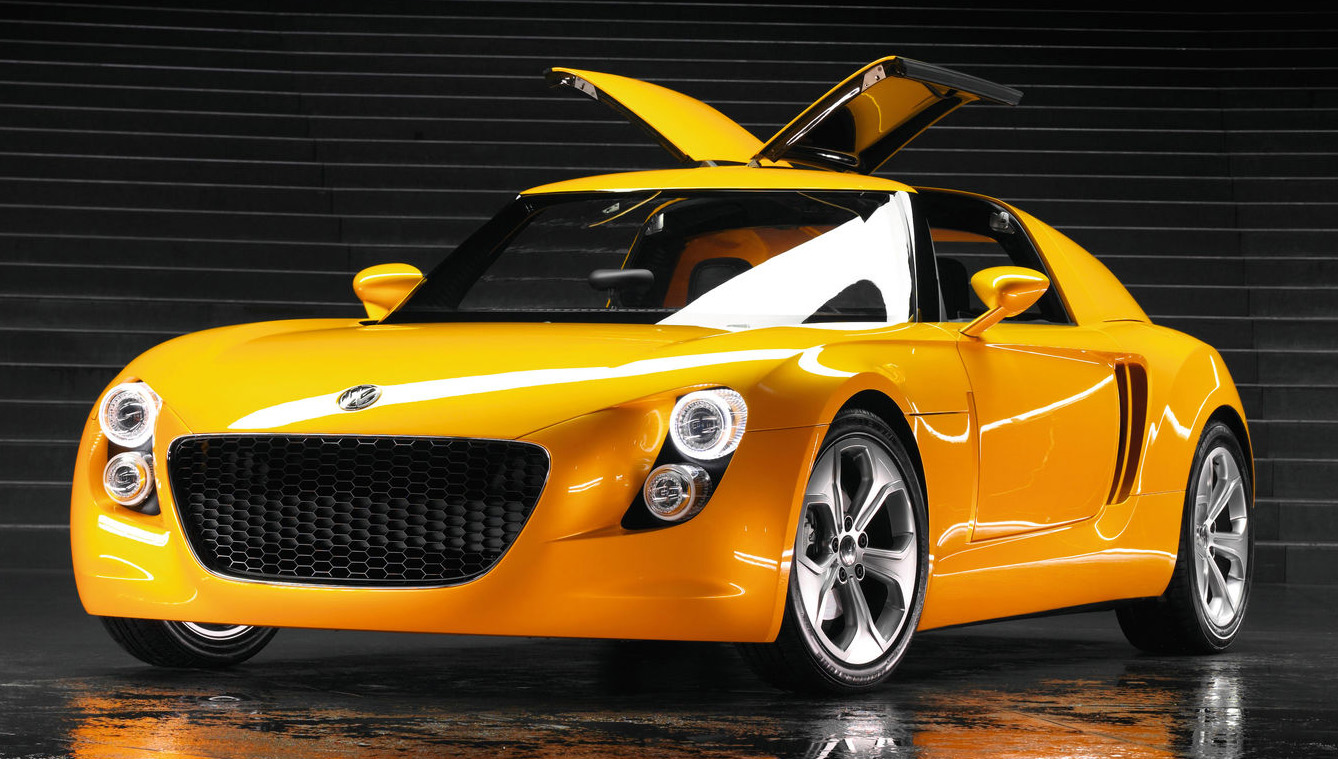
Earlier this year, Jason explained how, in 2005, Volkswagen teased a 70 mpg mid-engine diesel sports car:
The EcoRacer was very much a product of its particular time, which was 2005, a period when Volkswagen was heavily invested in diesel engines and eager to find ways to make diesels more exciting and appealing to mainstream car buyers, who often still felt diesels were slow, smoky things that were better suited to big rig trucks than passenger cars. Volkswagen was clearly willing to do a lot to make diesels drive better and be more fun and appealing, and as a result they took big swings like making fun diesel concept cars like the EcoRacer and, much more famously, designing elaborate software and hardware methods to cheat diesel emissions testing, which blew up spectacularly with the whole Dieselgate scandal that came to light around 2015.
The Dieselgate scandal cost Volkswagen plenty, both monetarily and reputation-wise, and also pretty effectively put an end to VW’s passenger car diesel plans, which meant that any fun diesel concept cars were dumped into that same coffin. But, before that happened, they did manage to do some fun diesel things, like this car, a mid-engined diesel sports car with modular, changeable bodywork.
The EcoRacer, despite its somewhat dumb, first-thing-that-came-to-mind name, was an extremely cool and appealing little car. First publicly shown at the 2005 Tokyo Auto Show, the EcoRacer featured a 1.5-liter inline-four TDI engine making 136 horsepower – which sounds low today, but remember, this is a diesel – and 184 pound-feet (250 Nm) of torque at a pretty low 1900 RPM. It could get to 60 in a respectable 6.3 seconds and managed to do all this while getting 70 mpg! It used a seven-speed direct-shift (DSG) transmission and only weighed about 1875 pounds. It was a little mid-engined oil-burning rocket, and at the time it was suggested that Porsche was supporting the concept as a way to perhaps make a reborn VW-Porsche 914, though to be fair, I’ve only found one source that reported that, appealing an idea as it may be.
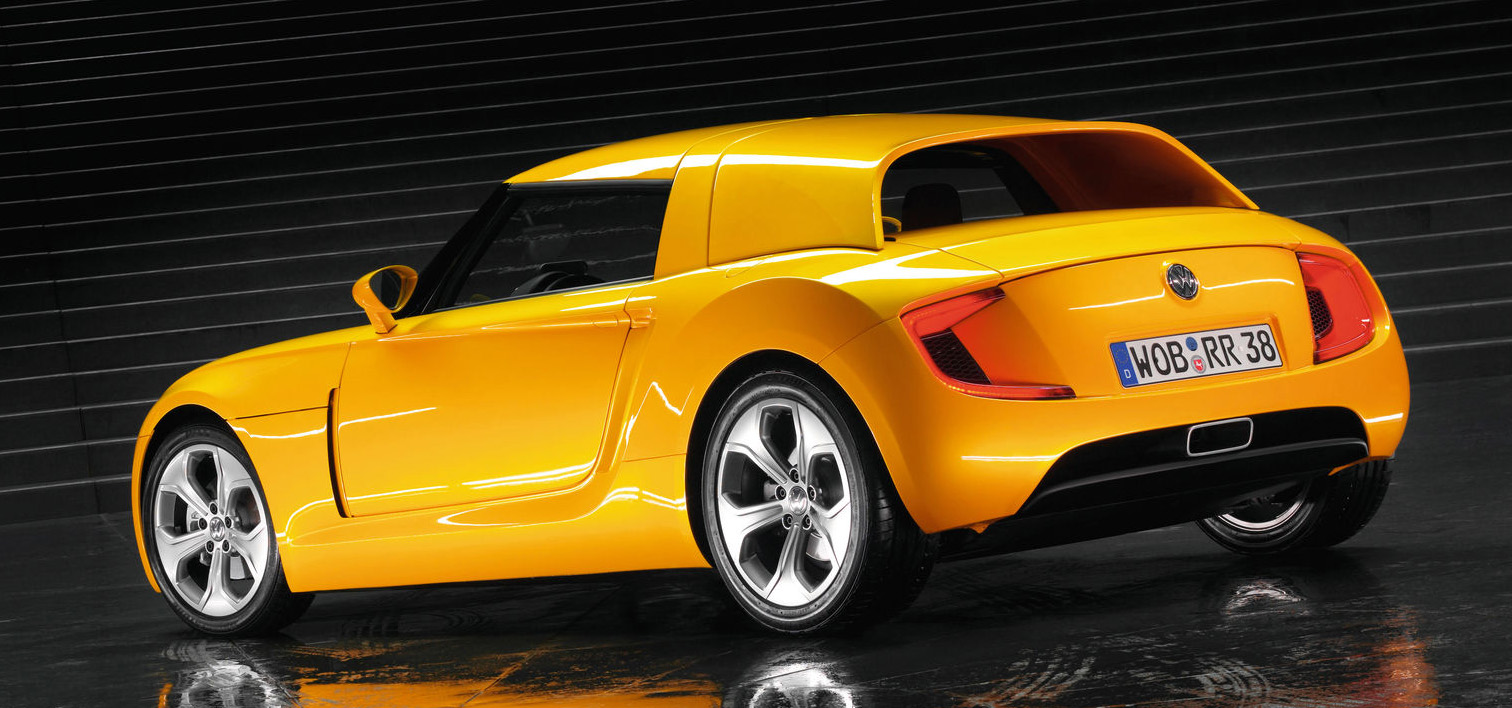
The EcoRacer isn’t where the Volkswagen Group’s great diesel sports car plans ended. Earlier, I mentioned the Audi R8 V12 TDI and the Audi TT TDI. Audi also took diesel-powered racecars to some incredible wins. There were also a diesel Scirocco and Golf GTDs, but America wasn’t cool enough to get these.
The Volkswagen BlueSport
In January 2009, Volkswagen had a treat for the attendees of the Detroit Auto Show. On the floor was something stunning. Volkswagen returned to the idea of a diesel sports car, but instead of being a dorky little car like the EcoRacer, this car looked serious. The BlueSport, as Volkswagen called it, was Volkswagen’s answer to the lightweight roadsters of the day, but with a compression ignition twist.
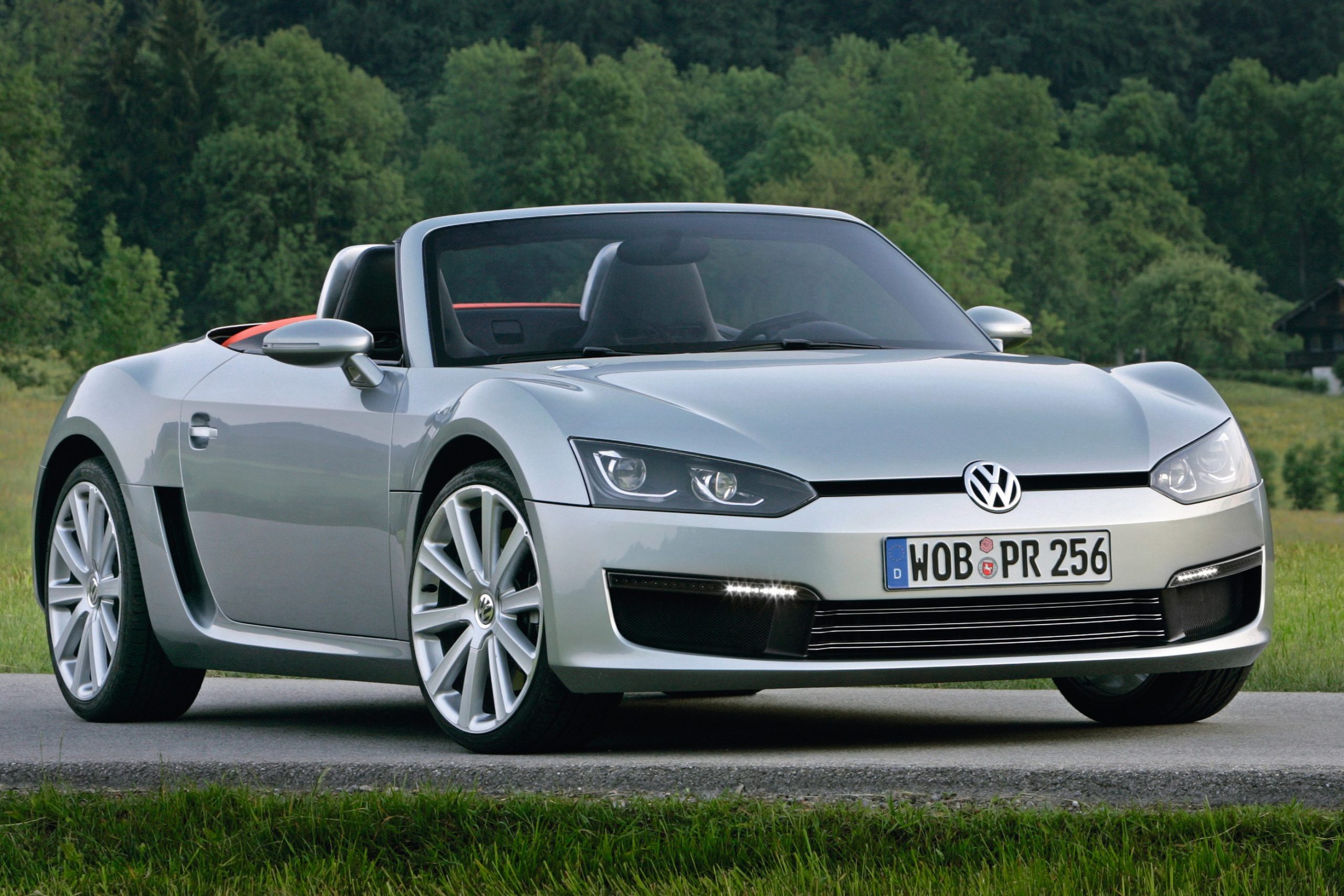
Volkswagen says that the BlueSport was designed by a team led by Volkswagen Director of Design Klaus Bischoff and Director of the Design Centre in Potsdam, Thomas Ingenlath. The team’s goal was to pen a car that was equal parts elegant and sporty, with a “purposeful stance” and clean surfaces. Like many VAG vehicles at the time, the Concept BlueSport, as it was officially called, was finished in a metallic silver. To add some contrast, designers gave the vehicle an orange convertible top. A set of 19-inch wheels (with 235x35ZR19 tires up front and 245x35ZR19s in the rear) and LED lights complete the exterior.
Inside, splashes of orange and brightwork played against black seats and a black dashboard. The interior was rather minimalist, featuring a rotary dial shifter, a small infotainment screen, and three minimalist knobs for HVAC.
What made this car really special was what was underneath the skin. The BlueSport rode on a bespoke platform that featured a mid-rear-mounted 2.0-liter turbodiesel inline-four making 177 horsepower and 258 lb-ft of torque. This was coupled to a six-speed DSG that spun the rear wheels. Essentially, this was a front-drive powertrain shoved in the rear.

The drivetrain was lifted straight from a Golf, as were many other parts of the BlueSport. The car used the Polo’s front axle and suspension, the Golf’s multi-link rear suspension, and the R32’s brakes. The BlueSport was said to weigh 2,866 pounds, had a 45:55 weight distribution, and was about as wide as the era’s Golf while being shorter than an Audi TT. The convertible top weighed 60 pounds, and the car even sported two trunks. Four cubic feet of stuff fit up front with another 2.47 cubic feet in the back.
Volkswagen’s stated performance claims were pretty good. Supposedly, the BlueSport could rush to 62 mph in 6.2 seconds and race on to a top speed of 140 mph. While not the fastest thing out there, that’s pretty awesome for a diesel! The sweetener, of course, was that the “Clean Diesel” engine was good for up to 57 mpg in Eco mode.
When the car was unveiled in Detroit, Volkswagen was cautious not to promise anything. In talking to the New York Times, Volkswagen Group chief executive Dr. Martin Winterkorn said “the future of driving and the future of Volkswagen belong to a car like this,” before noting that the car was, for now, just a concept. However, at the same show, Volkswagen of America vice president for marketing and strategy Toscan Bennett said: “It could also be powered by a gasoline engine.”

Ultimately, Volkswagen hinted at potential production by saying that if the public wants it, the BlueSport could be made.
As it turned out, journalists and the public alike couldn’t get enough of the BlueSport, and for some, the car was one of the highlights of the Detroit Auto Show that year. But then, things went quiet. The BlueSport disappeared, and nobody heard anything about it.
Volkswagen Got Serious

That was until May of 2009 when, as CarsGuide reported, Volkswagen officials said that, despite the Great Recession, the BlueSport could go into production. Volkswagen global production communications chief Christian Haacke said:
“The first challenge is to come up with a plan how to build the volumes required to earn money from such a car.” “The second challenge is to finish it and, as you can imagine in the current environment, this presents a problem.”
Reportedly, the concept car that appeared in Detroit was “almost-production-ready,” which explains why it looked like a production car already. The platform was rumored to be called MiMo (Mittelmotor), and as Australia’s Drive reported, the platform was also designed to underpin a pint-size Audi R4 sports car and an entry-level Porsche that was smaller than the Boxster.

On paper, this made sense. Toyota and Subaru were working on the car that would become the Scion FRS and the Subaru BRZ. The Mazda MX-5 Miata remained the market’s benchmark. Even General Motors was still producing the Saturn Sky and Pontiac Solstice at the time.
Then, things started getting real when journalists got to take spins in the BlueSport in summer 2009. Germany’s Auto Bild noted that the concept felt surprisingly close to being production-ready. But, like any hand-built functional concept car, it had a few quirks, like a top speed of 59 mph and some squeaks and rattles. Auto Bild continues, roughly translated into English:
Right after the first few corners, you get butterflies in your stomach. Direct steering, a sharp surge of power from the rear, and a wind in your hair – it all feels so similar to the MX-5. And the MX-5 is a proven master of its craft. No other car is more successful. For 20 years, this purist driving machine has thrilled enthusiasts, and its production numbers are rapidly approaching the million mark in its fourth generation. That’s something that needs to be replicated. But how? Simply copy the winning formula? Engine in the front, rear-wheel drive – and there you have a classic British roadster. Objection! That would be a copy of a copy. After all, Mazda’s MX-5 was originally conceived as the retro version of the Lotus Elan . VW prefers an innovative yet historically inspired approach. The BlueSport is both a sports car and an eco-mobile. That’s why only economical yet powerful downsized turbo and diesel engines are planned as power sources.
Unlike the MX-5, the engines aren’t mounted longitudinally at the front, but transversely at the rear. For sticklers for terminology, it’s therefore not a roadster, but a spyder or speedster, like the Porsches of the 1950s. Be that as it may, the BlueSport is the first rear-wheel-drive VW since the Beetle era and is based on cost-effective, mass-produced technology. The engine and transmission behind the driver are sourced from the Golf parts bin, as is the multi-link rear suspension. The front axle comes from the Polo. A particularly defining feature of the BlueSport is its long wheelbase of 2.43 meters with an overall length of just 3.99 meters. This combination results in extremely short overhangs and a sporty appearance. For comparison, a Porsche Boxster is longer, has a shorter wheelbase, and therefore appears less compact. In this light, the BlueSport could also make sense as a new entry-level Porsche. To make the project profitable, an Audi Spyder and a Seat derivative are also planned.
VW designed the roof simply and effectively. Nothing expensive or rigid from the premium electric sector, but a simple fabric roof that, like in the MX-5, can be opened or closed in a flash by hand. That’s how a convertible roof should work. The Mazda can also set a similar standard with its gearbox and steering – it couldn’t be more direct and precise. The six-speed dual-clutch transmission in the VW prototype also performs well, but a cheaper and crisp manual transmission would be just as suitable for the production model. To demonstrate the BlueSport’s fuel-saving potential, VW has equipped it with a 180 hp two-liter TDI engine. From the rear, there’s a tremendous hissing, roaring, whistling, and clattering. It sounds more like a tractor than something to give you goosebumps. “Our acoustics engineers will improve that,” BlueSport developer Fabiano reassures us. Until then, the bright roar of the Mazda ‘s 160 naturally aspirated horsepower remains the benchmark.

This was also when Volkswagen started getting confident enough to talk numbers. The BlueSport was projected to come in at under €25,000, or cheaper than a Miata at the time. The BlueSport was even supposed to come to America.
So then, it seemed like Volkswagen was going to go through with it. After all, it sounded like engineers already did a ton of development work. Yet, the BlueSport never came. What happened?
Volkswagen Throws In The Towel

Progress on the vehicle was quiet. Audi teased the R5 e-tron concept in 2010, which supposedly was built on the same MiMo platform, but not much was said about the BlueSport. In January 2012, rumors spread across auto media that Volkswagen was going to kill the project. In March of that year, Dr. Hackenberg admitted that, despite his championing of the car since 2009, he couldn’t convince Volkswagen’s management that there was a business case. From Drive:
“[The VW Group] will have lots of convertibles in the future, a Golf convertible, Audi will have convertibles, but of a roadster … I’m working on it,” says Hackenberg. “I drove [the BlueSport] last summer … and the car is fantastic. But I don’t have agreement of the company [yet] that we will build it.”
Reportedly, there was some consideration that, maybe, Volkswagen could drop the planned Audi and Porsche variants and just go with the BlueSport. By 2012, Drive noted, Porsche had moved away from its strategy to make another entry-level car, so a Porsche BlueSport variant no longer fit, anyway.

But then, there was a harsh reality that, according to Dr. Hackenberg, Volkswagen would have needed to sell 50,000 to 60,000 BlueSports to make the car worth it. This was a problem that the New York Times noted back in 2009. In 2008, Americans bought only 30,900 roadsters, with the sales largely evenly split between the Miata, Solstice, and Sky. Mazda moved just 6,739 Miatas in America in 2012. Sure, the BlueSport would have been sold in the global market, but Volkswagen would have had to work hard to sell 60,000 units over the car’s production run.
Sadly, by fall 2012, Volkswagen officially put the lid on the BlueSport, also shelving the Bulli van along with it. Why? The short answer was that, despite Dr. Hackenberg’s good fight, Volkswagen concluded that the future was in small crossovers, not sports cars. From Autocar:
“The segment is falling if anything,” said Hackenberg. “I don’t want to go to the board now with it as a rejection would kill it off completely. If we can make a business case for it, it can be put into production quite quickly. But if we make the proposal now, it dies.”

The Bulli, which was one of the many concepts that finally led to the ID. Buzz, was canceled for a similar reason. From Autocar: “It’s on ice,” said Hackenberg. “We didn’t find a market for it. There is no business case.”
Of course, Volkswagen would become embroiled in the Dieselgate scandal only a couple of years later. In the aftermath, Volkswagen made its hard pivot to EVs, ensuring that the BlueSport would never be built.
Was There A Market For A Diesel Roadster?
When you think about it, the BlueSport was probably doomed from the start. Two-seat roadsters were already a niche, and the Volkswagen BlueSport was essentially going to be a niche within a niche. It was smart for Volkswagen to raid its own parts bin to build the thing, but a sales floor of 60,000 units to make it worthwhile likely would have been hard to meet.

Volkswagen also had to ask itself just who wanted a car like this. Sure, car journalists and weirdos like me eat up silly diesels like catnip, but most other enthusiasts would just buy a Miata. Volkswagen might have sold dozens of BlueSports before Dieselgate hit.
But maybe I’m being pessimistic. In 2009, Volkswagen was on top of the world with its diesels, and there probably were some people who would have bought one of these thinking that they could get sports car fun and save the planet. It’s impossible to say what could have happened, but Volkswagen probably made the correct call here. The roadster market is tiny, and Mazda seems to run it. Not even General Motors unseated the king.
A part of me likes to imagine a future where this car went into production, anyway. The thought of hitting up California’s PCH with the top down and a 50 mpg diesel clattering behind my head is both funny and something I’d love to experience at least once in life. But like so many other concepts I’ve fallen in love with, I can only dream. Now, after reading this, maybe you will, too.
Top graphic image: Volkswagen


Such a shame. This would’ve been a fantastic little car if they just tossed the EA888 in it and had a go.
Now would be the time to flex on the competition by coming out swinging with one of these in a gasoline hybrid form.