

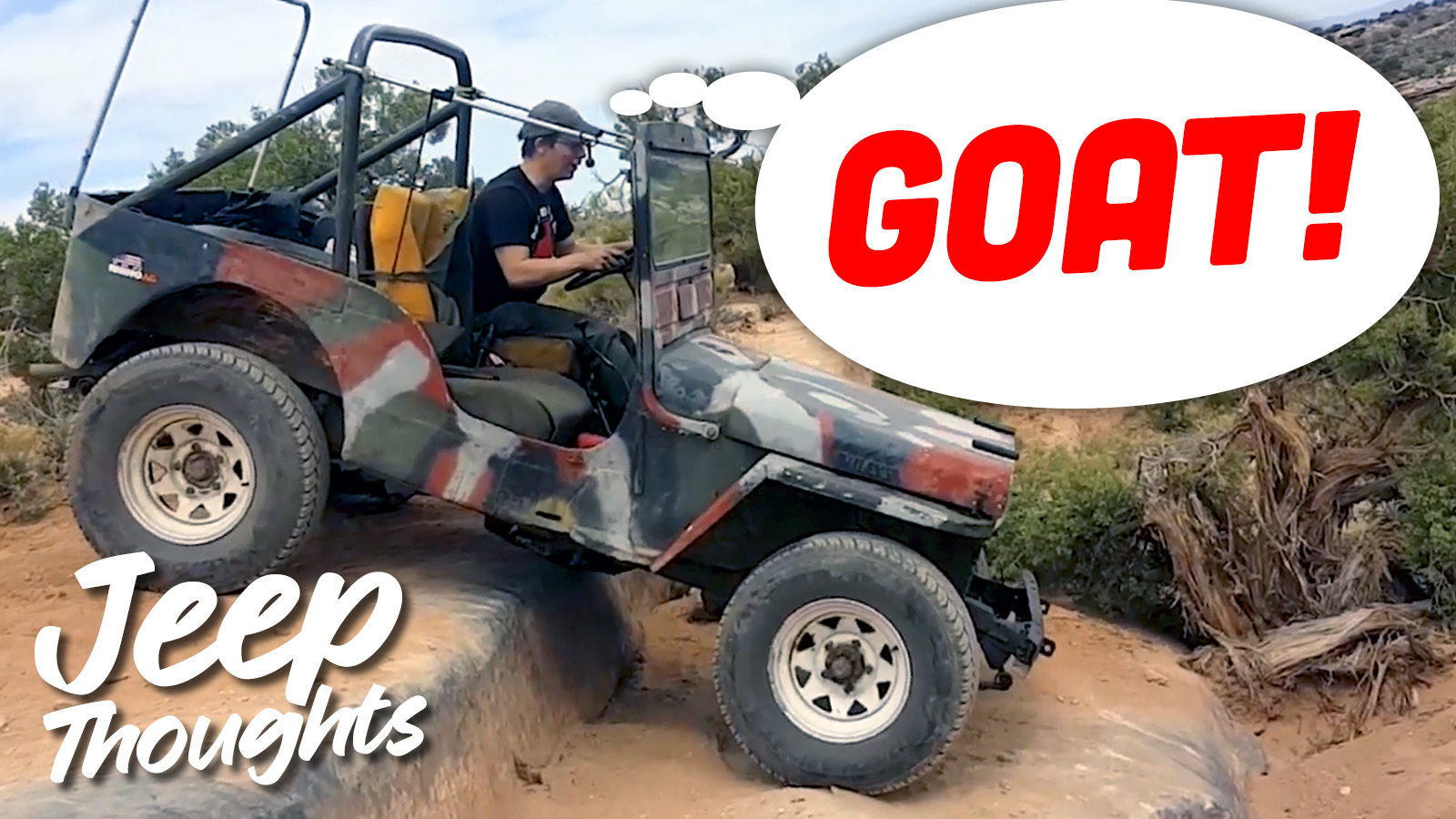
On this week’s installment of “Jeep Thoughts With David Tracy,” I want to talk about why I think the 1945 Willys CJ-2A may be the greatest off-road vehicle platform of all time.
The World War II Jeep may be the greatest Jeep of all time, but it’s not the best Jeep of all time. In fact, its successor, the civilian CJ-2A, was better. I am not disparaging the mighty Willys MB; it helped allies win World War II, and it set the standard for every single 4×4 to follow. The Land Rover Defender? The Ford Bronco? The Toyota Land Cruiser? The Nissan Patrol? All of these legends were inspired by the WWII Jeep.


But if I had to choose one vehicle to use both around the farm and off-road, I’d pick the civilian model that debuted for the 1945 model-year, the CJ-2A. It got rid of the Willys MB’s low-hanging fuel tank:
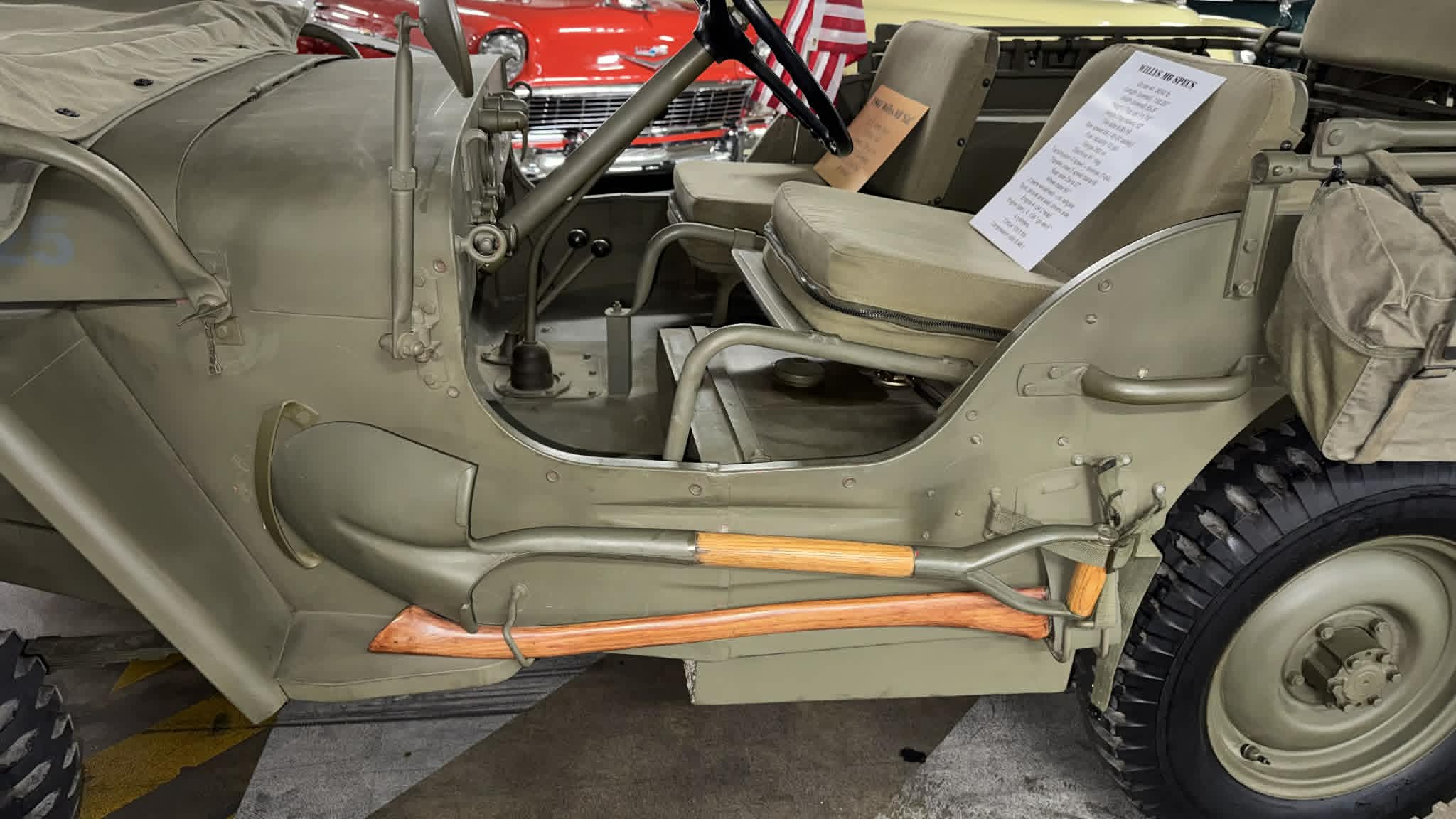 That tank, by the way, is pretty annoying to fill:
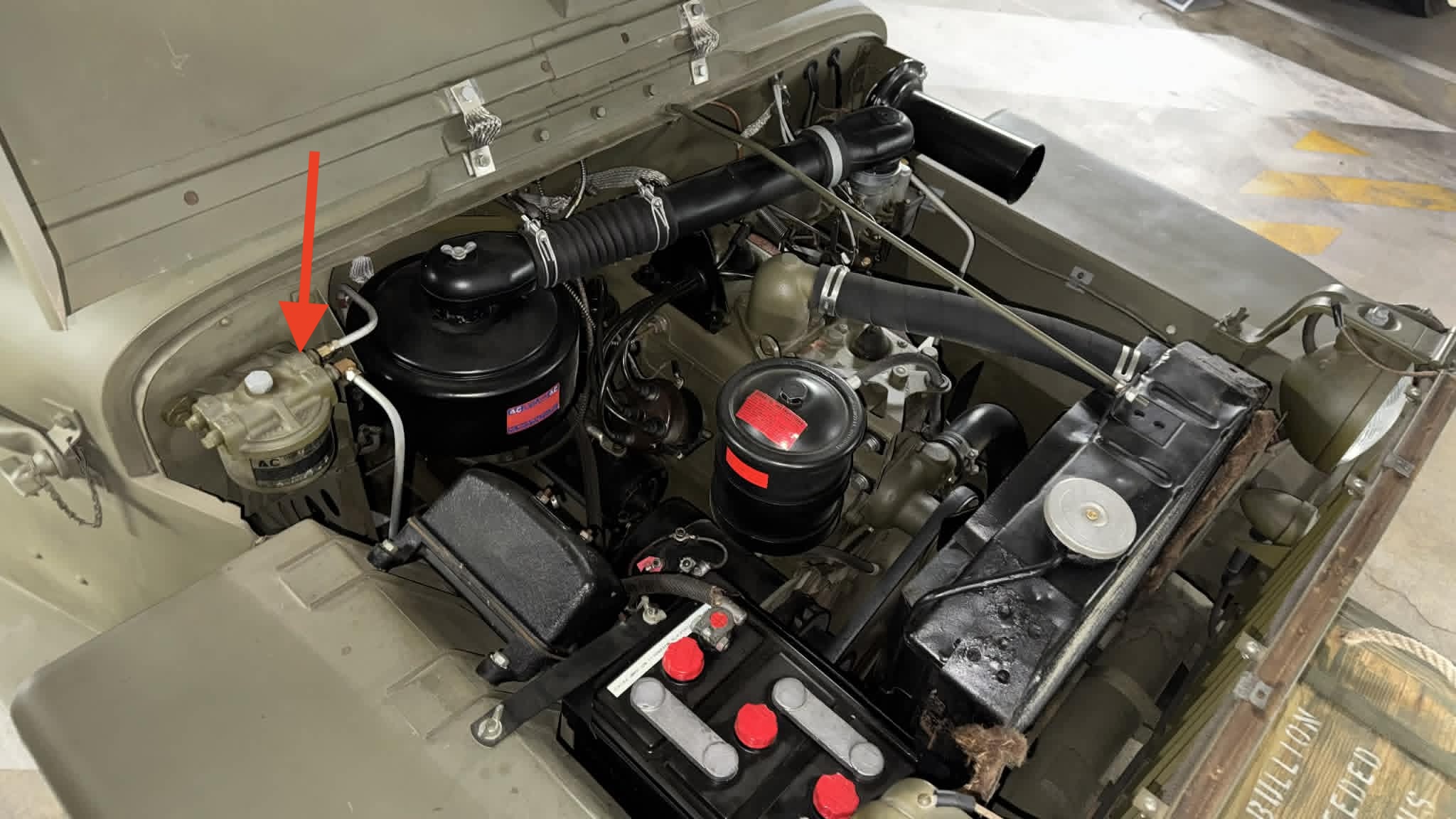
It also deleted the needlessly complex fuel line that goes from the tank, up the firewall, around the engine bay, and finally into the carburetor:
The CJ-2A bolstered the MB’s frame quite a bit by boxing the C-channel, it added a super useful rear tailgate where the MB had none, and — crucially — the CJ-2A’s T90 manual transmission is significantly more robust than the WWII Jeep’s.
Yes, the CJ-2A is slightly better than the WWII Jeep, a vehicle that I’ve argued remains one of the great off-road platforms of all time.
This has led me to conclude that the CJ-2A may very well be the greatest off-roader ever. What I mean by that is, I believe it is capable of traversing more obstacles than any other vehicle. Yes, some modern vehicles will get up dunes the Jeep can’t handle. Some will be able to power through deep mud pits the Jeep can’t handle. But when you factor in every type of terrain out there — rocks, mud, tight forests, brush — I believe the CJ-2A, especially if you added in a locking differential or two, can traverse the highest percentage of challenging obstacles. Here’s why.
Why The CJ-2A Is The GOAT Over Modern Off-Roaders

You might be thinking to yourself: How can an 80 year-old vehicle possibly still be the best off-roader when the world has the brand new Jeep Wrangler, Ford Bronco, and Toyota Land Cruiser?
The answer to that requires a look at what makes a vehicle great off-road. I’ve written about this many times, but the most important attribute of a great off-road vehicle is favorable geometry. That means short overhangs, good ground clearance, a small belly, light weight, and small overall dimensions. After geometry, things like traction, torque, underbody protection, and articulation become important.
Most modern off-roaders excel in the latter areas. Lockers have become commonplace on many SUVs, tires are better than they’ve ever been, engines are more powerful than ever (and transfer case/axle ratios are nice and short), disconnecting sway bars allow for great articulation, and skid plates abound. But what most modern off-roaders struggle with is weight (a two-door Wrangler weighs two tons!) and overall vehicle geometry. Let’s focus on the latter.

Because of demand for increased interior volume (and also the need to package more features), vehicles have become larger. In order to achieve great approach, departure, and breakover angles (plus ground clearance), many modern vehicles have to resort to humongous tires. Seriously, the very smallest tire you can get on a modern Jeep Wrangler is 32-inches (see above). The big-dog Jeep Wrangler Rubicon TJ from just 20 years ago offered 31s, and those were considered big:

With tall tires, the overall vehicle becomes taller, and to achieve decent stability you need a wide enough stance, which is why a Jeep Wrangler JL is a full seven inches wider than a Jeep Wrangler TJ from 20 years ago.
So yes, modern off-roaders have great ground clearance and approach/departure angles, but to pull that off they have to make significant compromises on overall vehicle geometry.

“But what about that TJ you keep mentioning? That’s small, right?” And the answer is yes. The Jeep Wrangler TJ is one of the best off-roaders ever because it combines compact overall size with the amazing suspension pioneered by the Jeep Cherokee XJ and ZJ.
The TJ Rubicon is absolutely one of the off-road kings, with factory lockers, a 4:1 low range in the transfer case, skid plates, great approach/departure/breakover angles, and small overall dimensions. But I still think the CJ-2A is a little better (not stock-for-stock, as the TJR has lockers, but as a platform).
Why The CJ-2A Is The GOAT Over Other Jeep CJs/Early Wranglers
It’s fairly obvious why I’d say the Willys is a stronger off-road platform than a new vehicle given how large vehicles have become and how heavily laden with safety tech they are. But what about other CJs like the CJ-5, CJ-7, and what about the Wrangler YJ and TJ?

For one, I can tell you as a matter of fact that the CJ-2A is better off-road than the YJ, because I have owned both, and the YJ does not come close. Its track bars limit articulation from the four leaf springs, its lower profile limits ground clearance, and frankly this results in an off-road experience that involves lots of scraping and lots of tire-lifts. I love my YJ, and it’s fun off-road, but a 1945 Willys CJ-2A crushes it on the hard stuff.
Even if you removed those track bars, the YJ couldn’t hold up. CJ-3Bs, CJ-5s, and CJ-7s may all offer more power than a CJ-2A, but the one area that they — along with any Jeep after 1953 (and also Land Cruisers and the like) — struggle with is top-heaviness.
Having short overall length is a boon for an off-roader. It allows the vehicle to push the wheels out towards the bumpers to create great approach and departure angles, without yielding a huge belly that creates a poor breakover angle. Being short is good.

The issue is that, in order to maintain stability up steep grades, a vehicle with a short wheelbase has to have a low center of gravity. It’s the reason why the vehicles that you often see roll over when off-roading are Jeep CJ-5s, CJ-7s, Jeep YJs, and TJs. They’re not as short as an old CJ-2A, but they’re still quite short, and with their overhead valve engines, their center or gravity is taller than that of early, flathead engine-equipped CJs.
View this post on Instagram
This really began in 1953 with the CJ-3B. Overhead valves are a great thing for engine efficiency/power, but when we’re talking about pure off-road capability, you really don’t need a ton of power — you need thrust at the wheels. The CJ-2A creates this with a fairly torquey engine and also super short gearing in the axles: 5.38 to 1.
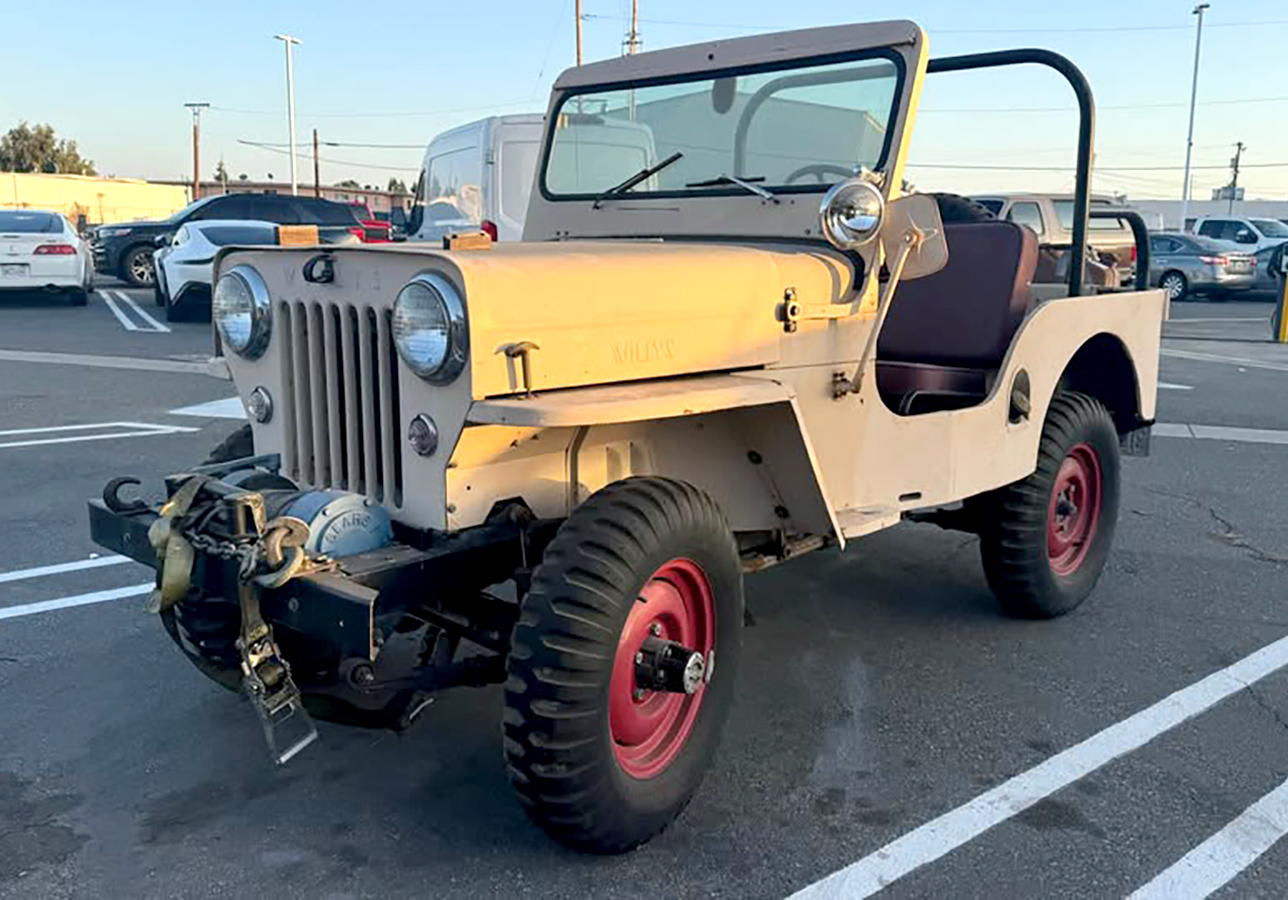
In 1953, the CJ-3B introduced the F-head overhead valve engine, which I quite love. But in order to package this engine, Willys-Overland had to extend the hood by about four inches, which required extending the cowl, which raised the windshield, which required a higher seating position. It was a chain reaction that led to a significantly taller machine. This can be an issue when climbing steep grades.
The other downside that many Jeep CJs and Wranglers have over the Willys CJ-2A is that they feature a roll bar. This is great for safety, of course, but if we’re talking about pure capability, being able to lower the windshield and create a slim profile that you can maneuver under downed trees and other low obstacles is a significant help.
The CJ-2A Has The Perfect Off-Road Silhouette

The CJ-2A is far from a truly perfect off-road vehicle. The leaf spring shackles limit approach and departure angle, the leaf springs themselves don’t flex as well as a coil spring setup, the frame flexes well but not quite as well as a flimsy WWII Jeep frame, and the Go-Devil under the hood doesn’t make a ton of power.
But the geometry is pretty much perfect. The rocker panels are way up high, as are most of the mechanical bits (many other Jeeps may technically have more ground clearance, but their rockers and more of their bellies are lower). The folding windshield and lack of a roll bar keep the profile low, the overall length is super short, the flathead motor keeps the center of gravity down, the width is really narrow, all the mechanicals are tucked up high, and weight is only 2,500 pounds. Combine this amazing geometry with a torquey engine, a low-range transfer case, and solid axles that flex well enough, and you’re basically a set of lockers away from being invincible.
It’s very unlikely that there will be a future vehicle that is as geometrically perfect as the CJ-2A. Gas engines have gotten too large, so hoods will be high. EVs will never come with two solid axles. A flat gas engine might solve this, but even then, the number of safety mandates in modern cars pretty much means that there will never be a vehicle as simple, as small, as lightweight, and as low as a CJ-2A.

There are plenty of vehicles that are great off-road, and many are right there with the CJ-2A. With lockers, many will outperform the CJ-2A on certain terrain. But as a platform, the CJ-2A (and its CJ-3A and M38 derivatives) is as close to off-road geometric perfection as there is. And there may not be a single vehicle out there that, with nothing but a simple mod or two (like a Lock Right locker), can handle a diversity of off-road obstacles as well as this first civilian Jeep.


Even a stock TJ seems small by modern standards, but I remember years ago seeing my mom’s ’03 Wrangler next to a restored WWII Jeep…those original Jeeps were tiny!
I think you should compare this jeep to a modern side by side. I bet they’re close in size and weight. Some are street legal now, too, right?
Or a roxor, which of course is a cj-3 if I’m not mistaken
Seeing that clip of the gas tank fill on the ebay jeep makes me ask: what happened to the coverage on the site? Following along on Insta was OK, but even that petered out. Was looking forward to some detailed articles and…it’s been sparse?
I have been wondering about this a lot. It was this huge deal, partnership with eBay, and then it was just silence with a few bits and bobs here and there, and apparently a video or article coming out on the 15th?
We got way better 2CV coverage from Torch. It all seems off to me…
It’s a distraction from the files. Jk.
But yeah I noticed the same thing, maybe it’s gonna be a mega jeep update!
I published the last story ~10 days ago, but I can’t wait to share more with you!
i met a guy on the road earlier this week in a cj-2 windshield down goggles on heading in the opposite direction. i was quite envious.
What advantages does this motor car have over say, a honda C90? …which I could also afford.
I totally agree with this take. Did plenty of 4 wheeling in my 20s. Friends had either CJ-5s or 2As. The CJ-5s were fairly modified with lifts, some lockers etc and the 2As were closer to stock. Both would go anywhere. I preferred the 2As on trails (even though I had a CJ-5) because it was so small and had such good visibility with the windshield down
This is a great article, thank you. Which really makes me want a Suzuki Jimny here in the UK, but I do too much road mileage on motorways, and only space for 1 car.
On the note of there not being EV beam axle 4x4s, Munro in Scotland are making this kind of vehicle which looks interesting. From reviews I have read it is very capable, but they’re still a small scale manufacturer.
https://www.munro-ev.com/technical
I like that a lot! very cool.
I’ve always personally wanted a 3A cause I find the singular windshield better looking. Otherwise, it’s essentially the same vehicle. I’d have a blast trying to cram a more modern power train into one. Maybe one day.
Regarding the EV piece. David. Jeep has shown a fully EV Wrangler with solid axles at a few Easter Jeep Safaris. It’s entirely in the realm of possibilities.
It’s possible, but highly unlikely, as our Huibert Mees has explained. Scout is doing it in the rear; I’d be blown away if anyone did it front and rear. But I’d love to be wrong.
Correct me if I’m wrong, but I believe what’s fascinating about Jeep’s Magneto concepts is that they have a traditional power train layout, just with an electric motor bolted to the front. So traditional transmission, transfer case, and solid axles. I’m by no means an engineer, and I think that poses other design issues, but it maintains the Jeep’s suspension design.
Now I don’t think current Stelantis leadership will build it anytime soon, but my JLU 4xe has plenty of life. So I’ll wait
Not trying to be rude, but I’m going to go ahead and be your post-post editor for a minute.
^would be good to clarify this as in not long instead of not tall (I think)
onto the content:
wouldn’t a single-seat dune buggy be pretty similar in ability as you don’t need to have side-by-side seats?
Also that width of new vehicles can come to your advantage at times straddling obstacles/ruts, so there are still tradeoffs to be had (playing devil’s advocate here).
No worries, doesn’t bother me one bit!
Dune buggies are a totally different animal, same with SxSs. And totally; you’re right about width, and to be honest, sometimes a longer wheelbase is an advantage, as it allows you to get tires on two more disparate bits of terrain (i.e. your axles being farther apart makes it so that the traction conditions between the front and rear wheels is more likely to be different than if they were close).
The truth is, there are so many factors in play. But in a variety of conditions, it’s my belief that the vehicle with the best off-road geometry wins (provided you’ve evened the playing field re: tires and lockers).
Appreciate the edits!
I think at the end of the day it can be summarized as using the right tool for the job, but more often than not lightweight, small, and lowdown weight is going to win.
Yes, the CJ-2A is the best off-road vehicle that is also *technically* street legal. But unless you live 8 miles from the trail, you probably don’t want to drive it on-road. So now you’re towing it to the trail. If you’re going to do that, you’d probably be better off buying a $10k SxS, something like the Polaris Ranger. You probably can’t get a CJ-2A in decent shape for $10k these days.
I found a solid axle e-axle on aliexpress with a 5kw motor for ~$1700. Two of those wouldn’t be a lot less power than the Go-Devil, would it? Next year!
That’s like 14 horsepower.
What I’m hearing is solid axle off road Changli then.
This is why side by sides and atvs have nearly completely replaces jeeps and trucks in off road parks and on trails.
I helped restomod my buddies 49 cj and the only mods are front disk brakes and 31 in tires and it goes off road really well.
Just hope you don’t need to hop on a highway between trails that 40 mph top speed will get you run over.
Friend has one of these he built in high school.
He paid for it towing bigger offroadie stuff out with a Datsun 510 or VW beetle. Physics, he says. The only original parts are the Jeep body though. Handbuilt frame made to take winching and other abuse, V8 engine and agricultural tires.
He’s warned me about the drawbacks of those tires, especially on pavement. I’m looking at similar for my swampy pasture issues.
I agree with David 90% of the time as the same age/slightly older same nutty Jeep guy who has owned 18 of them. But he’s wrong. The best all around stock Jeep for any terrain is a 2004 TJ Rubicon. Mine is only slightly modified with a budget boost and taller tires and it runs circles around lifted modern JK/JL’s on almost any terrain. Climbs hills, goes through mud, sticks to rocks. The secret to off roading is low weight/stability/traction.
I have to second this. I’ve previously owned a CJ-2 and a couple Dauntless CJ-5s. I currently own a ’71 CJ-5 with a Buick 350 and a 1963 DJ-3A that’s been converted to 4wd, has lockers, and 80:1 overall gearing.
The TJ Rubicon is better in every situation offroad and in another world on the road getting to the trail.
That said, I’m taking the DJ-3A over the Rubicon later this year instead of my actual Jeep Rubicon, because it’s more fun and more of a challenge.
If we’re going PURE stock, I’ll buy it (and it’s why I mention the TJ Rubicon specifically in the piece). But as a PLATFORM, the CJ-2A is the GOAT, even over the TJ. And it comes down to its having the superior geometry.
You do need to add lockers to get it to TJ Rubicon capability, for sure. But check out what flatfender guys can do with a lightly modified CJ-2A, and it’s no doubt it is the best platform ever.
I do wish Jeep had built a flathead CJ with coil springs to get the flex up and the shackles out of the way, but I believe the CJ’s overall profile gives it the edge despite its leaf springs.
I was thinking the same thing the whole time I was reading it. I see and agree with all DT’s points, but even then, I can’t stop thinking the TJ is peak SWB Jeep.
The CJ2 definitely has more charm, and I can 100% see the appeal. I’d most likely want to trailer or flat tow it to any trail though.
The church of Jeepus strikes again.
Is that a 1946 model year CJ2A with the one year only column shift? Wow.
Also, when you were browsing B-J for the pic and sending them an email for permission, did ENHRN look at the screen and give you a flat ‘No.” even before you explained what you were doing?
As it was in the beginning, is now and ever shall be … Amen.
That means short overhangs, good ground clearance, a small belly, light weight, and small overall dimensions.
Wow, I would suck at being an off-roader.
I think the Steyr-Puch Haflinger would like a word as to which little utility vehicle is the best off-road. It’s everything one of these Jeeps is cranked up to 11.
Aww, it’s a baby Pinzgauer!
It is indeed!
I interviewed the Off-Road King Of The World, Victor Ma. He agrees with you.
I’ve gotten to play with one – they are *amazing*. They make an off-road idiot like me feel like super-driver. And they don’t beat you up as much as a leaf-sprung Jeep does. Even more feeble ON a road though.
So when are your further adventures in brand-new WWII Jeeps making it here (or have I missed something)? I have enjoyed the YouTube videos I have seen of you frolicking in it. Nice job!
It’s another reminder of quite how good the original Jeep is, that the Haflinger was yet another vehicle designed, like the Land Rover, on the basis “these Jeeps that the Americans have left everywhere are really useful, we should make our own!”.
Somebody had to be first. The US Military had a pretty good idea of what they wanted and needed, and so the Jeep was created to fulfill that need.
A fully mechanized army was a pretty new concept – the Germans were still shockingly dependent on horses in the early WWII years.
I agree with this, and I really want to get a flat fender someday.
I think all these need is a rear locker, though some kind of a power steering system would nice too.
They’re super light and climb like mountain goats.
Prices are going up though, if I ever get one, it’ll probably a CJ3B with the F head and silly-looking high hood.
They seem to be less loved and not as expensive (yet).
The problem is I’ll need a garage or barn first, I can’t keep a vehicle like this outside year-round.
Until then, JLUR it is.
Love my ’53 CJ3B!
Was just chatting with a friend’s father about the CJ-2A that’s been sitting a few decades at his place. There’s a surprising amount of it left. Has a rollbar and a 3B engine swap even.
I’m not a Jeep guy, but before David became a father I thought about signing up for the “David shows up and wrenches w/you” membership and trying to get that 2A running again.
That’s still on the table!
Wow! Though I’d probably end up just dragging you to vehicle museums and ORV areas instead. 🙂
Sounds like a paid vacation!
Years ago “Dirt Every Day” did a comparison of an old Willys Jeep with a modern side by side. Weirdly enough they’re the same size.
I believe their conclusion was that the Willys was just more fun.
Would love to see a 3-way bakeoff with a Mahindra Roxor.
A 116-120″ wheelbase 4 door Bronco/Wrangler/upcoming Scout with 35″ tires would be geometrically similar to an 80″ wheelbase CJ with only ~24″ tires. To match the geometry of the CJ2A with 29″ tires, the big modern offroaders would need 42-43″ tires. No wonder why the tires sizes are getting so out of control to go with the modern size bloat, they are just trying to keep up with the little octogenarian.
Exactly my point!
I’d have to give it to the 3B as peak flat fender Willys. The 2A/3A do have a little better visibility with the lower hood but I’ll take the extra 15hp and ft lbs. A 25 percent gain is a big difference when you don’t have much to start with.
Best stock off-roading vehicle…definitely in the top tier. But then again, most off roaders have modified their vehicles a lot.