


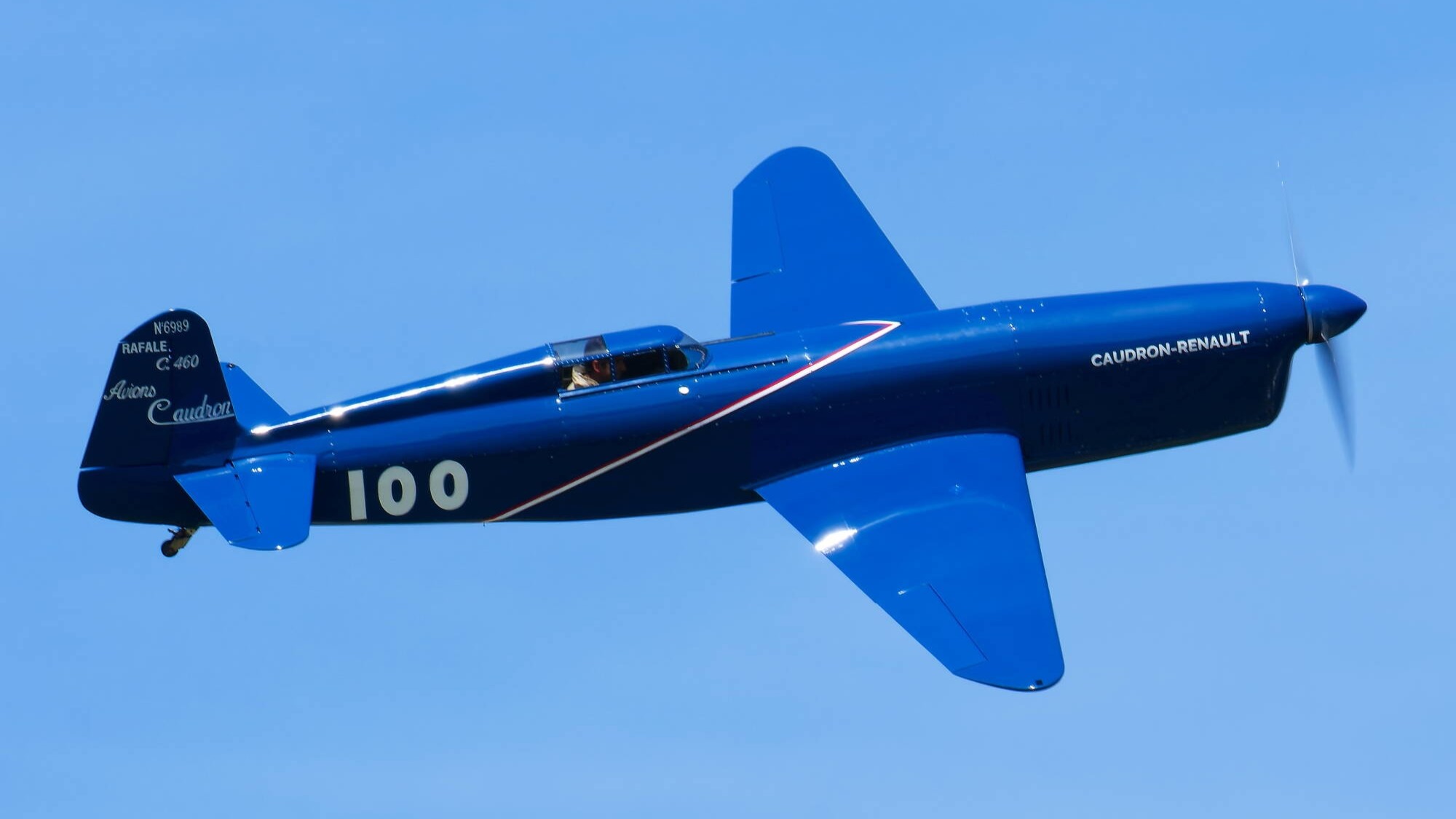
Many of the world’s storied automakers have colorful histories building things that aren’t cars. Some automakers have built trains, buses, bicycles, and even boats, while others have dabbled in aviation. The Renault of today is known for making weird French cars that Americans can’t have, but it was once a force in aviation. In 1934, the Caudron-Renault Rafale C.460 was the fastest light aircraft in the sky. Now, nine decades later, Renault has resurrected its record-breaking plane from the dead, and it’s an amazing work of functional art. Oh yeah, the Rafale also has a generic crossover named after it, too.
Back in 2023, Renault teased the launch of a new flagship crossover. When Renault named its coupe-style hybrid crossover, it reached into its bag of historic nameplates. The name chosen for the ride was Rafale, which is French for “gust.” But Renault didn’t just name its new flagship after a wind, but an obscure airplane that few knew about outside of aviation circles.


The Caudron Rafale C.460 was famous for setting an airspeed record of 314.32 mph in 1934. The 1,146-pound aircraft was also known for being a successful air racer. But there was only one problem, as Renault named its new crossover after a plane that didn’t have a single flying example in the modern day. Renault has rectified this by bringing the C.460 back from the dead. One of the coolest planes of the 1930s is flying once again, though weirdly, the plane you see here is not actually from the 1930s.
France’s Innovative Early Aviation Efforts
While Renault has been parading around the Rafale C.460 as a fabled part of its history, the aircraft’s story did not start with the automaker. The Rafale was built by Société des Avions Caudron, commonly just called Caudron. The Smithsonian National Air and Space Museum has details about its beginnings:
Gaston and René Caudron were among the earliest aircraft manufacturers in France. After building and testing a few original designs in 1909 and early in 1910, the brothers established a flight training school at Crotoy and an aircraft factory at Rue in 1910. The first factory-produced Caudron was the type A4, a 35-horsepower Anzani-powered tractor biplane in which the pilot sat completely exposed behind the rear spar of the lower wing.

The next major Caudron design, the type B, was the first to feature the abbreviated fuselage/pilot nacelle, characteristic of many later Caudron aircraft. It was powered by a 70-horsepower Gnôme or 60-horsepower Anzani engine mounted in the front of the nacelle with the pilot immediately behind. Although a tractor, the tail unit of the type B was supported by booms extending from the trailing edge of the wings, an arrangement more commonly featured on pusher aircraft. Lateral control was accomplished with wing warping. The type B established the basic configuration of Caudron designs through the G.4 model.
The first of the well-known Caudron G series aircraft appeared in 1912. Initially designed as a trainer, the type G was developed into the G.2 by the outbreak of the First World War, and saw limited military service in 1914 as single and two-seat versions. By that time the Caudron factory had been relocated to Lyon, where an improved version, designated the G.3, was being produced in significant numbers. Soon a second factory was opened at Issy-les-Moulineaux, near Paris, to meet military demand for the airplane. The G.3 was primarily a two-seat aircraft, but a few were converted to single-seat versions. They were powered variously by 80-horsepower Le Rhône or Gnôme rotary engines or a 90-horsepower Anzani radial. A total of 2,450 G.3s were built, including a small number built under license in Britain and Italy.

Elsewhere in France, there was Renault, which was founded as the Société Renault Frères by Louis Renault and brothers Fernand and Marcel in 1899. Renault was known for its innovative early cars, but it had also been involved in aviation since 1907. In that year, Renault produced a 6.1-liter V8 aviation engine that produced 45 HP at 1,500 RPM. The cast iron mill weighed 319 pounds in air-cooled form or about 400 pounds with water cooling. A few years after its debut, the engine was churning out 60 HP.
Renault quickly expanded its aircraft engine business. In 1911, Renault launched the world’s first V12 aircraft engine, which had a displacement of 10.66 liters, air cooling, and an output of 90 HP. Later, Renault air-cooled V12s would see bumps to 100 HP and then, eventually, 138 HP. By the 1920s, Renault says, it was cranking out engines for boats, buses, cars, trucks, and planes.
Renault Goes Racing, In The Sky
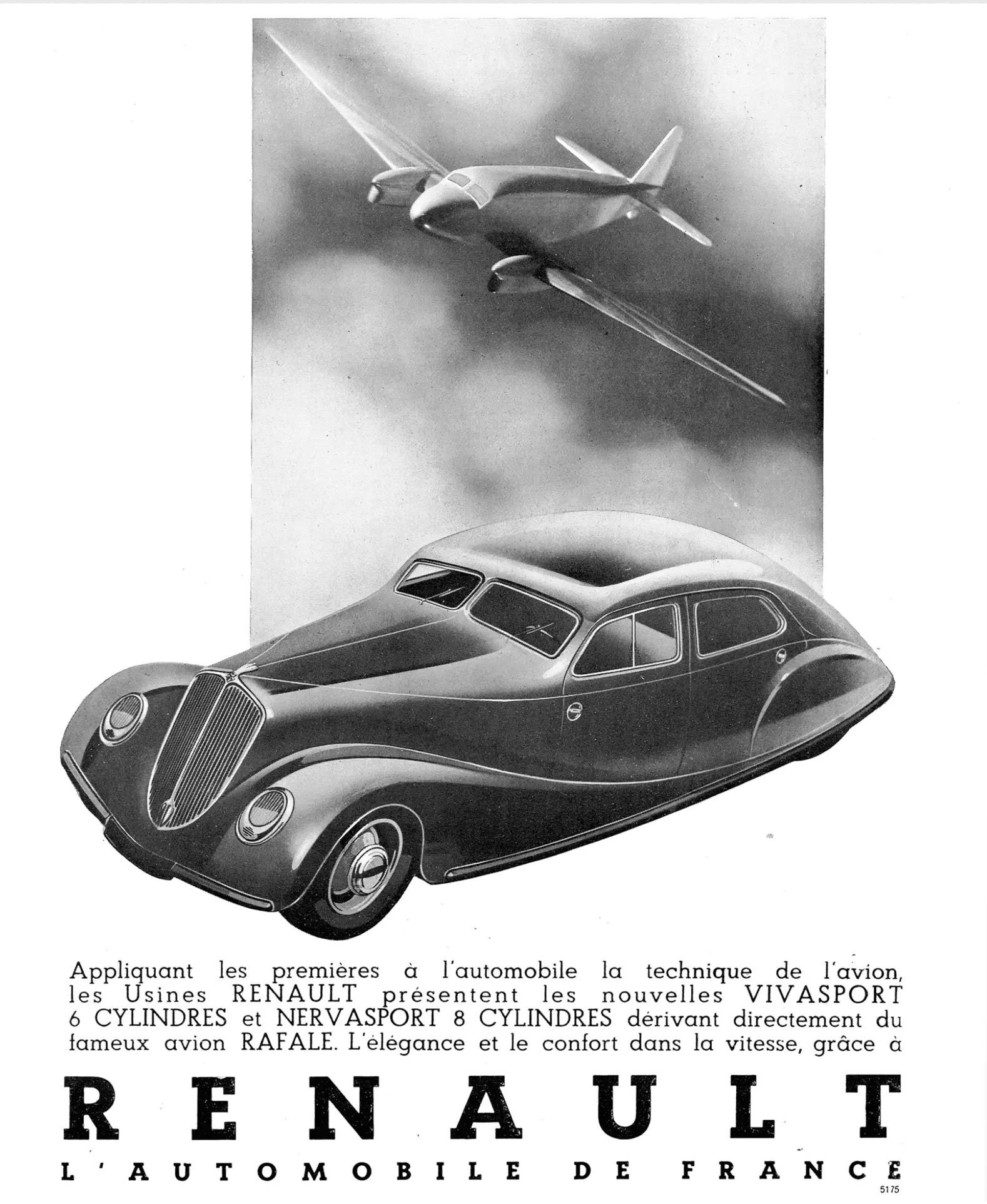
In 1933, Renault would embrace aviation even more. Louis Renault had become obsessed with aviation and, specifically, air racing. At the same time, the French government was looking to consolidate the nation’s aviation industry. That year, Renault purchased a 55 percent stake in Caudron, rolling the company into the Renault Aviation division. René Caudron maintained a minority stake of 45 percent of his company.
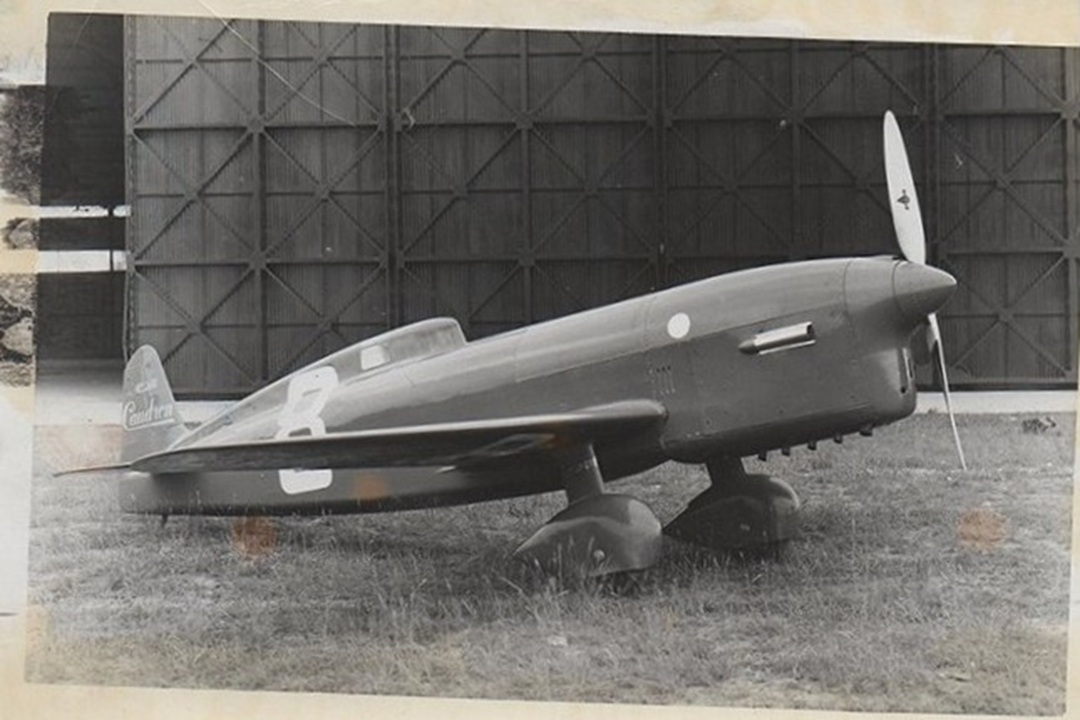
Under Renault control, Caudron shifted from military aircraft to lightweight racers to fly in France’s Coupe Deutsch de la Meurthe speed trial competition. Caudron entered the C.362 and C.366 into the 1933 race. One C.362 crashed after an engine failure, killing its pilot. The C.366 was heavily damaged during a landing, removing it from the competition. The surviving C.362 set a record for 206.84 mph over 621 miles and 207.40 mph over 62.1 miles. The aircraft finished second overall, flying 1,243 miles at an average speed of 197 mph.
Over the next two years, two more records were squeezed out of this aircraft, including 207.95 mph over 62.1 miles in 1934 and 214.76 mph in 1935.
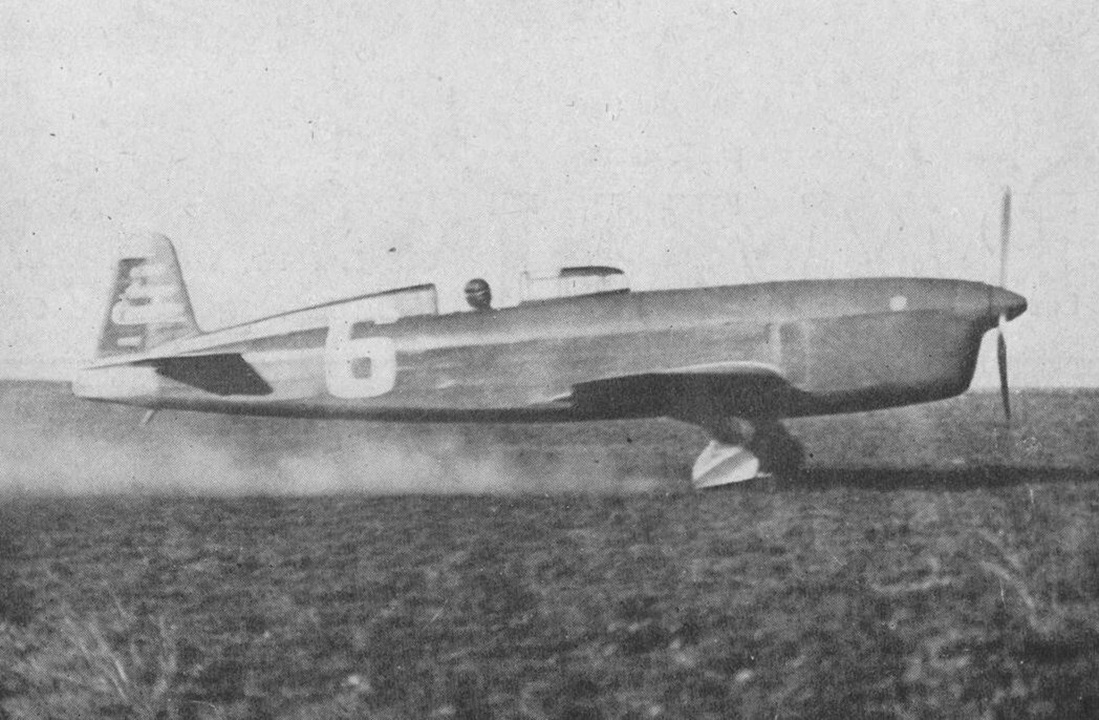
But the crown jewel of the Caudron-Renault racing program was the C.460 Rafale, and This Day In Aviation History describes the C.460:
The Caudron C.460 Rafale was designed by Marcel Riffard, technical director of Société des Avions Caudron, a French aircraft manufacturer which had been established in 1909. (Rafale means gust: “a brief, strong, rush of wind.”) It was a light-weight, single-seat, single-engine racer with retractable landing gear. Three were built. The airplane was primarily constructed of spruce, covered with doped fabric, with the engine cowling and fuel tanks fabricated of magnesium. It was 7.125 meters (23 feet, 4½ inches) long with a wingspan of 6.75 meters (22 feet, 1¾ inches) and overall height of 1.8 meters (5 feet, 11 inches). The C.460’s empty weight was 520 kilograms (1,146 pounds) and it had a gross weight of 875 kilograms (1,929 pounds).

The C.460s were originally powered by an air-cooled, supercharged, 7.947-liter-displacement (484.928 cubic inches) Renault 6Q inverted 6-cylinder inline overhead valve (OHV) engine. It had 2 valves per cylinder and a compression ratio of 6:1. The engine produced 310 horsepower at 3,000 r.p.m., and 325 horsepower at 3,200 r.p.m. The direct-drive, left-hand tractor engine turned a two-bladed metal Helices Ratier automatic variable-pitch propeller with a diameter of 1.80 meters (5 feet, 10.9 inches). The Renault 6Q was 1.62 meters (5 feet, 3.8 inches) long, 0.93 meters (3 feet, 0.6 inches) high and 0.52 meters (1 foot, 8.5 inches) wide. It weighed 190 kilograms (419 pounds).
Prior to Raymond Delmotte’s speed record attempt, the C.460’s engine was changed to a larger, more powerful 9.501 liter (579.736 cubic inches) Renault 6Q engine, also a direct-drive engine, which produced 370 chaval vapeur (364.9 horsepower) at 3,250 r.p.m. The engine’s centrifugal supercharger turned 26,000 r.p.m. The variable-pitch Ratier propeller was retained.
The Rafales Were Seriously Fast
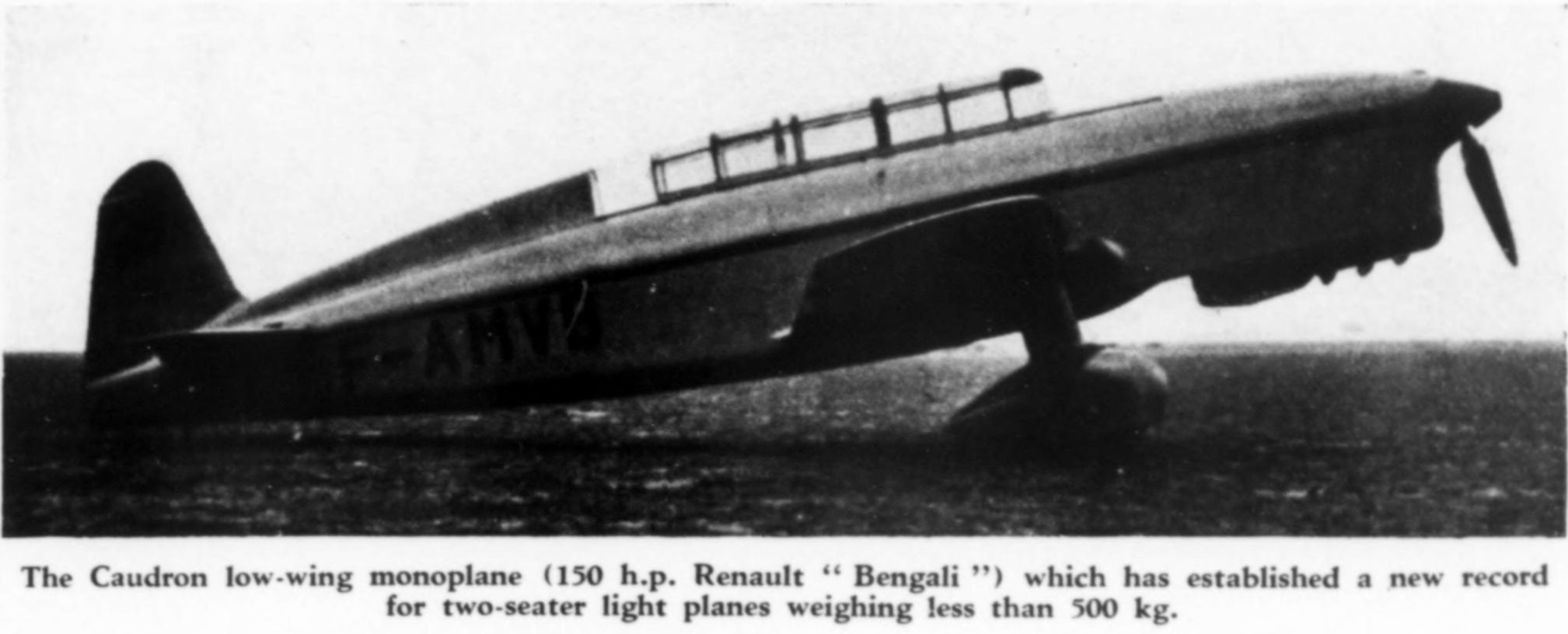
The spruce- and birch-framed Rafale was made in a few variants, including the 150 HP C.430 two-seater, the single-seat and 300 HP C.450, which had a fixed landing gear, and the C.460, which had a retracting landing gear. These planes were almost entirely wood and fabric, save for the engine and landing gear. There was also a slightly larger C.461, which weighed 1,457 pounds empty. These planes quickly racked up records. In early 1934, the C.430 picked up a light aircraft speed record when it flew 62.5 miles at an average speed of 181.4 mph. Two C.430s, one C.450, three C.460s, and two C.461s.
Renault lists more of the achievements of the Rafales:
Hélène Boucher, a prodigious aviator, signs a contract with the young Caudron-Renault company in June 1934. She went on to achieve many feats: a 621 mile world record for light aircraft; an all-category 62 mph international speed record; a 621 mile record with an average speed of 254 mph. On 8 July 1934, she finishes second in the Angers 12-hour race after flying her Caudron-Rafale alone for twelve hours straight. One month later, at the controls of a 140 hp Caudron-Renault monoplane, she sets the female world record with a speed of 277 mph!
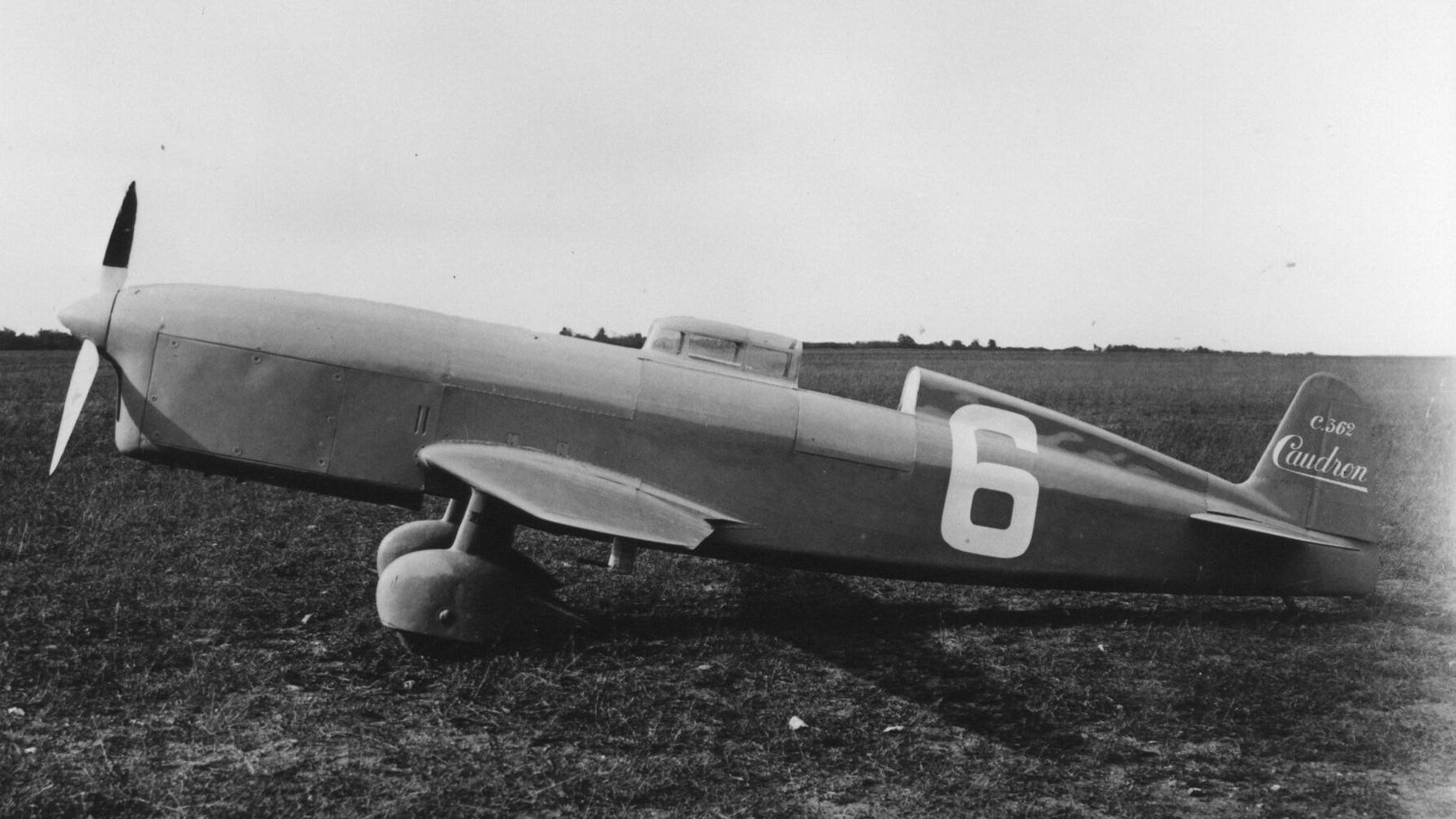
Boucher would later score another record, flying her C.450 to a speed of 284 mph. Renault continues:
A strong-willed woman of action, Maryse Hilsz held numerous speed and distance records. On 30 December 1938, she broke the distance record for flying non-stop in a category 1 plane, in a Caudron Simoun, by flying to Port Etienne (Mauritania) from Istres – a flight of 2,007 miles.
Madeleine Charnaux. Hired by Caudron-Renault, she was the first ever female pilot to become qualified in poor visibility flying. She soon went on to break a number of records at the controls of her Rafale, including the women’s and overall 621 mile speed records, the 62 mile duo record and then the solo record.
Maryse Bastié. She was the first French woman aviator to set multiple women’s records. Barely a month after Jean Mermoz disappeared, she crossed the southern Atlantic from Dakar to Natal in 12 hours and 5 minutes, flying solo aboard a 220 hp Caudron Simoun, setting a female world speed record for the route.

The biggest record tied to the Rafale happened with the C.460. Caudron factory test pilot and World War I flying ace Raymond Delmotte took his C.460 off into the sky during a Christmas Day race in 1934. That day, Delmotte sped the C.460 to an average speed of 314.32 miles per hour over one lap of a short 1.86-mile course. That technically made it the fastest light plane in the world at the time.
A year later, Delmotte would pilot a C.460 to an overall Coupe Deutsch de la Meurthe win, averaging 277.5 mph over the whole course. In 1936, another C.460, this time piloted by Michel Detroyat, won the Greve Trophy and the Thompson Trophy in Los Angeles. A C.450 would also take a Coupe Deutsch de la Meurthe win that year, too. The wins in America were a big deal because, as General Aviation News writes, up until that point, American planes dominated the circuits in the States. Now, a French plane was king.
Unfortunately, none of the original Rafales have survived to the modern day. The last C.460 crashed into a lake, where it remains submerged today. As for Caudron, it would be nationalized by the French government in 1944, falling under the umbrella of the Société Nationale de Construction aéronautique du Centre. Normally, this would mean that Renault would not have had a plane to go alongside its crossover, but something special happened back in 2006.
The Rafale Was Brought Back From The Dead

That year, Tom Wathen, an avid fan of vintage racing aircraft, commissioned AeroCraftsman Inc. of Tennessee, which is led by builder Mark Lightsey, to construct a new C.460. This was no easy task. All the team had to work with were a few photos, model airplane drawings, some engineering sketches from Le Bouget in France, and random parts from previous failed attempts to revive the aircraft.
AeroCraftsman would spend two and a half years painstakingly bringing the C.460 back to life. What was amazing was that the team kept modernization to a minimum.

The replica has a wooden structure just like the original, but aluminum is used for further reinforcement. The aircraft even uses a skin-type flush oil cooler – that’s what the random silver patch is on the left front of the aircraft – which was found on vintage racing planes for which reducing drag was key. This style of oil cooler later fell out of favor because it was easily damaged by gunfire when used on a fighter plane.
AeroCraftsman did make some upgrades along the way, like replacing the original design’s pneumatic landing gear with a hydraulic landing gear system. The aircraft also has more modern avionics and flight instruments than would have been on the original aircraft, but you wouldn’t even notice unless you peeled back the aircraft’s canopy.

The biggest departure from the original design was the replica’s engine. While the original Renault engines got as hot as 370 HP, the biggest, most powerful engine that AeroCraftsman had access to in the late 2000s was the Czech 260 HP LOM, which is an inverted 5.9-liter inline-six. This engine is somewhat similar to the old Renault engine and still produces some great performance. The C.460 remake has been taken to as fast as 280 mph at 6,000 feet MSL.
The airplane made its debut in 2009, and it appeared at the 100th anniversary Paris Air Show at Le Bourget and at EAA AirVenture Oshkosh in Wisconsin, and kept flying for a few more years. According to General Aviation News, one of the biggest surprises about seeing the recreated C.460 was its small size. A Cessna 152, which is a tiny plane, is 24 feet long and has a wingspan of around 33 feet. The C.460? It’s 23 feet long, has a wingspan of 22 feet, and its cockpit is a tight fit for anyone who isn’t particularly small.
The C.460 Replica Had To Be Restored

Renault purchased the aircraft in 2023, but sadly, it was no longer flying. Renault did not say when the aircraft last flew, but it was hauled into the 2023 Paris Air Show on a flatbed trailer. The automaker then paid for a no-expense-spared restoration, from Renault:
The extensive programme to restore the iconic Renault Caudron Rafale C.460 began in July 2024. It was conducted by Aéro Restauration Service (ARS) in Dijon, under the management of pilot and restorer Bruno Ducreux. Preparing the aircraft for its return to the skies was a major operation, involving extensive work on the entire airframe: the chassis was completely dismantled, inspected and then reinforced prior to a successful dry-fit assembly. Following reassembly, the engine completed a series of successful start-ups, marking a key milestone in the restoration project. A number of ground and flight tests were also carried out before confirming that the Caudron Rafale C.460 would be ready to take to the skies again from May 2026.

Now the only C.460 on the planet is flying again and is displayed in a gorgeous blue hue. For now, Renault has been producing tons of content showing the aircraft flying around and mingling with the crossover that took its name. The aircraft is also hitting the air show circuit, and has made an appearance at the La Ferté-Alais airshow in France last month.
Renault seems to be using the twice-reborn aircraft as an advertising tool, but also as catnip for aviation fans. The company says it will be publishing a documentary covering the aircraft’s restoration.
While the C.460 functions as a fancy advertising vehicle for Renault, I can’t help but love it. The original Rafales were once some of the fastest planes in the world, and yet, they were not preserved. While a replica might not have the same heritage, it’s just incredible that builders were able to resurrect a racing plane from only few resources. Now, hopefully, the world can enjoy this little piece of history for decades to come. I sure hope to see it at AirVenture one year.
Top graphic images: Renault


The Caudron M. series monoplanes are quite lovely. It would’ve been a thrill to see this and the Bugatti 100 together since they’re rather a bit of the front and backend of a particular aviation era. It’s really unfortunate that Scotty Wilsons Bugatti 100 had that terrible engine failure. Nice article, Ms. Streeter.
EDIT : I almost see Tintin getting into it!
That’s an exceptionally pretty plane. Almost cartoonish in a good way.
It’s beautiful!
Small typo:
I mean you gotta advertise, I’d much rather see more companies do it by preserving and sharing history than random ai slop *coughdodgecough*….
Wow. I never thought my interests in inter-war French aircraft and cars would overlap in one story, but here we are.
It’s Le Bourget, and it’s not a museum. It’s an airport, a Museum and every two years an Air Show. (the English Fanrborough takes the other year)
The museum part is probably at the same level as the Smithonian when it comes to rare birds and space related stuff. (yes there’s really rockets standing outside the museum)
Website : https://www.museeairespace.fr/en
I think some aviation geek at Peugeot really wanted to get this thing flying again, so they decided to name the car after the plane just for pretense to then go ahead and restore the plane.
I love my Peugeot salt and pepper grinders I bought in Bordeaux a few years back.
Little did Louis Renault know when getting all this done that he’d be beaten to death in the resistance’s jails post-liberation in 1944, have all of this nationalized immediately after, so the brand can advertise on this almost 100 years later.
We need some deep dives on some of the interwar racing aircraft. Some fascinating stories to be discovered. Check out Voisin, Fiat, Breda, Caproni, Marchetti, Ansaldo, and Macchi.
R. J. Mitchell and Howard Hughes, too!
My favourite “using a cool plane to sell a car” PR stunt was Aston Martin hiring the only flying Avro Vulcan to make the Aston Vulcan look cool.
https://www.newcarnet.co.uk/news-articles/2015/12/1/aston-martin-vulcan-meets-avro-vulcan
(I think I might have actually watched the Vulcan flying about when it was doing those PR pictures, assuming they were taken at Bruntingthorpe)
Not to be confused with the other French aircraft also named Rafale. Though that one is a large delta winged, twin-engine, fighter jet. I don’t think Dassault could file a trademark lawsuit though since this Rafale technically came first.
They should just call the Jennings motorsports guy. Some Marvel Mystery Oil will get that old girl running again.
This reminds me of the Bugatti 100, which never flew when it was new. There was a massive project to build a replica about 10 years ago, which unfortunately ended in a crash with the pilot dying. Beautiful plane. Crazy engineering. Two engines behind the pilot driving contra-rotating propellers in front.
What part of “never flew when it was new” did they not understand?
The original never flew due to those pesky events of the late 1930s/early 1940s.
The replica flew ok, it was the engines that were the issue.
The stupid part of that project was the use of Hayabusa engines. Obviously, they weren’t going to use original units, but small displacement engines that make power at high rpm designed for a completely different use and reliability standards was practically criminal in its stupidity and I’m sure someone must have brought that up at some point, but like that idiot with the Titanic explorer submarine, they knew better.
“some engineering sketches from a museum in Lebouget, France”
I’m pretty sure that’s referring to not just any museum, but the French National Air and Space Museum in Le Bourget (two words), just north of Paris. It’s absolutely worth the visit, but seems to get missed by many despite the throngs of tourists in Paris. Both times I went, it was extremely quiet. Among a lot of typically weird French aircraft, they have not one but two Concordes. Visitors can tour through F-WTSS, the prototype Concorde.
There’s not that many location in France, that can have engineering sketches of a typically weird French Aircraft.
Le Bourget is one of them, the Bibliothèque Nationale de France is another one, and the last one is Airbus archives in Toulouse
Even if many think of Airbus as a German company nowadays, it’s roots are built by all the various French Aeronautical companies that got merged one after the other. (and going down the rabbit hole you’ll find company names like Potez, Farman, Dewoitine that got merged and merged and merged…. into what is nowadays Airbus
I was particularly taken by the Leduc O.10 on display at Le Bourget. It is amazing and terrifying all at once – a 1938 design where they pilot sits INSIDE the intake of a ramjet. French aviation engineering is equal parts marvels and monstrosities, but all innovative and fascinating.
And I lived for some months just a few kilometers from the Airbus factory at Albert, so I default to thinking of Airbus as a French enterprise.
I have a sudden urge to play Microsoft Combat Flight Simulator 3 and I have no idea why…
Because you’re a sucker for punishment and want to buy more RAM and faster GPU.
I’m happy with my GPU, but component pricing went to the moon right as I was looking at finally re-doing my Media server.
(it’s still trundling along on the ancient i5 with 8GB of ram that came with it when I bought it for $120 off marketplace during COVID)
At least I managed to drop a 16TB hard drive into it while prices were good.
My media server is a retired small form factor corporate PC. You can get them for almost nothing.
I need a newer i7 for transcoding horsepower