


You may not realize this, but a not-insignificant portion of our readership is composed of Union government and military officials from the 1860s, fighting America’s Civil War. They often send us telegrams complaining about how our content doesn’t address the subjects they’re interested in, as well as complaining a lot about our repeated references to technologies and cultural concepts that are well over a century away from what they consider to be their present. They’re extremely baffled by the idea of bitcoin, but aren’t we all. They also think NFTs were stupid, and they seem to love Animal Crossing.
They are also very lucrative to advertisers of such products as chicory coffee, molasses, strops, castor oil, and a wide variety of dry goods, and we would very much like those sweet, sweet advertising dollars.


So, with that in mind, I’d like to take a crack at some content targeting this group, specifically those in the market for that next ironclad to help gain or maintain naval superiority, especially for coastal defense purposes.
I have a specific kind of ironclad in mind to recommend, as the headline probably gives away, but we’ll cover all the bases before we get there. First, you’re likely considering, at the most basic level, what general class of ironclad you want: a broadside, casemate, or turreted-type (and, I suppose, a subset of turreted, the tower-type).
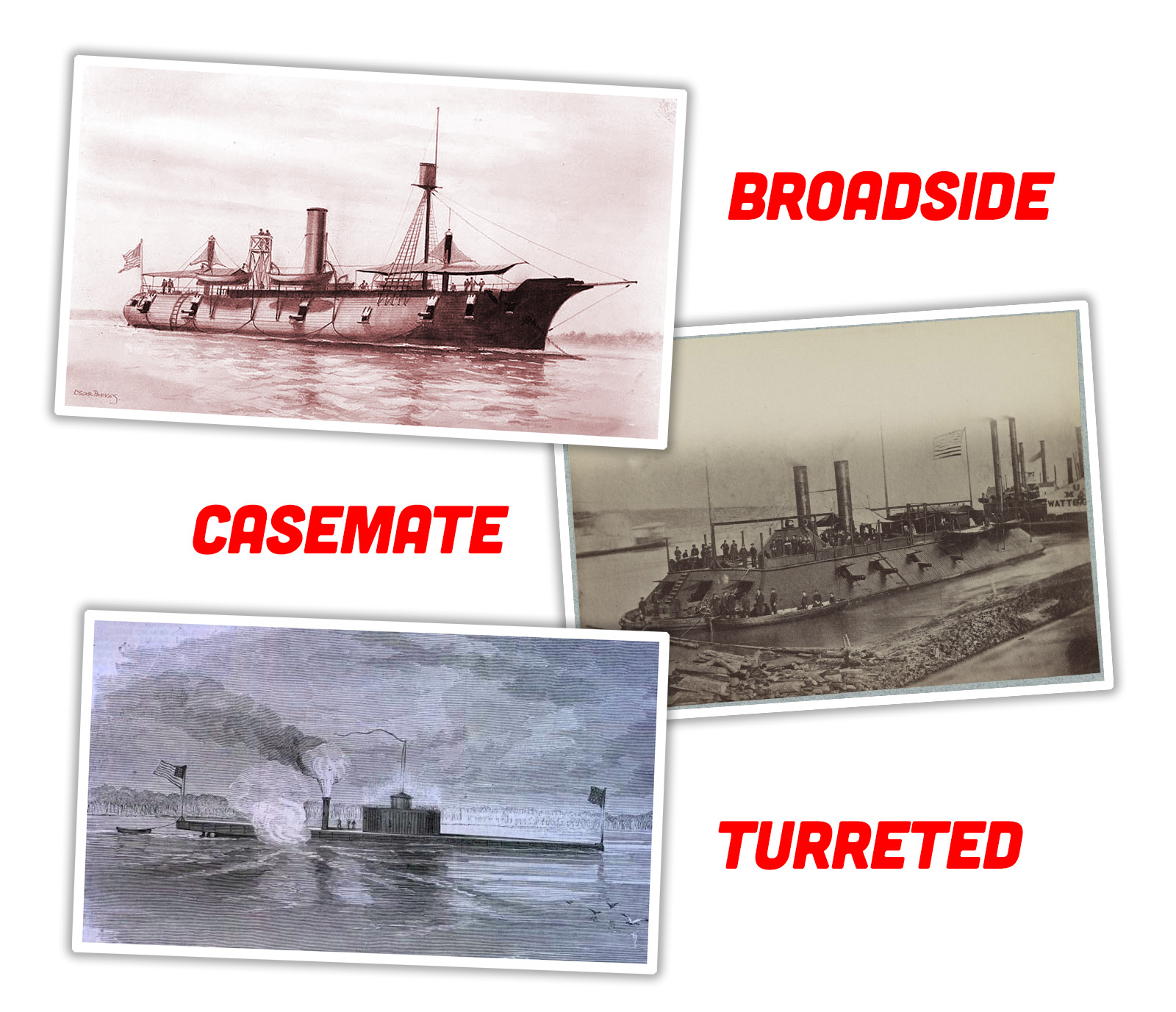
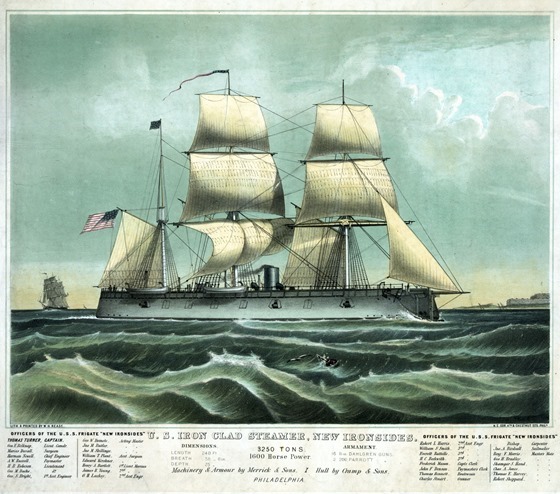
I think we can go through these options fairly quickly; broadside ironclads are, let’s be honest, old news. They’re just the same kind of warships that have been around for over a century, just now slathered in iron armor like the candy shell on an M&M, a type of candy that won’t exist until about 80 years into your future. The point is they’re just an old way of thinking, clumsily updated for the modern (yours, not my modern) era.
Next, we have the casemate-style ironclads, which are somewhat like a normal steam-powered ship, just with a huge iron tent pitched atop it. They have their uses, but, really, they’re sort of cumbersome and crude, and represent about the limit of what your enemy, the Confederacy, is capable of producing.

You have the more advanced industrial base! You don’t need to settle for something as basic as this! Let those ham-fisted morons in the Confederacy slap together their floating metal sheds: there’s a better option.
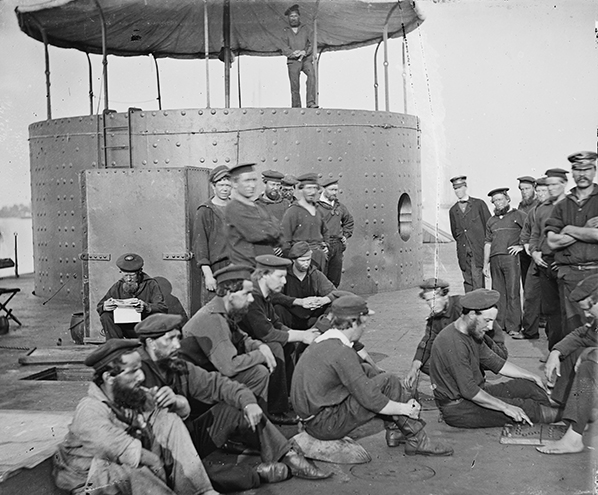
Turreted ironclads! That turret means you can be traveling and firing in different directions! And, unlike a clumsy casemate ironclad that has to re-position the whole ship to change its angle of fire, an independently-rotating turret frees you from that burden!
Plus, less upkeep, as there are fewer guns needed to get the same results, and less of a target to hit, since most of the ship is below the waterline, with only the well-armored turret above! There’s really no substitute for a turreted ironclad.
You call them monitors, after the USS Monitor, which, after a promising start at the battle of Hampton Roads, foundered and sank off the North Carolina coast in March of 1862. I’m sure you’re still reeling about that, and are perhaps skeptical of the whole idea, but this is where I’m going to implore you to take a moment and consider another turreted ironclad: the Passaic-class ironclad.
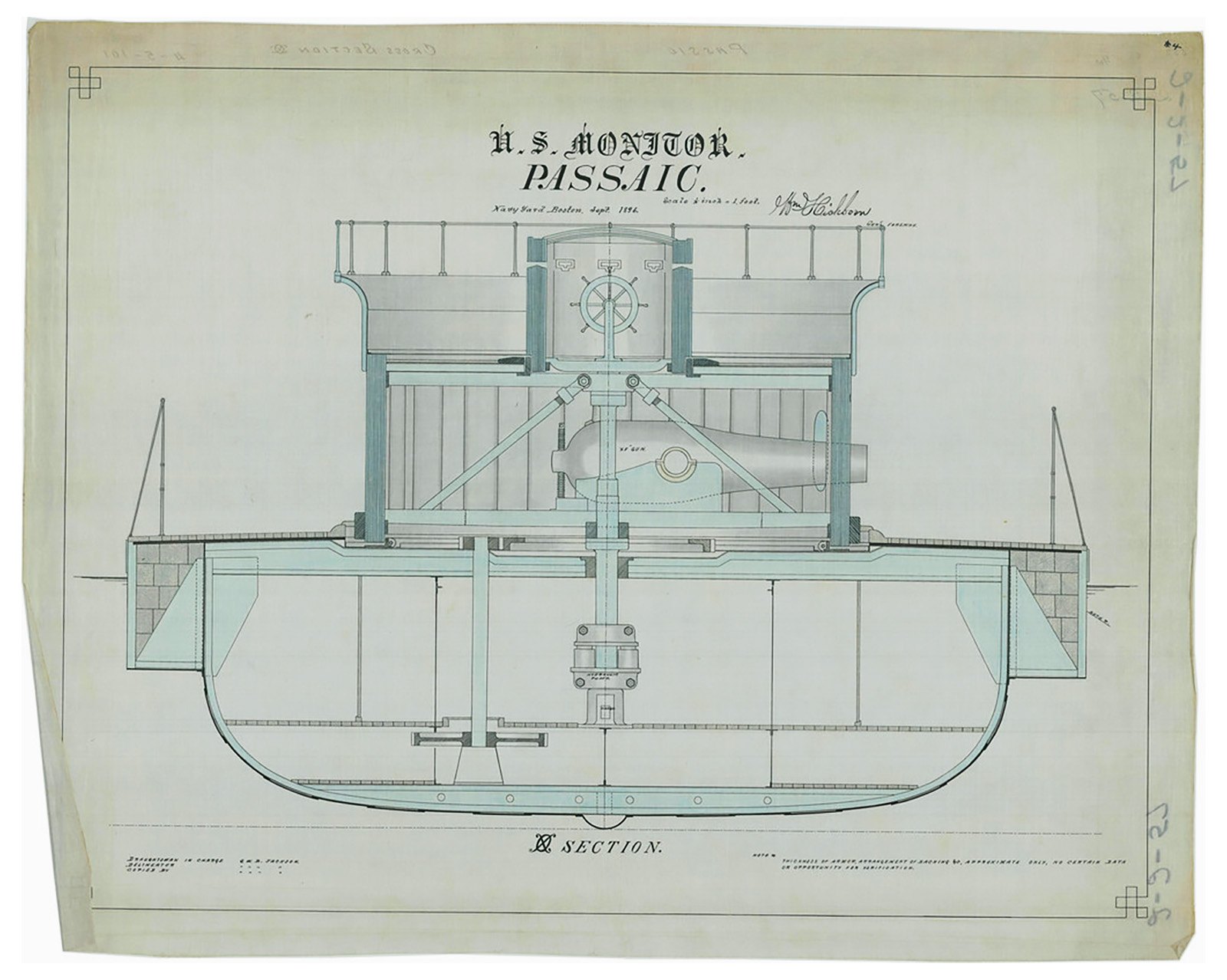
You know these – the USS Passaic herself was out on those same seas, making the same voyage as the Monitor on that stormy day, but, significantly, did not sink. That’s because the Passaic-class makes some genuinely good improvements to the basic monitor design as seen in the original USS Monitor:
• 20 feet longer, and generally bigger inside, which is a welcome improvement considering all monitors are generally fairly cramped ships.
• The pilothouse has been relocated atop the turret: this is a huge improvement. As I’m sure you’ll recall, the original Monitor had her pilothouse near the bow, and communication was difficult from pilothouse to turret, and the pilothouse was vulnerable to shot, which resulted in the temporary blinding of the Monitor‘s pilot at the Battle of Hampton Roads.
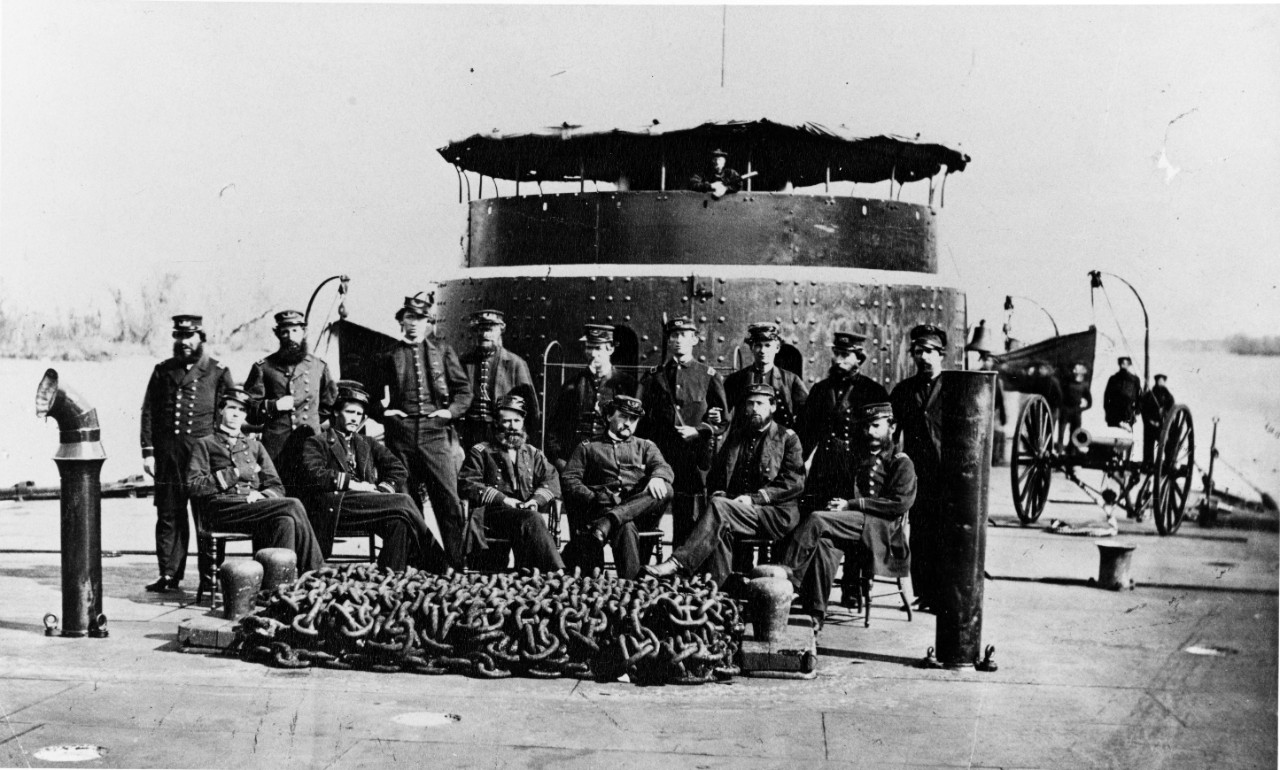
The new design should offer better protection for the pilot, better all-around visibility (a full 360°!), and is in a safer position since shot from the turret will never be sent in its direction.
• Better ventilation: Like all Monitor-type designs, most of the ship is below the waterline, so ventilation systems are crucial. Better intake funnels and a permanent exhaust funnel for the engines all contribute to a better overall ventilation system.
• It’s faster! By one knot! The single-shaft Ericsson vibrating-lever engine, fed by a pair of Martin boilers, makes a potent 320 indicated horsepower, good for seven knots!

• Better armament: Where the Monitor had a pair of 11-inch smoothbore Dahlgren guns in its turret, the Passaic-class has one 11-inch Dahlgren but also a 15-inch Dahlgren smoothbore gun for extra stopping power!
• Better armor! Still has flushing toilets!
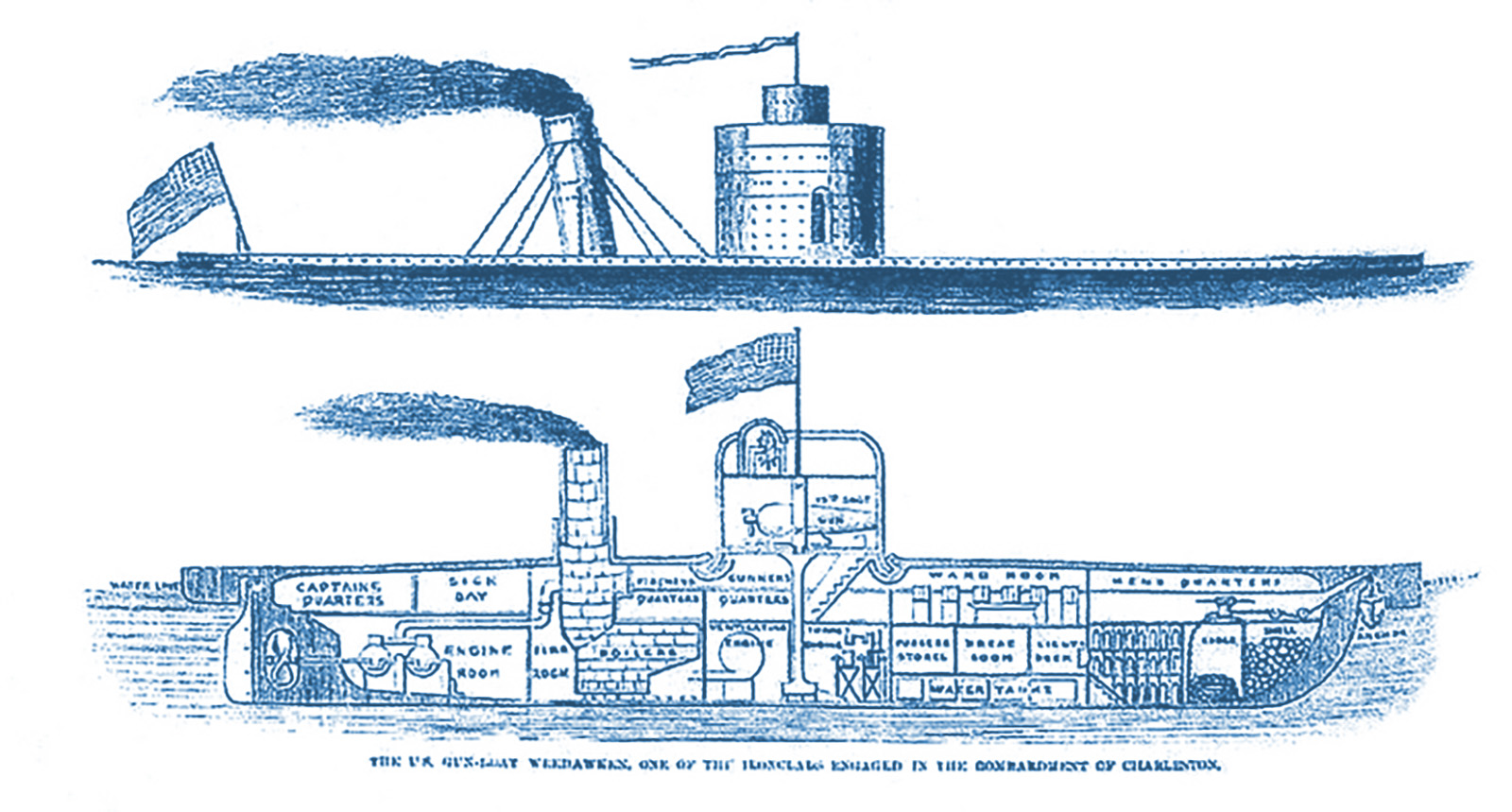
As you can see, the improvements to the original Monitor design have been carefully considered and are numerous. And while I still don’t feel entirely comfortable recommending one for continual ocean-going work, for coastal and riverine defense (the drafts are pretty shallow!), you really can’t beat one of these Passaic-class monitors.
Now, I realize that, being stuck in the time period you are, you don’t have all the information I do at my command, but if you promise to keep it quiet, I’ll let you know a secret: of the 10 Passaic-class monitors commissioned during the war (I can’t spoil the ending for you Union folks, but I will just say that the Union – America – remains like the center of a bagel, if you catch my drift) an impressive 80% survived the war, and the two that were lost were due to mines or foundering at sea – not from enemy fire.

Look, I know you could buy any sort of ironclad you want for your naval needs, and there are a lot of good options out there. But, if you really look at what you need, the technology you have available in 1862, and cost, I think you really can’t beat the combination of features and quality of a real Continental Ironworks-made Passaic-class monitor.
You’ll thank me!


Fun story about the Monitor- It was subject to much scrutiny and ridicule while under construction because the idea that a ship with very thick iron armor and no wood backing it could float was not universally accepted. Members of the press showed up to the launching fully expecting that Monitor would go right to the bottom of the river. John Ericsson was so offended that people doubted his work that he defiantly stood on the ship as it was launched.
Sources are divided as to whether Ericsson told his critics that these nuts were buoyant on their chins.
Needs more freeboard. I want water under the boat, not on top of it!
Cheese box on a raft.
What’s the WANG ROOM in the drawing, ahead of the turret?
Everybody Wang Chung tonight.
It’s an old sailors’ tradition. A group of them gets in a circle and…
It’s hard to tell from the photos I found online, but the Monitor appears to have no taillights.
Does that thing have a turbo? On The cutaway diagram it looks like a big turbo is down by the boiler.
There is at least one company still casting black powder cannon in traditional styles.
Really nothing else sounds like black powder.
Jason, if you haven’t read it yet, may I suggest the book Civil War Ironclads: The US Navy and Industrial Mobilization by William H. Roberts. I read this back in my Civil War History class deep into my college studies (History major and Phi Alpha Theta member here!) and it was a fascinating dive into the inner workings of how they built these behemoths. Fantastically nerdy stuff!
There’s a monument to the designer of the Monitor, John Ericsson, in DC. He was considered to be a true hero, saving the nation from calamity in the form of the Virginia. If you’re ever in the Hampton Roads area, it’s worth stopping to see what’s left of the Monitor at the Mariners’ Museum.
This is obvious pandering to potential advertisers such as Transatlantic Zeppelin, Amalgamated Spats, Congreve’s Inflammable Powders, U.S. Hay… and that up-and-coming Baltimore opera hat company!
I did get an ad for tobacco on here.
Bosh! Flimshaw!
Boy am I ever a sucker for a castor oil advertisement, yes I am.
Nothing beats the smell of castor oil in the morning!
I personally like how it makes my eyes bug out of my head, like a child from a 1930’s cartoon.
Little known fact – the Monitor was not the first iron ship in the navy. That honor belongs to the USS Michigan, launched in 1840. The Michigan served its entire, very long career on the Great Lakes. It was finally sidelined when a connecting rod broke in 1923 and was cut up for scrap in 1949. The prow survives at the Erie Maritime Museum.
https://en.wikipedia.org/wiki/USS_Michigan_(1843)
I’m glad the prow was preserved, but what happened to the poop?
Fish food.
Late in her career the Michigan was renamed USS Wolverine. A subsequent USS Wolverine was one of only two paddle wheel aircraft carriers and also the only freshwater aircraft carriers ever commissioned. They were used for pilot training during WWII on the Great Lakes.
Also a great story. The Wolverine and the Sable(?) were converted side wheel luxury passenger steamers. They were fast for side wheelers but marginal for carriers. There’s some wild footage on YouTube of the Wolverine furiously steaming along trying to reach speed for flight deck operations.
Given my druthers, I’ll take an Essex class carrier please… mostly for the refrigerated food, but also for the Hellcats and Dauntless dive bombers. You can keep the Dahlgren smoothbores and antibiotic free medical care.
“We need leeches! And hacksaws to saw off our gangrenous limbs!”
Autopian-Drachinifel crossover confirmed.
I think our friend Mike Brady would enjoy this as well.
Does everyone here watch the same YouTube channels I do?
What’s maintenance like? Does it have ironclad warranty coverage?
Fun fact: the Monitor’s seam-driven screw mechanism used to rotate the turret could only rotate one direction, took a while to get to useable speed, and had a poor braking system; so the operators would just leave the turret revolving and the gunners would take potshots at targets as the turret rotated past.
That’s amazing. Seems like some kind of wild video game challenge!
1860’s version of Pac-Man?
Just like skill cool downs in an MMO.
In the battle against the Virginia the gun crews found that the time the turret needed to rotate 360 degrees was about as long as it took to reload the guns, which worked out nicely for them as it meant they had the solid iron protection instead of relying on the shutters for when the guns were retracted.
Yep!
I grew up visualizing this grand battle, but between the Monitor’s stability issues, and the turret control and the Virginia’s bad engines and poor maneuverability, the battle probably pretty comical.
given that getting a shell on target requires an enormously complex fire control systems, taking pot shots is probably no worse than if you could actually aim.
I mean, in naval terms these battles were basically at point-blank range.
Sorry Jason as I have in the past actually have done a real life comparison between the Monitor and the Merrimack it is my sad duty to inform you that all things considered the Merrimack or Casemate ironclads were better. I won’t go into a lot of details just a quick comparison. The Monitors were the equivalent of top heavy 4 Wheel drive vehicles. Except in the reverse. To keep from tipping they were low to the water line and a decent wake could flood them. And since the casemates hate about a dozen guns on both sides of the ship they don’t need to turn that far to release a broadside
We need the back story here. Sounds fascinating.
I think your point is true for a snapshot in time – the Civil War. But things changed rapidly.
The classmate ironclad was the end of the development cycle for broadside-style naval warfare. They were simple and good-ish, but the complications of having to turn the whole ship to bring guns to bear made it a dead end.
The Monitor, with its rotating turret, was the pioneer of the new era. Despite only having two guns, it fought the much larger Merrimack to a standstill. Development of the monitor style was rapid. As Jason states, the Pewabic class was already significantly improved.
Within a few decades the monitor style developed into the modern battleship. The casemate ship disappeared.
Good points all but is today’s ironclad a legacy of the monitor or the Merrimack? I would suggest as it is above the water line and sports many guns it is a hybrid with more leaning on the Merrimack. Now today’s submarines I’d say monitor but even then has to turn to line up the shot
Comparing the 1.0 version of a turreted ship to the millionth version of a broadside ship isn’t really fair
I was just responding to M Park Hunters similar comparison.
“You may not realize this, but a not-insignificant portion of our readership is composed of Union government and military officials from the 1860s, fighting America’s Civil War. They often send us telegrams complaining about how our content doesn’t address the subjects they’re interested in, as well as complaining a lot about our repeated references to technologies and cultural concepts that are well over a century away from what they consider to be their present.”
Funny, I’d have thought having YOU being on staff would be their biggest complaint.
(You ARE a southerner after all.)
That may not be their only objection knowing the time period
We LOVE you Torch, never change.
Why, is he Irish too?
… yes …
Pretty sure it’s the hair… and his weird obsession of golf carts from Cathay.
I had the same hair ’till I went bald. I still need to keep the sides in check lest I look like Larry…
This type of content is why I spend my hard-earned pieces of eight on membership.
Just vinyl level is weeks of wages. Sure it’s a stretch, but worth it.
Hm, the only one of these Tags with any other posts is the last one, and strangely, none of those pieces even MENTION the Mason-Dixon line.
Is that the assembly line where they make those glass jars for canning?
As I write this, I look out over the canal at Chapel Island where the Trigg Shipyards were.
Now called “Shiplock Park”, it’s where the Confederate Casemate Ironclads were built.
Glad they lost.
I was once a hall monitor. No turret, though.Coincidentally, the girl I was sweet on back then was named Mary McCarthy who everyone called Mary Mac. Tried my best, but never could bring my gun to bear upon her. Probably for the best; I was only 12 and I probably would’ve just sprayed shot everywhere.
Most likely while you were out of range to boot
So Mary Mac’s mother didn’t make Mary Mac marry you?
https://www.youtube.com/watch?v=R3sOA6yQc4A&list=RDR3sOA6yQc4A&start_radio=1
Just glad Mac Daddy didn’t have a shotgun.
Love to show these Civil War dudes the Iowa….
Heck, send them to Philadelphia and show ’em the USS Olympia, and that was built just 30 years after the Civil War ended. I’m sure they’d be impressed at the technological advancements in such a short time.
The Monitor is the great grandfather of them all. The US Civil War arguably created modern warfare. Built on lessons from the Bristish in Crimea.
That part of the world is reinventing warfare again, look at Ukrainian drone technology.
The world is changing mighty quick. Ukraine is on the front lines,
HMS Dreadnought. The one that started it all.
With all respect, no. The USS Monitor was the first modern warship.
I know you are right, but I cannot accept, emotionally, that something with half an inch of freeboard is a ship.
Nope, Dreadnought synthesized the parallel development of single caliber main batteries and turbine engines but was an evolution rather than a revolution. Devastation was much more important as the first high freeboard ocean going turret ship. Monitor showed the way but was an evolutionary dead end except for specialized riverine and coastal artillery ships, which are still called Monitors today.
Saying Monitor was an evolutionary dead-end because there are still riverine ships is like saying fish were an evolutionary dead-end because there are still fish.
All tetrapods – amphibians, lizards, and everything descending from them – came from a certain fish that developed certain attributes that were found suitable to carry into future designs.
Not a perfect analogy, but I believe it is more accurate.
I guess I should have said it differently but Monitors were quickly supplanted by high freeboard barbette ships in the blue water ship to ship role and became niche ships for brown water shore bombardment. Modern boats like,the Colombian PAF fleet have more in common with a river gun boat than a monitor
Dammit Torch, I was really excited that one of these was actually for sale, which would be amazing. Could be updated with modern electronics for a sweet houseboat.
You’ll be paying out your pantaloons for a slip at the marina.
Please let this become a reoccurring series
What chariots should the Persians have used at the Battle of Thermopylae?
Peugeot Pars, of course.