


You may not realize this, but a not-insignificant portion of our readership is composed of Union government and military officials from the 1860s, fighting America’s Civil War. They often send us telegrams complaining about how our content doesn’t address the subjects they’re interested in, as well as complaining a lot about our repeated references to technologies and cultural concepts that are well over a century away from what they consider to be their present. They’re extremely baffled by the idea of bitcoin, but aren’t we all. They also think NFTs were stupid, and they seem to love Animal Crossing.
They are also very lucrative to advertisers of such products as chicory coffee, molasses, strops, castor oil, and a wide variety of dry goods, and we would very much like those sweet, sweet advertising dollars.


So, with that in mind, I’d like to take a crack at some content targeting this group, specifically those in the market for that next ironclad to help gain or maintain naval superiority, especially for coastal defense purposes.
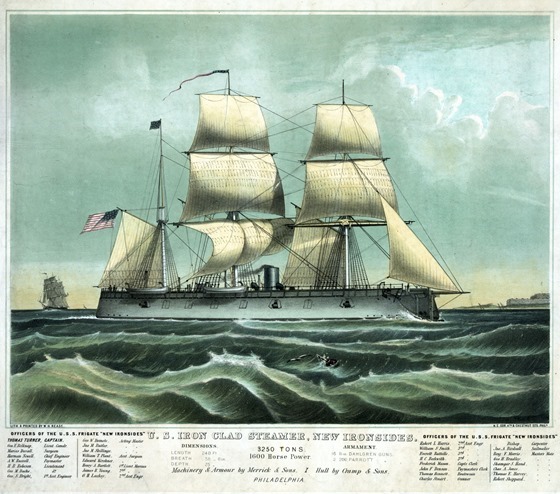
I have a specific kind of ironclad in mind to recommend, as the headline probably gives away, but we’ll cover all the bases before we get there. First, you’re likely considering, at the most basic level, what general class of ironclad you want: a broadside, casemate, or turreted-type (and, I suppose, a subset of turreted, the tower-type).
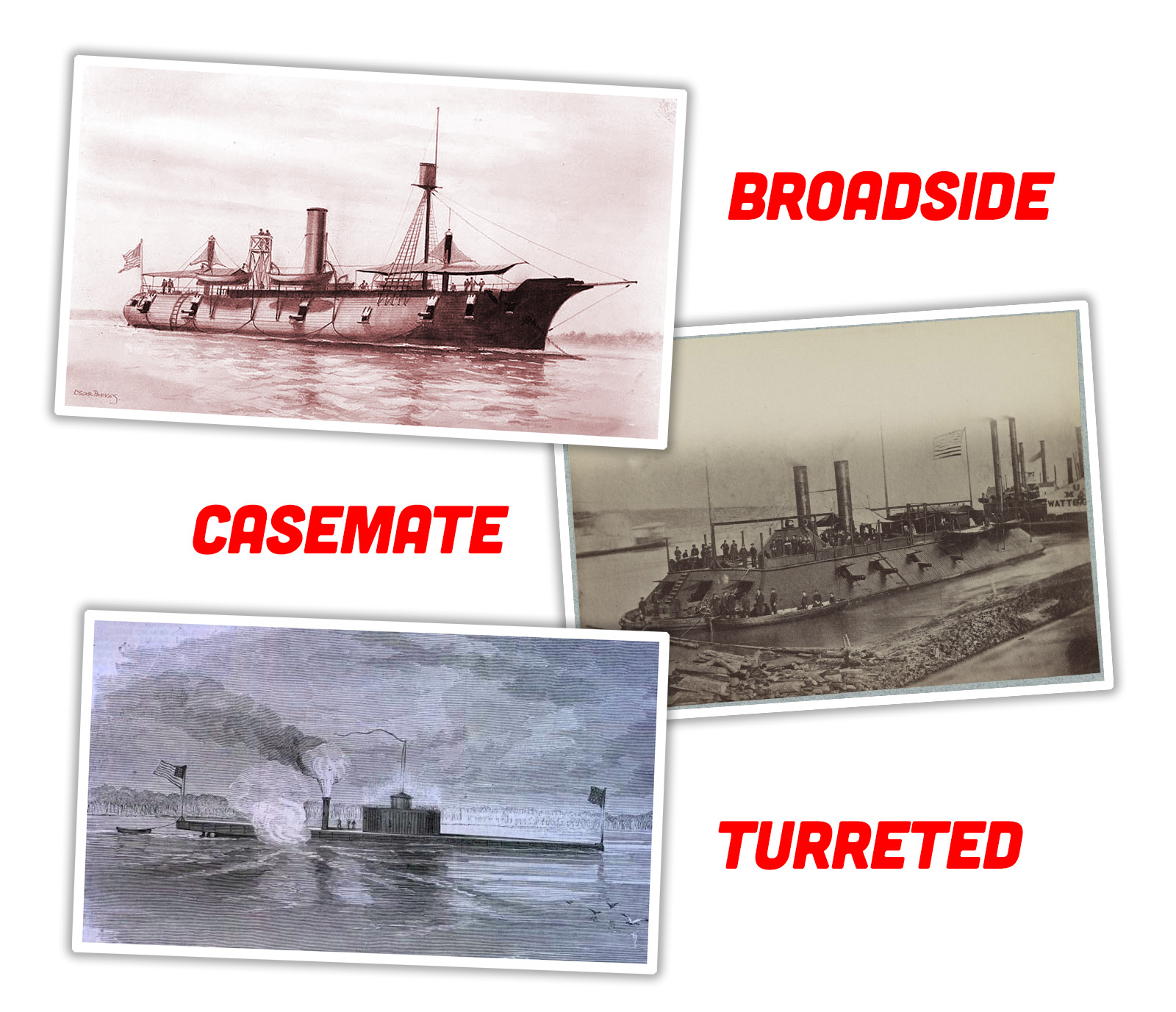
I think we can go through these options fairly quickly; broadside ironclads are, let’s be honest, old news. They’re just the same kind of warships that have been around for over a century, just now slathered in iron armor like the candy shell on an M&M, a type of candy that won’t exist until about 80 years into your future. The point is they’re just an old way of thinking, clumsily updated for the modern (yours, not my modern) era.
Next, we have the casemate-style ironclads, which are somewhat like a normal steam-powered ship, just with a huge iron tent pitched atop it. They have their uses, but, really, they’re sort of cumbersome and crude, and represent about the limit of what your enemy, the Confederacy, is capable of producing.

You have the more advanced industrial base! You don’t need to settle for something as basic as this! Let those ham-fisted morons in the Confederacy slap together their floating metal sheds: there’s a better option.
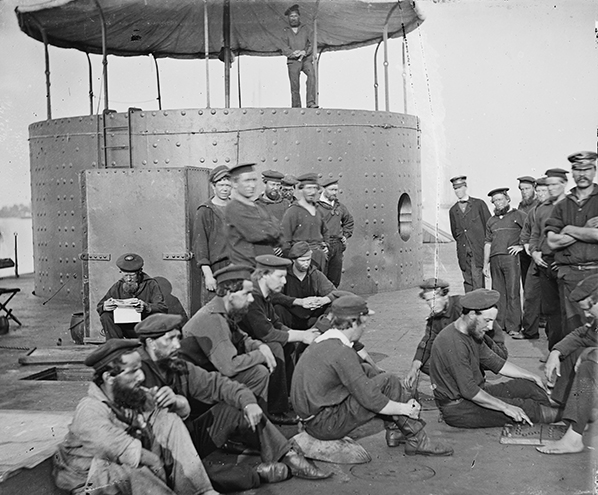
Turreted ironclads! That turret means you can be traveling and firing in different directions! And, unlike a clumsy casemate ironclad that has to re-position the whole ship to change its angle of fire, an independently-rotating turret frees you from that burden!
Plus, less upkeep, as there are fewer guns needed to get the same results, and less of a target to hit, since most of the ship is below the waterline, with only the well-armored turret above! There’s really no substitute for a turreted ironclad.
You call them monitors, after the USS Monitor, which, after a promising start at the battle of Hampton Roads, foundered and sank off the North Carolina coast in March of 1862. I’m sure you’re still reeling about that, and are perhaps skeptical of the whole idea, but this is where I’m going to implore you to take a moment and consider another turreted ironclad: the Passaic-class ironclad.
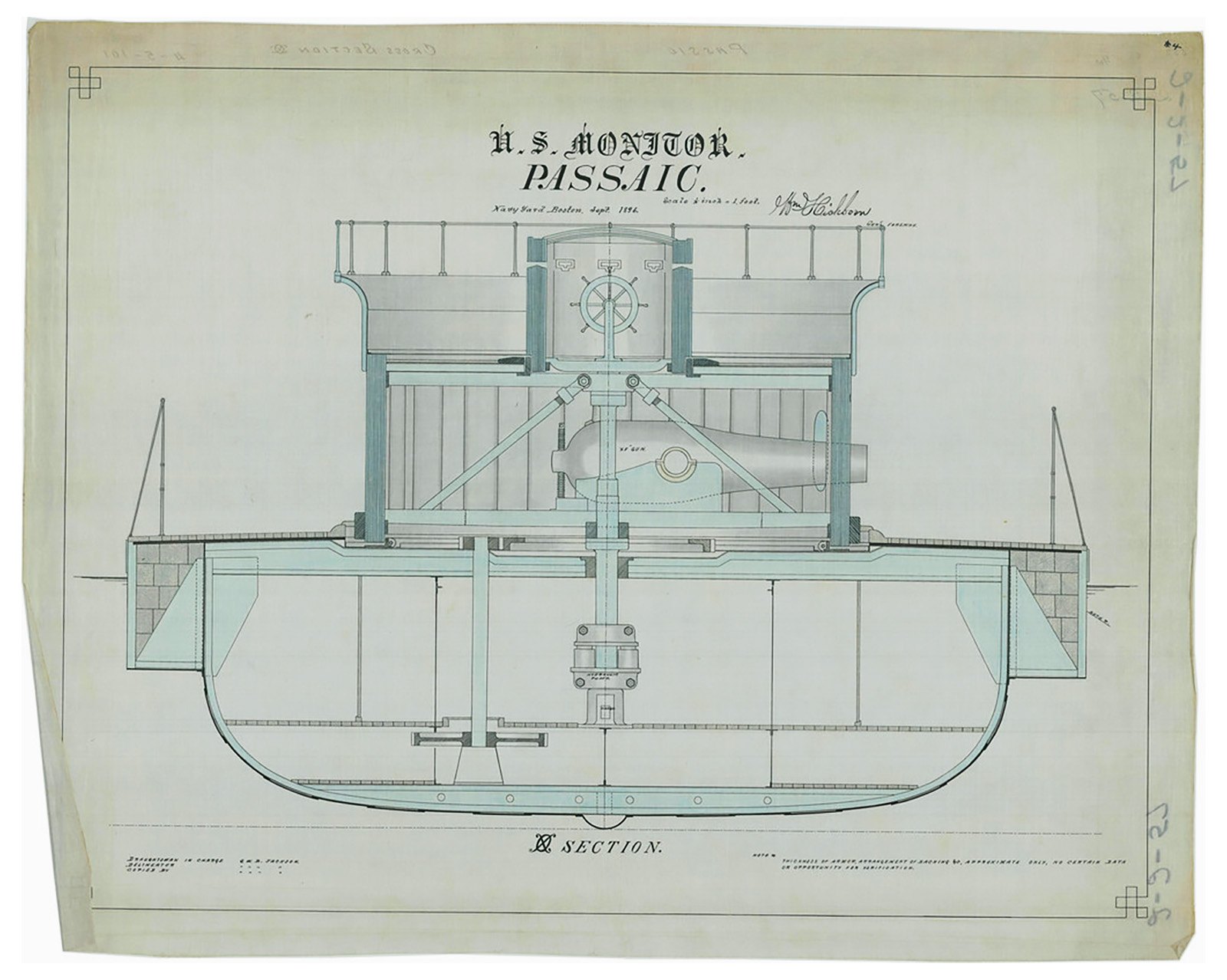
You know these – the USS Passaic herself was out on those same seas, making the same voyage as the Monitor on that stormy day, but, significantly, did not sink. That’s because the Passaic-class makes some genuinely good improvements to the basic monitor design as seen in the original USS Monitor:
• 20 feet longer, and generally bigger inside, which is a welcome improvement considering all monitors are generally fairly cramped ships.
• The pilothouse has been relocated atop the turret: this is a huge improvement. As I’m sure you’ll recall, the original Monitor had her pilothouse near the bow, and communication was difficult from pilothouse to turret, and the pilothouse was vulnerable to shot, which resulted in the temporary blinding of the Monitor‘s pilot at the Battle of Hampton Roads.
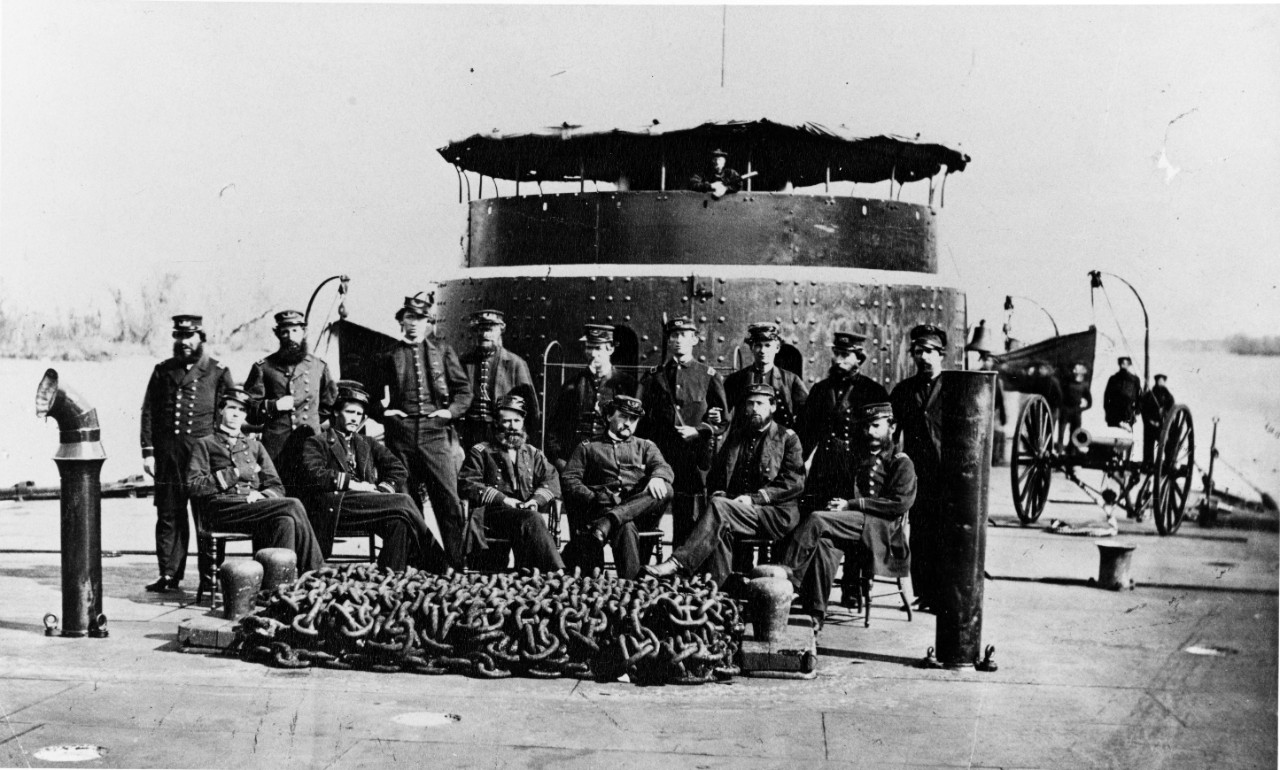
The new design should offer better protection for the pilot, better all-around visibility (a full 360°!), and is in a safer position since shot from the turret will never be sent in its direction.
• Better ventilation: Like all Monitor-type designs, most of the ship is below the waterline, so ventilation systems are crucial. Better intake funnels and a permanent exhaust funnel for the engines all contribute to a better overall ventilation system.
• It’s faster! By one knot! The single-shaft Ericsson vibrating-lever engine, fed by a pair of Martin boilers, makes a potent 320 indicated horsepower, good for seven knots!

• Better armament: Where the Monitor had a pair of 11-inch smoothbore Dahlgren guns in its turret, the Passaic-class has one 11-inch Dahlgren but also a 15-inch Dahlgren smoothbore gun for extra stopping power!
• Better armor! Still has flushing toilets!
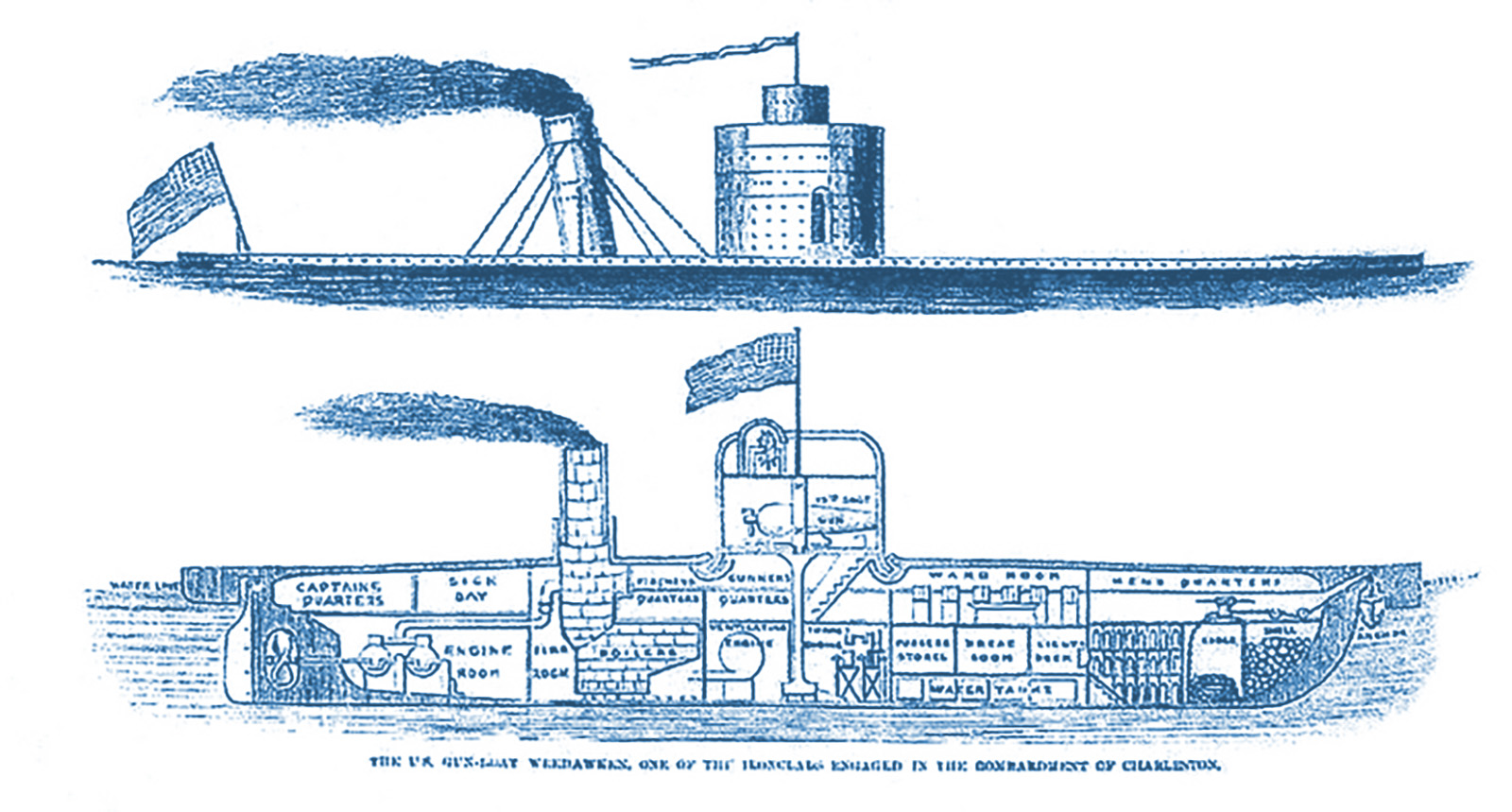
As you can see, the improvements to the original Monitor design have been carefully considered and are numerous. And while I still don’t feel entirely comfortable recommending one for continual ocean-going work, for coastal and riverine defense (the drafts are pretty shallow!), you really can’t beat one of these Passaic-class monitors.
Now, I realize that, being stuck in the time period you are, you don’t have all the information I do at my command, but if you promise to keep it quiet, I’ll let you know a secret: of the 10 Passaic-class monitors commissioned during the war (I can’t spoil the ending for you Union folks, but I will just say that the Union – America – remains like the center of a bagel, if you catch my drift) an impressive 80% survived the war, and the two that were lost were due to mines or foundering at sea – not from enemy fire.

Look, I know you could buy any sort of ironclad you want for your naval needs, and there are a lot of good options out there. But, if you really look at what you need, the technology you have available in 1862, and cost, I think you really can’t beat the combination of features and quality of a real Continental Ironworks-made Passaic-class monitor.
You’ll thank me!


Dare I ask— how many telegrams come from the other side?
Uh oh…
This was posted under “Buyers Guide”…
David has been alarmingly quiet, and we’ve been left in the dark (on the Autopian site proper) about updates with his WW2 Jeep project.
He heard “Ironclad”, realized that – especially with their exposure to salt water – most of them are derelict rust heaps by now.
He bought Torch a truck, one capable of potentially towing something large and heavy cross-country (eventually).
…oh no…
David is buying a boat!
…what would his family in the Army think of him starting his own rusty navy?!
“Folks, I have just 3 weeks to get my new boat USS Autopian ready to sail to Moab for the yearly Ironclad Offroad Extravaganza. Turns out the ship was in much worse condition than I expected and I’m having trouble sourcing parts on eBay. Also, my wife is upset this is taking up all our driveway. Torch is flying out this weekend and we’re going to try to patch the rusty areas with bondo and get it on the road”
Nostradamus, thy current form is revealed!
With a name like Tim, are you also a sorcerer?
Ok but the casemate ironclad took all the confederate gold with it to Africa
Ah, a Clive Cussler fan! Are there any villains who can defeat Dirk Pitt or Al Giordino?
No sir, NUMA is invincible
Really interesting article. Next you could do one about the Hunley.
Well I’m sure the these ‘monitors’ are fine for you colonials, in shallow coastal waters, but if don’t want to spend all your time sailing around the backwaters of the world, you need a proper ocean-going ironclad like the Devastation class ironclads.
More power, twice the armament, designed by and for the best navy in the world!
Don’t bother with foreign junk, Buy British!
Point of order: construction on the Devastation class won’t begin until 1869. A bit late to the party, unfortunately.
Yeah but they don’t know that yet.