


Electric vehicles are generally less likely to catch on fire than their internal combustion-powered counterparts. They aren’t filled with highly combustible fuel and don’t have hot engines that mingle with that fuel and other flammables. But when EVs do go up in flames, they have a tendency to burn very hot and very long. Such was the case of a Tesla Semi that burned down in California yesterday. The truck burned for so long that it shut down an entire section of Interstate for hours as it reduced itself to a pile of ash.
At around 5:35 p.m. Pacific Time yesterday, a Tesla Semi was traveling down the southbound lanes of I-880 in Hayward near Route 92 when it burst into flames. The truck wasn’t involved in a crash; it was just moving along in traffic. Luckily, the driver escaped the cab without harm and watched from the side of the Interstate as their rig became a roaring blaze.


The truck involved was one of the early production units delivered to Frito-Lay to transport snack foods, and it was pulling a leased trailer. The fire appeared to center around the battery area of the tractor, but eventually spread to the whole unit. Here’s what one of these trucks looks like when it’s in one piece:

Information is a bit thin on the ground right now, but we know that the California Highway Patrol was on scene within ten minutes and immediately shut down both northbound and southbound lanes of I-880 from Winton Avenue to Route 92 due to concerns about toxic smoke. The Hayward Fire Department then arrived and began dousing the truck in foam.
A passenger in a passing vehicle got footage of the rig when the fire was in its earlier stages. I have embedded the video below; click here if you cannot see it:
This is what it looked like for us, before cops or fire got there.
According to CHP, the driver said that the rig just caught fire, and they had no idea why. As for the fire itself, CHP says that, due to the truck’s battery, the fire proved rather difficult to extinguish. Then, even when there wasn’t a visible fire, hazardous smoke continued to billow out of the rig for some time.
As we recently wrote when covering the EV blaze that took 18 hours to extinguish at a Cadillac dealership, putting out an EV fire isn’t as simple as just tossing water onto the flames.

Here’s what the UL Research Institute’s Fire Safety Research Institute’s “Full-Scale Electric Vehicle Fire Experiments and Recommendations for Fire Incident Response” report recommends for firefighters when faced with EV fires:
Immediately Suppress EV Fire With Water While Protecting Exposures
Suppression with a handline with water (no additives) is recommended as the first choice of suppression strategy, similar to a conventional vehicle fire attack. The use of tools designed to introduce water directly into the battery pack was not examined in this work. However, firefighters should not open or pierce the battery pack outer case.
Fight the Vehicle Fire First, the Battery Fire Second
The fire in the passenger compartment represents a significant portion of the thermal and chemical exposure hazard and will readily respond to water. Rapid suppression of the cabin fire reduces the thermal and chemical exposure hazard to surrounding objects, civilians and first responders, especially if battery involvement is prevented.
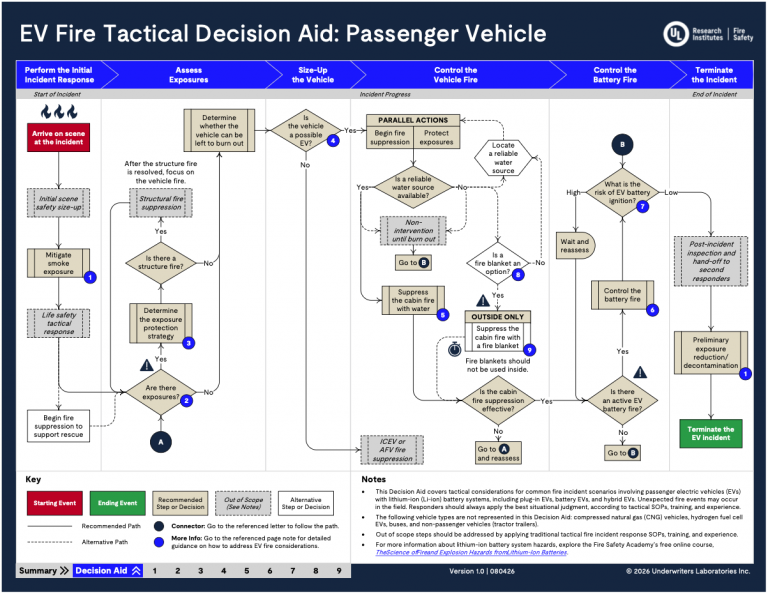
The battery fire is best controlled by supervising the battery fire until thermal runaway stops. Water should be applied intermittently to prevent reignition of the rest of the vehicle and redirect flames from exposures if necessary. Applying copious amounts of water to the battery enclosure is wasteful and will not stop thermal runaway. Likewise, introducing water into an uninvolved battery may increase (re-)ignition risk.
Use Caution if Deploying Fire Blankets
Fire blankets, while not recommended as the first choice in suppression strategy, may be effective under limited operational scenarios. They will not stop thermal runaway or the resulting production of flammable gases, and they limit firefighters’ ability to monitor the vehicle. Firefighters should not manipulate the blanket once it is deployed and remain cognizant of the latent reignition and deflagration hazard. It is inadvisable to use fire blankets in areas where flammable gases may accumulate and form an explosive atmosphere, such as indoors. Fire blankets should remain undisturbed for at least one hour after the last visible fire or smoke emanating from under the blanket.After the Fire
Following extinguishment, the vehicle should be observed for reignition risk to identify any ongoing hazards. Release of the vehicle should occur after inspection has identified the relative reignition risk. Even if the battery appears to have burnt out, it cannot be excluded that moving the vehicle may cause a short circuit and subsequent reignition of remaining intact cells. For this reason, firefighters should remain vigilant and continue to use an SCBA during overhaul and inspection. Fire departments should consider escorting the tow truck to the tow lot to ensure rapid identification and suppression should reignition occur. A quarantine distance of at least 5 m (16 ft) to any other combustible object should be left at the salvage yard.
The whole report is a whopping 150 pages, which you can read here.
A known cause of EV battery fires is thermal runaway. Batteries are made up of clusters of individual cells, and it’s possible for a single cell to be damaged, be it through overcharging, a physical impact, overheating, a short circuit, or even just a defect. When this happens, a chemical reaction can occur that generates heat and toxic gases. This reaction eventually becomes self-accelerating, as the battery heats up faster than the vehicle’s systems can cool it.What’s really insidious about thermal runaway is that it will reach a point where isolating the cell or disconnecting the battery from the vehicle’s systems will not stop it. As all of this occurs, the rapidly heating cell causes neighboring cells to also heat up, eventually causing them to enter a thermal runaway, too. At a critical breaking point, the toxic cloud of gases spewed by these batteries can ignite into a fire or even an explosion. From there, the fire more or less feeds itself.

One important note is that subsequent short circuits and battery cell thermal runaway events can extend the time it takes to extinguish a fire. The fire might not consume the whole battery at first, and cells that might have survived the initial fire might fail later. Experts recommend that, when the burned EV is finally towed away, it should be stored in an open area away from other vehicles and buildings as the battery may light up again. Some fire departments use special blankets to fight these fires.

The Australian Government has an entire EV fire safety website dedicated to educating the public and first responders about the science and dangers of EV fires. The short of it is that, when EVs go up in flames, they burn hard, hot, and for long. Something like a Tesla Semi adds an additional curveball by having a battery with eight times the capacity of a long-range electric passenger car. That’s close to 10,000 cylindrical cells that firefighters might have to battle.

Thankfully, in this case, the fire was limited to just the tractor, and firefighters even extinguished the flames faster than originally anticipated. Northbound lanes of I-880 were reopened at around 8:40 p.m., while the southbound lanes, where the burned truck was, were reopened at 3:30 a.m. Wednesday morning.

At first, CHP estimated that the fire could have taken through the morning commute hours to extinguish. That was 10 hours to deal with what was a single-vehicle fire. Depending on intensity and other factors, a fire emanating from an ICE vehicle can be extinguished in under an hour.

Videos and images show that there was little of the Tesla Semi remaining. The truck’s rear frame and axles survived, and there were even still tires on the wheels. But the rest was essentially leveled into nothing. The trailer came out of the other side pretty burned and warped, but largely still in one piece.
This is the second reported instance of a Tesla Semi fire. The first one happened in 2024. In that incident, a Tesla-operated Semi was driving down I-80 near Emigrant Gap, California, from Livermore, and was headed to Tesla’s facility in Sparks, Nevada. As the National Transportation Safety Board reported, the truck failed to negotiate a curve and left the highway, striking a delineator post before plowing into a tree. The rig’s batteries were damaged in the crash, causing a fire that took 15 hours and about 50,000 gallons of water to extinguish.

Big truck fires are actually pretty common in America. According to the National Fire Protection Association, during the span of 2018 to 2022, firefighters had to battle an average of 15,462 commercial truck fires a year. The vast majority of these trucks were powered by internal combustion, and mechanical failures were a cause of 44 percent of these fires. So, while a Tesla Semi burning down might be news, it’s not like other trucks don’t do the same thing.
Ultimately, investigators will be seeking to figure out why this truck went up seemingly all on its own without a prior crash. Hopefully, whatever they find out is an isolated occurrence and not likely a widespread fault.
I think it’s also worth applauding the first responders here. CHP quickly and effectively shut down the freeway, which prevented the fire from being a hazard to drivers. The firefighters also successfully wrangled the truck fire, while recovery gear cleared it all out in time for people to get to work in the morning. The best of all is the zero reported injuries, even among the first responders. Great job, everyone!
Top graphic images: BlueSky; Tesla


The poor thing burned when it really wanted to fly.
1) I’m glad to hear the driver is okay and managed to get to safety.
2) So you want a pallet of cargo? How about pallet of fire instead? Pallet of fire, completely free!
The future is bright.
FritoLay, more like Frit-oh-holy-shit!
This fire needn’t have begun with the electric drive system, but once it started the batteries make it much more challenging to extinguish. A locked brake/overheated hub can start a fire.
I had a Shorai Lithium battery fail in spectacular fashion in my motorcycle. As with almost every VFR ever made, my regulator/rectifier shat the bed during a ride, sending 15+ volts constantly to the poor lithium battery.
The bike completely shut itself off after puttering for a few moments, I pulled the clutch and coasted to a stop, in a white, cherry-scented cloud emanating from under the seat. I had the pillion cover on the seat, and getting to the battery required a 5mm hex key to remove it – something I didn’t have on me. Extricating the smoldering battery was not an option.
All I could do was watch and pray that it didn’t self-ignite – thankfully, it didn’t. That single overvoltage event burned up my ECU and the speedometer in a matter of seconds, luckily not the entire bike…
that’s a lot of wasted cheetos
Nominative Determinism strikes again!
I really wanted to be a smart aleck here, but I won’t. So I’ll just say, shadenfreude.
Argh. This is breaking my brain. Here’s what I’ve got:
A work Silverado self-immolated over the weekend, in the yard, alone. The amount of damage was brain-melting. And running board- and tire- and bedliner- and interior-melting. Just astonishing how much more destructive than a “classic” car fire.
Flaming hot Cheetos!!
I mean the joke was definitely already there. I read the article expecting it, but it made it through somehow, besides the title.
Doesnt help that it was a truck hauling cheetos. Those things are 90% grease so that probably helped fuel the flames!!!!
Cheetos make a halfway decent fire starter in a survival situation.
And their boxes were probably helpful, too
Since there are so few Tesla trucks on the road, it’d be useful to know fires per miles driven for ICE vs Tesla. I suspect Tesla still has fewer, but that’s a guess.
The Flaming Hot Cheeto’s jokes write themselves!
And that first Tesla truck crash? I mean, it was on its way to Sparks!
The worst part about putting out this kind of fire is all the orange dust that gets on your fingers.
You mean you don’t eat your Cheetos with chopsticks?! Savages!
I use a fork
Just kidding, I don’t eat them at all