

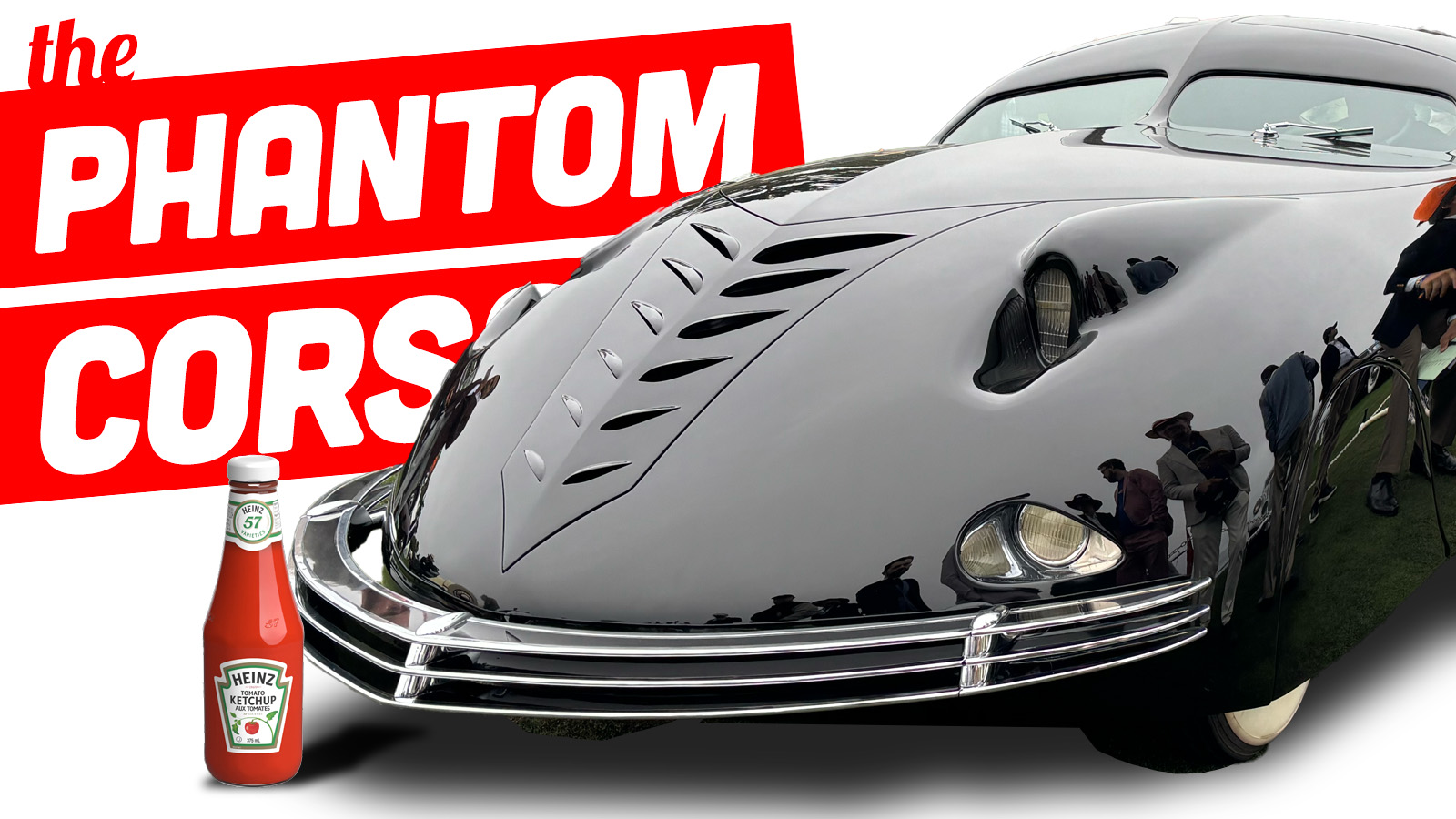
One of my favorite things about going to the Concurs d’Elegance at Pebble Beach, aside from the joys of knowing my entire net worth (that includes my kidneys’ resale value) is a rounding error for most of the people I’m trying not to bump into on that storied lawn, is getting to see cars in person that I’d only seen in books, often since I was a kid. This has happened more than once, and it’s not that different than seeing some celebrity that you’ve been a fan of for years, only a car is a lot less likely to mutter something racist under its breath when you approach it.
This year, there was a car there that was very much one of those cars I’ve been looking at pictures of since I was old enough to crack open a big coffee table book about cars: the Phantom Corsair. The name alone is evocative enough to get people excited; the car itself does not disappoint. The Phantom Corsair is a massive strange thing, a glossy black refugee of daydreams about the future from the 1930s.


The car seems to have attracted a lot of attention as a result of its appearance at Pebble Beach; the last time it was at the Concurs was almost 20 years ago, back in 2007. That’s a whole generation ago! It’s long past time people got to see this deeply odd and impressive machine.
I did a little reel about the Phantom Corsair, but it’s also worth exploring in a bit more detail:
View this post on Instagram
The car does indeed owe its existence, at least indirectly, to ketchup. The designer of the car, Rust Heinz, was the grandson of H.J. Heinz, the man who made sure ketchup would always be flowing in vast, crimson waves for everyone who craves it. Rust had been interested in boat and automotive design most of his life, and even designed a promotional vehicle for Heinz in 1935, the Heinz Comet:
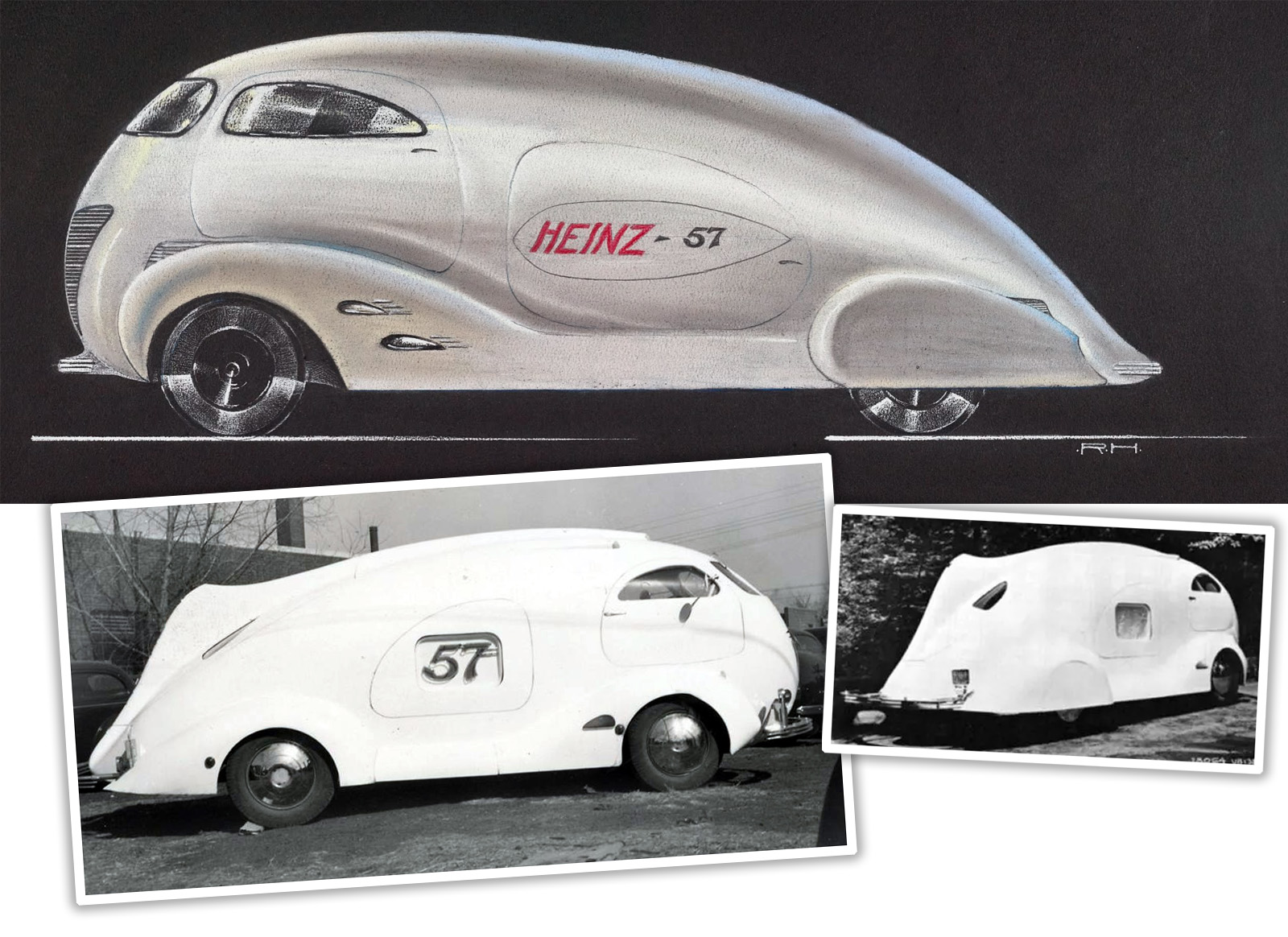
The Comet was built on an Autocar truck chassis, and the bodywork was done by the Square Deal Body Company of Michigan. The rear of the streamlined van opened like a hatch, presumably to load or eject any of the 57 varieties of products that Heinz claimed to sell. It’s not really recorded specifically anywhere that I’ve found, but Rust Heinz must have been pretty delighted to see one of his automotive creations made real, because he started work on what would become the Phantom Corsair soon afterwards.
Sadly, Rust was one of the few in the Heinz family that shared his enthusiasm, as his immediate family was not interested in bankrolling his next automotive project. Fortunately for Rust, his aunt was willing, and she provided the financial support to begin the project that would become the Phantom Corsair.

It’s not like Rust didn’t make any materialistic sacrifices to make the car happen, though: he gave up his personal Cord 810, which would become the chassis and drivetrain of the new car. That’s already a pretty advanced place to start: the Cord 810 was a cutting-edge car when it hit the scene in 1935. Not only was it the first car with pop-up headlights, but it had a 4.7-liter Lycoming V8 engine making about 125 horsepower, connected to a front-mounted differential that put that power through the front wheels. There was also an advanced four-speed preselector gearbox, and independent front suspension. This was an ideal platform to start with to build a futuristic dream car.
Rust worked with Bohman & Schwartz Coachbuilding Company in Pasadena, California to develop his designs into an actual car, and some sources suggest that clay models of the car were wind tunnel-tested, so this may not be entirely an aerodynamics-by-vibes sort of design like most of the streamliners of the era.
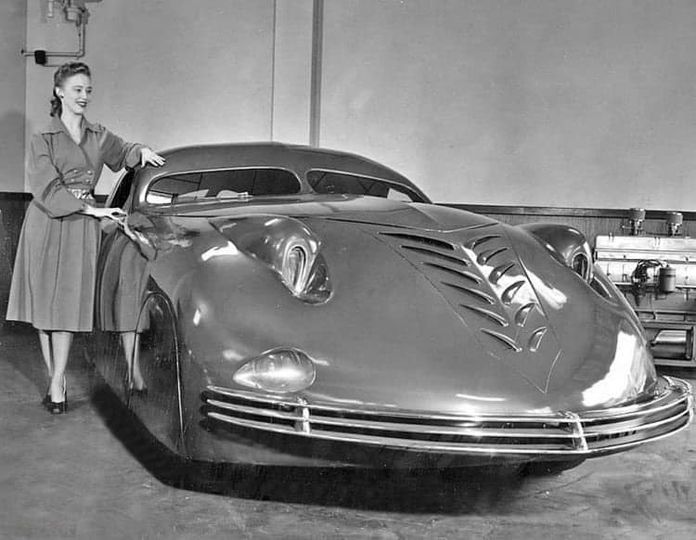
The look of the car was striking; incredibly long and impossibly low, with all four wheels skirted, small windows, and an overall imposing presence. The front end has an almost fern-like array of air intake vents to feed that often-overheating radiator, and there were four prominent headlamps; a pair of low-mounted driving lamps faired into the body and set under plexiglass covers, and a pair of narrow Woodlites integrated into the top of the body in their own pods.
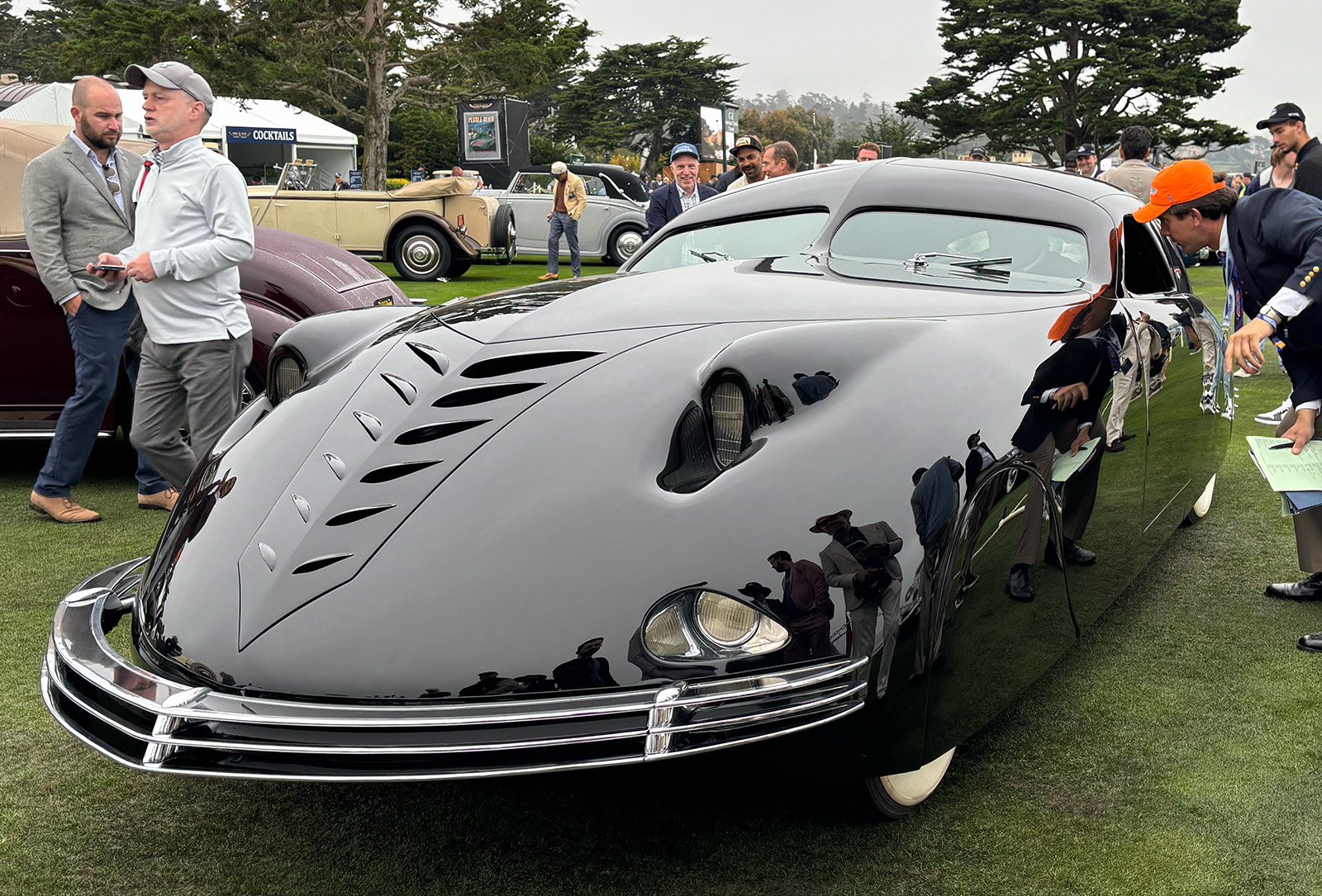
I’m not sure I’d go so far to say that the car was actually pretty, but it was certainly striking and had a metric crapton of presence. Back in 1937 when the Phantom Corsair was first exhibited, it really felt like the future, bold and powerful, a sleek and inevitable coming of a future dominated by technological prowess.
And the Phantom Corsair wasn’t all talk! There were plenty of techy wonders built into that car, like electrically-actuated door handles. Sure, we’re all sick to death of them today, but I think the Phantom Corsair may have been the first car to truly implement them.
There were also a considerable amount of safety features incorporated into the design, like tempered, mutli-layer glass, extensive use of rubber and cork padding all over the interior of the car and dashboard, and a steel safety cell for the occupants.
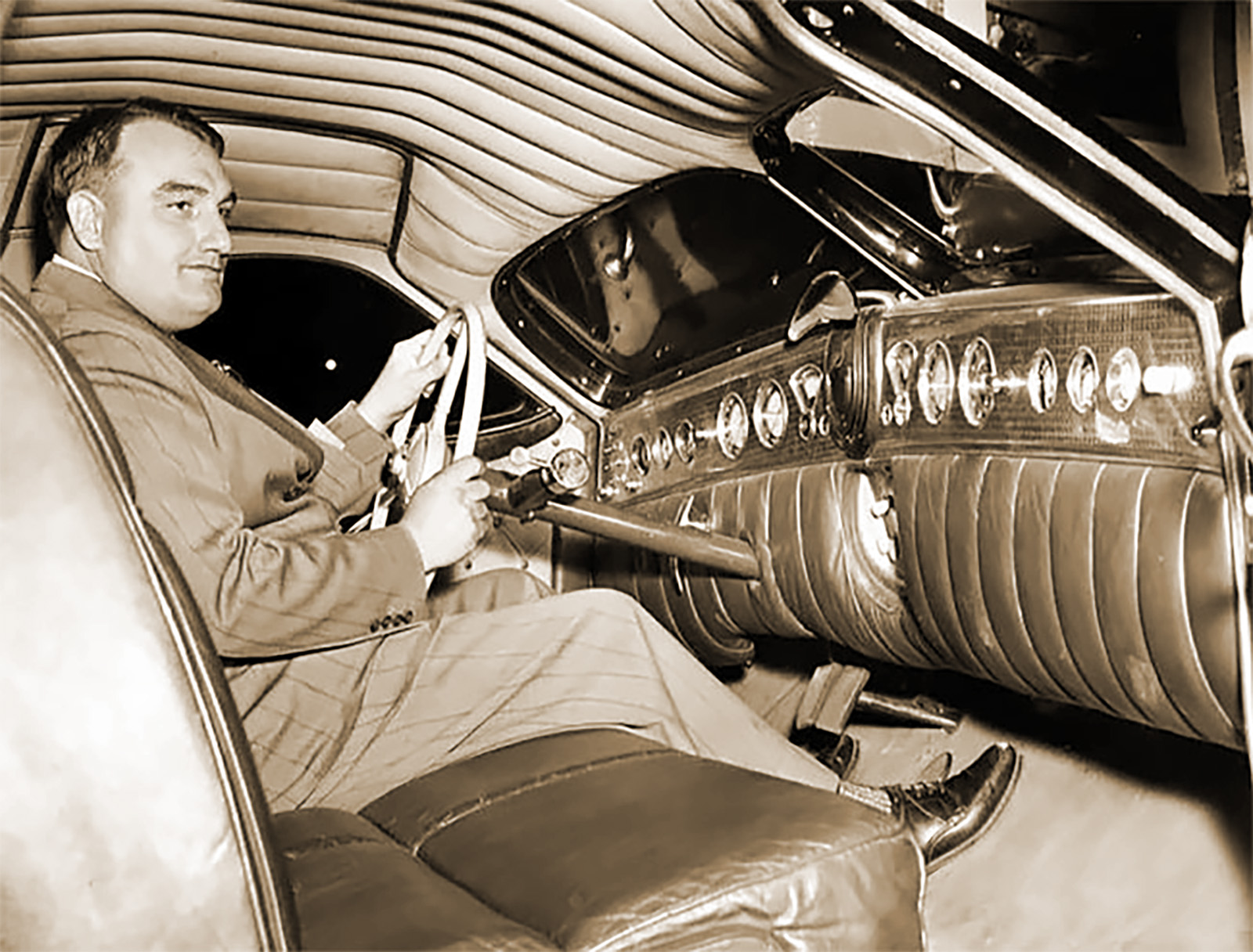
The interior arrangement was a bit odd. The car sat six people, though four of them would sit abreast in the wide front bench seat. That’s Rust himself there behind the wheel, and his position was actually one in from the left, meaning there was room for one passenger to the driver’s left and two on the right. There were also two jump seats in the back of the car, who shared that space with a pair of large and well-appointed bar cabinets full of delicious, nutritious liquors.
Instrumentation, as you can see, was extensive, including an altimeter and compass, among other gauges. And look at all of that rubber/cork padding, on the lower dash and the whole headliner! And note how the doors cut into the roof!
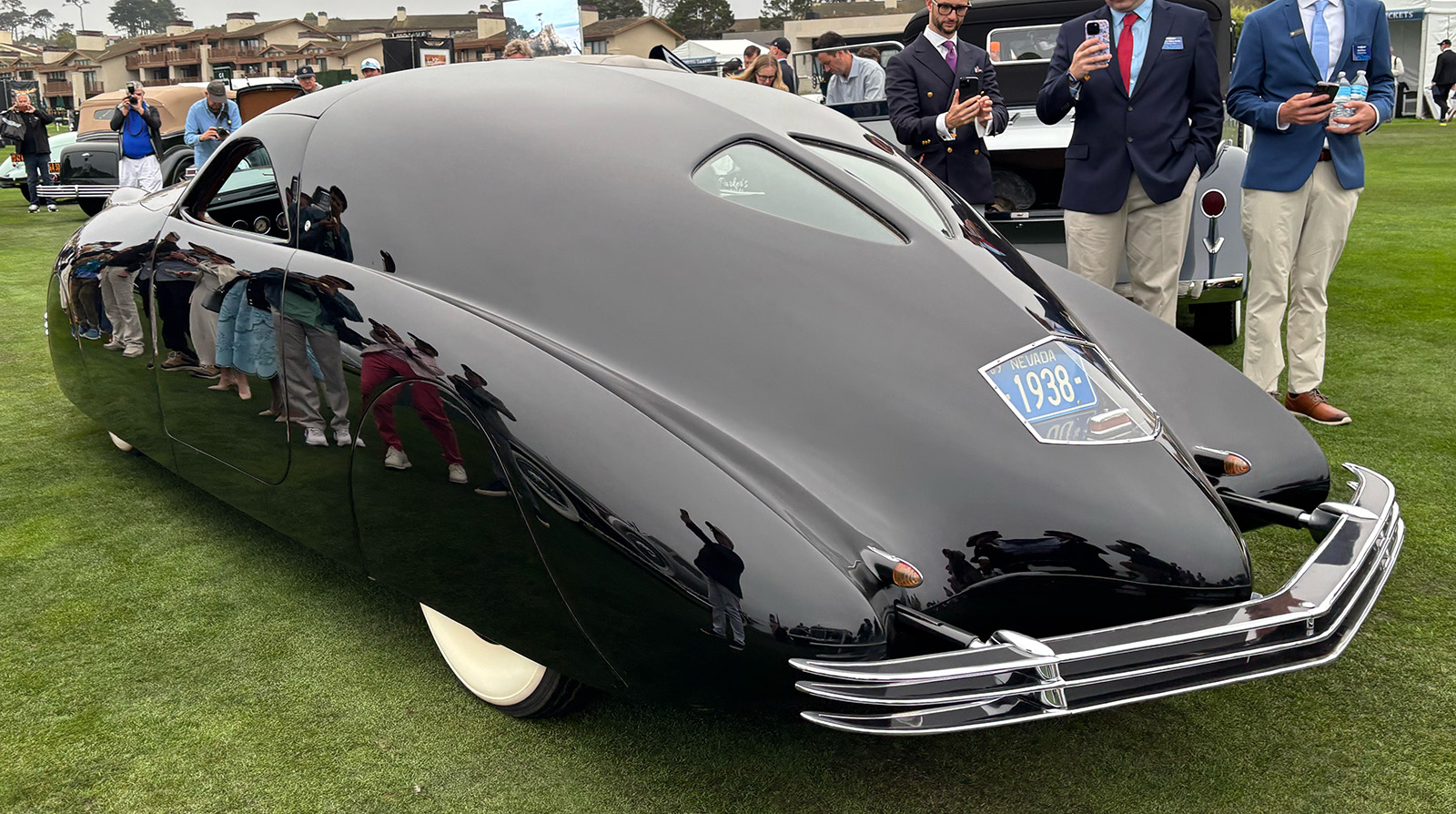
Strangely, there was no provision for a dedicated trunk; I suppose if you had four people or less and didn’t mind restricted bar access, luggage could have gone in the rear seat area. Also notable are those triple-bladed bumpers, which were mounted on hydraulic struts, another very forward-looking innovation.
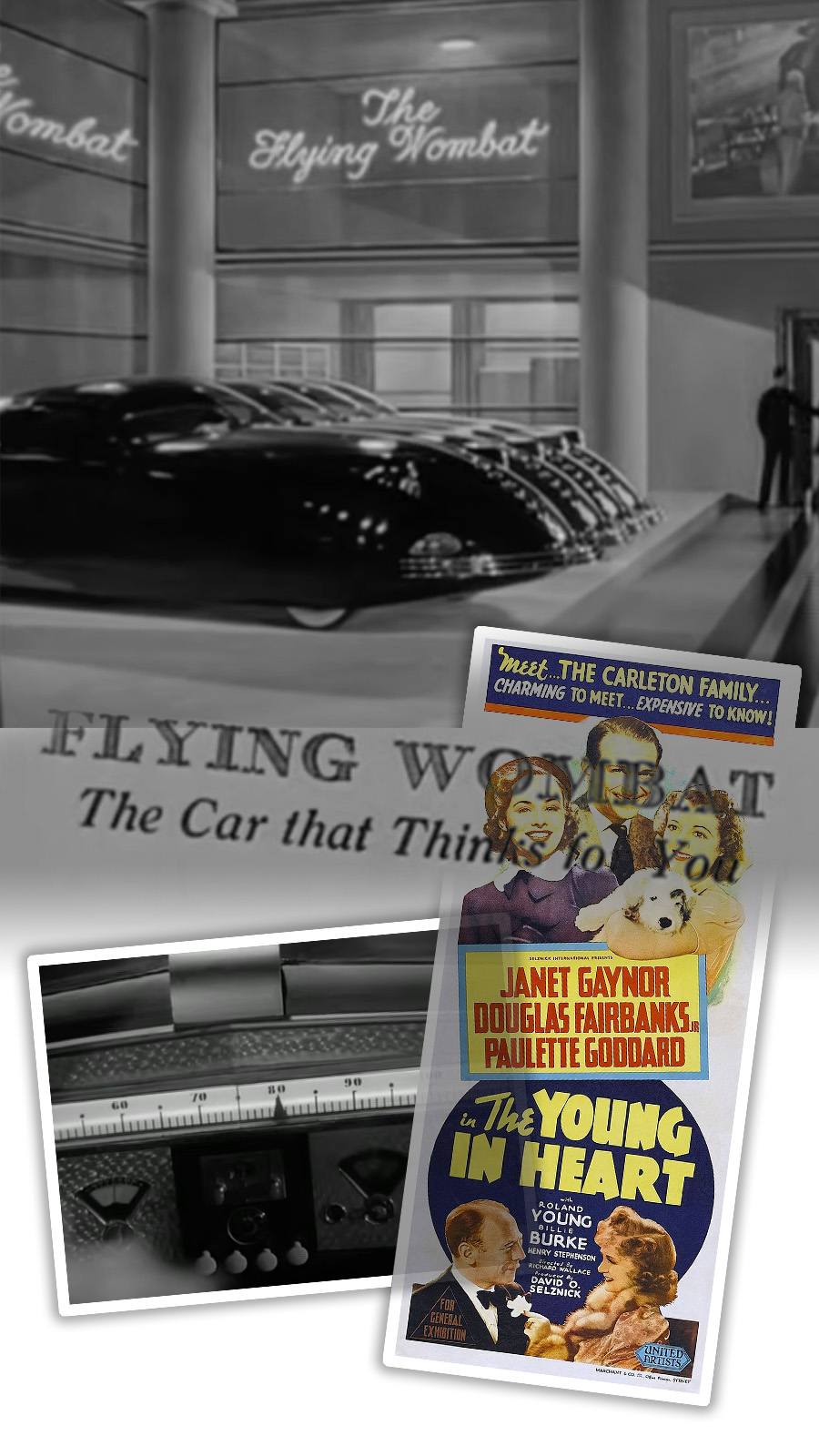
Interestingly, the best (and only?) footage of the Phantom Corsair in action comes from its role in a 1938 David O. Selznick movie, a comedy about a family of con artists, one of whom gets a job selling a car called the Flying Wombat, which was played by a Phantom Corsair. Camera tricks were used to give the illusion of a whole showroom full of Flying Wombats, and there’s actually a good number of very spirited driving scenes with the car:
They’re really wringing that thing out in these scenes! Knocking over cyclists and swerving around goats – that’s a good time right there. To really sell the recklessness and speed, it looks like a huge strip-type speedometer has been superimposed on the dashboard, too.
Despite the publicity the Phantom Corsair got from its peach of a movie role, mass production was never to be. Tragically, Rust Heinz was killed in a car crash in 1939, when his friend, who was driving, attempted to retrieve a hat that had flown off. Any hopes of production for the Phantom Corsair died with Heinz that day.
It’s not likely the Phantom Corsair would have been a huge success, though, mostly due to its considerable price. Heinz was planning on selling the car for about $12,500 in 1938, which comes to close to $300,000 today. This was never going to be a volume car.
Still, it’s an incredible machine, and one of the earliest concept cars of any type. I’m very happy to see how much attention it has gotten in its first big public showing in almost 20 years, and I hope this will help promote interest in all manner of strange and wonderful cars from long ago, condiment-related or not.


Jay Leno’s Garage had an entire episode on the car, where it was even driven, so really should be linked anytime the car is discussed: https://www.youtube.com/watch?v=3ey4cpmd6_Q
It’s not exactly to my taste, but a fascinating car.
It looks like a sperm whale pondering its existence as it hurtles through space.
tldr hot take : UGLY.
despite liking most Deco design & appreciating the craftsmanship, I do not find this car attractive in the least; it reminds me of the (still-)prehistoric horseshoe crab too much. The very cool and still-unique Cord it is based on is WAY more to my liking. Fascinating backstory tho, I admit.
It’s not a hot take if most people think the same thing.
The car is certainly not a looker. It just has presence, lots of it. Imagine a billionaire party full of Chirons and other super expensive cars and then you arrive in this.
For some reason it reminds me of Jar Jar Binks.
Yousa in big doodoo.
I first saw that car in person back around 1990 or so at the Meadowbrook Concourse. We were showing a couple of customer cars from the restoration shop I worked at and I remember everyone making a big deal about the car. My young and naive self had never heard of the car until then. Seeing that it was shown over last weekend at Pebble Beach was a nice surprise as I don’t think it had been shown much anywhere else since 1990-ish.
While only being based on the Cord 810 chassis, it could still be considered one of the earliest potential “super cars” of its day had it made it into some sort of limited production.
Not pretty? How about drop dead gorgeous? Ten years later it should have been the Batmobile.
Interestingly, the Heinzs and Trumps both originate from the same ancestral village in Rhineland-Palatinate. The Heinz family has had some ongoing connection to the community, paying for some restoration work on the historic village church, and seem to still be well-regarded there. Not to be overly political, but the Trumps don’t seem to have maintained any sort of connection, lets say (although the tenuous one would be that they were wine traders/wine merchants when they were in town, and now own a vineyard/winery in Virginia, so I guess there’s that)
The Heinz family was (and still is) very active in Pittsburgh area community and philanthropy as well. The late John Heinz was a well regarded US Senator in my youth, his wife Theresa married John Kerry after his death.
Is that legal?
Wasn’t John Kerry married to a Heinz heir?
That’s a pretty significant difference from Trump, considering Kerry could have found his way to a deferment and chose to serve and was careful about sending US troops into danger. That’s like the negative of orange man’s path.
He is married to Theresa Heinz, the former wife of late Senator John Heinz who passed away quite young.
Thanks for the deep dive – I saw that thing on Sunday and wondered just what the hell it was.
I’m sad that the Harrah’s collection had to sell of a whole bunch of their cars.
Never realized that a member of the Heinz family had a part in this.
Only video game I know you can drive it in was LA Noire.
Mafia 1 has it too. In the sandbox “do side quests to collect unique cars” part.
Not sure if that module made it into the re-release.
This needs to be at Heinz History Center in Pittsburgh (a Smithsonian institution named after our late Senator John Heinz; yes a family heir).
That would be a great car for the next Car movie. However that is the car version of Catsup when Heinz is Ketchup.
You don’t need luggage when you’ve got a full bar in the car.
Probably wouldn’t live long enough to use it anyway.
I liked it more before I found out a Cord had to die for it.
Still an interesting car. Are there any shots of the interior? I want to see the bar layout.
I can’t find any good images of the bar, but what a weird collection of gauges.
It looks like it had a fuel level gauge that is also an oil level gauge, but with a single needle.
There is a giant gauge that seems to offer everything from braking distance to wind resistance (expressed in lbs/ton, of course). I am not sure how I would read that while driving or why I would need to know that.
https://s1.cdn.autoevolution.com/images/news/gallery/jay-leno-loses-brakes-on-airport-drive-in-the-phantom-corsair-a-1937-one-off-made-by-a-renegade_51.jpg
The little remembered British rock group Lazy Racer featured the Phantom Corsair on the cover of their second album, Formula II, in 1980. They never had a hit or performed in concert, but they did get some airplay for the song, “Keep On Running Away” that peaked at #81 on Billboard. Remember that? Anybody? No, I didn’t think so. I’ve still got the vinyl if anyone’s interested. I promise it was only played once.
I love the smell of Wombat horn in the morning!
An underrated part of that “technological prowess” is the use of plexiglass (or polymethyl methylacrylate as all the cool kids call it) for those covers. It would have been brand spanking new, maybe not even available on the open market, when this car was built.
Drag coefficient of 0.23. The average family sedan has yet to catch up to that. Had cars done that during the 1970s fuel crisis, we could have kept V8s and gotten better fuel economy than the 4-cylinders of the time…
If you consider the Tesla Model 3 an average family sedan, based on sales and ubiquity, with it’s CD of .23 (.219 for the Highland) we’re already there.
Yeah, because 150hp, 400cid V8s were soooo fuel efficient.
The Model 3 is the exception, not the average. We could have sedans getting into the 0.15 range, while still retaining all of the practicality that sedans offer.
And the V8s of that era had terrible efficiency. But the fact was the platforms themselves were every bit as atrocious from an efficiency standpoint, and downsizing the engines didn’t help efficiency much for the American offerings. The Japanese offerings improved efficiency mostly because the platforms were lower in mass and CdA than the American offerings.
“The Japanese offerings improved efficiency mostly because the platforms were lower in mass and CdA than the American offerings.”
1970’s Japanese cars were not particularly aerodynamic – they were just smaller and had efficient 4 and 6 cylinder engines.
They had about half the CdA of the US offerings at the time, but yeah, their drag coefficients still were quite bad. Around 0.4 was typical. Smaller meant less frontal area, and that was where most of their gains came from. They also STILL had slightly lower drag coefficients than most US offerings which were around 0.5-0.6. Even in spite of high Cd values, the CdA of some of those small Japanese cars still matches or beats most modern vehicle offerings to this day because everything has gotten so damned big.
The thermal efficiency of the 4/6 cylinder engines of the time was not that much better than the V8s, and they don’t come close to the efficiency of modern engines. In spite of this, it wasn’t difficult to get 30-40 mpg out of many of these Japanese offerings of the time. With a modern engine and taller gear ratios, performance would be monstrous, and the car would probably get 50-60 mpg. Turn it into a streamliner with a sub-0.20 Cd value and the same frontal area in addition to the engine swap, and watch fuel economy climb to 80 mpg, and beyond…
Well, US automakers also could have embraced innovations like the Honda CVCC system, instead of shooting off their mouths like GM CEO Richard Gerstenberg did. Not only would American cars maybe not have sucked so bad from approximately 1974-1985, but GM would have spared itself the embarrassment rightly heaped on it by a pissed-off Soichiro Honda, as memorably described by Torch over on Ye Olde German Lighting Site:
https://jalopnik.com/when-honda-gave-gm-one-of-historys-most-amazing-smackdo-1576732771
I have always wondered if the test results Soichiro-san sent to Gerstenberg had a photo of his nutsack on the last page, and instructions on what to do with it.
Come on, we all know Uncle Adrian bought this one. He even wrote an article on it.
It is an interesting car, but looks a lot like that inflated Porsche 911 from a few decades ago. But the car does look a lot better from the rear,at least.
How does the driver visibility compare to a 2500 Silverado?
Saw this (or something strikingly similar) at the excellent Reno car museum, and could only think about how hard it would be to drive. Cool looking though.
>>A Wildly Advanced Car Made By A Ketchup Heir Was One Of The Surprise Hits At Pebble Beach
Huh, it doesn’t really scream “Natural Mellowing Agents”, does it?
It’s an auBuffetmobile?
Edited to add: In Heinzsight, I see I was incorrect!
I’m goofy on a Friday afternoon, so I’m just going to notice that such a curvy beast played a role as a Wombat, which is an animal known for making cubed poop. Rectilinear and curvilinear convergence! I wonder if this came to mind in the car casting.
I love this thing. Have two models of it here at home, looks like an angry, sentient ink blot.
I flashed my media pass this year and got to peek inside for a look at the bar cabinets in the back and the wide-as-hell front bench seat
I have the Brooklin (correct spelling) 1/43rd version in my collection; the one painted flat beige used for filming.