

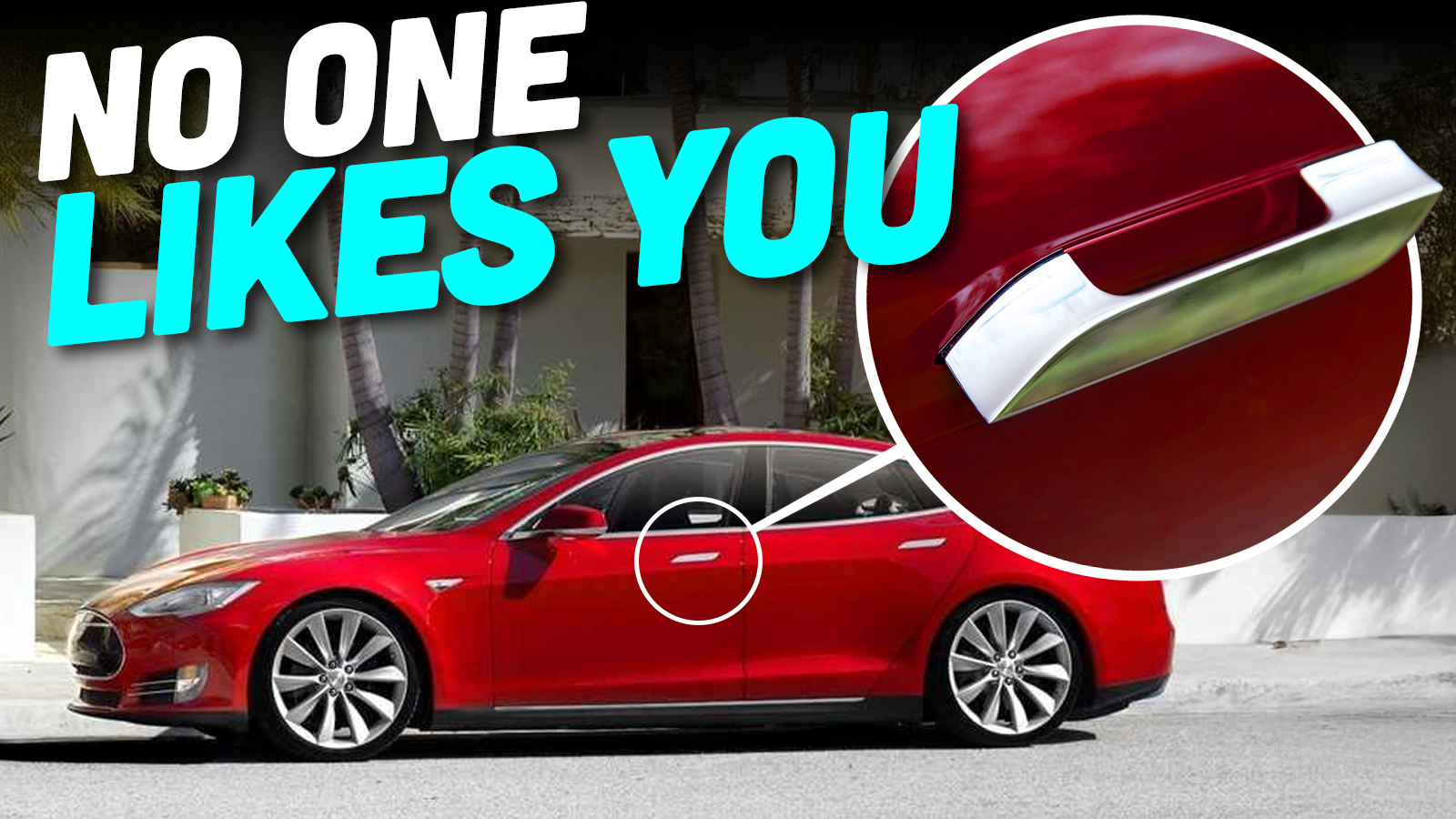
The core idea of how a car door handle should work has not changed much in over a century of motoring. You manipulate a knob or handle, and that moves a latch that lets you in and out of your car. For most vehicles throughout history, door handles have been intuitive, and vehicle occupants have been able to figure them out, even in an emergency. There’s a newer trend out there of electric handles that disappear into the vehicle body. It seems that nobody likes these handles, and in some cases, users have been unable to operate them when they were needed most. Now, the U.S. National Highway Traffic Safety Administration is finally considering doing something about it.
The car door handle has long been a beautiful piece of engineering that didn’t require a second look to figure out how to operate it. Some of the earliest car door handles weren’t much different from what was mounted to horse-drawn carriages or maybe even the door of a building. You grabbed a handle, rotated it, and that made a bar or pin slide in or out to secure the door or free it to swing open.


Since then, car door handles have taken on seemingly a million different forms, from the twist handles of the early 20th century to the mid-century push-buttons and pull-levers. The bars and pins became rods and cables, and designers got creative with handle styling. Over time, the automotive world has seen handles that flip up, flip to the side, pull out, push in, and flip out. The linkages that make these handles work allow designers freedom to place handles in visually appealing places while the latch and striker could be in optimal positions for safety.

Of all of those designs, the pull-out handle has long been favored by automakers around the world. It just works. You walk up to the vehicle, pull the handle, and it opens. It’s just so easy.
Complicating What Should Be Simple
One of the trends brought on by the modern electric car revolution is a rethinking of how door handles work. Now, instead of just walking up to your vehicle and pulling a handle, your vehicle might have to electrically extend those handles first. Or, maybe you have to push an electronic button of some kind.

Take a look at the Ford Mustang Mach-E above. There are no handles at all. Instead, you thumb a button embedded in the door’s pillar like you’re unlocking a phone’s screen.

This technology isn’t exactly new.
If you own a Chevrolet Corvette, for example, you’ve long been accustomed to mashing buttons to get out of your car. These electronic doors also have manual overrides, where you can pull a handle somewhere to pop the door in an emergency.

Unfortunately, it’s not always obvious where these escape handles are, and that costs precious seconds in an emergency, such as a vehicle fire or immersion in water. Then it gets worse, because while there might be manual door overrides inside of the car, that isn’t always the case for exterior door handles.
Let’s go back to that Mach-E. Do you want to guess how you’ll get into that car if there’s an electrical failure and, for some reason, the occupants can’t get out? Ford says you have to go through the frunk. That’s simply unacceptable in an emergency where every second counts. A door should just work like a door, even if there’s no power.

It’s not just Ford, either. If you have a fancy electric Cadillac, you also have electric door poppers, and if there’s no electrical power, you’re getting in through the trunk. As ABC7 reported, there was a real case when this could have been disastrous that didn’t even involve a fire or crash, as a baby got trapped in a Cadillac after its 12V battery suddenly failed.
Then there are vehicles like Teslas. The Model S has handles that have to electrically extend before you use them. The Model X doesn’t have door handles at all, and instead requires you to press door buttons that resemble handles. The Tesla Cybertruck doesn’t even pretend to have door handles, and you’re getting in through a hidden touchpad. The Model Y and Model 3 have physical handles, but they trigger electrical switches.

Tesla’s worst offender is the Model X, which requires you to disassemble a part of the interior if you want to manually override the Falcon Wing doors from inside.
In 2025, Bloomberg News published an investigation into a string of incidents where Tesla door handles failed to deploy during emergencies, delaying rescuers from saving trapped vehicle occupants. From Bloomberg News:
Max Walsh spotted the plume of smoke just as an emergency alert flashed on his smartwatch: vehicle fire with entrapment. Less than a minute later, the off-duty firefighter pulled up to a busy intersection in northern Virginia, where a Tesla Model Y lay crumpled and aflame against a utility pole. Having responded to electric vehicle fires before, Walsh knew what he was up against: electrically powered doors that may not function after a crash, manual releases that can be hard to find and battery cells that burn more intensely than gasoline. Every second mattered.
He sprinted to the SUV. The driver’s door wouldn’t open, but the window was cracked. Walsh smashed it with his bare hands and reached inside, burning himself in the process. “I’m trying to open the door and it’s like, ‘What the hell, where is the backup thing?’” Unable to find the mechanical release, he and a friend pulled the dazed driver, Venkateswara Pasumarti, up and out through the window frame.
[…]
The Virginia crash is one of a string of incidents exposing this paradox. Last November in California, a Tesla Cybertruck slammed into a tree and a wall and caught fire, killing three college students trapped inside. The same month, in Wisconsin, a Model S fire left five dead, with a cluster of bodies in the front seats suggesting to a detective there may have been a struggle to escape. In Los Angeles this spring, an All-American basketball player survived a Cybertruck crash by kicking through a window before bystanders pulled him out by his legs.
In a story earlier this month, Bloomberg has identified at least 15 deaths across a dozen incidents where rescuers and vehicle occupants were unable to open the doors of a Tesla.
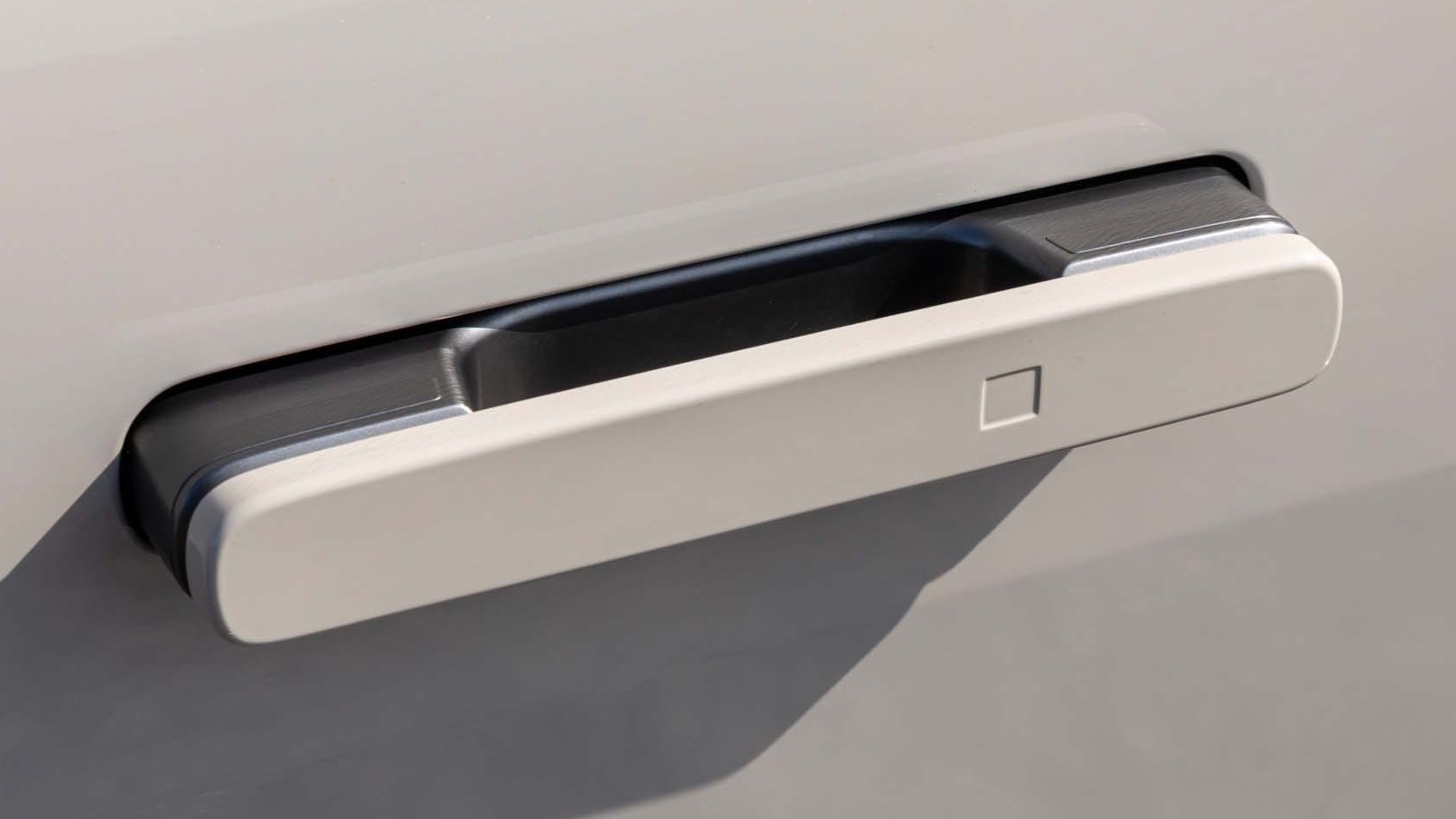
While Tesla has come under fire frequently for its flush electric door handles, it’s hardly the only company doing it. You’ll find electric handles on vehicles from Rivian, Hyundai, Kia, and other brands. It seems like these door handles are solutions in search of problems that don’t exist. Is adding all of this complexity really worth the aerodynamic gains?
Thankfully, some of these handles aren’t entirely electric. For example, Hyundai’s handle is still mechanical where it counts. The only electric part pushes the handle out of the body. In an emergency, the handles might not extend, but rescuers can still get into the vehicle if they press the handles.
This issue isn’t limited to America, either. Electric door handles are found on cars all over the world, and drivers all around the world are finding out that these handles sometimes don’t work when they’re needed the most. Over in China, there have been some tragic incidents that spread across social media, depicting the horrors of what happens when door handles don’t deploy. As such, early this year, China became the first nation to outright ban these types of handles, and drivers around the world have been begging for similar regulations in their home countries ever since.
The Feds Are Getting Involved

Following Bloomberg‘s investigation, the National Highway Traffic Safety Administration opened a defect investigation after reports of some Tesla Model Y door handle failures. Then, in November 2025, Kevin Clouse submitted a petition to NHTSA, hoping to get a safety defect investigation started on 2022 Tesla Model 3 vehicles. This is what the petition said, from the Federal Register:
In a letter dated November 7, 2025, Mr. Kevin Clouse (the Petitioner) requested that NHTSA “open a safety defect investigation into the emergency mechanical door release design” in the MY 2022 Tesla Model 3 vehicles as the design “fails to comply with FMVSS 206 requiring emergency egress controls to be readily accessible and clearly identifiable.” Mr. Clouse supported his request with details regarding his own experience during an emergency event.
The Petitioner stated that following a head-on collision, the MY 2022 Tesla Model 3 suffered a total loss of electrical power and caught fire. Due to the loss of power, the electric door handles became inoperative. The Petitioner stated he was unable to locate the mechanical door handle, forcing him to climb into the back seat and exit the vehicle through a rear passenger window. The Petitioner further stated that the mechanical emergency door release in his 2022 MY Tesla Model 3 is not accessible and clearly identifiable and thus fails to comply with FMVSS 206. NHTSA has based its decision on a review of the material cited by the Petitioner, pertinent information in NHTSA’s databases, and other relevant information in possession of the agency.

NHTSA denied the petition, noting that the design of Tesla door handles does not violate any existing Federal Motor Vehicle Safety Standards. However, in denying this petition, NHTSA noted that it received another petition that sought to update FMVSS to account for these new types of doors. From the Federal Register:
On November 4, 2025, NHTSA’s Office of Rulemaking received a petition to initiate the issuance of a new Federal Motor Vehicle Safety Standard (FMVSS) to mandate a robust and obvious door egress system in all motor vehicles. The request has been granted, and the Agency will accordingly commence a rulemaking proceeding. See 49 CFR 552.9. A decision as to the issuance of a rule will be made on the basis of all available information developed in the course of the rulemaking proceeding, in accordance with statutory criteria.
It’s too early to tell what these potential new rules could look like. The aforementioned petitions complained about occupants being unable to locate the manual door overrides inside of vehicles. That’s a different – though still very serious – problem from electric door poppers and handles that fail on the exterior. However, in crafting new rules for an obvious door egress system, it’s possible for NHTSA to also require a way to open doors from the outside in an emergency. Also unknown is how long it’ll take to implement these hypothetical rules.
Still, this is a step in the right direction. Some automakers have seemingly taken a technology that has been settled for decades and changed it in a manner that makes it no longer intuitive and, arguably, no longer safe. Drivers should be able to trust that a door handle will work like a door handle when it’s needed, and in some cases, that’s not happening. Hopefully, NHTSA can fix this.
Top graphic images: Tesla


I had a buddy who “shaved” the door handles off his S-Blazer and installed electric door “poppers”. After a while they failed and his only method of entry and egress involved the rear tailgate. Fun times.
I know I’m old, but I honestly can’t fathom how in the world anyone ever thought that mechanical door handles and latches would be better in any way by making them fully electric. Anything that relies on wiring and a power supply risks becoming inoperative if the power source or wiring fails. (Yes, mechanical linkages can fail, but it tends to be far less likely.)
Further, hiding the interior manual release seems borderline homicidal to me. People don’t read the owner’s manual. Most of them will have no freaking idea how to get out of the car if the electrical system is disabled for any reason.
You want streamlined, fully-flush door handles? Fine. Do it like has been done on airplanes for decades. Make them so you push one end in to lever the other end out, and then pull on the end that pops out. People will figure it out quickly. For the interior? Stick to an obvious mechanical handle the pretty much shouts “PULL ME”. That’s all that’s ever needed.
The only actual improvement I’ve heard of is regarding child locks on the rear doors. Rivian has made some sort of argument that (if I’m understanding correctly) is that they are able to turn off child locks (thus a child can escape) in the event of an accident. Where on a traditional child lock situation where it is 100% mechanical, to turn off the child lock you have to open the door from the outside, flip that little switch, and then it’s off.
That being said, it seems like the an even better solution would be partially electronic child locks in conjunction with mechanical levers. Basically, some sort of spring return solenoid activates the child locks which prevents the internal handles from working, but if power is lost or an accident is detected or something like that, the solenoid returns to a fails-safe position and the interior handles now work.
Well, that’s horrific. It’s like a mini version of The Station night club fire*. I wonder how the engineers who designed this shit sleep at night?
*: I’m told video exists of this incident. I’m also told you absolutely should not watch it unless you like having nightmares. You’ve been warned.
As many other effing stupid recent changes in automotive world, I blame Tesla.
Damn, Tesla is the one single responsible for worse cars in this decade.
Big screens
Buttonless HMI
Intrusive features
Complicated handles
…
It’s all well and good until Elon Musk donates a few million dollars to Trump and they decide these doorhandles don’t need regulation anymore.
If companies want electronic door handles, go for it, but make the requirement be the manual override has to be operated at the same location as the primary door handle. Dont make the manual over ride a completely separate and hidden spot, in an emergency muscle memory is going to take over.
I have been for about a month now:
https://live.staticflickr.com/65535/55369439461_ac766f27d9_c.jpg
The parts for converting its tail light (singular) into a combination tail and stop light (thereby giving it a stop light) are supposed to arrive in a few days, so until then pretty much all I’ve been doing is basking in the car’s simplicity as a stationary object. The door handles and latches work great, though.
Also another thing not talked about with these crappy door handles/buttons is bears and moose in bear and moose country. Most people are kind enough to leave their cars unlocked in those areas in case someone is getting chased by said bear or moose. Well now you are running and you get to a car with flush door handles or button that only open if they sense a key around and well now you are getting eaten by the bear or the moose (that is one blood thirsty moose)
I, of course, want to blame the manufactures, instead of making proven cars EVs they had to make EVs all loaded up with show off technology and wonkey designs and to try to attract the tech bros.
You know you’re in odd times when China beats you to a consumer protection rule.
This what baffles me with my Polestar 2 and my dad’s Blazer EV both have normal door handles but other EVs all have these goofy hidden door hands or something terrible like that Mach-E button thing. Door handles should be all mechanical and not require any electronics to close or open.
“We need these fancy handles to maximize range! … Yes the wheels are 21″, why do you ask?”
Make it make sense hah also really how much efficiency does it really save especially vs giant wheels as you said.
While they’re at it, could they get rid of haptic touchscreens controlling the functions inside the cars, dealership-only parts/tools ecosystems, surveillance in cars, and put forth solid right to repair laws?
I feel like this does a disservice by basically grouping together electronic handles and flush handles. While both generally aren’t the most ergonomic to use, the safety risks of them are different.
Hyundai’s flush door handles (at least on the Ioniq 5) are mechanical. All the electric motor does is “present” them on the exterior so they are easier to grab. But they are still mechanical. You pull on it and you are mechanically actuate the latch mechanism. On the interior, is a very traditional mechanical pull handle. If the battery dies, the doors still work like any traditional handle, but the exterior just doesn’t pop out (it still works). Emergency exiting is just like any other vehicle
Conflate that with brands like Tesla or Rivian where if the battery completely dies or power to the door is severed (I’m ignoring any supposed electrical redundancy either brand claims to have), the interior handle might not work at all. You may have to remove some hidden little cover, and then find some emergency pull cord stashed away inside. Totally cumbersome and easy to forget in an emergency.
I think what we would consider “traditional” designs are better. But the current flush and electronic handles complaints require nuance.
Yeah. I don’t have any problem with the various “exotic” door handles that are nonetheless mechanically straightforward (even if the actual mechanism is electric like on C6 and newer Corvettes) so I’m not enamored with the over the top calls I’ve seen to legislate door handles to look like GM truck door handles from 1994; but the ridiculous stuff like “press the button to slide out the electric handle open the door” like on Teslas I have no problem with being made to go away.
I think the worst is the hidden pull cords. Some brands have different escape methods from the front seat vs the back seat. And then it’s different from one brand to the next. Different spots where to find dumb covers looking for different pull cords….
You shouldn’t need a flight attendant to give you a pre-flight safety demonstration when getting in a different car, just so you can safely get out in an emergency.
I’m not familiar with the Ioniq 5 handles, but if the electrics fail and the handle doesn’t “present” itself, can you still use the handle with a gloved hand? If not, I would lump it in the same boat. You don’t want your rescuer fiddling with a little shim to pry out the handle while your lungs fill with smoke.
Door handles are a kind of safety device. It’s the reason electronic deadbolts for exterior building doors always have a big dumb mechanical latch on the inside.
Subjectively yes. It would likely be more difficult depending on what the gloves are. The handles are spring loaded levers. Push in on the leading edge and trailing edge pops out so you can grab it just the same way it would be if it electronically popped out. Keep pulling it beyond that “presentation” kinda position, and it becomes a mechanical actuation of the latch. Yes it’s likely to create some confusion for the unfamiliar. Yes it’s likely to add time to process. No, I don’t love it.
Like I said, I think “traditional” designs are best, but this design is leaps and bounds better than something like what is found on the Mach-E or Teslas and Rivians.
It definitely sounds better, kind of like the original Model 3 handles except it’s actually mechanically connected to the door latch. I’m all for new designs, especially in the name of aero efficiency, but anyone better be able to walk up to the handle and be able to open the door within a couple of seconds regardless of the condition of the vehicle.
There’s like 3 inches of space when the Ionic 5 handles are “presented,” and I’m pretty sure you can physically push the front portion of the door handle to force the rear part out that would normally open electrically.
The Ioniq 5 look to use the same type of handle as my EV6- you can always press in the leading edge of the handle to pop the trailing edge out to grab. In fact, the lower trim levels don’t auto-pop at all, they’re always flush until you manually push them out.
The other nice thing about the EV6/Ioniq 5 is that there’s a conventional lock tumbler under the drivers side door handle and a regular key in the key fob. Makes it very easy to get into the car and under the hood if the 12v battery fails.
Each time my EV6 pops out the door handles when I unlock it, I wish the GT was available with the non-powered levers of the lower trims just so there were no electric motors to break. Honestly, though, I just wish it had traditional door handles so my hand wouldn’t slide off when the levers are wet (which is often here in the PNW).
The Ioniq 5 got an updated fob so that back-up key is now separate and the fob looks like a giant sextoy. Well, the fob is huge, but still small compared to most sextoys. So, I guess I should say, “the fob is now giant and looks like a sextoy.”
Yeah I would say as long as there is a physical way to get the handles to pop out if/when the 12v is dead and you can still open the doors that is fine now in a situation like the Mach-E ummm kind of SOL from the outside if the battery is dead.