

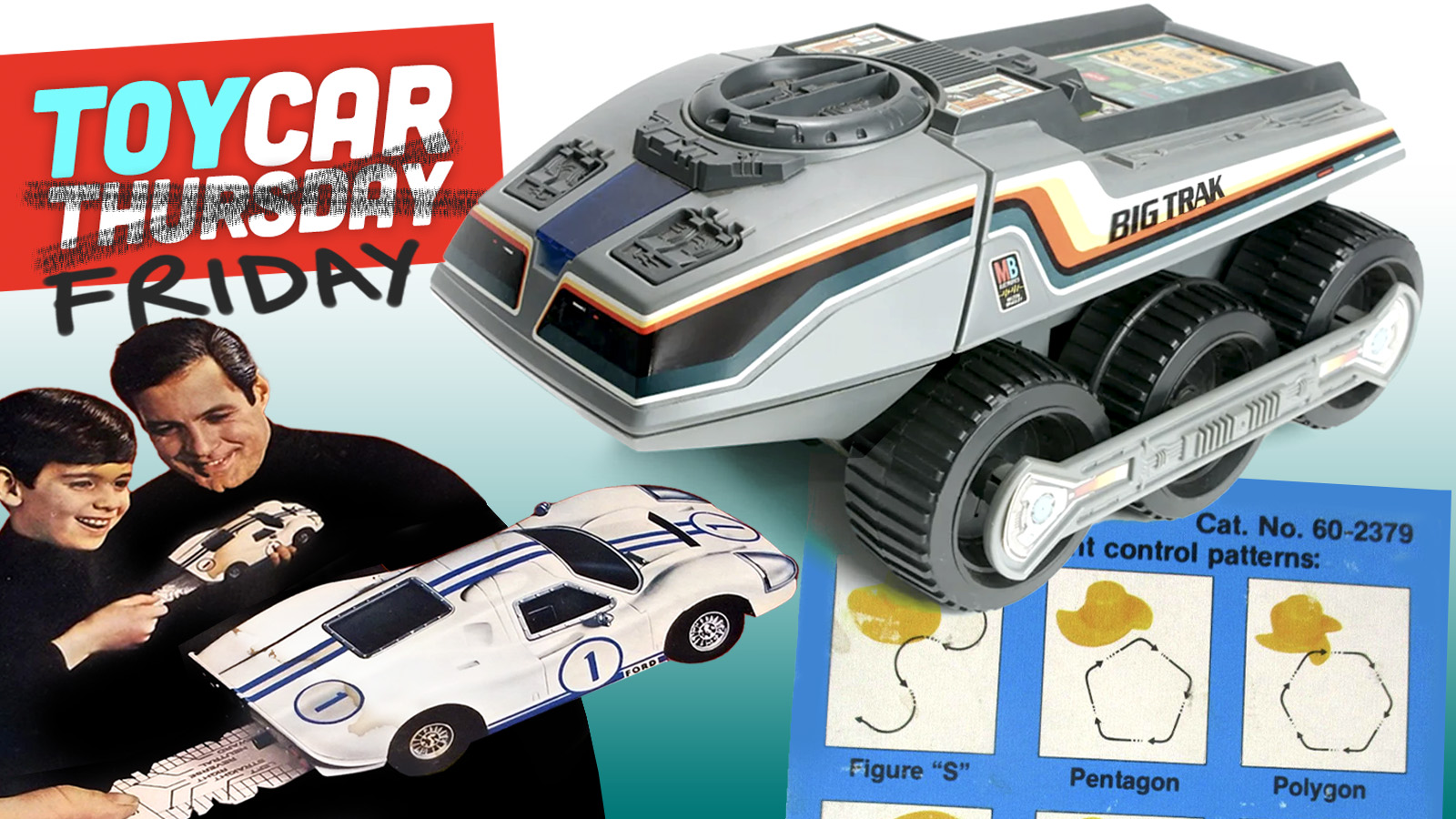
Toy cars that operate under their own power have been a thing as long as practical cars themselves have been a thing, with wind-up versions of the earliest automobiles hitting toy store shelves as quickly as the real things took to roads. Toy cars that could be automatically controlled in some way were the next logical step forward, and tether cars (literally a tether attached to the car and anchored to the ground so the car would run in a circle) and mechanisms that reversed a clockwork car if it crept past the edge of a table or reversed it if it bumped into an obstacle were common.
Cars that could be “programmed” to perform different actions would come later, but well ahead of actual computing technology in the sense that we think of it today. For this Toy Car Thursday Friday, let’s take a look at some of the ways toy makers have given kids the ability to customize their motorized toy-car fun.


First, and least satisfying, we have Trik-Trak from forgotten toy maker Transogram, which was mostly known for games. Though not marketed as a programmable anything, the Trik-Trak concept functions as a sort of physical program. By placing disconnected track elements in the car’s path, you can send it anywhere you like. The car itself is “dumb,” you just turn it on and let it loose to slowly do its thing. According to Transogram, it was THE GREATEST!
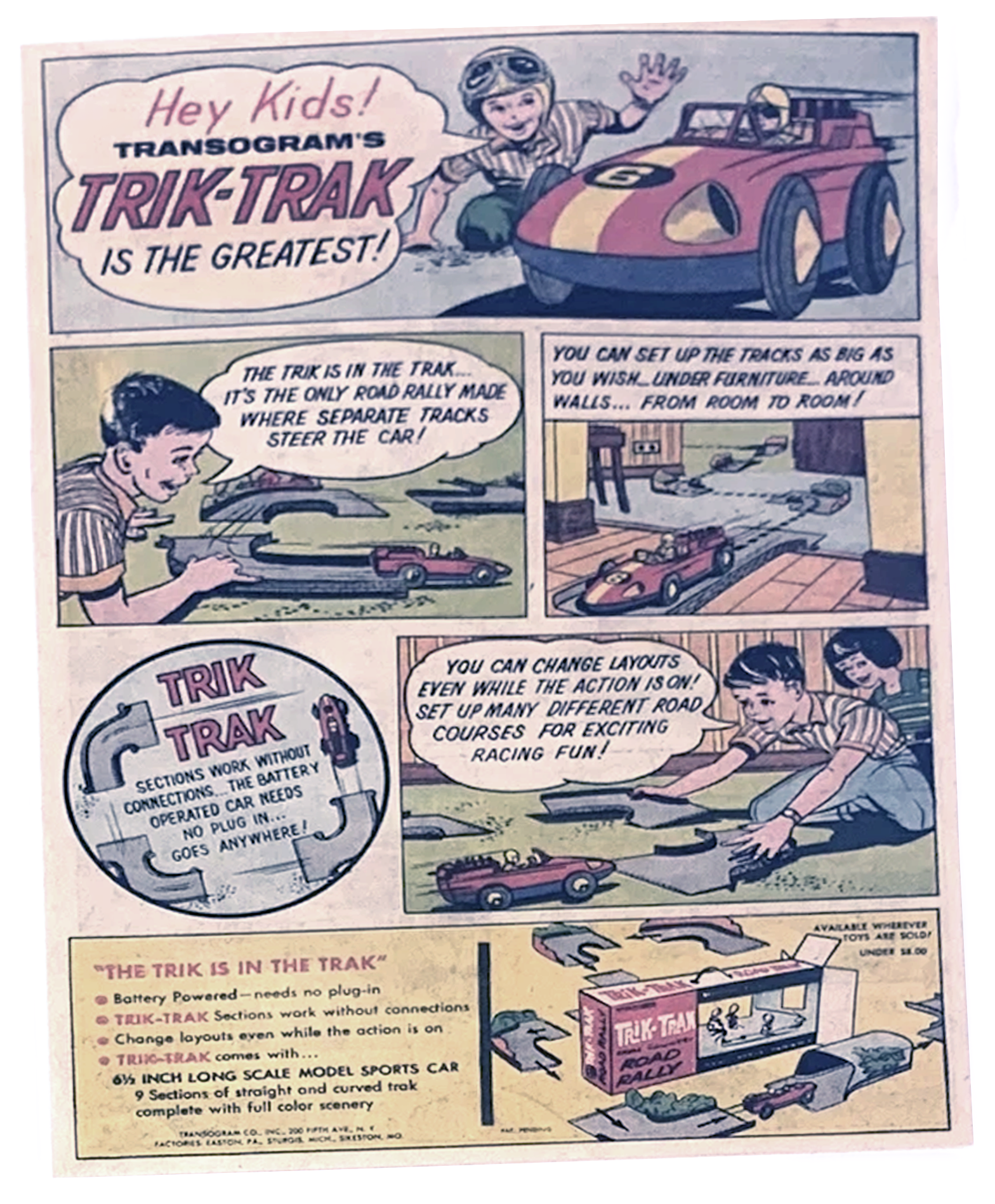
Trik-Trak was supported by a television campaign featuring a creepy kid and his creepier father. The boozy, honking sax music, the way the young lad shouts “Terrific,” and how his Dad repeats it with a shudder-inducing grin to the camera will haunt you.
Trik-Trak’s initial offering was just an assortment of turns, which must have gotten old quick – even with the thrilling addition of the rotating section in the center for on-the-fly course changes.

But at least the little car was cool? Ehh, not so much. This mishmash of sports-car tropes is coming off very aquatic. Note too the friction-driven rear wheels, with a rubber roller contacting the smooth plastic wheel.
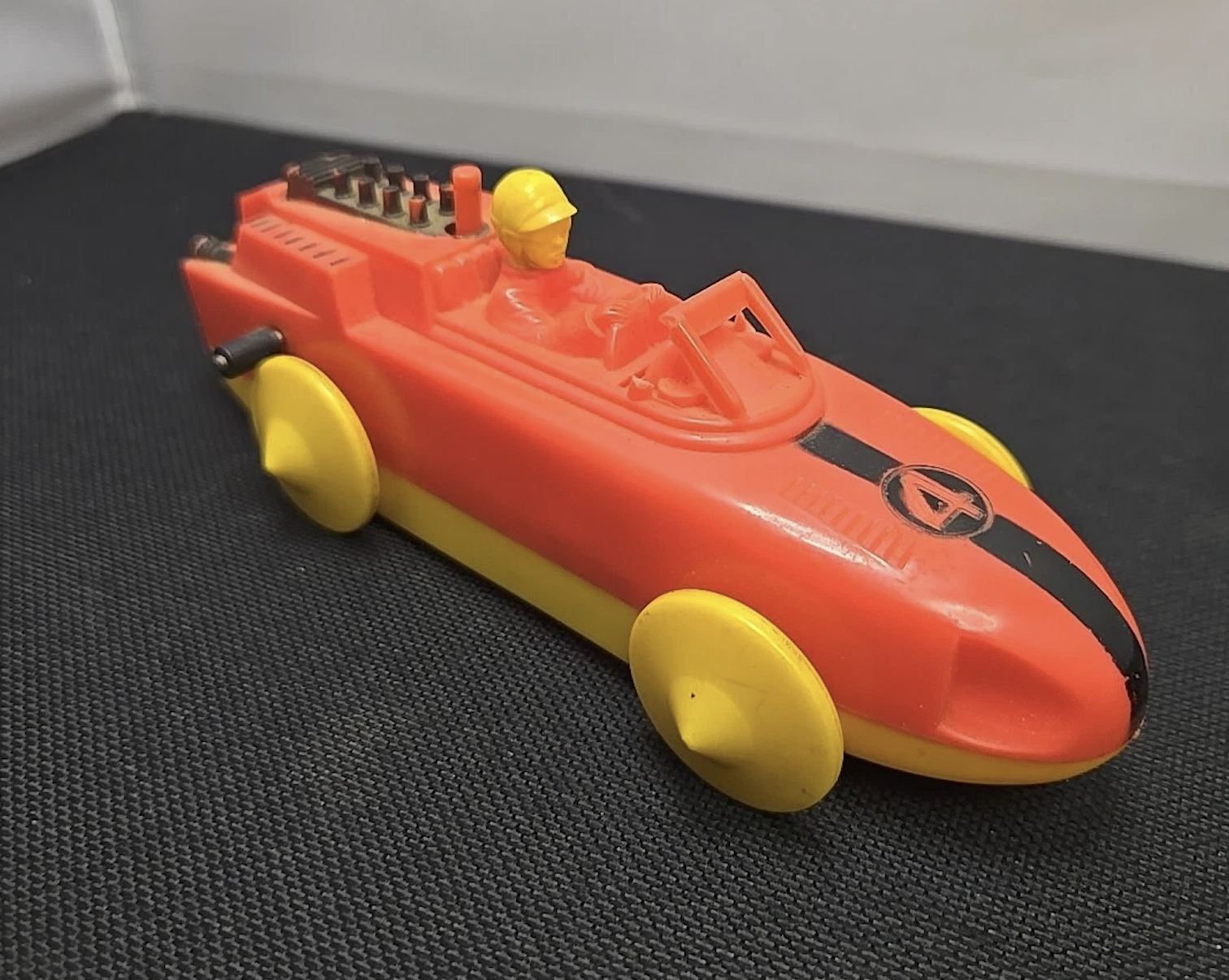
The Trik-Trak Dare Devil set upped the excitement with action-feature obstacles for the restyled car and its new but still janky closed-cockpit look. The “Dolphin Racer” was upgraded to gear drive “for longer battery life,” according to the commercial a little farther below.
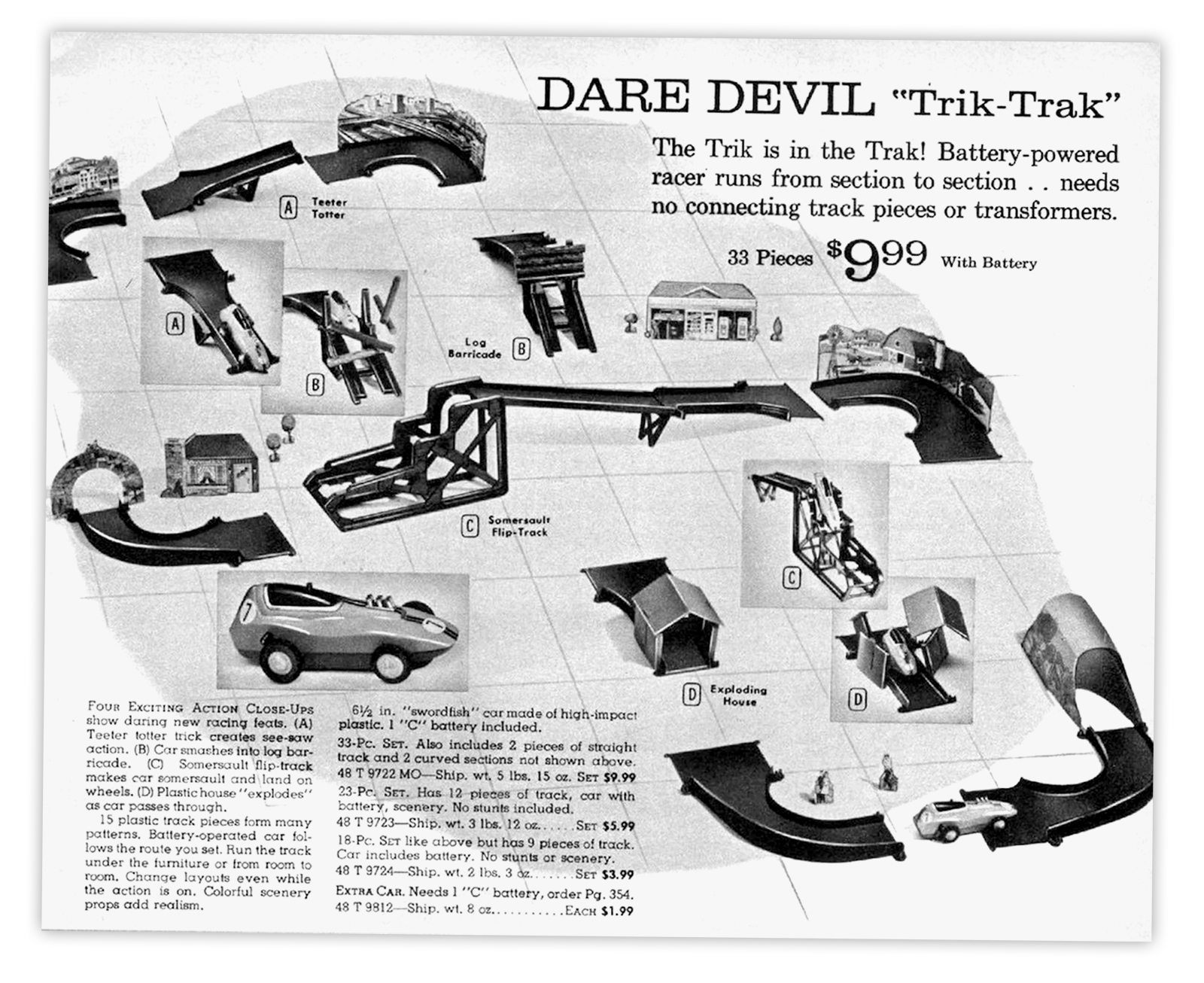
The set included a teeter-totter, “fly apart” house, logs to plow through, and a stair-step-like rack that would make the car somersault before landing back on its wheels. Watch:
OK, that’s enough Trik-Trak. Let’s get into some …
Actually Programmable Cars
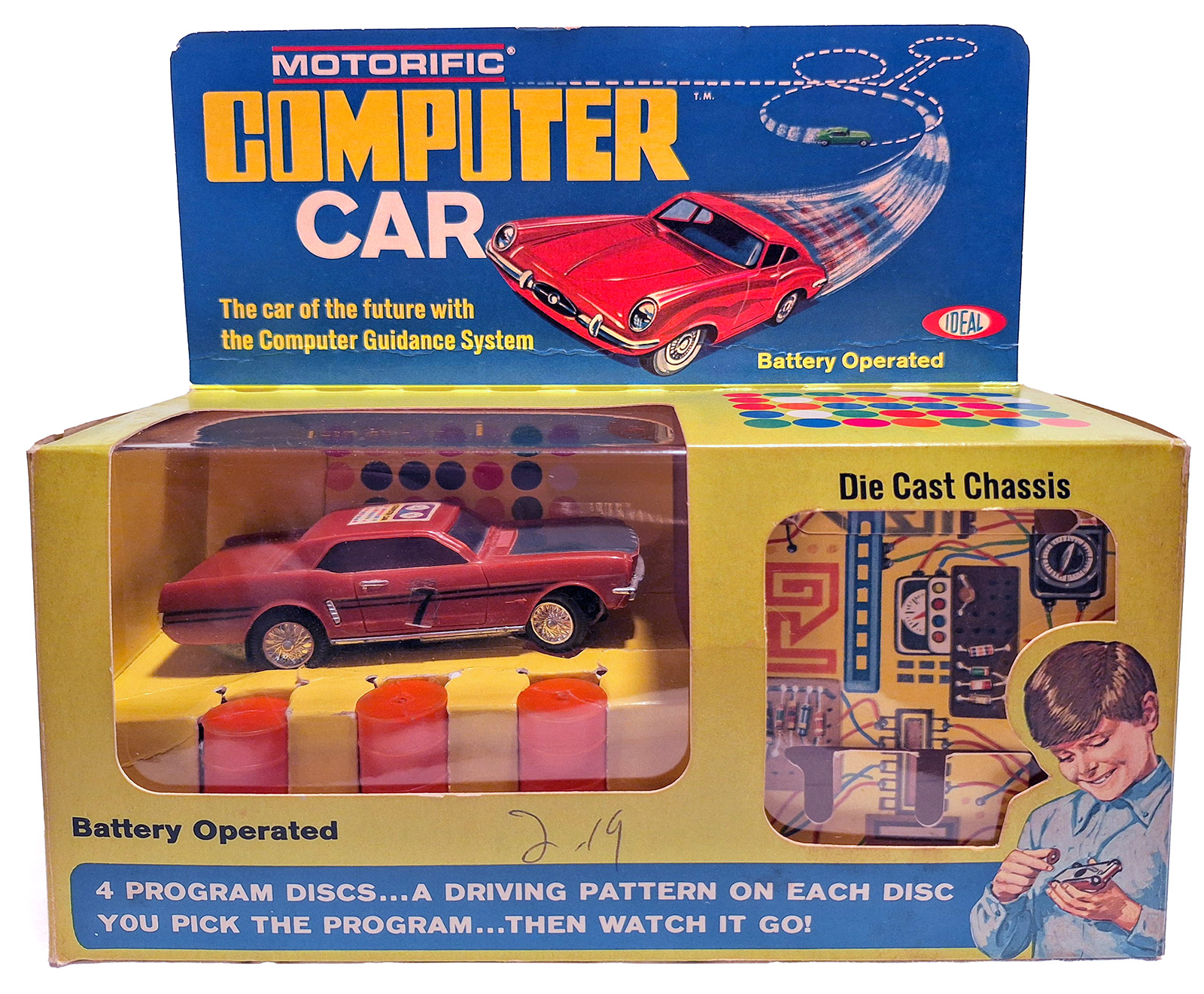
A truly programmable car allows changeable instructions to be stored inside the car and replayed. The earliest means of doing this that I am aware of is via cams, as employed by Ideal for its “Motorific Computer Car,” though I’m not sure Ideal was the first to market a cam-controlled car. It’s not Toy History Thursday Friday, so I’m not that worried about it. Anyway … the concept is simple and ingenious.
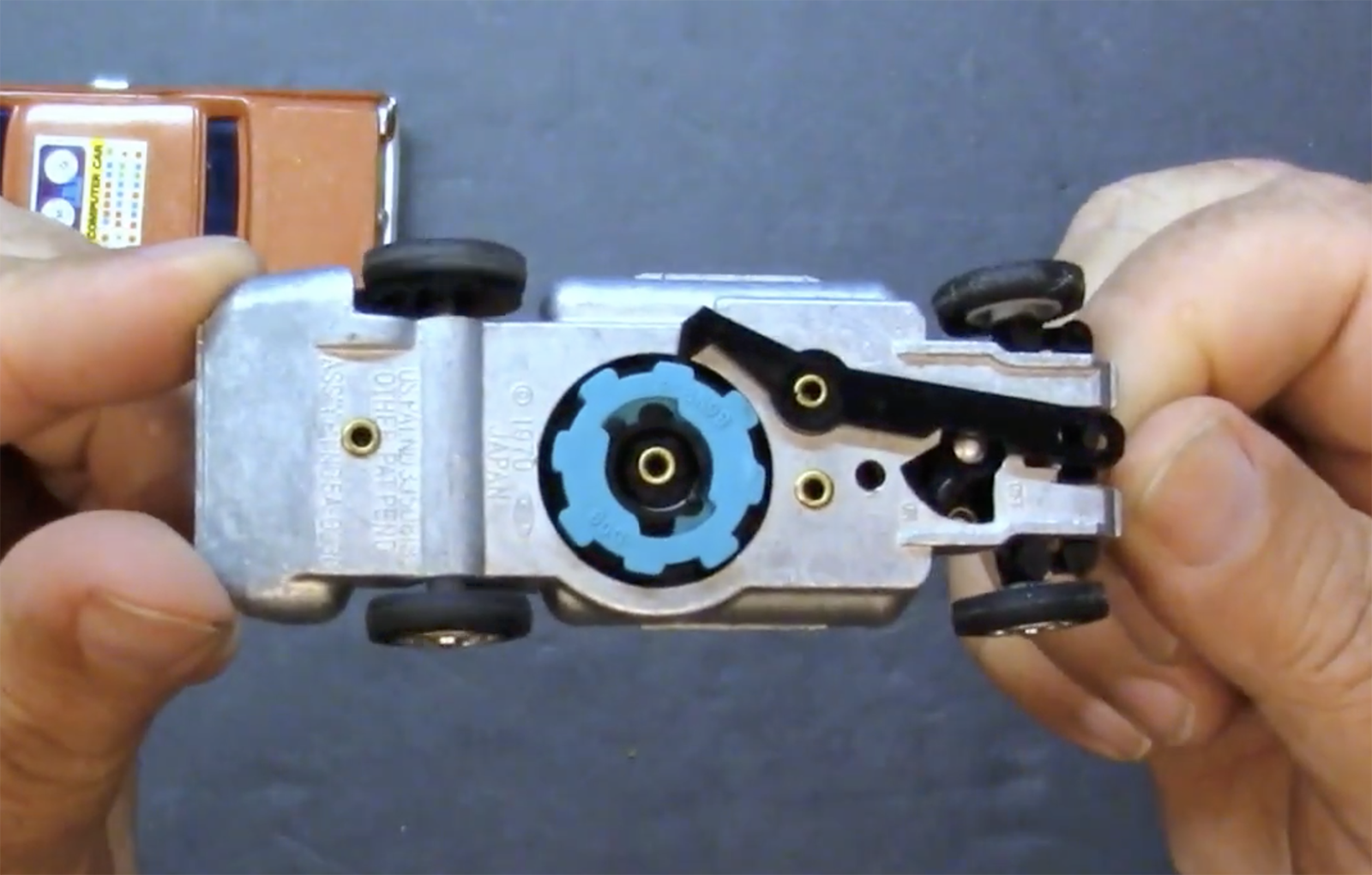
As this screengrab from the video below shows, the underside of the car (which is diecast, nice) has an opening for interchangeable, multi-lobed cams to be twist-fit onto a rotating base. A cam follower attached to steering bellcranks changes the car’s direction as the follower rises and falls over the lobes. Pretty neat!
Here’s a deeper look at the Motorific Computer Car:
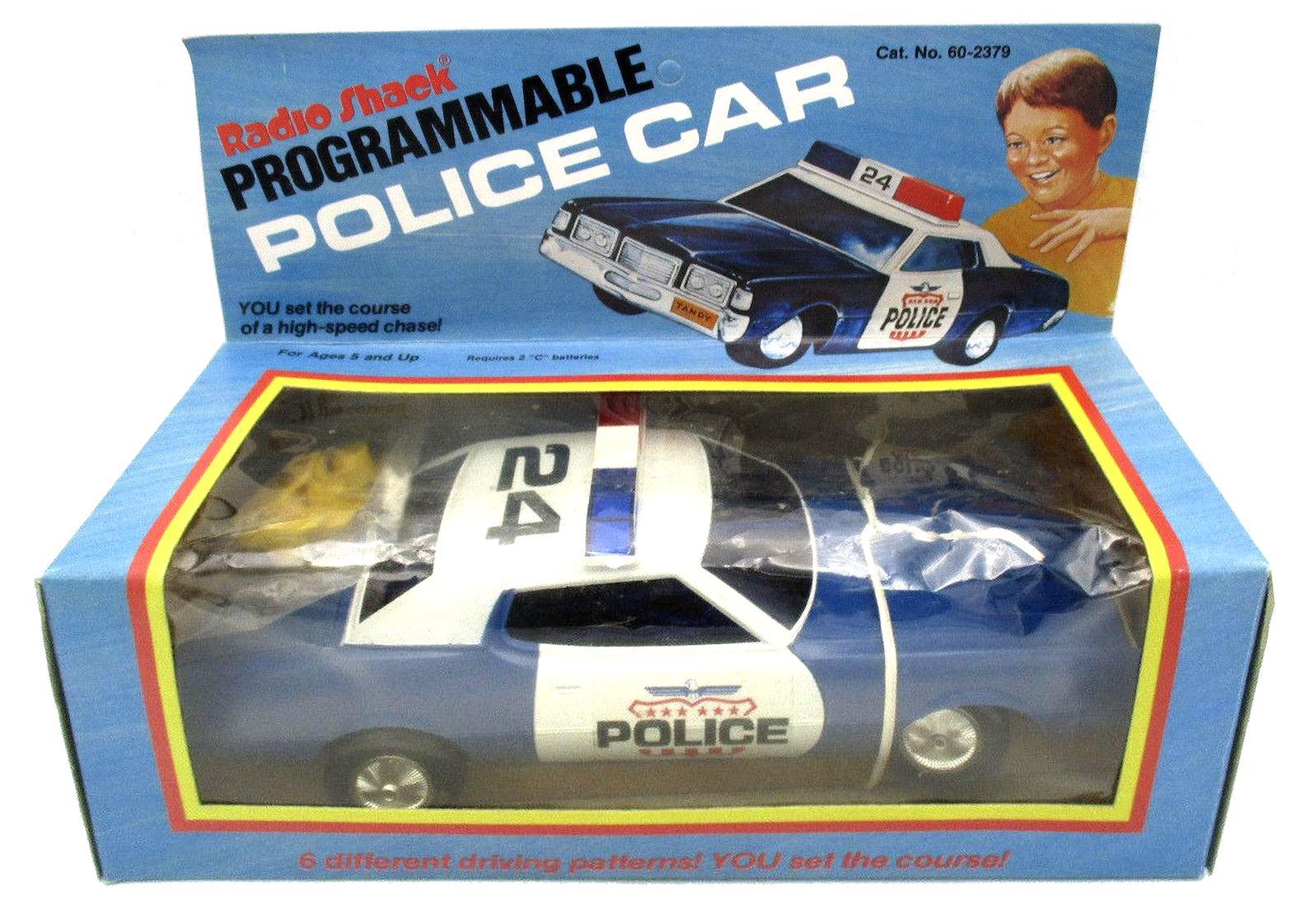
Radio Shack offered what I think is a superior spin (no pun intended) on the cam-car concept, and I’m sure the same cars were marketed under other brand names as well. Sold as “Programmable” and “Computer” cars, these vehicles were larger than the Ideal models (which look about 1/32 scale to my eye) and appear easier to operate with their top-loaded cams. Also enticing: the replica bodies are nicely detailed and realistic, right down to operating headlights on some models.
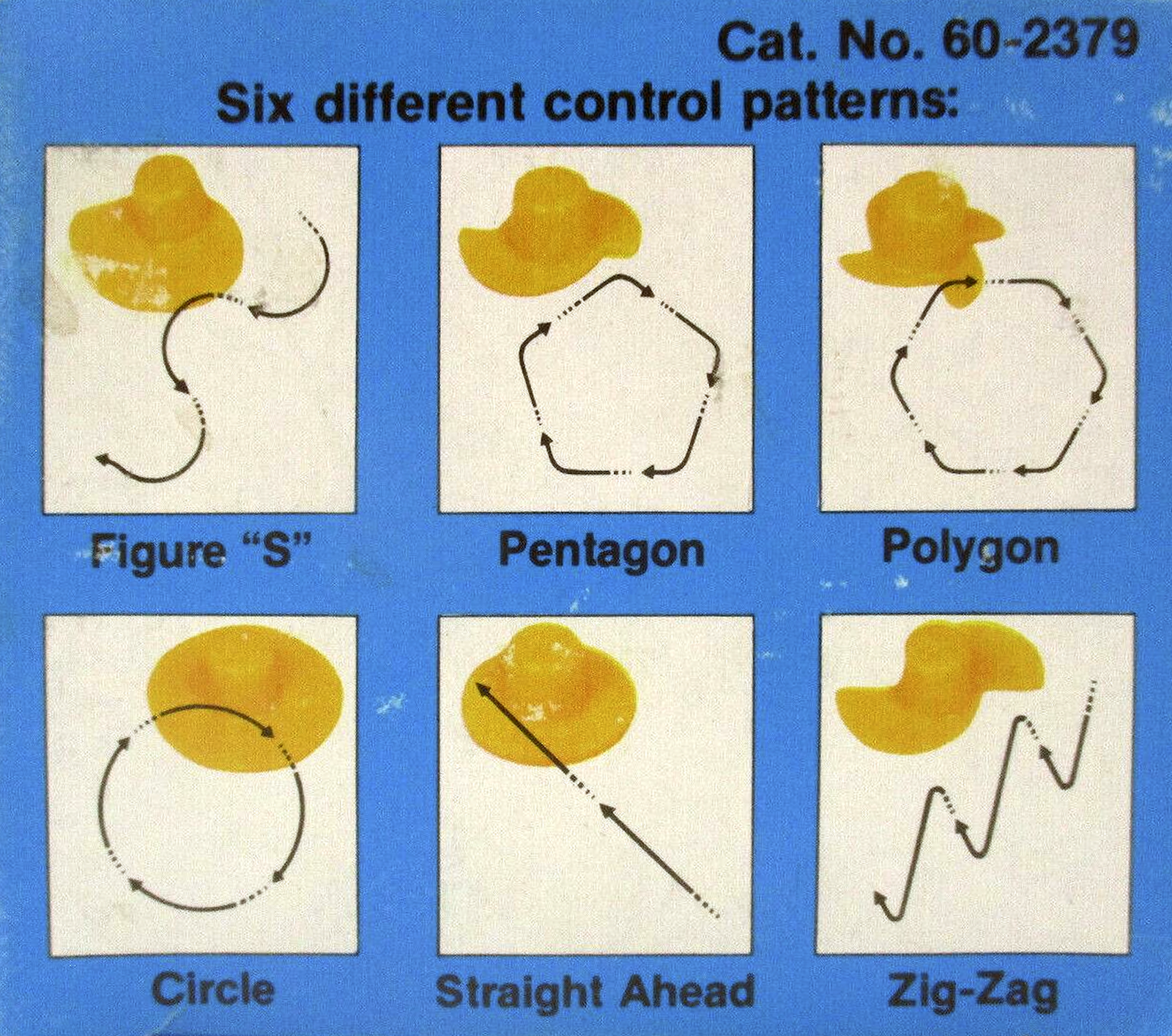
The patrol car is wonderful, but get a load of this Porsche 917! What appears to be a boat propeller incongruously emerging from the engine cover is the programming cam for an pentagon pattern, according to the box panel below.
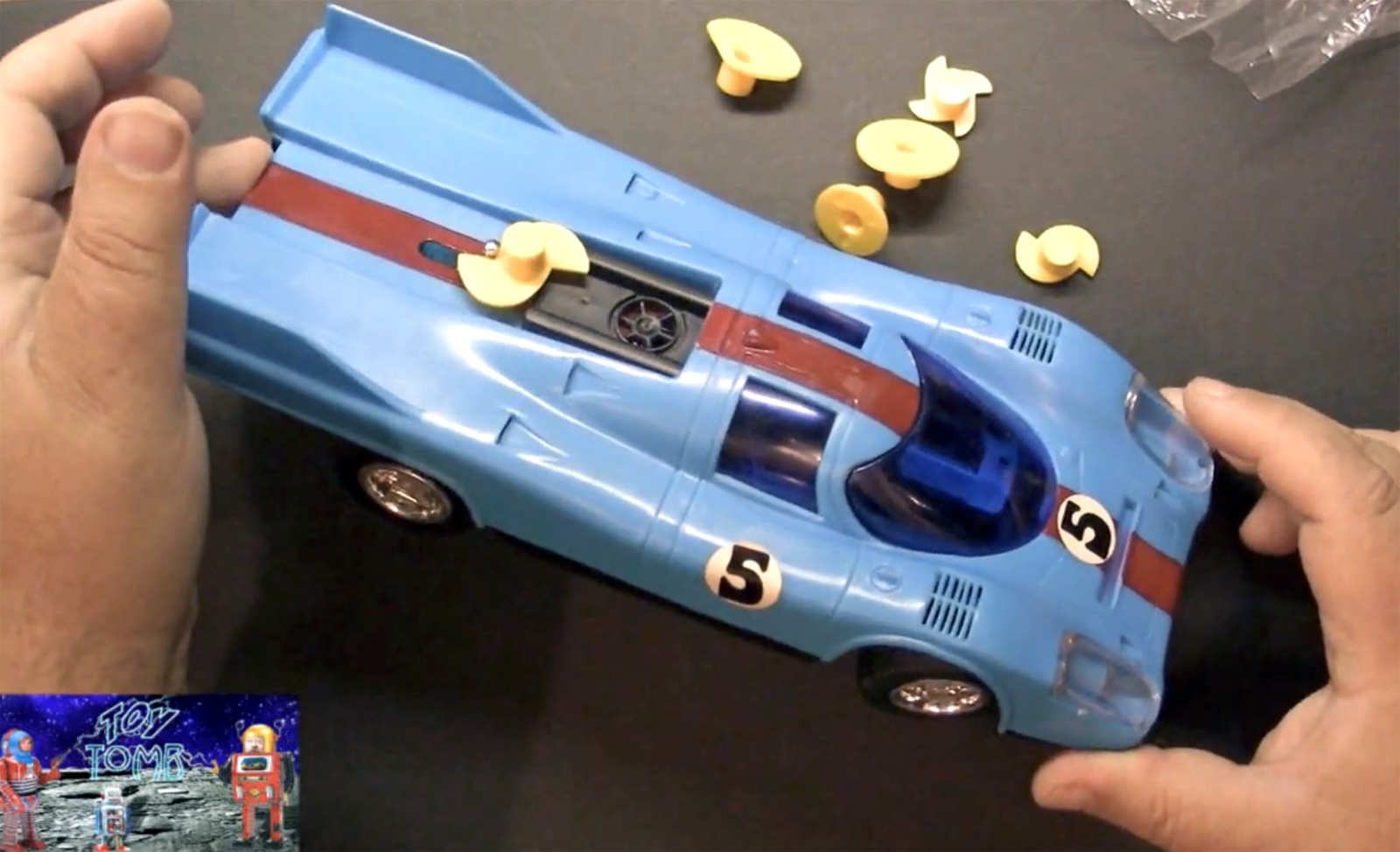
I like how the “cams” for straight running and a continuous circle are simply round, with the diameter set to hold the wheels straight or at an angle.
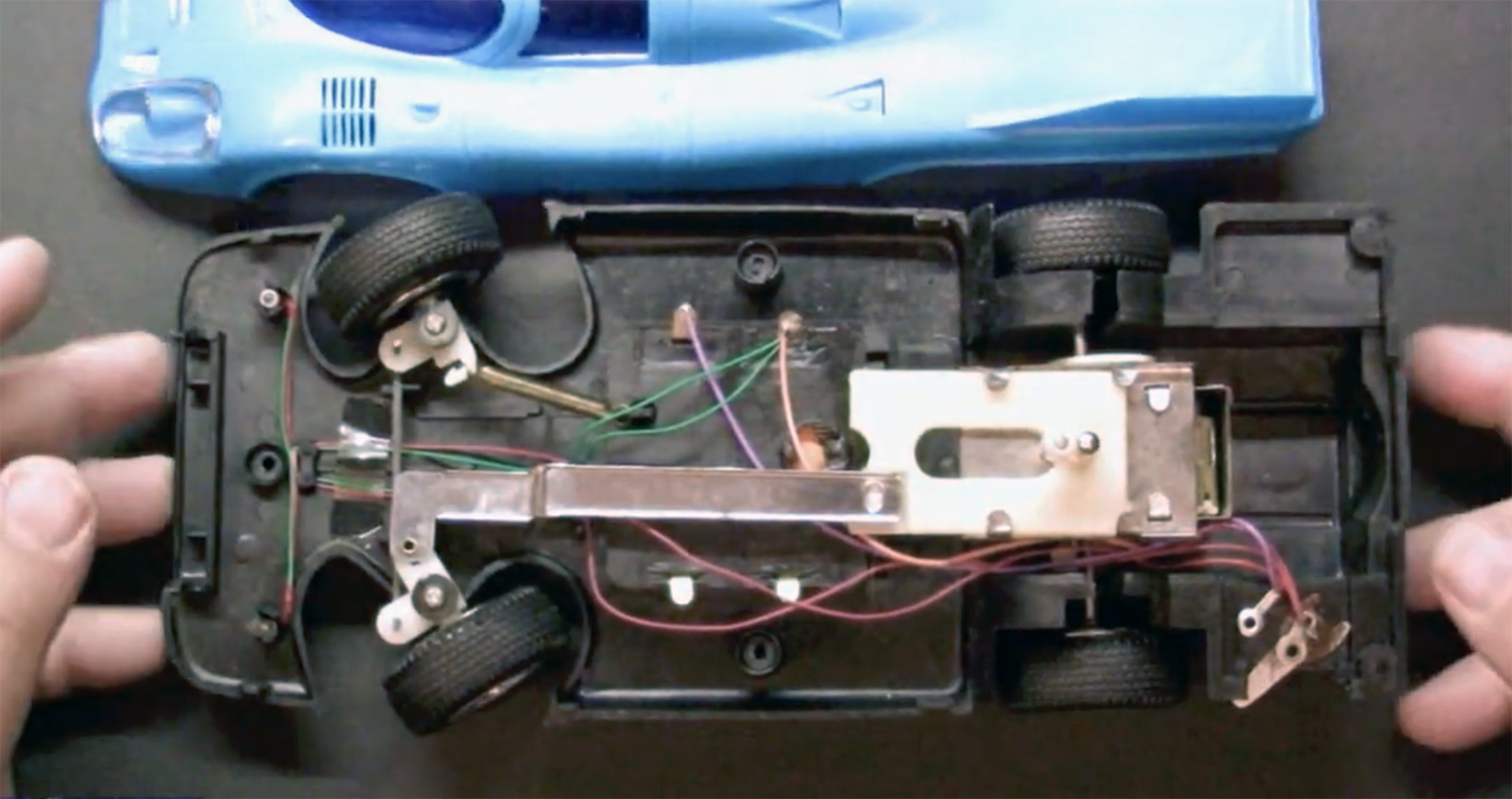
Here’s a look at the cam mechanism, which I think is quite elegant. The cam fits onto an output shaft with a hex-socket interface so it doesn’t slip, and the cam follower is a post attached to a sliding rack that reaches up to the front wheels. As the post tracks the cam’s contour, it slides the rack back and forth to operate the steering bellcranks. You can see the mechanism in action in the video below.
I shall be scouring eBay for one of those Porsche 917s.
Card Or Cam? Both!
Magnetic tape data storage was already a thing when Hasbro’s Amaze-A-Matic arrived around 1970, but punchcard storage was still very much associated with computer technology. And so, inserting shaped (but not punched) cards into a motorized car as a means of loading commands was “computer” enough for Amaze-A-Matics, “The Fantastic Car With A Brain.” But, truth be told, Amaze-A-Matics were essentially cam-cars.
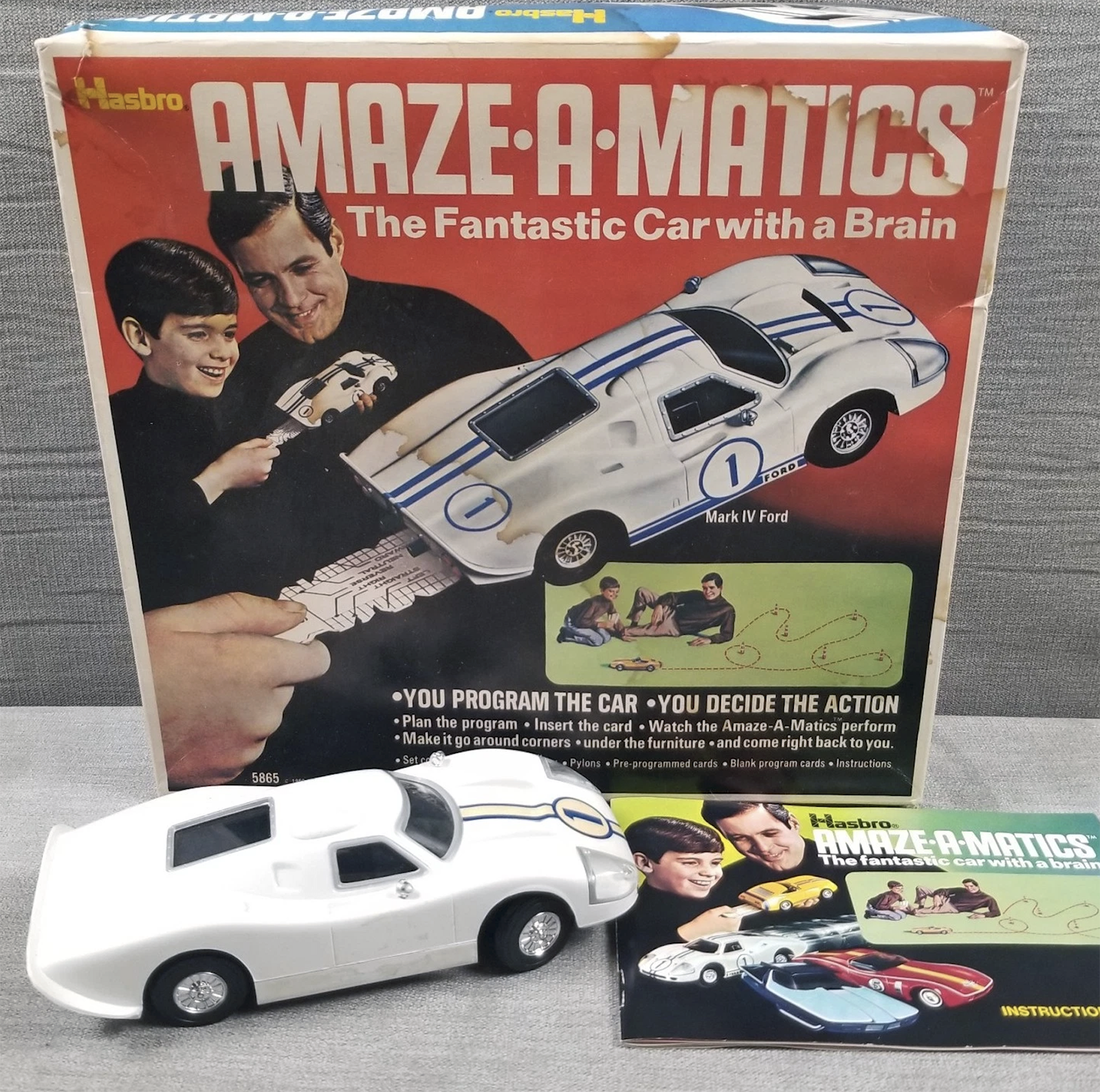
Each Amaze-A-Matic “program” was a stiff card inserted into the chassis that was pulled through the car via a friction roller. Pre-shaped cards were included to simulate actual tracks, and blank cards were provided so kids could create custom programs. Or their Moms or Dads could, and maybe not even then – it wasn’t the most intuitive thing, and the Amaze-A-Matic manual has strong “the engineers wrote it” vibes. You can freeze-frame the video below for excerpts.
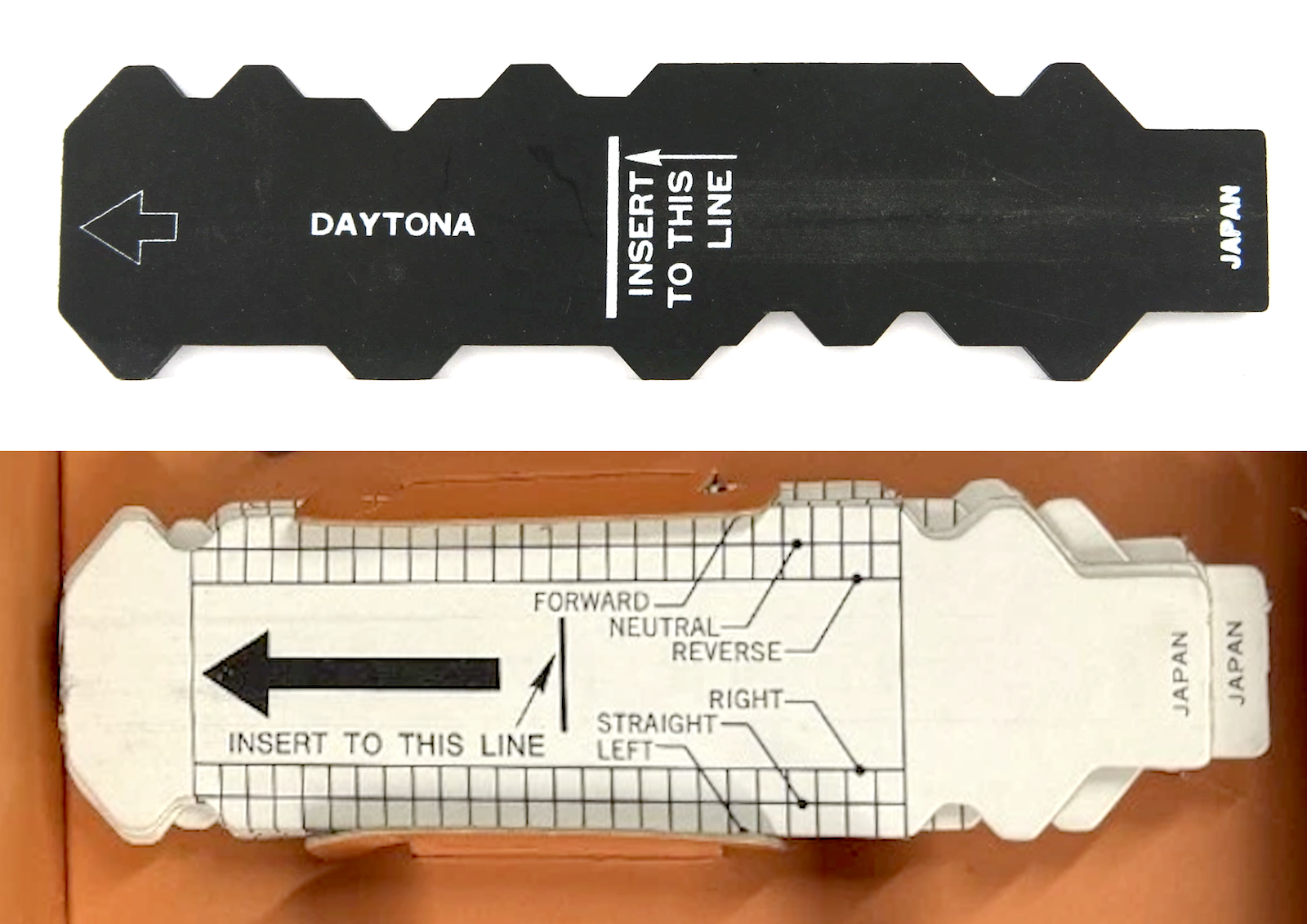
For users with some mechanical inclination, however, Amaze-A-Matic operation became crystal clear with a look at the exposed mechanism beneath the chassis. I’ve colorized the critical parts for easier viewing, and you’ve probably already surmised what’s going on. The car has two followers that move in and out as the program card passes between them. One follower operates steering bellcranks, Motorific-style; the other follower translates its motion to a movable gear via a wire lever, which engages forward, reverse, or neutral depending on position. It’s cam-car technology, but the cam profile is translated to series input with a start and finish rather than a continuous loop.

It’s very clever! And the body styles are pretty sweet, too. Let’s watch the commercial:
Big Trak, the programmable car to rule them all
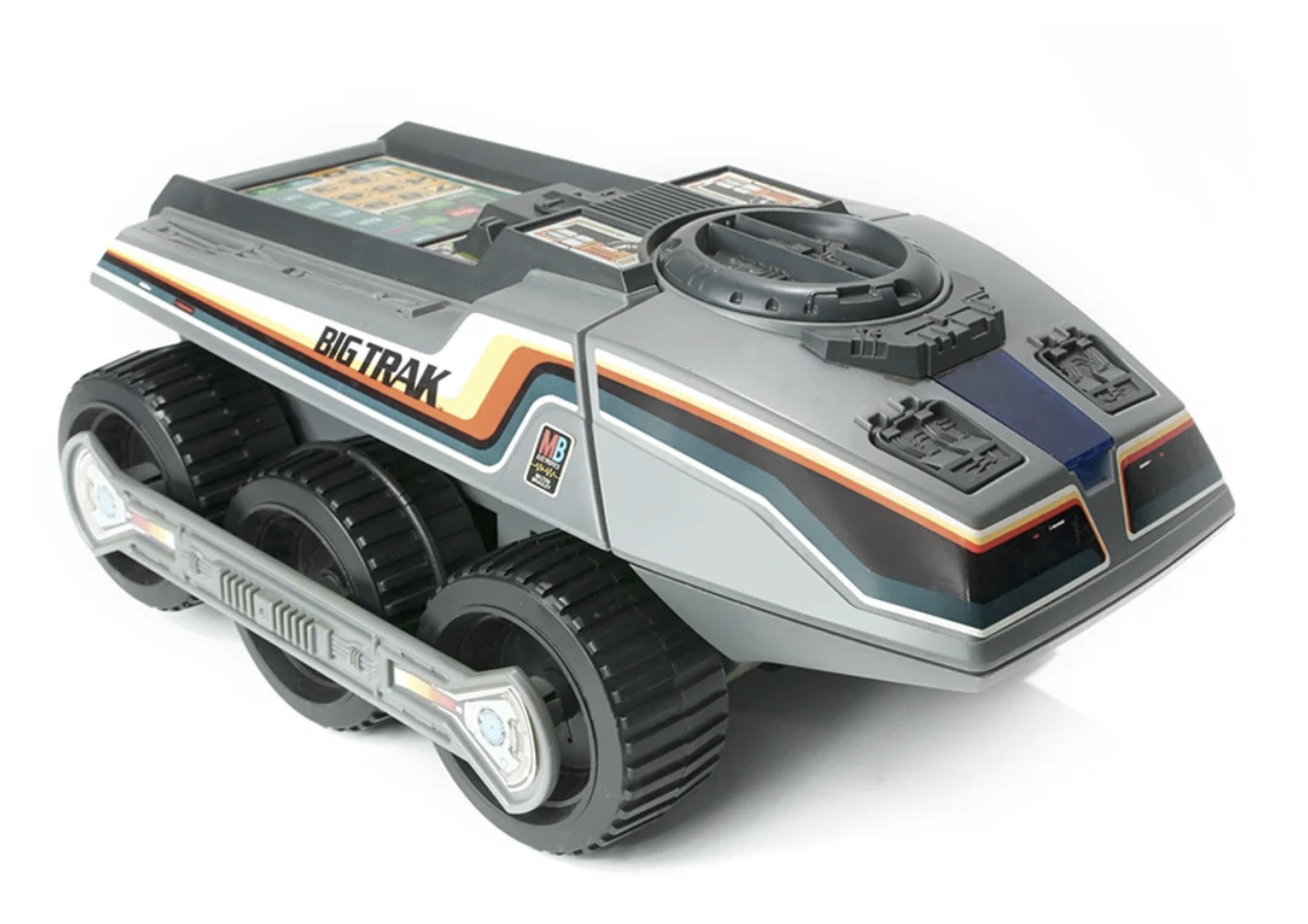
Now we arrive at the first truly programmable toy car in the mode that we associate with programming: ones and zeros stored on a chip to execute commands electronically. Milton Bradley (or more accurately, “MB Electronics”) was going hard on electronic toys and games in 1979, and the Big Trak was the brand’s halo car, if you will.
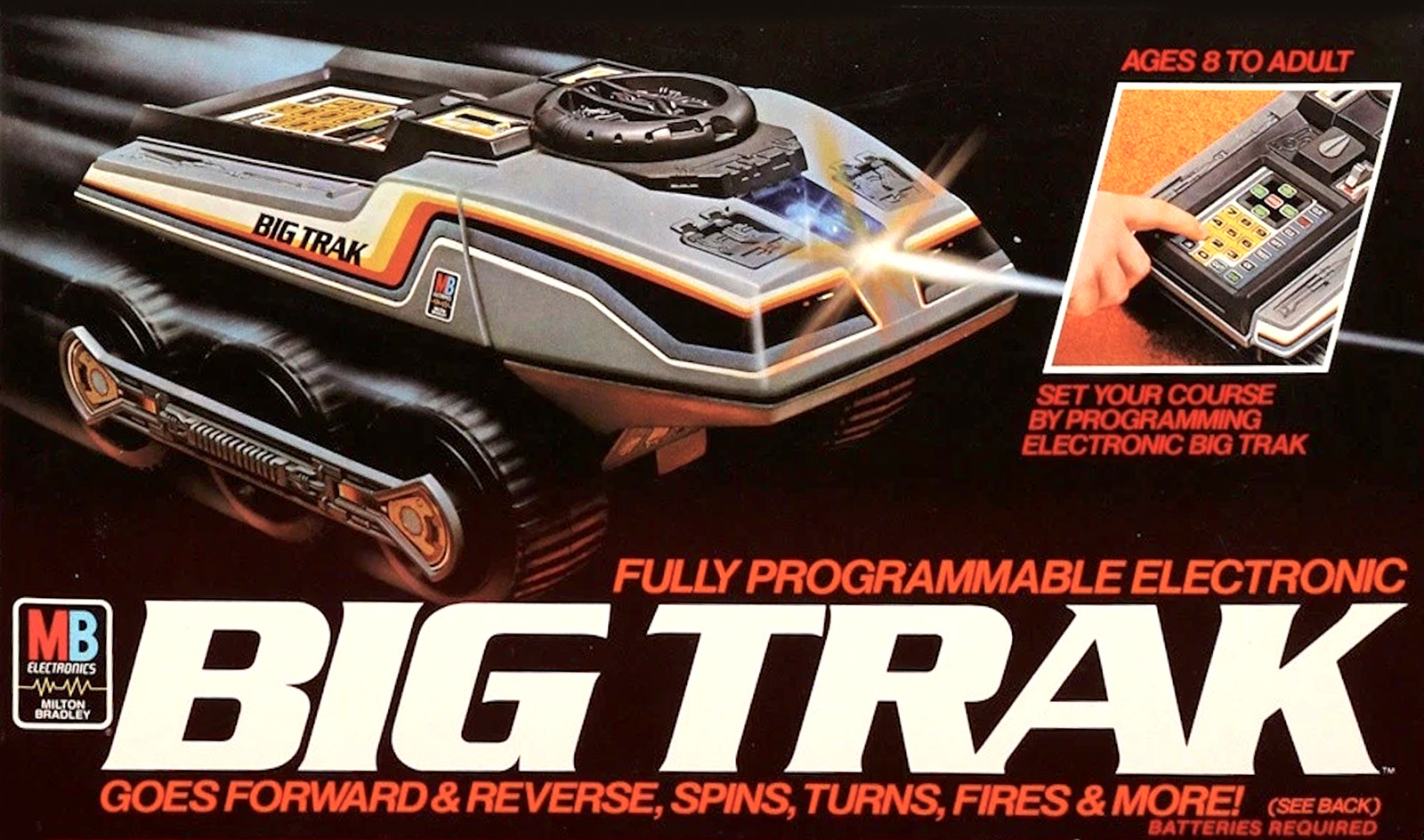
It remains iconic for its beautifully realized sci-fi design and powerful (for the time, for a toy) computing ability. It wasn’t the easiest toy to master, however; have a look at the manual yourself and you’ll understand why many a kid went directly to Mom or Dad for help operating the membrane keypad controls. I deciphered the system for the younger neighbor kid when I was twelve and was able to teach him how to do it, so it mustn’t have been that hard, but yeah, it wasn’t just a few easy steps – you really had to commit to learning.
Here’s the UK commercial for Big Trak. You can tell it’s the UK model because it’s white, and the kid sounds like he’s out of a third-grade production of The Clockwork Orange.
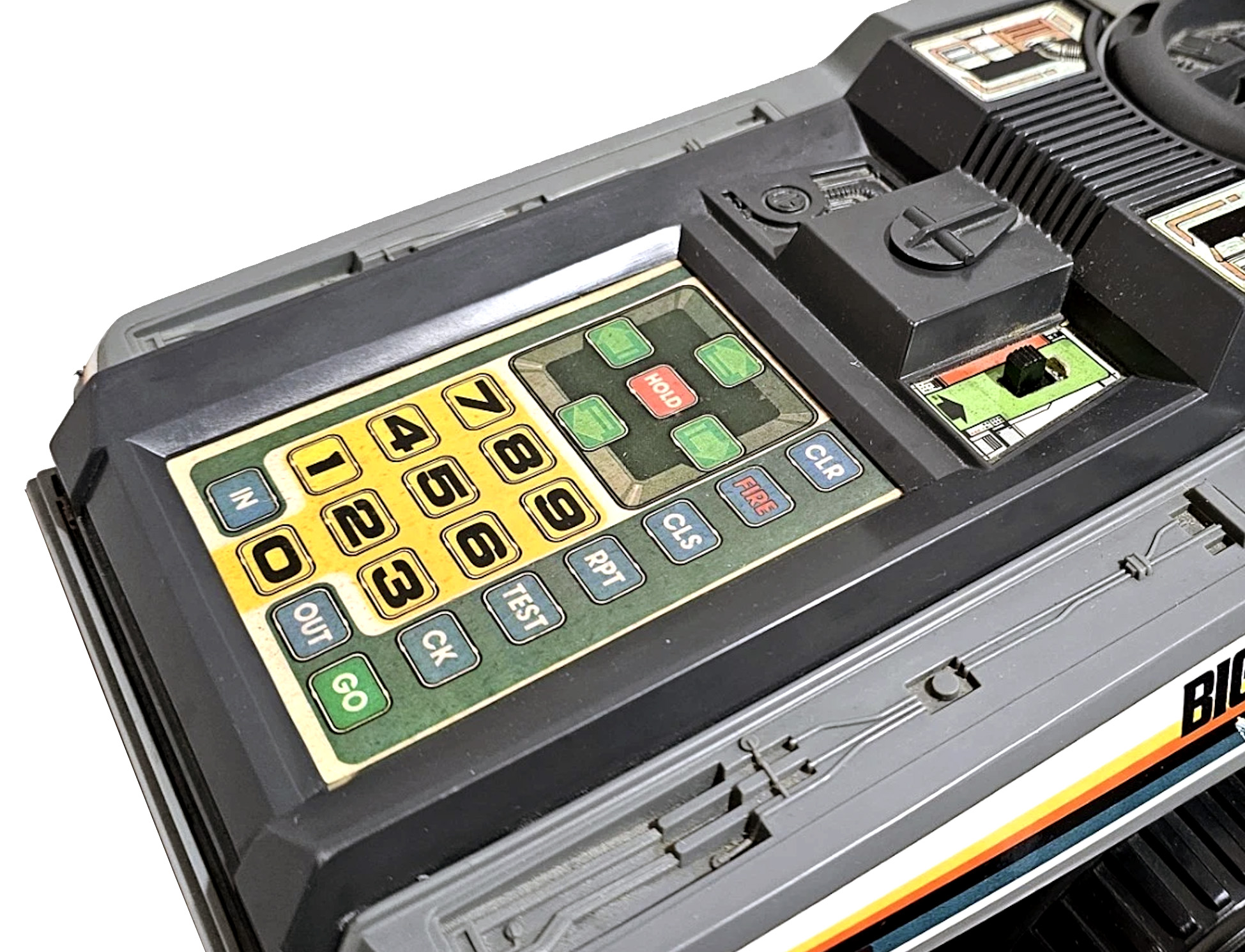
And here’s Big Trak’s membrane keypad. I defy you to figure out how to program this thing just by looking at the buttons, but the concept is easy to glean: you input units of distance via the numbers, place turn points and forward/reverse changes via the arrows, and insert laser blasts via the fire button.
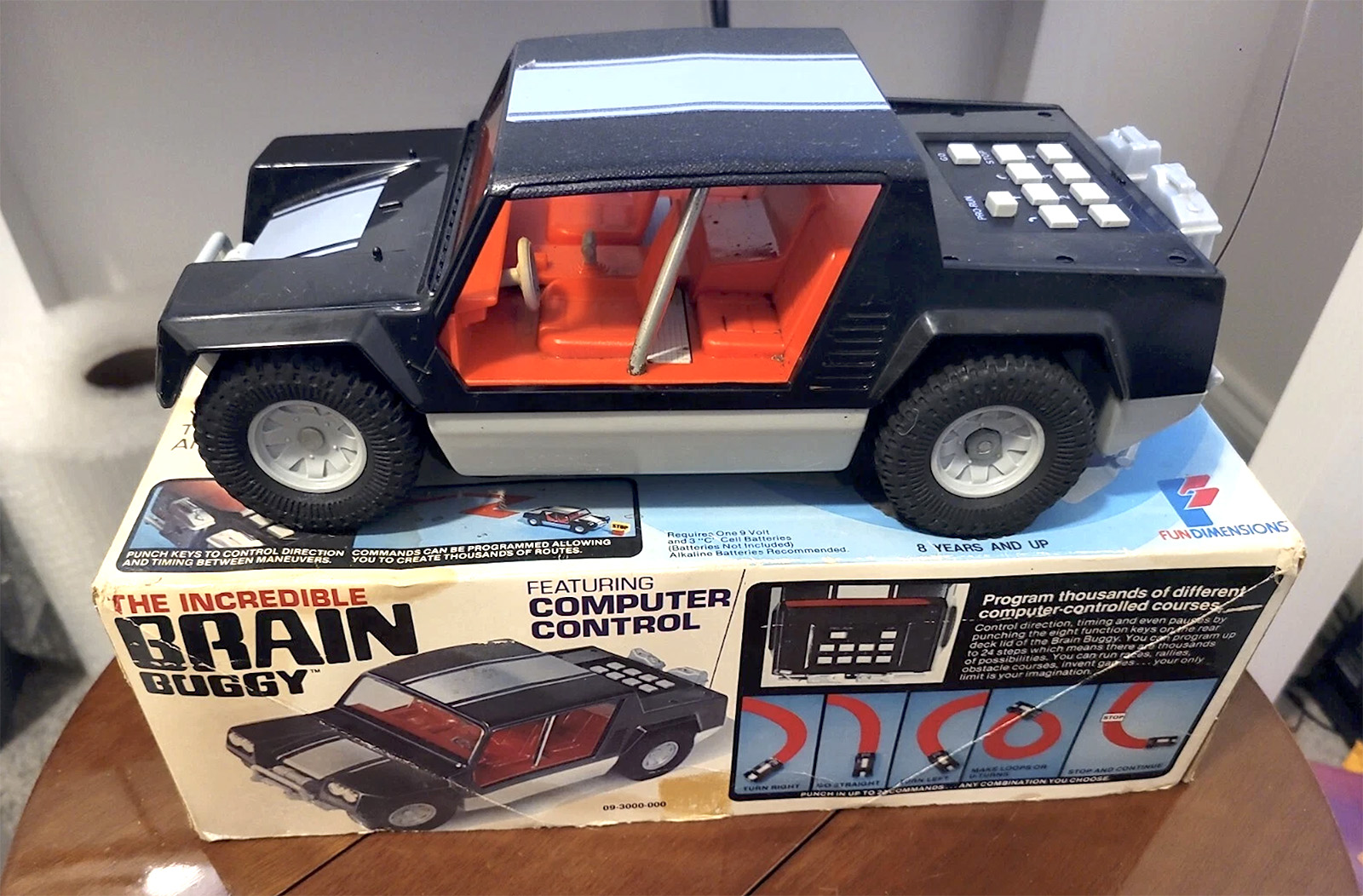
Big Trak is the best-executed and best-known computer-programmable car toy, but not the only one. FunDimensions offered The Incredible Brain Buggy, a good-looking model of the Lamborghini Cheetah (though not officially called out as such), its pushbutton controls appear much less versatile than what Big Trak offered. If you had one, let me know in the comments; I never saw one as a kid.
Also news to me: LJN’s 255 Computer Command, a very sharp-looking C3 Corvette that tantalizingly hides its membrane keypad beneath the hood.
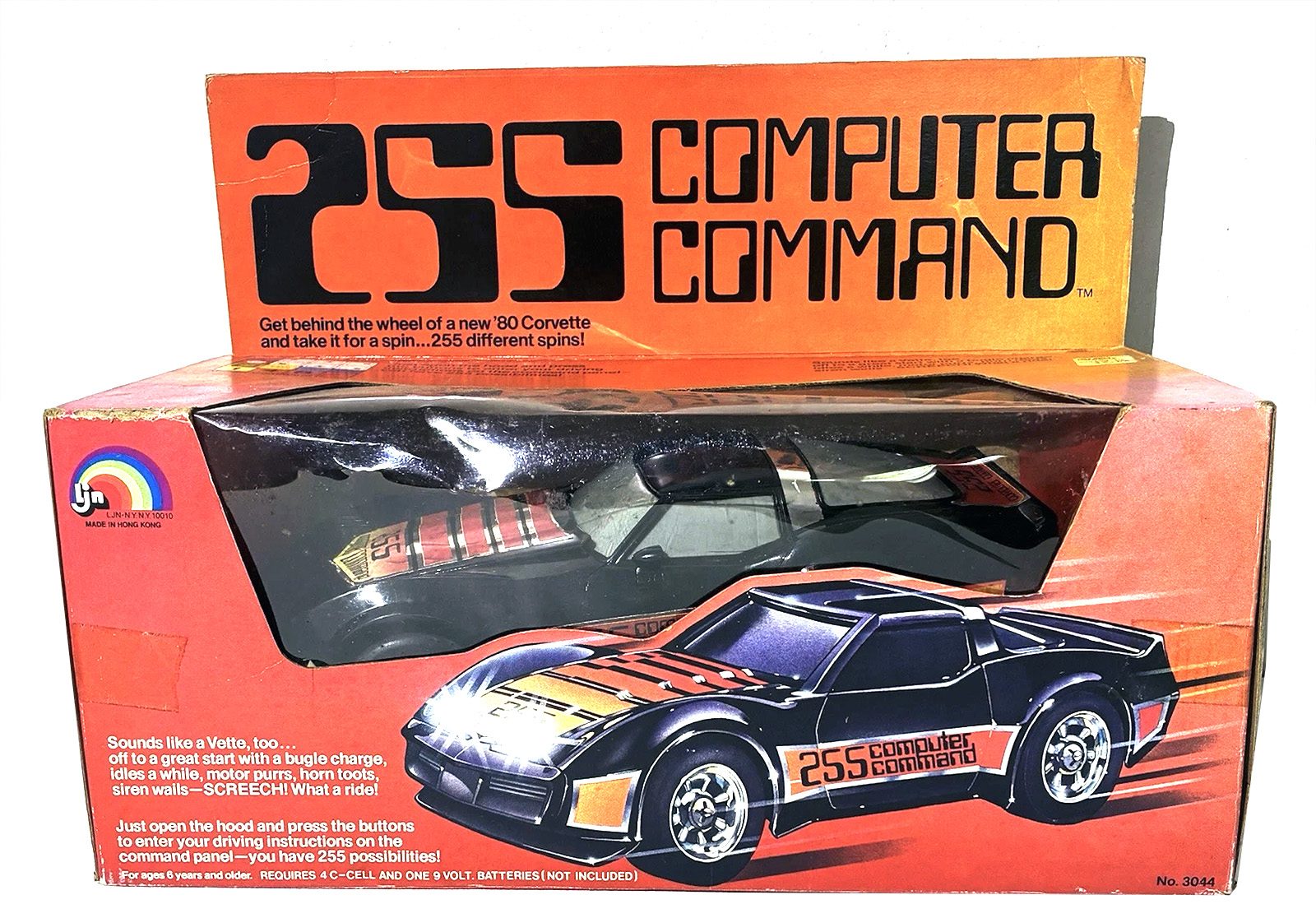
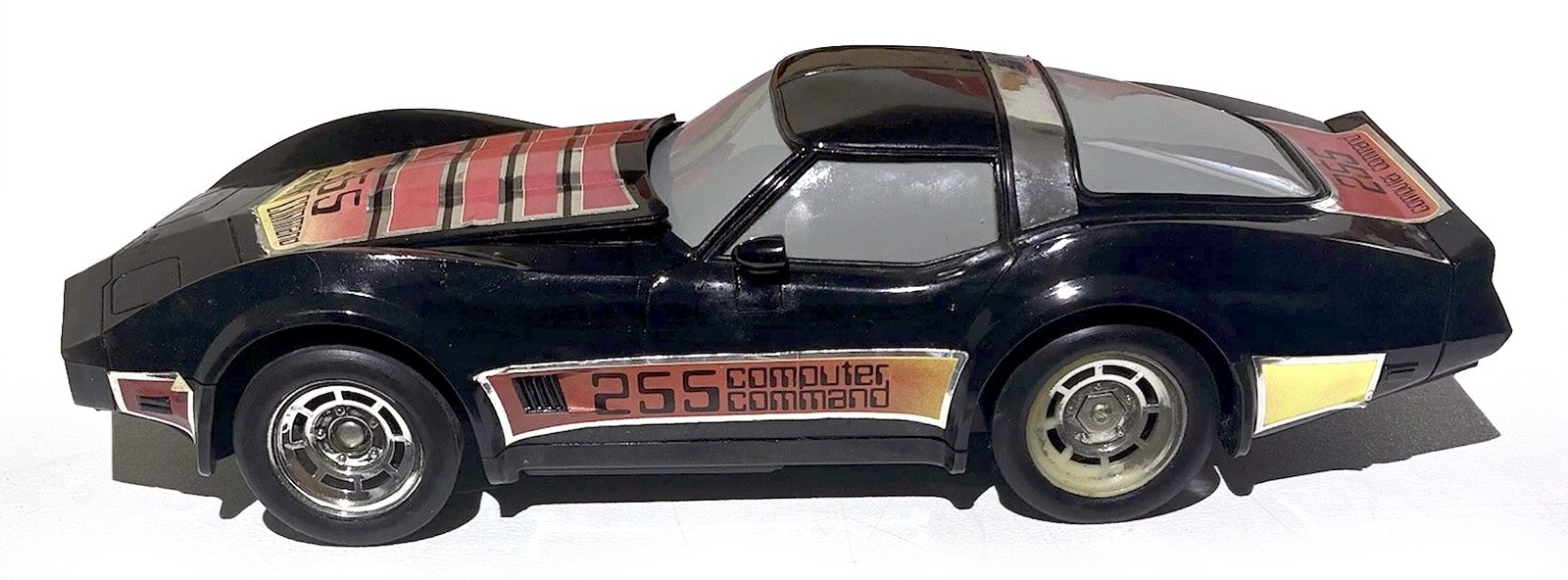
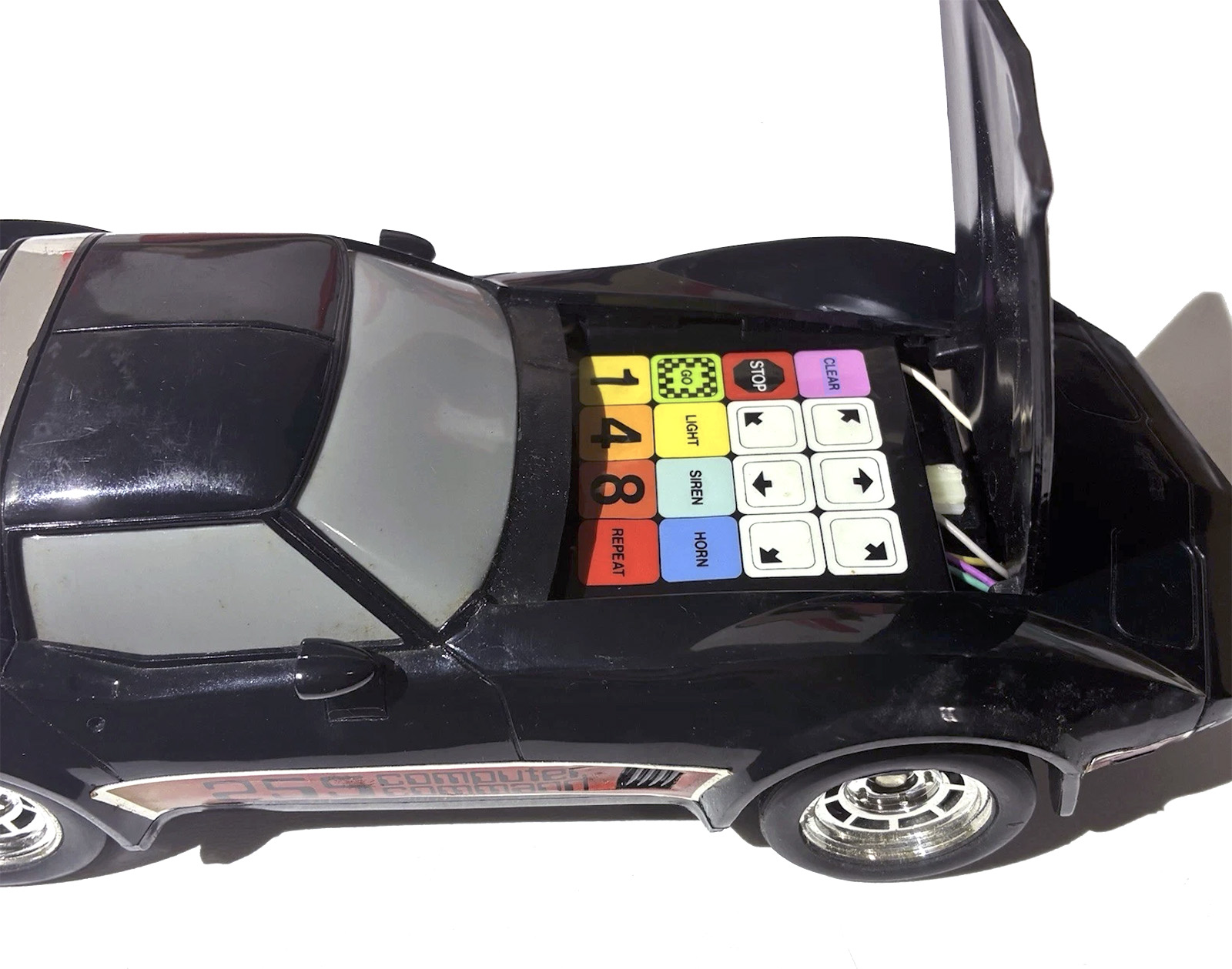
The 255 Computer Command is so named because “You have 255 possibilities!” for programs, which seems low given all the variables presented by the controls below. Along with the direction and travel units, there are light, siren, and horn controls. Once again, I’d love to hear from you if you had one of these!
… and that includes another Toy Car Thursday, but on Friday. More next week, most likely on Thursday! But no promises.
Top graphic images: eBay sellers


I had a Big Trak with a dump trailer. I loved it. As a kid I don’t recall it being difficult at all to program. As an adult, I dunno…
The cam-cars remind me of the mechanical computers used for firing solutions on warships once upon a time. Any time they needed to implement a complex function like a logarithm or tangent or such, they would map it onto a cam and use a follower attached to a rack and pinion to turn it into the appropriate rotary motion.
I had a 255 Computer Command Corvette. Pretty flashy for a gift! And it was relatively easy to figure out how to program. It sounded more like a Recognizer from Tron than a car, but the lights and horn were fun. It was heavy with all the batteries, and you kinda got bored after spending a bunch of time trying to figure out the moves and duration just to sit back an watch it run into a wall. Also, it didn’t do well on carpet. I had a cheesy remote control Radio Shack tank that was more fun.