

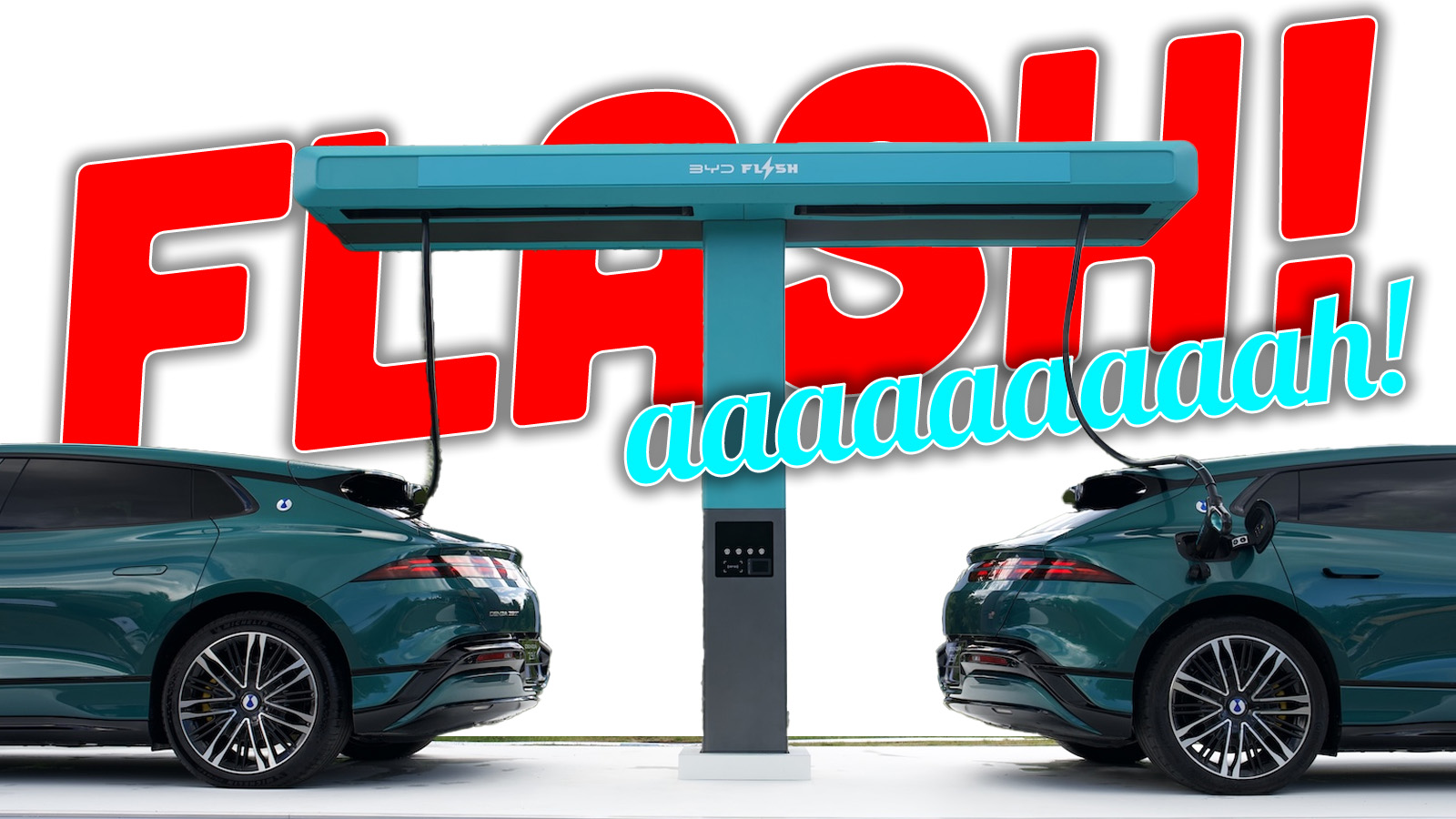
While electric cars are wonderful commuters if you’re able to charge at home, they still face some limitations when it comes to long-distance road trips. Even though DC fast charging in North America has come a long ways since the days of 50 kW CHAdeMO stations, fast charging an EV still takes far longer than filling up a combustion-powered car. On a properly long trip, that can add hours to the travel time, presenting a significant turn-off. However, that’s about to change in some parts of the world. Thanks to BYD, megawatt charging is starting to get surprisingly convenient.
Let’s start with the big number: 1,500 kW. That’s more than four times the power of the 350 kW stations generally considered to be the gold standard in America. It’s a big number for a charging station, but it’s only usable because of the wild C-ratings on BYD’s Blade battery 2.0 cells. A battery’s C-rating is a measure of how quickly it can charge or discharge, and BYD’s latest chemistry supports an 8C charge rating. That means these cells can theoretically charge from zero to 100 percent capacity eight times in an hour. We’ve seen megawatt charging before, but the big deal with BYD’s Flash Charging setup is that it can deliver all that power through one connector. Some previous megawatt charging setups required two cables for connection, and that just gets a bit cumbersome.


The other historical problem with megawatt charging is simply pulling that much power from the grid. Let’s say you have a bank of just two 1,500 kW DC fast chargers. If they’re just hooked up to the power system, each one only needs to see about four hours of use per day for the station to consume the same energy as the Walmart in Covina, Calif. before it received renovations to reduce power consumption in 2023. A big bank of megawatt chargers may require expensive direct transmission, but BYD’s using battery banks to spread the load.
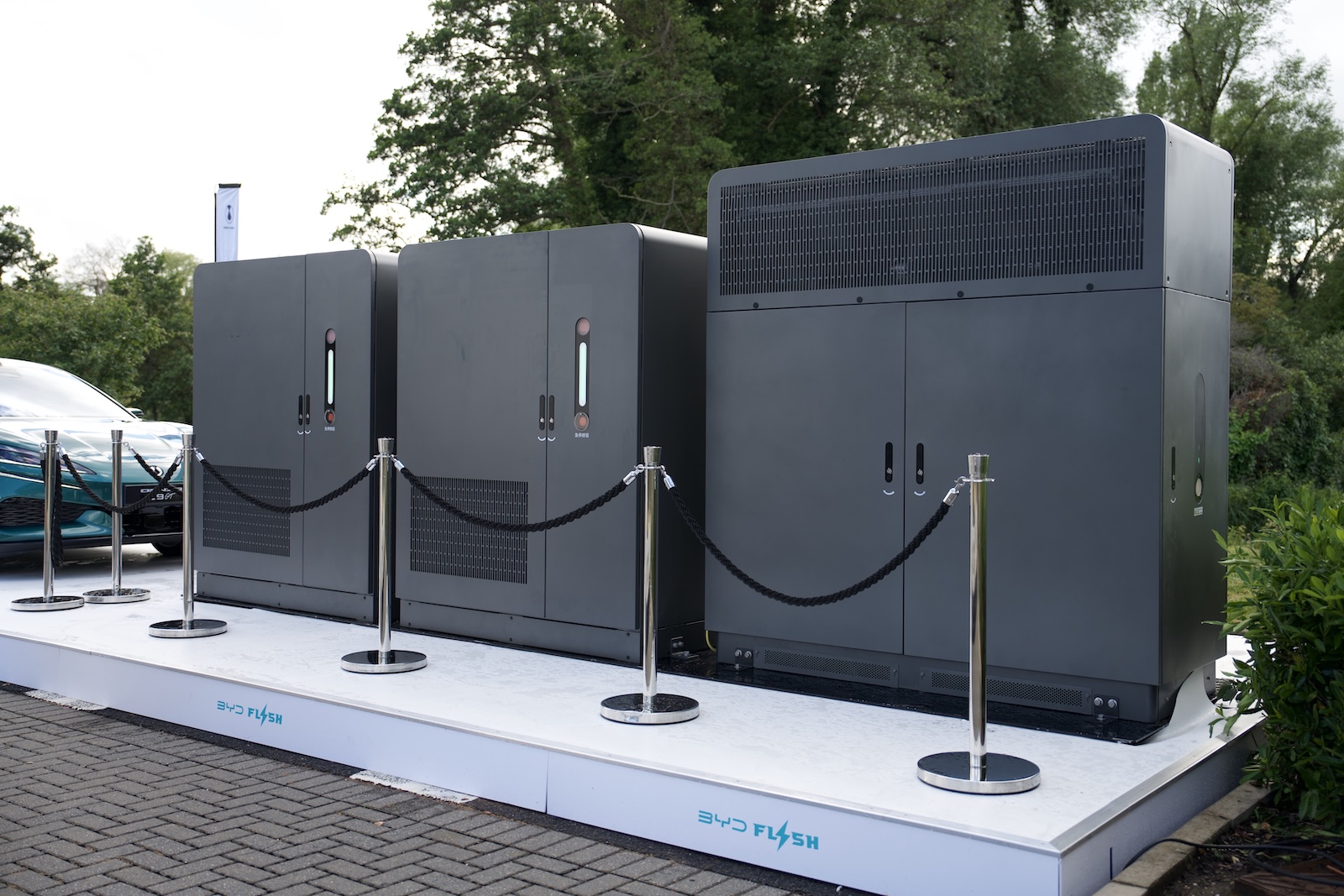
These battery banks can pull a maximum of 560 kW from the grid, and provide charging support while reducing power transmission needs. They top off when things aren’t tapped-out, then discharge when plugged-in EVs need a boost. We’ve seen this sort of system in use by many EV charging station companies, but BYD is taking it to a different scale.
This all results in charging speeds that seem like science-fiction come to life. With BYD’s Blade Battery 2.0 on this charging network, the marque claims five-to-70 percent in five minutes and 10-to-97 percent in nine minutes, with an extreme -22ºF (-30ºC) cold 20-to-97 percent charging session done in as little as 12 minutes. The thing is, BYD doesn’t cite battery pack sizing with this claim, but third parties have already tested these megawatt chargers with interesting results.
Out of Spec Reviews plugged a Flash charger into a slightly crashed Denza Z9 GT that was sitting around the back of a dealership in China and saw it charge the EV from 30 percent to 97 percent in eight minutes and 53 seconds. Impressive stuff for a 122 kWh battery pack. That’s hundreds of miles added in about the same time it takes to fill up a regular gasoline-powered car.
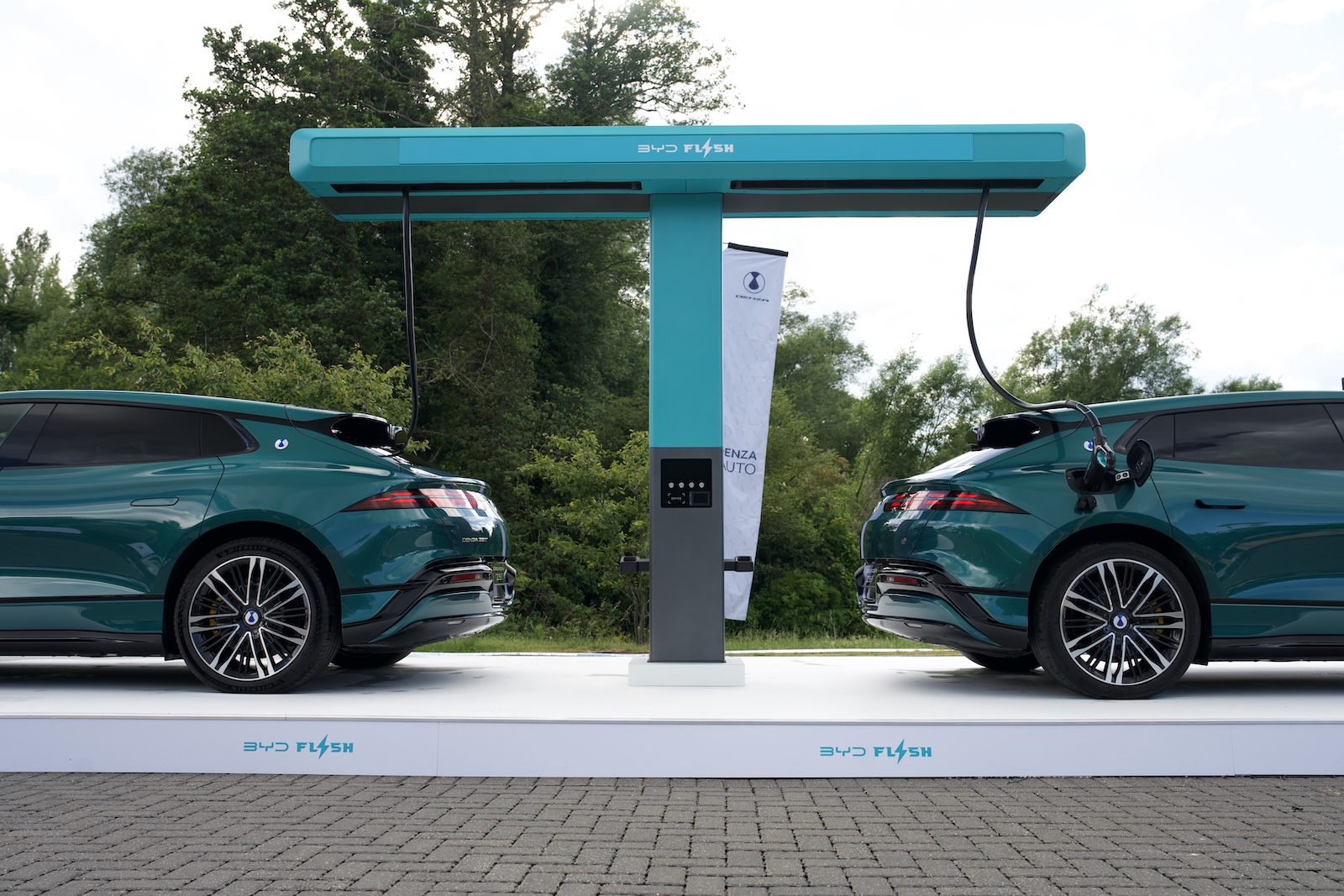
I’m also rather impressed by the design of the charging station itself. You’d expect something capable of flowing that sort of power to have a huge cabinet and a cable the diameter of a drainpipe. Not so. Instead, the cabinet’s a tall T-shaped thing with fairly normal-sized charging cables hanging down from above so they don’t drag on the ground and get dirty. Dual heads and relatively long cables should mean that no matter where on a car a charging port is, these charging stations will reach. The only miss is that cabinets in certain markets seem to lack credit card readers. Probably fine for a car you own with plug-and-charge capability, but it may make paying for a charge in a rental car more complex.
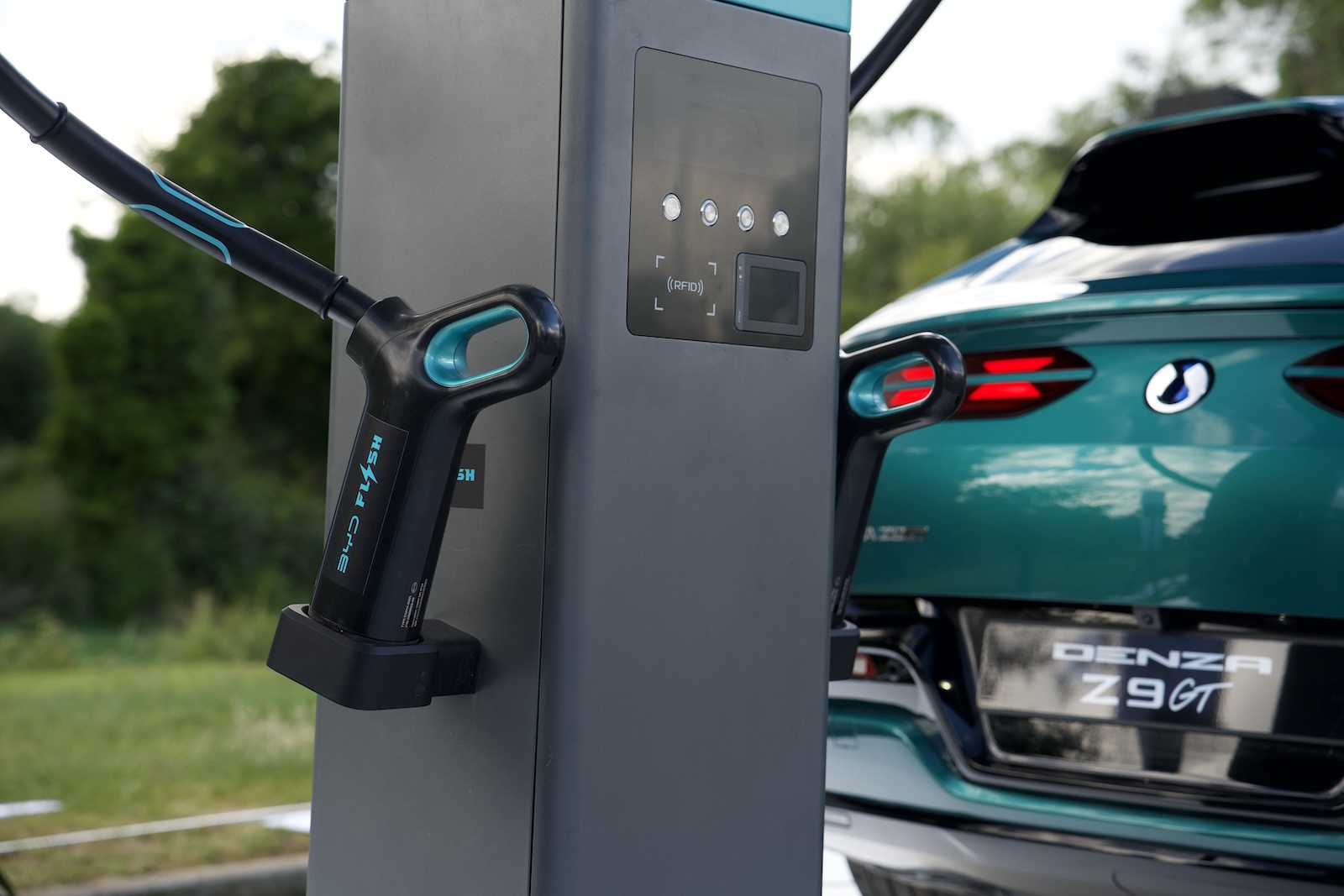
Ah yes, markets. It shouldn’t be surprising that the Flash charging setup first launched in China, but BYD’s been aggressive about expansion. Not only has the automaker recently opened its first Flash charging station in Germany, it just demonstrated its first megawatt charging station in Britain. A total of 300 megawatt stations are slated for the United Kingdom by the end of the year, with aggressive expansion also planned for other markets. Don’t be surprised if they end up coming to Canada soon enough, given how BYD’s been eyeing the Canadian market.
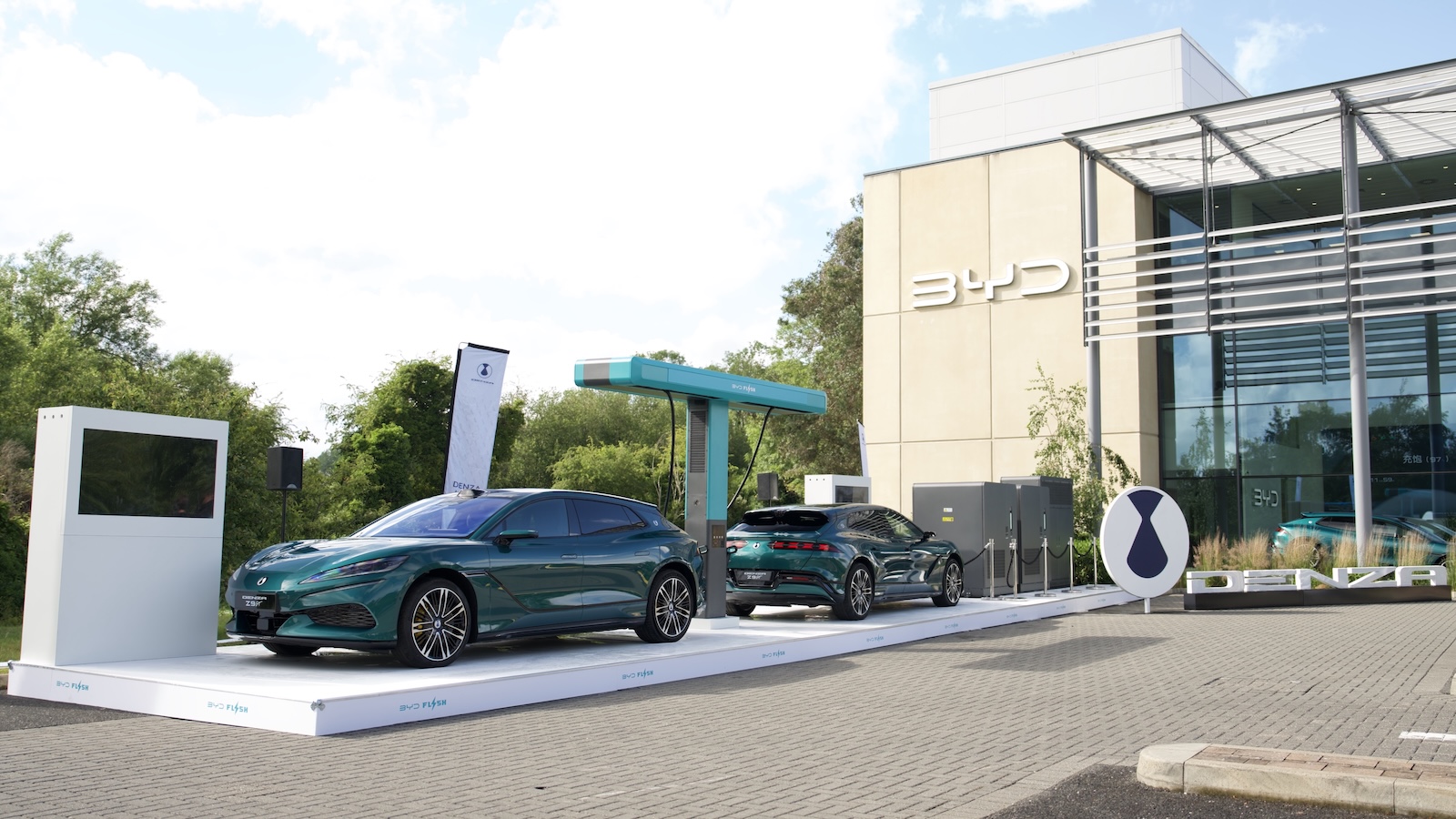
Pending rollout, it seems that the biggest dig against electric vehicles may now be solved. With megawatt charging, the time gap between charging up and filling up shrinks dramatically, and that should make long-distance road trips far easier. While BYD’s early to this thanks in part to its battery chemistry, it certainly won’t be the sole player in the megawatt charging field. Given how the technology’s already being deployed, it’s only a matter of time before the future becomes the present.
Top graphic image: BYD


I applaud use of one of the lesser known Queen efforts.
“Oh well…Who wants to live forever? DIVE!” — Prince Vultan
it’s all fun and games until meta’s datacenter opens a block away and now it costs $500 to charge your car.
I’m suspicious of the fact that they avoided the usual 10-80% numbers that matter in the real world and are what basically everyone else quotes. My guess is if you directly compared the numbers you would realize that for your nearly 5x increase in power (over a 350 kW charger) you don’t get anywhere near that in terms of charge time reduction.
I also don’t think this moves the needle. I said this way-back-when on the Hyundai 800V article, but the charge speeds the H/K EVs support are fast enough. You plug in, go inside to pee and grab a snack, and by the time you get back you’re ready to go. That’s all I care about. If I’m driving far enough to need DCFC then I’m driving far enough to need to take 15 minutes every few hours to stretch my legs and take care of biological needs.
The problem then was that there weren’t that many chargers capable of giving an 800V architecture a full-speed charge. That has changed substantially in the past few years and after playing around with ABRP a bit, you can easily find 350 kW chargers to use on any of the routes I drive semi-regularly.
There are still issues with every EV on the market today IMHO, but none of them are “can’t charge at mW rates”.
Yeah, I think the issue (for my style of road-trip) is to be able to pull off at almost any exit, get access to charger with no wait (5min max), and to be guaranteed that it will charge at the full advertised rate with no drama, and of course to pay locally with a credit card.
/PS I’m not anti-EV! Recently bought a plug in Volt as my daily and I love it. I love being able to drive on pure battery mode. But I do drive long distances, where the gas engine is critical.
Yeah this sounds impressive and all, but I don’t think I’d need it. I stopped to fast charge my Ioniq 6 at a 350kW charger on Monday, and it went 25-80% before I was done stretching my legs and buying a snack at the gas station next door.
That is the reality but people that have never owned an EV won’t believe it.
So, our choices for legit EV charging are…
I would be cool with some good old American competition here.
I’m guessing the Koch brothers will roll out fast chargers with local coal power.
Outside of no available spaces on ocassion due to demand… EVGo and Electrify America have both been solid for me.
There is! I mean, maybe not with the same level of flashy headline numbers, but Electrify America has been getting their act together lately and Ionna is consistently good and rolling out fast.
Yeah, I don’t know how necessary this is.
I’ve only been doing the pure EV car thing for a little while, but when I’ve had to do road trips, I didn’t see the charge time as an issue, rather it’s the waiting in line to get to the charger.
If they could build out 10 150kW chargers instead of 1 1500kW charger, I think it would work out better for everyone. That would bring more accessibility to a wider audience, since so few people could use that kind of C rate.
I think we should pause for a moment to recognize this may be the first time any photo has been taken of an electrical panel behind a velvet rope.
Sparkies everywhere: You are seen.
We can’t use that much power to charge EVs! We need that power to run our datacenters!
Its a great idea but actual megawatt charging for EVs when they become mainstream seems impossible. If a megawatt charger needs just 4 hours of use to match the daily usage of a WALMART, I don’t see how we can provide 1 mW of charging to a large # of EVs throughtout the day, partitcularly on a busy long weekend. It seems mathematically impossible. This tech as a way to get 300ks more easily seems more reasonable.
I feel like providing 1 milliwatt (mW) of charging to a large # of EVs would be easy.
oh! you meant 1 megawatt (MW)!
/I kid. We knew what you meant.
The charging rate doesn’t affect the amount of energy needed. Whether someone charges at MW rate or level 2, the amount of energy is approximately the same. It’s just the instantaneous power that becomes an issue, which the local battery functions to reduce.
C rating for charging is how many amps the battery can safely be charged at as a function of pack size. It’s figured out from capacity in amp-hours. Say we have a 1 aH battery. It can charge at 1 amp, or 1 C. A 120 aH battery theoretically can accept 120 amps at a 1 C charge rate. Voltage isn’t directly relevant to C rating since the charge voltage is related to pack voltage. Voltage is relevant in figuring out cable sizing and connector type to discharge the pack without letting out the magic smoke. At a hobby level, 1C to 2C is generally regarded as a safe charge rate. Better packs made from better cellz can safely charge up to 5C if the manufacturer label is to be trusted.
Given the reported 1000v architecture, that will need much thinner wires to provide the same power as a 400v architecture. Since amps halve when voltage doubles and amps are what heats stuff up, less amps for doing the same work is generally a good thing.
That’s why I was so underwhelmed when the Donut videos came out. That their cell can take a 5C charge? BFD. I can do it all day every day with my RC helicopter packs (but I don’t, as I value cycle life above all else.)
This is good and theoretically fixing *a* problem but it’s not fixing the bigger problem which is access to slow charging where people park cars.
Isn’t this solving things in the correct order then? If I’m going to park for some length of time such that charge rate is immaterial, I’d rather have (if I had to pick one) slow charging there than slow charging when I’m just passing through and trying to go on my way.
Trying to replicate the gas pump model with EV chargers simply doesn’t work because of the very high cost of fast charging.
Homeowners like myself do the vast majority of charging at home. What I need is more 150 kW to 350 kW chargers – both more at each charging stations and charging stations in more locations. However, I don’t need 1500 kW charging because the difference between an 10 minute or 20 minute charging stop really doesn’t matter to me if I’m on a long trip because I’ve going to be taking breaks every few hundred miles anyway.
If EVs are going to work for renters we need a lot more slow AC charging either at those apartment buildings or at employers – places were cars are parked for hours at a time.
Oh you know what I think we’re all saying the same or similar thing, or at least would be if I hadn’t misread beasy’s comment. 100%, widely available slow charging would do lot more for us than a very few ultra high power chargers.
Topshot: I know I should be thinking Queen, but I’m stuck on The Nightman Cometh.
Yah gotta pay the troll toll… to charge your EV Kia Soul.
Cautiously optimistic as these would solve range anxiety if deployed at scale.
Let’s hope.
I’m waiting for the Donut Labs version where they slow it down because drivers were getting upset they didn’t have time to do more than slam an espresso while charging.
I’m pretty sure you will never need to charge a Donut Labs battery.
This is great, truly. Now, who has the extra power and infrastructure ready for these things? Anyone? Anywhere in the USA?
Okay okay, you have power. Are they going to outbid a data center for it?
America needs to stop fucking around and fix our bones. They are old, frail and breaking with every stumble. No more grifting, no more buddy buddy contracts, no more lost billions with no tracking of funds in sight….. Okay I’m dreaming I know. But that’s the only way these will ever happen so anyone else who wants them is dreaming too.
I heard it reported the other day that data center projects are bigger than all other infrastructure projects in the US now.
It’s infuriating how this country fails its citizens in every way.
Adjusting for inflation:
https://www.aljazeera.com/news/2026/2/19/visualising-ai-spending-how-does-it-compare-with-historys-mega-projects
The difference is that data centers are constructed with private money and then pay property taxes to governments.
The point of expenditure isn’t to compare the sources, but rather the scale. I get your point, but you are also missing the point. We were able to rebuild (basically) all of Europe for like 20% of what we’ve spent on friggen data centers.
Another minor point, but tax incentives seem somewhat common in my area for data centers.
$155 Billon a year sounds like a lot without context. That is 0.14% of global GDP. We spend 3% of global GDP on cars.
Data centers and all large corporate projects have tax incentives.
Without context? Did you not see the list?
I did see the list. Did you see how small a percentage of total spending $155 billion a year actually is?
Why do you care if private companies spend a tiny fraction of percent of GDP on data centers to run our increasingly online and automated world?
This website we are both using would not exist without data centers.
You might want to check how much taxes data centers are actually paying. There are huge tax incentives they are being given by State and Local governments and then tons of these companies pay no to very little in federal taxes.
We have 12 data centers in my small city of 110K people and more under construction. I have actually looked up property tax records which are public record.
Data centers built in Enterprise Zones have property tax exemptions on the building and equipment for 3 to 5 years. (Same as any other business that zone like the Amazon distribution center) Even with the tax incentives they are pumping massively more property tax into our local community than the “farmers” that owned the land before them. Combined those 12 data centers paid $61 million in property tax last year.
QTS is one example. They have 5 data centers with 250 MW of capacity. Last year they paid $600K in property tax. The farmer that owned the land previously paid $3,791 in property tax per year. The tax incentives phase out 20% per year starting this year. In 2030 QTS will be paying $32 million a year based on the current property. Not bad for 90 acres of land that has been sitting vacant for decades.
The battery backbone helps a LOT with those issues, but doesn’t totally solve them.
Sorry was replying to something else originally. Thanks!
This would be fantastic in the US just because of the size of the country, I know these would come to the US at some point but 10 minutes from 10% to 80% is fast enough for me and 90% of the people, by the time you use the facilities and buy a drink or whatever, your car is waiting for you to move it. This would also change the game in trucking or hauling big stuff, having this kind of speed is what we need to make EVs the population choice.
That’s the case for passenger EV’s now. It takes 10-15 minutes anyhow to stop when people have to use the bathroom.
Towing or heavy duty, yes, this will help. Having a good charge curve is excellent for getting back on the road without a 30 minute stop every 120 miles or so.
Its diminishing returns in my opinion. A car charging in 10 vs. 15 minutes requires FIFTY percent more power over the time of the charge. I’m happy with 15 minutes since that seems way closer to current reality.
I feel the same.
I don’t need faster DC charging. What I need is a lot more DC chargers in more places. I’d much rather have ten 150 kW chargers than one 1500 kW charger.
I only use DC chargers rarely on trips and I’m going to stop and take a break on those trips every 200 to 300 miles anyway. The difference between a 15 minute stop and a 8 minute stop really doesn’t matter to me.
“Let’s say you have a bank of just two 1,500 kW DC fast chargers. If they’re just hooked up to the power system, each one only needs to see about four hours of use per day for the station to consume the same energy as the Walmart in Covina, Calif.”
By that math, you’re saying that an entire energy-hog Walmart uses the same amount of energy as 64 EV’s?
Wait ’til you find out the energy density of oil, and how much it takes to refine before it’s able to be burnt in a vehicle.
At least could, in theory, have a small field of solar panels that’ll keep them going with minimal work.
The point I was getting at was how much energy it takes to move a car
That’s definitely a step in the right direction.
This charging speed also means we could do with smaller batteries. Faster charging means smaller ranges more workable.
This. I average about 700KM (430M) on a tank of gas and I rarely ever run it below 1/4. This is with an efficient car. If I had to live with say, 450-500KM and had this charging it would be just fine. The biggest question remains, would the charging be available where I need it? The only time I’m really doing those distances in a single trip is in rural areas.
I also don’t like going below 1/4 in general. In my previous car that meant a range of about 400km.
That was perfectly ok.
Of course availability of those charging points and geographical coverage is also very important.
Seeing some of the comments complaining of basic infrastructure outlines and highlights some of the issues for practical implementation.
I can only imagine how many times the cables on this one will get stolen in certain areas – they’re going to have a hefty gauge of copper.
Simple solution – keep the cable energized at all times. If any tries to cut it….
LOL that will get the owner sued ASAP by the survivors family. No one is going to agree to that on their land.
Oh, I know.
My dad used to be director of transmissions for our regional power company. Which meant that any time some idiot got electrocuted to death trying to steal copper from a substation, he had to go to the scene. We called it natural selection.
I know nothing about this stuff.
Doesn’t fast charging at high wattage wear batteries out faster? I thought I had read that a long time ago when fast charging started becoming a thing in cell phone batteries.
A few things:
1) battery chemistry changes
2) phones and cars are nothing alike.
3) your phone has only a few cells. Cars have thousands.
4) car battery cells are actively cooled. Your phone’s battery is not
5) cars don’t charge and discharge all cells at the same time. The car’s internal systems cycle through charging cells based, on part, on cell temperatures
okay, but that didn’t answer the question. Does super fast charging, add more wear to the battery than a level two or similar.
Yes. Yes it does, but given the batteries are actively cooled, less than you would think. Charging fully to 100% is probably worse.
Thanks. I figure there is a trade off for everything, and for most, that is worth it! The second or third user has more worry, but that industry should be maturing for replacement packs and people able to do it.
And even then, EV batteries are largely proving to be longer lasting than originally thought.
It does but it’s much more mitigated in modern EVs due to active cooling while charging. Would you see an increased degradation in an exclusively fast charged EV at a fast charger? Likely yes. Would it be significant? Unsure, and the answer will depend on how the battery cells were engineered.
Thanks!
Probably, but new chemistries are always improving and it’s becoming less and less of an issue.
The pouch cells in cellphones tend to see significant degradation because they are the absolute minimum size needed for the phone, and often get charged up to 100% and then down to near zero on a daily basis. This cycling is really hard on the battery, they are only rated at like 350 cycles anyway.
The cylindrical cells used in EVs and power tools are much more durable, and the EV batteries have shown very low degradation over 1000s of cycles.
Realistically through, this megawatt charging is for road trips only, at least for the foreseeable future. You don’t need to do this on a regular basis for daily driving. The best value electricity is always going to be charging at your home, or place of business.
I realized I have several decade old li-ion power tools batteries that are working just fine. The cylindrical type, probably 18650’s based on the pack size.
Yup. Some of our original Makita 3Ah packs are at least 12-13 years old, and seem totally normal. Definitely 18650s.
Many fast chargers blow air through the packs as well, which definitely makes a difference. I’ve had a few packs ive gotten fairly toasty using the rotary hammer on hot days, and the Makita chargers gets them back to room temp in a few minutes.
Key thing to watch here is the mfg. battery warranty. Looks like BYD is guaranteeing at least 70% capacity to 8 years / 250,000 km. That’s a touch shorter than required in California (10 years). Presumably they think that the battery should last that long under a 100% fast charge, taxi/uber style usage pattern. A personal car should do a lot better then that assuming at least a decent amount of slow(er) charging.
On Tesla’s at least, not at all. This study compared 13,000 vehicles, and found that there was no statistically significant difference in range degradation between fast charging more than 70% of the time and fast charging less than 30% of the time.
https://www.recurrentauto.com/research/impacts-of-fast-charging
To add to the other replies – DC fast chargers for EVs are a decent bit smarter than phone chargers, so they can safely push more charge when the battery can handle it without also pushing more when it can’t. Phones have a very limited amount of space and weight to cram the charging control circuitry into and a chunk of that already has to be for dealing with USB chargers.
My little town sits at the end of. a 40+ mile feeder line and all it can give us is 440 volt 3 phase. Thusly we got no EVs ’cause plugging in two EVs at once would probably brown us out and two other towns on this tired rural grid. So where we supposed to get the megawatts for these fast chargers?
Check out the article again- The charger pulls energy from the grid at a normal rate, preferably during off-peak hours. The energy is stored in a large battery, which can then discharge at megawatt speeds. If anything, this setup is actually better for your town than a typical L3 DC fast charger.
This is the same principle as the 12v battery in your car- Trickle charged by the alternator at just a few amps, but able to discharge hundreds on demand.
Yes, duly noted the battery buffering of loads, and still too much load for our grid.
Is your little town one of those off a major interstate with 6 gas stations and 8 fast food restaurants as soon as you exit the highway? If yes, the grid can probably accommodate this setup. If no, you weren’t ever going to get one anyway.
Sorry, we have none of the above. Already researched doing a grant application for a conventional charger and no way could we make the deal work, even if they gave us the charger.
No hate, but this sounds like more of an issue of local politics than a limitation of EV tech.
At least you can install some L2 chargers, that’s still an improvement over your town’s non-existent gas station.
It’s more like an issue of lack of tax base- Our whole town has a tax base of barely a million dollars, still amazed we managed to get grants of $700K to rebuild our failing water system. A charging set up would be over $100K which is 3 times our annual budget, and no 100% grants available. That closed the door, the weak grid slammed the door in our face.
Ah, I gotcha. That’s too bad. Must be quite challenging whenever a major spend like the water system comes up. The town we’re moving to has some similar issues, despite being significantly larger.
Oh come on we all know nobody has 5 minutes to wait to refuel, and they also need the ability to drive 500 miles without stopping, /s
And haul multiple sheets of drywall, and their entire family, and tow a horse trailer at the same time.
Through two feet of snow
Uphill
Both ways
In your father’s pyjamas
Please, I need to drive 900 miles wearing a catheter to confront my romantic rival in our astronaut love triangle.
https://en.wikipedia.org/wiki/Lisa_Nowak
I would have some concern about hurting the battery life charging that fast
I don’t need 1500kW. Hell I’d be happy as a pig in mud pit if I can reliably and consistently get 200kW here in Northeast US and Southern Ontario.
For the rare instances my wife has had to plug in to a fast charger, the 150kW the EVquinox can accept is good enough. That getting cut in half when another car plugs into the same charger is really not good enough.
So so many times, when I visit my parents just north of Toronto, I’d arrive at the hotel after midnight and need a recharge.
That I’d be the only car in a 4-bank, 200kW-rated charger, and I’d be lucky to pull 75kW out of it.
There’s a dozen Tesla Superchargers across the parking lot but I refuse to use them unless there are no options.
I continue to be big mad that the US is lagging so far behind in this kind of infrastructure and EV tech.
It’s almost like it’s by design…..
Crazy, huh? Who would have thought.
The insane thing is that when it comes to this sort of things, it’s not a question which country is #1. The only question left is whether that country does more than the rest of the world, combined.
How long until the local crackheads cut off the cable?
One 0f the great jokes is “Rich man/Poor man”. Knows the market price for copper.
“This is why we can’t have nice things”
Sadly, like catalytic converter theft, there’s a whole industry behind this. It’s not just ‘crackheads’.
We need to teach the crackheads about data centers.
Huh, maybe two wrongs do make a right. 😉