


War is, I’m told, hell. I think the events and situations that inspired that pithy and concise statement are, sadly, many and varied, though I suspect that none of them have anything to do with the existence of wooden car bumpers. Still, wooden car bumpers were absolutely a by-product of war, just perhaps not rising to the level of making war be hell. Heck, maybe, at best. Still, war did cause some cars to be delivered with crude wooden bumpers, and even more cars to have their chromed steel bumpers removed and replaced with crude slabs of tree meat.
The specific war in question was World War II, a war that, like all wars, was very resource-hungry. Even before America officially entered the war in 1941, the country’s industrial might was already being redirected away from mass-market consumer goods and onto wartime production, and that absolutely included America’s automotive manufacturers, who were arguably the best-equipped industry to produce military hardware.


So, for a company like GM, this meant that essentially the entirety of their manufacturing capabilities were switched over to wartime production, and that included even their crown jewel, Cadillac. Cadillac started war production back in 1939, helping to build parts for GM’s Allison division’s aircraft engines. By 1941 Cadillac was supplying V8 engines and Hydra-Matic automatic transmissions for tanks like the quick M-5, which used a pair of Caddy V8 drivetrains per tank.
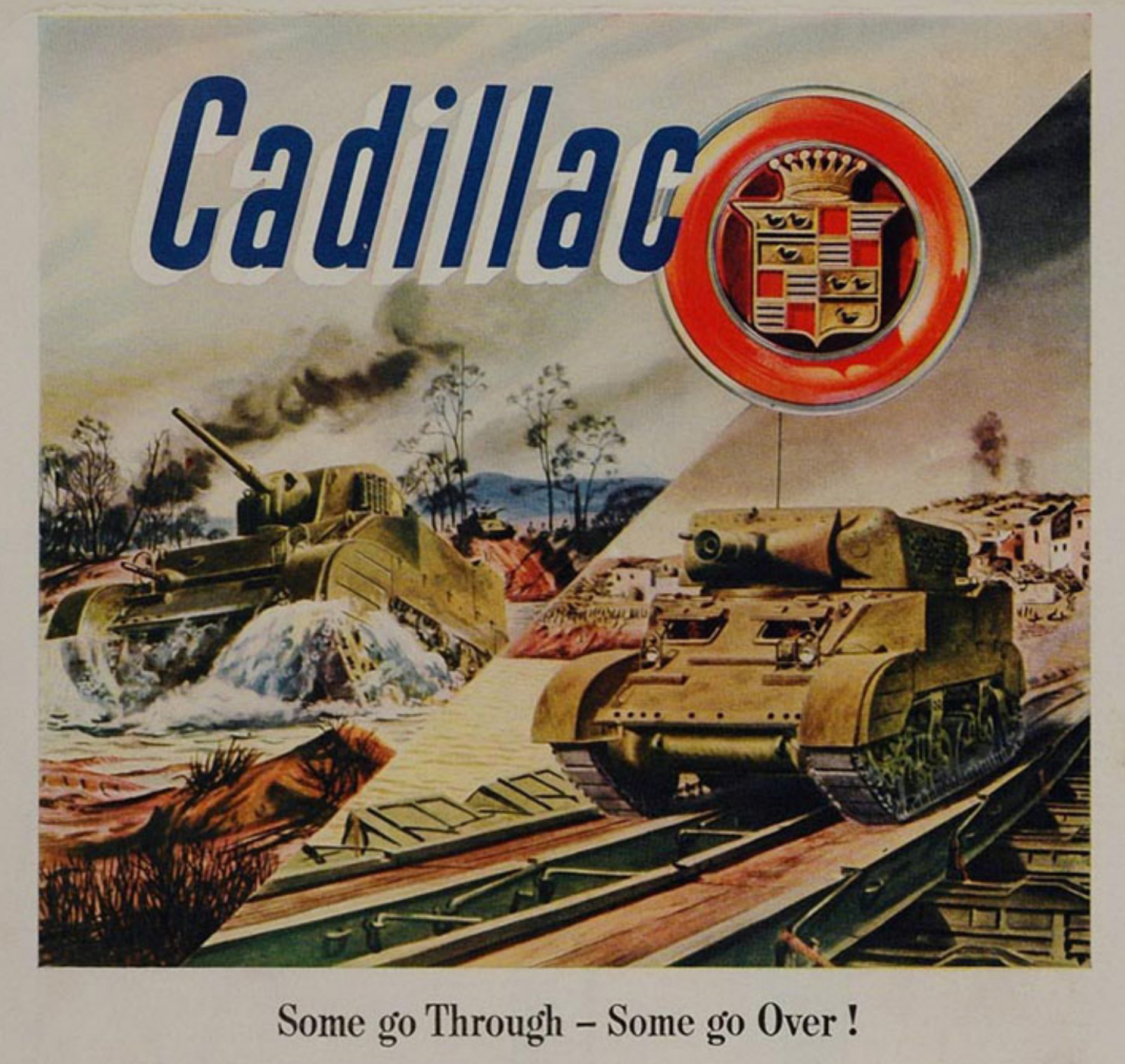
All this is to say that during WWII, Cadillac definitely had their hands full. Cadillac officially stopped passenger car production in late 1941, building 1942 model year cars. As the war progressed, though, latent demand for cars, including Cadillacs for the big machers, grew steadily, so by the time the war was over, the American public was absolutely ravenous for new cars. To answer this demand as quickly as possible, Cadillac re-started postwar production by making 1946 model year cars (starting on October 7, 1945) that were really just a continuation of those 1942 model year cars, with some minor trim changes:
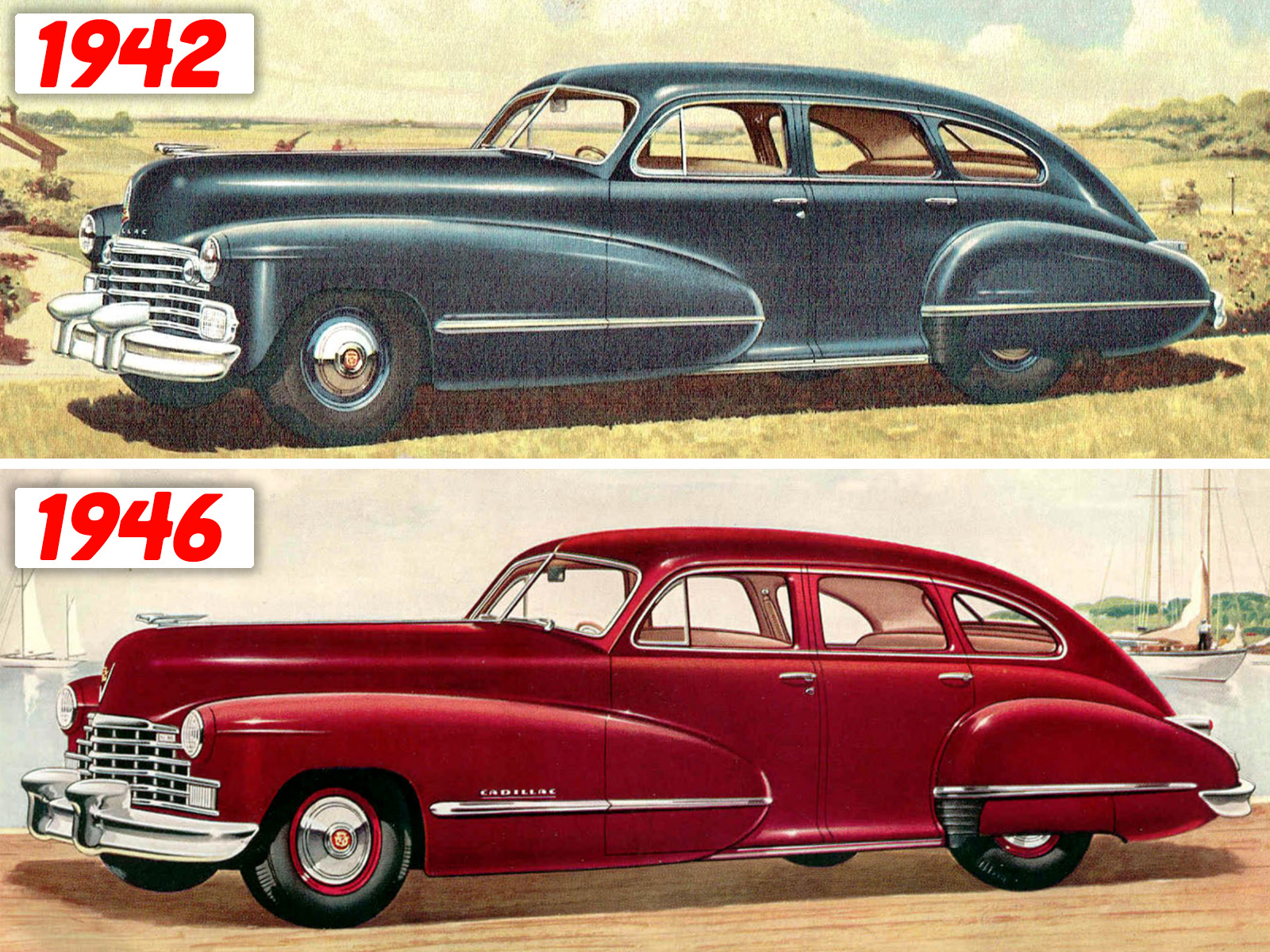
Even though Cadillac was jumping right back into car production as soon as they could, that doesn’t mean that they were entirely ready. The truth was that there really weren’t enough materials to make these cars in quantity, so some corners needed to be cut. In this case, “corners” are almost literal, as the very outer corners of the car, as defined by those massive chrome bumpers, are what got cut.
I guess less “cut” and more “find/replaced” because those early postwar cars did ship with bumpers, they just happened to be made of wood. From what I can tell, they were pretty simple wooden planks, too, nothing fancy. The minimal effort expended was likely because these were only ever supposed to be a temporary measure – Cadillac dealers were instructed to replace them with real chrome bumpers as soon as supplies became more readily available.
I’ve not been able to find a really reliable number of just how many Cadillacs were delivered from the factory with wooden bumpers – Cadillac made and sold about 29,000 cars for the 1946 model year, and I’ve seen some estimates that up to 10,000 of those could have shipped with wooden bumpers, but I really can’t confirm that number. Because these bumpers were temporary and pretty much nobody who bought a Cadillac was thinking, hey, these 2x4s instead of bumpers are good enough, there are effectively zero surviving examples of a 1946 Caddy with a wooden bumper, or even just any examples of wooden bumpers themselves.
The best-known reference to this peculiar anomaly in Cadillac history is probably a lone reference in Francis Ford Coppola’s iconic 1972 movie The Godfather, which, aside from insisting upon itself, includes this scene where Clemenza is complaining that his new Cadillac came with wooden bumpers. Remember, the movie takes place between 1945 and 1946, so this is precisely the right moment such a conversation would happen:
I just wish they had a better shot of the car where you can actually see the “stupid wooden bumpers.” There is at least one scene where you can spot a wooden bumper on a Cadillac in the movie, though, even if it is small and in the background:

Even if surviving examples of these cars with their bumpers are effectively extinct, and even photographs seem incredibly hard to come by, there are some other examples of WWII-inspired wooden bumpers of cars that are a bit better documented, because they happened for different reasons. Where Cadillac was sort of forced to make do with wooden bumpers as a sort of temporary expedient about which they seem to have felt, at best, sheepish, there were wartime drives to get people to willingly donate their bumpers so the steel could go to the war effort, and in those cases the lack of a chrome bumper was a source of pride, and pictures of cars with replacement wooden bumpers were used for propaganda purposes, as in the case of these pictures of Rita Hayworth, posing on her 1940 Lincoln Zephyr that had been liberated of its chrome bumpers, which were replaced with signs guilting people into giving up their bumpers, too:

I’m sure that was effective! If a bombshell like Rita Hayworth can get by with wood bumpers, why can’t I?

This image, from UTSA Libraries Special collections, shows Sgt. C. Schwamkrug and his painted wooden bumper. He looks a little suspicious about the bumper on his Hudson, but a quote from the accompanying article suggests he’s all in:
“…Sgt. Charles Schamkrug of the Cooks and Bakers school at Fort Sam Houston…has started something, in his home town of New Braunfels residents already have donated the [front] steel bumpers of their car and like Sergeant Schwamkrug, their bumpers have been converted into anti-Axis slogans…”
Yeah! Bump the Axis! Bump ’em right into hell!

Whole cities and towns, like Yonkers, NY, shown here in a photo from the October 1942 drive, would organize salvage drives where people would donate their bumpers to the war effort en masse, or at least en some sort of masse. Actual numbers of individual bumpers were not kept, only the overall weights of the donated scrap metal that was collected as part of material drives.
Aside from aesthetics, wood planks can serve as reasonable bumpers, and maybe even had some advantages over metal ones, since they could flex a bit more without denting, and, if they did get damaged, were cheap to replace.
All of this is a fascinating footnote in American history, and I wish there were at least one surviving Caddy with a genuine, GM-factory set of wooden bumpers. I mean, I suppose they’re easy enough to replicate. I wonder if there are any 1946 Cadillac owners who have deliberately chosen to restore their car with period-correct wooden bumpers? That would be pretty cool, if you ask me.
Bump the Axis!



A neighbor was the first to remove his bumpers during the war.
First to put them back on afterward too.
Huh, there was a restaurant in New Braunfels called Schwamkrug’s Garden. It’s where I first met my future in-laws. My FIL liked going there until it closed sometime in the aughts. I wonder if Sgt. Chuck was a part of the Cooks and Bakers school because his family owned the restaurant or if he started it after the war?
I work on a lot of antique radios and when you get into American radios from the war period, past 1942 all radio and electronics manufactures were required to halt production of new material. BUT they were allowed to use whatever stock was leftover and seeing as how the same applied to cars, there was a huge glut of unused car radios. These were eventually retrofitted into wood and bakelite cabinets- some of which looks truly bizzare as its obvious to anyone looking at them that they’re just car radios stuck in a box. But… they are pretty senstive seeing as how they had to be- as they were meant to be in a moving metal car and thus had much better shielding and sensitivity.
Jason, I see much of the car brochure and advertisement media before the 1970’s was illustrations. Makes sense, photographs were pretty rough. The thing about illustration is that the artist probably isn’t going to capture the exact dimensions and proportions of the real-life car perfectly. One might even expect they get pressured to paint the subject as flatteringly as possible?
Putting myself into the shoes of a consumer from say the 40’s or 50’s, I can’t help but think I’d have been weary of this. “Those Cadillacs never look as good in real life as they do in the brochures,” that sort of thing. Was this a thing!? Were there good and bad apples out there, in terms on car aesthetics media honesty??
Studebaker generally got the proportions right but made the paint colors brighter; maroon became bright red, creamy beige became bright French’s mustard yellow, blues and greens got more intense than what was actually available.