

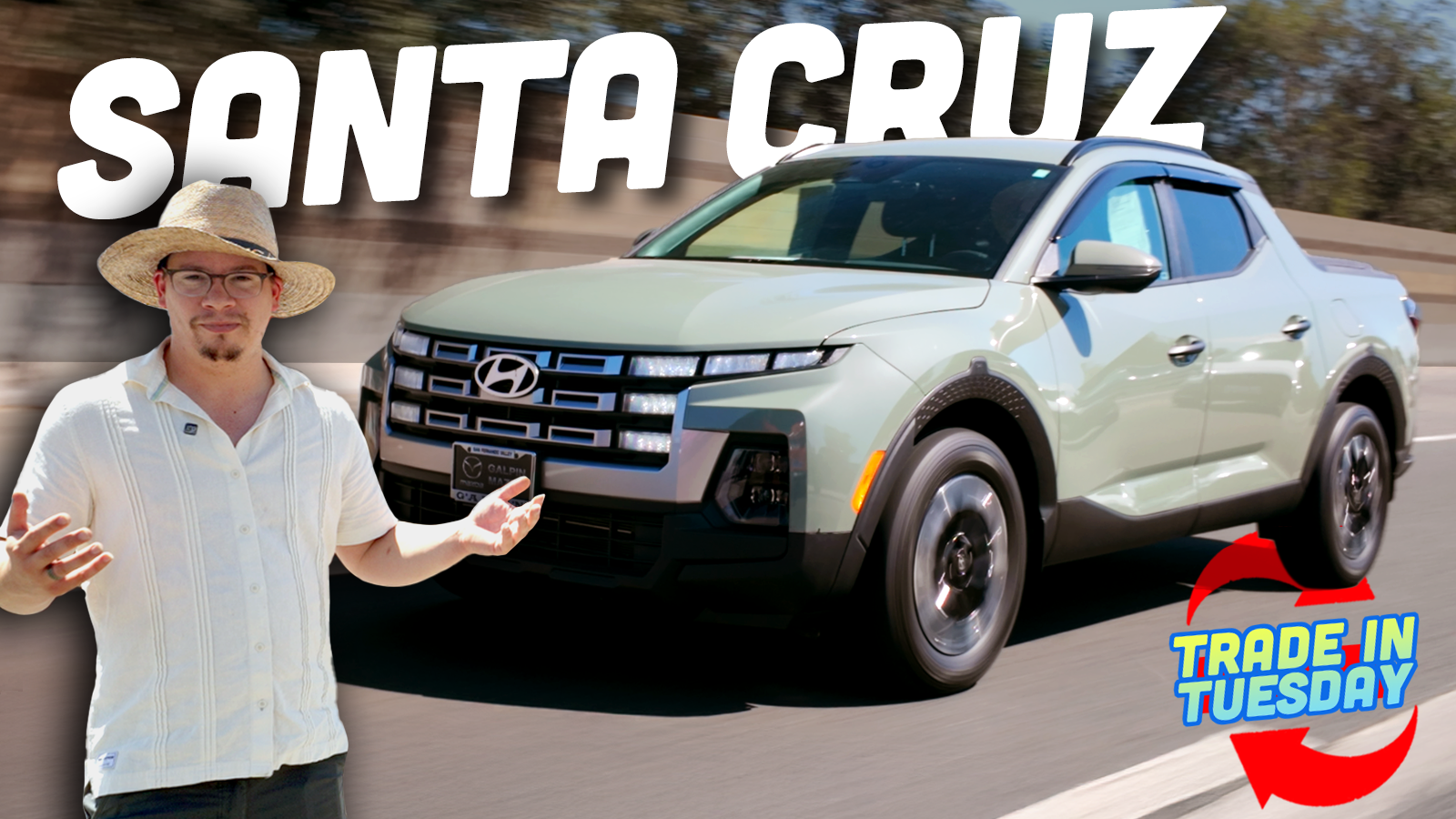
In January of 2015, Hyundai surprised the world with the debut of a brand new concept pickup truck called the Santa Cruz. One of the first car-based unibody truck America had seen (after the Honda Ridgeline and Subaru Baja), the sharper, edgier, and cooler Santa Cruz drew adoration from the public, with such overwhelmingly positive feedback that Hyundai greenlit the project. The problem was, it took forever to come to market, and by the time it did, Ford had launched an absolute showstopper in the Maverick. But does that mean the Hyundai Santa Cruz isn’t a great vehicle? I just test-drove a traded-in 2025 Santa Cruz, and while I found it extremely disappointing, I also think it’s a good deal. Here’s what I mean.
The Hyundai Santa Cruz could have been something special. It should have been. The amount of buzz surrounding the vehicle when it hit the scene meant the South Korean automaker was poised to disrupt the market with a truly cool pickup truck that could offer the comfort and efficiency that go along with a unibody car-platform. Small, efficient, and with looks like that? Everyone was excited. Including our own Jason Torchinsky, who wrote this at Jalopnik:


I actually think I’m more excited by this concept than the Ford GT, which is both the most insane and most rational thing I’ve ever thought, simultaneously. I really hope Hyundai can bring this thing to market as close as possible to the concept. I guess we’ll see.
I felt the same way.
Wards Auto said Hyundai’s plan was to fast-track development if people liked the truck (they did):
Hyundai will take the Santa Cruz to multiple U.S. auto shows this year to gauge media and consumer interest. If feedback is positive, the automaker could accelerate its normal 4-year product launch timing to 3 years for a Santa Cruz production model, Zuchowski says.
But three years later, Motor Trend reported that the truck was still two years from showrooms, writing:
Hyundai showed a concept of the “crossover truck” at the 2015 North American International Auto Show and it garnered enough positive feedback to act on. Then-CEO Dave Zuchowski pushed hard for it to be added to the brand’s car-heavy portfolio, and in late 2016 the decision had been made to greenlight the project to arrive in 2018 as a 2019 model. An announcement was coming soon, Zuchowski said.
But even that was optimistic; the Santa Cruz didn’t actually hit the market until late 2021 as a 2022 model-year. That’s six years after that Detroit Auto Show surprise-debut. Auto Blog talked with Gilbert Castillo, who ran Hyundai’s product strategy and regulatory compliance in North America to try to understand what took so long:
Castillo explained that the problem was the platform they were working with. At the time, the plan was to use the previous generation Tucson crossover platform. The team developing the truck discovered they would have to make many compromises to use the now-old platform and weren’t going to meet internal targets for the truck.
Instead of trying to put out a subpar truck, the Santa Cruz was put on hold for the next Tucson. And as development began for the crossover, the platform was developed with the idea of adapting it to a truck later, giving us the pickup design we saw unveiled today. And as you can see, the truck has changed a fair bit, taking on more styling cues from the Tucson that provided its platform. It also picked up a larger rear seating area than the concept, which Hyundai product planners felt would be more appealing to buyers…
[…]
So there you go, the Santa Cruz took a while because Hyundai wanted to get it just right, and that took a new generation of small crossover.
That conclusion — that Hyundai waited so they could get it just right — would make sense if Hyundai got it just right. They did not.
The Santa Cruz Is Disappointing Because It Could Have Been So Much Better, Even Late To Market
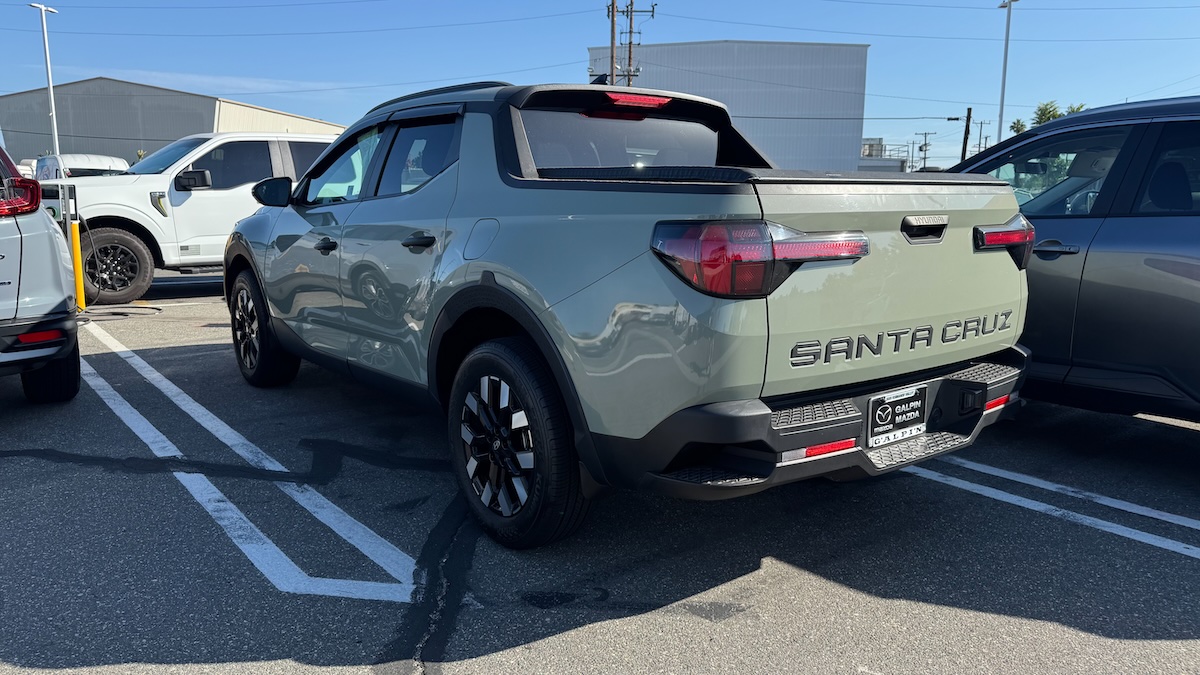
The car I drove was a 2025 Hyundai Santa Cruz SEL with the base 2.5-liter naturally aspirated engine. In Sage Gray, the truck looks awesome from every angle. I love the sail pillars between the cab and the bed; I think the rear end looks aggressive; and up front, the face, while busy, is definitely fitting for a truck.

The interior is especially nice. The badgeless steering wheel thing that Hyundai has done on some cars like this and the Ioniq 5 feels a bit odd, but materials are good, and the styling gave off a nearly-luxurious vibe.
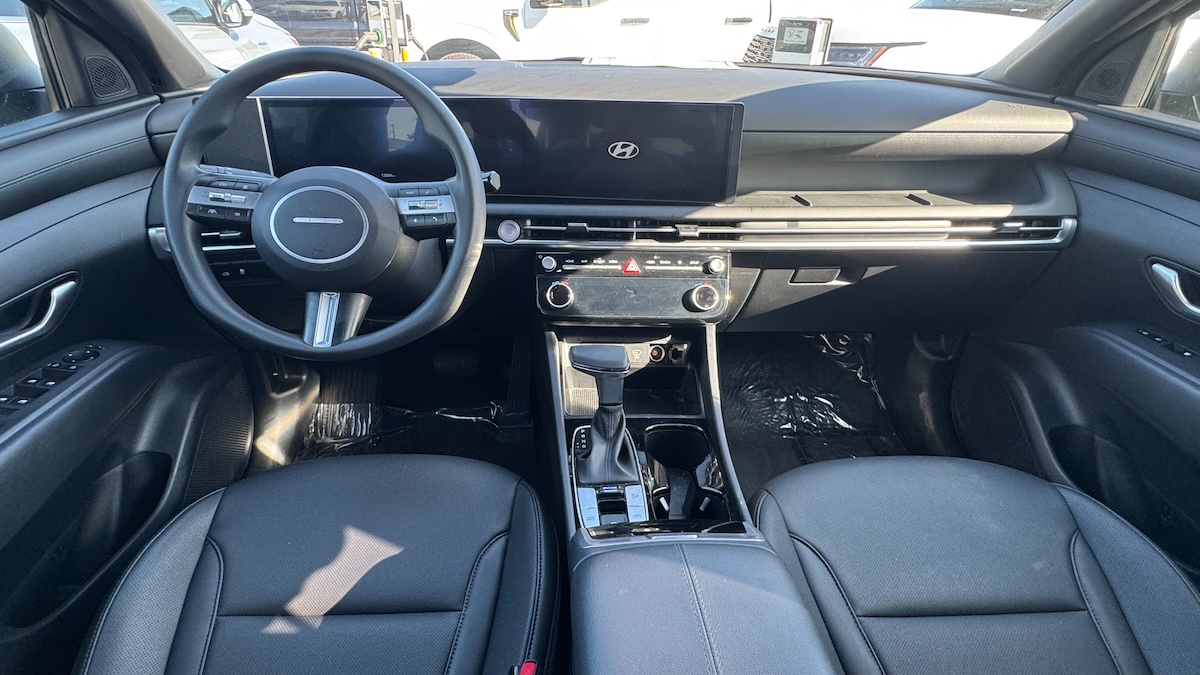
There’s a giant horizontal screen that contains the infotainment display on the right and the gauge cluster on the left. Down below the center stack are HVAC controls (sadly, too many of them are touch-screen and not physical buttons), and under that is a chunky T-handle shifter.
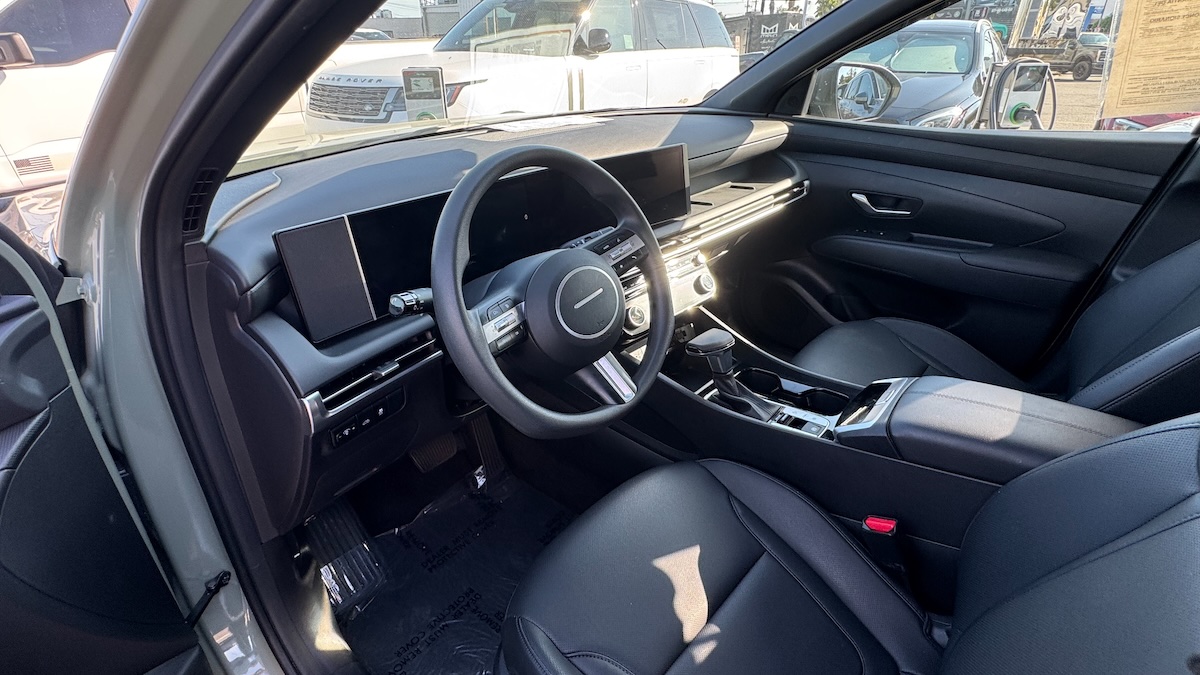
To the right of the main screen is dashboard storage and to the left is a speaker.
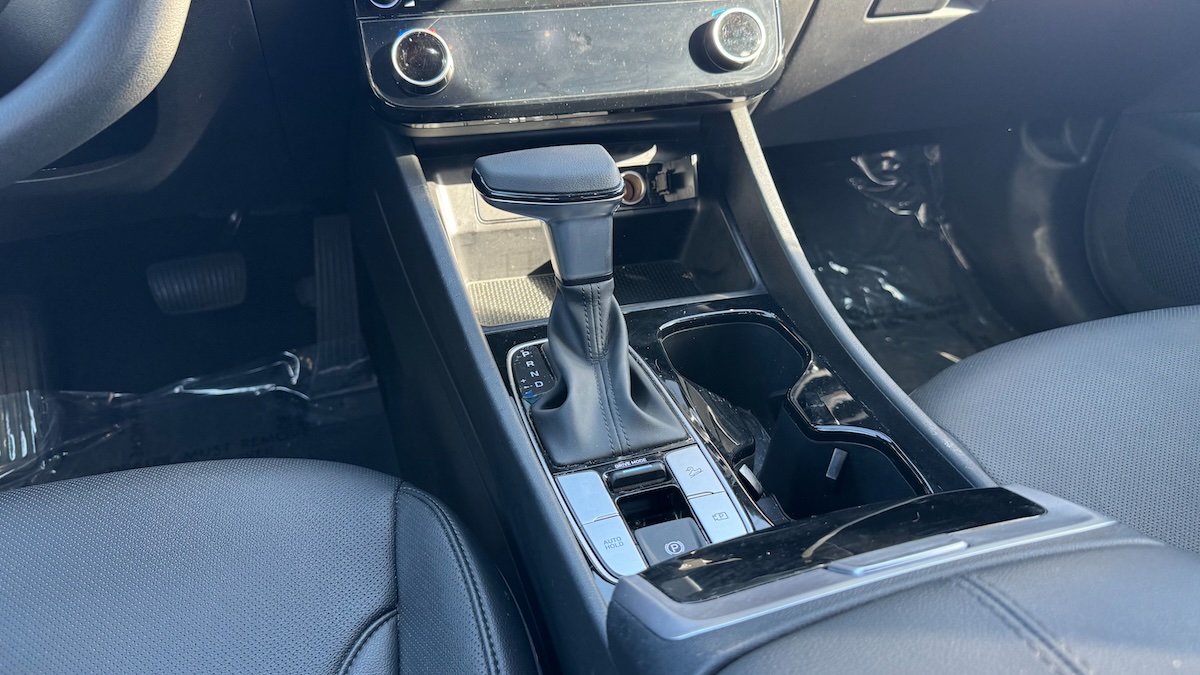
I like the competing Ford Maverick’s interior as well, but whereas the Hyundai’s cabin feels a bit upscale, the Maverick’s feels a bit chunkier/Tonka Truck-like:

The Hyundai Santa Cruz’s interior isn’t its problem. The problem is the powertrain, which is — compared to the Ford Maverick’s — simply awful. It’s the same 2.5-liter naturally aspirated GDI four-cylinder one might find in a Tucson, Sonata, or Sorento. It makes 191 horsepower, 181 lb-ft of torque, and absolutely struggles to move the 3,800 pound truck down the road, despite a competent 8-speed automatic.
I haven’t called a modern automobile slow in a long time, in part because I drive lots of old, legitimately slow machines, but the Santa Cruz feels lethargic even compared to vehicles like my 1991 Jeep Wrangler YJ. Why? That old YJ makes 190 horsepower, weighs about 3,200 pounds, and does 0-60 mph in probably around 10 seconds. No new high-volume car should be that slow, and yet, per Consumer Reports, the all-wheel drive Santa Cruz with the base engine scored a 0-60 time of 10.3 seconds. Again, I drive lots of old cars, so I can tell you that 10.3 seconds to 60 is livable, but on a vehicle this quiet and refined, it feels even slower than it does in my Jeep rattle-trap (to be fair, the car I drove was a front-wheel drive model, and those seem to do 0-60 mph in around 9 seconds, per various sources. Still slow.).

What makes the Santa Cruz so disappointing is two things. First, that slow, 191 horsepower powertrain gets awful fuel economy. Check it out:

Look at that absolutely gargantuan chasm between the Santa Cruz and the hybrid Ford Maverick, which, despite making the same 191 horsepower, is quicker to 60 mph (just under 8 seconds, per various sources) and is cheaper. 25 MPG combined compared to 38 is laughable.
What’s also laughable is the fact that the turbocharged, 250-horsepower Ford Maverick — which does 0-60 mph in the 6s and also costs less than the Santa Cruz — also scores better fuel economy than the anemic, base Hyundai.
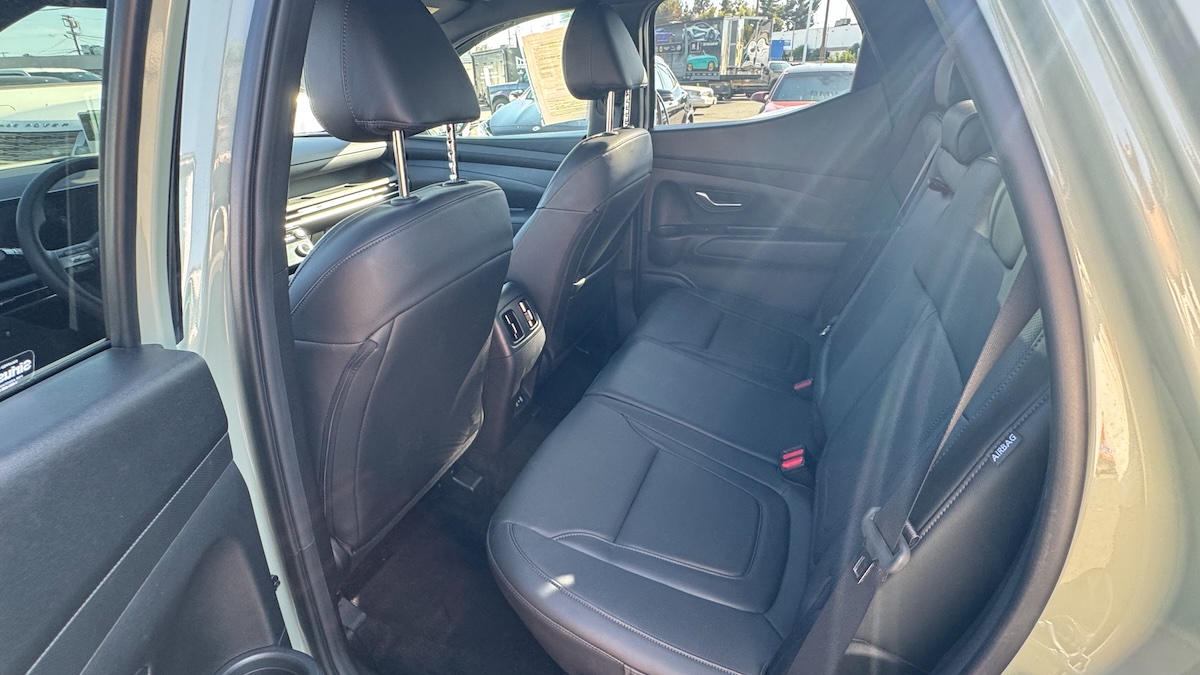
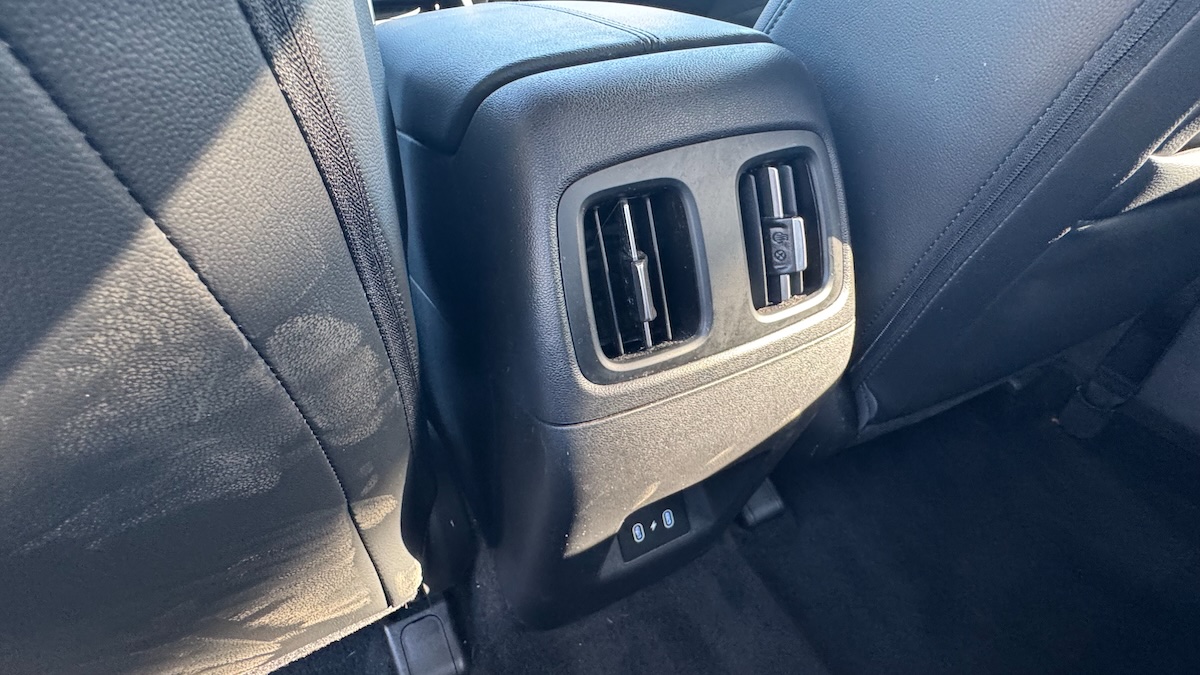
I get that driving a car isn’t all about numbers. And the Hyundai’s cabin and overall refinement are worth celebrating (the Maverick, for example, doesn’t have vents for the rear passengers), but for the Santa Cruz to be slower, more expensive (~$31K vs ~$30K) and way, way less fuel efficient (a 20 MPG delta in the city!) makes it a huge disappointment in my eyes, given how long it took to get this thing to market.
I hear things are different when you get behind the wheel of the Santa Cruz Turbo, as my colleague Matt once wrote, “The Hyundai Santa Cruz Is Exactly The Great Car-Truck We Asked For,” saying:
Thankfully, the Santa Cruz is good and nicely serves its mission of being a truck-type object that you could live with daily, park in a city, and occasionally use to haul things around while returning fuel economy that doesn’t make you feel bad…
[…]
Here in the United States we only have two small unibody pickups, so your choices are the Maverick or the Santa Cruz. My advice is to get either the cheapest Hybrid Maverick you can find or, if have more budget, get the higher end trim level of the 2.5T Santa Cruz. T
The problem is that the good version of the Santa Cruz, the 281 horsepower turbo that does 0-60 mph in about six seconds and that Road & Track says is “great to drive” — costs over $41,000. That’s a lot, and there’s still a 6 MPG fuel economy delta with the 250 horsepower Maverick.
It’s Still A Good Deal

That may all sound pretty damning, but then you look at used Santa Cruzes. The one that someone traded in to Galpin for a Mazda (I think a Miata) is listed on Galpin’s website at $26,072. That’s an amazing deal for a soulful, four-door vehicle with only 13,600 miles on the clock in 2026. In fact, just a cursory look at Santa Cruzes versus Mavericks shows that these Hyundais are actually quite cheap, despite their higher MSRPs:

Here are some Mavericks, for comparison:
So yes, the Santa Cruz that we all prayed would come to market ended up arriving with a sad powertrain, making the vehicle a huge disappointment. But if you have the scratch for a turbo model, that may be worth it, and if you just want the cheapest small truck that won’t bankrupt you in fuel costs compared to other pickups, snagging a used Hyundai Santa Cruz seems like a pretty good option.



I rented one of these down in Florida back in 2022. I agree with the pros and cons of it. I will also add the Santa Cruz has the under-bed storage compartment like the Ridgeline is famous for. It was a perfectly fine vehicle. Didn’t do anything wrong or right. You could absolutely tell me I was driving a Tucson and I’d believe you.
Yup, needed the hybrid powertrain, which the Tucson has. I guess they decided they couldn’t build those powertrains fast enough, so they locked the Santa Cruz out so they could push as much cashcow hybrid Tucsons as possible? I think that’s what i read somewhere.
It’s not badgeless they are on the Morse code H badging for the newer models the four dots are an H.
Nice looking car with underwhelming performance and horrible mileage? How is this not a Mazda?
I liked this idea of these, and I don’t dislike the styling, but yeah, that mileage is terrible.
My crew cab 3.0 Ram on offroad tires is getting 20-21 in normal driving, I’m at 21.3 so far into this tank (300 miles).
Given that the regular Tucson with that base engine doesn’t exactly drive nicely, I don’t really think the powertrain is the issue.
I think the problem is that it has too much of the Tucson’s design in it. The idea of a pickup truck on a compact transverse-FWD car platform is a sound one (that’s exactly what the Maverick is), but it should have looked more distinctive, more butch.
And then there’s the short bed, which is even smaller than that of the Maverick and therefore bad enough that Hyundai needn’t have bothered.
I’m not at all a fan of Hyundai, but if there’s one thing that company will do, it’s learn from its product-placement mistakes and improve measurably on subsequent generations. If there is another Santa Cruz, it won’t make the same mistake of being too obviously a Tucson with a pickup bed. And even if it is, the upcoming blocky, cyberpunk 2027 Tucson is a much better starting point.
You hit the nail on the head, They will learn from this, like Ford has learned from 50+ years of making trucks. The Maverick puts everything they have learned into a smaller cheaper package. upright blocky/butch styling, practicality, low entry cost point but options out the wazoo if you have $$$. Truck people know what they want and don’t want, and now Hyundai is learning. Santa Cruz II Electric Boogaloo is gonna b lit!
I saw the first reveal of the Santa Cruz prototype at the Detroit Auto Show in like…. 2015? yeah 2015. John McElroy slid in behind me and did a video review for whatever show he was making at the time.
It looked awesome! Short cab, 6′ bed, aggressive and very truck like.
When the real thing came out with it’s 4′ bed, I immediately threw it in the mental dumpster, never to be thought of again.
So true about the MPG. The saddest part is that Hyundai’s takeaway has been that rather than figuring out the segment, they’ve decided they need another BOF truck.
If you mean Body on Frame, they don’t have any of those.
I think they decided that rather than try compete with the Maverick in the unibody segment, they’ll just go ahead and build a real truck.
Yes, I meant to say that instead of developing a new body on frame truck with inherently inferior MPG for a market saturated with them, Hyundai instead should have fixed the shortcomings of its compact truck-thing and not abandoned it. Seems like Hyundai learned the wrong lesson.
All they really need to do is add a trucky blunt front end cap, reshape the side so it looks like a bed, and plop in a hybrid drivetrain. It’ll be an easy fix if they decide to do a second generation.
The BOF truck will be a whole new lane for them, and I’m interested to see what they come up with.
They technically do have one, the Porter. It’s over 20 years old, a cabover and basically the Chevy Express of Korea.
That’s interesting. I wonder if any of it’s DNA will make it into the new truck
Hyundai’s are sort of popular in my hood, and I expected to see a lot more of these. (for reference, Subarus like Crosstreks and Outbacks are very plentiful). But I rarely see them. If a Maverick XLT Hybrid with 2 or 3 options ticked had been available at MSRP at the time of introduction I’d probably be driving one now. But we know how that went.
Yeah, I briefly cross-shopped these last summer, in concert with the Ridgeline. The lack of power and tow rating took the Hyundai out of contention early on, and I ultimately ended up with a ‘21 Frontier that wasn’t even on my radar. Oddly enough, it has the same mileage rating as the Santa Cruz Turbo, but with a 310hp V6, a conventional 9sp trans, and a 6720lb tow rating. Coupled with the low-level SV spec, it’s been exactly what I needed.
I’d be willing to wager you’ll actually get better mileage too, as you don’t have to stand on it to get everywhere.
People are sleeping on used Frontiers, I think.
People are sleeping on the new ones too. I rarely ever see them on the road, but they honestly seem like a fairly compelling option. 300hp n/a V6, conventional auto, traditional 4WD, an interior that’s mostly all buttons, and being Nissan, you’re not paying the Toyota Tax- and can probably find one actually below MSRP.
I was actually waffling between a Frontier and the Maverick I ended up with. I could get a mid-trim Frontier NEW for low 30s OTD, something equivalent in a Tacoma was like 10 grand more. I went with a slightly used Maverick, mostly because I didn’t even really need a “midsize”, the “compact” Maverick was fine for my needs.
But if I needed a little more truck, or wanted to go new, 99% it would have been the Frontier.
New powertrain or not, it’s old and I can’t help but wonder if Nissan let it go so long without improvement that they killed the model’s reputation. Tacoma, GM twins, and Ranger all saw more rapid redesign cycles and sucked the air out of the room.
Nissan didn’t even equip the Frontier with a telescoping steering wheel until MY2025, 3 full years after the “redesign”.
Now that they fixed that, I’d strongly consider one if in the market. I don’t mind old school as long as the fundamentals are done correctly.
My boss came by yesterday for a review and was driving a ’26 Tucson, basically the same interior as the Santa Cruz. In one word, disappointing. You could definitely feel the downgrade interior going from my Outlander to this thing.
If you want real automotive disappointment you need to fly to the US for the first time in 14 years only to get given a Mitsubishi Mirage to drive through Ohio.
This was last week. I’d assumed I’d get a bland hire car, but the Mirage was genuinely terrible. I’m going to assume something was wrong with the suspension as it needed constant corrections at freeway speeds (and it wasn’t windy). Luckily it had an engine and gearbox combination that delayed the onset of achieving freeway speeds for aaaaages.
Noisy, slow, tiny gas tank that we had to fill up three times a day and that gearbox, which because of maths is statistically unlikely to ever be in the right ratio. Infinite available gears, only one ratio is right, one over infinity is as close to zero as you can get.
The last time I was in the US I had a Mustang. Still, at least this time I had a sausage biscuit (thanks to a recommendation on here) and it was delicious.
You were a cheapskate renting the cheapest available vehicle and then you complain about it. You almost sound American.
Zero need for this kind of comment here — This ain’t the place.
Whoa there. Maybe you read something I didn’t, but I don’t see where Dave said that he rented the cheapest vehicle available.
And even if he did, this is an automotive website, and he’s discussing an automobile he drove and found disappointing context of another disappointing automobile being reviewed.
The events that led him to drive the Mirage are entirely irrelevant to his experience behind the wheel. Chillax.
Usually cheapest available gets you an Elantra or such, which are fine for a rental. I’m surprised they are still renting out Mirage’s; I’d be disappointed too.
It was the last car they had. They told us we could swap it for something better at any Enterprise rental place.
In fact they were so keen for us to bring back something better we decided to bring the shitbox back, out of spite.
Plus it worked fine as a car. I’m not such a princess that I can’t spent 10 hours driving something so much better than a 2CV.
But I can’t imagine buying one in a world where 20 year old Civics are a thing.
In Ohio they aren’t. The ones that weren’t hooned to death 10 years ago collapsed from rust 5 years ago.
Any car doomed to drive around Ohio prays for an early rusty death.
Many apologies. Didn’t mean to be mean.
All good, tone doesn’t come across via text. A smiley face or /s may have helped if it was intended to be a joke.
Agreed.
When I’m paying I get a Mustang, when the company is paying I get the cheapest option.
I too ended up with a Mirage last year for a 4hr freeway trip to Dallas — I would’ve gladly paid more had literally any other car been available for a one-way rental — and also found it laughably terrible. Not to mention the fact that the example I was driving was nearly brand new (with less than 1k miles on the clock), and still felt slapped together and worn out. Fittingly, I arrived at my destination minus a wheel cover as well.
The nice thing was that I was driving over to pick up our new-to-us V60, so the return trip was a delightful study in contrast.
I once got stuck in a fairly-new Escape ST-Line (with the 3-cylinder) that could barely keep up with Houston traffic. I had them swap it and they gave me an IONIQ 5, which was great.
I can’t imagine a Mirage in any Texas metro; they drive too quickly and too aggressively there.
Luckily all it had to do was get me down Highway 75 to the Enterprise drop-off at Love Field!
“one over infinity is as close to zero as you can get.”
This guy Maths. I love it.
Sloping rear, four doors and a trunk lid: It’s really just a sedan.
– With yet another arrow shaped indicator pointing the wrong way, to top off the stupidity…
For the curious, the 2026+ turbo models are equipped with a conventional 8-speed automatic, which handles more torque and is better for ‘truck’ work.
The Santa Cruz isn’t for everyone, and that’s OK. 2027 should be its last year before Hyundai begins its full body-on-frame assault.
I was very excited about the concept car, but the Santa Cruz turned out to be a typical concept vehicle bait-and-switch. The production vehicle was a sad, fat, ugly disappointment. Way too expensive as well.
What could have saved it would have been the hybrid power train from the Santa Fe, and a few thousand off the MSRP. I might have considered it; bought the Maverick instead.
That’s not a truck, it’s a car missing part of its top. The Maverick is a truck. Those are completely different vehicles to me. This is like a Baja, or similar to an El Camino except with more butt space and almost no usable bed space. And just like the Baja, this thing was DoA. America doesn’t do utes. And I don’t understand who the target buyer is.
The Maverick is no more a truck than the Santa Cruz. It’s a unibody with a transverse mounted engine – it’s based on the Escape (C2) platform. Not slamming either, I own a Maverick and the Santa Cruz was considered.
Some of my (mouth breathing) neighbours are fond of telling me that it isn’t a ‘real truck’. I usually reply ‘Thank god because I definitely didn’t want one’.
Fair. Note I didn’t mean “it’s not a real truck” in a macho sense, but rather that it’s just a different kind of vehicle.
The Santa Cruz is exactly the same class of vehicle as the Maverick.
Same objective, just executed differently.
The Maverick looks most convincingly like a truck, and that’s the perfect formula to sell to the majority of buyers who don’t care what a real truck is.
When I see a Maverick, I see a truck. When I see a Santa Cruz (or Baja, or El Camino) I see a sedan with an unusual butt.
The general car buying public sees exactly the same thing.
I’m expecting this segment is about to explode in popularity. I really think this kind of configuration would work well in Europe, where the roads are too small for 1/2 ton pickups.
In the US it’s been one failure after another. In Europe? You may be right.
The Baja didn’t sell well, so Subaru canned it. But now it has become a bit of a cult classic, and nice examples fetch good money. Beau should put this in his collection for 15-20 years and then sell it for top dollar on BaT.
“…the truck looks awesome from every angle.”
Are we looking at the same vehicle??? ????
I really dislike the front end on these (and the Tuscon). It’s like exhibit A for Hyundai’s overstyle it to death tendencies. A more conservative grill with none of the weird kinda-stacked lighting would help sales a bunch I suspect.
The 2015 concept car was awesome. The real thing is a weird turd.
Is this drivetrain any more reliable than the inadequate 8f35 ford saddled most of its volume vehicles with? Mine struggled to survive 70k conservatively driven miles.
My disappointment with these is that I grew up when Hyundai did a series of almost identically styled single cab concept car versions of this back in the 90s with the Skoda Felicia Fun style convertible and folding extended cab seating. During my 20s these were always just three years away. And then we ended up with another lame crew cab.
Much like the oft-lamented Jatco CVT, I blame a lot of the 8F35’s “problems” on the manufacturer claiming ultra-long/lifetime fluid change intervals rather than an inherent flaw with the design.
Ford only specifies to change the transmission oil at 150k in “normal” service. You might also realize that’s waaaaay outside of warranty. However, for “severe” service, that becomes 30k.
Both via teardowns of failed ones, oil analysis, and loads of owner experience, change the oil at least every 50k. If you have an AWD, also do the PTO unit and rear diff at the same time (Ford says those are “lifetime” fill- yet around the time the Maverick came out, they actually re-added drain plugs to both to make servicing easier….hmmmmm). There’s also a TSB out about a groaning noise from the rear end in turns or accelerating….it’s the clutches in the rear diff…..the fix? Change the damn oil. That they also told owners you don’t have to.
My new-to-me Maverick 2.0 AWD had about 45k on it when I got it. Right off the bat I changed the oil in the trans, PTO, and rear diff. The PTO looked fine, the rear diff was downright nasty, and the transmission oil was fairly dark also, barely any “redness” left and more brown. It was still driving and shifting fine, but to think that oil supposedly had over 100k of “life” left seems ridiculous.
The Jatco’s can/have made it to 300k+ miles….if you change the fluid occasionally. But Nissan says it’s “lifetime”, nobody ever does it, and they start acting up and break usually right as the warranty expires, so not their problem.
I mean I would agree with you if I didn’t have first hand experience.
First transmission fluid change at 33k dealer overfilled. Second at 65k.
The torque converter has the same problem as with the 10 speeds. They start coming apart due to partial lockup strategy and put debris everywhere in the system including the coolant valve and the coolant channel hoses. I know they say they’ve fixed that on the 10r80.
The cdf drum is similar on the 8f35 to the 10r80 and what failed on mine. They acknowledged that the bearing was improperly specced on earlier units. I hope they installed retainers on the 2021 and later units.
The dry solenoid improperly installed and retained teflon tape guide wrecked early units too. They’ve revised their production procedure supposedly but again this doesn’t touch fluid.
I think the fundamental flaw with all of these units though is the asynchronous shift strategy and voltage fluctuation problems from auto stop start, only charging battery when coasting alternator on strategy, and battery degradation after 50k miles. I think the sensors lose track of the shift position momentarily and start eating themselves. I think the cdf drum issue is from the two gears engaging momentarily as the failure mode pushing the bushing out would be what you would see if two clutches were fully engaged at the same time.
Add to that ford chose an anodized aluminum pump on their unit instead of the cast iron pump on the GM 9speed.
I hope they’ve fixed all the problems that were on my 2020 8f35. But my trust of ford doing the right thing vs doubling down and encouraging dealers to sell extended warranties is low.
I like the mavericks and hope for only good things for yours during your ownership experience.