

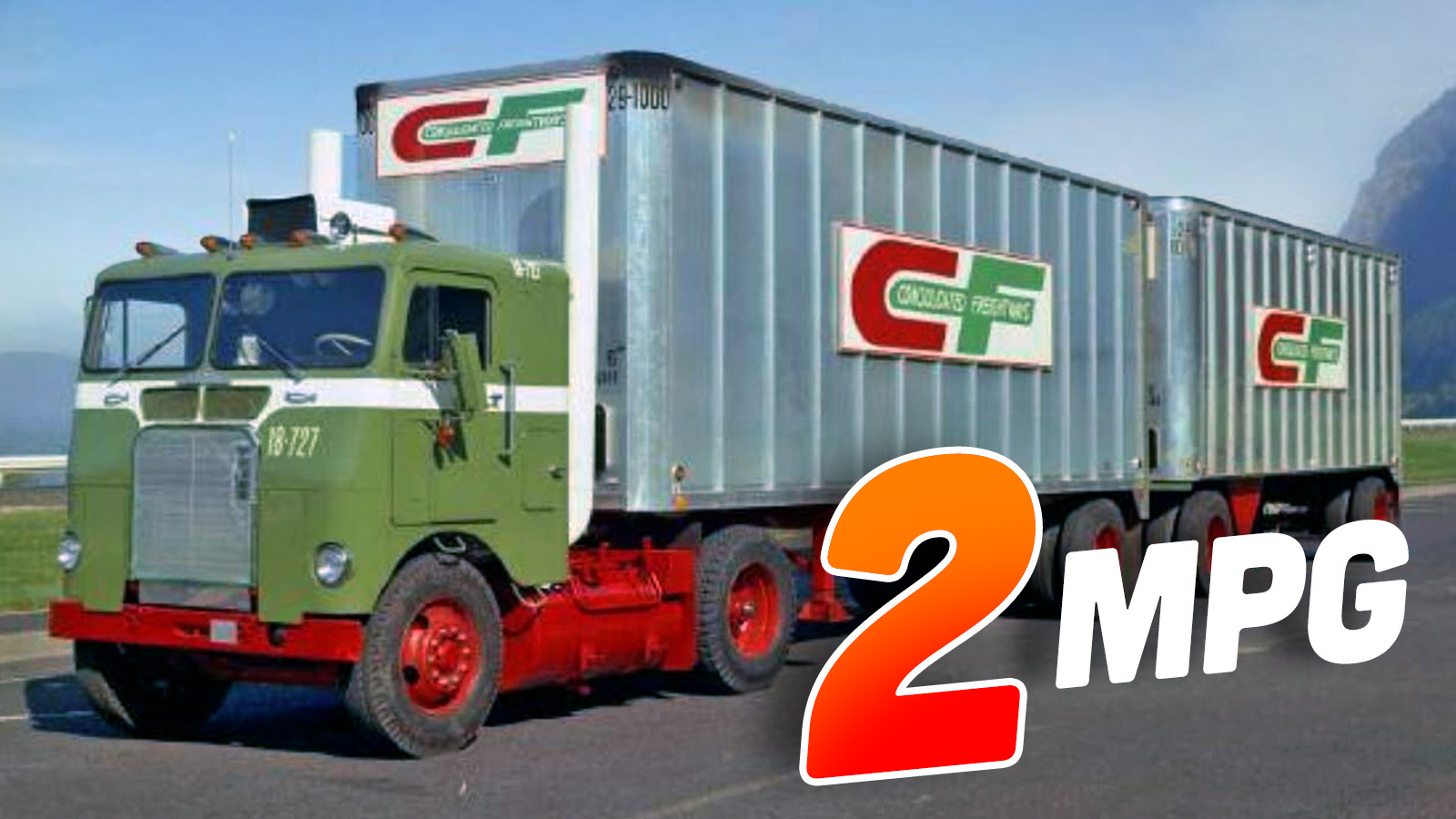
The heavy diesel engines that power today’s trucks, locomotives, tractors, ships, and more are complex machines that do hard work for often over a million miles of hauling. But the diesel wasn’t always thought of as the internal combustion engine to rule heavy industry. In decades past, diesels were thought to be too heavy, too bulky, and too unreliable. Many truck manufacturers heard the call of the gas turbine, and one of them was Freightliner. Back in the 1960s, Freightliner partnered up with Boeing to create the future of trucking. The turbine-powered Turboliner sounded like the future, but with an embarrassing fuel consumption of only 2 mpg, it was relegated to the dustbin of history.
Fuel efficiency is of critical importance in the modern trucking world. Fuel alone can be a quarter of a fleet operator’s running costs, and rising fuel prices mean less money in the operator’s coffers at the end of a load. For decades, truck manufacturers have chased better aerodynamics and greater fuel efficiency so that truckers can keep more of their money. However, things were different in the 1960s.


Back then, diesel fuel was cheap, and only a few designers were thinking about aerodynamics or squeezing every possible mile per gallon out of a unit. The semi-trucks of the era reflected the industry’s priorities. States heavily restricted how long and how heavy trucks could be, and because of that, there was a sort of arms race to create lighter, more compact tractors that carried greater loads. The cabover truck – where the engine and cab sit atop the front axle – ruled the road because of its small footprint. These rigs were often brutal squares that pushed through a wall of wind rather than sliced it.

By then, there were maturing engine technologies that promised tantalizing benefits over reciprocating engines. The gas turbines of the day put out high amounts of power while being substantially smaller and lighter than a reciprocating diesel engine of similar rated output. Designers also saw the fewer moving parts of the gas turbine as another potential advantage, as it was believed that a turbine could be easier and cheaper to repair over time compared to a diesel. Further, it was believed that, with enough development, gas turbines could be made more efficient than diesels while also being cleaner, too.
Just how pervasive was the promise of the turbine? A non-exhaustive list of truck and engine manufacturers that tried to make turbines the future includes Ford, Mack, General Motors, International Harvester, Leyland, Magirus-Deutz, MAN, Berliet, Freightliner, Chrysler, Kenworth, Peterbilt, and Autocar. Boeing was also a major player in this experimental era of gas turbine trucking, and its contribution was weirder than some because it tried and failed to make a successful truck turbine not just once, but at least twice, and with two different truck manufacturers.

Boeing’s first effort was with Kenworth in the 1950s, and while the engine itself was impressive, its abysmal fuel economy of only 1 mpg basically made it dead on arrival. A diesel semi might have gotten 5 mpg back then, while a big gasser would have gotten closer to 3 mpg, or maybe 2 mpg in certain situations. A fuel economy of just 1 mpg was untenable.
For Boeing’s second try in trucking, it paired up with Freightliner to make a gas turbine-powered semi-tractor that achieved a 100 percent improvement over Boeing’s previous effort. But sometimes, even making something twice as good as it was before still isn’t good enough.
Boeing’s First Effort
As I wrote last year, Boeing began its gas turbine research program in 1944. Boeing didn’t intend to develop a gas turbine for trucking, but as company engineers continued their research, they began to believe that the engine’s potential was endless. They thought that gas turbines could power planes, Navy boats, or missiles. The gas turbine could even do work as a starter for a jet engine.
The Model 502, which first fired in 1947, differed in a major way from Boeing’s first turbine, the Model 500 turbojet, in that it didn’t use thrust for power. Instead, this turbine spun a propeller, making it a turboprop engine. Later, this engine would be tweaked to turn a shaft, converting it into a turboshaft engine. The Model 502 would go on sale in 1949.

The Model 502 weighed 140 pounds and made 120 shaft horsepower (SHP) in its earliest version before getting a bump to 160 SHP, would power a Kaman K-225 helicopter in 1951. According to the Smithsonian Air and Space Museum, this chopper became the world’s first known gas-turbine-powered helicopter. A year later, the Model 502 would also power the Cessna XL-19B Bird Dog, which is credited as the world’s first turboprop light aircraft. Boeing even managed to score a contract with the Navy, and six Model 502s were bolted into personnel boats.
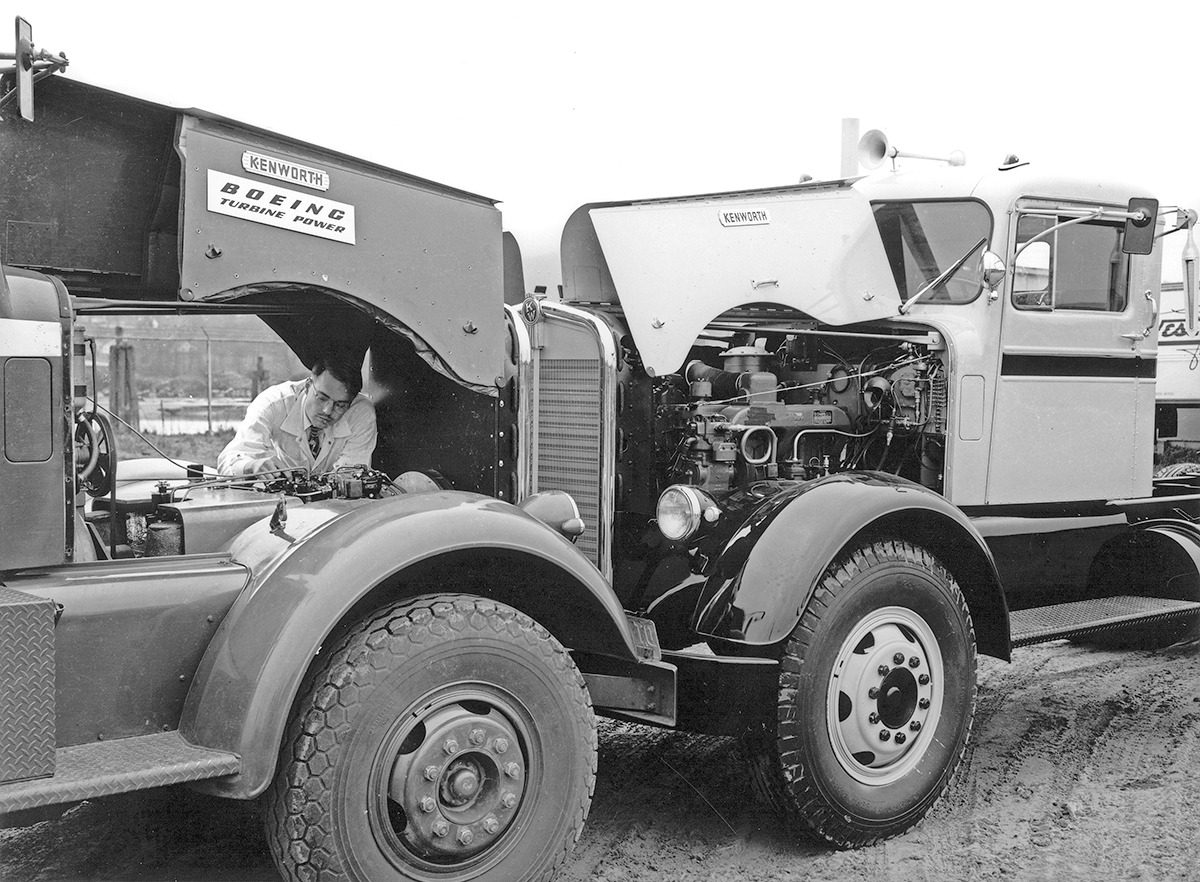
Boeing soon realized that the Model 502 had even more potential in it. The engine had only a twelfth of the weight of a diesel of equivalent power and occupied only a tenth of the space under a tractor’s hood. Add in the potential high reliability, and Boeing thought that, maybe, this engine could revolutionize the trucking industry. Boeing reached out to Kenworth, which was based in Boeing’s hometown of Seattle and also had experience in aviation thanks to building B-17s and B-29s during World War II. Kenworth liked the promises of the gas turbine, too, and the two companies teamed up.

Boeing and Kenworth strapped a Model 501 into a semi-tractor and then sent it to work for West Coast Fast Freight, pulling up to 68,000 pounds of gross weight in testing. The truck version of the engine weighed only 200 pounds, compared to the 2,700 pounds of an equivalent diesel. America’s many media outlets went into a frenzy and couldn’t stop writing about the “jet-powered” truck thundering down the highway. Of course, “jet-powered” implies thrust for motivation, but as I said earlier, the Model 502 operated by turning a shaft, which ran the truck’s running gear. Lloyd E. Hull, one of the engineers involved in the project, described the engine’s application in a semi-tractor:
“You have to think of this engine in two stages,” said Hull. “In the first stage, a centrifugal compressor rotates at a maximum speed of 36,000 revolutions per minute. Sucks air like a vacuum cleaner, then compresses it to three times normal atmospheric pressure and delivers it to the burners. As fuel is fed into the burners, the temperature is raised to a maximum of 1500 degrees Fahrenheit. The hot gas then passes through the first-stage turbine wheel. This wheel extracts sufficient power from the gas stream to drive the compressor which is on the same shaft.
In the second stage, the gas stream passes through another turbine, which is not on the same shaft as the first-stage turbine wheel. The second-stage or power turbine wheel operates at 25,000 revolutions per minute. This is reduced in an 11:1 reduction gear to drive the truck. The system is really simple.”
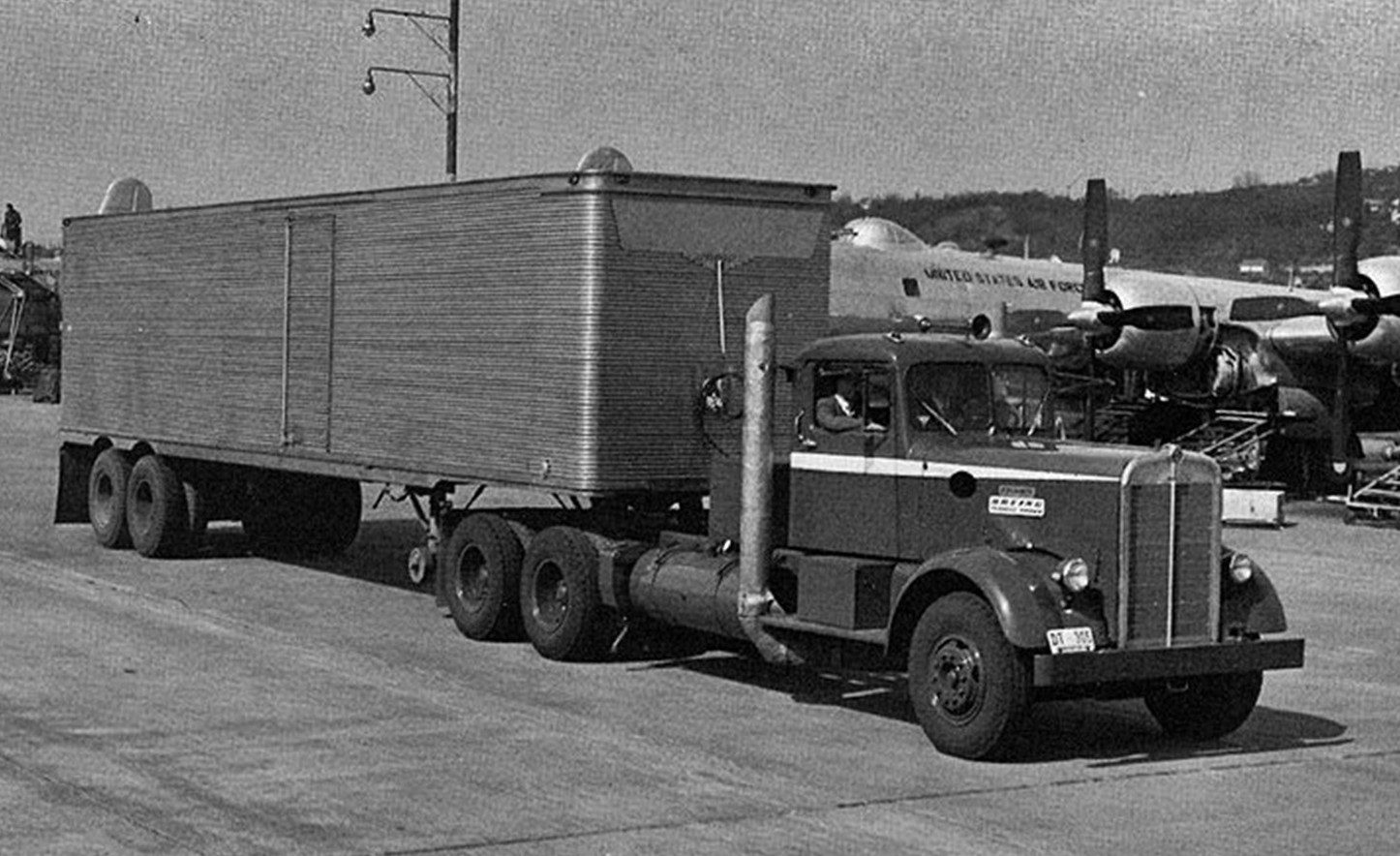
At first, it seemed like Boeing and Kenworth had invented the future. This engine made nearly one horsepower per pound and required only 13 percent of the space of the typical diesel engine. In theory, a future truck built to use this engine could be smaller and lighter, and thus carry a larger load.
Unfortunately, as I’ve noted in my previous story, the Model 502 got only 1 mpg in Kenworth’s truck while performing worse than a gasser or a diesel. The engines also failed unexpectedly and were calculated to have three and a half times the running costs of a diesel. West Coast Fast Freight tested the engine for only a few years before giving up on the concept.
In 1958, Boeing put a Model 502-10C turbine inside an Allis-Chalmers P-91 crawler tractor. It made an improved 240 SHP, but also weighed 320 pounds. The concept of using the Model 502 to revolutionize farming would flop for the same reasons the turbine Kenworth failed. Click here to read more about Boeing’s early turbine effort.
Boeing Tries Again
Back in 1950, researchers had already known one reason why the roadgoing versions of early gas turbines got such awful fuel economy. The engines weren’t doing anything with the exhaust heat from their operation but blowing it out. Researchers figured that if they could capture some of that waste heat and use it to preheat incoming air, the preheated air-fuel charge could burn more thoroughly and potentially double the turbine’s fuel economy.
Another problem was that the metals of the day couldn’t handle all of the heat, from a 1950 issue of Popular Science:
It goes right back to that voracious appetite of a gas turbine for air. In a piston engine about 4,500 F is developed in a cylinder head at the instant of fuel explosion, the start of the power stroke. The engine metals can stand this only because the explosions are intermittent. Water jackets, air, and oil keep carrying away the heat.
In a gas turbine there is continuous burning of fuel at about 3,500 F. There must be a great extra volume of air to cool the gas down to 1,500 before it is fed to the special-alloy turbines, so the metals can take it. That’s where the loss occurs—most of the energy developed in burning the fuel to get gas volume and velocity to turn the power turbine is expended in turning the air compressor. The engine produces shaft-power as a sort of afterthought. The ultimate solution to better efficiency is better metals. The metallurgists are working on that one.

Going into the 1960s, Boeing was able to increase the output of its gas turbines while keeping overall weight low. By 1961, the Boeing Model 502 was 41.5 inches long, two feet in diameter, and weighed 325 pounds. At full throttle, it punched out 330 SHP. An actual rating of one horsepower per pound was finally achieved.
There was more good news, too. While the turbine engine had grown in size, it was still a tenth as heavy and a quarter of the size of an equivalent diesel. The engine was advertised as not requiring oil changes, as the lubricating oil did not get contaminated through combustion. Boeing also got the startup time down to only 10 seconds.
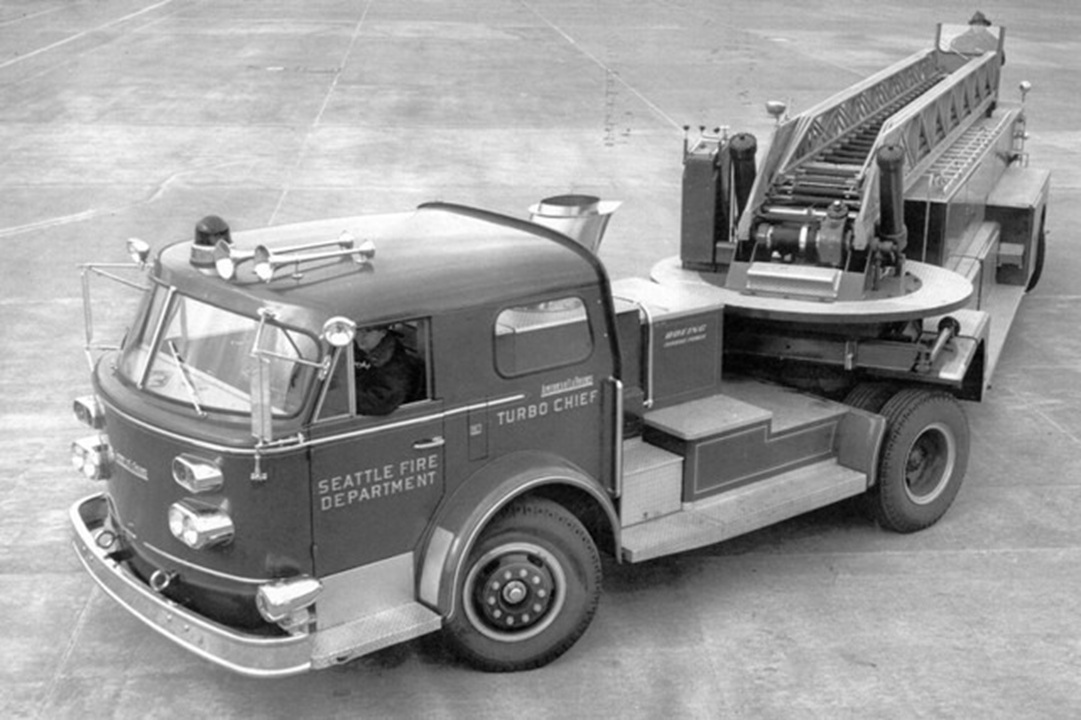
In 1961, American LaFrance fitted a Model 502 to a fire engine in San Francisco and to another in Seattle, then put them into testing. A 1961 issue of Popular Science describes the starting procedure:
When the driver pushes the starter button, a glow plug is heated. As his finger leaves the button, the starter engages. With a rising whine like a bicycle siren’s, it twirls the first turbine to a speed of 3,000 r.p.m. At that point the fuel solenoid opens and the glow plug ignites the fuel-air mixture. The engine comes to life with a deep-toned bellow, spinning the gas-producer turbine to 15,000 r.p.m., which is idle speed. The ignition and starter then drop out. From there on, combustion is continuous, and there is no further need for electrical power.
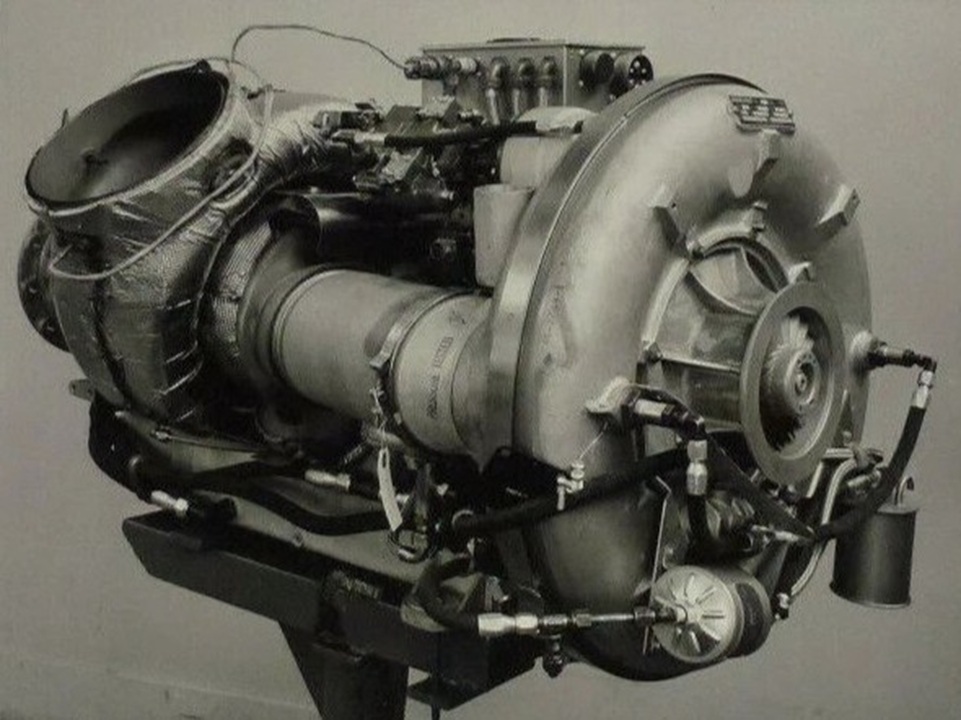
Further details noted by Popular Science were that the compressor turbine spun slightly faster, to 37,000 RPM, and that the gas at the turbine wheel was hotter at 1,700 degrees. The gas from the compressor turbine was fed to the power turbine and to an 8.9:1 gear reduction. By the time the power reaches the output shaft, speed is reduced to a maximum of 3,200 RPM. The pumper trucks with these engines were able to hit 60 mph on the highway.
In service, the turbine-powered pumpers had proven impressive. The turbine trucks pumped faster than any of the diesels at 2,000 gallons per minute at 150 pounds of pressure, or more than 1,000 gallons per minute at 300 pounds of pressure. It also climbed the city’s steepest streets at a 20.2-degree grade faster than any of the diesels. On flat ground, the Boeing Model 502 Turbo Chief pumpers were able to accelerate from a dead stop to 50 mph in 45 seconds, which was quick for a 26,000-pound pumper. The truck also ran so smoothly that firefighters loved balancing half-dollar coins on top of the engine compartment without them falling over. Drivers also appreciated the weight reduction, as it meant that the pumper now steered as if it had power steering.
In other words, Boeing’s engineers had finally made a gas turbine that, by some metrics, was ahead of a diesel. The fuel burn of the updated Model 502 was now only twice as much as a diesel. While still bad, it’s a vast improvement over the older Model 502s.
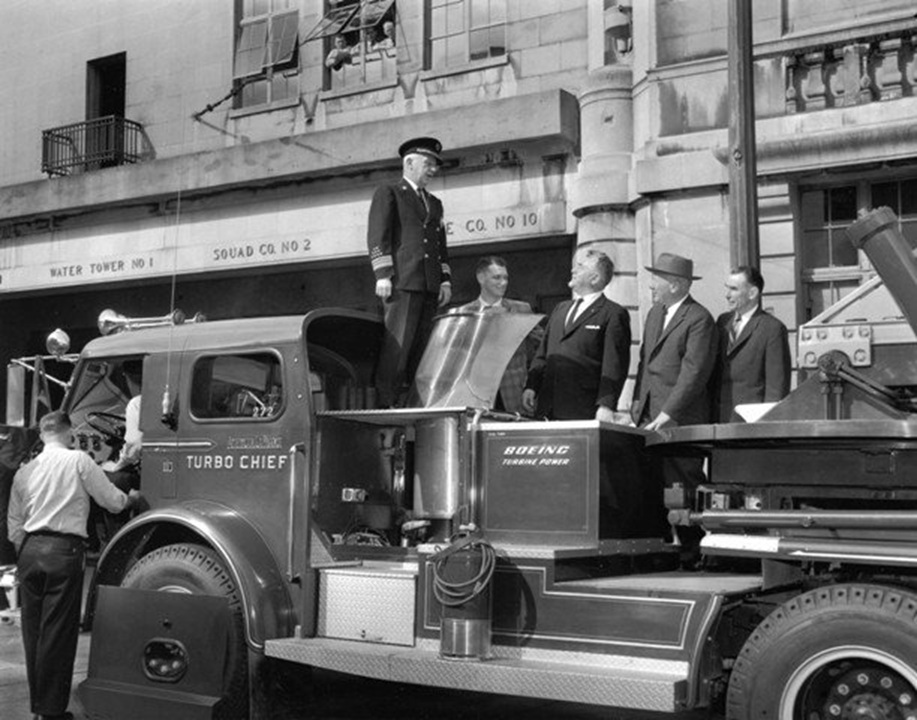
So, what went wrong here? This time, it was more about money. The gas turbine-powered pumper was at least $10,000 more expensive ($112,053 in 2026) than a piston-powered model of comparable power. Reportedly, that made the turbine fire engines about a third more expensive. At the time, San Francisco believed that the higher upfront cost would even out with reduced maintenance over time. The city’s fire department noted that reciprocating engines sometimes spent a couple of months out of service getting repairs that cost up to three grand. But Boeing said that its techs could rebuild a whole Model 502 in only a day. Likewise, with only seven moving parts in a Model 502, the city thought there was less to go wrong in the first place. Diesel and kerosene were also much cheaper than gasoline in the 1960s, so the fire department didn’t even sweat that much about the fuel economy.
Unfortunately, the reality of the situation was a bit more complicated. Whenever something broke, Boeing had to fly an engineer out to San Francisco, which took valuable time. The fire department had to put him up in a motel, too, which added more money to the cost of repairs.
The Model 502’s parts were also more expensive than those found on reciprocating engines. When the test pumper’s fuel control governor failed in either 1966 or 1967, the bill was allegedly $3,000. Compounding the issues was the fact that the gas turbine couldn’t provide engine braking, and Boeing hadn’t quite figured out a substitute yet. This meant that the fire engine’s service brakes had to be replaced frequently due to constant heavy use. San Francisco grew tired of the process of fixing the turbine, and eventually swapped the engine out for a Continental straight-six, ending its turbine pumper program.
Freightliner Makes A Turbine Truck

Boeing still didn’t give up after this. In 1965, it partnered with Freightliner on a new gas turbine truck program. Leading the project was chief engineer Roger Sackett, and this time, the truck would use a fresh gas turbine development from Boeing called the Model 553. This engine would be fitted to a modified Allison automatic transmission. In September 1965, Freightliner “Turboliner” serial 18-727 was completed. This truck would undergo testing at Consolidated Freightways.
The Boeing Model 553 represented the latest in Boeing’s materials research and achieved an output of 300 SHP when bolted into a semi-tractor.
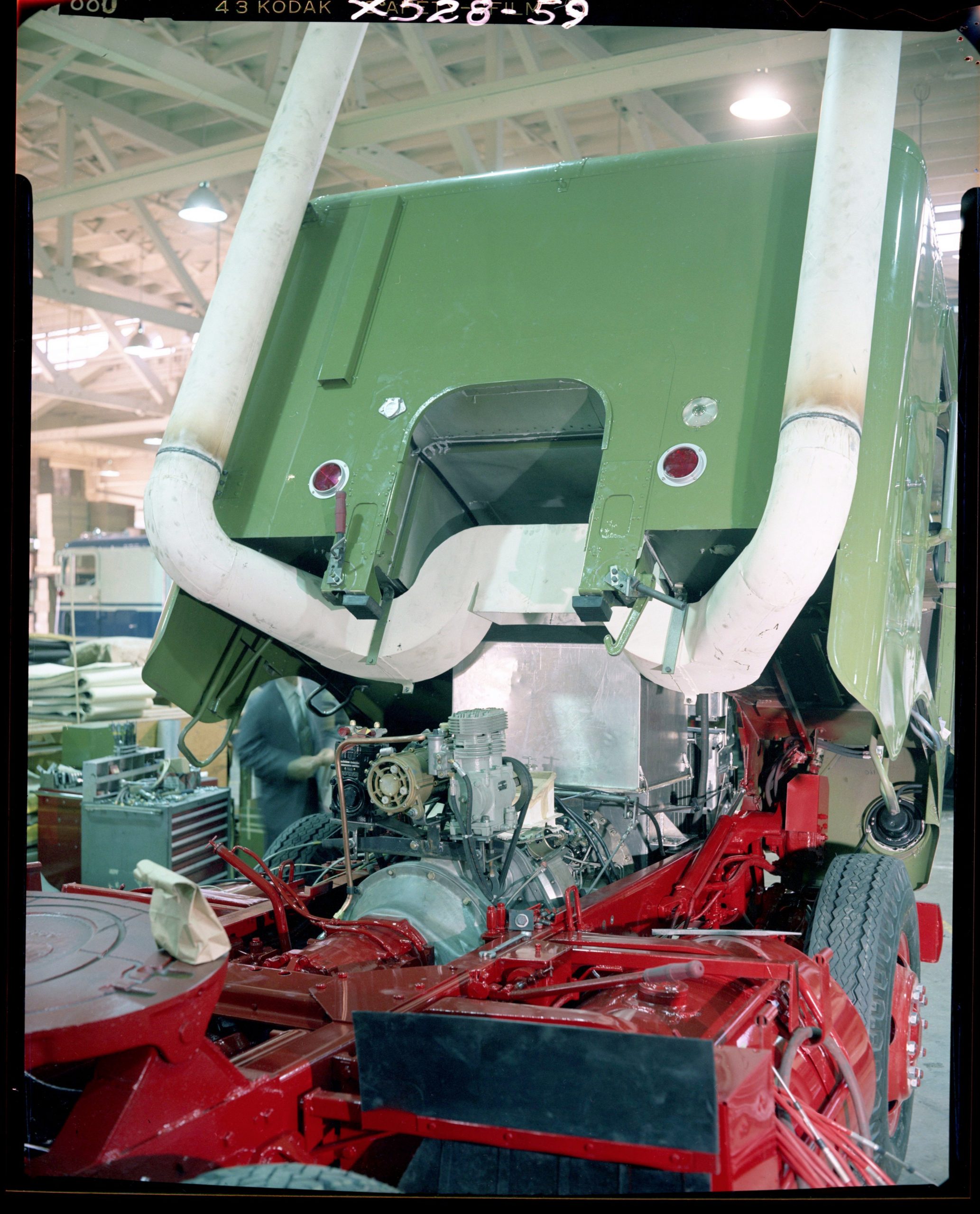
This new gas turbine was designed with a compressor turbine that spun as high as 38,000 RPM. A military version of this engine was available with an output as high as 490 SHP. The military Boeing Model 553 was used in the Swedish Stridsvagn 103 main battle tank in the mid-1960s. As a tank engine, the Model 553 did not have a heat exchanger. It wasn’t the sole engine in the tank, either, as a Rolls-Royce K60 two-cycle diesel with 240 HP also provided power.
Sadly, I could not determine if Boeing had added a heat exchanger to the Model 553 used for trucking. What I can say is that the primary advantage of this engine was that it reduced the weight of the Turboliner tractor by 2,400 pounds. In 1968, Pacific Intermountain Express also began testing a Turboliner. It’s believed that the Turboliner that went into service with Pacific Intermountain Express was not a second unit, but the unit from Consolidated Freightways with a few revisions and new paint.

Boeing’s part in this project was short-lived. Reportedly, by 1965, Boeing’s gas turbine program had lost money every single year since the very first Model 500 fired for the first time. Boeing had decided that, while its gas turbine program made incredible progress, it could no longer financially support continuing it.
In 1966, Boeing announced the end of its gas turbine research as the company diverted resources toward the Boeing 747. Since Boeing still had turbine orders to fulfill and some 1,200 engines to support, the winding down of the operation was gradual. By late 1966, Caterpillar took over turbine development and support. Operations finally came to a close in April 1968. Boeing-designed gas turbines would later be sold by Steward-Davis, Inc. in California.

The Boeing 553-powered Freightliner Turboliner soldiered on to 1969 before breaking down. During its four years of testing, the truck proved to have better performance than the old Model 502-powered trucks, but running costs were still far too high. The Turboliner averaged an unfortunate 2 mpg. While this was twice as good as the Model 502-powered trucks, it was far worse than any diesel on the market at the time.
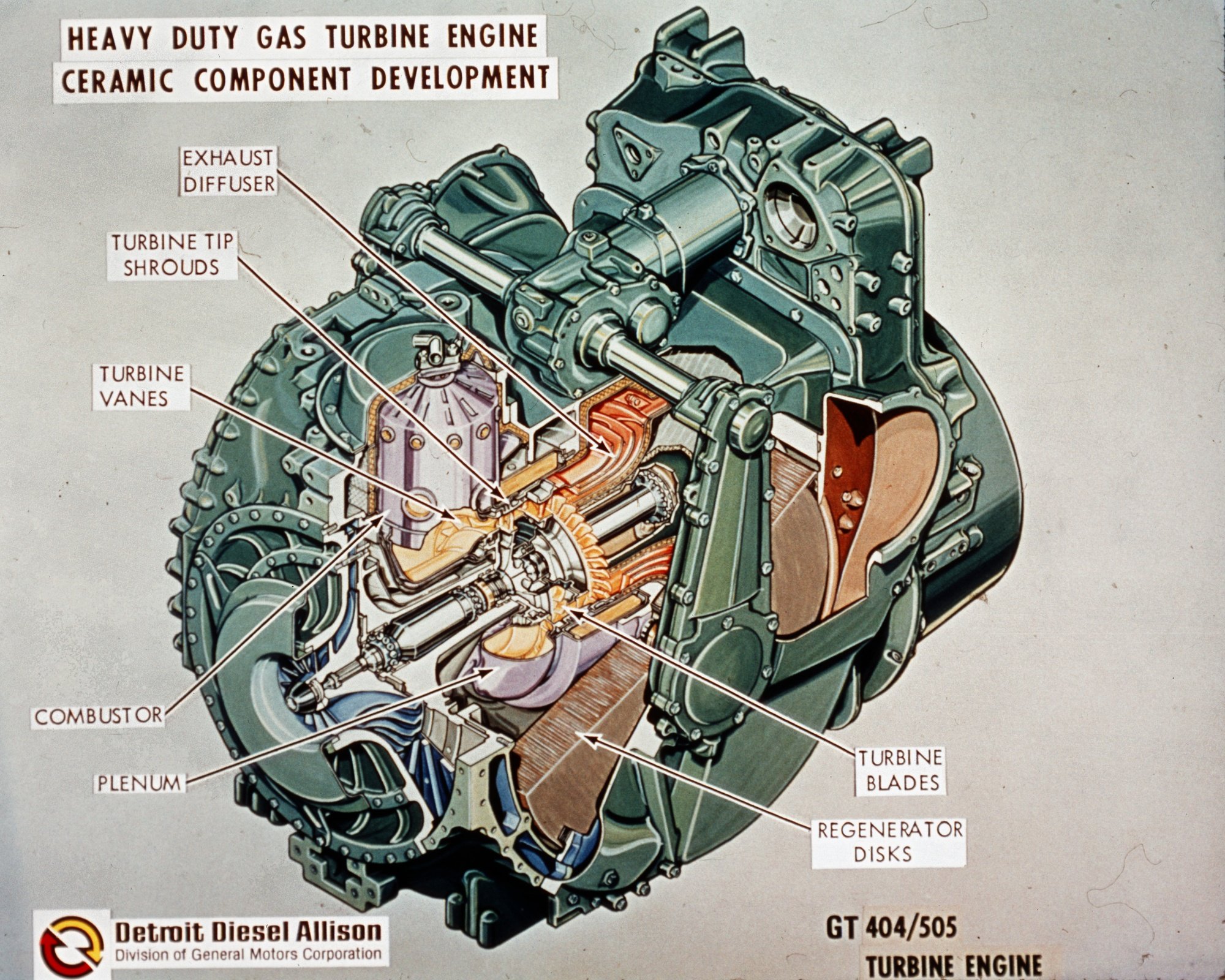
While Boeing was out of the game, Freightliner was not. In 1971, a White-Freightliner cabover was converted to run a Detroit Diesel Allison GT-404 gas turbine, which had the distinction of being designed primarily for road use, unlike Boeing’s engines. General Motors had been working on gas turbines for about as long as Boeing was, but its engines were mounted into buses, cars, and semi-tractors. Click here to read my historical piece on General Motors gas turbine development, and click here to read an engineering paper specifically about the GT-404 gas turbine.

The important part, at least for this story, is the spec sheet. The GT-404’s gasifier spun at 37,103 RPM, and the engine was capable of making 325 HP and 595 lb-ft of torque. Notably, these engines also featured regenerators, which captured waste exhaust heat to preheat incoming air for better fuel economy.
GT-404s were not exclusive to GM products or White-Freightliners, as GM was willing to sell a unit to any company that wanted to take a swing. In 1971 alone, GT-404s were also mounted into GMC Astro 95, International Transtar, and Chevrolet Titan cabover semi-tractors.
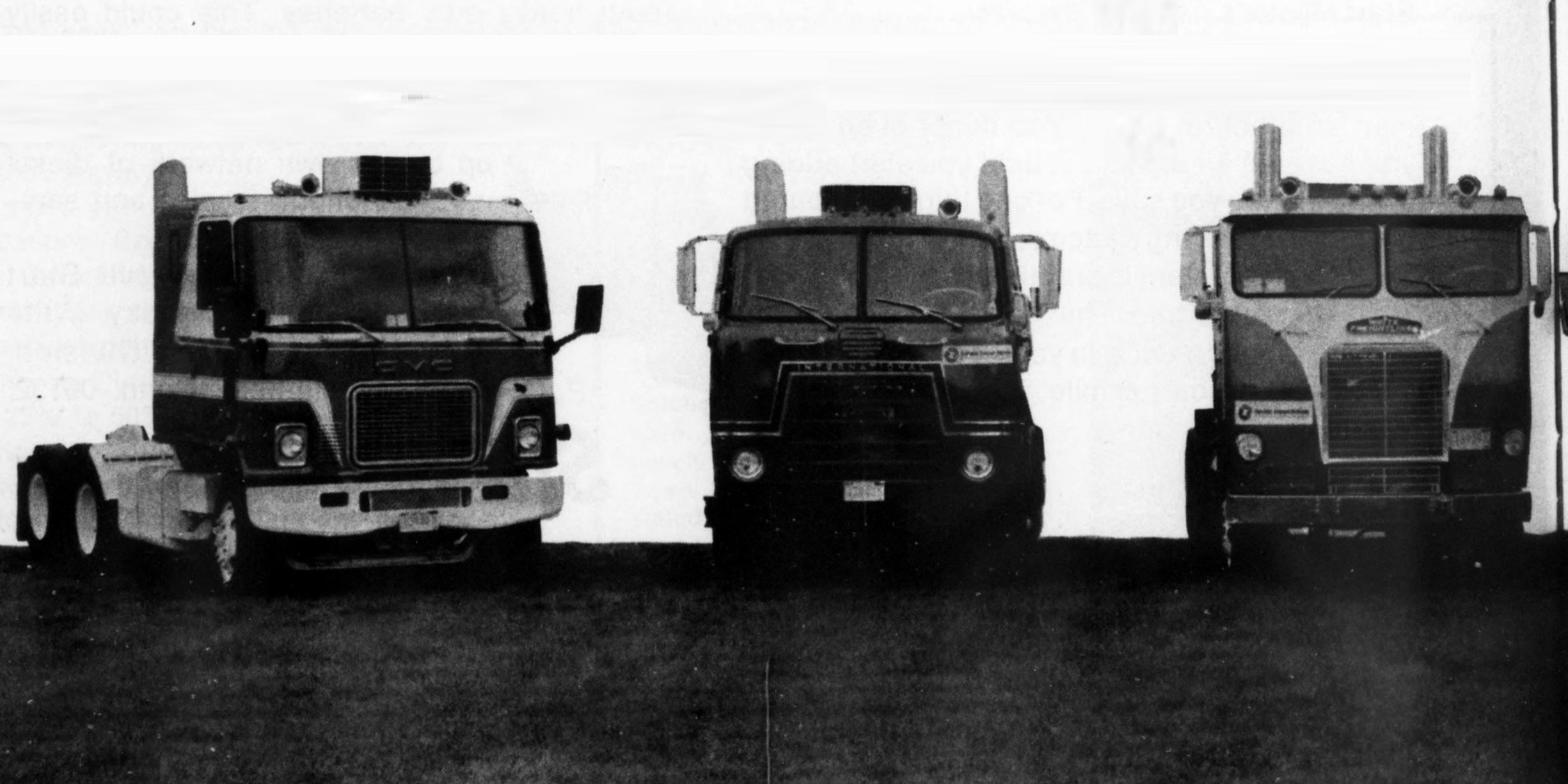
Freightliner called its truck the Turboliner II. Another White-Freightliner cabover was sent to Ford, which mounted its own gas turbine into the truck for testing purposes. Freightliner would later power seven more cabovers with GT-404 engines, keeping one for its own testing purposes. Five would work for Consolidated Freightways, and one more would undergo testing at Goldston Transfer.
A Glorious Dead End

As I have written in my story about GM’s gas turbines, these engines were hard-working machines, and General Motors had even achieved a high level of reliability. However, GM, along with every trucking company that tested a GT-series turbine, found out that even the might of General Motors couldn’t solve the fuel economy problem. According to NASA, buses with gas turbines achieved 25 percent to 40 percent worse fuel economy than a comparable diesel.
Per GM’s own research, turbine-powered trucks were capable of matching a diesel’s fuel economy when running flat out on level ground, but performed worse than diesels in any other situation. This, per GM, was due to the fact that turbines are most efficient when they’re run hard, but that’s not always possible. That was especially true in the era of the national 55 mph speed limit.
Making matters worse, fuel prices had skyrocketed during the multiple oil crises of the 1970s. While GM’s turbines could technically run on many different combustible fuels, the most widely available fuel to truckers in the ’70s was diesel or gasoline. It no longer made sense to intentionally run an engine that ran on diesel but got worse fuel economy than a diesel. GM also admits that it wasn’t able to figure out how to make gas turbines affordable, and the company also hadn’t figured out how to integrate gas turbines into road vehicles in a practical manner. Finally, GM says there was no chance a gas turbine would comply with modern emissions standards.
Many gas turbine projects reached their ends in the 1970s for these reasons and more. It’s unclear when Freightliner gave up on gas turbines or when the trucking companies stopped using their Freightliner turbines, but so far as I can tell, Freightliner did not build any more Turboliner IIs in the 1970s.

I have now covered several different examples of gas turbine trucks and, amazingly, I haven’t even begun to talk about what happened in Europe yet. I’m a bit surprised that so many companies all tried different flavors of the same thing, all to reach the same conclusions eventually. Like the Wankel, so many companies and engineers couldn’t resist the theoretical benefits of turbine power. Sure, some turbine trucks were far better than others, but absolutely all of them failed to dethrone the diesel as the king of trucking.
Yet, I can’t stop looking into each and every one of these rigs. Each company had a slightly different idea to make the truck of the future, and it’s fascinating to see the story play out. They all might have ended at the same sad conclusion, but these companies took several routes to get there. Boeing tried to make turbine trucks work not just once, but at least twice. Freightliner also gave it multiple shots. General Motors spent three decades trying to make this technology work.
I admire the dedication that it took for these projects to even reach the light of day. Teams of engineers made the so-called “jet-powered” truck a reality, even if it wasn’t as sensational as the headlines suggested. That alone is just so cool. So, even though turbine trucks were failures, they still have my respect.
Top graphic image: Freightliner


Economics question: if you get yourself a truck with 25% better fuel economy, yes you’re making bank until everyone else gets one. And along the way freight rates go down to match, right?
It’s a good thing if we’re using less gas, I’m just not sure anyone is coming out ahead (besides all of us who benefit from lower shipping costs).
The company I work for has a long-haul trucking segment, and early in my tenure here I scanned and indexed the fuel tax envelopes that drivers have to fill out. I was surprised (but not shocked) to find that MPG for them is basically always below 10. Besides the hauling, there’s a lot of idling involved.
It was my understanding that diesels consume relatively little fuel at idle compared to equivalent gasoline engines. My ’01 Jetta TDI consumed ~0.1 gallons per hour at idle, according to a OBD2 monitor (ScanGauge) I had on it.
The idling was just speculation on my part, based on seeing trucks constantly idling while sitting at a dock. Also, one time gas prices were way up for reasons I don’t recall, and Wal-Mart sent out a letter to all its vendors (which I scanned at some point) that drivers were required to turn off their engines while waiting at their docks. But I was a document scanner, I wasn’t privy to details beyond what I could deduce from those envelopes I was scanning.
In a lot of jurisdictions, idling is prohibited for air quality reasons. There is a certification that allows exemption, but I forget what it’s called.
10mpg sounds terrible, but it’s pretty good if you think about it: what really matters is miles per gallon times cargo weight or volume. An efficient car might get 4x the mpg, but carrying 1/50th as much stuff. Overall, on the order of 5-10x better fuel efficiency than passenger vehicles.
Before reading these articles, I thought that the Chrysler turbine car was an anomaly. Turns out the whole automotive and trucking industry tried their hands at turbine power.
I’d love for Mercedes (the writer) dive into how the M1 Abrams army tank developed its turbine engine. I have heard they eat fuel, but also that they produce gobs of power. I’d love to see the dots connected between trucks and tanks.
It seems the government doesn’t really care about how much fuel the military stuff burns.
As long as it’ll go 60 miles an hour it can burn what it needs.
I think many countries that have bought the M1 tank have switched from the turbine to a big turbo diesel engine instead, for this reason and others.
I can’t imagine the sound pressure levels inside just about any tank, diesel or turbine.
Apparently the turbine is quiet enough to be considered a tactical advantage. It doesn’t rumble like a diesel.
I saw several WW2 tanks (Sherman and a German one) at an exhibition. They were so loud! You could not sneak up on anyone with one of those.
I wonder if some company took a swing at making a turbine for road use again, if it might actually be successful? Since all of those listed programs ended no later than the 70s, in 50 years we have had significant progress in materials science (better higher-temp alloys) as well as the ability to rapidly prototype and test, all without building a single unit (CAD/CAM with other tools for analyzing fluid thermodynamics, heat management, combustion management, etc…)
Does anyone else think that a modern attempt at such an engine might have a shot at success? Or is a constant high-rate fuel burn just too much of a compromise to start with on a clean-sheet design?
Capstone had a run at that with a microturbine EV range-extender a few years ago. Used air bearings and the electric power takeoff was direct from the compressor shaft. Unfortunately not super efficient because of all the wasted heat; their microturbines were usually marketed in a combined heat and power application.
Loving these deep dive articles from Mercedes!
I can only imagine what the semitruck pulling scene would look like if these made it into full production somehow. Way less smoke, that’s for sure.
I wouldn’t say that’s necessarily so. I can sometimes see some sooty exhaust from jets on takeoff, these days usually smaller, lower bypass turbofans.
Better than old diesels for sure, but you can’t run a particulate filter on a turbine.
I mean, yes, but also have you seen a super stock class semitruck (or pickup…or diesel tractor) puller compared to, say, a turbine engine tractor puller? The diesel pulling scene is where the smoke tune came from.
I wonder what the noise would be like…
I like big pipes and I can not lie 😀
2mpg, so about equivalent to the Hyundai Santa Cruz?
I really disagree about the Santa Cruz. My aunt has one, and she loves it. Anytime I have driven it, perfectly fine.
I’m just joking about the MPG’s being 2, it looks like it’s ~18, which is less than some full size pickups but way better than a semi.
Brings me back to grad school years, when I was doing film cooling research for [redacted] on the [redacted] fighter project. The trick is running as hot as possible without torching the first stage. I’ll leave the metallurgy to materials science, we were more interested in ways to bleed compressor air around to blade to form a ‘blanket’ over the blade to run above actual melting temperatures.
Fun times. Fuel burn on these projects was not a priority…
From what I remember, the materials science of turbine blades is fascinating, at least for this old materials scientist. At one point single crystal blades were grown to avoid creep at the grain boundaries. I think some nickel based alloys found a way around that. I’ll do some searching when I can.
For a time they were single crystals, if I recall correctly, the pass rate was around 20%
Was that before or after they started using ceramic cores to form cooling passages inside of the blades?
After my time. Moved into another field after writing my thesis papers, but being done with going to classes, dropping out. Loved the research part.
Longer story, but a little too smart for undergrad, not sufficiently motivated for grad school, where everyone is as least as smart as you are.
I shared an office in grad school (applied physics) with a 16-year old who had already spent 2 years in the physics department. He got booted out of physics after a conflict with an Italian high energy prof. He was not the smartest person by a long shot. Many stories to tell…