

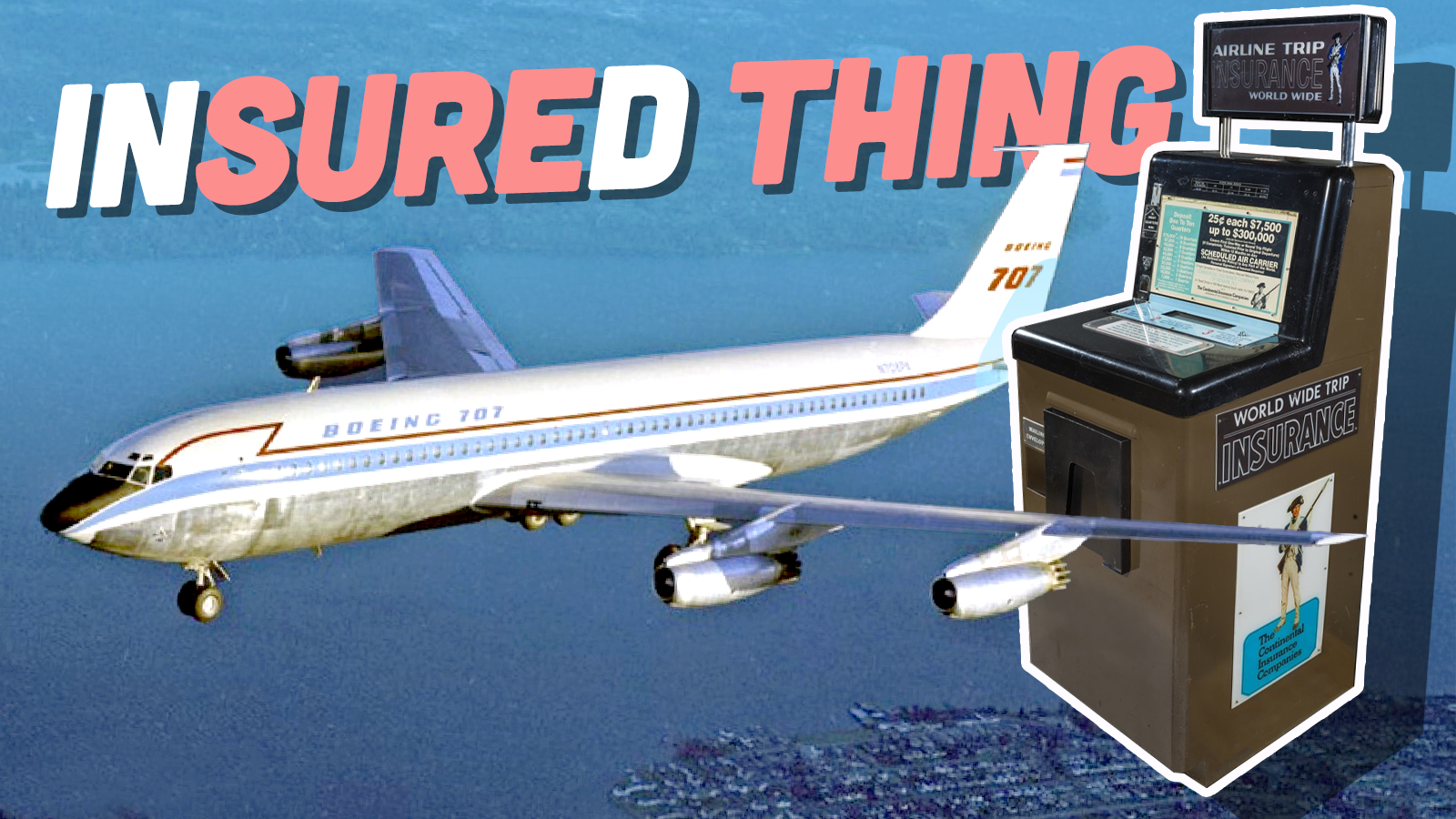
Flying is one of the safest ways to travel today. On average, there are 28,000 commercial flights every single day in America, which ferry nearly three million passengers to their destinations. For the vast majority of the time, each and every one of those flights would arrive without incident. But this wasn’t exactly how flying used to be, and, in the 1960s, passengers were so scared to fly that insurance companies came up with a wild idea. Decades ago, you used to be able to spend a couple of dollars at a vending machine at the airport to insure your life for your flight. One of the reasons why these machines are gone might not be what you’re thinking, either.
One of my guilty pleasures is the air disaster flick. I’ve watched the Turbulence trilogy, Sully, and Flight more times than I’m willing to admit. Last night, I also finally completed watching the entire Airport saga by watching the movie that started it all, 1970’s Airport. This film was a trailblazer in popularizing the air disaster genre, even though the movie didn’t even start building up the disaster until about halfway in. The disaster itself didn’t take place until nearly the end of the two-hour, 15-minute slog. The movie makes up for the time with its beautiful bare aluminum Boeing 707s and wonderful late 1960s cars.


If you haven’t seen this 56-year-old movie and are concerned about spoilers, skip on. Otherwise, there was a part of the film that took me by surprise. The disaster part of the plot hinges on a man who was at rock bottom and was desperate to provide for his wife. To give her all of the money she’ll need, the man wires up a bomb, places it in a briefcase, and rushes to the airport. When he arrives, he buys a life insurance policy at a kiosk right before his flight. The idea was that he’d blow up the plane, everything would look like an accident, and his wife would get the payout.

I initially thought that this had to be some Hollywood movie magic being worked into this film so that the plot made sense. Admittedly, the first time I ever flew on a commercial flight was in 2016, and this movie was made more than two decades before I was born. I was surprised to find out that, yes, insurance companies really did sell life insurance policies to scared passengers on their way to board flights. Even wilder is that Airport‘s crazy plot? That more or less happened in real life more than once! Let’s look into the once wacky world of so-called flight insurance.
Crashes Used To Be More Common
Aviation wasn’t always as safe as it is today. In the early days of aviation, crashes weren’t just common, but they were almost expected. Engines weren’t reliable, aircraft structures sometimes failed, and navigation was primitive. Those old propeller-driven planes also couldn’t fly above the weather, weren’t pressurized, and had few redundancies. Even the iconic Wright Brothers technically crashed their plane before their first actual successful flight.
At first, putting more planes into the sky didn’t help much. According to the Mackinac Center for Public Policy, in 1929, there were 24 known fatal crashes of commercial aircraft in America. It wasn’t just a bad year, either. Reportedly, in 1928 and 1929, the commercial aircraft accident rate was about one crash per one million miles of flight.

Such a rate would be unconscionable today. Airlines in America currently fly around 8.1 billion miles per year. If the planes of today crashed at the same rate as the planes of the 1920s, that would be the equivalent of 8,100 commercial airliner crashes a year. Yet, the 2025 mid-air collision of American Airlines Flight 5342 and an Army helicopter was the first major crash of a commercial airliner in America in 16 years.
That’s how far aviation safety has come. You have a far greater risk of getting harmed in a car crash on the way to the airport than on the plane itself. Sadly, as some aviation fans say, aviation safety and regulations are written in blood, and the industry had to learn a lot of hard lessons to get to where it is today.
Flight Insurance

It’s understandable, then, that many airline passengers of the first half of the 20th century were scared to board a plane. Travelers Insurance claims to be one of the first companies to insure a passenger against air accidents. On May 6, 1919, President Woodrow Wilson was given “ticket number one” by Travelers in France, which insured his travel. Apparently, Wilson probably didn’t board a plane, and thus never got the chance to use the ticket.
In the early days of flight insurance, an airline would work out a deal with an insurance company, and then the airline ticketing agents would offer the insurance as an upcharge when passengers bought their boarding passes.
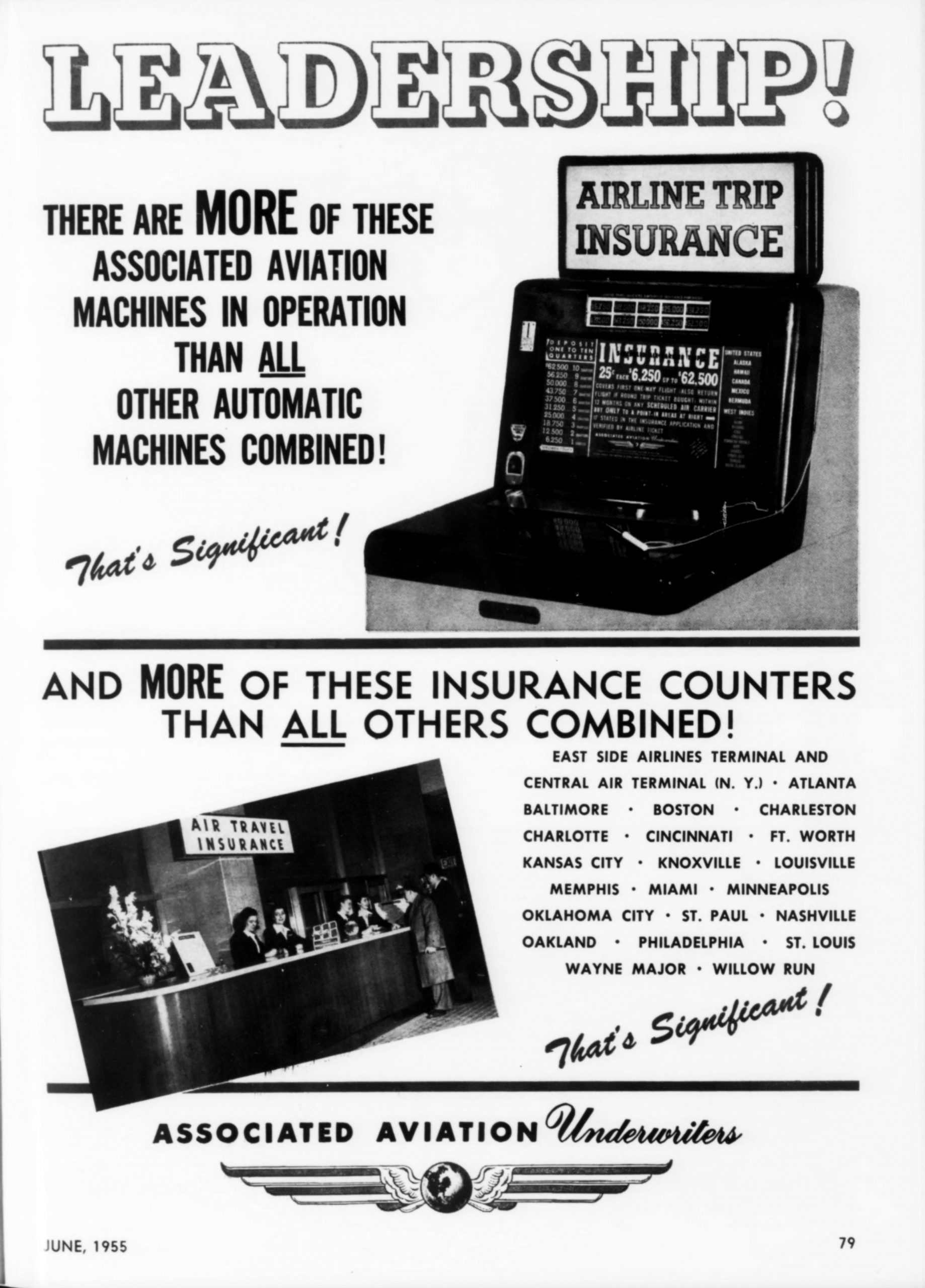
After World War II, flight insurance would take off as its own monster of a business. Instead of partnering up with airlines, the insurance companies would sell policies right out of booths and vending machines installed at the airport. These policies were marketed as giving travelers peace of mind on their flights, but it was also a way for insurance companies to rake in additional revenue.

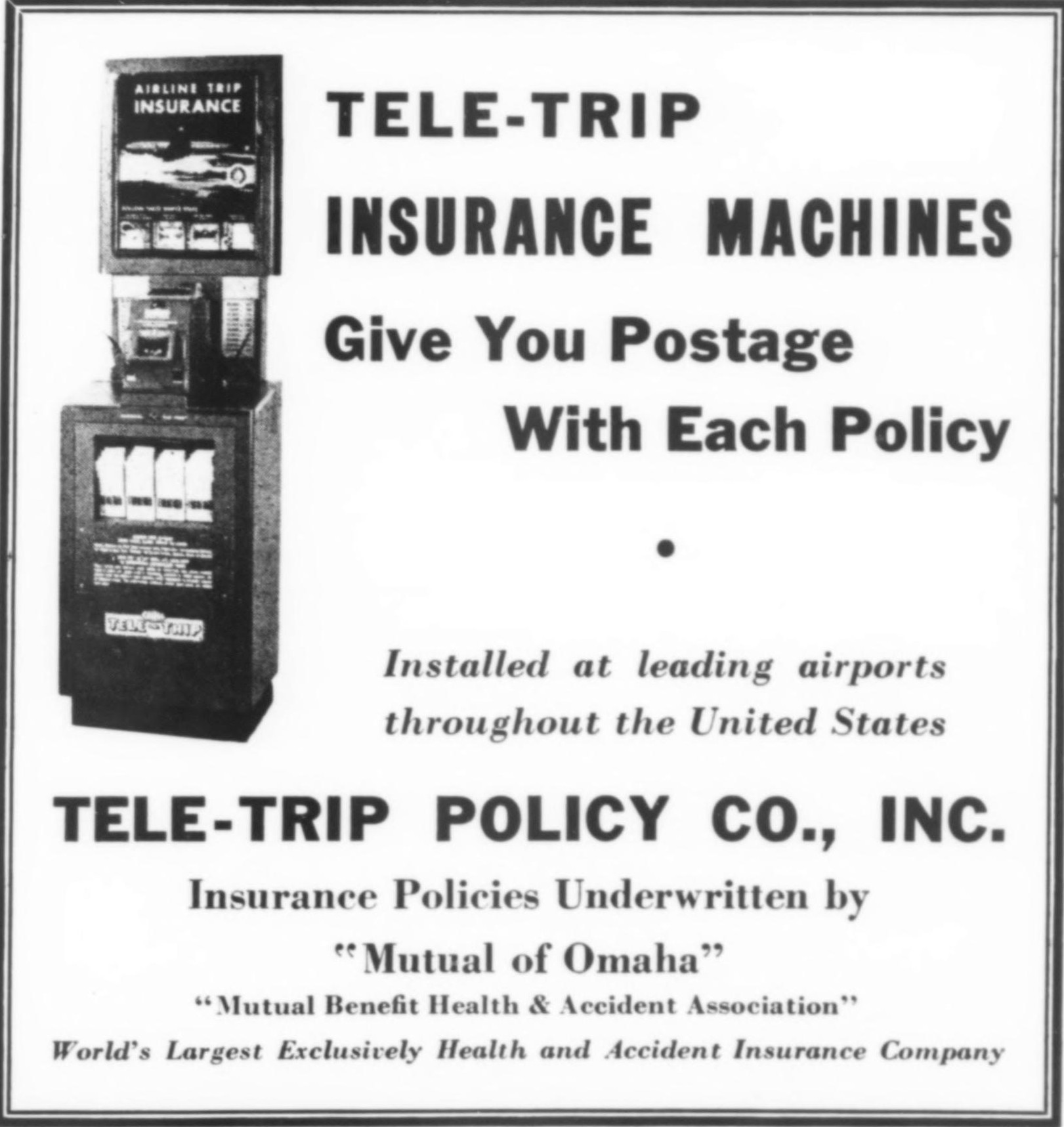
One of the masterminds of this new strategy was John M. Shaheen. As the New York Times writes, Shaheen served in the Navy during World War II. There, he was attached to the Office of Strategic Services, which ran clandestine operations. In 1947, Shaheen came up with an idea to revolutionize the sales of flight insurance. He founded Tele-Trip Insurance, and its calling to fame was selling life insurance out of vending machines at airports. Now passengers could purchase life insurance for their flight with quarters as easily as they purchased other small objects from vending machines.
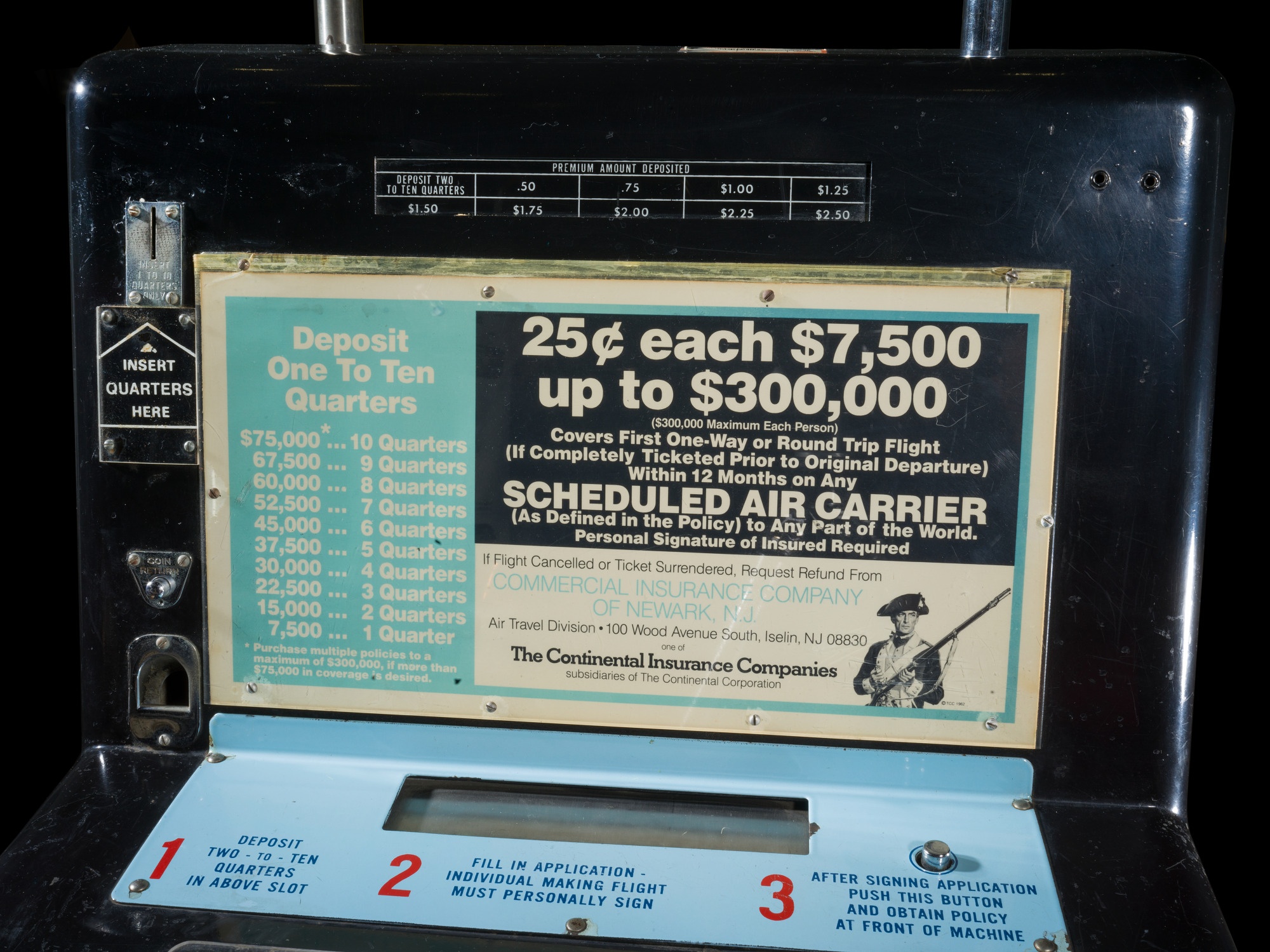
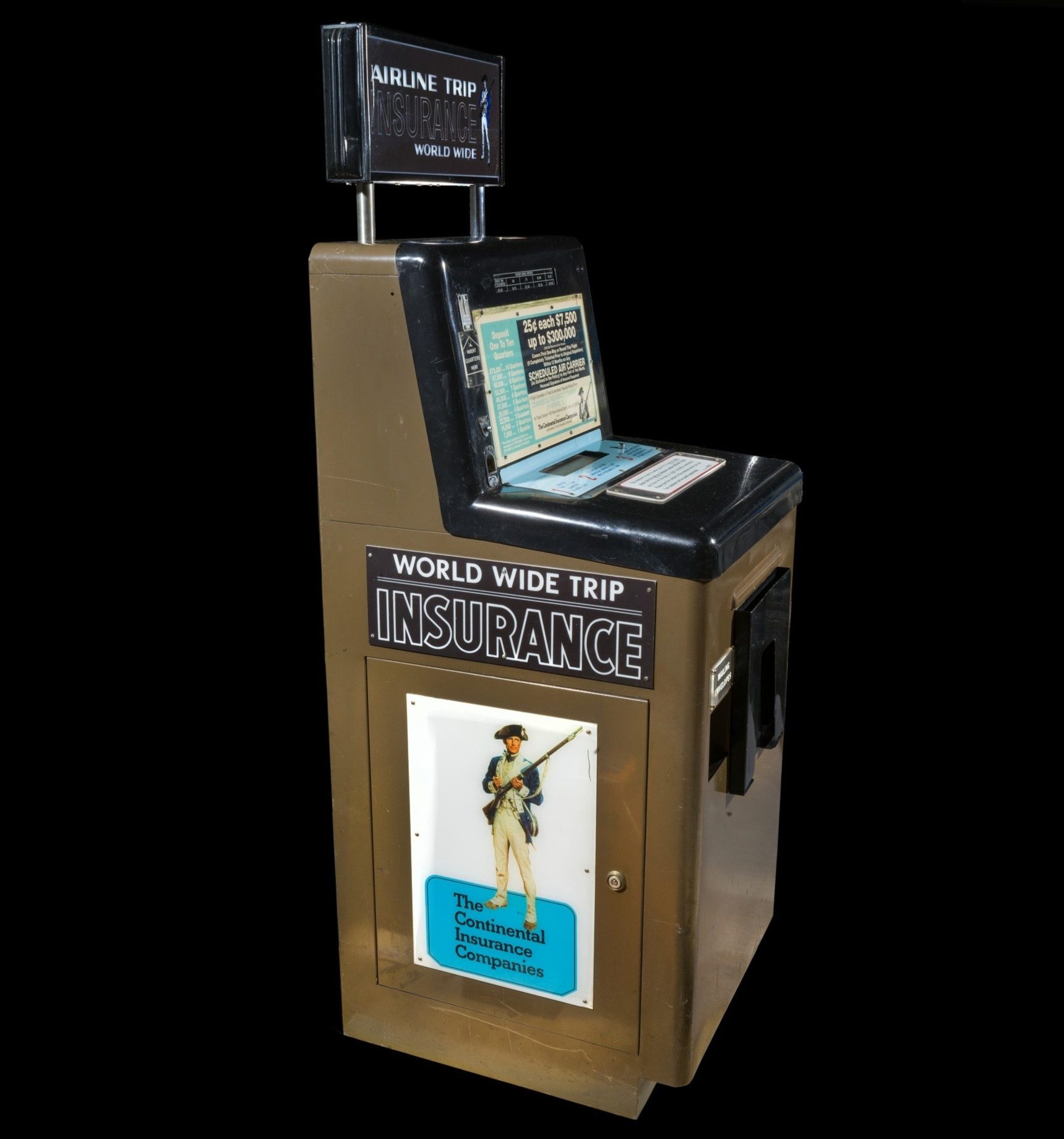
The brilliance of the booths and vending machines was how easy the policies were to obtain. A vending machine didn’t make sure the person buying the policy was who they claimed to be, depending on the insurance company, each quarter gave you a specified amount of insurance coverage. For example, the Continental Insurance Companies had vending machines that offered $7,500 of coverage per quarter, up to 10 quarters. You could then buy multiple policies for the same trip if you wanted to, for a maximum of $300,000 of coverage.
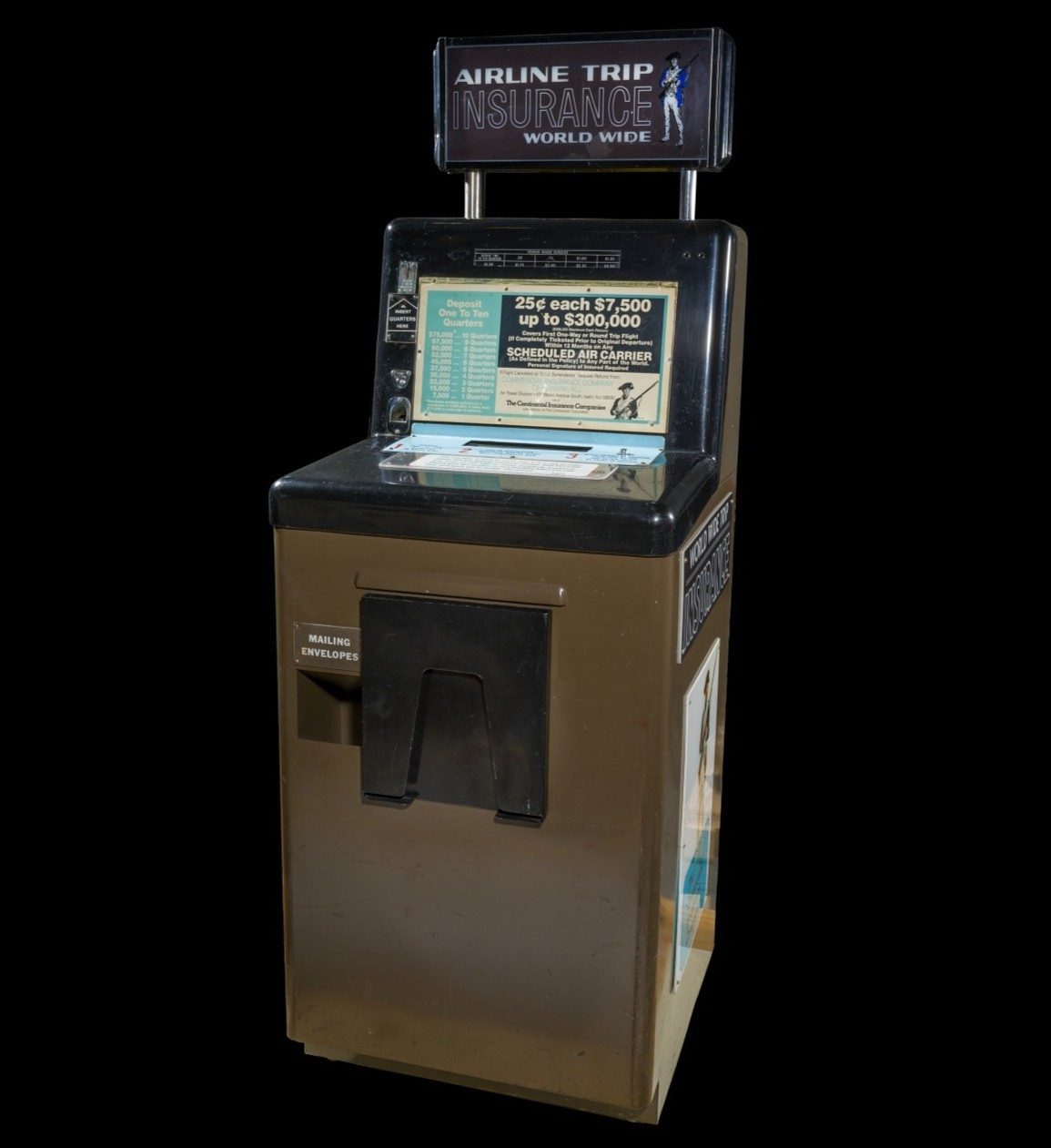
The process was simple. You dropped your quarter in the machine, filled out the application, and then pressed a button to get your policy. You’d then drop that policy in a mailbox at the airport before boarding your flight. These policies had numerous catches. The most important thing was that the policy covered just the duration of a one-way or round-trip itinerary. So, if you got injured or killed in any other situation, this policy didn’t touch it. The insurance also covered only trips on scheduled airline carriers. If you died in a general aviation aircraft, in a flight operated by a “non-scheduled” carrier, a charter flight, or some other situation, you weren’t covered.
Lachs v. Fidelity & Casualty Co. of New York, 306 N.Y. 357 (1954), detailed what the application might say on a policy dispensed from a vending machine:
“I hereby apply to Company named below for Airline Trip Insurance to insure me on one Airline trip between: Point of Departure? ____ Destination? ____ And return ____ Beneficiary’s home? ____ Beneficiary’s Street Address? ____ Beneficiary’s City? ____ Beneficiary’s State? ____ Name of Applicant (please print) Signature of Applicant”.
In Lachs v. Fidelity & Casualty Co. of New York, a passenger purchased flight insurance and would ultimately perish when the flight they boarded crashed. The insurance company denied coverage, claiming that the airline was a non-scheduled carrier and thus not covered. The court ruled that the exclusions of the policy were too ambiguous. This case is a major reason why insurance polices have miles of fine print today.
The business of selling flight insurance would become marginally profitable, and Mutual of Omaha would purchase Tele-Trip Insurance in 1954. Meanwhile, pilots pushed back. Aviation was getting safer practically every year. By the 1940s, Mackinac Center for Public Policy notes, the average number of crashes per year had fallen to around five to 10 crashes per one million miles of flight. By the 1970s, advancements in air safety had gotten the average down to less than five crashes per one million miles of flight.
To pilots, the advertised need to purchase flight insurance was overblown. Yet, that didn’t stop the insurance companies from offering the vending machines and it didn’t stop passengers from scooping up policies.
Just how nutty did it get? Take this paragraph from Insurance Business Magazine:
The trend became so prominent that one 1963 lawsuit alleged, “In recent years air trip travel insurance has developed into a business of tremendous volume. For example, a recent annual report filed by a group of underwriters who handle a large portion of air trip insurance business in the United States, showed total premium collections for the year to be $3,382,561. In the same year the group wrote air trip insurance for $84,564,025,000 and paid out $1,388,839 in losses.”
While insurance companies raked in cash, a lot of it would go to the airports, which took a cut in concession fees. Still, even after the airport got its money, the machines were still profitable for the insurance industry. Aside from Tele-Trip Insurance, another big name in the insurance machine business was Fidelity & Guaranty Co. of New York.
The Dark Side Of Insurance Vending Machines
The business of selling insurance right before a flight also came with an unfortunate downside. Those looking to commit insurance fraud now had a new way to do it. If you insured yourself or a family member before a flight and then blew up the aircraft, you or your loved ones would get paid, provided the insurance company didn’t figure out your scam.
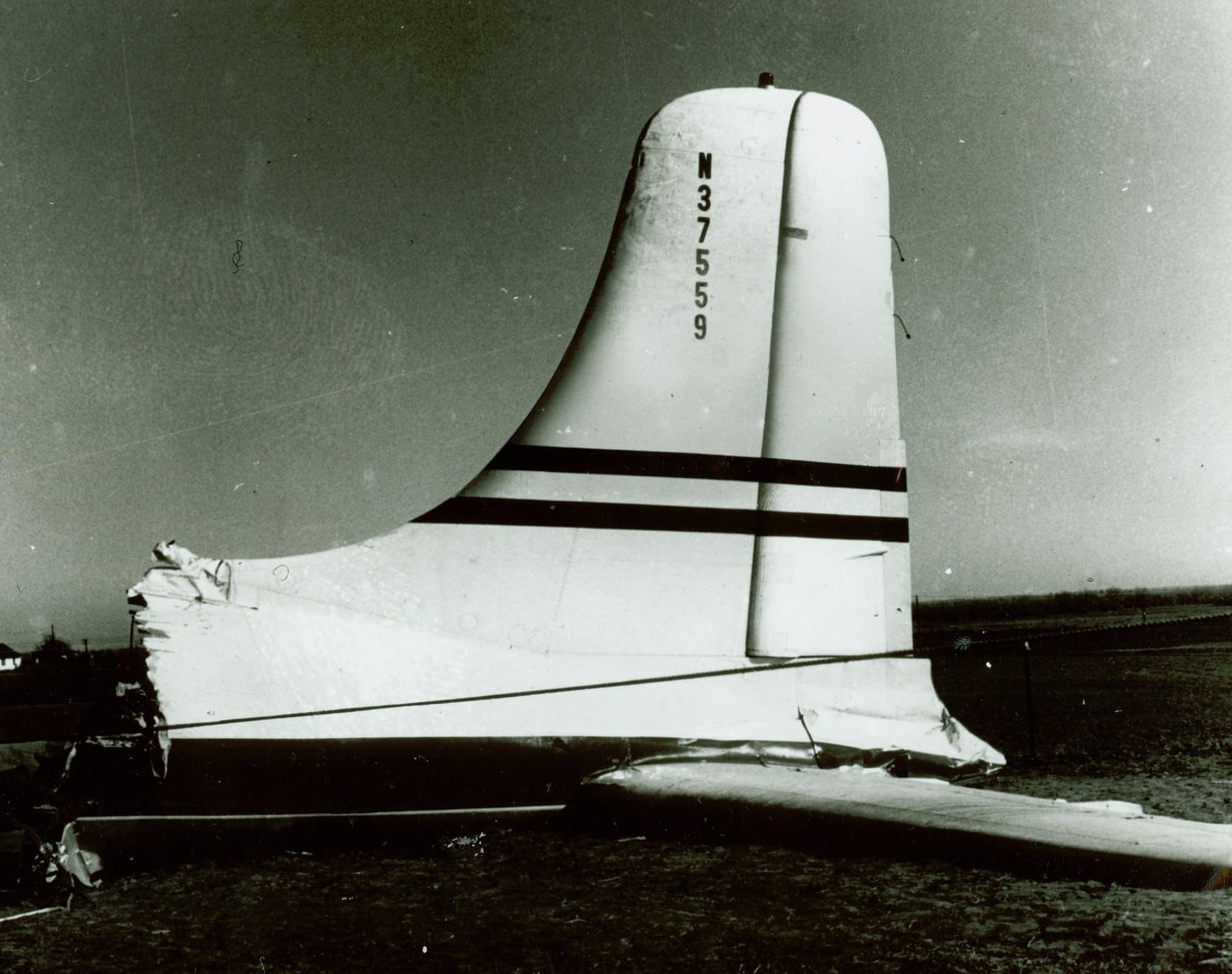
The risks of insurance fraud were well-known even in the early days of the flight insurance vending machine. On November 1, 1955, United Air Lines Flight 629 departed Stapleton Airport in Denver, Colorado, bound for Portland, Oregon. The aircraft, registration N37559, was a Douglas DC-6B with 44 people onboard, and it would never reach its destination. Barely 10 minutes after departure, an explosion rocked the aircraft, and it crashed into a field near Longmont, Colorado, killing all onboard.
The Civil Aeronautics Board, United Air Lines, and the FBI would discover that the aircraft itself was in operational condition, and it wasn’t a mechanical or structural issue that brought the aircraft down. Instead, something inside the aircraft exploded. The investigation revealed that nothing flammable or explosive was reported to have been shipped in the aircraft’s cargo hold. The extensive damage also suggested that no component from the plane itself was the source of the explosion. So, how did something blow up on the plane?

The Federal Bureau of Investigation explains what happened next:
A considerable quantity of personal effects of passenger victim Daisie E. King was recovered form the wreckage and closely examined by the agents. This material included a number of personal letters, newspaper clippings about her family, a personalized checkbook, $1,000 in traveler’s checks, an address list, and two keys and a receipt for safety deposit boxes rented by Mrs. King. These articles revealed considerable information about the background of Mrs. King.
One of the newspaper clippings reflected that her son, Jack Gilbert Graham, had been charged with forgery by the Denver County District Attorney and had been placed on the local “most wanted” list by that office in 1951. From the fact that most of these personal effects of Mrs. King were found on or near her body, it was apparent that she had been carrying them in her personal handbags at the time of the crash rather than in her luggage. Despite careful searching, practically none of the contents of Mrs. King’s luggage was recovered, and only small bits of the suitcases believed to belong to her were found.
Immediate effort to determine the identity of passengers on which large amounts of trip insurance had been obtained revealed that six passengers had a maximum of $62,500 of such insurance; four had $50,000; two had $37,500; one had $35,000; two had $12,500; and two had $6,250. Because of a holiday weekend, however, a complete check of all companies writing such insurance was not possible at once, and among policies located later were three on the life of Daisie E. King.
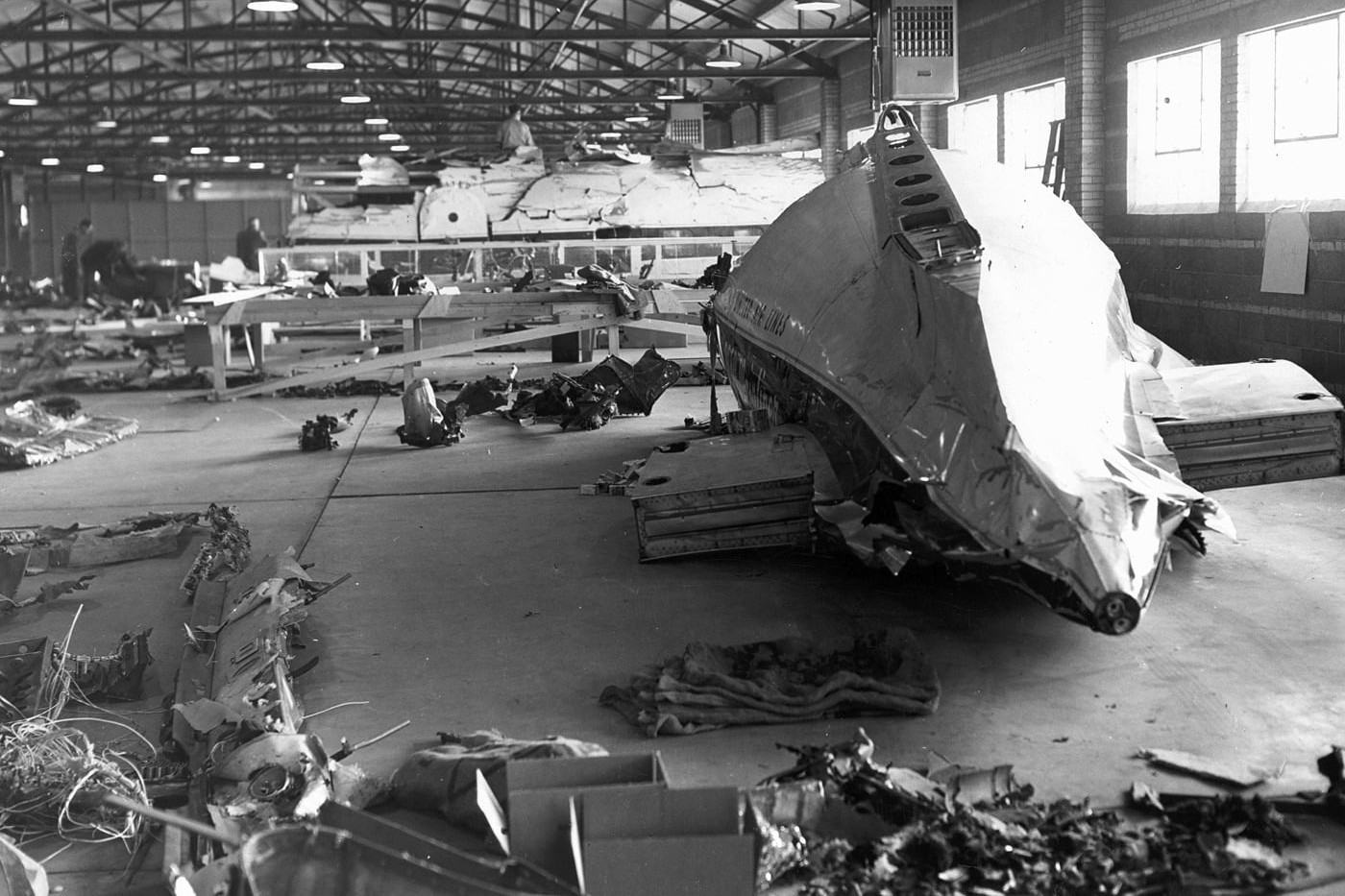
The investigation would find that Graham took out a duplicate insurance policy on his mother valued at $37,500. He would later admit to placing 25 sticks of dynamite into his mother’s suitcase to bring down the aircraft and cash in on his mother’s death. Graham had also insured his mother’s restaurant before blowing that up, too. At the time, the idea of someone intentionally blowing up an aircraft was such an anomaly that America didn’t even have a specific law to cover it. Apparently, Graham had a grudge against his mother for placing him in an orphanage when he was a kid.
The state of Colorado responded to the result of the investigation by banning insurance vending machines in airports.
Graham’s actions would not be the last time someone would use insurance purchased at an airport to cause mayhem. In just the decade following this incident alone, at least three more fatal crashes were caused by people committing insurance fraud by blowing up flights. Of course, insurance-fraud-related crashes would become so infamous that they inspired the novel Airport and the subsequent film.
The Fall Of Flight Insurance
Yet, insurance companies were undeterred and kept selling the policies, anyway. You’d think that the chances of blowing up in an insurance fraud incident would have brought an end to the flight insurance vending machine, but it didn’t.
Instead, as Insurance Business Magazine writes, it was simply the fact that aviation kept getting safer. Insurance companies kept the machines around through the 1970s, but they began to fade in the 1980s as flying became far safer and the public began realizing that flying wasn’t nearly as dangerous as it used to be. Those who still feared flying also found that they could obtain other life insurance policies that covered plane crashes. Likewise, credit card companies also offered their own coverage.
In other words, people simply stopped buying the policies. Those who were scared to fly had no reason to buy insurance at the airport anymore, and everyone else didn’t care. The machines became obsolete. Apparently, you might still find one of these machines in some parts of the world, but they’re certainly an anachronism.
That’s not to say that flight insurance is totally gone. Nowadays, instead of selling you a temporary life insurance policy, companies will sell you “travel insurance,” which might cover injuries, trip cancellations, lost luggage, delays, and other losses. Travel insurance is a multi-billion-dollar industry, too. But, thankfully, it doesn’t come attached to the fear of going down in a Boeing 737.
Another Obscure Part Of History
I know this is merely a review for some of our older readers. But, for someone who has grown up in this modern era of aviation? Honestly, it blew my mind. It’s wild to think that some people were so scared of flying that they wouldn’t board a plane without throwing some quarters in a vending machine. But I suppose it made sense. Planes did crash more often back then, and people didn’t want to leave their families with nothing if they died.
The flight insurance vending machine is one of those pieces of history that’s sliding into obscurity today, alongside hits like the payphone, the pager, and the floppy disk. That’s why I’m happy that places like the National Air And Space Museum exist and collect artifacts like these. If it weren’t for people preserving history, my jaw would still be on the floor.
The fact that these machines are gone is a good thing. The next time you board a flight, you can rest assured that over a century of safety innovation will almost certainly get you to your destination safely. Now, airport vending machines can be left to jobs like replacing those headphones you forgot at home.
Top graphic images: Boeing/National Air And Space Museum


Idea for a reality show.
Surprize Skydiving!
These twenty people think they’re going to Palm Springs.
Little do they know!
I’m 51 and took my first flight in 1974, and I had no idea these existed! Perhaps I noticed them as a kid, who knows. I love articles like this from Mercedes.
I do remember (even as an adult, I think) smoking sections in aircraft, which seems absolutely wild to me now.
I do remember those flight insurance machines! Another great Mercedes story!
Because air safety statistics were nothing but a myth made up by the marketing teams.
Analysts actually looking at this area say buses are four billion times safer than airliners, trains being next in safety after buses. Additionally flying is only partially a substitute risk, and often an added risk to your normal travel.
Airlines are currently getting less safe, with near crashes being the key statistic.
Cramped seats risking evacuation deaths, lighter airframes, loss of lightning protection, scheduling and traffic risks, and the failed Max design.
They’re lying with numbers.
The good news is that group statistics don’t apply to individuals especially when they make decisions like not flying in bad weather.
Flying to the desert once, I took the trip insurance, as it was stated value and very low.
I found adding a medical rider cost almost nothing, as it was based on the primary coverage price, but not restricted by it.
So I covered lifeflights.
FYI, last time I flew into LAX, we had a very near crash on the ground when landing.
We were already level with nearby buildings going at least 150 knots, when we went into a full throttle climb at a steep angle and a go around over the ocean. Everyone on the plane was completely silent!
People that work at LAX said constant changes made the airport unsafe to fly to.
I’ve taken that advice. I had no issues flying out, other than luggage destruction.
This is laughably incorrect. It is approximately 10 orders of magnitude incorrect. And that’s comparing absolute terms, if you do it by passenger mile it jumps to 12 orders of magnitude.
Are busses safer than cars? Yes, by quite a lot. Are trains safer than busses? yes, slightly. Are airliners quite a bit safer than either trains or busses? Yes.
As Wikipedia says, citation needed. Near crashes are also called “not crashes”. They get written up as safety reports, analyzed, and lessons passed on to improve safety. There are only two industries on Earth that actually have internationally standardized and rigorously enforced safety management systems: commercial aviation and nuclear power. Nothing else is remotely close.
Uh yes, that’s a standard go-around. The pilot saw something in the conditions that would have potentially led to an unsafe landing, and executed the correct procedure. It’s a much safer approach than trying to continue with a potentially compromised landing. You can even fully touch down, wheels on the ground, and still execute a go-around if conditions warrant it. Emphasizing and standardizing go-arounds for most non-normal landing conditions, and especially the fact that crews will not be punished for them has vastly increased safety. It’s not something to be alarmed over, it’s the system working as designed.
There are entire books addressing the airline safety fraud, some by ntsb experts.
Much of it is wrapped in the false premise used to run numbers to start with.
Comparing passenger miles is the biggest one. Comparing multi million dollar airliners running in a support system that costs billions is another fallacy.
It’s been suggested that departures and arrivals is a potentially more relevant number to compare.
I am also unaware of an airliner available for the roads where I am actually at most risk.
If I chose to fly, I still have to subject myself to those risks. They are not isolated from flying.
It’s not because of the deceptive practices and tombstone engineering that I don’t fly now. It’s simply no longer worth the inconvenience and expense, unless I’m going overseas.
We should face the reality of it though.
That they stick to a made up 60s ad slogan is not comforting.
Name one.
Yeah, I used trips, you were off by 10 orders of magnitude. It’s 12 OoM if we’re talking passenger miles.
Airliners are expensive, and the system is expensive, mostly because it’s so safe. This is not a fallacy, it’s a consequence of engineering and policy decisions. Another consequence of engineering and policy decisions is that passenger car crashes are a leading cause of death in most countries worldwide.
Oh no, my boat is useless in the desert? What is your point here?
This is true for literally anything you do. Unless you just want to shut yourself in and never go out and do anything (except oops! that actually raises your risk for cardiovascular disease massively).
The reality is the drive to and from the airport is by far the most dangerous part of the trip.
The system is so costly because air travel is not inherently safe.
We simply persist in trying to fix the problems, sometimes.
Every new mystery failure is another proof of that.
Perhaps the numbers on smaller aircraft are more relevant?
There were cigarette machines. Everywhere.
Anybody with a coupla quarters pulls a knob and the pack of your choice pops out.
People (my mother) busy talking with their friends send their pre-teen children (me) across the restaurant to get a pack (unfiltered, of course).
My memory of this was that regular life insurance polices were voided while you were flying. You were on your own.
That’s how my mother explained it, anyway. The dream job of her life was selling flight insurance at the Nashville airport, during the early 1960s. Her office was a sales counter at the center of the action, right where opposite concourses split. Down at the Crossroads, so to speak. All of Nashville passed by there, and many of its visitors. The one story I remember is the day Chet Atkins came by with a medical emergency. He’d ripped a fingernail on his picking hand. Nashville’s hottest guitarist really cared about his nails. In Mom’s immortal words, “Yew woulda thought he broke a laig!”
Of course she had a manicure kit on hand, and she took care of him on no time. Chet thanked her and invited her by the house sometime. So she did just that. I was only six or so, but I knew music well enough to want to go along. Unfortunately, he hd been called away on something urgent before we arrived, so we never met. Instead we were given a brief tour of the house. I remember several gleaming Gretsch guitars on stands, as tall as I was, placed around the big living room, They had evocative names like the White Falcon, and Chet’s own nickname, the Country Gentleman. Seeing how interested I was, someone warned me, “Don’t you go touchin’ any of them now. He can tell.” Sadly, I complied, but I can imagine an alternate history where I touched the spark of greatness and magically became a much better guitarist than I am. All because of the miracle of flight insurance.
The rise and fall of these insurance vending machines seems like a rare example of human workers replacing the machines. A technological two-step, backwards. My ma knew better than selling one person three policies for the same flight!
I love cheesy airplane disaster movies from the 70s. I would suggest two that revolve around the crash of Eastern Flight 401 in the Everglades in 1972 — The Ghost of Flight 401 and Crash (which has William Shatner doing his best over acting).
And yes, there were people who swear they saw ghosts of the flight crew on other planes that were using salvaged parts from Flight 401.
That’s a completely debunked myth created by con artist John G. Fuller, there weren’t even any salvageable parts left from N310EA, and the galley area, where he specifically claimed parts were taken from, was one of the most heavily decimated areas of the plane
Mercedes seems to have missed some of the great air crash films!
My favourite so far is when they crash in the Amazon, and repair the propeller blades OVER A CAMPFIRE!
Then fly out!
Have you seen the Mayday series?
Excellent stuff
I LOVE THE MAYDAY SERIES! Sorry for the shouting LOL. The acting is terrible, but it’s just so addictive.
My favorite of the Airport series is definitely Airport 77, even if it gave me an irrational fear of being trapped under water. To this day I don’t know how they got that stellar cast to do such a cheesy movie.
Whenever possible they have the original people involved telling their stories on Mayday.
Besides not being performers, most have no experience in public speaking, and are often traumatized, even disabled.
The surgeon in the FedEx highjacking case was one of my doctors so I can confirm it’s him.
The pilots actually put the 747 through fighter aerobatics, something Boeing never even considered. There were bloody footprints all over the ceiling of the aircraft.
A much worse event than news made it sound!
My brother recently retired from FedEx and confirmed the details of that event. He’s former Navy and noted that the pilot did an extraordinary job flying the plane and putting it through the acrobatics without losing control. Doubly extraordinary given how injured he was.
It was all a very close thing!
I remember those kiosks from my youth and there was usually a line of people waiting their turns. If you like old airplane movies may I suggest “No Highway in the Sky?” James Stewart plays a slightly befuddled aircraft engineer who is ignored when he claims a new plane will suffer metal fatigue. Very little action but very suspenseful.
Based on a real plane.
I’ve loved this movie since childhood and I never knew that.
It is an excellent film.
I remember a kiosk at Wittman Field in the 1970’s, purchasable before you got on your North Central Airlines “Blue Goose” Douglas DC-6B. This airport more famously known as the home of the EAA convention.
There was a kiosk in Minneapolis. And also St. Paul!
I know exactly where that flight out of Denver crashed in Longmont, Co.
I hope that piece of crap son of that woman is spending eternity in hell for killing so many others.
I bought insurance a couple times in the late 1970’s.
Mostly because of that asshole’s behavior.
What a total douche…
How was it ever possible to insure another person without their permission?
Not sure what you are talking about.
It was apparently possible to insure other people without informing them or getting permission.
It’s been done for fraud, but usually by deception.
The serial killer H. H. Holmes took out life insurance policies on his employees, then killed them. From the 1980’s until 2006, corporations would take out life insurance policies on their employees (payable to the corporation) as a tax shelter, because life insurance payouts are not taxable, It was known as “Janitor Insurance”.
I wasn’t aware of janitor insurance, though it’s not surprising.
I’m familiar with key man insurance, of course, but I expect the insured would be aware of it in most cases?
Yes, my understanding is that since 2006 it is limited to key persons and they have to be informed.
Another aviation disaster movie inspired by real events, “Skyjacked” starring Charlton Heston. Inspired by the epidemic of real-life airline hijackings during the 1960s and early 1970s. Hijackings were so common they were regularly fodder for late-night comedians, and every airliner regardless of its actual destination carried aviation charts for Cuba. The book “The Skies Belong to Us” recounts many of the wild and crazy events of this era. It was tolerated for so many years because rarely did the hijackers hurt anyone; they wanted either money or to go somewhere (often Cuba). The era came to an abrupt end when one hijacker threatened to crash the aircraft into Oak Ridge National Laboratories. Metal detectors appeared at all major airports within a week.
Feels like this is the sort of thing that would reinforce people’s fears.
“Why would they sell life insurance if it isn’t dangerous?”
Please tell me that you’ve seen the movie Airplane!
Airplane Classic Scenes
Wait until some airline partners with Kalshi or Draftkings so you can “live trade” if your plane will crash or not.
I know I still saw some of those around in the 1990s, but, they were one of those things, like pay phones, that were around until they weren’t and you couldn’t quite pinpoint exactly when they disappeared, just that one day, you suddenly realized they had
I would say cigarette vending machines are in the same category, except I know where at least one of those still is, in working condition
At least in Texas cigarette machines are still fairly common in a lot of bars. They’re almost always really old machines (with the rows of different options and a knob you yank out to dispense a pack) that have been retro-fitted with a bill acceptor or card reader, which makes me think nobody really makes them anymore.
They don’t scan IDs or anything, so I guess they are just relying on teenagers being famously obedient and following the warning on the machine that you must be 21 to use it.
Yeah, the one I’m familiar with is in a gun club that doesn’t allow any unaccompanied minors under 21 into the clubhouse (it used to be 18, as long as you weren’t drinking, but they upped it when the tobacco purchase laws changed, its also a private club, so you can still smoke indoors in the bar area)
This feels a bit like the F&I guy at the dealership telling you about all the things that will go wrong with your new car. Like, if it’s that bad maybe I don’t want it at all?