

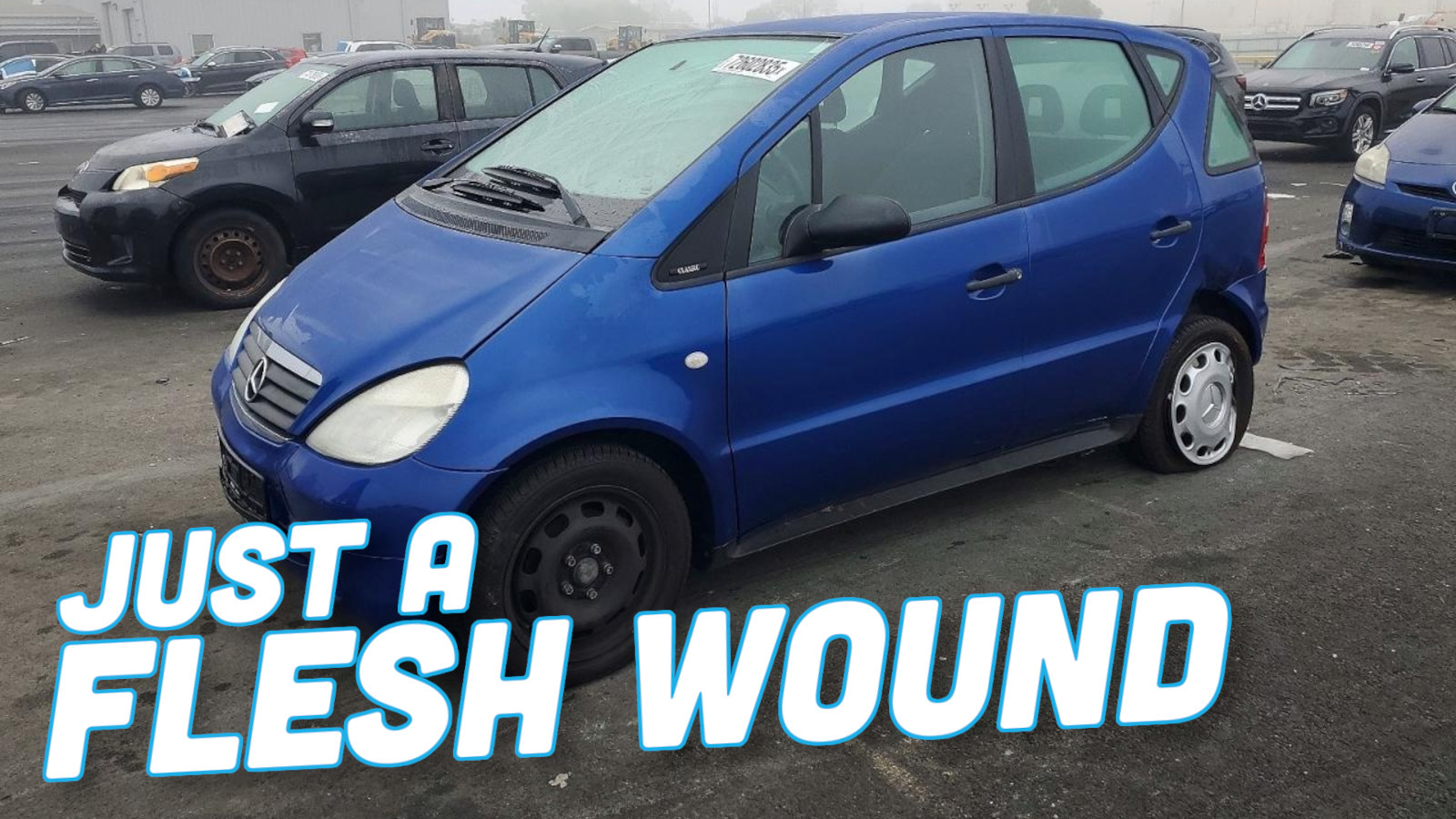
Owning an imported car that was never sold in America is an adventure. You get to experience something that was never meant for your American eyes, and often, buying an imported car is the cheapest way to get Lamborghini levels of public attention without actually buying a Lamborghini. Doug DeMuro got to experience this when he imported a 1998 Mercedes-Benz A140. The car’s been passed through four owners since Doug, and then it got into a crash that technically totaled it. Now, it’s at Copart, waiting for a hopefully better chapter of life.
Imported cars from Japan tend to get all of the attention. What car publication hasn’t written about imports from Japan like the Honda Beat, Kei trucks, or Nissan Skylines? I’ve imported four cars from Japan. I’m sure a good number of you reading this story have seen at least one right-hand drive import from Japan in recent years. Part of that comes down to the fact that Japan has an entire developed industry that does nothing but send old cars to other countries. It’s so easy for anyone to bid in a Japanese auction and buy a car.


But there’s an entire world of cars that aren’t in Japan that are just waiting to come to America. Unfortunately, Europe doesn’t really have a million websites and companies dedicated to sending cars elsewhere as Japan does. Instead, you either have to fly to Europe, buy the car, and drive it to a port, or you have to hire someone to do all the legwork for you. Doug DeMuro went through the process in 2023 and brought a beautiful 1998 Mercedes-Benz A140 to America.
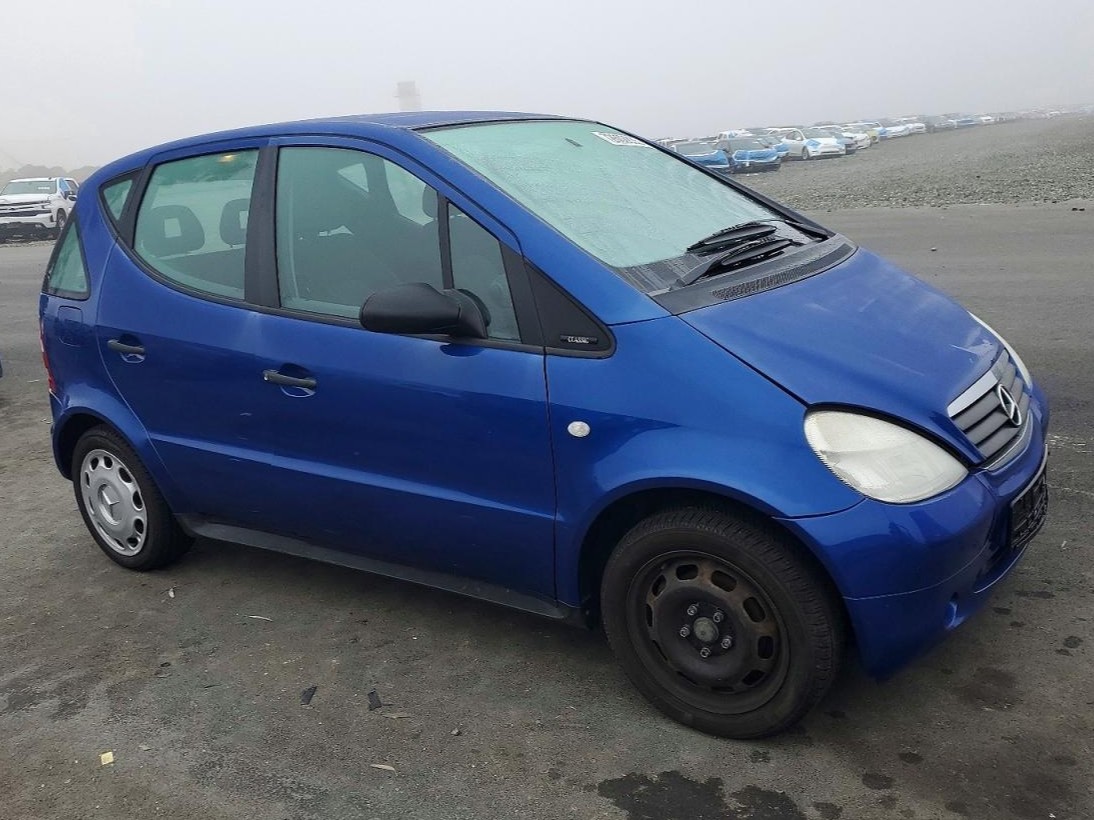
Unfortunately, Doug would learn that even a city car with a three-pointed star on it is, we’ll say, an acquired taste. The car would go through at least a few more owners after Doug, only to end up in a fender bender with a minivan in December 2025. Now, it’s on Copart, and damage aside, it still runs.
If you want to read about the history of the A-Class, click here to check out my recent piece on it.

While the A-Class might have been a Mercedes-Benz, these cars were treated as mass-produced, disposable transportation. Most of these cars have been driven hard, beaten up, and then sold. They aren’t even particularly collectible today. As such, it’s not even that hard to find one of these for sale for under 1,000 Euros in parts of Europe. These cars will be beaters by American standards with steel wheels, cloth interiors, dents, and rust. Basically, a lot of Europeans don’t even care about these cars.
The Cost Of Importation
Unfortunately, the process of getting that cheap car to America will cost you multiples of the car’s value. If you fly to the country and buy the car in person, you have to pay for plane tickets, pay for lodging, buy the car, drive it to a port, pay for shipping, and then pay to get it into America. If you let someone else buy the car, now you have to pay an army of middlemen on top of shipping, customs duties, and everything else.

My $258 Honda Life was around $3,700 by the time I rolled it off the car hauler into my parking spot. It then passed the $4,000 mark after I gave the car a set of new tires and wheel bearings. That’s even after considering the fact that my U.S. Dollar went further in Japan thanks to exchange rates.
Last year, I looked into importing an Audi A2 into America. I contacted Dutch Munich, a vehicle sourcing agent in Europe, to find me one. Here’s the quote he gave me for a cheap A2:
Asking price of the car: $2.500
Sourcing, inspection, payment, documentation, and transport handling: $1.500
Transport within Europe (open): $500
Ocean shipping to New York: $2.250
Customs entry fees: $450
Import duties (3% of vehicle value):$75
Service fee – Inbound Motorsports: $1,500
Total: $8.775
A lot of these fees are higher in part because exchange rates do not favor the dollar, but also because Europe is a big place. If you have to get the car shipped to the port, it’ll cost you. I still haven’t pulled the trigger on getting a car from Europe because of the costs.
Doug’s A-Class
But Doug DeMuro did. In 2023, he imported a 1998 Mercedes-Benz A140 through Dutch Munich and Inbound Motorsports. Doug DeMuro is the reason I even learned about Dutch Munich. Click here if you don’t see the embedded video above.
I’ve been following the story of Doug DeMuro’s A-Class because, to my knowledge, it is one of the best-documented European imports in America. Doug was transparent about the whole process, down to the dollar, on how much it cost. That’s great for my research into importing a car from Europe.
When Doug bought his A-Class in 2023, he explained that he did it because he went through a period of owning serious cars, and he wanted to get back to his roots of embracing weird cars. A Mercedes-Benz A-Class was different, and Doug suspected that he likely had one of the only original A-Class cars in America.

Doug’s A140 was purchased for 2,200 euros, which was $2,416 at the time. He then spent $1,999 (1,820 euros) on truck shipping from South Germany to Antwerp. Another $1,878 (1,710 euros) went to ocean shipping from Antwerp to Newark, New Jersey. He paid $421 to Customs, $1,500 to Dutch Munich, and then another $1,500 to Inbound Motorsports, which handled the importation once the car reached America. Doug also didn’t pick his car up from the port as I do with my imports, so he spent another $550 getting the car to his door.
Add it up, and Doug spent $10,269 on his $2,416 car. That didn’t include the work he had done to the car, which ballooned the cost even further. Per Doug’s documentation, the vehicle needed extensive rust repair, including entire areas of metal cut out with patches welded in. Doug explained that his car was actually one of the cleanest examples that Dutch Munich was able to find, and it still needed rust remediation. The image below shows the rust after Doug got it fixed:

Factor in the rust repairs, replacing missing parts, and a light mechanical refresh, and Doug spent a whopping $18,214 on his $2,416 car. If you dig into the photos of Doug’s Cars & Bids auction, you’ll see the car still had tons of rust. So all of that money didn’t even erase all of the rust. I think you can see why I bailed on buying a different A-Class.
Why did Doug sell his A-Class? One reason is that, as he indicated in a recent video, he’s not a car collector and does not believe in forever cars. He thinks of cars as experiences, and when he thinks he’s reached the end of his experiences, he gets rid of the car. The novelty of the A-Class ended sooner than he expected.
Click here if you don’t see the embedded video below:
Doug learned that this pod of a car was a little loud, had few luxuries, and probably wouldn’t meet the comfort and highway performance expectations of the typical enthusiast. These were cars designed to make city living easier. It’s not that the A-Class can’t go on the highway, but you have to go into it knowing it doesn’t have tons of passing power, doesn’t have cruise control, and might not be as comfortable as expected. Whenever someone tells me they want to buy a Smart or a Kei as their only car, I warn them to temper their expectations.
Doug’s A140 is at an additional disadvantage because it has one of the weaker engines from the A-Class lineup. The 1.4-liter four under the hood has 80 horses to its name. That’s only 16 more ponies than a Japanese Kei car. The A160 that I recently wrote about had a hotter 1.6-liter 101 HP engine. That’s all to say: these weren’t fast cars. The original A-Class also isn’t known for being a particularly thrilling car. It’s fun to look at, but once that novelty wears off, it’s just a plain commuter car.

Now, there are a lot of slow car enthusiasts out there like myself who think 80 horses are more than enough. Look, I own five Smarts, two Kei cars, and a Vespa. My slowest car has only 40 HP on tap. I know what it’s like to exercise every pony under the hood just to reach the speed limit. I’ve road-tripped in city cars across America, even though they technically weren’t built for it. I love it.
But that experience isn’t for everyone, and so Doug let his A-Class go sooner than expected. Specifically, Doug said that he thought that the novelty of owning the car would overcome the vehicle’s “boring” and “fairly mediocre driving experience,” but the car wasn’t novel enough to achieve that. Not even the car’s five-speed manual transmission was able to save it. Doug would even say that he regretted spending so much money on the A-Class.
Ultimately, Doug sold it for $12,250 in January 2024, barely six months after he made his first video about the car.
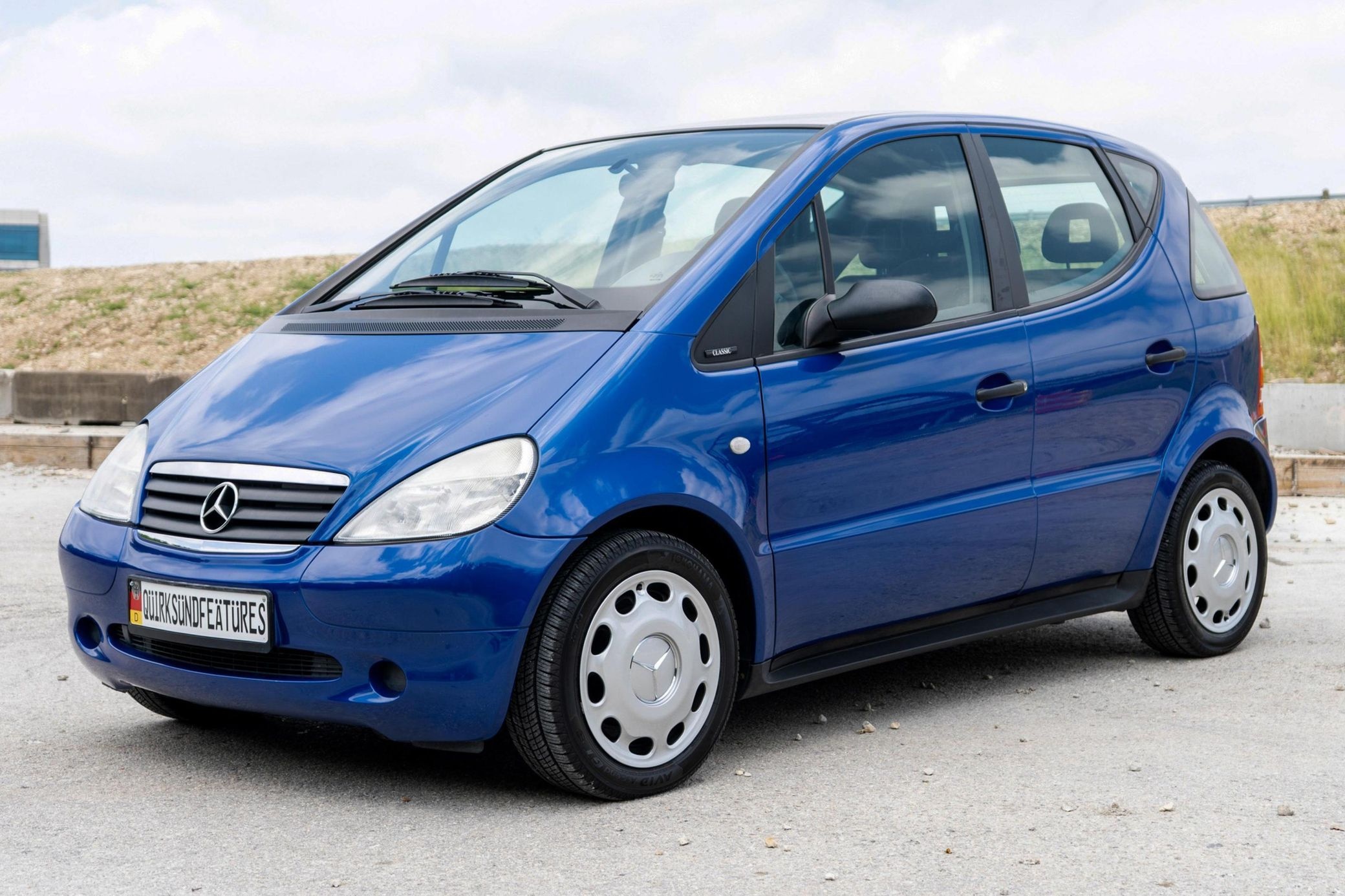
The car would go on to end up in the hands of at least a few more owners, as I suspect that they, too, learned that owning a cheap city car wasn’t for them. The person who bought Doug’s A140 in January 2024 put it up for sale on Facebook late that year. The car’s third U.S. owner fixed the rust that Doug didn’t. Then, in June 2025, the car was put up for sale again. That time, it sold for a price of $8,140.
The buyer from that last auction goes by mzgrr on Instagram, who lives in the San Francisco Bay area, and they would feature the car in several posts. Then, one day, the A-Class was parked on the street when someone in an old Toyota Sienna side-swiped the A-Class.
When reached for comment, Doug responded:
Fun fact. I bought that car in summer 2023 thinking it would be cool. It got hit Dec 2025. In that time it went through four owners, all of whom probably were hoping for more. ????
Amusingly, mzgrr replaced the A140 with the Audi A2 that Doug imported.
Another Chance

But this isn’t the end of the road for Doug’s old A140. It seems to have been cursed by never staying in anyone’s garage for very long and then being battered by a minivan. But it’s also not dead yet.
The car is currently up for grabs at Copart in Martinez, California, and it doesn’t look too bad.

The only visible damage is to the left rear quarter, which is pushed in somewhat far. The wheel does seem like it’s at an angle, so I bet you’d need to have some suspension work done, too. But the rest of the car looks okay, with only a couple of wheel covers missing. Copart says that the vehicle runs and drives. Usually, this means that the car started and then moved, maybe a few feet in the lot. But in this case, the car probably does drive fine, except for whatever suspension bit is broken in the back.
Otherwise, the car looks pretty good. The interior is clean, and the body looks about as it did in the auctions.

Copart says that the vehicle has 117,726 miles, but that’s incorrect. The odometer reads in kilometers, so you’re actually looking at 73,151 miles. The A-Class had 62,600 miles on it when Doug sold it in 2024 and 69,200 miles when it came up for sale in 2025.
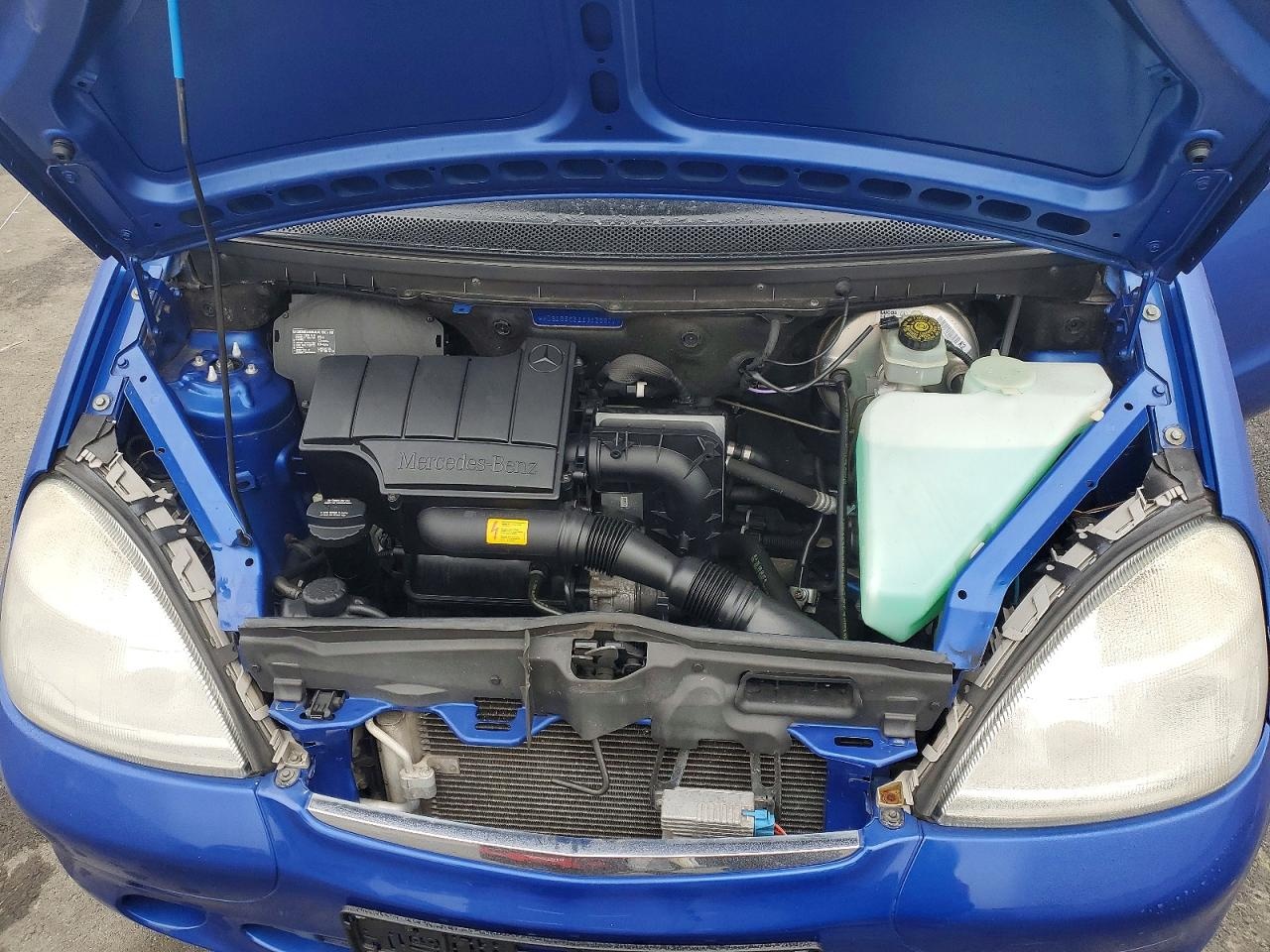
While it never really stayed in anyone’s fleet for very long, it was being driven. That’s good! Even the engine bay is squeaky clean.
As of right now, Copart hasn’t set a sale date on the vehicle, but the current bid is at $80, with the reserve not met. Of course, if you’ve ever bought a car from Copart before, you know there are tons of fees, and you usually have to use a broker if you aren’t a dealer. Based on our experience using the platform, I’d say to budget for the winning bid plus 25-50 percent depending on how cheap it is. That’ll probably be close to what you’ll actually pay when all is said and done.

I have known about the existence of this auction for about a month now. When the rest of the Autopian staff figured out about the auction this morning, a serious question was raised. Should we buy it as our next project car? We’re not afraid of questionable cars… the taxi, the Leaf, and the CrossCab were all a success. Should we take on a cursed A-Class and do silly stuff with it? I’ll leave that for our readers to ponder.
I do hope someone saves this car. Sure, an old A-Class might not be particularly thrilling, but it’s such a weird little piece of automotive history and a rare car to find in America. Everyone loves to give attention to automotive legends, but everyday cars like this A-Class are important, too. I’m happy that Doug brought it to America; now, someone needs to write the car’s next chapter.
Top photo: Copart





IMHO it might be a fun-ish practical vehicle. Definitely not for what DeMuro nor the next owner paid. Me says such high price tags made expectations too high on this car, which is probably better than most econoboxes sold locally back then.
I’m not an A-Class apologist, I’ve never driven one, I’m just saying this might be the ticket for a decent 1st gen A-Class that’s already been through all the paperwork for import. I think it could be an interesting buy if it goes for $3K before tax and fees. Add tax, fees, suspension work and you might still be under $5K. The body doesn’t look too bad, I’d probably leave it alone.
Now if you want to start clean sheet with an import I would advise to look for cars that also sold in Mexico. The A-Class was one of them and the few ones left (if any) would not have any rust.
But I’d personally look for a Ford Ka, Peugeot 206 or a Renault Clio from the same vintage. Or go big with a last generation Ram Charger with a manual transmission. No need to pay for transoceanic freight.
I had two of these as rentals in the UK in 2002, drove one from Manchester to London and back and around the cotswolds as well. About the same spec as this one. It was an ok drive, reasonably comfortable but slow on the road, meh handling and the materials were not great, nor was the fuel economy if you were on the motorway trying to keep a decent pace. This was before the UK went completely mental with speed cameras…
These are neat looking but no, it’s not a fun car or a nice car to own… I thought it would be like the Smart I had rented there (Also a 2002) but no, that was fun and cheery in its own way, A class was just lame… A bank vault German quality machine this is not, think of that fake luxury watch you got on vacation that broke before you got to customs…
As much as I like weird and rare things, this needs to be in a lemons race or something, or just left in a yard as weird yard art…
JT needs to pilot this speed machine at the next Lemons event. It’s well within budget.
5 different owners have looked at this and thought, “That might be fun” then immediately turned around and unloaded the car for less than they paid for it. If there’s a bigger red flag I don’t know what it would be.
It’s a boring car with a lot of problems. The only interesting thing about it is the purchase history, which you’ve already covered. The Autopian has gotten all of the content that is available out of this car already. CP.
Buy it, and run it in Lemons. Document the build. Have all the US owners join the team as drivers. Great cross-branding opportunity.
Certainly someone needs to Lemons 24hr it.
But Autopian should run a mile in the other direction..
Honestly it sounds like Doug bought a bit of a shitbox example to begin with (on top of buying a skinflint base model of an already budget car whose design was an evolutionary dead end), so I wonder how many of his issues (and the subsequent issues of the subsequent buyers) stem from that.
Agreed. Some little cars like this can be a blast to drive in the right places but penalty boxes otherwise…and some are just penalty boxes. It’s cute, love the interior, but cute only gets you so far.
I can’t believe someone paid over $12k for it after all of his “fixes.”
so true. I’m almost sure he set his expectations too high on the car after paying so much for it. Any econobox of the same vintage would’ve underdelivered at that price tag
Yes it should become the next Autopian staff car. Have David bash the suspension into good enough and do some questionable/ill-advised modifications. Then given fact that it changed hands so many times, David has to use it as his daily driver for say a month. Then Mercedes flies in, road trips it home to use it has her daily driver for a month. Torch then picks up the … torch ect until all of the North American writers have had their turn at torturing it/being tortured by it. Finish it off by having Mercedes run it in a Gambler or the event where she finished off the Freestar.
Just don’t.
We had these in Australia as a bourgeoise inner city snob car. They failed terribly.
Youtuber garbage times junkyard adventures are always showing these at the wrecking yard with the line ‘ bet it hasn’t been crashed’. https://youtu.be/qFiVy1Vs6-4?si=a7vtKhRAYu_G8V1v&t=438 Junk. walk away.
I do hope someone saves it but don’t make it an Autopian car.
Update. There is two uncrashed A class Mercs in that video.
You could definitely do a lot better than an A-Class. Nothing exciting or new to be had with it.