


Some of the coolest pickup trucks in American automotive history are the ones that are sort of bad at being a truck. A GMC Syclone can outrun sports cars, but has a payload worse than a minivan. The Ford F-150 Raptor can skip across the desert at 100 mph, but its soft suspension makes it squat something fierce when hauling something heavy. Perhaps the coolest of these off-road specials doesn’t have a million horsepower and wasn’t even built in this century. In 1988, Nissan produced a limited run of its iconic Hardbody pickup called the Desert Runner, and it went so hard on off-roading that you couldn’t even use the bed if you wanted to. Yet, you probably wouldn’t care because it’s just too awesome.
There was once a time when American car buyers had an incredible list of small pickup trucks to choose from. Datsun and Toyota started importing tiny trucks in the 1950s, and it wasn’t long before their competition followed suit. The so-called mini truck often offered big truck capability, but in a fun size form factor with great fuel economy, fun colors, and wicked graphics. Mini trucks would become so popular that even Detroit got in on the action, slapping their own badges on trucks from the likes of Isuzu, Mazda, and Mitsubishi.


By the 1980s, America’s adoration for the mini truck hit a fever pitch. In 1980, Car and Driver pitted the day’s compact trucks against each other, and the list of competitors was staggering. That year, buyers could get a Chevrolet LUV, a Datsun 720, a Ford Courier, a Mazda B2000, a Plymouth Arrow, a Toyota Pickup, or a Volkswagen Pickup. That comparison test didn’t even include another choice with the Subaru BRAT coupe utility. Later, Chevrolet would come out swinging with the S-10, Dodge with the D50, and Ford with the Ranger. Dodge and Plymouth also got into the coupe utility fray, pumping out the Rampage and the Scamp, respectively. Even the Chevrolet El Camino’s final years were in the ’80s.
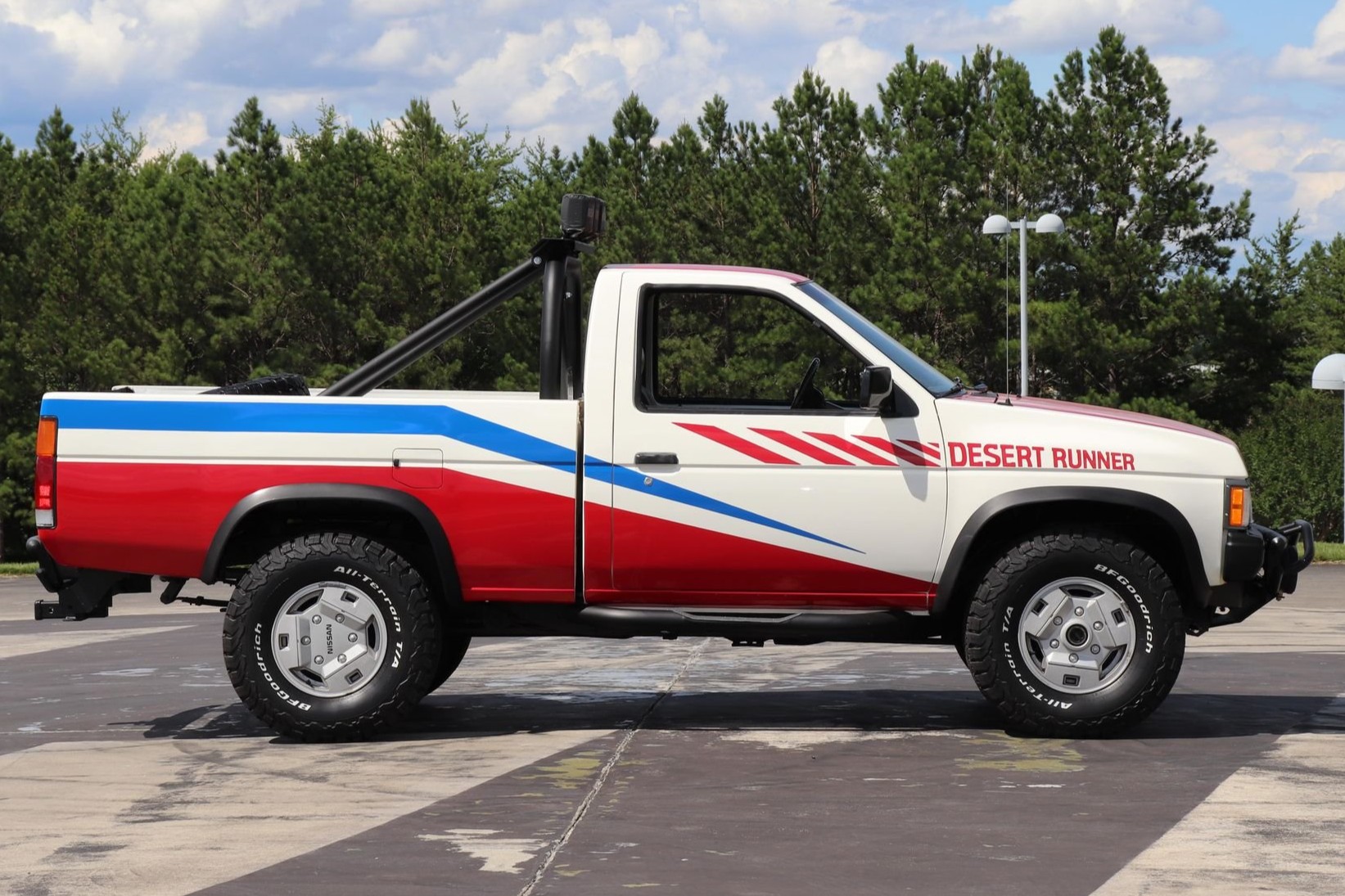
Nissan launched what is arguably its most famous pickup truck in the 1980s. The Hardbody, which was sold under over a dozen different names across the world, was a little truck that worked hard and played hard. They would gain a bit of a cult following, and are durable enough that you’ll still see some of them working today, four decades after their launch. Yet, the coolest of the Hardbody trucks is probably the one that could do the least work.
Nissan’s Bet On America
The Hardbody pickup was the first production vehicle created by Nissan Design International (NDI), which is now known as Nissan Design America today.
Launched in 1979 in the La Jolla neighborhood of San Diego, California, NDI was an experiment of sorts. America was Nissan’s largest export market, and Nissan president Takashi Ishihara wanted to see what designers could do if they penned the cars where they would be sold, free from the shackles of Nissan’s management in Japan. NDI would also be Nissan’s answer to Toyota’s Calty Design Research, which had roots in America dating back to 1973.
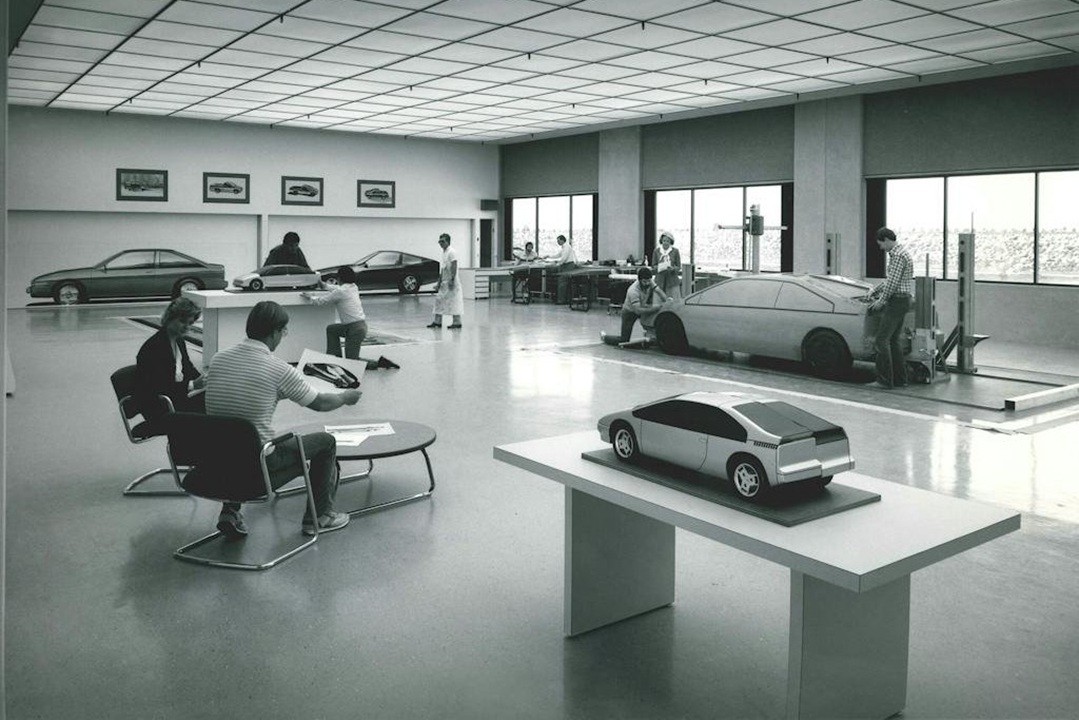
Leading the charge at NDI would be Jerry Hirshberg, who was a designer poached from General Motors, and Nissan executive Kazumi Yotsumoto. Hirshberg would manage to get two other GM designers on board, Allan Flowers and Tom Semple. Hagerty details how Nissan managed to fill its design studio with minds from Detroit:
Hirshberg and Flowers both went to work for GM right out of design school in 1964. By 1979, Hirshberg was Buick’s chief designer, and Flowers was the division’s assistant chief. Both had worked on serious blockbuster cars, like the 1971 Buick Riviera and 1976 Buick Regal, and their designs would be on Buick lots into the mid-1980s. Semple, who joined GM in 1967, was assistant chief designer at Chevrolet. That summer of ’79, Hirshberg was approached by a headhunter for the Nissan job and at first dismissed the call as a prank. It wasn’t, and the second call set off seven months of interviewing and negotiating with Nissan, and not just for himself. “[Jerry] wanted to bring along people who he’d worked with and knew and trusted. He had talked to Tom and me for months about it and about us with Nissan, but neither party could act until he actually accepted the job and was hired.” One morning in February 1980, Hirshberg took the job and resigned from GM.
“This sent a shockwave through GM. They’d never had a chief designer or anybody at that level leave, let alone for a Japanese company, and it was shocking even when people left for Ford or Chrysler. It was big news back then, and everyone immediately started asking, ‘Well, who is he going to get to go with him?’ Tom and I both got roped into those discussions and played dumb about it.” That was on a Tuesday, Flowers recalls. By Saturday, they both had job offers. Nissan’s studio would be in California, and there was no guarantee that the project would work out long-term. Following Hirshberg was a one-way decision. Once gone from GM, returning would be impossible, and the change also meant uprooting family and friends. “My kids weren’t thrilled, but it was February in Michigan, so my wife and I thought California looked pretty good.”
As Hirshberg later related, GM’s design culture had also grown stiff and rigid after decades of market dominance, and bean counters increasingly watered down its designs. Nissan was a chance for something entirely new, and Hirshberg had negotiated many things with Yotsumoto that spelled success, including the California location. It was chosen because of its proximity to a vibrant car culture and its distance from established design cultures.
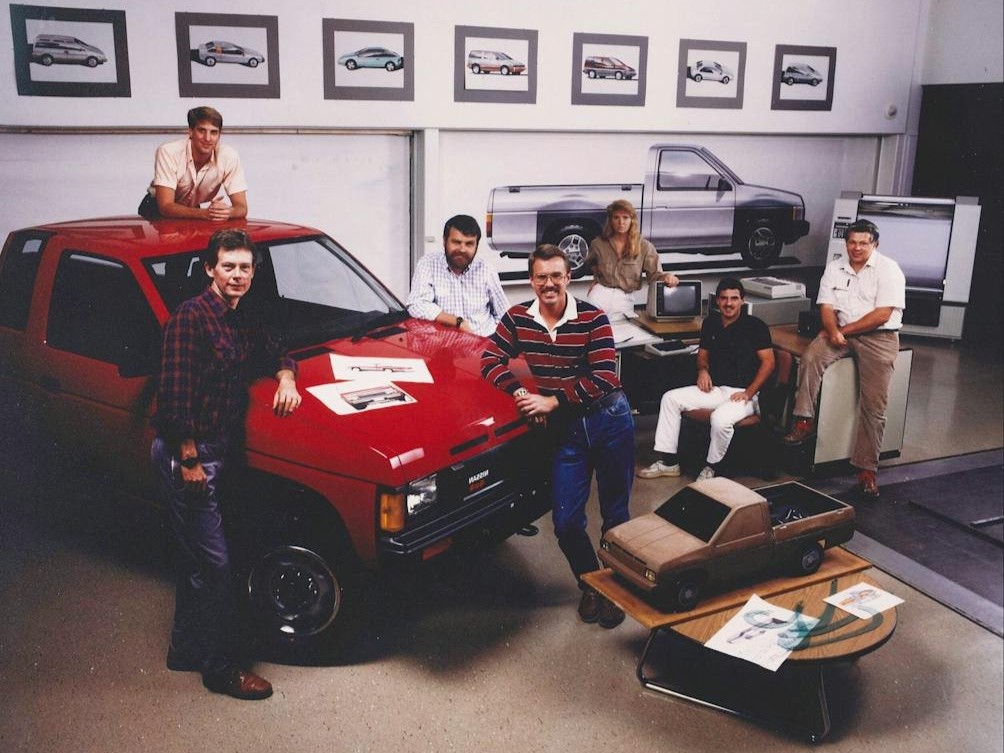
NDI started in a rented office in a house before growing so rapidly that they needed a real building to work in. The design studio would move into a space owned by industrial design firm Tesa Design. Some of Tesa Design’s people transferred over to NDI and helped pen some of the studio’s great ideas. NDI eventually produced the Gobi helicopter-inspired concept pickup truck, the NX coupe, and even the van that would become the NX. The designers also penned ideas for the Prairie and the Maxima, but Nissan chose Japanese designs for those two models.
Of all of NDI’s grand ideas, the first to actually reach production was the Hardbody, which had the codename of Project 850 and the chassis code of D21.
Nissan’s Harder, Better, Faster, Stronger Truck
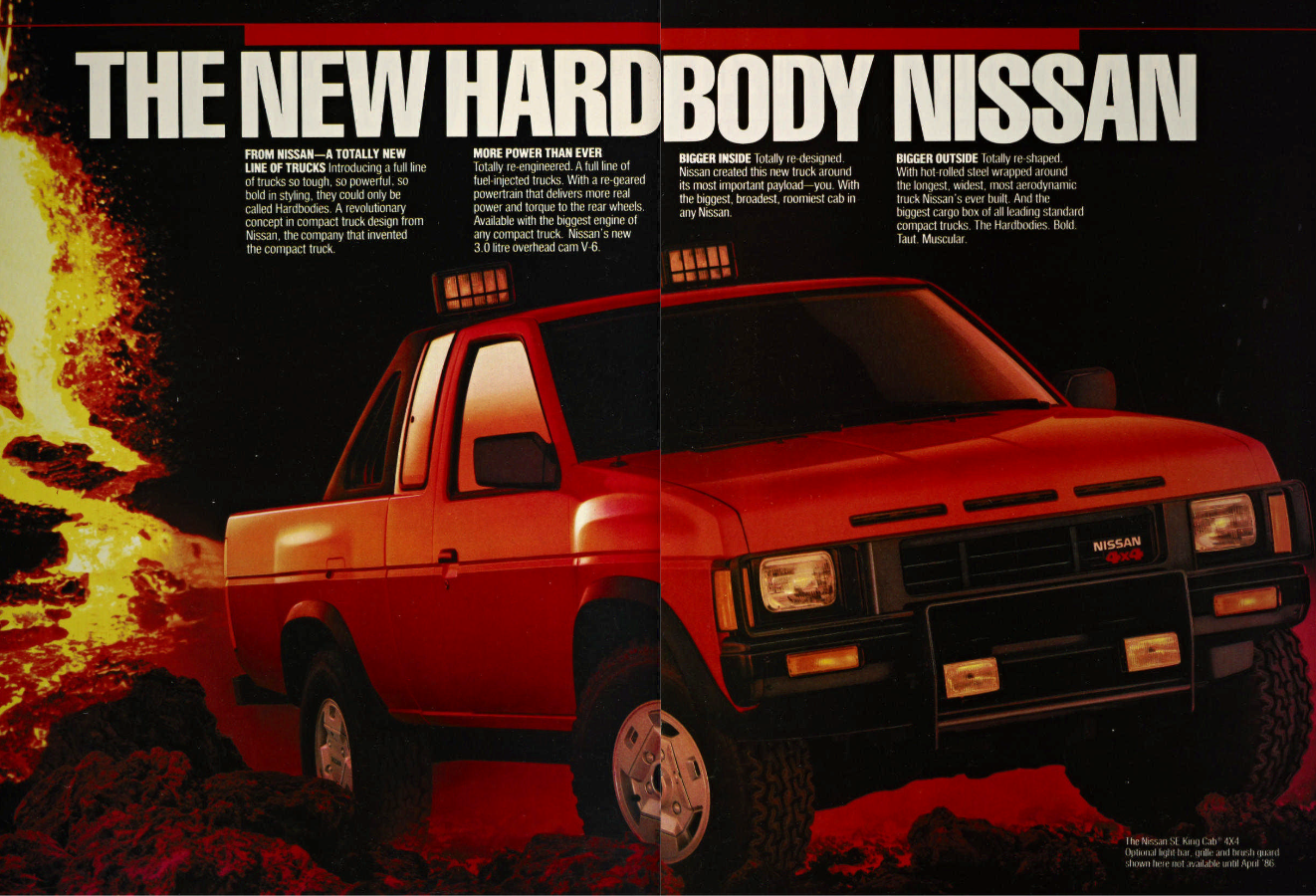
The Hardbody’s development came on the heels of a smashing success in truck sales in the 1970s. Americans loved Nissan’s mini trucks, and scooped them up not just as work vehicles, but lifestyle vehicles. Reportedly, Nissan’s management couldn’t wrap their head around why Americans were buying Nissan pickup trucks but not actually using them as trucks. Instead, Americans were using them as daily drivers, modifying them into street trucks, and taking them off-road. This was a contrast to what was happening in Japan, where the same trucks were mostly farm vehicles.
Nissan would decide to build two versions of the D21, one for the global market, and one just for America. NDI tweaked the truck for the States. Two teams at NDI designed the Hardbody, and while Nissan technically chose the design of one team, the truck actually had the front end of that team and the rear end of the other team.
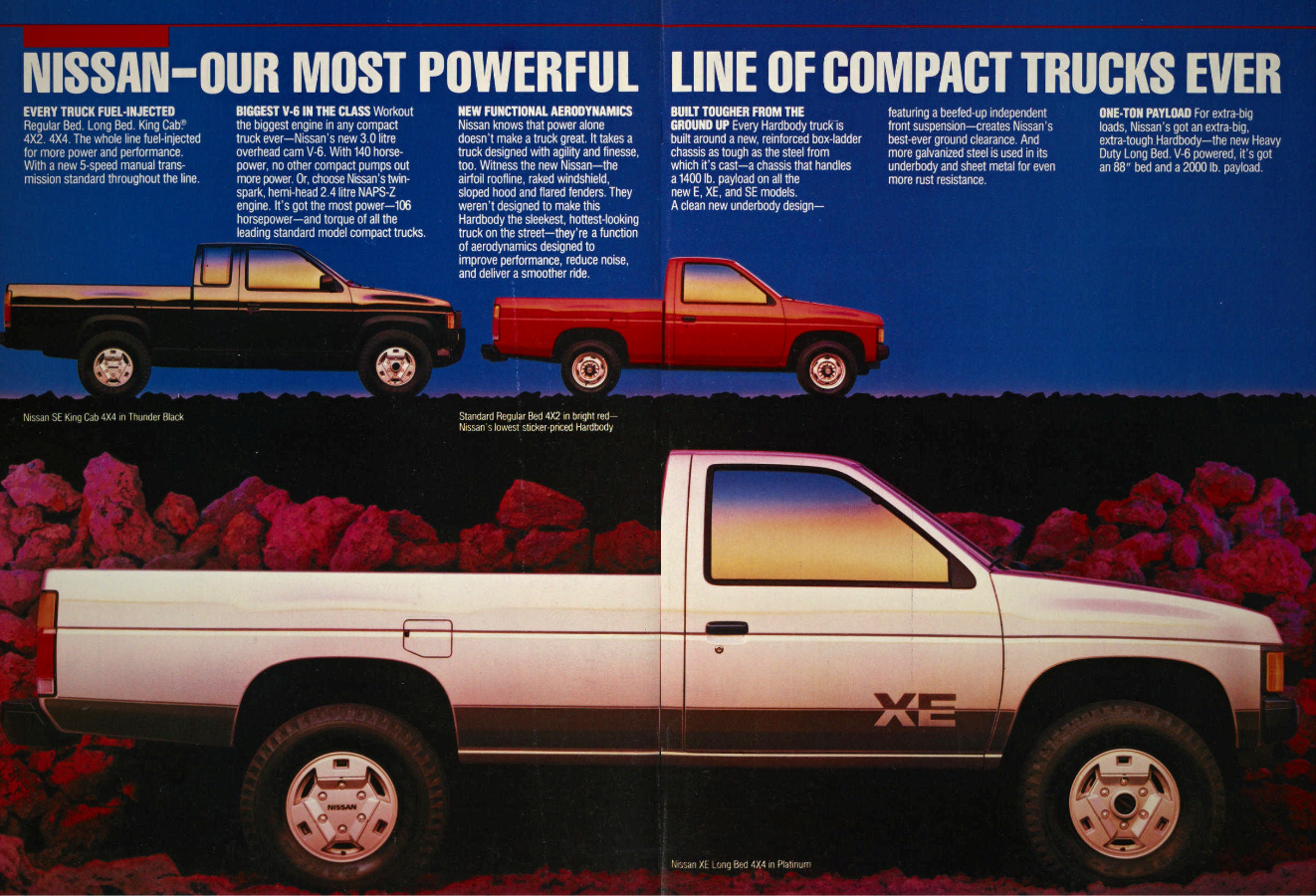
On August 28, 1985, Nissan showed off the hard work of the NDI team, championing the new Nissan Truck – the Hardbody name very soon after this release – as a “Human Oriented Pickup.” From Nissan:
The styling of the Nissan Truck has been revised to create an angular, linear silhouette with a sense of spaciousness in the cabin. This is enhanced with a large glassy cabin with bonded front windshield, full height single pressing doors, and smooth flush body surfaces. The front end features a restyled grille, sturdy bumpers, and the hood sports an aggressive bulge that accentuates the ruggedness of the product. This image is further enhanced by the bold, projecting wheel arches and the large, practical side steps.
There are two cab styles available including the standard cab with a single row of seats, and the double cab with two rows of seats. The double cab style is reserved for the long wheelbase (2950 mm) long body models, while the standard cab model is offered with either a short wheelbase (2650 mm) standard body or the long body. The work truck two wheel drive models are also available with a flat bed load bay. Inside the cabs, a bright, airy interior is created by the large glass area, with the addition of an optional removable glass sunroof on selected 4WD models. This sense of spaciousness is matched by an actual increase in dimensions with an extra 90 mm in cabin length (both standard and double cab), 40 mm more interior width, and 20 mm greater height. The quality of the interior fittings is also improved, with full door trims, molded pillar coverings, and total color coordination. In addition, the 4WD double cab model features a “full flat” seat whereby the front seat backs, with headrests removed, can be reclined to lie flush with the rear seat cushion to create a long makeshift couch. Completing the efforts for improved comfort, a powerful new ventilation system has been fitted, with a four speed 80W blower motor and 200 cm2 of outlet vent area (70 cm2 more than before). Additionally, Middle Eastern market models will be equipped with a 190W blower motor. The driver is presented with a new facia design featuring substantial padding and a new analogue instrument display with orange colored instrument illumination. Driver comfort, is ensured with an enlarged seat with comfortable thick urethane foam padding and a greater range of adjustment than before.
Underneath the restyled body, a newly developed high stiffness frame provides rugged dependability under all load and road conditions. The frame is of the ladder type, with a closed section welded construction, with enlarged, stiffer side members and an additional cross member for enhanced stiffness in the vicinity of the rear axle. […] Transmissions comprise 5-speed manual transmissions for all models, with a floor shift for the 4WD models and a column shift for the workhorse 2WD models. The synchromesh on 1st and 2nd has been strengthened, and the control mechanism has been improved to ensure smooth, reliable shifting. For the four wheel drive models is a new transfer mechanism that is now integral with the main transmission, eliminating the short primary propeller shaft previously used. Benefits include lower weight, less noise, and reduced vibration. An additional refinement to the transfer mechanism is the adoption of synchromesh for the shift between 2H and 4H, allowing drive selection on the move at speeds up to 40 km/h. In conjunction, the front wheel free wheel hubs are now automatically controlled.
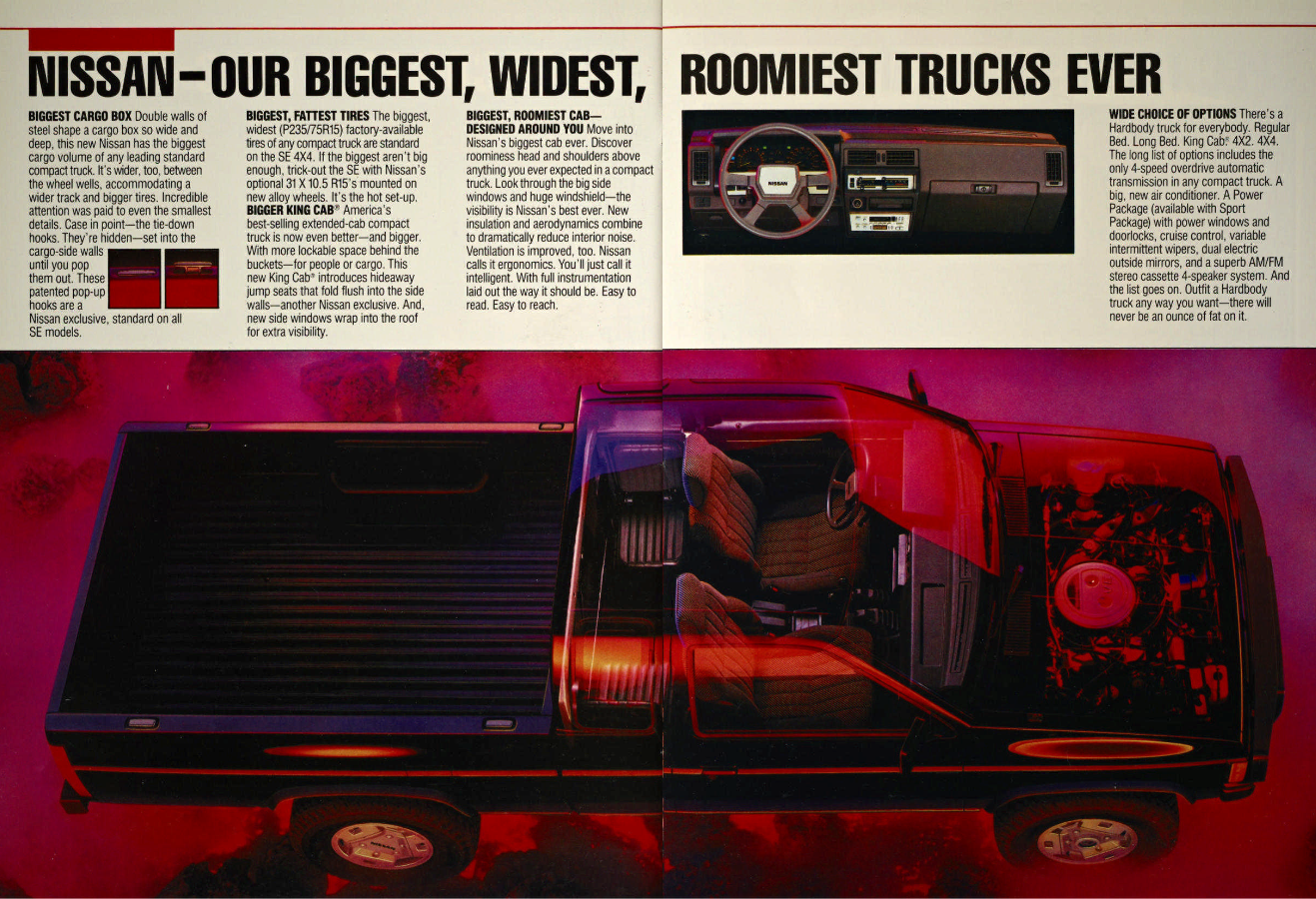
Nissan continued by noting the Hardbody’s independent double-wishbone front suspension with torsion bar springs, and rear leaf springs with bias-mounted shock absorbers to reduce so-called axle “wind up” under torque. Manual recirculating-ball steering was standard, while four-wheel-drive examples had power steering.
My favorite feature noted by the press release is the standard “high capacity 5-inch audio speaker for the AM radio.” I’ve never heard of a speaker described as “high-capacity” before, and I’m here for it!
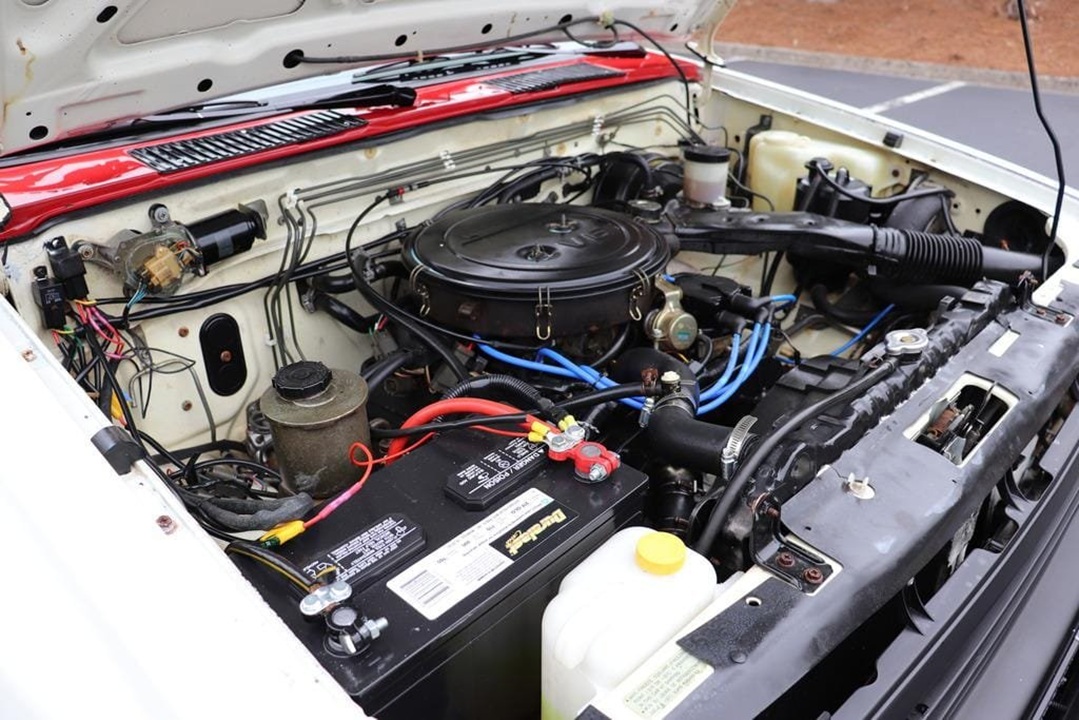
MotorTrend tested the 1986.5 Hardbody in March 1986, stating that, thanks to the suspension work, the truck “feels great under most conditions,” and that the truck had an “outstanding” optional V6. That engine had a steel block, aluminum heads, and put out 140 horsepower alongside 166 lb-ft of torque. Standard at launch was a 2.4-liter inline-four with 106 horsepower and 137 lb-ft of twist on tap.
Complaints were few, and the magazine noted that the hard suspension oscillated in really tough terrain, necessitating the driver to slow down. Overall, MotorTrend said that the “overall package is very good,” but predicted that the truck wasn’t going to be a home run, but more of a hit into centerfield.
MotorTrend might not have given the truck enough credit, because over 100,000 units were sold in 1986 before peaking at 140,000 units sold in 1988. Part of the magic was Nissan’s marketing, which really played up just how big, wide, durable, powerful, and yes, hard, these trucks were. If you were a young adult in the late 1980s, how could you not get one of these rigs? Prices started at $6,494 for a regular cab, rear-wheel-drive model, escalating to $8,395 for four-wheel-drive and beyond, depending on trim level and option packages.

When the Hardbody finally ended production in Smyrna, Tennessee, in 1997, the factory managed to crank out 1.2 million trucks. They were also built in nine more factories across the world, and production continued in Venezuela until 2014. A shocking number of Hardbody trucks were built, and it’s no surprise that they remain a cult favorite even today.
At least here in America, the coolest version of the Hardbody was one that sold for only a single year.
The Desert Runner

The Nissan Hardbody Desert Runner was a celebration of off-road racing from the time when Nissan loved to prove its vehicles by taking them on endurance rallies.
Nissan put itself into the racing scene from early on. To demonstrate the toughness of its 220 pickup, Datsun entered two 210 sedans, which had the same chassis as the truck, in the 1958 Around Australia Mobilgas Trial. The race spanned roughly 10,000 miles, and Nissan says it was so abusive to the cars and competitors that it was never held again. The Datsun 210s finished in first place and fourth place, respectively. Nissan says that this win helped the brand gain traction in America.

In 1970, Nissan did it again when a Datsun Bluebird won the 3,852-mile East African Safari Rally. Nissan returned to the race a year later, where #11 Datsun 240Z won first place, and other 240Zs took second and seventh places.
Nissan had a particularly great year in 1987, when it dominated the off-road scene, from Nissan:
In 1987, the Hardbody won the Baja 1000, Mint 400 and Gold Coast 300. The Baja 1000 was the toughest of them all, with competitors battling difficult sandy, rocky conditions in the Mexico desert.

Nissan was feeling itself after these wins, and punched out bombastic advertisements. But that wasn’t all, because to capitalize on the off-road racing excitement, Nissan built just 1,000 Nissan Hardbody Desert Runner pickup trucks.
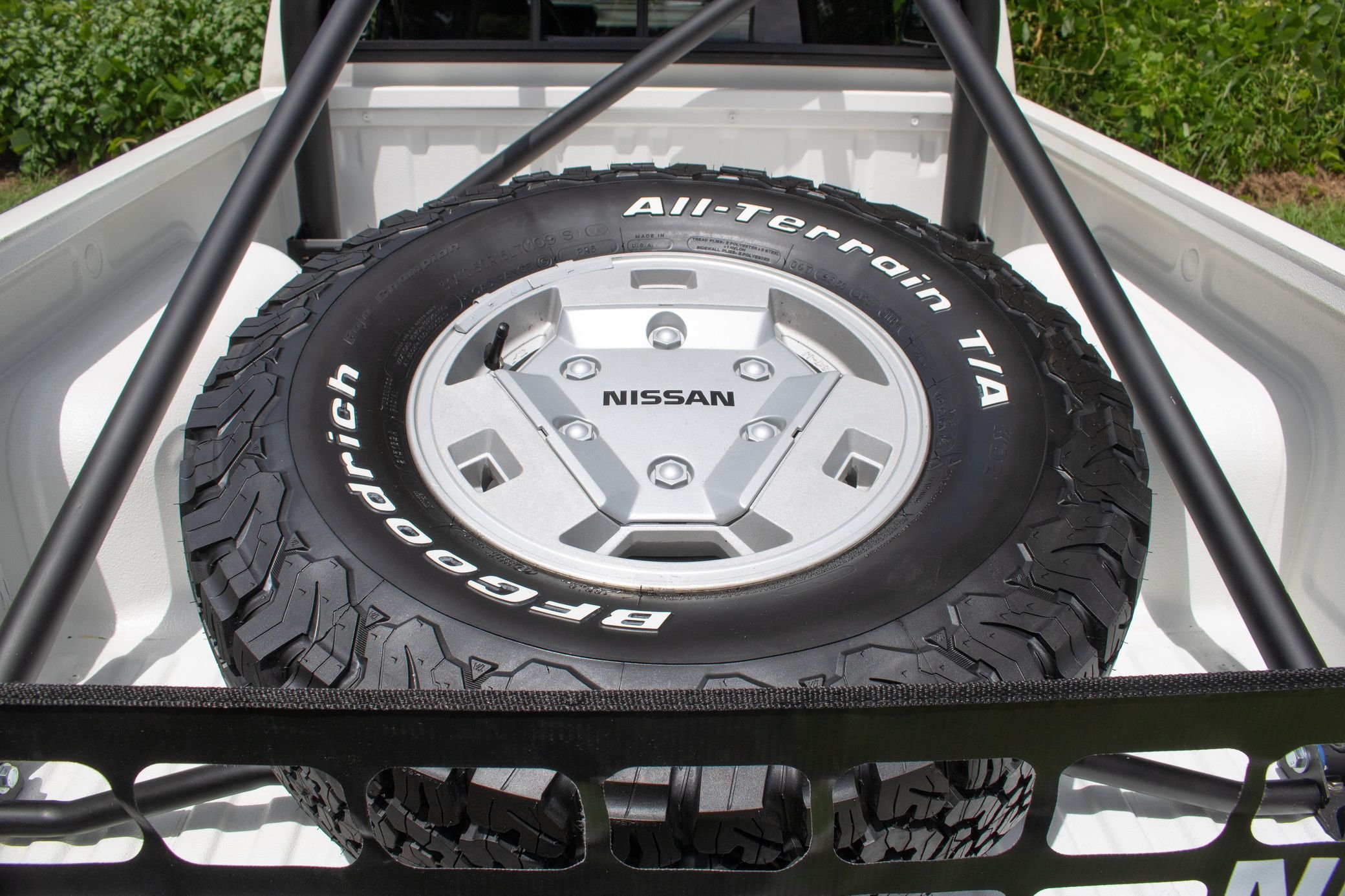
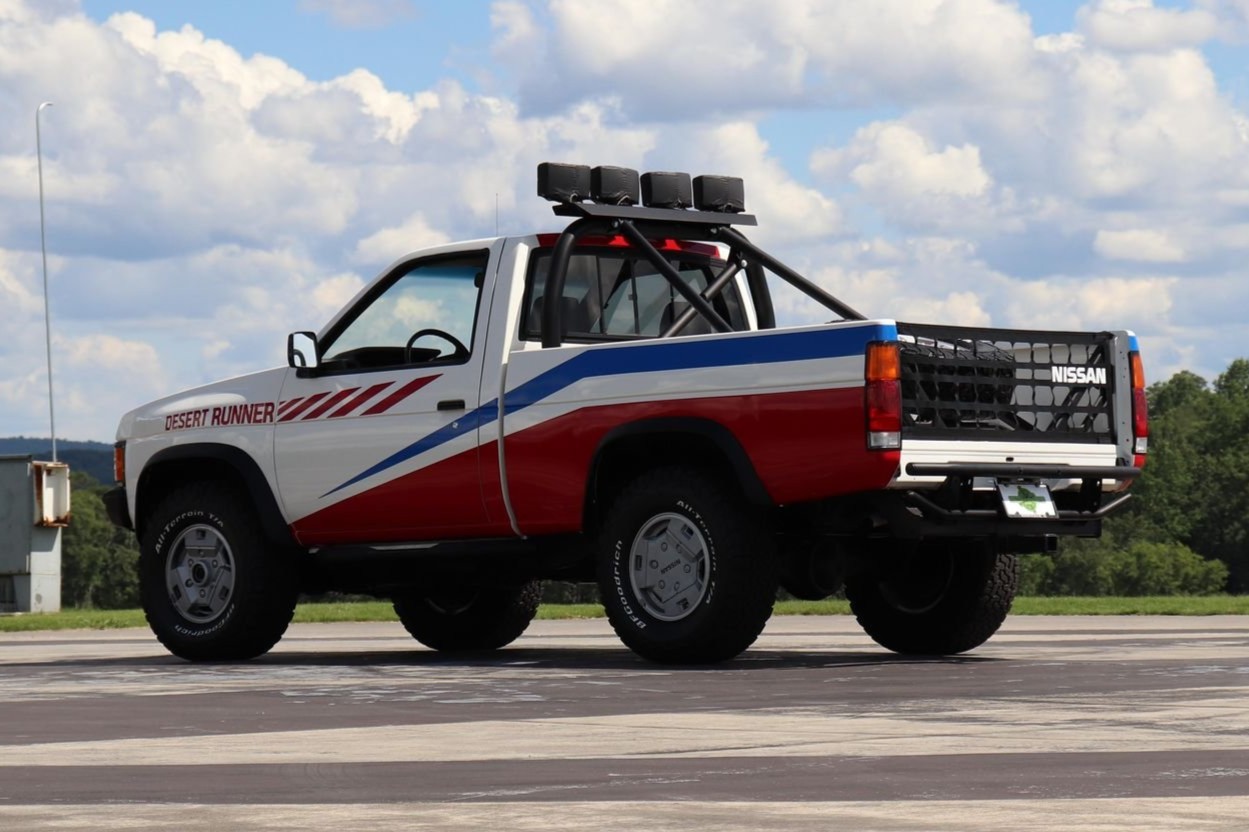
Like a desert racer, the Hardbody Desert Runner was all about going fast off-road and pretty much nothing else. The off-road kit of the special edition included 31-inch BFGoodrich tires, tube bumpers, side step bars, a front skid plate, a limited-slip differential, and rally lights in the front bumper and rollbar. Nissan said that the off-road gear was good for 10.3 inches of ground clearance.
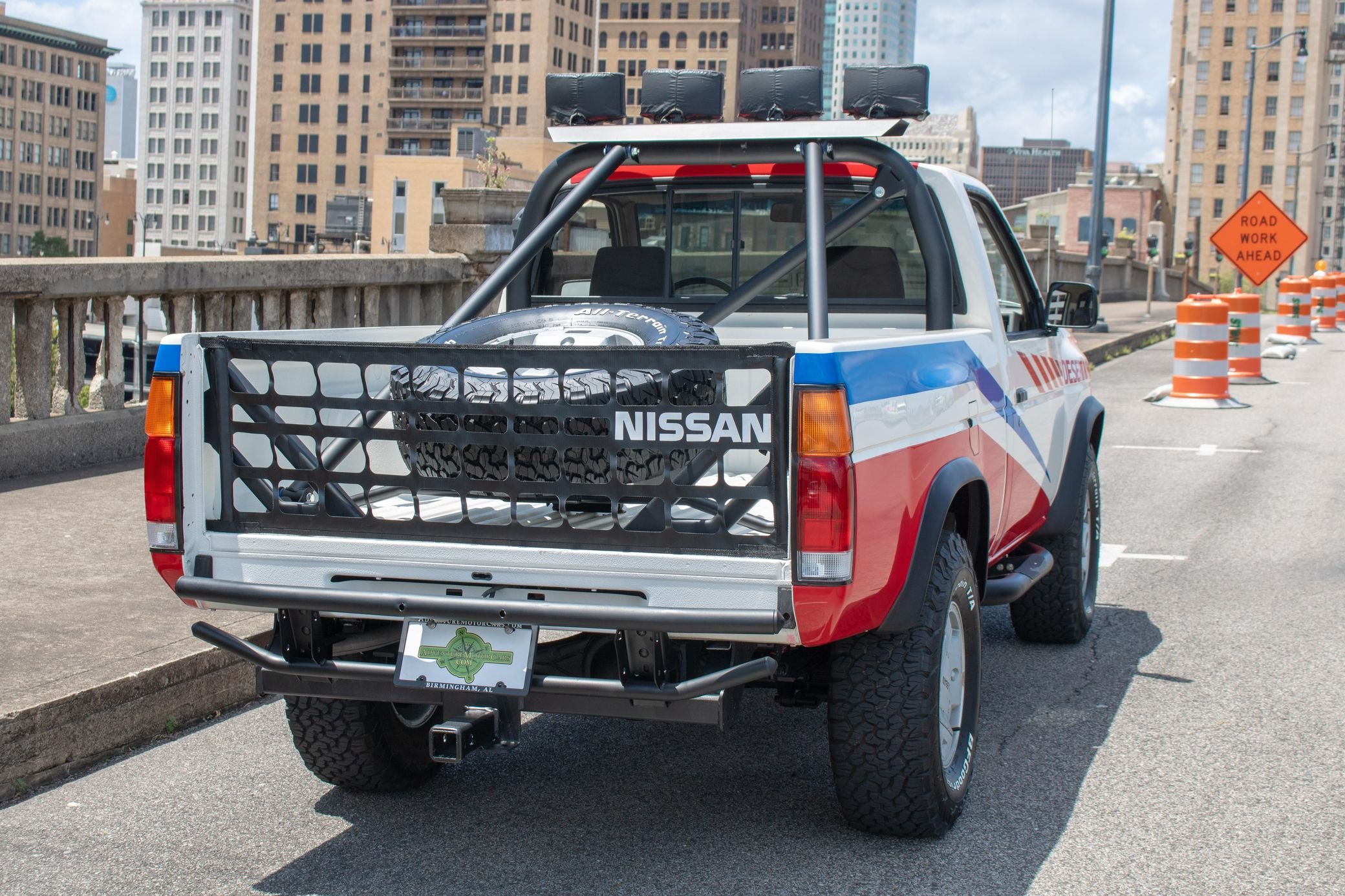
Nissan couldn’t leave it there, and really leaned in on the desert racing vibe by deleting the tailgate for a net, mounting the spare tire right there in the bed, and equipping the truck with the hotter engine choice that year, the 145 HP and 164 lb-ft of torque VG30 3.0-liter V6. This came paired with a five-speed manual and four-wheel-drive system with a two-speed transfer case.
The comfort features were fascinating by themselves. You got full instrumentation and full carpeting to go with your cloth seats, but the radio and air conditioner were options. Standard, and Nissan joked that this was the most important part, was a rack to secure your cooler of cold snacks. Only three options were offered in the Desert Runner, and they were an automatic transmission, a radio, and air conditioning. Despite a deep search, I could not find what the original MSRP of the Desert Runner was.

In essence, you got a pickup truck that couldn’t haul anything but its own spare tire and a cooler, but in exchange, you got Nissan’s ultimate dirt toy. Oh, and you got it in Nissan’s official racing colors. In a way, the Desert Runner was like a Raptor decades before such a truck even existed. But it also wasn’t that unheard of even back then, as Nissan’s mini truck competitors also built their own special off-road trim levels. But so far as I can tell, nobody went as hard as Nissan did.
I could not find a period review of the Desert Runner, but it’s not hard to imagine what one is like. Take the ruthlessly dependable Hardbody, then make it hot with big tires, flashy graphics, and that slick bed arrangement. What’s not to like? The off-road parts don’t seem to hurt that durability, either. The lowest-mile example featured on Bring a Trailer had 118,000 miles, and more than one example had over 200,000 miles.
It also looks like you wouldn’t even spend that much money on one of these. The most expensive example on Bring a Trailer was $16,670. Granted, that one had 215,000 miles, and I’d expect a low-mile example, if one exists, to cost more. But that’s not bad for a classic truck.
The Coolest ’80s Mini Truck?
So, if you’re looking for the perfect ’80s mini truck, and you don’t want to make yet another replica of the Toyota from Back To The Future, maybe a Desert Runner is in your future. Sure, you’ll get a truck that hauls more beer than plywood, but you’ll probably get looks everywhere you go, and have a platform that can still be tons of fun in the dirt today.
Sadly, the Desert Runner seems to be a bit of a one-hit wonder. The Frontier got a Desert Runner off-road trim level in the 2010s, but that was rather mild compared to the Hardbody Desert Runner. I suppose the closest modern equivalent would be the Frontier Hardbody Edition, which gets a little closer to the old Desert Runner in spirit.
I miss when automakers used to go this hard for their special editions. Forget blacked-out badges and a special color, as you might get in a special edition today; Nissan had the gumption to delete the tailgate, fill up the bed, and emblazon the thing in a racing livery. And you got it solely with a manual transmission and a regular cab. Honestly, I would love to see something like that happen today with any pickup truck.
Top graphic image: Nissan


I had an ‘86.5 the only year they offered a regular cab short bed V6 5speed. I got one. It was so much fun. 10 years and 186k miles and it still had the original clutch. Ran perfectly, everything worked. It was rusting away by then though.
Manufacturers really need to bring back awesome graphics packages for trucks.
I’ve always loved these trucks, IMO the best looking of the 80s/90’s minitrucks. I also thought it was very cool that these and the Pathfinders could be had with 31×10.50 tires stock, which was a big tire at the time, especially on a truck this size. That wheels design is killer too, it’s up there with the Toyota truck alloys of the time as my favorite wheel designs ever.
Those factory wheels are sick AF.
They’ve unfortunately disappeared, but there used to be yearly New Car Guides (?) which listed MSRP for every vehicle sold in the US, for all trim levels and including all available options. I don’t recall where I bought them, but in the early-mid ’90s I loved those things. I spent more time than I probably should have spec’ing out my Porsches, for which about a quarter of the book was dedicated too.
They’re damn near impossible to find now, but that would be a good place to find option prices.
My first car was a hardbody Pathfinder with the same oh-so-rad 80s “Lego wheels”. To this day, it’s still one of my favorite wheel designs from the era.
The S-10 Baja was Chevy’s equivalent, and it went pretty hard at this look too. Also had a roll bar and a bed mounted spare. I’d love to own one of either, they’re just so freaking cool.
I’ve never owned one, but I’ve always had a soft sport for the Hardbody. When I turned 16 in 1997, the local dealer was advertising base models for like $7,800. I had half of that saved, but couldn’t convince my dad to help me with the other half.
Buddy of mine in high school (decades ago) had a hardbody. That thing was literally unkillable. He’d always rub it in to the students who had old beater American pickups that they were all soft bodies. Fights were had and I brought the popcorn.
Look at the fantastic long truck beds in those old pictures. Actual useable bed space.
Also I miss the day you could get a cheap new truck as a cheaper alternative to a car. Back in the 1980s it was not uncommon to send kids to college with a mini-pickup truck. They were cheap and held all the college crap and no back seats for trouble reduction.
Did anyone else catch the “loaded” versions of these trucks sold for less than $26k in today’s money?
Always loved the RoboCop styling on those Nissans. With a few simple lines it looked so much more modern that all it’s competitors of the time.
Could be fun to find a rust free one: Mine shold be a diesel manual 2WD King Cab.
Hardbodies are great! This is a very cool version that, until today, I didn’t realize didn’t come with a tailgate new.
I’ve always secretly wanted to buy a 2wd hardbody to drop and then paint in the same livery as the Desert Runner, though without the name on the side.
I think it was a Desert Runner on shitbox showdown a couple months ago, either that or a replica. I definitely voted for it. I love these things.
3 ‘Sadly’s. Check with your editor…
You must be fun at parties.
Ope! I’ve probably done worse before, as I have a known issue with repeating things. But at least it was only three times over 3,000 words. I have reduced the “sadly” count to just one.
The hard body trucks were so well designed that today, 40 ish years later, if they introduced a modernized version of it, im sure it would be a sales hit.
And on that note, I think if any automaker offered a nostalgia package with 70s or 80s themed color packages like this, they would be a hit. Actually maybe the Bronco Sport already does.
The full size Bronco does.
As anyone who knows me can imagine, I LOVE the Desert Runner. I’m a fan of ’80s Japanese mini-trucks, graphics, and the VG30. What’s not to love? If I’d happened upon one for sale at the right time, it might have even steered me away from my beloved Ram 50.
I love the look of the wheel in the bed, Baja-style. So much so that I threw together a reasonable facsimile for my road trips this summer using a ratchet strap and a spare American Racing sawblade.
We had one sit on our lot for almost a year. Everyone cited the spare tire location as their least favorite feature. I agree, it took up all the room. We finally wound up selling to a young guy for a song. He came from out of state because he said it was the only one he could find. It was harder to run down cars pre-internet. Sorry, for the life of me I can’t remember the price. I did drive it and it rode surprisingly well.
Exceptionally cool truck. I would love to own one.
As for the Hardbody itself, I’m not old enough to remember when they were first released, but I distinctly remember reviews from their last model year in 1997. Reviewers excoriated these trucks for having rear-only ABS, poor ride/handling, and few amenities. One particularly memorable review summarized these trucks as “ancient” and said something like “Nissan dealers are looking forward to next year when they no longer have to sell these turkeys.”
While I love these trucks, I appreciate them in the same way I appreciate any other classic truck – I think they are cool, but I also think they objectively kind of suck to drive and live with. As someone who (mostly) grew up in an era when pickup trucks were expected to be as civilized as a car, it is interesting to be reminded that there was a time when these trucks were the new, improved, modern option.
Oh yeah, I do not doubt that by 1997, these things were properly ancient!
Definitely. Not only were they 12 years old, but the ’90s were the decade when trucks transitioned from work tools to family vehicles. I know crew cab trucks existed before 1990, but they were rare. By 2000 crew cab trucks were a common sight. All vehicles changed a lot between ’85 and ’97, but unlike cars, they way trucks were used also fundamentally changed in that time period.
The ’97 model year Hardbody might have been 12 years old chronologically, but it was functionally closer to 30 years old when you consider how much trucks evolved during that time period.
I’m probably biased since I started with a 521, so the switch to ball joints and front discs and the addition of A/C and double-walled bed were all I could ever ask for. Crazy that it was roughly the same I4 shortblock, frame, and torsion/leaf suspension from 1968 – 2004.
A few months ago I bought a friend’s beloved low-miles 1997, and even my spouse likes driving it. Gotta do the lower ball joints though.
I was a teenager then, and I remember the release of the Frontier in 98 was a HUGE deal for them. Then they came out with the crew cab with the Xterra style roof rack and people went wild for them.
I bought a 1995 new off the lot for $10,800 (4×2, 5MT, regular cab value truck package) with 21 miles on the odo. Over 13 years and 150,000 miles I only had two issues: The speedo died at 36,300 miles and both battery cable connections rusted into Tracy Bites and had to be replaced around year 11.
What an odd coincidence that a local guy I know that has 2 D21 Hardbody trucks just picked up one of these. It’s rusty and missing the bumpers and roll bar but what a cool truck! Those parts can be replicated and replaced. I gave him my D21 Ironman Stewart Tyco slot car version of the Baja D21.
These were the best styled mini trucks of their era IMO. Probably helps that I had a Tyco 9.6V Turbo Bandit R/C version of one of these as a kid.
But it always bugged me that the front and rear center caps mismatched due to the locking front hubs. Nissan themselves addressed that on later models.
YES! I had that Tyco Bandit too, haha.
Saw a Hardbody parked in my neighborhood walking the dog yesterday. Such a good looking little truck.
Dream garage would have one of these and a Marty McFly Toyota Pickup…and a poster of Kathy Ireland on the wall.