


I’ve been trying to crack to code for the last four years here at The Autopian. What could Cadillac have done in the early eighties to make an affordable and sensibly-sized car to bring in new buyers but still have a car with the qualities that made a Cadillac and Cadillac?
I’ve proposed a number of solutions, but I know now that the answer was a best-selling GM product that was right under our noses the whole time. No, it wouldn’t have been sophisticated or world-beating, but it would have pleased buyers and bean counters alike. Let’s try once more to make a better Cimarron.


Imagine if Toyota had made a Lexus based on something like a Corolla, Tercel, or even a Yaris. How do you think that would have gone for them? Thankfully, they made an entry-level car out of a Toyota Camry (and later the RX crossover that shared a lot with the Highlander) which turned out to be their best-selling products and money makers by far.

On the other hand, General Motors really did make a Cadillac Corolla in the early eighties: the much-lambasted Cimarron-version of the J-Body Chevy Cavalier. What were they thinking?

How could they not have taken a product that would have been far better suited to wearing the crest-and-wreath logo and, more importantly, justify a Cadillac-level increase in price? Something smaller than a big Fleetwood but not as expensive and less sophisticated than the crowned-jewel FWD Eldorado and their other big eighties flub-up, the bustleback Seville?
I think I have just the car that would have been like printing money for Cadillac around 1980: the much-loved G-Body.
This Is What The Word “Hubris” Means
The big question many might have is how the hell the Cimmaron ever saw the light of day in the first place. The impetus for this embarrassment was almost certainly the success of the 1976-79 Seville. Based on the proletarian X-Body (Nova), this “international sized” car was aimed at Mercedes-Benz, Rolls Royce and other understated-looking European rivals. With its crisp lines and minimalistic detailing, it attracted the well-to-do despite the fact that under the skin it wasn’t nearly as sophisticated as the rivals from Stuttgart.

The Seville was by far the smallest product you could buy from Cadillac at the time, yet they stickered it as their second most expensive car, just below the massive factory Fleetwood 75 limousine.

Despite the absurd price, Cadillac seemingly couldn’t build enough of these dressed-up-and-polished Chevy Novas. This, naturally, sent the absolute wrong message to GM’s top brass who now thought they could do the same thing with any old compact or subcompact sedan and have a Euro-fighting winner. Enter the Cimarron:

We’ve beaten this dead horse a lot, but the Cliffs Notes of the story is that nobody wanted to pay twice the price of a Chevy Cavalier for one with a Cadillac grille, different taillights, ever-so-slightly changed interior, and literally nothing else.
As I’ve explored before, there were plenty of other competitive options GM had from their overseas divisions to convert into worthy “international” Cadillacs. I’ve already shown the Cadillac Cantata–a Bitter SC-style Opel Senator sedan to be made in Russelsheim and imported to America:

The Opel interior would have been lightly modified Cadillac style but kept most of the German bits.

I even made a second-generation Cantata with Pininfarina Allante styling on a later German Opel Senator chassis as a sedan, hardtop coupe, and four seat convertible:

There was also a station wagon edition…

..as well as a V8-powered M-style sport sedan:

If GM had wanted to go more traditional with a smaller but still rather sizeable car in the early eighties, they could have gone Down Under and brought a V8-powered Holden-built Statesman luxury sedan over here, as shown in the alternate universe 1980 Seville below:

Naturally, General Motors did none of these things, and I can guess why. As much as these imports would have given them far better and highly credible small Cadillacs, the shipping and exchange rates combined with federalization cost would have made them not nearly profitable enough for GM (as proved by the insane 747 “air bridge” production of the failed Allante). No, they needed to use a domestic (or Canadian) built platform to work with; one that was smaller than a “standard” Cadillac but not clown-car sized. Enter GM’s best mid-sized rear-drive car ever.
Nuthin’ But A G Thang Baby
A lot of Autopians (like our Jason Torchinsky) don’t understand the worship of the “Tri Five” 1955-1957 Chevrolets; to many of us under the age of boomers the real GM car to put on that pedestal is the 1977-91 B-Body full-sizers or the car that followed that one into the “downsizing” program in 1978: the GM A/G-Body. The A/G drove deceptively well for what amounted to a rather spacious “mid sizer”, providing a comfortable “big car” ride and easier maneuverability (it’s actually half a foot shorter than the current Charger and the same size as a Genesis G80). It was a little bigger and heavier than its archrivals from Dearborn- the Fox Platform sedans- that were somehow more European feeling than old school American.

The only real issue, as we’ve stated many times before and will continue to bitch about, is that the rear windows did not roll down.
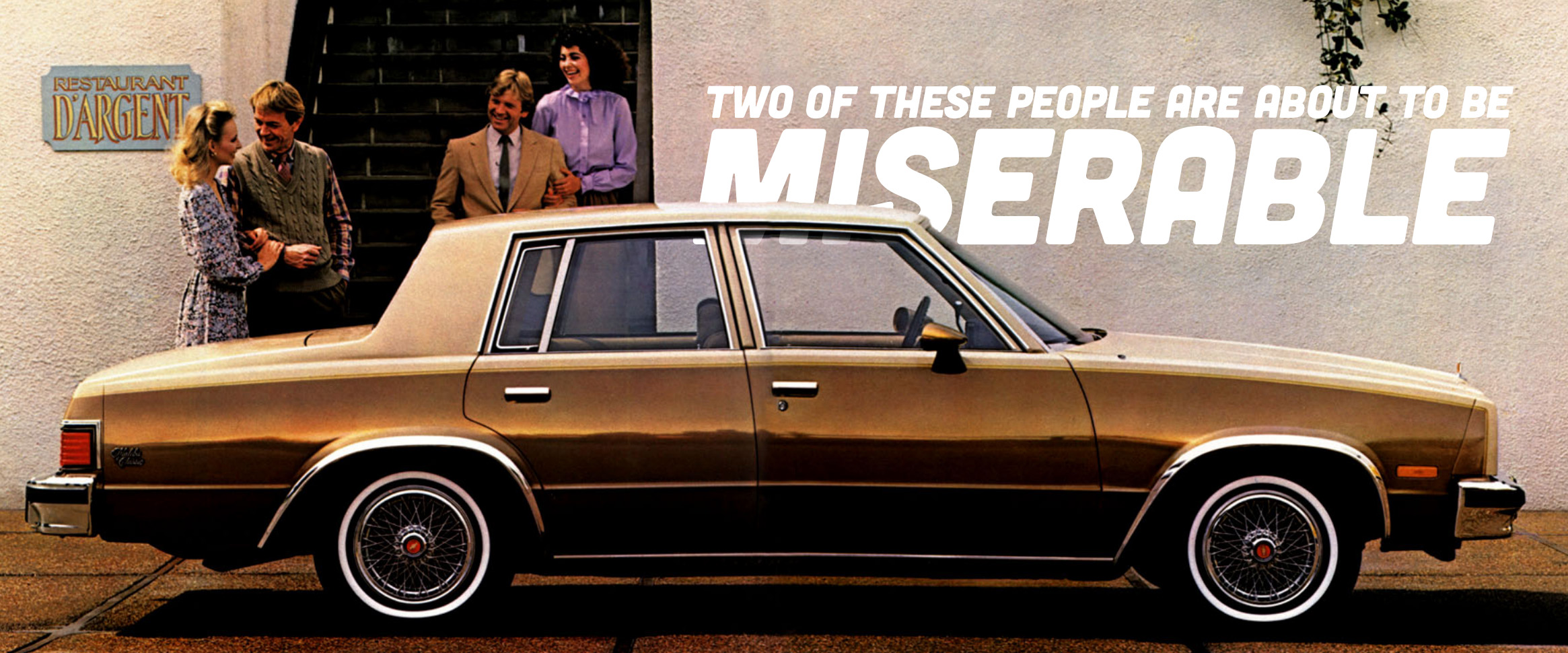
Offered as the Chevy Malibu, Pontiac LeMans, Buick Regal/Century and in endless versions of Olds Cutlass, the top-20 best-selling cars list in America was often made up of at least five of these A Bodies, later called “G” after the new FWD Celebrity/6000 cars essentially replaced them and became the “A”. Well, they were all successful except for the early “fastback” ones that tanked in the sales department:

A variety of V-6 and V-8 motors were available, all of them with rather pitiful malaise performance figures. None, of course, were as pitiful as the infamous diesel V8; however, look at those whopping fuel economy figures it got when it when the head bolts still held the heads in place (they didn’t for long).

Say what you want about malaise-era General Motors cars, but these things were almost as indestructible as the larger B-Body cars, if not more so. Our own BMW-and-Porsche-driving Thomas Hundal’s first car in 2014 was a three-decade old Cutlass (gasoline, thank God).

He no longer owns it and probably wrote it off for dead but, sure enough, a few years ago he saw his old ride daily driving the salt-covered Ontario strerets that it had been since the early eighties.

I could give you many more stories like this, including the vaunted Chicago Cutlass:

The durability and quality (well, quality relative to some other GM products) is great, but best part about using the A/G-Body as a Cadillac might be the size. Take a look below at the “full sized” C-Body the silly J-Body Cimarron. What were they thinking? The A/G is exactly the length and width of what a “near” buyer would have been looking for in the era of high gas prices, higher interest rates and a recession economy.

Also, the “J car” was a rather underpowered (even for the time) and subpar econobox while the A/G-Body had essentially all of the qualities of a “real” rear drive Caddy but in a more efficient size. Let’s give it a try; it’s not like would could do worse, rught?
This Cutlass Went To Finishing School
We’ll start with the notchbacked formal-rear-window version of the A/G Body four door for our Cadillac Centaur; essentially, it’s the 1980 Cutlass or Buick sedan. The size is really fine as-is ,but I’d like to pull the wheelbase a few inches longer and put all of that extra length in the rear doors and back seat. Slightly more overhang in front and a Cadillac grille tapers back into the hood bump that fades outwards into the beltline of the car. No vinyl roof on this example below, and you’ll note that the “opera” lights are just subtle things buried in the B pillar. I know wire wheel covers would be the primary choice but I added aluminum wheels from a Holden.

Here’s an animation of a G-Body Pontiac (called the Bonneville here and the Grand LeMans in Canada) transforming into a Caddy Centaur. Note the wheelbase change and nose extension to make the owner feel like they were piloting something more than a Malibu:
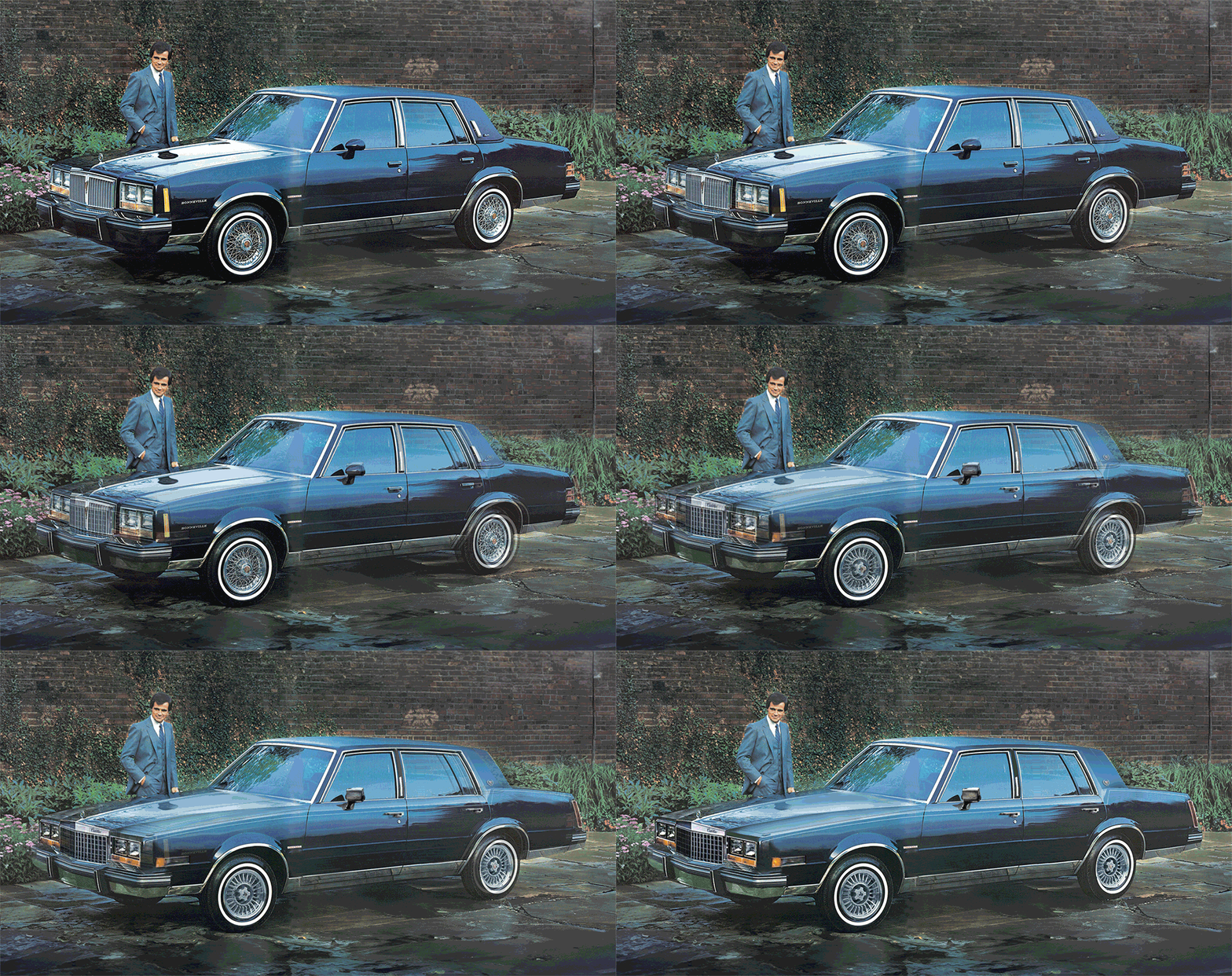
The rear window is slightly more upright, and I’ve added raised quarter panel “shoulders” similar to what’s on the concurrent Eldorado coupe. Vertical Cadillac-style taillights finish off the back.
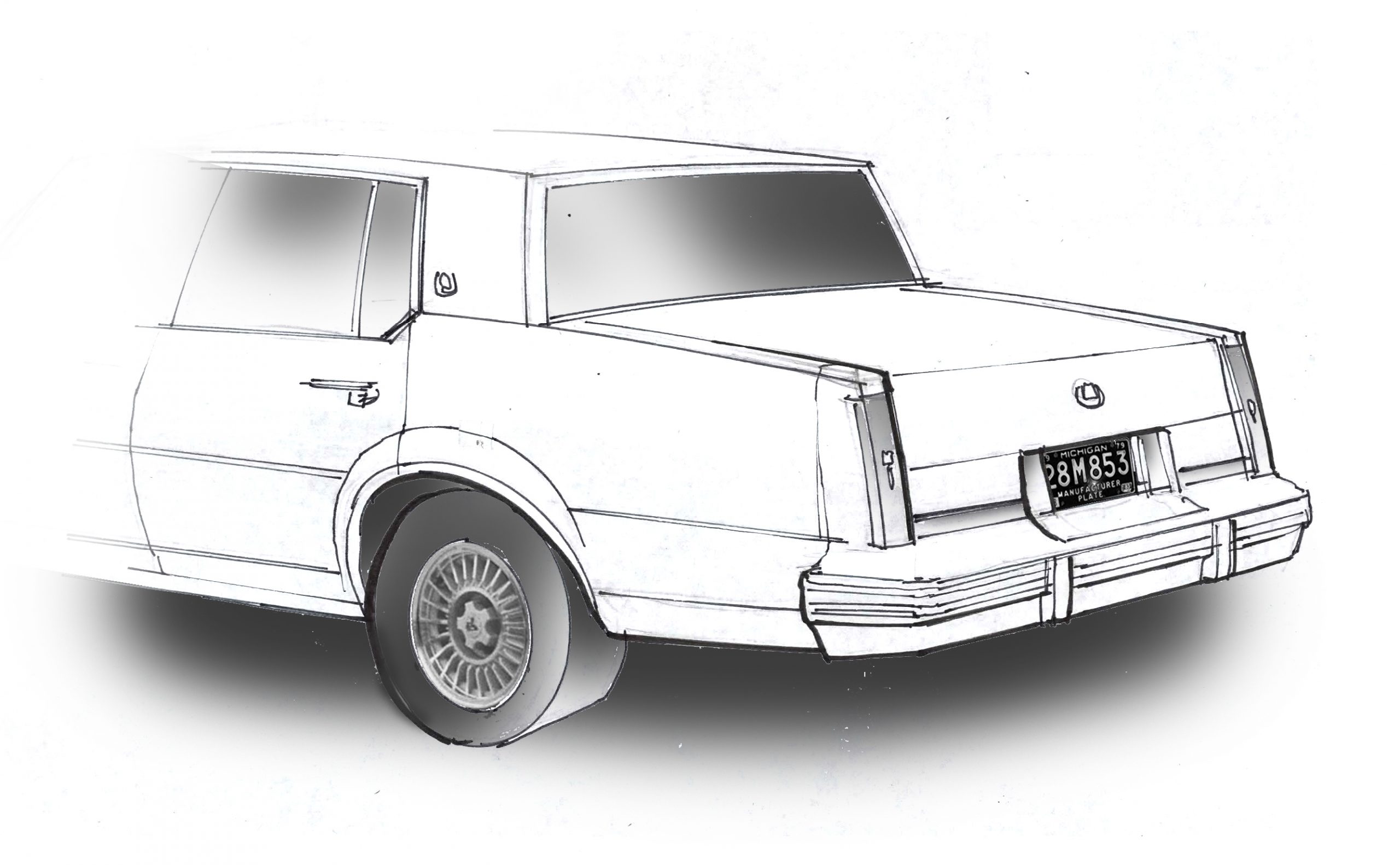
It obviously looks similar to other GM products, but then that was part of their whole modus operandi of the time. Also, such a car would not step on the toes of the upper-level Caddys so there would still be incentive to make more seasoned and monied buyers move up to a DeVille or a Seville. That would have been those buyer’s loss: the Centaur would have offered almost all of the ride comfort and space of the bigger, more expensive cars but be much better to drive. Yes, a V6 would likely have been standard, but most Centaurs would have come with the five-liter (305 cubic inch) Chevy V8 under the hood. The EPA standards would likely have deemed the gas 350 too thirsty, but do know what the third optional engine would be? Yes, you already zoomed on the logo stuck behind the front wheel, but you don’t want to say it: the 5.7 liter Olds diesel! Hey, these later diesels weren’t nearly as bad as the first ones, and it wasn’t like a Mercedes 240D was any kind of rocket ship. I’d hope that four-wheel disc brakes could have found their way onto this thing.
Still too much of a barge for your tastes? Fine. It’s a G-Body, so you know that means any of the bits from a Monte Carlo SS or even a Buick Regal T-Type (cough, Grand National, cough) would bolt right on. Apparently, that’s why our own Thomas Hundal bought one since the possibilities of creating a latter-day muscle machine were endless. Hey, Cadillac could even have offered a version with an F41-style suspension, trim blackout, no whitewalls, bucket seats and a floor shifter. Oh, and a Buick 3.8 liter intercooled Turbo under the hood. I wish. Anyway, here’s the Centaur “Touring Sedan” before you commenters badger me for it:

Inside, I’ve used the Pontiac LeMans/Bonneville G dashboard and modified the area inside the padded frame with a Cadillac-like instrument setup featuring digital gauges with a trip computer. Base model Centaurs would probably get a similar looking panel but with analog gauges and your standard GM three-slider climate controls instead. Just the thing for wafting down the road with a Yacht Rock cassette playing through the four Delco speakers.
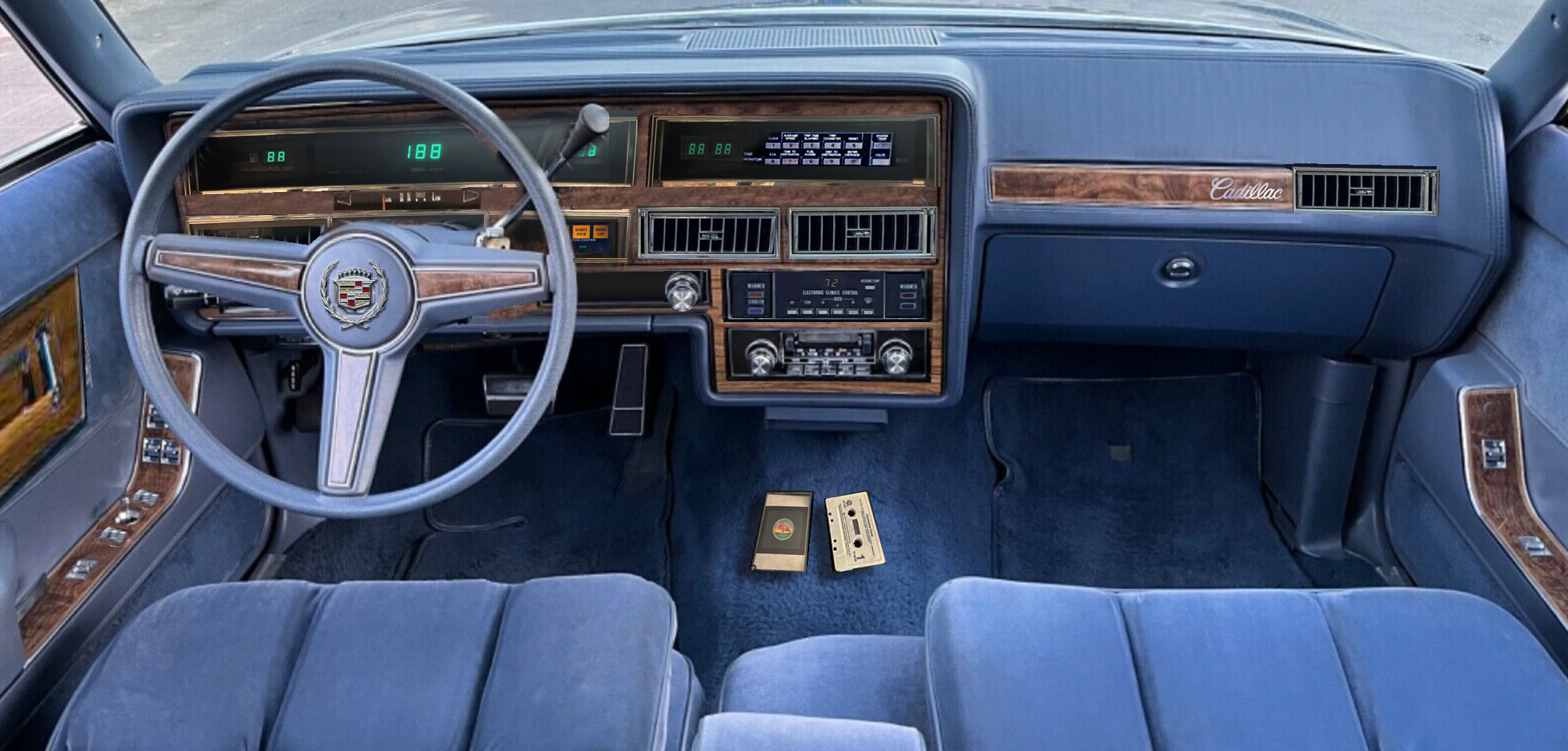
Seat controls move to the door panel, and yes there are four window switches on the driver’s door! The need to make new, stretched rear doors would be an opportunity to make the rear windows roll down like on, I don’t know, every other four door car on the market?
Knick Knack Paddywack, Still Ridin’ Cadillacs
Make no mistake: the 1980 Centaur wouldn’t have been a brilliant all-conquering sport sedan to make the BMW 5-Series irrelevant, but neither is the Lexus ES series. However, nobody that owns an ES350 has to convince their friends and neighbors that they’re driving a Lexus; Cimarron drivers even needed to work hard to convince themselves. The Centaur wouldn’t have had that problem.
As a fellow former big American iron owner like Thomas, I can see the strange appeal of this kind of machine. If you have a Real Job and walk out to your car from the office in the dark past seven o’clock after a crappy day, there’s nothing quite like seeing that big chrome-covered box, opening the door to about six dozen courtesy lights and knowing that this big cushy velour-lined ride is essentially going to waft you home over potholed suburban streets while you sort of give it a suggested direction with one finger. A Cimarron didn’t provide that, but the G-Body absolutely could have in a relatively affordable, medium sized package that ran forever.
Best of all, it would have been a Cadillac.
Topshot source: General Motors


The OG Seville was not an X-body, despite being based on that car. Unless you had a Nova and a Seville side-by-side on a hoist, you’d never know the bones were the same. That helped its success.
The Cimarron was 99.9% Cavalier. Even Ray Charles could see that. That’s why it was a failure.
This splits the difference. Is it that much better than a Regal or Cutlass Supreme? I don’t know how buyers would have felt.
Exchange rates aside, the mid-size Cadillac should have been based on an Opel or a Holden, like you’ve showed us before. That’s the best path to a BMW/Audi/Peugeot/Volvo/SAAB fighter.
This is what the 2nd Gen Seville should have looked like rather than that bustle-back mess – all this would have fit on the E Body platform just fine, which also had the same V6 and Diesel choices.
As far as the Cimarron – The issue with that car is that Cadillac did a Versailles with it.
If Cadillac had done the Seville thing with it – giving it different sheetmetal, including a distinctive roofline and an upgraded dash (even the Buick/Olds J Body dash was better than the Chevy/Pontiac dash the Cadillac got) we may still be referring to the Versailles as the punchline….
The bustle back wasn’t unpopular at the time. Maybe not as popular as the 71 Buick Riviera, but the 1981–1983 Imperial imitated the look, as did the 1982–87 Lincoln Continental
Generally when customers buy your products, and your competitors imitate them, the consensus is that that it’s not a mess.
“The bustle back wasn’t unpopular at the time.”
Let’s look at the actual Seville sales numbers, shall we?
1st Gen:
Year Total
1975 16,355
1976 43,772
1977 45,060
1978 56,985
1979 53,487
2nd Gen:
1980 39,344
1981 28,631
1982 19,998
1983 30,430
1984 39,997
1985 39,755
Clearly, the first Seville was quite successful – bringing buyers over to Cadillac from Mercedes-Benz. The second Seville actually repelled buyers – sending many back to Mercedes-Benz.
As far as the others:
Lincoln sales had nowhere to go but up from Versailles – while Imperial sales were dismal by any account..
Just because Chrysler and Ford followed the trend doesn’t mean it was a success.
There was a severe recession in 80-82, along with the 18% interest rates that eventually broke the back of inflation.
Reagan’s recession was July 1981-Nov 1982 – Exactly where you see the dip.
People who buy the most expensive Cadillacs generally don’t lose when there’s a recession and high interest rates. They make more money because their bonds pay them more interest, and they can snap up more valuable assets when they’re cheaper.
Yet outside of those years – 2nd Gen Seville still sold fewer cars during it’s best year than 1st Gen sold during its worst full year.
(1975 was a partial year as Cadillac ramped up production and only sold Silver cars).
While 1st Gen Seville buyers were largely already Cadillac owners who wanted a smaller car, 15% of 1st Gen Sevilles went to people who traded in a luxury import. Then during the early 80’s, while many 1st Gen Seville owners traded for an Eldorado due to it’s more attractive styling, 15% of people who had 1st Gen Sevilles went to Mercedes-Benz, BMW, etc. for their next car.
A better idea than the Cimarron for sure, though I’m not sure a lower end car was a good idea for the marque, either way, and the mileage wouldn’t have been that great. The Cimarron only made any sense if CAFE had applied to the brands individually, but I’m 99.467% sure it was applied to GM as a whole.
The thing is, a brand like Cadillac should not be thinking about building cheaper and affordable cars in the first place. That was the job of other brands under the GM umbrella, and just diluted the already suffering Cadillac brand even more.
In the 60’s, Cadillac was on par with Rolls-Royce, and in legit competition to be the finest luxury sedans in the world. They pissed that away chasing volume in the ’70s, and by the ’80s they were just sad rebadges.
I was thinking that late 70s and 80s GM was incapable of building a car worthy of the Cadillac name.
I think you are right. The very early 70s cars seemed to be good, but once they downsized they seriously lost the plot, and even before then the quality was supposedly going to Hell.
My parents had a early 80s Sedan de Ville – diesel. The only benefit it carried was when my county was struck by a huge tornado in 1984 (one of my teachers was killed.) My stepfather wanted a look at the damage and the police let him drive through the barricades because they thought he was with the insurance companies.
They sold it after a brief ownership they sold it and bought Volvos.
One of several nails in the Cadillac coffin engine-wise. That horrid Oldsmobile diseasel. The V8-6-4. The gutless Olds 350 gas V8, then the MORE gutless 4.1L aluminum V8, then the fabu-LESS-ness that was the Northstar. Amazing they are still around, all things considered.
I think the big RWD Caddies were dead before the Caprice and the Olds Roadblaster got the LS v8, yes? They died with the 4.1? Or did those barges actually get a decent motor the last few years too?
I believe the last 1992 Fleetwood Brougham (which had a whale-like body similar to the Caprice) had the LS V8
I forgot (probably intentionally on the part of my subconscious, because yuck) about those.
The 1994-1996 Fleetwood Brougham got the LT1 V-8, which was a (transitional) engine distinct from the LS series. No General Motors B-body, C-body, or D-body ever received an LS V-8 (from the factory).
The early 70s was when the quality drop became really noticeable, GM had aggressive volume goals for Cadillac, and they started cheaping out on materials to speed production and increase margins
Exactly why the quality dropped.
Chasing volume with a luxury brand rarely ends well.
Hate to say it, but it’s chock full of Fairmont vibes to the point I can hear Ford’s lawyers calling.
Columbo looks confused. Where is my Puegot?
Then someone could hang the Cadillac A/G body front clip on an El Camino and have a Caddy-Camino and predate the Escalades.
Wish I’d done a pic of that.
Dad considered himslef an Olds man. Bought a brand new ’77 Cutlass Supreme coupe when I was an infant. Was completely let down by the (lack of) quality control and rustproofing. Went to replace it in ’81 when my little brother was on the way. Was horrified by the lack of rear roll down windows and other cost cutting on the G-body (mind you – his 2 non- negotiables were A/C and an FM radio). Bought a Fairmont, then a Fox LTD wagon, then a Colony Park, then a Town Car, etc…. GM alienated a core customer with stupid decisions.
The hilarious part was that those fixed windows weren’t really cost cutting, though the saved cost was probably a bonus. By eliminating features here and there (IIRC they also had really small fuel tanks for the day, and some aluminum bits that probably actually cost more), GM got those cars down a weight class for fuel economy and emissions testing, allowing them to advertise higher EPA fuel mileage figures AND helping with their CAFE averages. There was a magazine article about it way back in the day I wish I could find.
Of course, it made absolutely ZERO difference in the real world fuel economy. Pretty much the most GM thing ever.
Not that the Fox-body was state of the art in ’78, but it was a damn sight more modern in many ways (and handling) than any G-body.
That platform certainly lasted a LOT longer.
Also that hollow doors supposedly allowed for the recessed armrests that gave a wider back seat for the rare times you carried three across there.
Another silver lining. Why not do that once you ditched the mechanism in the door? It’s free space.
My grandfather had been a loyal Oldsmobile buyer for years, except for a period in the 60s, when he was doing business with Chrysler, but, his last one was a 98 diesel, and that got traded for an Acura. If GM could make a WWII Pacific vet who still carried a chip on his shoulder about the Japanese do that, that Olds had to have been really bad
Or…GM could have kept the styling of the first generation Seville and modified it a bit. That would have been better than that bustle back monstrosity that came out in 1980 and still given Cadillac a mid-size sedan.
Irv Rybicki should have been hauled out of the GM headquarters and had his pension revoked for what he did to Cadillac in the 80s. Bill Mitchell and Harley Earl he wasn’t.
Actually, the bustleback Seville was the last complete new design Bill Mitchell signed off on before he retired. He had been wanting to do a bustleback shape for a long time and had considered something like that for the ’67 Eldorado
I’d just like to see the return of blue/wood interiors.
Or just wood trim in general. I have piano black in one of my cars and want it gone
I have a love/hate relationship with (fake) wood trim. It looks nice and is restrained in my high end ’13 Highlander, same in my ’05 MDX. I’ve also seen the worst of the worst GM/Ford/Chrysler crap. Dad’s ’85 Colony Park was almost hilarious, his ’90 Town Car actually somewhat restrained. Most egregious was my ’88 Regal. All the fake wood was a wonderful grey tone EXCEPT the steering wheel hub which was an awful yellow tone. Two days after buying it I ripped it off and spray painted a matching steel grey. How did this leave the factory this way???
Replacing the piano black garbage in my 128i with the (real wood) poplar trim from a 135i significantly elevated the look of my car.
Pretty!:
https://flic.kr/p/2k8HC8J
As a bonus, I sold the mint condition piano black plastic for less than I paid for the wood. No accounting for taste or lack thereof.
That looks great!
LOL – I can’t type today – I sold the crap plastic for MORE than the wood trim cost me. It’s actually rare, as it was only used in really BASE 128i’s, nearly everyone got the optional wood or aluminum trim.
Long story but I ordered my late uncle’s W206 C-Class with wood trim. That was great.
Bring back wood on the interior.
I very much agree. So tired of shiny black plastic or shiny fake aluminum plastic.
This would have made so much more sense than what Cadillac actually did which was to come in late to the J-car program and to downsize the C-bodies too much so that by the time they came to market they were the wrong car at the wrong time.
Your Cadillac G-body would work if it was the smaller car in the lineup or it also could have become the traditional option for buyers who weren’t taken with the downsized C-bodies and generated some sales and revenue to pay for a proper C-body redesign to make them competitive in the luxury market.
I ran a Goodyear service center during the G body heyday. We cleaned up fixing it’s weak points! At 30k miles, the idler arm had play. The Delco shocks were leaking! Peanut oil? I tasted it! Lol the rear springs were a joke. You could remove them if the car was up on a lift just by pulling on them.
Therefore I stocked TRW 18799 idler arms, gas shocks Gabriel front and rear. Variable rate springs for the rear. AKA Cargo Coils!
Customers were well pleased with improvement in handling and felt good knowing the could put stuff in the trunk without bottoming out!
I’d take the customer out to the car with it on the lift. Do my presentation. Sell it. Go on the back room pull the parts, put em under the car and tell the tech…Fix It! Alignment took as much time as the parts replacement.
Those were the good old days!
Why not slap the HT4100 engine in it? It would probably be more suited in a G-body than in the other barges they put them in. And if you really want a diesel, how about the 4.3 liter V-6?
Because head gaskets and main bearing failures
I figured if we were being hypothetical here, we can go all out and assume it was a solid engine.
Or that they learned from the Vega, since the specs (iron heat, aluminum block) were pretty similar.
In typical GM fashion, the later production 4100s were much improved, but too late to save its reputation. It was also reworked into the 4.5 and 4.9, which were both solidly reliable
Gotta believe even the Cadillier might have been more popular if GM had resurrected one key Cadillac feature: the glovebox minibar.
Although the successful FWD A-body needed more differentiation between GM divisions, I think a decent Cadillac could have been made from it. Both the Buick and Olds variants had “luxe” or “sporty” trims and the market at the time was inclined towards FWD and better MPG. The G sedan was good but to me it was a 70’s car still being made (too) far into the 80’s.
“The only real issue, as we’ve stated many times before and will continue to bitch about, is that the rear windows did not roll down.”
If you bought the 2-doors like the Monte Carlo, Grand Prix, or Regal, or the 2-door versions of the other G-bodies, like almost everybody I knew did, you did not have to worry, or even know about this.
I remember being surprised the first time I saw a Malibu that had 4 doors. I just thought all of them were 2-doors, based on what I saw growing up.
There were a lot of four doors, but nobody seems to have saved them. Almost all the survivors I see today are the much-loved coupes
That’s pretty much the case with all 4 door cars of the 60s and 70.
I’ll throw in that the first car I drove was a 75 Monte Carlo, and I loved the downsized ones, particularly the MC SS. I finally had an opportunity to ride in a mid 80’s Grand National, and was quite disappointed. The big problem was the seat belt cut into my neck badly, making it uncomfortable to ride for more than a couple of miles (I was 6’5″ at the time.)
What have you shrunk to now? (sorry, I had to ask!)
No problem – 6’3″
I completely forgot there were 4-door Cutlasses. Maybe it was because they were so bland that they blended into the background, but I remember coupe Gs everywhere and hardly any sedans.
Maybe Olds would’ve sold more if they had the guts to put the coupe front bumper and grille on the sedan and wagon.
I wonder if it was intentional in that they wanted to move buyers to the FWD cars, so by making them bland like those, the better space efficiency and fuel economy of the FWDs could prod more old fashioned buyers out of the RWDs. Or maybe it was just GM rooting around in the dark knocking shit off shelves as they go.
Were there no police in your town?
The odd Mustang or Camaro pursuit cars aside, I only recall full size cars as police vehicles back then, so Caprices and LTDs.
The police drove Diplomats or Crown Vics.
This would have fit the bill better than the Cimarron. And would have made a solid basis for Caddy keeping RWD like Ze Germans the brand was chasing. Not for nothing did they get lambasted in the 1990’s for making FWD barges that had nothing to compete with Ze Germans. Their advertising be darned.
“Also, the “J car” was a rather underpowered”
The J car wasn’t underpowered for the era if it had the V6.
And I think if Cadillac had made the V6 standard in the Cimmaron in 1982, that would have improved its perception from the start. And it would have separated the Cimmaron from all the other J-body cars which didn’t get a V6 until 1985.
If they had made the Cimmaron a luxury ZR4 from the start it would’ve been better.
It also annoyed me that the Cimarron used the Cavalier dash. The Skylark and Omega had nicer, more contemporary dash designs. The V-6 Cimarron was finally decent just before, in classic GM fashion, they killed it.
A few design changes would have greatly differentiated the Cimmaron from the rest of the J cars. Maybe a slight change to the roofline and a new dash, instead of the Cavalier dash. However, what it really needed was:
A 2 liter, (dual, maybe) overhead cam engine with fuel injection
A 5-speed transmission with limited slip to eliminate torque steer
4 wheel disc brakes.
These alone would have made it competitive with the BMW 3-series.
I think the 5 speed didn’t become available until 1983. And at that time, GM didn’t have a DOHC 4 cyl version of the Family II series until 1987.
But they definitely could have done 4 wheel disk brakes and the V6
Also note that in 1982, the BMW 3 series being sold in the USA was still the E21… with no 6 cyl option.
So if they gave it the V6 from the start, it would have beat the 3 series that was on sale in a lot of ways.
The E30 came to the US and Canada in 1984… and I think the 6 cylinder 3 series didn’t come until 1985.
The US didn’t get the 323i E21?
No. Nor did Canada.
“The E21 was sold as the 320i in the United States from model years 1977 to 1983, first as a four-cylinder with a 2.0-liter engine, and from 1980 with a 1.8 liter version of the same. Six-cylinder models were not sold in America, because the E21 versions of the M20 engine did not meet U.S. emissions regulations at the time.[citation needed] The 320i models sold in the United States have a thermal reactor as a pollution control device. U.S. models came standard with air conditioning.”
https://en.wikipedia.org/wiki/BMW_3_Series_(E21)
If you were in North America back then and wanted a 6 cyl BMW, you had to move up to the 5 series.. with the 528i and (later) the 528e being the most common ones I recall seeing back in the day.
Interesting. One would have thought a six-cylinder 3 Series would be naturally suited to the US
The reason was the energy crisis. At the time, there were fuel shortages… so people suddenly became very interested in fuel economy.
Not that different from what we are experiencing today… but without the benefit of having good BEVs and hybrids as an option.
I think where the 6s would have had to have been so detuned to pass emissions back then, that few would have wanted to pay for the option, plus the extra fuel. The cars we did get from various companies were often pretty heavily turned down power-wise to pass US emissions. The EU didn’t require catalytic converters until 1993, but were mandated in the US in ’75 and those old emission systems sapped a lot of power in the days before decent computer controls.
I was reaching too far with DOHC, but GM had a European (“Family II”) 2.0-liter OHC engine available during the launch of the Cimmaron. They also had the Getrag 240/245 5 speed used by GM in Europe.
Not really. It still would have been a tarted up Cavalier.
And since people like tarts, that’s good, right? RIGHT???
GM had enough other brands in the 1980s that a cheap Cadillac didn’t make sense, then or now.
The best “cheap Cadillac” is a Buick or Oldsmobile.
They’ve been fighting back against the perceptions left over from going downmarket for almost 50 years now.
This is easily the most realistic option you’ve done, I mean, it is literally so close to GM’s corporate playbook, I really have to wonder if something like this was at all considered at the time, before some higher up stepped in and ordered them to do the J-body instead, and with a $40 budget for differentiation work
And now introducing…The King of the G’s!
*trunk-rattling Rap follows*
this G would indeed look good as a donk
I thought so. Or a SLAB. Or a lowrider if that’s more your thing. Needs rims, needs paint, needs the entire ‘hood to know what bassline y’all listenin’ to.
I too still can’t figure out how the big American 3 let their luxury brands fall so far behind the Europeans. This would have definitely been a better concept than the Cimmaron for sure but it still doesn’t address how they got it so wrong for so long.
Xenophobia played a part. Red blooded Americans dislike and distrust anything European and that was, if anything, worse in the 1970s.
That makes sense for part of it but my big stump so-to-speak is the American car companies seeing people willing to pay MORE for a smaller European car.
It always baffled me that European cars exist in this higher price point that the American companies didn’t even attempt to play in but that American consumers were more than willing to pay for.
Why wouldn’t GM or Ford want some of that Rolls Royce or Ferrari profit margin?
I was born in the 90’s and grew up in the 00’sso maybe the price differences weren’t so stark in the 70’s
“Stark” is a good word to describe the 1970’s, like “The Dear Hunter” made flesh.
That is because of our geography and construction. Bigger cars don’t fit so we stuffed the smaller ones with the goodies.
Oh I understand that completely, but these were Americans willing to pay more for a smaller car. Sometimes significantly more!
If I was an American car company, I’d want to do everything I could to get that piece of pie
You have to remember that American car companies were run from Michigan – Where foreign cars were not a thing, and excursions to hunt deer in the YouPee were as much a thing as golf.
Those guys had no idea what to do with them weird little Teryoters, Saaaaabs and AwwDees, if they’d ever even seen one in person.
Arrogance and ignorance makes sense. I’m always surprised by the amount of hubris in industry
Also part of the problem was the industry being based in the Midwest while the growth markets, trends, and $$ were on the coasts.
Hubris and incompetence, plus, in Cadillac’s case, about a decade of Roger Smith
Yeah, I guess I just can’t imagine that amount of hubris to ignore the rest of the industry
I do think, as the Bishop mentioned in the article, that management learned the wrong lessons from the first gen Seville. Yes, it was based on the Nova, but it was heavily and expensively modified to deliver a premium customer experience. The Cimarron, on the other hand, was a very efficient way to devalue brand equity. Somebody in the GM building must have lost every argument.
They became stuck in time, always catering to the wealthy retirees.
Being into cars as a kid in the last 70s and 80s felt strange. We knew everything was garbage but just could not do anything about it.
The only thing I’d add is that the wheelbase stretch needs to be let in just behind the frame in the door glass so the windows could finally slide into the door. Not being able to talk about Grey Poupon with the plutocrat in a nearby car just wouldn’t do.
But would that Caddy zig? The importanest question.
No, but it can fit a set of golf clubs in the truck.