


If you’ve spent any time in the Jeep Cherokee community, chances are you’ve heard of someone who’s dealt with a broken PTU or have dealt with one yourself. The PTU, or the power transfer unit, is a transfer case that transmits power from the transmission to all four wheels in KL-generation Cherokees. And from the start to the end of production, it’s been a huge headache for owners and Jeep. On Tuesday, Jeep issued a recall for faulty PTUs—the fourth such recall since the car went on sale.
Since Jeep began delivering Cherokees in 2013, owners have had to deal with PTUs, built by a supplier called American Axle (which currently goes by Dauch Corporation) that fail without warning, leaving drivers without motive power or the ability to put their cars in Park, sometimes leading to dangerous situations on the road.


Jeep tried to fix this issue with software before eventually replacing PTU units entirely. Despite knowing about the issue for years, the company has just issued another recall for PTUs built well after it first found out about the problem. And right now, there appears to be no clear, solid solution in sight for owners.
A Timeline Of Events
Let’s start at the beginning. The KL Cherokee first went on sale in 2013, but it wasn’t until 2020 that Jeep issued its first recall for the PTU, specifically part numbers 68090605AJ, 68090605AK, 68090605AL, 68282447AA, 68282447AB, 68282447AC, 68307403AA, and 68307403AB, citing no fewer than 839 warranty claims as the reason why the potential issue was flagged in the first place. It covered vehicles built from April 2014 to October 2016.
As far as safety recalls go, this one was pretty serious, as a failure meant that AWD-equipped Cherokees, which sent power only to the front wheels under normal driving conditions, could become fully undrivable. From that 2020 report:
Relative movement in the PTU between the differential input splines and the transmission output shaft may result in the teeth of the input splines wearing off, which may eventually cause a loss of engagement between the transmission and the differential inside the PTU. If this occurs, torque cannot be transferred between the front wheels and the transmission which results in a loss of motive power while the vehicle is in motion and a loss of the PARK function while stationary.

Rather than going through the costly and time-consuming task of installing new PTUs in the 67,248 potentially affected Cherokees, Jeep determined that a software update would be an apt remedy for the problem:
The remedy component will be a software flash that, if failure of the input splines occurs, causes a MIL to illuminate, rear axle engagement to prevent a loss of motive power, and electronic parking brake activation when the vehicle is in PARK to prevent a loss of PARK function.
While that sounds more like putting a tiny bandage on a deep, open wound than actually fixing the dilemma, it did solve the safety issue that prompted the NHTSA-mandated recall. At least with this software update, drivers wouldn’t be totally stranded should the PTU’s spline to the front wheels shear away.
Jeep issued an additional recall in 2023 targeting another population of Cherokees built between September 2015 and September 2016 that used a PTU with a “revised design” from earlier models. It involved 25,980 cars, cited the same internal spline problems, and used an identical software-based solution to mitigate the safety issue.
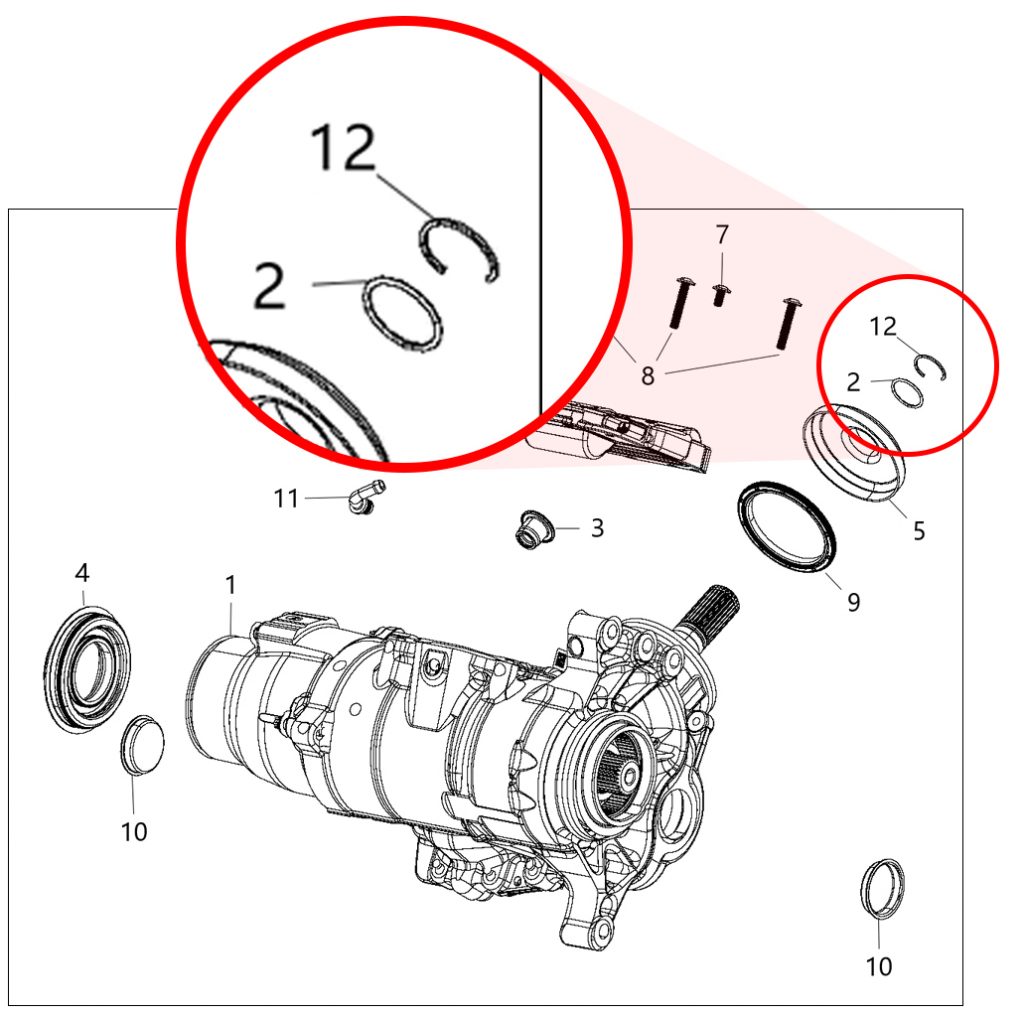
Of course, the drama didn’t end there. In 2025, Jeep issued another recall for Cherokees equipped with faulty PTUs, for cars built from October 2016 to February 2019. Targeting another 63,082 potentially affected vehicles, the problem this time around could be traced to an “improperly seated input shaft snap ring” that allowed for “uncontrolled movement of the input shaft inward.” This allowed the original spline problem to rear its head again. From the 2025 recall report:
Uncontrolled movement leads to the potential for wear to the range shift sleeve, spline damage, and / or range fork damage which can cause an unexpected loss of motive power or loss of PARK function while stationary.

For the 2025 recall, at least, Jeep’s solution was to actually replace the PTU with a new unit if it arrived at the dealership already broken (it would get a software update otherwise, per instructions from Jeep listed by the NHTSA). In the remedy section of the recall report, Jeep also mentioned that it would reimburse owners who paid for a new PTU out of their pockets.
Now, in May 2026, Jeep has issued a fourth recall for yet another batch of potentially defective PTUs. This one covers 61,711 cars built from December 2018 to February 2023, when production of the KL-generation Cherokee ended.
The safety risks involved with this defect are the same—when the PTU fails, the car can lose all motive power, and the Park function may no longer work. But the recall document doesn’t list a description of the cause. A Jeep spokesperson told me only that the PTUs “could experience an internal failure.” One could only assume this recall is also spline-related, given the identical safety concerns. That’s just speculation at this point, though.
These Poor Owners
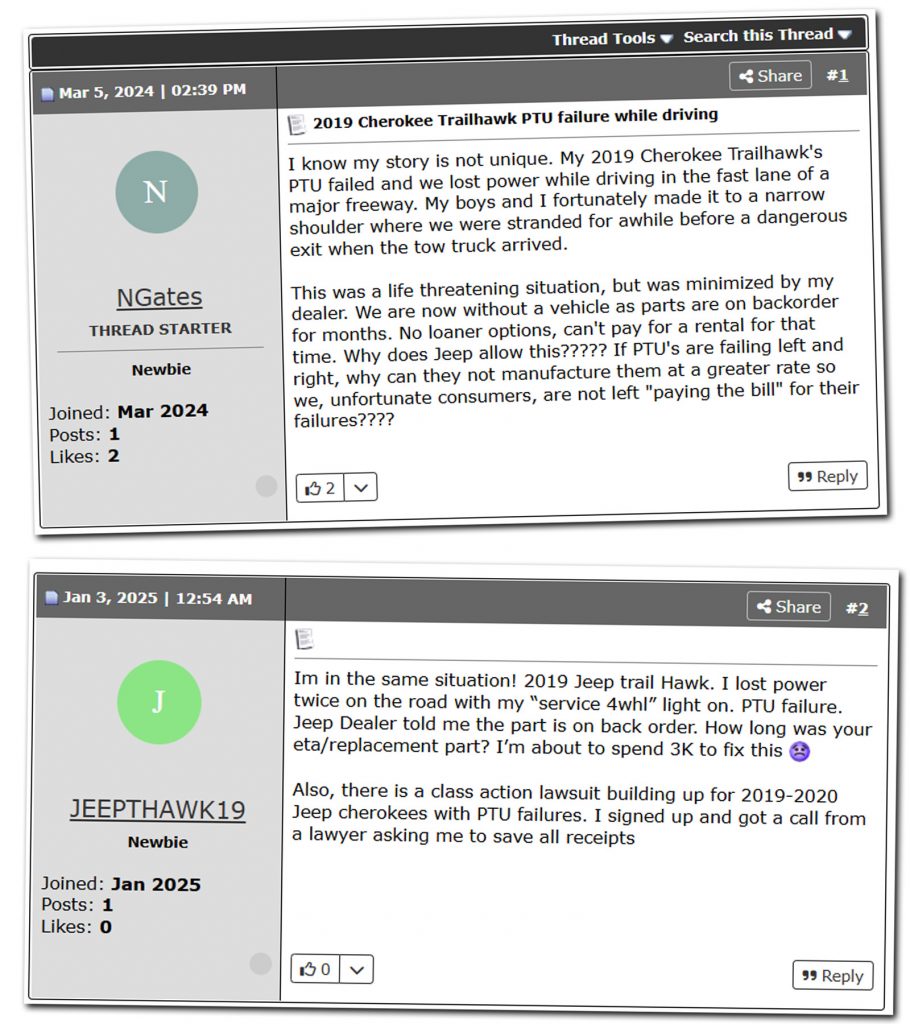
As The Autopian noted in our article on the snap ring issue last year, there is no shortage of Cherokee owners complaining about their PTU failures online, either through Reddit or on KL Cherokee forums:
Ultimately, you don’t have to go far to find owners frustrated with this situation. Reddit is full of stories of failed PTUs, with one owner complaining they had the part fail three times after repeat replacements. Similarly, over on Cherokee Forum, owners have shared tales of sudden and shocking failures. “My 2019 Cherokee Trailhawk’s PTU failed and we lost power while driving in the fast lane of a major freeway,” stated user Ngates in May last year. “My boys and I fortunately made it to a narrow shoulder where we were stranded for awhile before a dangerous exit when the tow truck arrived.” The upshot of their case was a long wait for repairs due to backordered parts, suggesting a significant demand on the supply of new PTUs.

It’s not like things have gotten better since that post was written. Another Reddit thread on the KLCherkoee Subreddit, published a few months ago, contains nearly a dozen more owners who claim they’re on their second or third PTU, voicing the same concerns about turnaround times and parts availability. Meanwhile, there are dozens of PTU failure-related threads on the JeepCherokeeClub.com forum stretching back years.
Why Does This Keep Happening?
When I reached out to Jeep asking how these recalls, which seemingly involve the same or similar failures, keep happening, the company didn’t give me an answer. Instead, a spokesperson provided me with a blanket statement reaffirming the latest recall information without touching on any of the previous recalls (emphasis theirs):
FCA US LLC is voluntarily recalling an estimated 61,711 U.S.-market vehicles to address a potential issue involving certain two-speed power transfer units (PTUs).An internal investigation
identified that some model- year 2019-2023 Jeep® Cherokee vehicles may be equipped with PTUs that could experience an internal failure. In rare circumstances, this condition could result in a loss of propulsion at any speed or allow a vehicle to roll while in PARK. If the condition occurs, drivers may notice a “Service 4WD” message on the vehicle’s instrument cluster, unusual driveline noise, vibration or a change in drive quality.
The remedy is currently under development. Affected customers will be notified when service becomes available and will be advised on next steps at that time. Until then, customers are reminded to use their parking brakes, as recommended in their owners’ manuals. In the unlikely event of a loss of propulsion, drivers can maintain steering and braking control and bring the vehicle to a controlled stop.
This response leaves me with two questions: Why does this keep happening, and what will be Jeep’s latest solution? The most I can do is speculate based on the information already out there.

If I had to guess, Jeep attempted to remedy the problem with software and updates to the PTU during production, but those updates weren’t enough to fix the underlying issue. The failure points remained in place until Cherokee production ended, and now that the newest versions are a few years old, they’re accumulating enough mileage to show signs of PTU failure, unmasking a problem Jeep thought it had fixed.
The most logical solution would be for Jeep to replace the faulty PTUs (as it did for the 2025 recall) with revised units. Whether Jeep will go that extra mile is anyone’s guess. The company’s approach thus far has been to add software to make sure the cars wouldn’t be stranded, but didn’t actually replace the faulty part with something that wouldn’t break a second time around. It feels like Jeep has done the bare minimum to satisfy NHTSA’s safety requirements, and, unless a significantly revised PTU is installed into these vehicles, it’s possible the vehicles could need a replacement down the line.
Top graphic image: Jeep





Re-check the article title 😉
As widespread as Jeep’s problems are – especially the FWD-based ones – it’s baffling that folks keep buying them, especially when there are solid options like the RAV4, CX-5, CX-50, and even the Bronco Sport (with the 2.0L) and Escape (with the 2.5L), etc., out there instead.
My son’s 2015 Escape (AWD) made it to 150K miles with no problems. Except HVAC distribution issues that would require tearing the entire dashboard et al apart and cost more in labor than it was worth. Now he and his wife have a Mazda CX-5 and a Subaru Outback. Both are AWD. And they live in Wisconsin, so I guess they feel better having it. I got around fine in Cleveland with just FWD. Kids these days… Fingers crossed for them.
Nw, I have a ’17 Accord V6 with <80K on the clock. I’m two years (not miles) overdue on its timing belt which I will take care of when I get back home from taking care of my mom who now has 90 years on her clock. Can’t do much about mom, but I can take care of the timing belt and leave a well-maintained car for some used car buyer. For some reason, it’s a dent magnet from careless parkers. But mechanically, if you see it on SBSD, jump at it.
I am torn. I like my car. I like some things about newer ones, but I’m getting stuck in the “if it ain’t broke, don’t fix it” mode of things. It gets nearly 40 MPG on the trips up and down I-5, to help mom, but 20 MPG around town/my home, on the short trips I do there.
I’d keep the Accord. It’s paid for, reliable, and V6.
Yeah, 20mpg around town isn’t great, but how many “around town” miles do you do?
My old Grand Cherokee beater got like 13 in my around town driving, but I only used it around town and only put fuel in it barely once a month.
I feel like if one only does a few miles a day, fuel economy is somewhat irrelevant. Just my .02.
I don’t disagree. For my around town stuff, when the weather is decent, I ride a scooter. Which is fun, I can park it almost anywhere, and it takes me 88 miles per gallon. I remember a few years ago when fuel was the equivalent of $6 per gallon in Europe. I haven’t read what it’s up to now.
I think fuel in Europe is closer to 7 or 8 dollars/gallon now.
Almost certainly has to be. I’ve never known what fuel runs in various parts of Asia or Oceania. I have read it was pretty cheap in the Middle East, but that was long before the current mess.
Curiously, gasoline prices in British Columbia are actually cheaper than here, south of the border in Washington. Currently, about $US4.97/gallon once you do all the conversions between dollars and liters and gallons.
It was almost always the opposite the last 30 years. We’re at ~$5.30/gallon at the least expensive stations around Seattle.
I can barely understand people buying Wranglers, but I cannot understand at all why they buy other Jeeps where the doors and top don’t easily come off and without the iconic styling. This weekend, I was at a table where two Wrangler owners were talking, both on their second, one of which had a lot of trouble with the previous one only for both to have bought 4XEs to try to get mileage that didn’t match that of almost 60-year-older big block muscle cars. They were, of course, not discussing the remarkable mileage PHEV tech allows their antiquated bricks to achieve, they were discussing endless recalls and orders not to plug them in and to park them outside.
Other than that, this is another problem with OTA updates—not only does it let them get away with dumping products on the market running on shitty code, it lets them easily issue BS software updates to solve
kickmajor hardware problemsdown the road until they’re out of warranty.If I had to have a Jeep (and I shudder at the thought) it’d be a WK2 Grand Cherokee (ideally a Trackhawk, but that’s too much for my use case) with whatever mix of fewest mechanical failures (so no air ride, which means no Trailhawk) and most off-road capability would turn out to be, preferably in PCJ (dark olive green) or a similar nice olive green color, with a brown or tan interior.
If I wanted a Wrangler I’d get a Bronco.
Loss of motive power and loss of Park means it can roll and coast. That’s crazy. That’s some loco-motive power. Jeep is apparently reverting to training wheels.
It’s been increasing common the last decade it seems for certain manufacturers (I’ve seen it from the Koreans and the Big 3) to issue “recalls” that are band aid fixes at best and then never bother with a proper solution, or eventually issue a real recall but leave it pending with no real fix forever or include a small print way to wiggle out if it. One of the main reasons that regardless of how good a product may appear on the surface I’ll never buy or recommend any of their vehicles.