


If you’ve spent any time in the Jeep Cherokee community, chances are you’ve heard of someone who’s dealt with a broken PTU or have dealt with one yourself. The PTU, or the power transfer unit, is a transfer case that transmits power from the transmission to all four wheels in KL-generation Cherokees. And from the start to the end of production, it’s been a huge headache for owners and Jeep. On Tuesday, Jeep issued a recall for faulty PTUs—the fourth such recall since the car went on sale.
Since Jeep began delivering Cherokees in 2013, owners have had to deal with PTUs, built by a supplier called American Axle (which currently goes by Dauch Corporation) that fail without warning, leaving drivers without motive power or the ability to put their cars in Park, sometimes leading to dangerous situations on the road.


Jeep tried to fix this issue with software before eventually replacing PTU units entirely. Despite knowing about the issue for years, the company has just issued another recall for PTUs built well after it first found out about the problem. And right now, there appears to be no clear, solid solution in sight for owners.
A Timeline Of Events
Let’s start at the beginning. The KL Cherokee first went on sale in 2013, but it wasn’t until 2020 that Jeep issued its first recall for the PTU, specifically part numbers 68090605AJ, 68090605AK, 68090605AL, 68282447AA, 68282447AB, 68282447AC, 68307403AA, and 68307403AB, citing no fewer than 839 warranty claims as the reason why the potential issue was flagged in the first place. It covered vehicles built from April 2014 to October 2016.
As far as safety recalls go, this one was pretty serious, as a failure meant that AWD-equipped Cherokees, which sent power only to the front wheels under normal driving conditions, could become fully undrivable. From that 2020 report:
Relative movement in the PTU between the differential input splines and the transmission output shaft may result in the teeth of the input splines wearing off, which may eventually cause a loss of engagement between the transmission and the differential inside the PTU. If this occurs, torque cannot be transferred between the front wheels and the transmission which results in a loss of motive power while the vehicle is in motion and a loss of the PARK function while stationary.

Rather than going through the costly and time-consuming task of installing new PTUs in the 67,248 potentially affected Cherokees, Jeep determined that a software update would be an apt remedy for the problem:
The remedy component will be a software flash that, if failure of the input splines occurs, causes a MIL to illuminate, rear axle engagement to prevent a loss of motive power, and electronic parking brake activation when the vehicle is in PARK to prevent a loss of PARK function.
While that sounds more like putting a tiny bandage on a deep, open wound than actually fixing the dilemma, it did solve the safety issue that prompted the NHTSA-mandated recall. At least with this software update, drivers wouldn’t be totally stranded should the PTU’s spline to the front wheels shear away.
Jeep issued an additional recall in 2023 targeting another population of Cherokees built between September 2015 and September 2016 that used a PTU with a “revised design” from earlier models. It involved 25,980 cars, cited the same internal spline problems, and used an identical software-based solution to mitigate the safety issue.
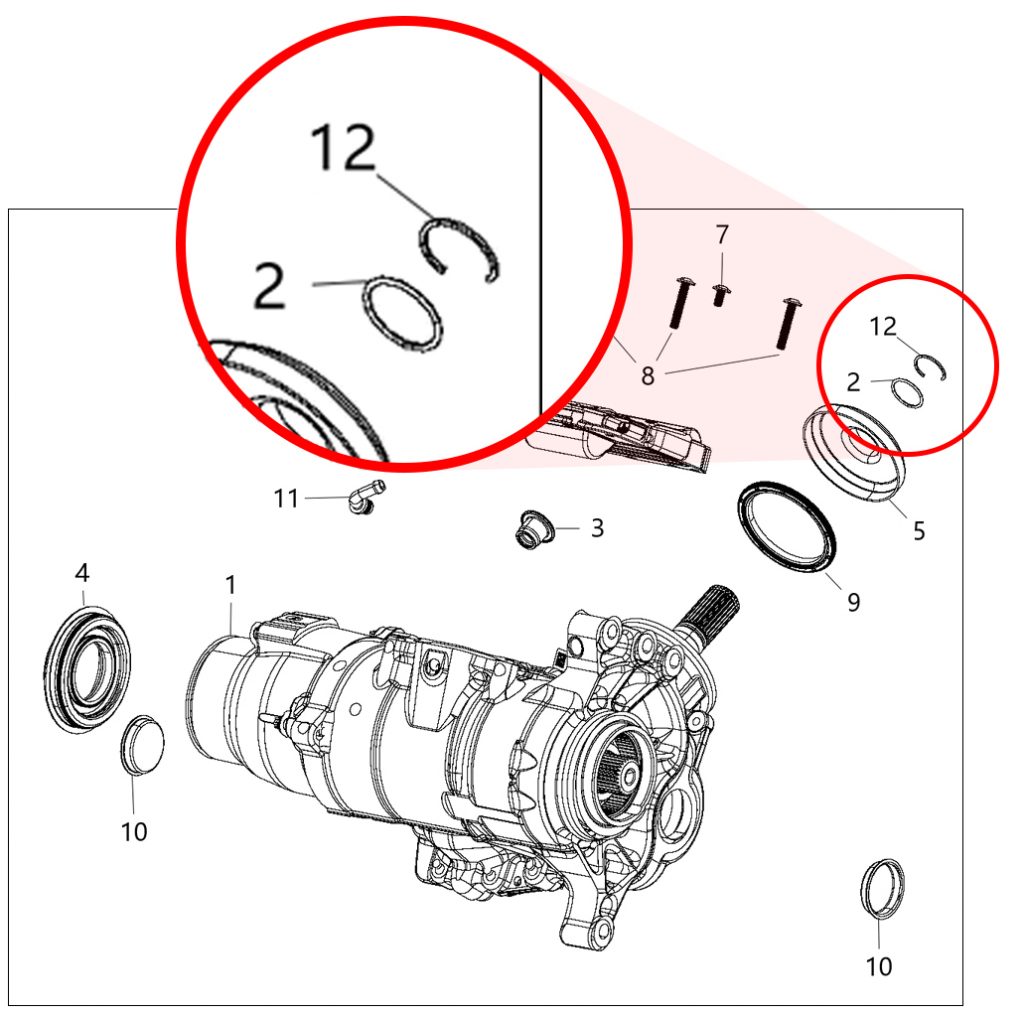
Of course, the drama didn’t end there. In 2025, Jeep issued another recall for Cherokees equipped with faulty PTUs, for cars built from October 2016 to February 2019. Targeting another 63,082 potentially affected vehicles, the problem this time around could be traced to an “improperly seated input shaft snap ring” that allowed for “uncontrolled movement of the input shaft inward.” This allowed the original spline problem to rear its head again. From the 2025 recall report:
Uncontrolled movement leads to the potential for wear to the range shift sleeve, spline damage, and / or range fork damage which can cause an unexpected loss of motive power or loss of PARK function while stationary.

For the 2025 recall, at least, Jeep’s solution was to actually replace the PTU with a new unit if it arrived at the dealership already broken (it would get a software update otherwise, per instructions from Jeep listed by the NHTSA). In the remedy section of the recall report, Jeep also mentioned that it would reimburse owners who paid for a new PTU out of their pockets.
Now, in May 2026, Jeep has issued a fourth recall for yet another batch of potentially defective PTUs. This one covers 61,711 cars built from December 2018 to February 2023, when production of the KL-generation Cherokee ended.
The safety risks involved with this defect are the same—when the PTU fails, the car can lose all motive power, and the Park function may no longer work. But the recall document doesn’t list a description of the cause. A Jeep spokesperson told me only that the PTUs “could experience an internal failure.” One could only assume this recall is also spline-related, given the identical safety concerns. That’s just speculation at this point, though.
These Poor Owners
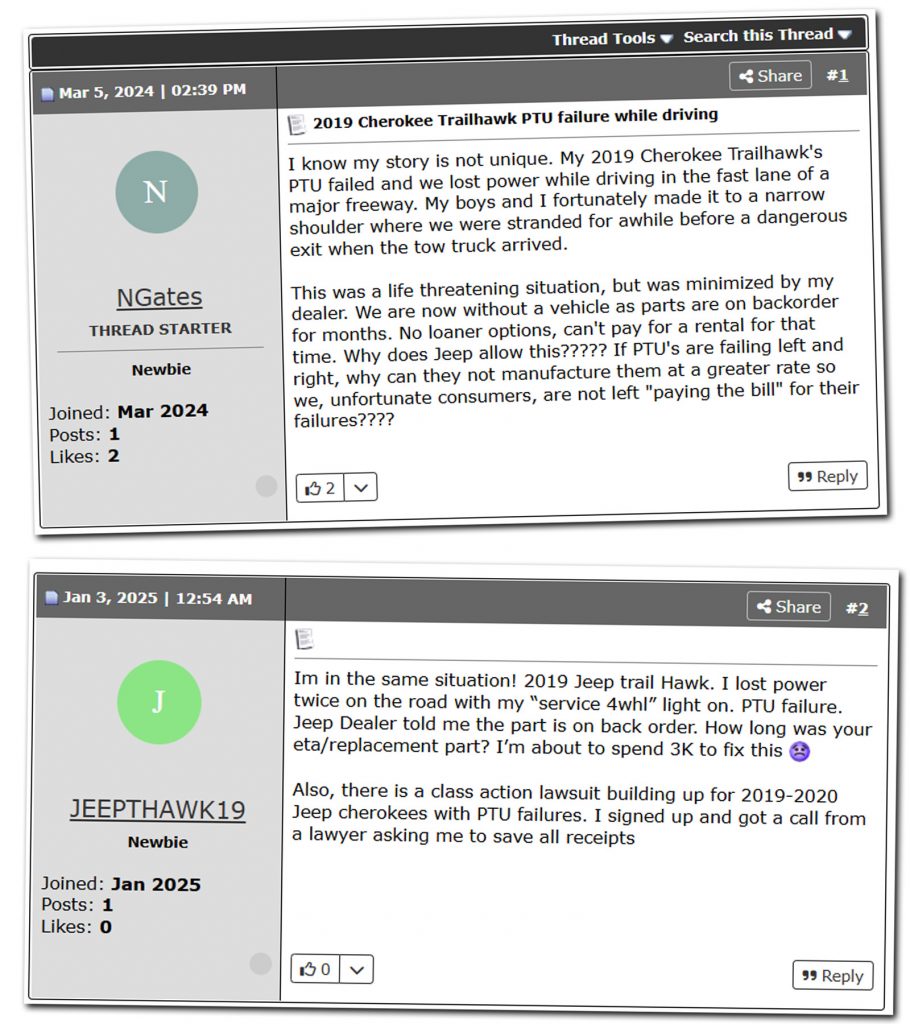
As The Autopian noted in our article on the snap ring issue last year, there is no shortage of Cherokee owners complaining about their PTU failures online, either through Reddit or on KL Cherokee forums:
Ultimately, you don’t have to go far to find owners frustrated with this situation. Reddit is full of stories of failed PTUs, with one owner complaining they had the part fail three times after repeat replacements. Similarly, over on Cherokee Forum, owners have shared tales of sudden and shocking failures. “My 2019 Cherokee Trailhawk’s PTU failed and we lost power while driving in the fast lane of a major freeway,” stated user Ngates in May last year. “My boys and I fortunately made it to a narrow shoulder where we were stranded for awhile before a dangerous exit when the tow truck arrived.” The upshot of their case was a long wait for repairs due to backordered parts, suggesting a significant demand on the supply of new PTUs.

It’s not like things have gotten better since that post was written. Another Reddit thread on the KLCherkoee Subreddit, published a few months ago, contains nearly a dozen more owners who claim they’re on their second or third PTU, voicing the same concerns about turnaround times and parts availability. Meanwhile, there are dozens of PTU failure-related threads on the JeepCherokeeClub.com forum stretching back years.
Why Does This Keep Happening?
When I reached out to Jeep asking how these recalls, which seemingly involve the same or similar failures, keep happening, the company didn’t give me an answer. Instead, a spokesperson provided me with a blanket statement reaffirming the latest recall information without touching on any of the previous recalls (emphasis theirs):
FCA US LLC is voluntarily recalling an estimated 61,711 U.S.-market vehicles to address a potential issue involving certain two-speed power transfer units (PTUs).An internal investigation
identified that some model- year 2019-2023 Jeep® Cherokee vehicles may be equipped with PTUs that could experience an internal failure. In rare circumstances, this condition could result in a loss of propulsion at any speed or allow a vehicle to roll while in PARK. If the condition occurs, drivers may notice a “Service 4WD” message on the vehicle’s instrument cluster, unusual driveline noise, vibration or a change in drive quality.
The remedy is currently under development. Affected customers will be notified when service becomes available and will be advised on next steps at that time. Until then, customers are reminded to use their parking brakes, as recommended in their owners’ manuals. In the unlikely event of a loss of propulsion, drivers can maintain steering and braking control and bring the vehicle to a controlled stop.
This response leaves me with two questions: Why does this keep happening, and what will be Jeep’s latest solution? The most I can do is speculate based on the information already out there.

If I had to guess, Jeep attempted to remedy the problem with software and updates to the PTU during production, but those updates weren’t enough to fix the underlying issue. The failure points remained in place until Cherokee production ended, and now that the newest versions are a few years old, they’re accumulating enough mileage to show signs of PTU failure, unmasking a problem Jeep thought it had fixed.
The most logical solution would be for Jeep to replace the faulty PTUs (as it did for the 2025 recall) with revised units. Whether Jeep will go that extra mile is anyone’s guess. The company’s approach thus far has been to add software to make sure the cars wouldn’t be stranded, but didn’t actually replace the faulty part with something that wouldn’t break a second time around. It feels like Jeep has done the bare minimum to satisfy NHTSA’s safety requirements, and, unless a significantly revised PTU is installed into these vehicles, it’s possible the vehicles could need a replacement down the line.
Top graphic image: Jeep


eh, Ford got away with the Powershift built during the same time Frame, TCM were initially blamed, but the end it was just a junk design. they extended some warranty periods after many lawsuits, and they claim the 2017 and up global designs are better, but the warranty stuff is failing too and thankfully they abandoned that DCT with the cars.
And don’t forget about their wet belt 3 cylinder…
Unfortunately that stupid DCT is what helped cause them to “not make money on cars”… and thus indirectly contributed to the decision to cancel all their cars.
“ and they claim the 2017 and up global designs are better,”
‘better’… defined as ‘still terrible, but less terrible’.
DCT transmissions are great on the track. But for day to day use? A hybrid with an eCVT transmission is a far better option.
Also the stupid wet timing belt on some of their engines didn’t help things
And the stupid unreliable half-baked Microsoft sat-nav system didn’t help either.
And the transverse V6 engines where the coolant pump would leak coolant into the oil was/is another source of reputation damage for Fords.
well the duratec waterpump was backed by wonderful 2-3 thread heads that popped spark plugs out randomly.
They should already just change the first letter of the brand’s name so that you get an accurate picture of what sorta hot garbage they are peddling. Welcome to your local Heep dealer. We only sell heeps of crap!
That and add a letter: Cheep
So instead of “Just Empty Every Pocket”, it’s “Hopelessly Empty Every Pocket”? Yeah, that tracks.
Thats what you get when you re-badge a bunch of Fiats.
What I’m taking from this is that post-recall, the KL is likely a few snipped wires away from a drift mode.
I highly doubt 100% of the power would make it to the rear.
It has to go somewhere – although cogs exploding through the cabin is probably not ideal
“Why Does This Keep Happening?
My guess is that it being on a shitty Fiat CAR platform using shitty Fiat parts might have something to do with it.
American Axle is a US company. They were one of many GM operations divested out during the long decline. Dick Dauch from Chrysler was the major domo of the buyout.
301k miles on mine. Hope it doesn’t fail anytime soon.
It keeps happening because even after knowing the problem they tried fixing one part which just pushed the problem to the next designed for just enough to operate and then that part broke.
TBH I often suffer from lack of Motive Power nowadays
Blowing up PTUs
Finally… something they can commiserate with Ford about.
Blowing up PTUs, giving blow jobs a bad name since 2013
Except that Ford doesn’t recall or fix theirs. Same problem still exists for any unibody awd ford.
No maintenance listed for PTU gear lube, it never gets changed because it’s lifetime fluid. Lifetime of the PTU which is about 90k miles. Good news is that when you replace the entire thing, you get free gear lube with the purchase of a PTU.
I didn’t really read anything about the PTU failures on Ford’s platform until I had about 60k on mine (’12 MKZ) and did a fluid change right away. The fluid was pretty bad but at least it was still there and not completely sludged, yet. Luckily, it’s just gear oil and easy to get quality fluid to replace it.
Whoda thunk having very little fluid and no cooler in a gear box that is attached to or surrounded by every hot thing in the engine bay would be a problem?
And some of the Ford PTU’s (early ones?) didn’t even have a drain plug.
Great job guys.
Not sure which years had what but I distinctly remember having to use a vacu-sucker to get the old fluid out. I guess a positive was it was so thin and broken down it came out without much trouble.
All the more reason for Jeep to just move towards a rear electric motor, and just get rid of this pesky part. I’m sure that would solve all their problems, and be completely reliable. Could call it 4xe…
I have had 5 jeeps from 1970 commandos to 2012 Wrangler and I would not buy anything but a wrangler from jeep right now and from what I am hearing even the wrnagler has gotten worse from 2012.
I’d argue it’s better. Especially with the 2.0T. The 3.6L is a poorly designed lump
I will never in a million years understand why anyone would purchase a car from this company. Any other brand, and I would have some empathy.
I agree. Jeep has produced almost entirely junk for the last 30 years, and it’s hardly a secret. At some point we have to start blaming consumers for keeping these clowns afloat and allowing this farce to continue.
Whoa, whoa whoa. 20 years. The 4.0/ax15/np231 bombproof combo was available through 2006.
Interesting how their only reliable drivetrain combo was an AMC motor, Aisin transmission, and AMC transfer case.
Not exactly. The AX-15 gave way to the NV3550 in 2001. Still a stout transmission. Then the NSG370 6 speed came out and was used in the last couple of years of the TJ. That one had some issues.
True. What’s crazy is how long they ran the A904/30RE. I think it was in the low trim all they way up to 06. That’s a transmission designed in the 60s, and just lightly modified thereafter.
I think the Wrangler has the fastest jump in the number of gears in the automatic transmission. 3 speed in 2006, 8 speed in what, 2012?
They are the same soft brains voting Democrat in California.
But think of all the rubber ducks!!
Fortunatel, my Cherokee was optioned with a rock solid NP231.
Jeep… doing their best to make FORD’s recallapalooza look less crappy.
Thank you sir, may I have another!
It’s a Jeep thing, you wouldn’t understand.
We’ll just put this one by the other Jeeps that keep catching on fire and the problem will sort itself out.
Sure, you’re in danger, but we have software than can remind you to use a parking brake! Ugh, the US/French/Italian auto industry deserves to have it’s lunch stolen by China when they weasel out of stuff like this.
Not that the Chinese are better. Apart from Changli
It’s a damn shame, because that AAM drive system (Ecotrac, Ecotrac II, and Ecotrac Lock) were extremely unique and gave the KL a capability that still doesn’t exist anywhere else on a similar architecture. That being said, No other OE picked up on the Ecotrac line and I would guess they saw the wisdom in letting another manufacture be the beta tester first. Sadly we wont likely ever get to see a Gen 2 of this system that irons out the many bugs because no one else thought it was worth it. The KL could have been so good, but it was so rushed. Jeep doing Jeep things.
Is there a reason why the “RWD and electronic parking brake when park is selected” failure mode software WASN’T included from the factory after the first recall?
That would have cost monies that weren’t mandated by the recall. And Stellantis sucks worse than Scooty Puff Junior.
That’s rough. I have it on good authority that Scooty Puff Junior suuuuuuuuuucks.
In a thousand years, we’ll get right on that
This is the company that decided:
https://www.theautopian.com/dodges-surprising-claim-that-the-charger-ev-is-supposed-to-accelerate-on-its-own-if-the-gas-pedal-fails-might-actually-be-legit/
Something something, Jeep Engineers, Something, “good enough”, Something….
“
goodenough” – Jeep, probably.It doesn’t matter. Jeepers gonna Jeep. It doesn’t matter what crap Stellantis (or FCA, or Daimler-Chrysler) puts out, Jeep buyers will keep buying.
Yeah, I long since stopped having any sympathy for Jeep owners. You knew what you were getting into, and willingly forked over (too much) cash for a bag of shit labeled “Shit”. Caveat Emptor.
I see little jeep loyalty out side of the wrangler and a little in the grand cherokee.
The Jeep Wagoneer S would like to have a word with you. It sold an absolutely MASSIVE 175 units in the first quarter of 2026. Sales were so bad they’re taking s break for it’s second model year.
What’s odd to me is gearing seems like it should be a “solved” engineering problem. How do you not have a proven gearset for these types of things?
No one else made or makes anything like this PTU, it has a 2 speed gearset in it for 4-low (in many models, some are still 1 speed with a similar architecture). It was ambitious, but apparently needed more R&D time.
Yeah, a two-speed transfer case in a transverse powertrain is pretty uncommon.
completely unique to the KL at this point.
I thought so, but didn’t want to say…lest someone come and tell me the original Land Rover Freelander had one, or something like that.
Yes, but a splined shaft is failing, this is far from new tech. Is it a heat treatment issue? Wrong material selection? Just under sized?
Mechanical enigneer here…
From what I’ve read just now its that there is lateral play that is at the heart of it. Could be the way the gear is being retained isn’t good enough and its taking the gear out of mesh enough to slip and chip.
So an issue that should have been found during long-term testing.
Once again, none of this is new. I have nearly 30 years experience in industrial maintainence, most in heavy (steel mill) industry. Shaft thrust loading is a solved problem in most applications.
I came here to post something similar, though I’m not an engineer. It’s not like it’s a failure of something unique to that PTU, which could at least be forgiven because they were doing something new and different. It was a failure of a conventional component that shouldn’t have been difficult to engineer and test properly.
Although this is Stellantis, so maybe it did come up in testing and they just said “fuck it, sell it anyway and let’s see what happens.”
Finite element analyis (FEA) was in place during my undergrad years, I used it and CAD for my senior project damn near 30 years ago. I also had to justify/support my findings with hard math and hand calculations.
I almost can’t understand how this fell through the cracks.
If there’s one thing Jeep and their suppliers should be able to get right, its a damn transfer case. Glad I never bought one of these, but just another data point for why you shouldn’t buy a Jeep past the 4.0 I6 era.
New Venture to the rescue! Both my Jeeps, an XJ and a WJ were 4.0L.
Between this and the myriad of issues with the hybrids…oof.
Guy 1: “Hey man, can I get a ride to work again?”
Guy 2: “Dude, what is going on? How are you stranded AGAIN? Isn’t your car almost new? What they heck do you drive?”
Guy 1: “It’s a Jeep Cherokee, you know what they say: It’s a MOPAR; NO CAR :(“
Rats, This sucks. I am usually for newer designs but good old fashion transfer cases and normal rear diffs seem to have most of the bugs worked out unlike these overly complex AWD crossovers. (see the bronco sports dual clutch rear drive system with a separate cooling system)