


We’d like to believe that the world, in some fundamental way, makes sense. We’re islands of order in a greater sea of chaos, and the idea that via our thoughts and actions we can keep the relentless march of entropy at bay is part of what makes life bearable. I want to believe this. Generally, I do believe this. But sometimes, rarely, I suppose, but less rare than I’d like, I’m confronted with some evidence that I’m deluded, and, fundamentally, the universe does not actually make sense.
Sometimes, like this time, the realization happens because of minivans.


You see, I was recently made aware, by an Autopian named Tim, of a minvanical mystery. A strange one that is simply confusing, a mystery that points to wasted efforts and weird design choices. A mystery I simply can’t explain, and any one who could is either long gone or sworn into silence.
The mystery has to do with this:

Those are the rear bumpers of GM’s second-generation U-body minivans, which you may know as the Pontiac Trans Sport Montana, and later, just the Pontiac Montana. What I want you to notice about the rear bumper covers on these vans is that it seems to have a very deliberate and intentional molding in the center section that seems to delineate a wide, rectangular recess, flanked by little bumper-guard-like protuberances on either side.
These sorts of details don’t just happen by chance; they were very carefully designed and implemented. Some versions even seem to include the text TRANS SPORT embossed into the framed center section there:

So, why would Pontiac do this? It’s a sort of strange design motif, when you think about it, especially the blank ones lacking the model name text. But when you give it some thought, its purpose seems clear: based on the size, proportions, and location, this must be the area designed to accommodate European-style license plates. The twin bumper guard-like blocks would even be ideal for mounting a pair of license plate lamps.
That has to be it, right? It’s really the only answer that makes any sense! It should be easy enough to confirm, too – the Montana had a European sibling, the Opel Sintra (Vauxhall Sintra in the UK). So let’s take a look!
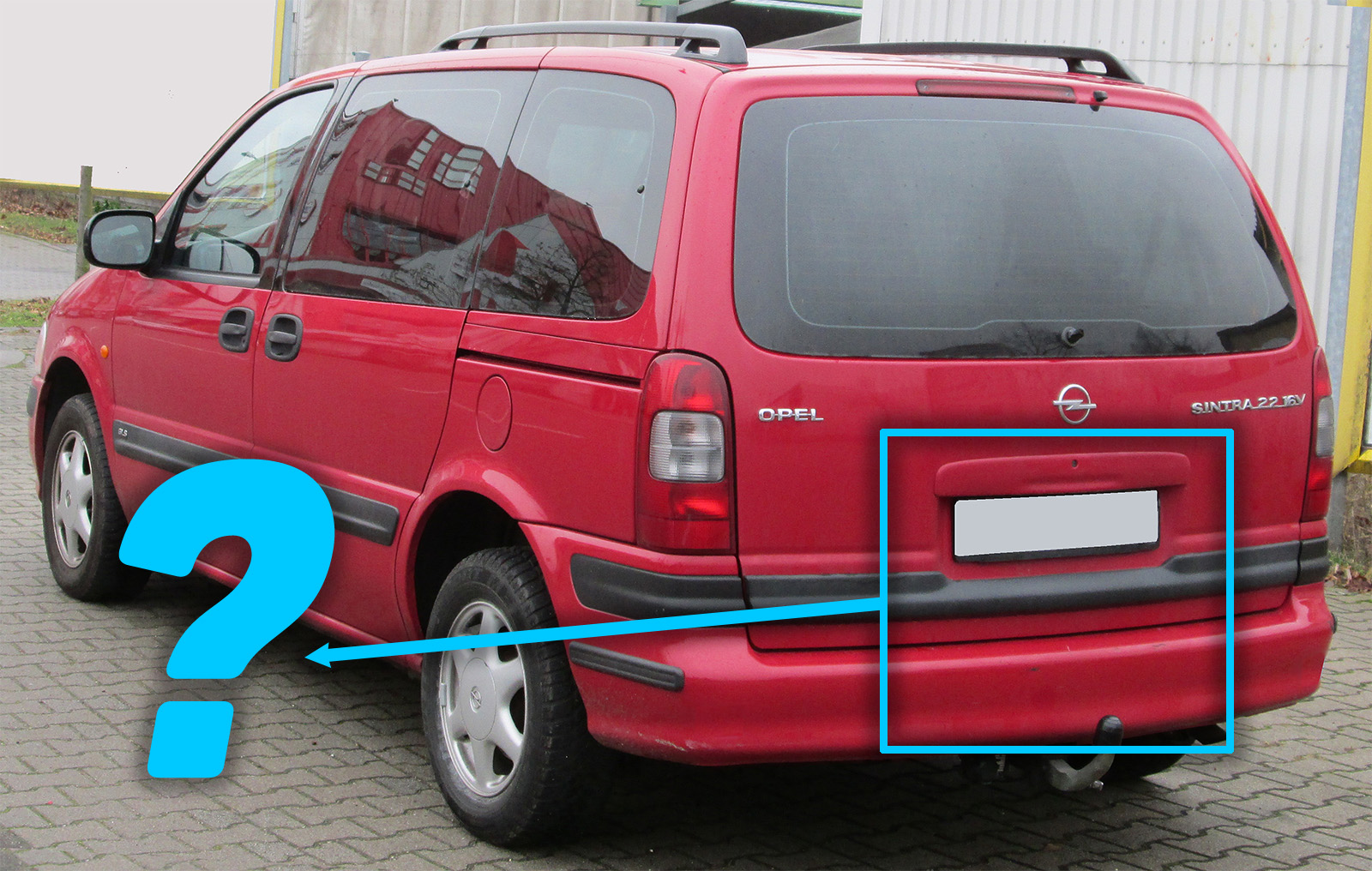
What. The. Fuck.
Wait wait wait wait – what am I looking at, here? Am I really to believe that GM’s Euro division went out of their way to design and mold entirely different rear bumper skins that did not have the perfectly-sized indention for a European-spec license plate, and instead just stuck the license plate in the same spot where the shorter US-spec plates went?
Why?
If the Euro plate fit in that original spot already, what the hell was the point of the bumper skin with that recessed Euro-plate-sized panel? Was it never intended for a Euro plate? If not, then what the hell was it for? Looks? It couldn’t have been.

The Euro tailgate seems to be the same stamping, with a bit of extra cladding slapped on it. Why did they feel the need to make a new bumper cover mold? Because the US one might confuse people because it would appear that there are, in fact, two places you could mount a license plate, because, again, that’s exactly what that bumper skin seems to have on it!
I can’t wrap my head around this. Did GM forbid contact between its American and European divisions? No one talked to each other about this? Why didn’t they all use the Euro-style rear bumper? Why did the US design that Euro plate area in the bumper in the first place? Why were we Americans okay with that weird-looking blank panel when Europeans weren’t?
None of this makes any sense, and it drive me clamshit. I just want to know what the hell everyone was thinking!
Ugh. I can’t leave you on such a miserable note, though. To improve your mood, check out what the concept car version of the Montana looked like – the Montana Thunder!
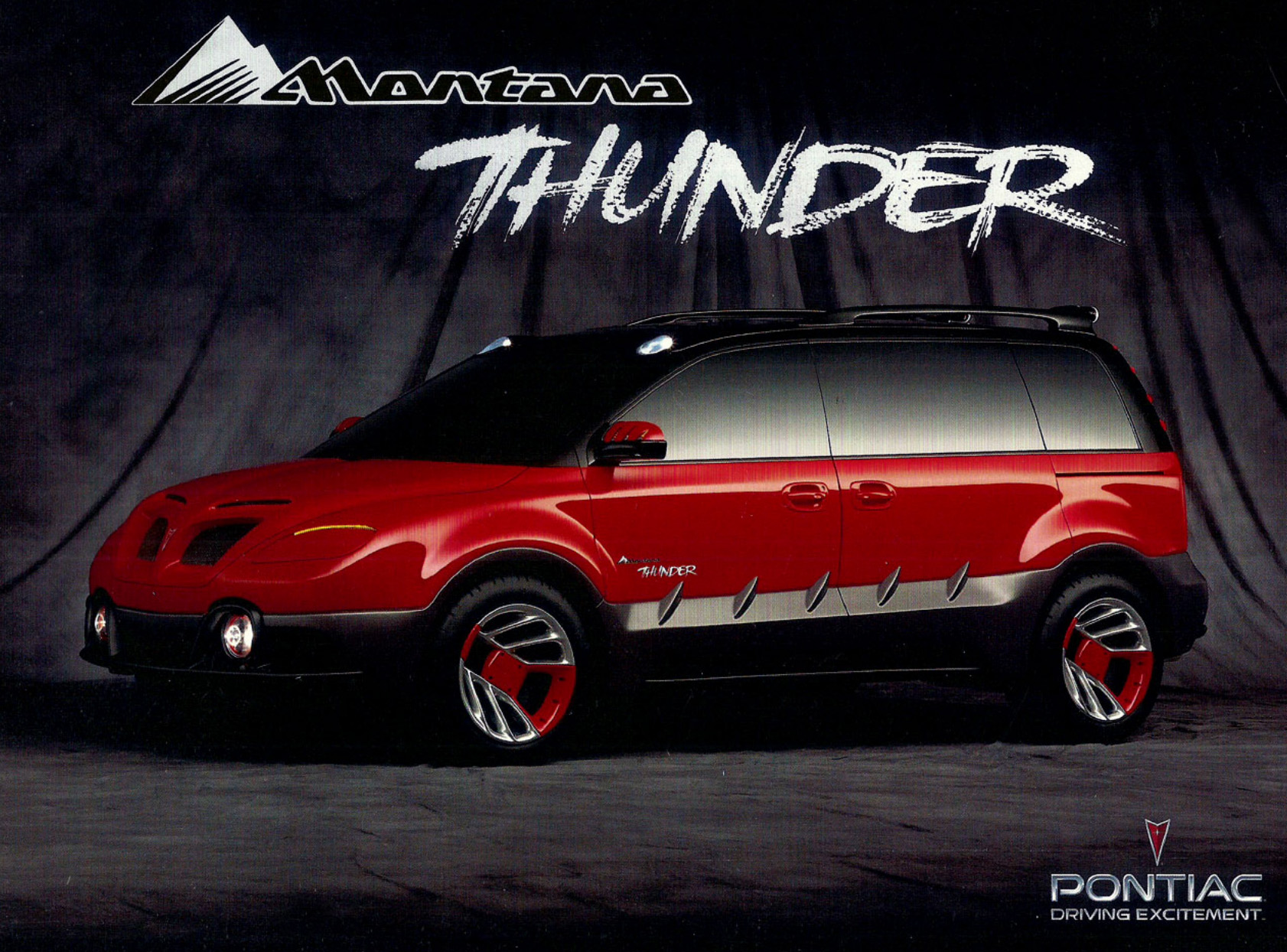
This was a 1998 concept car that tried to merge minivans and SUVs, and also, interestingly, hinted at the Pontiac Aztek’s front end styling a couple of years before the Aztek came out. It’s a bit overdone and silly, but in fun ways, and I applaud any manner of badass minivan concepts.
Sure, the resulting Montana didn’t exactly have the teeth of this thing, but you know, real life is a tepid reflection of the car show world.
You know what you need to hear now? Hell yeah, you know. It’s time to ride, Pontiac, ride, bitches!


That Montana Thunder is just plain fucking awesome!
Asked dad who was involved in this program and also the SAIC (China market) version of it. GM wanted a “global platform” minivan and universal bumper. But GM gonna GM, and SAIC, Opel in Russelsheim and Warren did their usual let’s work together but oh yeah no we really aren’t going to, and it was tooled up for large scale run with the center bumper blank for a European plate. But then the US teams said it won’t work with our larger format plates and then it’s back to the rear gate, and since the plate light wiring was easier to run to the back gate, they abandoned the rear bumper since that was also going to need plate lights which was another complexity to reroute wiring just for that market. China was the new kid on the block, so they just wanted to keep costs down as they started so some of the GL8s got the Europe bumper. But since it was tooled up for mass production, there it went and history was made for the Montana. And theirs some cross division and allocation accounting stuff he said was in play which seems elusive to any of the engineers at the time who weren’t really in the know but still told what to do…
“Did GM forbid contact between its American and European divisions? No one talked to each other about this?”
As somebody who has spent a lot of time in the corporate world, I can ASSURE you that they were not talking to each other. Different parts of the same company IN THE SAME BUILDING have trouble collaborating and talking to each other, so across the pond makes it worse.
On top of that, throw in office politics like “The Euro design department needs X budget to make a euro version of the van” and once that gets approval, boom, they have a budget that they NEED to spend (in terms of hours and deliverables), otherwise it looks bad and their budgets might get cut the following year.
Corporate is extremely dumb.
I work at Mercury for 10 years, we rarely if every had contact the boat group (Sea Ray, Whaler, Bayliner, etc) even though we were designing the controls for the boats.
The Montana Thunder’s attempt to look like an SUV did result in the 2005-2008 U body vans acquiring a giant schnozz and some rebranding. The Montana became the Montana SV6, the Chevy Venture became the Uplander and Saturn got a version. These sold like warm beer in July and did nothing to halt the slide into bankruptcy.
“Did GM forbid contact between its American and European divisions?”
Probably. That is one of the most siloed companies I’ve ever dealt with.
In my head I’m imagining if you asked a GM exec. At the time he (likely to be a dude) would reply with something along the lines of the following…
“we never thought about talking to each other, between USA and Europe, bc even though we were selling basically the same vehicle… all the stuff primarily was designed in Detroit or sometimes California and any of the badge engineered vehicles that sold in Europe under Opel or Vaxhall, made whatever minimal changes they thought they needed to sell units there, themselves…”
And while Im thinking of it, I want to see more weird vans. Being back the GM Dustbuster vans, Toyota Previas, Mitsubishi Delcias, Japanese luxury vans, K-vans, etc…!!!
Bumper stickers will be easier to read and to apply without wrinkles, so that must be it.
As fascinating as this extremely GMy styling kerfuffle is, I have a burgeoning obsession sponsored by this article, and that obsession is a burning need for the Montana Thunder. I’ve never had a desire or a need for a minivan but I find myself desiring and needing a Montana Thunder in a very deep, visceral, passionate way.
THANK YOU FOR BRINGING THIS TO MY ATTENTION
I’ve had the same burning desire (maybe I should see a doctor?) for the original Previa-esque Trans Sport concept car from….86?
Having worked in big companies, I have quickly become used to the idea that with enough decentralization and siloed teams, common sense can become almost impossible to put into practice.
I suspect some location where it was sold required the plate to be seen when the door was up.
The Suzuki Wagon R (Opel Agila) also had 2 😀
I recall a few Montanas being used by USPS. Could it possibly something to with that? The later caravans and uplanders they put their ID numbers on the glass. Uplanders might have had them on the hatch possibly bumper too. But Montana I’m fairly sure I’ve seen with the numbers in that area.
I’m pretty sure the USPS would have used the Chevy Venture Cargo, not the Montana
Might have been but had the Montana bumper and front end. I don’t think it was even badged. Possibly some weird mix maybe even planned to be sold as GM or gmc to USPS. I only ever saw a few in the DC metro area. I remember some of the fords being debadged as well.
I don’t believe they used astro vans or previous GM mini vans in any numbers. But had been using ford and ram mini vans for a while.
Theory: the US bumper mold was indeed designed for Euro plates, but the Euro division changed their minds late in the game. It would have been too expensive to redo the mold, acceptance testing, etc. So they kept it and made the most of it when inspired (the embossed brand) or just left it when not.
> Why were we Americans okay with that weird-looking blank panel when Europeans weren’t?
That odd design is hardly the most problematic thing about that vehicle.
Why did my son fill his mouth with pond stones? Fuck if I know.
I recall a few Montanas being used by USPS. Could it possibly something to with that? The later caravans and uplanders they put their ID numbers on the glass. Uplanders might have had them on the hatch too. But Montana I’m fairly sure I’ve seen with the numbers in that area.
That concept is actually pretty sick. Shades of PT cruiser in the shape, but better proportions.
Now I irrationally want a Pontiac Montana Thunder.
The video is quite the nostalgia piece now. So much 80’s hair.
Gm is notorious for designing things by committee, and they seemingly don’t communicate with each other (which is why their designs are generally so mediocre if not awful).
Team Tailgate thought they were responsible for the global license plate mount.
Team Bumper thought they were responsible for the global license plate mount.
The committee that patches all the various designs together, and differentiates the badge-engineered corporate cousins didn’t catch that there was a duplicate design aspect until after all the stampings and moldings were already set.
It’s cheaper (probably) to run wiring through the tailgate than a bumper cover, and/or eases assembly, which makes the bean counters happier. There also had to be room to run the wires for and to mount the parking sensors, which were still new-ish tech in that bracket at the time. So they went with the tailgate instead of the bumper for the plates.
The European team noticed the redundancy, though. (Actually I think the other brands noticed, too, since the chevy Venture and Oldsmobile Silhouette also had a plain bumper cover like the Simca)
Plastic is easier to change than metal stampings, so the redundant (and, frankly, silly, because negating the function of a bumper) rear bumper was replaced with a simpler one on the European models.
I don’t think it was for a trailer hitch. The photo of the red car even shows a hitch below the bumper. These are unibody vehicles, not body-on-frame so the bumper isn’t necessarily the best place to mount a hitch to.
Possibly it was for model names like in the brochure (which makes it easier for salespersons at the dealers that sell multiple gm brands), but that got nixed.
The standoffs look like they could be for lamps, true, but then the parking sensors would be blocked or would require a different location. They moreso resemble the bumperettes on older vehicles, though that makes less sense on a plastic bumper.
I’m just gonna chalk it up to gm silliness and call it a day. These are such wretched and unsafe vehicles they barely seem worth the thought. I didn’t realize gm foisted these off on Europeans, too, for which I somehow feel a touch guilty about.
After spending a few years in big companies, I can tell you, this happens all the time.
This entire, well-written, very much appreciated reply could, with no offense intended, be boiled down to two words:
“gm silliness”
and achieve the same effect and accuracy
You’re quite right!
I guess my reply was a distillation of the article, and yours an even further distillation, to the point of near-terseness (in a good way).
I appreciate the efficiency (which gm probably wouldn’t understand).
Is it true that in middle school Torch released such an impassioned broadside on obscure car trivia that confused non car people interpreted it as somehow political, inspiring a Very Special Afternoon Special that is mandatory viewing to this day in the California school system?
Just wondering?
Long time lurker, first time poster, thought I’d finally make an account because I think I know why this is the case.
When these first went on sale in China as a Buick, they also used the Pontiac bumpers: https://online-auction.state.gov/en-US/Auction/Lot/a2d49e8b-5ee2-40e1-873f-971379215864?auctionId=c5a54d3a-bd2c-435b-867b-06ccbd937cb4
Sure, this one has parking sensors installed in that spot (aftermarket or OEM, I have no idea), but I have a feeling that China is exactly why this element exists. Cars in China must also have Hong Kong and/or Macau registration to be driven in those territories, and vice versa, and will need to bear the territories’ license plates in addition to China’s own.
Being former European colonies, they just so happen to issue Euro-sized plates that would fit perfectly into that spot on the bumper. While this doesn’t answer for what would be done for the front plate (given that no such provision exists on the front) or multiple plates (if one were to register their GL8 in both HK and Macau, along with its native China), it seems to make the most sense to me.
Here is an example of how multiple plates are usually mounted on the rear of a vehicle if it didn’t have this provision: https://www.alamy.com/stock-photo-double-numberplates-for-china-admission-hong-kong-china-asia-10550652.html
The plot thickens. I love this.
I don’t believe it could be for a license plate there is no light over it. So I will have to believe that the reason it exists is “excitement”. Because that was what Pontiac built.
Some license plates are illuminated from the sides, which could explain the protrusions if the lights were supposed to be placed there.
It would of course look ridiculous be a well selling spare part if they put a small light as the most protruding part at bumper height, but I’m still ruling it as “plausible”.
Yep. We are all very, very mildly excited at the moment.
The Chevrolet version used the Trans Sport bumper, but with the license plate on the hatch
https://www.flickr.com/photos/harry_nl/35476933453
The previous generation had even weirder lights
https://www.flickr.com/photos/45904802@N08/5167315587
It seems like these and the Chrysler clan minivans were/are(?) the most popular North American exports to Europe.
Almost all of 1992–2002 Chrysler Voyagers and Grand Voyagers sold in Europe were built at Eurostar (now Magna Steyr) in Graz, Austria. Over 600,000 Voyagers and Grand Voyagers were built there. So, they weren’t exactly the “exports”.
That’s interesting… so built under license or something like that, based on the US design? Oh, and with an available diesel engine like DT’s!
I had a Steyr bicycle when I was 10-12 years old. Nearly identical bicycles were sold by Sears & Roebuck at the time. I remember my brother and I becoming adept at rebuilding our coaster brakes because we were quite abusive to them and they were pretty fragile compared to whatever Schwinn was using (maybe Bendix?). They came from the factory with Semperit tires. I was amused being transported up to the top of ziplines near on Maui and one near Ketchikan, Alaska in Steyr Pinzgauers many years later. The ride up to the top of one in Whistler BC was much more comfortable in a Yamaha SxS more recently.
Eurostar was established as 50/50 joint venture between Chrysler and Magna Steyr to build Chrysler vehicles in Europe. After the dissolution of DaimlerChrysler, Eurostar was fully absorbed by Magna Steyr.
Of course, I had a 10-speed bike with drop handlebars produced by Steyr-Daimler-Puch in the late 1970s. My brother worked part-time at the bicycle and moped centre as mechanic, fixing the Puch mopeds.
Could this be related to a desire from the Opel marketing department or a European regulatory requirement that the license plate be readable when the vehicle is operated with the hatch open (e.g., when hauling something too big for the hatch to be closed)? This was communicated to the American design team, who responded with the design we saw for America. Then at some later point, this desire/requirement was dropped, and therefore the associated additional cost for a stamping tool to make a European-specific hatch skin was no longer justified? Just a theory…
I was wondering that same thing…but I just can’t fathom why they would have designed the tailgate “hard point” in metal AND the plastic bumper part.
Montana Thunder would be a great stage name.
She still accepts cash. Two drink minimum.
That bumper is Pontiac specific – look at the side ribbing. I think the Chevy version used the same bumper as the Opel.