

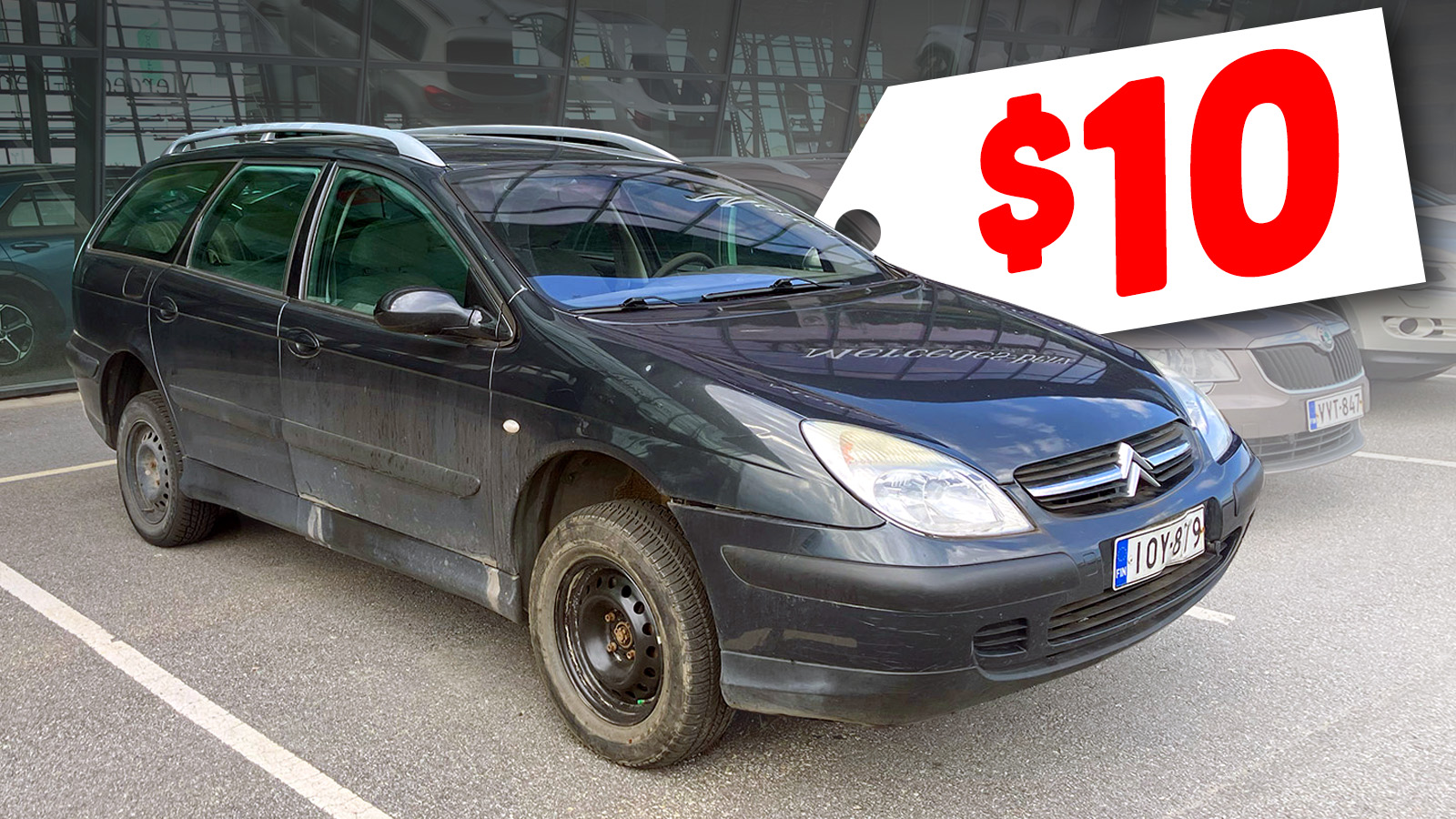
What’s the least you’ve paid for a running car? I once got a Volkswagen for 60 bucks, but that one was in severe need of a head gasket before I could use it for anything. The cheap-car dream is to snag a car from an auction for pennies, before anyone else gets it, and put some miles on it before it ultimately gives up the ghost. With a car bought for pocket change, sunk cost fallacy doesn’t even get to enter the picture.
As well as regular classified ads, I quite often view auction listings for used cars. Why wouldn’t I want to pay intact car money for something that’s likely broken? Well, that’s a bit harsh, but ever since auctions started to become more popular here in Finland, the likelihood of bidding on something that’s riddled with issues has gotten stronger. Then again, if the car is cheap enough, and the issues not too bad, you can overlook a lot of stuff.



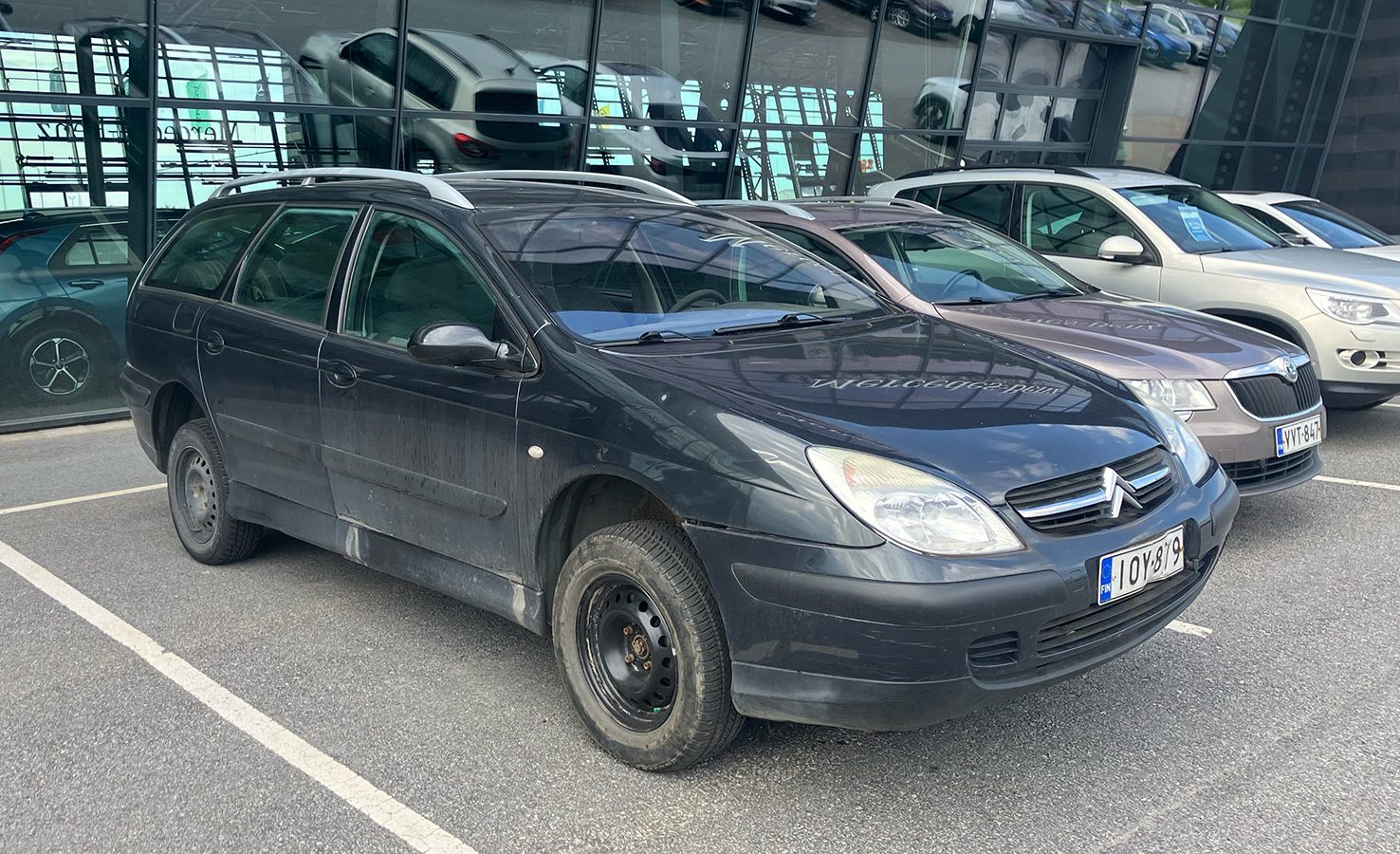
Last week, I stopped to eye this 2002 Citroën C5 wagon for sale in the next town over. It had been traded in at the dealer that sells new Citroëns as well as Mercedes-Benz and BMW, and it looked a bit forlorn at the end of the line for auctioned cars. Since it’s a nearly 25-year-old Citroën wagon in unspectacular condition, ending up on the auction list must have been a no-brainer.
It all has to do with consumer protection laws. When you buy a used car from a dealer, you have rights as a customer. If something goes wrong, the dealership is expected to do the right thing. With this in mind, combined with knowledge of typical faults in given cars – let’s say a Volkswagen TFSI engine likes a bit more oil than it’s supposed to – a dealership is far more likely to auction a trade-in car if there is any suspicion it might come back to bite them if sold directly to a customer. If you buy a car off an auction, the deal is with the auction platform and not the dealership, and while you can still cancel the deal if the car’s not at all what you expected to get, it’s less of a hassle from the dealer’s perspective when they have outsourced part of the process. Another thing is that a certain set of trade-ins are only sold to traders, with the implication they will fix them up on their own coin to sell them on. As a result, there are a lot of used cars being auctioned here, and the turnaround is quick. Quite often I check what’s being offloaded in the towns nearby, and sometimes I get to see them in person if the dealer’s on my route.
The auction ad shows the Citroën in a very dirty state, with the trunk full of bald tires and a list of faults that begins with “a vibration when turning,” continues with a note that temps are rising at idle, the cambelt and other necessary service have been skipped, and finally that it’s been smoked in, a lot. The odometer reading sits at 224,000 km, which is a touch under 140,000 miles. The car was imported second-hand from Germany in 2006, and according to available data, it has only had a handful of owners since, as three sets of title papers have been issued for it.
Someone has also reversed into the front plate with a tow hitch. This actually bothers me a lot, because if you replace the plate, the new one will come with a different-looking letter “Y” than the rear plate, as they changed the character design a couple of years ago.
A Complete, But Unwanted Car
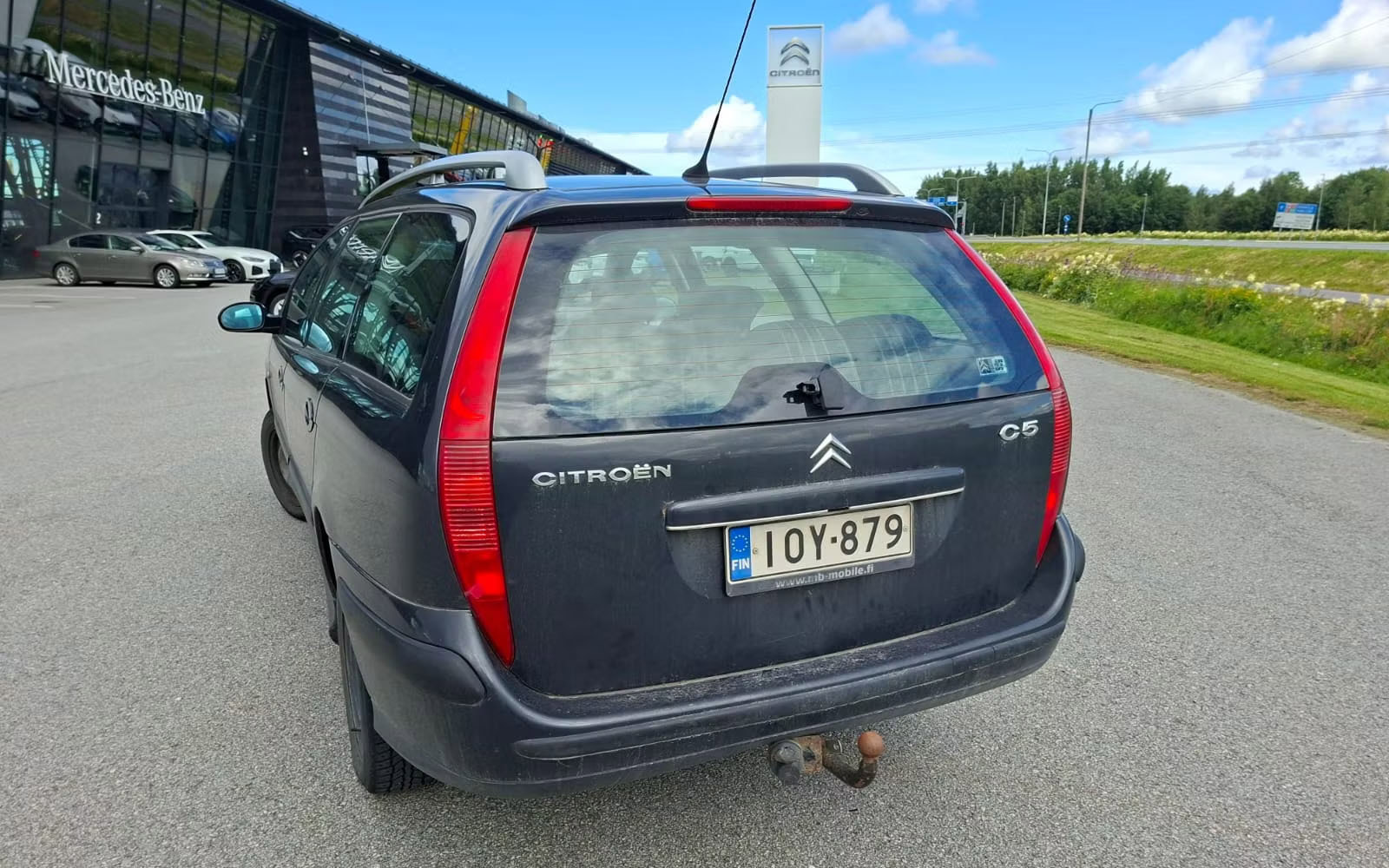
The 2000s C5 followed the 1990s Citroën Xantia, used some of the same engines, but offered more space. It does look worse, mainly because Citroën ended up combining styling ideas from several cars on the same body, giving the production cars terrible dimensions. The wagon is especially barrel-shaped, but the sedan isn’t too pretty, either.
The thing is, it’s a complete car. The roadworthiness inspection is valid til April 2027, which means that from the traffic authority’s point of view, you can just drive it as is for nearly a year, as long as it’s taxed and insured.
To make sure they wouldn’t spend too much on it, the dealership hadn’t even washed it, just parked it out back by the side of the road, lifted the hydropneumatic suspension to the highest position to show it works, took a bunch of photos, and listed it online.
The first auction had a reserve, yet the result was surprising for a road-legal car: no bids. Not one person wanted this car. I bet the dealer would remove the reserve the second time around, and they did.
The second auction ended at 6:30 PM Friday. I went to check the ad to see how much the Citroën had fetched, and had a good laugh: ten euros. This is a ten euro car. The ad even showed the single, smallest possible bid as having been accepted, so they will sell it for ten euros. Somebody got a ten euro car to drive home. That’s, what, 11 bucks and 50 cents?
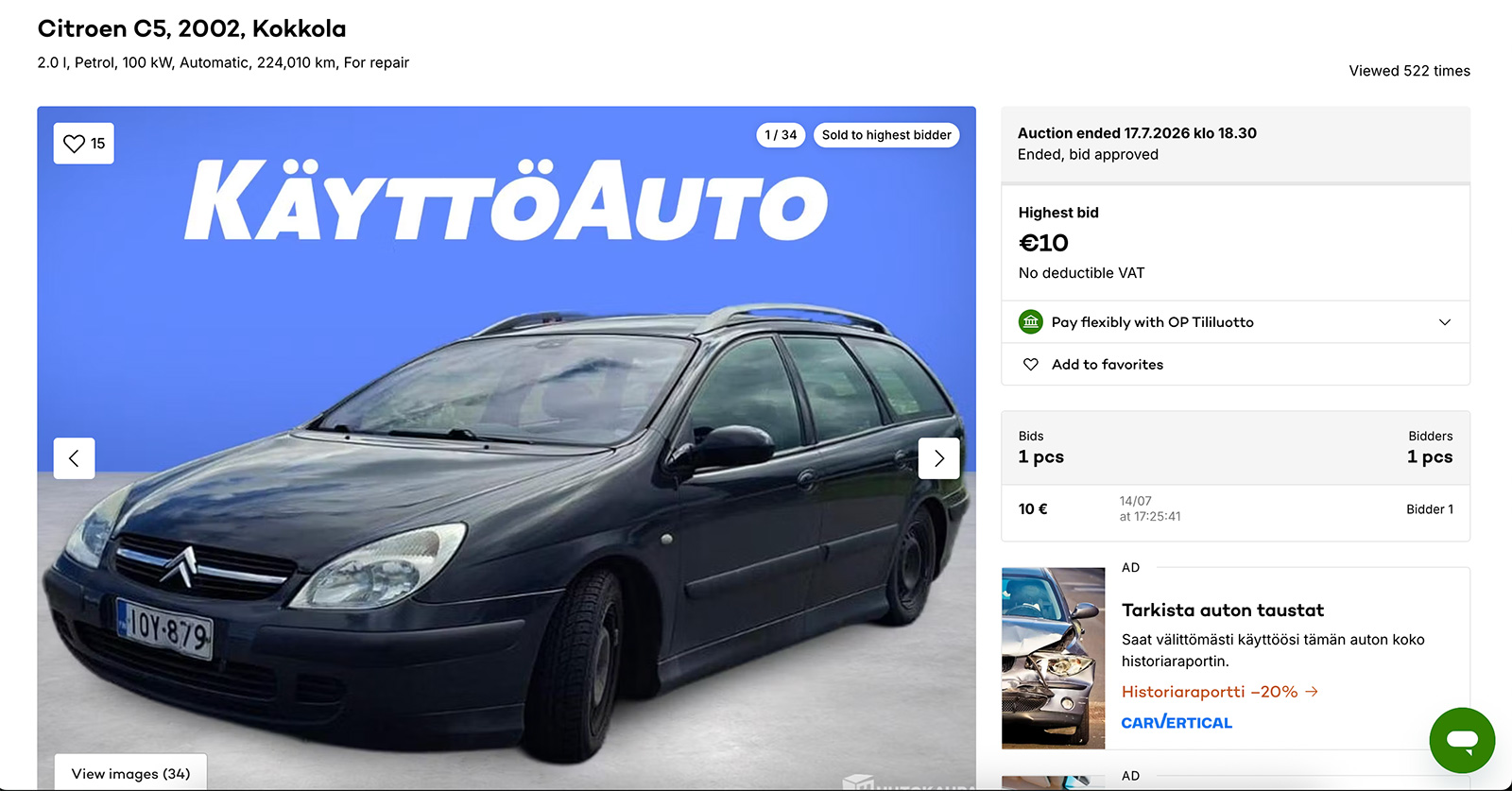
It’s also great that there weren’t any other interested parties than the eventual winner, who bid the smallest possible increment. Had anyone else tried to get the car, there would probably have been competitive bidding up until a few hundred, but for some reason only a single bid was enough to seal the deal.
Naturally, the winner pays more than ten euros even if that’s what the car cost. On top of that were fees, for the dealership and the auction platform to make any money, meaning even a free car would cost a couple hundred to get in the first place. What would this car really cost?
Breaking Down (The Costs)
Let’s count: the handling fee is 46 Euros, and despite the dealership not washing or cleaning up the Citroën, it still costs 199 Euros to go there and pick it up. That’s 245 Euros, so 255 Euros if you include * the price of the actual car * on top of that. It’s nearing 300 bucks just to get it from 20 miles away.
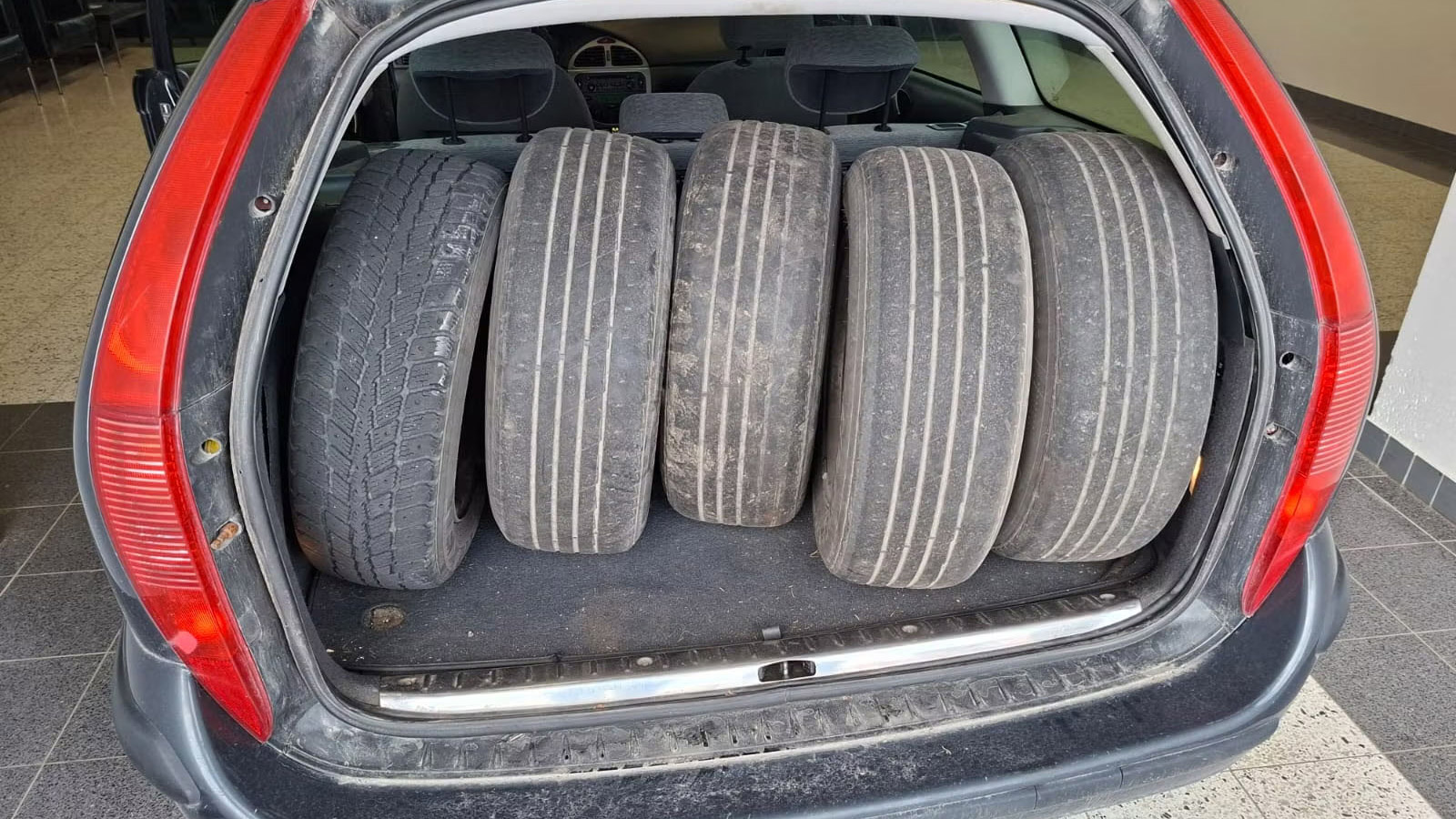
The summer tires are completely bald, nearly showing cords, so if the car makes it home from the dealer, it would need a separate set to be safe on the road. Let’s say you get a used set on correct 4×10⁸ bolt-pattern wheels for 100 bucks and mount them yourself, and since it rides on de-studded studded tires that cannot be used in the winter, add 200 euros for a used set of winters. I’d say you get three months before you actually really need winter tires, but nothing included with the car is any good for winter months. The Citroën uses the very common 195/65R15 tire size, which is quite cheap and commonly available both new and used.
We’re at 555 Euros for anyone keeping score. But you cannot register it under your own name without insuring it, and the cheapest insurance I could see for myself was 140 Euros per year. I have breakdown cover from the car club, so I only need the most basic insurance.
Finnish road tax for this specific car is (throws dice) 352 euros ($400) per year, which you can pay in four increments depending on how long the car lasts; should we be generous and only account for half of that? Of course, you have to insure and tax every car, so you could leave those out of the calculation, but those have to be paid if you want to drive whatever you buy. Tax also depends on the car and its weight or emissions.
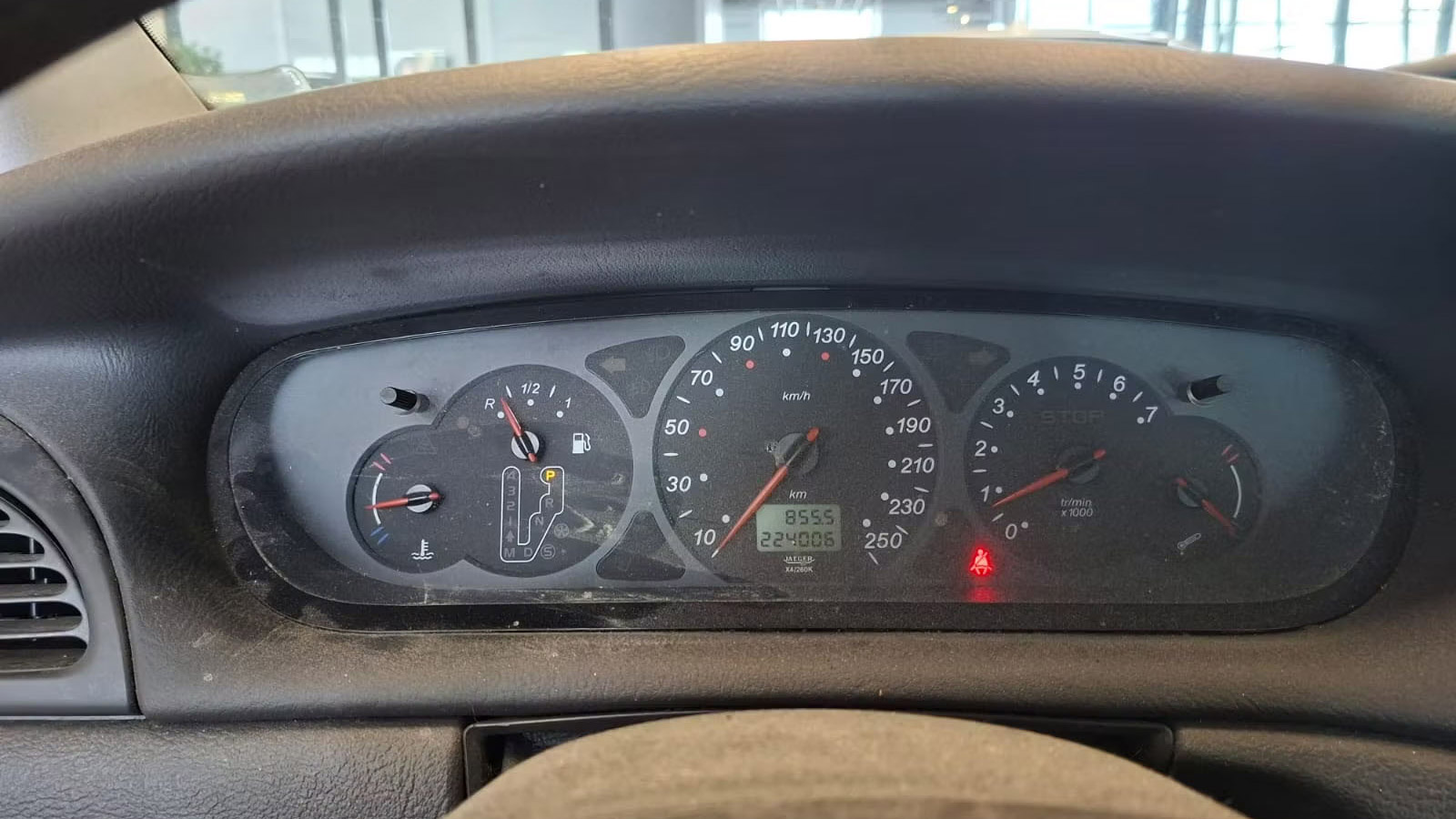
With the car drivable, legal, and under your name, you’re not quite at a grand yet. Nobody in their right mind includes a tank of fuel in the price of a used car, but since this is Europe, expensive fuel should at least be mentioned.
A full tank of fuel costs 130 Euros with current prices (two euros per litre, with a 66-liter / 17.5-gallon tank), but let’s be generous and assume you can only put in a hundred’s worth as the low fuel light isn’t on in the dashboard. Despite using up the tires and skipping maintenance, whoever traded the car in didn’t leave it at the dealer running on fumes. What is this, amateur hour?
What If You Wanted To Make It Last?

With no proof of recent maintenance and the belts overdue, it’s anyone’s guess how far the Citroën will make it. Don’t get me wrong, it’s a stout car for what is essentially a worthless automobile, and even at this state, it’s sure to be comfy, but naturally it’s an interference engine which will bend the valves if the cambelt snaps.
The two-liter, 136-horsepower engine is the same as in the Peugeot 206 GTI, and it’s more of a family car engine than a hot Peugeot hatch engine. The automatic gearbox here is the ZF 4HP20.

But here’s the kicker: a ten-dollar car can immediately be driven into the ground, no questions asked, no love lost. You don’t need to do anything to it, just use up whatever it’s got. Don’t fix anything. Don’t even hoover the mats. Maybe check the seat backs for coins (at your peril).
But a thousand-euro ten-euro car? You have to get your money’s worth. What if it lunches the belt tomorrow? You’re out a grand with nothing to show for it. This is where it becomes obvious that anyone going for a car this cheap needs to be able to do their own wrenching, because if you start throwing real money on what is essentially a 100% depreciated crapcan, you might as well throw it out of the window.
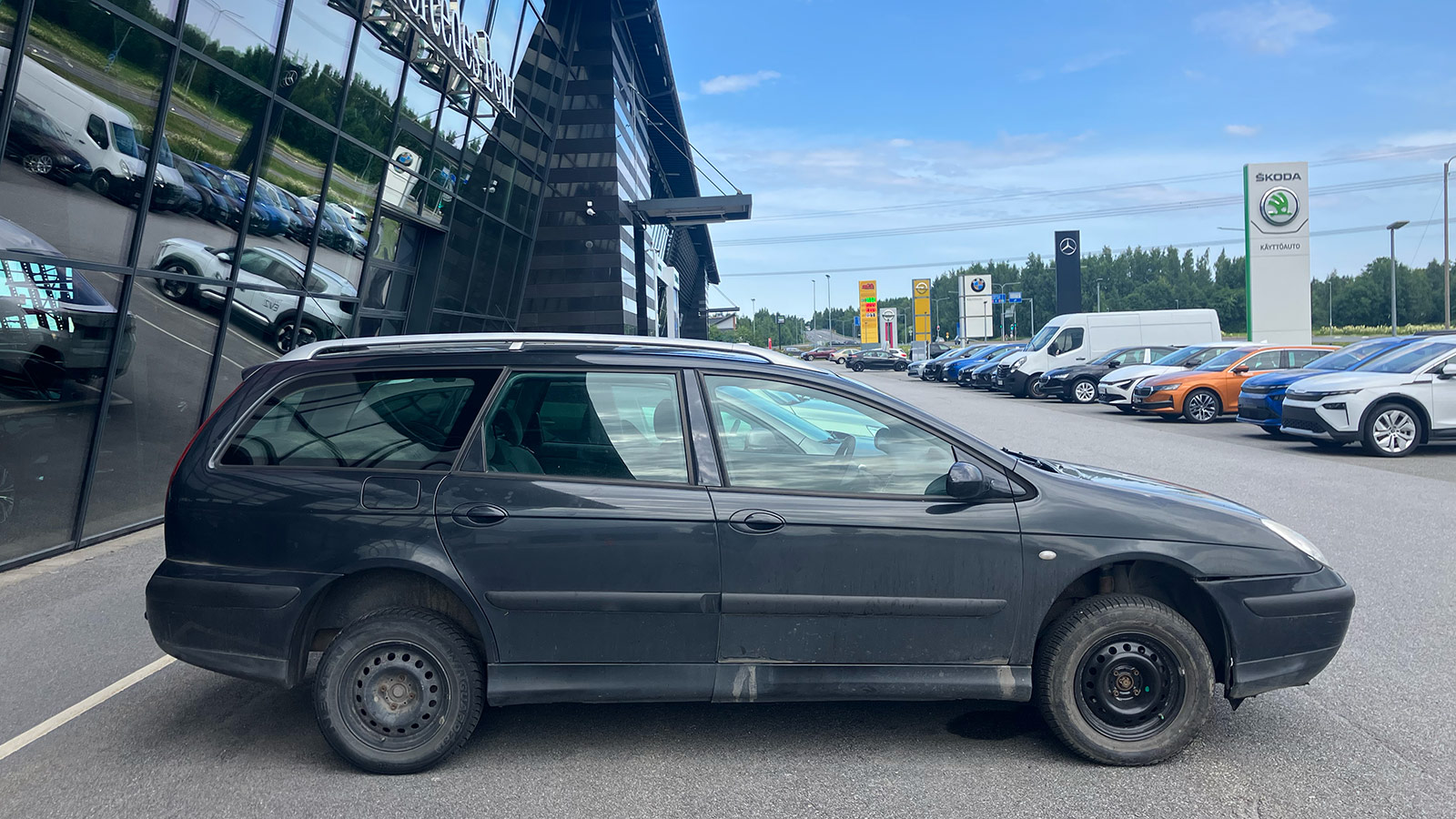
Of course, if it dies tomorrow you can cancel the insurance and will only have to pay road tax for the shortest period, so there’s some cashback to be expected. Heck, maybe someone will pay a few bucks for the catalytic converter even if the values of those have gone down the drain. And it’s sitting on superlight Citroën “steelies,” which are actually in demand among Peugeot-Citroën enthusiasts. They look like steel wheels but are made out of aluminum, and they are a great fit for the 205, for example. I have a couple sets myself. Also, if it dies before winter, it doesn’t need a set of winter tires.
To prevent the car from prematurely dying before you get some use out of it, you’ll likely need to account for servicing the belts. That costs around 500 unless you do them yourself (budget $150 on a belt kit), and it’s probably one of the reasons why the car has been offloaded despite having nearly a year’s worth of perfectly fine roadworthiness left in it. Taking care of that doesn’t yet make the car bomb proof, but it’s one less ticking time bomb. If the mentioned vibration is the driveshaft, a new axle is another hundred. That also brings the car’s price in line with the rest of the similar Citroëns for sale online, which shows how difficult it is to make a buck with a cheap French wagon, especially if you have a few fees to pay before you can even play.
None of the issues listed here are in any way out of the ordinary for any car, let alone the wagon shown here, but if you have to budget for every maintenance item at the same time, they make for a long list. That ten-dollar car shown in the auction ad is suddenly a lot more expensive, but then again: it costs more to drive through the car wash at the dealership forecourt.
Now, I’m mainly interested in seeing if the car pops up anywhere near, cleaned up, with decent tires and the timing belt taken care of – and what kind of asking price it will get. Without any of those fixes, it’ll be a tough sell no matter how cheap it was to get.
Photos by author and Huutokaupat.com


It boggles my mind how cheap mechanical work is in some European countries. $500 for a timing belt is about a quarter of what it costs around me.
1972 Mazda 1300 – $A300 (or about $210 Freedom Dollars). Parents had a friend in the local Toyota dealership that wanted it gone. Didn’t have a straight panel on it as had been driven by touch by a little old lady – she touched something she’d gone too far… Honed by ‘panel cream’ skills with it, had it painted canary yellow then rolled it – onto it’s side. Traded it for $A600 on my first Falcon.
My cheapest was a ’79 Plymouth Volare Sport Coupe for $175 in 1995. It had been sitting for two years, but my friend and I jump-started it, aired up the tires, and drove it 20 miles home, on whatever old gas was in the tank. Did 70 mph on the freeway without issue, once the flat spots worked their way out of the tires. Gotta love a Slant Six. I drove it for three months and sold it for $400 without doing anything except changing the oil and replacing the battery.
‘64 Dart 270: $0. Got a couple years out of it, traded to my friend for a pretty blue ‘60 Falcon with a very tired 144. Sold for $400.
‘59 Peugeot 403 : $0. Good daily, sold for a $250(?), when I moved back to cali in 1999.
‘85 Peugeot 505 (gas) : $0. Bought a used motor from the Ethiopian Peugeot garage down the street for $100, put it in the car. Junkyard differential $25. But then it turned out the tires had some expensive metric size (weird bc i had what looked like the same rims on my 505 Turbo Diesel and they were 13” or 14”, also lived in Europe for a few years after that, all the tires use the same size scheme as in the US). So gave the car away.
‘69 Impala hardtop, with a 327 : $0. Smoked like hell, gave it to Big George Heath (RIP????, I would be surprised if no one here knew him). He put it in his backyard and chopped it up with a plasma cutter. For fun.
‘70 something B210, art car. $0. Ran and drove just fine. Gave it to my coworker Jacinto at the Tofu Factory. Dropped it off with his housemate Claudio, who sold it and never told him I’d dropped it off. Jacinto was pissed. I don’t know what happened to either of those guys.
‘70 Peugeot 504 Diesel. : $100. Nice car, head gasket leak. Got a replacement motor from some guy in Salem, OR. Tight motor, but had bent rod, so one cylinder smoked like crazy. Drove all the way down to Salem again, guy gave me another. Head gasket leak. XD90 engines can go to hell. Cylinder liners/sleeves. F that. XD2 on the other hand, good motor.
Run of $20 to $250 Darts and Valiants. Too numerous to get into. One we called ‘The Cayman’ because it would sputter and spit until it warmed up. You could just see in your mind, the angry little cayman spitting and thrashing inside the muffler. One had such a worn thrust bearing on the crank that the crank would move about 1/2” forwards when you revved it. Traded that one to ‘Mingo’ in Bishop, Ca, for some Subaru tires and I think a front caliper for a broken free Subaru that my friend got.
‘65 Chevy C20 with a 283 : $300. That truck was killer, nothing more to say about that. I had gone in on it with my friend, so after a few months to a year, he took it over. He was living in S.F., and it got stolen. The cops found it eventually, stripped ????.
‘80 Peugeot Diesel Wagon $400. Killer car. Sold to housemate. Replaced it with an ‘84 505 Turbo Diesel, also
killer. Traded that to a friend for a ‘70 280SE with a leaky main seal (rope or felt, why?). Sold to other friend and started paying a few thousand for actually good cars since then. Had 3 cars in last 27 years. One we only got rid of because we moved from Germany back to US.
Oh yeah, probably TRX metric wheels and tires on that 505. The 504, 604 and 505 also had the weird 4×140 bolt pattern that was only seen on old Subarus, so a metric set of those sounds like the most useless set of wheels I can think of.
“What’s the least you’ve paid for a running car? ”
For me, that would be the 2003 Suzuki Aerio I bought in 2018 for CAD$1000… which works out to about $1265 in 2026 Canadian dollars.
It was in good condition and only had around 140,000km on it.
It ran, drove and stopped fine. But it needed a new accessory belt and it needed brake service as there wasn’t enough pad material to pass inspection.
All-in to get it on the road, it cost CAD$2300.
The car lasted me 3 months until one evening just before Christmas, a jackass with no lights on, no signaling and no checking did a U-Turn right in front of me.
I stood on the brakes and pressed the horn.
Upon hearing the horn, the jackass just stopped in front of me instead of speeding up to get the fuck out of my way. So he got T-boned by me… not too hard mind you.
Nobody got injured and my airbags didn’t go off. But his side airbag did go off.
My Suzuki was theoretically repairable, but the cost of the repair was way above the value of the car and thus, it got written off.
Had this not happened, I estimate this car would have lasted me at least 4 years.
If we don’t adjust for inflation, then the cheapest is a 1987 Honda Civic Wagovan that I bought for $800 in 2003. And that car lasted me just over 3 years and I put 60,000km on it.
Oooooh. Wagovan. I thought those were pretty cool. I had a ’71 Tercel 4×4 wagon. That was its natural competitor, but the Wagovan seemed cooler.
“What’s the least you’ve paid for a running car? “
For me, that would be the 2003 Suzuki Aerio I bought in 2018 for CAD$1000… which works out to about $1265 in 2026 Canadian dollars.
It was in good condition and only had around 140,000km on it.
It ran, drove and stopped fine. But it needed a new accessory belt and it needed brake service as there wasn’t enough pad material to pass inspection.
All-in to get it on the road, it cost CAD$2300.
The car lasted me 3 months until one evening just before Christmas, a jackass with no lights on, no signaling and no checking did a U-Turn right in front of me.
I stood on the brakes and pressed the horn.
Upon hearing the horn, the jackass just stopped in front of me instead of speeding up to get the fuck out of my way. So he got T-boned by me… not too hard mind you.
Nobody got injured and my airbags didn’t go off. But his side airbag did go off.
My Suzuki was theoretically repairable, but the cost of the repair was way above the value of the car and thus, it got written off.
Had this not happened, I estimate this car would have lasted me at least 4 years.
I once gave away a MK4 Jetta wagon that was gold (brown), manual and diesel (TDI). I had been on a trip to western Maine and was going 70mph on a dirt road when a culvert repair had created a “jump” and when I bottomed out, I cracked the oil pan.
I gave the car to my buddy who liked TDI cars and he brought me a bottle of Bourbon and one bicycle tire since he didn’t like taking things for free.
My son kept tradition alive by buying a 1995 Legacy wagon for $400. Beaters with Heaters are great fun to have.
What’s the least you’ve paid for a running car?
Adjusted for inflation: $1834.
That Chevy wagon had several issues, but it ran. And if I’d kept it thirty years longer, it wouldn’t have been merely a “1964” Chevy, but rather “My 6-4.”
$10 for a running and road-worthy Citroen Safari?
Take My Money!
My best $10 car was a 1971 Oldsmobile Ninety-Eight Regency with a 455 Rocket. This was back around 1988 or so. My cousin sold it to me for $10 back when a whole carton of cigarettes cost around $10, and she really needed some cigarettes.
She said the transmission wasn’t working right after her ex-husband had taken it down an old logging road. I limped it home, crawled under it and found a dented transmission pan that was missing 3 or 4 bolts. I found replacement bolts at an auto parts store, as well as a couple of quarts of transmission fluid, tightened the bolts, poured in the fluid, and got another year out of that car before the transmission finally failed for good.
I also later bought a $20 car from that same cousin because it had a leaky gas tank and her landlord told her to get it out of the driveway or he was going to have it towed. Some JB Weld gas tank epoxy putty took care of the leak and I got a year out of that one, too before it was wrecked while parked one day.
You’re right. Cheap cars owe you nothing, and you don’t owe them anything, either.
I bought a 1.0 Polo for about $50. Drove it around for a couple of years, my friends would open beer bottles on the roof drains. The best deal was the 205 I got for free as the owner thought there was a transmission issue. It was a broken engine mount that was fixed in a half hour, that was driven for quite some time and thoroughly abused. Can’t beat a beater.
How often are safety inspections done on cars in Finland? Yearly? How thorough are they? Are they TUV-like in depth?
The superficial appearance of that car makes me think it barely made it through inspection before.
1000+ Euros plus additional hassle of paperwork for 8-9 months and then it almost certainly fails inspection in April 2027 makes it pretty questionable.
I also live in a jurisdiction that only does safety inspections on sale/purchase of a vehicle. As long as the owner keeps the car in their name, no additional inspections are required, changing the calculus for this sort of thing.
They are TÜV enuff that DEKRA’s even been buying some of the inspection stations here. But then again, I can’t believe the fingersoft CLK I drove last winter had been inspected by anyone with functioning eyesight.
These are unbeatable on a price-comfort ratio, as long as things still work properly. They’re goofy looking in a very 90s way and very practical and tough. You see it standing like this, a decrepit old soap shaped shitbox, still rides better than probably 90% of new cars.
it looks like a video game error with the suspension jacked up to max like that
This car has the hydropneumatic suspension and it’s completely raised on those pictures. That’s not the normal driving height.
I saw that almost immediately afterward when I kept reading and changed my comment. lol
In High School (1967) I bought a 1955 Chevrolet 2dr BelAire. Six cylinder & three on the tree for $250. Other than the front fenders which were rusted through at the “eyebrows” above the headlights it was in beautiful condition. Replaced the fenders for $125 each and Dad paid for a repaint in dark green. No recollection what the cost of the paint job was but he blew his stack when he got the bill. So, technically I paid only $500 since Dad paid for the paint 🙂 Should have kept that one…
Cheapest car I ever bought I paid $10, it was a thoroughly clapped out 1956 Pontiac 4 dr, I spent about $200 fixing it up and drove it for three years, then sold it for $150. Of course, that was WAY back in the day – mid 1960’s. Next cheapest was a 1953 Chevy 4dr for $75, I did nothing to it and drove it for three years also, sold it for $25.
Antti: why can de-studded winters not be used?
I get that they’re nowhere near as decent as proper studded or friction winters, but logically they would still be roadworthy (especially as many cheaper brands will sell un-studded studded winters as a ‘friction’ option).
They are legal, but by the time you’re making all-seasons out of old winters, you know the rubber’s no good anymore.
That’s a valid point, my counter-argument, on the cheap, to ride out the rest of the year on dead winters until snow flies and see if it’s worthwhile to invest further into the car or shop for the next 10€ auction-find.
Welcome to the buy here, pay here business!
I’ve gotten a few free cars and $50 to $100 cars but those were years ago. The cheapest I’ve gotten a car in this decade I think was $600 for a Highlander hybrid. Auction fees are the killer of so many good deals.
It looks like a shitty Daewoo, and since it’s French, probably even shittier than a Daewoo LOL
who gets the 199 euro? the dealer or the auction platform? is that like our (USA) tag and title fees?
Or… for less than $1,000 you get a car that runs for a bit. Then, when it meets it’s inevitable fate you start a new business venture as a Citroen used parts supplier. It has one bad axle which means it might still have one good axle to sell. Sometimes you have to approach these from a haphazardly glass hall full perspective.
So pragmatic it almost brings a tear (of joy) to my eye. 🙂
Oh, I enjoyed this Antti! 😀 Eductional and entertaining! Plus, some perverse part of me kind of wants a crapcan Citroen wagon, especially with a hydropneumatic suspension and aluminum steelies.
I don’t even think it’s that ugly! 😉
PS: I don’t think I ever got a super-cheap car. I’ve bought a few cars in the $2K price range : an ’81 Rabbit Convertible with a seized engine (spent another $800 putting a used engine in). Also, my current ’95 NA Miata with only 85Kmiles on it cost me $2,250. just before Covid, though I bought it w/o a title, so there was some risk. But I never (yet) bought a $200ish car, to my regret. There was an old Prelude I tried to buy for $250 a few years ago, but there turned out to be some sort of hold on the title due to accumulated tickets, so that didn’t happen, much to my regret.
I bought my Miata from Germany, dented and rusted, for 770 Euro in 2015. I’ve had it fixed up since but values have probably risen more than what I’ve put in the car.
Yes, there’s that for many used cars purchased pre-pandemic, but used Miata prices have gone up like 3x+ here in SoCal. My 240 wagon (purchased recently/post-Covid) cost me about twice what it would have before the pandemic.
It’s nice to have a running NA Miata in the garage. It keeps me from wandering into first-gen Boxster ownership and all the potential perils that entails. 🙂 Plus, I play Elastica when I’m driving the Miata, which is period-correct and the car/music fill me with joy. 🙂
I bought a running/driving 1982 Chrysler Fifth Ave at an auction in 1998 for $125. I drove it for a full year, then re-sold it at the same auction for, you guessed it, $125.
Takeaway: Car insurance is really cheap in Finland.
It can be! The quoted 140 euro price for third-party insurance (mandatory) is for a 40-something driver (me) living in the countryside (me) with full no-claims bonuses (also me). Another company shows 200 euros for the same coverage, so it pays to shop around. A younger capital region driver with a different record might end up paying a grand per year, but YMMV.
That’s still cheap compared to the UK.
There’s a lot less to hit in Finland (Apart from elk, but they don’t tend to need resprays afterwards).
Moose tend to take out the driver, so it could results in less medical leave coverage.
1000€ for a young urban driver sounds like a deal from here.
In my state, the average auto insurance for minimum coverage appears to be $197/month.
That’s dirt cheap compared to Canada. I pay about CAD$1500 (935 Euros) annually for my 2017 Ford C-Max
I’ve got my ’95 Tracker down to CAD$85/mo, or $1020/yr on bare minimum coverage, which I’m really happy about! It’s half to a third of what most of my peers are paying, and is a big reason I wouldn’t want to buy something newer
Absolutely; I first read it as 140 euros per month and didn’t bat an eye.
I was just quoted nearly CAD$4,000/yr for one (1) relatively modern family hauler. Just one car, in a small town, from my longtime provider which has all my insurance business and zero claims made.
That’s terrible. Over here EV insurance costs have ballooned over the past couple of years, so my Peugeot EV which I initially insured for 500 per year (full coverage as you’d expect with a brand new lease, but with some temporary discounts) would have cost a grand per year from the same provider a year ago. I shopped around and managed to bring it down to 800, but couldn’t find anything cheaper. The Mitsubishi hatchback we also have costs less than 500 per year, with similar coverage but with 25k km/yr instead of 15k.
Antti: Be aware that comparing insurance costs between Finland & Canada might not be an apples-to-apples comparison. In Ontario, the province I live in, there are many more benefits included in basic insurance coverage than there are in the USA, or possibly Europe.
For example, I pay about $1,800 CAD ($1,300 US, €1,100) a year for my 2024 Golf GTI. For that, I get $2 million liability, collision, comprehensive, full health benefits (including at home caregiving if needed), death & funeral, and income replacement.
Back in 2024, I wanted to buy a 2014 Tesla Model S85 which was selling for CAD$18K.
My insurance quoted me $4500/year. And even shopping around to other insurance companies resulted in quotes similarly expensive.
So instead, I ended up with my 2017 C-Max which costs about $1500/year to insure.
Side note: The Prius is similarly cheap to insure.