

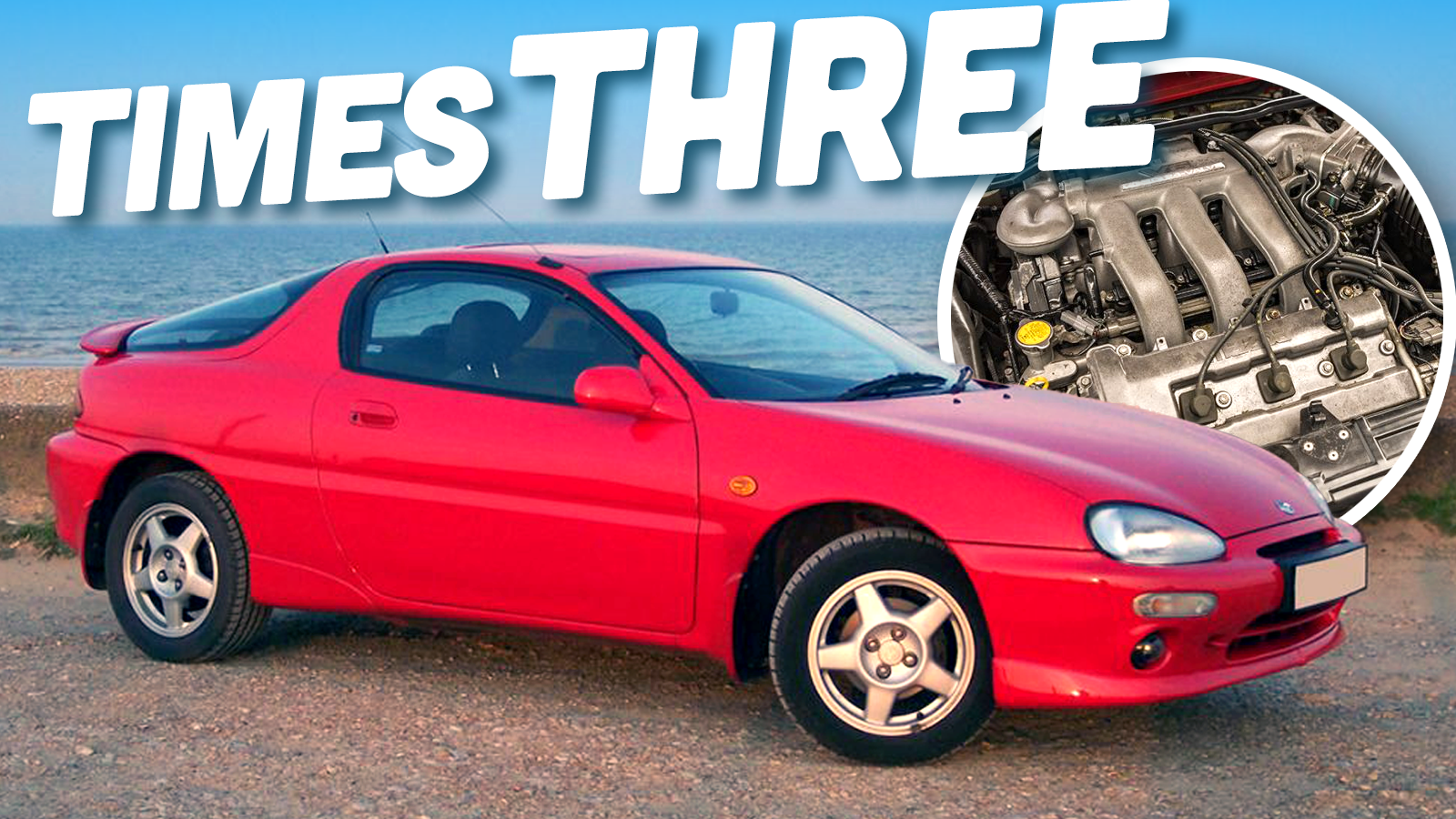
All being well, you’ll be seeing my name popping up here on The Autopian a few times over the coming month, and by way of introduction: I’m Andrew, and I have three V6 Mazda MX-3s. No, I don’t have a problem.
Unless you have a particular personal reason to remember the MX-3, it’s unlikely you’ll have thought about it at any point recently until reading this. Even in its day, and that day lasted six years depending on your local Mazda office, the MX-3 wasn’t a particularly popular or common car. Google it now, and the LLM that’s replaced the search engine will think you mean the Mazda 3, MX-30, CX-3, or MX-5.


Actual sales figures are hard to come by, but the main Canadian fan site puts the total there just over 29,000, while UK car-survivor tracker website howmanyleft.co.uk has a peak of around 3,400 registered cars here – only 150 of which are still either covered by current road tax or declared legally off-the-road. If there were ever six figures of MX-3s globally, I’d be surprised, even though they were sold under five different names.
Why Does This Car Even Exist?

The MX-3 arrived during that strange spell of 1990s small, front-wheel-drive, hatchback-based liftback cars where suddenly every manufacturer – or every Japanese manufacturer at least – had to have one, just before crossover SUVs turned up and made the roads a lot more boring to look at. Although cars of this type had existed before, the 1990s saw an explosion in them, and before long, if there was a sensible FWD B/C-segment car there was a sportily styled, three-door version of it.
Honda, Nissan, and Toyota all had them, positioned as aspirational cars for their gentleman’s agreement machinery, but they weren’t alone. Even on the smaller end of the scale, Ford had the Fiesta-based Puma while Opel/Vauxhall brought the Corsa-based Tigra. The MX-3 was essentially built on the underpinnings of the BG-generation 323, which also spawned the Ford Laser.
One thing they all had in common, though, was relatively dreary four-cylinder engines; the variable-valve timing Honda was fizzy enough, and the Yamaha-developed 1.7 variable-cam in the Puma is by no means bad, but still.
Where the MX-3 differed was that it had the option of a V6, and not only that but at 1.8 liters it was the smallest V6 engine ever offered in a production car available in multiple markets up until the Mercedes-AMG One’s 1.6 beat it in 2023 – and that’s turbocharged and hybrid-assisted, not nat-asp like the MX-3. Mitsubishi made a smaller 1.6 V6 in the same era, but only for the Japanese market.
Behold, The K8

The “K8” engine, as it’s known, was developed for the MX-3 in order to slip in under a tax bracket for two-liter engines, but also formed the basis of a family of engines. A two-liter “KF” went in the (CB) 323F/Lantis coupe and various Xedos models, with the larger “KL” 2.5-liter finding a home in the Mazda MX-6, the second-generation Ford Probe that was based on it, and the Xedos 9. It was also developed further into a very odd engine indeed, the “KJ” (which I’ll get onto in a minute). Reputedly, Mazda mashed two of each together to form various V12s, from 3.6- to 5.0-liters, for the aborted Amati brand.
With only around 135hp, depending on market, the K8 may have been the top engine for the MX-3 but only just about matched the 1.8-liter four that arrived in the mid-life refresh for the first-generation MX-5, so it wasn’t the last word in straight-line performance. Clever intake trickery known as VRIS – Variable Resonance Induction System – meant that peak torque was there for quite a lot of the rev range; I did manage to get my original MX-3 to, admittedly from a downhill roll, pull away in 4th gear and past 100mph. In theory.

How I got to owning the first one was actually pretty odd by itself. My Dad had been driving a Ford Explorer – yes, in the UK – but found the fuel consumption A Bit Much, and on a visit to a car supermarket the small, red MX-3 just leapt out at him for some reason. After a year or so, he found he missed the performance even compared to his old V6 Ford Probe, and ended up with a Focus ST170, which lasted about six weeks before he got rid of it due to, and I quote, having to “drive it like a twat” to go quickly. Luckily, I caught him before buying the Focus, drove 240 miles back home, gave him £3,000, and set off back with the MX-3. That was in 2003.
I Don’t Have A Problem, You Have A Problem (Ok, Maybe I Have A Problem)

It was a car I found incredibly easy to live with, primarily because the seating position and gear change were perfect. Despite the 2+2 seating setup, I regularly took a couple of adult back-seat passengers and all their kit (including keeper kit) for hockey games around the county, and even went on a 700-mile round trip to collect a chocolate labrador with my black labrador in the trunk and my eldest child (and luggage) on the back seats. The trunk is absurdly large, considering.

The second car came about from the desire to make it quicker. Aftermarket bits for the MX-3 were not exactly common – probably not helping its original popularity – and even claimed specialist Mazda tuners didn’t really have an answer. Or much of a clue. Internet wisdom holds that the best way to get an MX-3 V6 quicker is to swap out the K8 for a KL, ideally the Japanese-market, 200hp KL-ZE from the MX-6, but I didn’t want to do that to my own car and take it out of action or deal with punitive insurance for a modified daily car. Solution: buy another car.

In the meantime, I’d become more aware of that “KJ” engine, which is better known as the Miller Cycle engine. Based on the 2.5 block, the 2.3-liter KJ employed valve-timing trickery to enhance efficiency at the expense of compression and therefore power, with a supercharger nailed on (between the banks of the V) to bring it all back. The net result is 230hp and about 40mpg in English gallons, even in the heavy Xedos 9/Millenia it was only fitted to, but it’s not done as an MX-3 swap because the engines are rare and some say it doesn’t even fit.

Egged on by an automotive engineer friend who volunteered his time – I can fix like for like, but I’m not anywhere near creative enough for this sort of thing – I picked up a crashed Xedos 9, and then an SE version of the MX-3 from a lovely couple who didn’t want to sell their car, “Marvin,” to someone to strip all the special bits out (like the natty half grey-suede seats and door cards) just to junk it, but loved the idea of keeping him going through this project.
It’s far from complete, with life perpetually getting in the way, but the KJ is now at home in the engine bay where it fits like it was always meant to be there; the K8 went to a chap building a classic Jaguar replica wanting V6 sound but not a lot of power.

And finally, the third one. The thing with these cars is that parts are getting scarce now, and bits like the moonroof (which rots), huge rear screen (which smashes), and intake flexipipe (which perishes), among others, will basically cost more than a car to get new ones … so we bought an entire extra car, for £250, to keep the others running.
As I’m now too creaky to be dropping into a car that low regularly (or our NA MX-5), I daily drive a 2.3 turbo CX-7 instead. Maybe I do have a Mazda problem after all.
Photos by the author unless otherwise noted.


Welcome Andrew! I wouldn’t call it a problem, it’s a good problem. Separately, yours is not “hoarding” at all but I don’t understand why car “hoarding” is bad…I do understand why if they just sit forever…but I’m actually jealous! Ha ha…since I’ve never had that and want a whole field of awesome rusty, junky classics
As a fan of the Yamaha SHO engine and someone who is looking at the Lexus is350, how does that mini V6 sound?
Edit: I’m back from YouTube. It sounds fantastic!!!
Why are these cars not the darlings of autocross?
I actually learned to drive in one of these – well, technically a manual Eunos 30X, as they were branded in Australia.
For a while, my parents actually had two Eunos’ (Eunii?), as my mum had the Eunos 500 (fancy Mazda 626) before dad randomly and without notice traded his huge Ford Fairlane Ghia for the tiny 30X.
Fun car to drive though! And you’re right about the boot space, cavernous back there in direct contrast to the rear seat I frequently had to squeeze into. Not made for a 6″ frame.
I always thought these were neat quirky little cars
Just the commercial alone will make sure that I will never forget this awesome little car. Check it on youtube the Dutch version: Dutch Mazda MX-3 V6 commercial.
These are awesome and I always liked them! Definitely here to encourage the Mazda problem, haha! I love my NC Miata.
I used to be a VW fanboi, but now I’ve got an NC MX-5, and I think I might now be a Mazda person…
I started out as a muscle car guy till I learned to drive stick on my dads NB, haha