

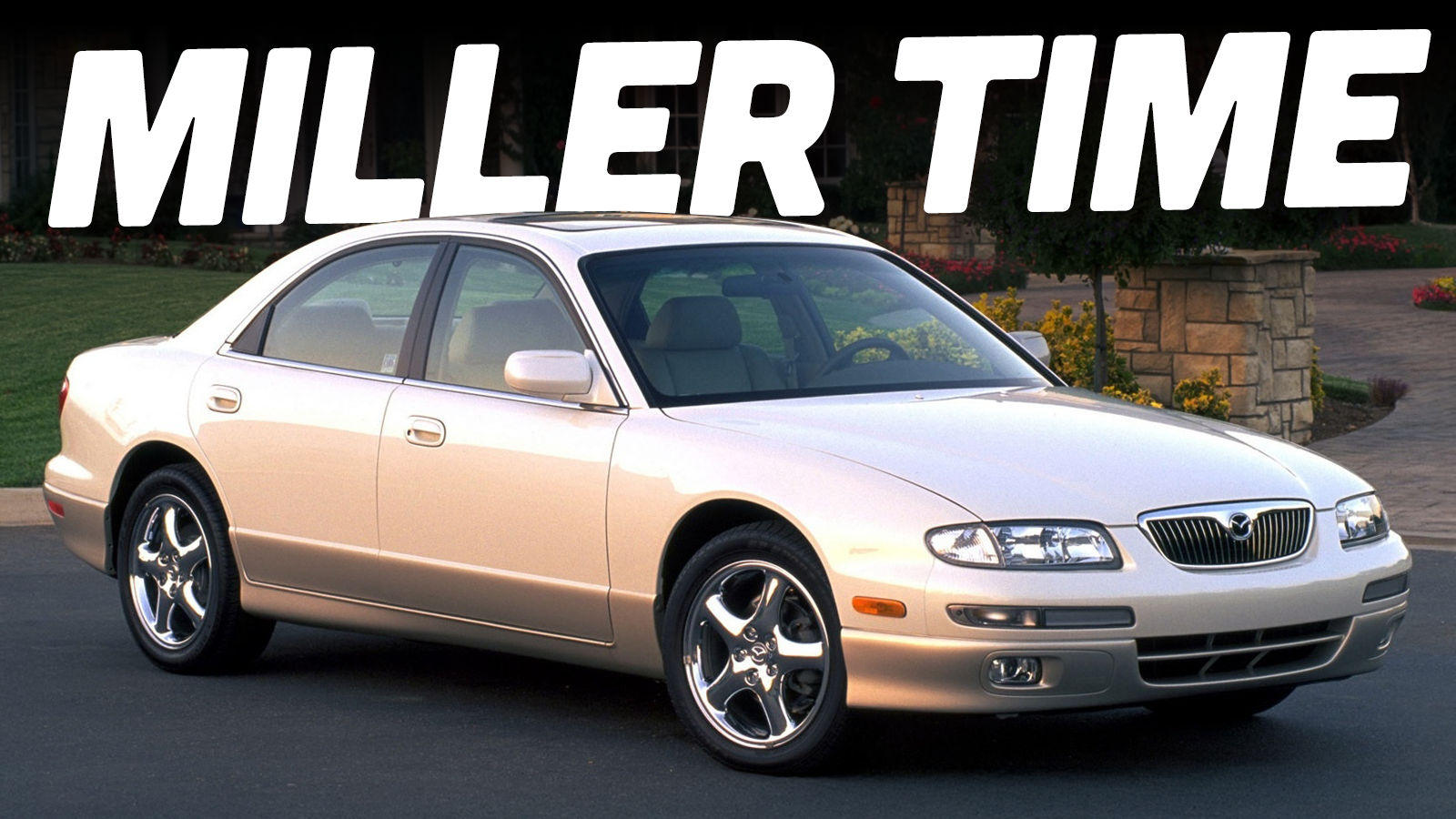
You almost have to stand back to appreciate that while emissions standards are tighter than ever, cars remain wildly powerful. A regular six-cylinder BMW X3 now makes almost as much power as a V8-powered E39 BMW M5, and a variety of fairly normal turbocharged two-liter four-cylinder engines have crossed the 300 horsepower mark. That would’ve been ballistic 30 years ago, but maybe a few enthusiasts could’ve seen the future back then. In 1994, Mazda launched a sedan called the Millenia, and this oft-forgotten sedan launched a technology that keeps some of today’s high-performance engines emissions-compliant.
The turn of the 1990s was a pivotal moment for the Japanese car industry. As Honda and Toyota launched Acura and Lexus, Mazda had huge plans of its own. The automaker’s luxury sub-brand was going to be called Amati, and while Lexus’ four-liter quad-cam V8 was an achievement, Mazda planned to upstage this with an outrageous V12 in its flagship model. Sadly, before Amati was ready for public consumption, the Japanese economic bubble burst. The V12-powered Amati 1000 was not to be, but a remnant of the Amati program made it to America under the name Millenia.


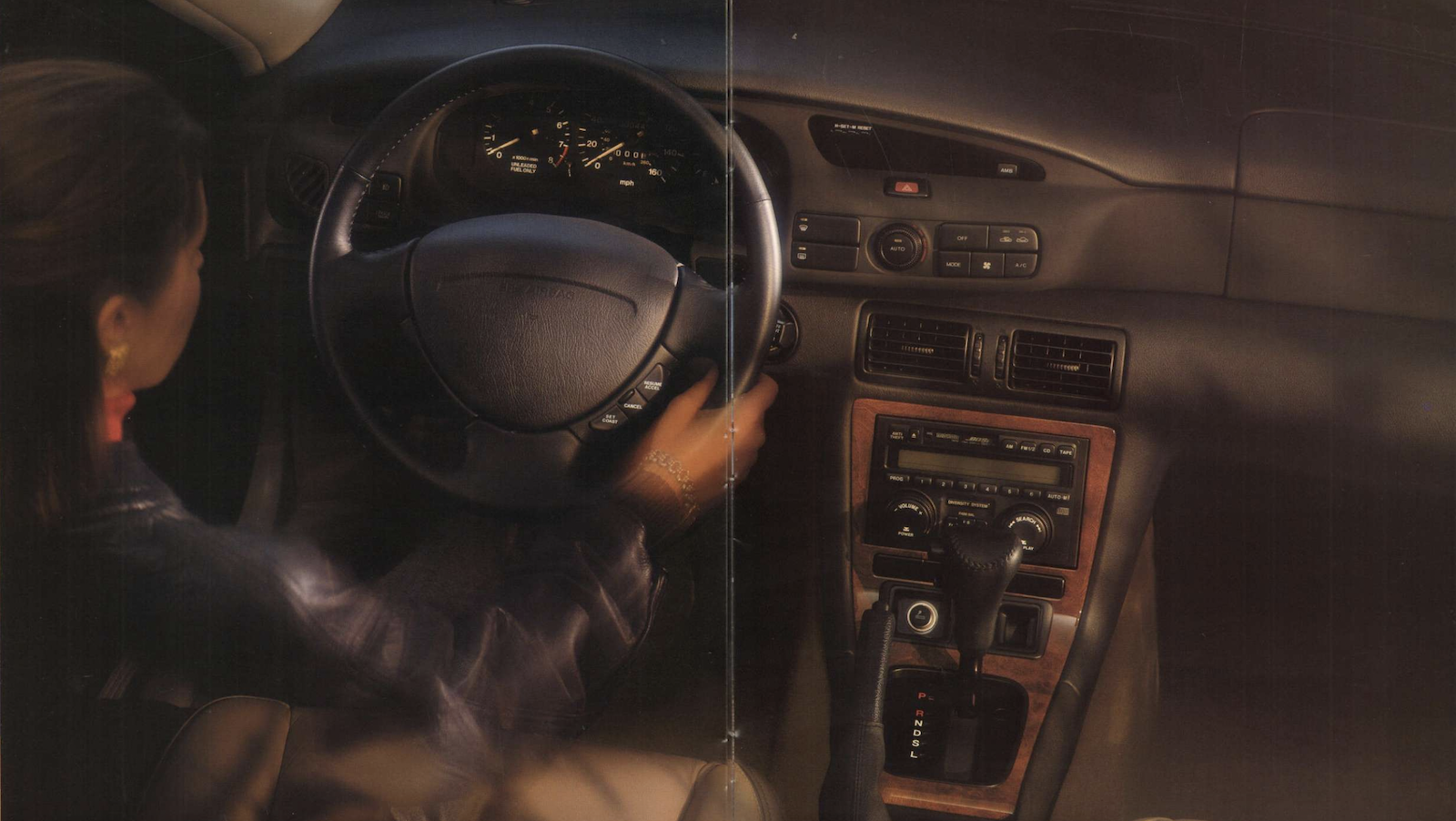
In hindsight, the Millenia was a bit of a weird car. It was definitely larger than the mainstream 626 midsize sedan, but it was only about as large as the U.S.-market Toyota Camry of the time. However, the Millenia was a whole lot nicer than the 626, and you could tell with just a glance inside. There were some funky aspects, like a high-set display and controls for the automatic climate control, and volume and tuning knobs on the radio that were roughly the diameter of condensed soup cans, but the materials were quite nice overall for the time. Tick the right option boxes, and you’d get ruched leather, a power moonroof, and a Bose audio system. Oh, the trappings of mid-’90s luxury.
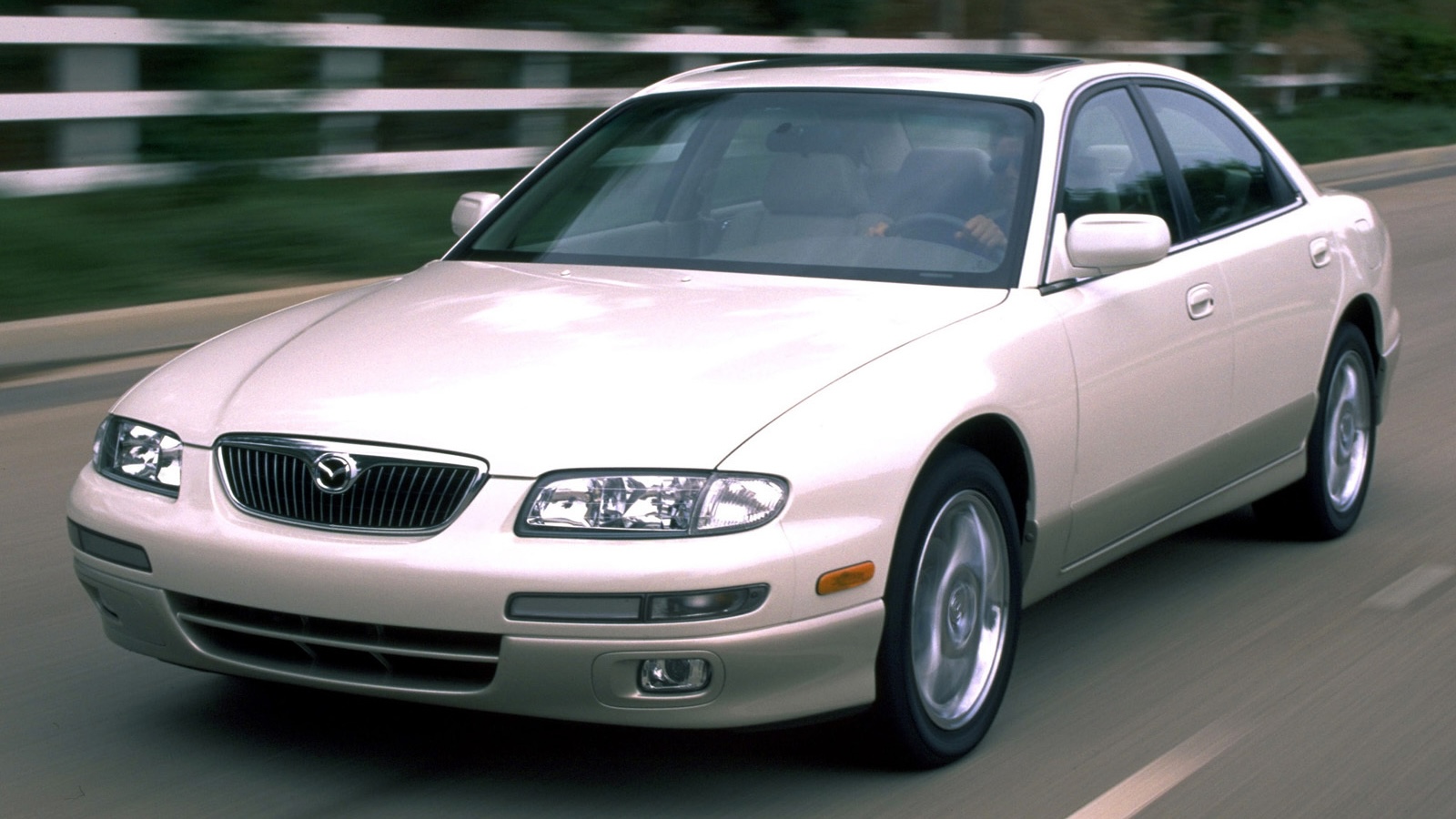
The Millenia was a good-looking car too. Sleek, streamlined, and launched with uncommon-at-the-time projector headlights, this sedan certainly had an air of sophistication to it. However, undoubtedly the most influential thing on the Millenia was its optional top-spec engine.
Operation of a common four-stroke Otto-cycle engine is fairly easy to explain, especially if we’re assuming it’s a normal port-injected engine. First, the intake valve opens and the piston drops down, allowing for the intake of the fuel-air mixture. Next, the intake valve closes and the piston travels upward to compress the fuel-air mixture. Once the piston’s reached the top of its travel, the spark plug lights off the fuel-air mixture, forcing the piston back down in its cylinder. Then the exhaust valve opens, the piston travels back up its bore to expel the spent exhaust gases, and the process starts all over again.
An Atkinson-cycle engine, commonly used in hybrids, posits that if an engine’s expansion ratio can be greater than its compression ratio, it can be more thermodynamically efficient. Therefore, during the compression stage when the piston squeezes the fuel-air mixture, the intake valve stays open just a little bit longer to effectively reduce the compression ratio. The result is a more efficient engine with reduced emissions, but with a sacrifice of power due to the lower compression ratio.

A Miller cycle engine fixes this power deficit using forced induction. By compressing the air entering the engine beyond atmospheric pressure, power is restored. How did Mazda compress the intake air in the Millenia S? By using a positive-displacement Lysholm supercharger like you’d find on a muscle car. Sure, it used a little bit of engine power to compress the air, but it was lag-free and returned that power back to the engine with interest.

Compared to the normal 2.5-liter V6 in the cooking-grade Millenia, the 2.3-liter supercharged V6 in the Millenia S pumped out an extra 40 horsepower and 50 lb.-ft. of torque while returning the same city fuel economy and an extra MPG on the highway. This 210-horsepower machine was potent enough to match pace with a BMW 325i from zero-to-60 mph despite being a larger, heavier car. In 1994, Car And Driver put the Millenia S up against six other upscale sedans and came away impressed.
Wow! Great throttle response, composed chassis, precise manual shifts, amazingly good grip. Little understeer compared with the Lexus and Chrysler. The tradeoff is toward handling, and ride suffers, but this one is me. Phenomenal power for a wee V-6.
In that comparison test, the mighty Mazda managed to beat the Mercedes-Benz C-Class, the Volvo 850 Turbo, and the Lexus ES, playing second-fiddle to only the aforementioned BMW 325i. The Millenia was good, but there was just one problem: It sort-of got lost in the noise. While the Miller cycle V6 was undeniably cool, supercharging added cost and complexity over a traditional V6, and for the longest while, it looked like the use of this technology would be a one-off. Then came the widespread adoption of twin-scroll turbochargers.

Unlike a supercharger, a turbocharger uses waste exhaust gas to spin up an air compressor, meaning it effectively compresses that air for free. The downside in decades past was lag. Hop into an old-school turbocharged car like a Dodge Omni GLH-S, mat the throttle, and you’ll be waiting a moment before the turbocharger spools up and actually does its thing, partially because it needs a fair amount of exhaust gas flow and partially because the individual exhaust gas pulses all collide together through the turbo flange, reducing scavenging efficiency. A twin-scroll turbo, on the other hand, splits its exhaust ports to maximize the efficiency of exhaust pulses. If said turbocharger is sized right for response, this results in substantially reduced lag in the sort of light-load conditions where single-scroll turbochargers have previously struggled.

Indeed, over the past few years, we’ve seen more and more cars use the Miller cycle for efficiency. Volvo effectively uses it in its 48-volt mild-hybrid models, BMW uses it in models like the new X3, and Audi’s used a modified version of the Miller cycle in many of its four-cylinder turbocharged engines for the past decade.

So the next time you’re awed by the power of BMW’s latest B58 turbocharged straight-six or appreciate the continued sale of Volvo’s combustion-powered cars, take a moment to acknowledge the Mazda Millenia S. The first mass-produced road car to use the Miller cycle, permitting greater efficiency and good power.
Top graphic image: Mazda



In 1999, the S15 Nissan Silvia was putting out ~250hp from a 2.0L turbo-4 from the factory, and people were modifying them to over 500hp.
A few issues here:
“The result is a more efficient engine with reduced emissions, but with a sacrifice of power due to the lower compression ratio.”
By keeping the intake valve open longer into the intake stroke, the engine pushed back out some of the intake air, effectively making it act like a smaller engine since the entire displacement isn’t used for intake. The entire displacement is used for expansion though, so you can extract more energy out of the combusted gasses than with a typical otto cycle where the expansion ratio has to match the compression ratio. That’s why power, but especially low and torque, typically is reduced, not because the compression ratio is reduced. In fact the geometric compression ratio is often higher for Miller and Atkinson cycle engines since some of it is “given up” by the late intake valve closing, making the effective thermodynamic compression ratio lower.
Just about all engines today have some degree of this, often with cam phasing, to achieve a thermodynamically larger expansion ratio than compression ratio when desired for efficiency, but the intake cam phasing is advanced at higher speeds and loads to recover the power
Still looks clean now… yes, a bit generic, but that’s only because we all lived through a decade and a half of smooth, rounded, bubbly cars around the 1990s. IMO, it’s only the chrome wheels that give it an air of yesteryear… it’s a sharp design: handsome without being flashy. I could happily drive that today, without waving any flag about retro.
I know the Miller cycle engine is the main attraction of course, but the overall competency and quality of the Millenia (compared to contemporaries) always appealed to me.
Kudos of course to Mazda for following the beat of its own drum… how were they to know that Japan was about to enter the Lost Decade (economically)?
I agree, take those chrome wheels and give ’em a coat of regular silver paint and its much better.
I thought it was gorgeous at the time, but I’ll admit it’s a bit bland in retrospect. I still think it looks good, mind you, but I remember being able to spot one from a quarter mile in the ’90s.
Anyway, you missed the best option: a solar moonroof that would pop open when it was hot inside & sunny outside (IIRC there was also a power vent). IOW, the car would keep itself (relatively) cool in sunny weather without risking rain getting in.
It really doesn’t look like a 30+ year old design. Almost kind of like someone today doing a retro 90s design. I mean that as a compliment.
My dad had a ’98 Millenia (standard 2.5 v6) and it was such a nice car. We got it on some absurd lease deal where it was 2 years for $199 a month. Despite loving the car we gave it back because the buyout was just too expensive.
The Mazda Millenia helped me sell tons of Honda’s. In 1998 I worked at a small Honda and Mazda dealership and customers would come in to look at the Millenia. Most of these customers found the Millenia to be nice but a little pricey. Unfortunately the step down from the Millenia to the 626 of the day was huge. The 1998 626 was about as OK as a car could be. So when these customers inevitably turned up their nose on a 626 I would walk them straight over to a Honda Accord EXVL (V6 with Leather) and they would soon sign for a new Accord. The Accord was so much nicer than the 626 that it was much closer to the Millenia in creature comforts and performance and offered equal or more space for less money.
I remember sitting in the Millennia at the 1996 Pittsburgh auto show, and it was the only car there that would let you adjust the electronic seats without the key in the ignition (a common feature nowadays but unheard of back then)
Still so, so pretty.. peak japanese 90’s design
I recall sitting in a brand new Millenia in a Mazda showroom back in the day and it was truly a beautiful car. I enjoyed the 929 better though.
The word “millennium” is derived from Latin mille (a thousand) and annus (year), hence the double n. “Millennia” would be the plural form.
Is “Millenia” derived from mille and anus?
my parents bought a mazda millenia brand new in 1997. it was at one of those dealers near the military base in germany that negotiates the customs and buys us spec cars you can drive in germany and then have shipped back home to the states when you get back… that dealership ripped them off. they paid EXTRA for air conditioning. air conditioning was not installed. “oh it’s a dealer installed feature air conditioning is not attached at the factory we are waiting on it to arrive so we can install it” it never came. as soon fortunately they bought it in the winter and may 1998 we went back to the states. they had to take a HUGE bath on a brand new car that was missing it’s air conditioner that they were upside down on and it got swapped for a 1999 Plymouth voyager minivan that we traveled the entire US in.
I do remember the millennia absolutely ripping on the autobahn No problem driving 100mph for extended periods of time wich was mostly why they bought it they needed a big engine for the autobahn because if you just drive 80 or slower cars will FLY up behind you faster than you can react to get over. sometimes they will attempt to pass you on the right (illegal) because you didn’t have you blinker on and they think your not going to let them over but the reality is they just haven’t seen you yet. it can get scary!
You make sound driving on the Autobahn like an absolute hell…
Well only in the american imagination, driving on the autobahn is great. In reality it’s not very exciting and usually too much traffic. Nothing fancy about it.
Agree. The infrastructure is great and driving etiquette (in general) too.
Driving etiquette suffered a lot in the past years. But this is also just a result of way too much traffic. Not only traffic caused by german drivers, but of course we have a lot of transit traffic from all over europe.
I have to be honest: I hate driving in Germany. In most other European countries it is so much more relaxed.
Automatic Climate Control was standard on the US spec Millenia. If it was missing on your parent’s car – it was not a US spec car at all.
And nobody passes on the right on the Autobahn – it’s strictly prohibited and carries heavy fines. 80 clicks is nowhere near fast enough – that’s only 50mph.
I said 100mph not kmh. And yeah they needed a faster car to drive the autobahn the 91 grand am was not really keeping up.
It was most likely a german spec car but those dealerships can file paperwork to get them a us title and able to be imported to the us.
Can I share a story about the Millenia?
I had a stepmom. She was evil. I was 12-13 or so.
But, she had a ‘99 Millenia S. It was the same color as the car in the photo for this article. White over tan leather. All options. Power everything, sunroof, Bose stereo (that sounded amazing), heated seats, etc. To middle school me, it was amazing. But, it was mechanically finicky and ended up having some gigantic problem that cost the evil woman a LOT of money.
That feat made me like it even more. Because the enemy of my enemy is my friend.
One of my dad’s friends was a merchant marine generally a Volvo guy but got sick of them in the 90s. He bought a Millenia new because of it had the miller cycle. Apparently there were several marine engines operating on miller cycle and he saw the positives. He also had an Infiniti j30 I don’t remember his facination with that maybe exhaust ports or variable value timing. He went back to Volvo eventually.
They were basically an early Avalon with a brand that failed to launch a luxury brand. I think there could have been success there just something was off. Maybe if they had the magic Johnson lady people would be driving around in Millenias instead of Altimas.
Just a great example of how automotive manufacturing is concerned about the wrong thing. Stop worrying about HP and 100 mph speed and concentrate on the low end a good 0-60 speed to merge into traffic and a decent economy mpg to drive 75 mph all day long.
That’s what GM did with the 3800, but the automotive press trashed them for years as “unable to make the same power as competitors” and Top Gear continued to beat that drum about American cars for decades later.
That’s true but it was before you could buy a house cheaper than an average house.
I always liked the Millenia/Eunos 800. It was a good-looking car and had some interesting ideas which only someone like Mazda would pursue at that time as an effort to differentiate themselves. Fun fact, there was a Eunos 800M SP in Australia with some suspension mods and bigger wheels/tyres. Shame the Miller cycle version never came with a manual.
I enjoyed the 323F that I had for a few years before it got driven into. That little V6 loved to sing.
I remember lots of jokes about Mazda trying to go luxury when these were new, but while I thought they looked nice, I didn’t think much of them until I actually sat in one and saw how nice it was. But I also recall the S trim being too expensive for a non-FD RX7 Mazda, and also the blown Miller cycle engine not being very well regarded in the reliability department.
Yeah, this was supposed to be the entry level Amati in the US. When that marque was dropped at the very last minute, Mazda figured they’d just drop this into the Mazda lineup, since the 929 wasn’t selling, and at the time, FWD was a selling point.
Ah, yes, Amati. I had completely forgotten about Mazda’s plan to launch a luxury brand.
I have one of these superchargers sitting in my shed. They are more complicated to swap on to other engines than say, an Eaton M90, but supposedly are 1.2L compressors. Not many people have used them but those few I can find having done so report quite high boots pressures when used on a standard Otto cycle engine. Eventually I want to install it on the 2.2L engine I swapped in to my 71 Datsun 510 wagon.
Steps: Install bigger carb engine in wagon (done).
Fuel Inject (aftermarket ECU)
Supercharge
Measure each step for funsies.
I do wish they had put a version of this engine in the 929. Those were the RWD flagship sold at the same time.