

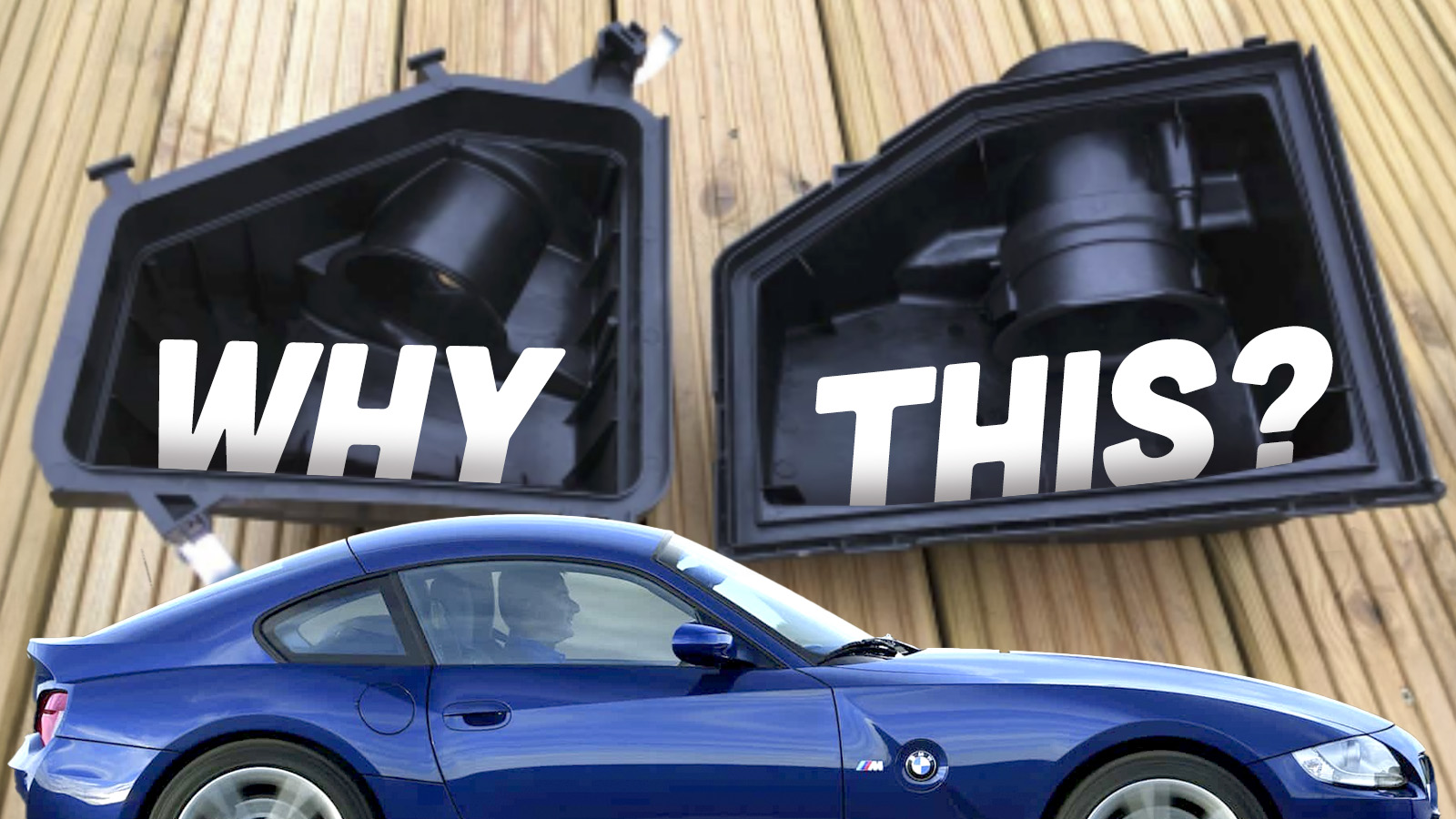
One of the first things you do when you tune a car is bin the terrible OEM air box and put on a nice cone filter, and maybe some sort of cold air intake kit. OEM air boxes are weird-looking things that always seem like an afterthought crammed into a corner out of the way. Here’s why that is.
Take this one below as an example. The inlet and outlet don’t line up at all, and the air has to do this weird S-shaped zigzag to get in, through the filter, then out again.


Spacer
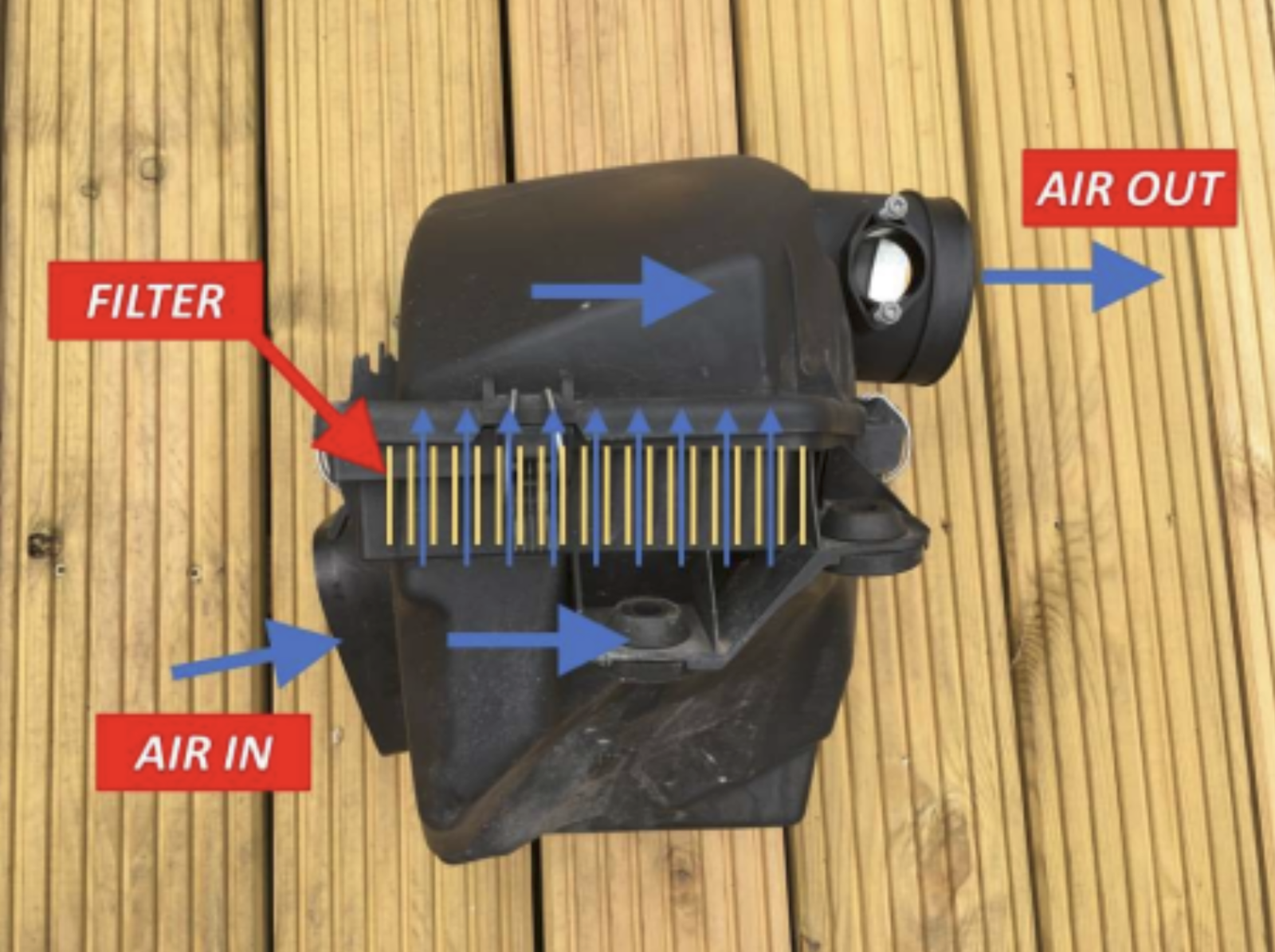
It’s even worse when you look inside; the outlet at the top isn’t even at the edge or pointing at the filter. It’s sort of in the middle but off to one side and at 90 degrees to the air filter, with the internal part of the tube masking off a chunk of the filter.
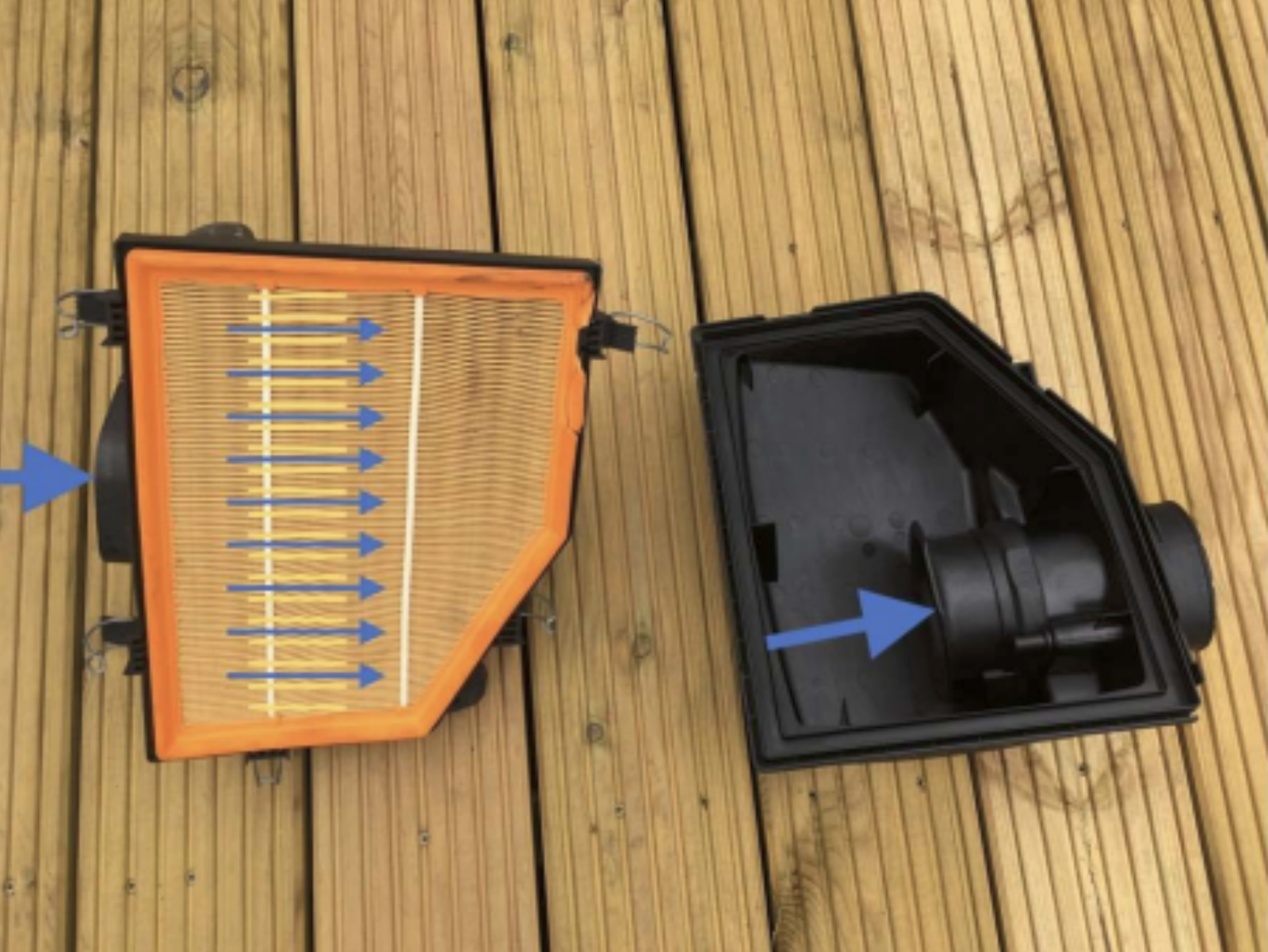
It’s not just a terrible one-off, either: I found another car from a totally different manufacturer with a very similar, oddly designed air box.
[Dave Larkman is a mechanical design engineer who had a 25-year career at Lotus Cars and Lotus Engineering (the consultancy business that worked for other OEMs), eventually becoming Lead Engineer of Powertrain Design. He has also been a semi-pro drifter, rides sports bikes, and used to feel ashamed about his taillight collection until he found Jason Torchinsky on the internet. Wait, why am I writing this in third person? It’s me, Dave, writing my own bio. – DL [Ed note within ed note: You know Dave from his excellent article “I Was So Bored At Work I Redesigned A Tiny Engine Part For Fun And Accidentally Saved 22,000 Pounds Of Aluminum.” -DT]]
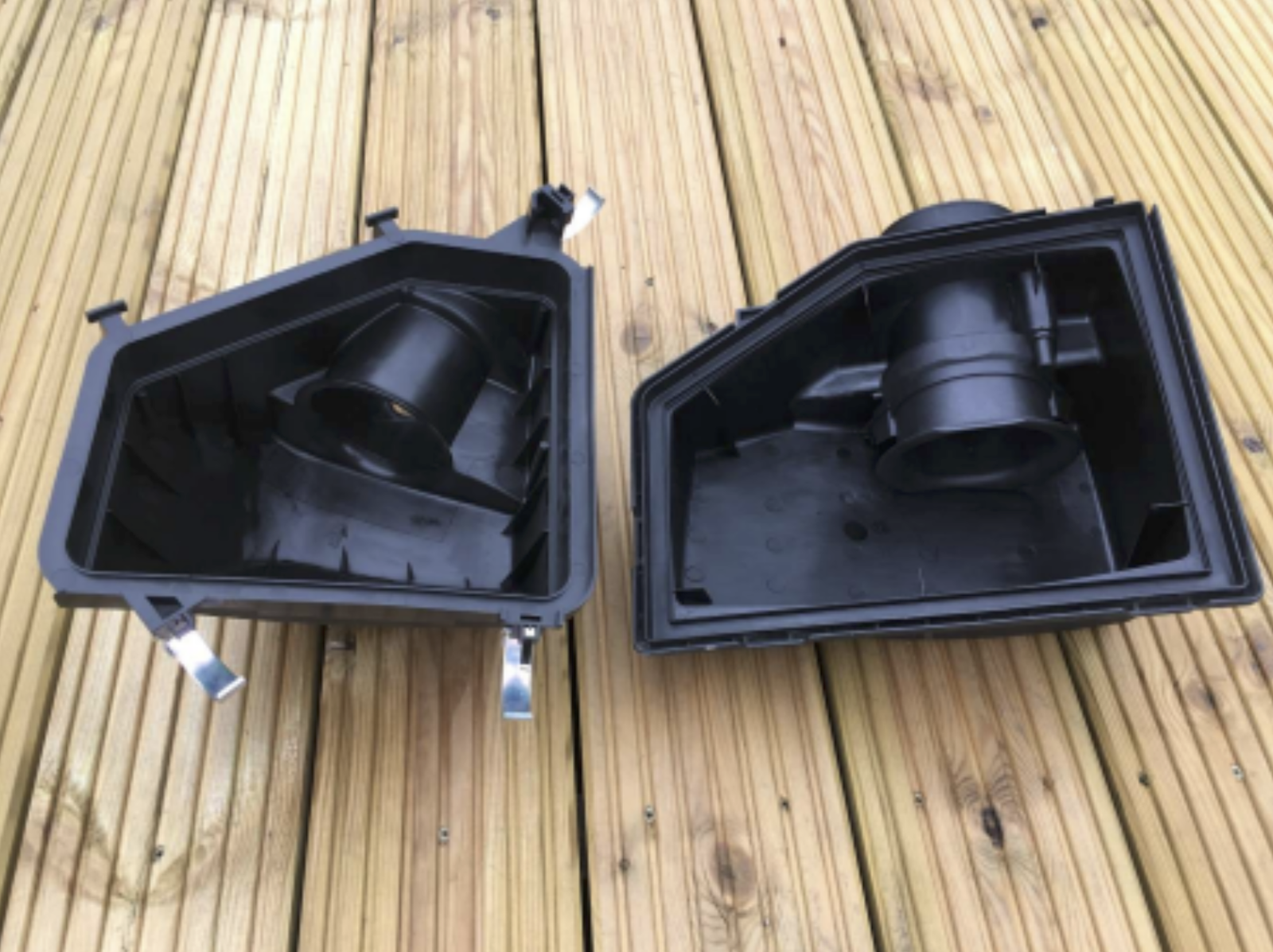
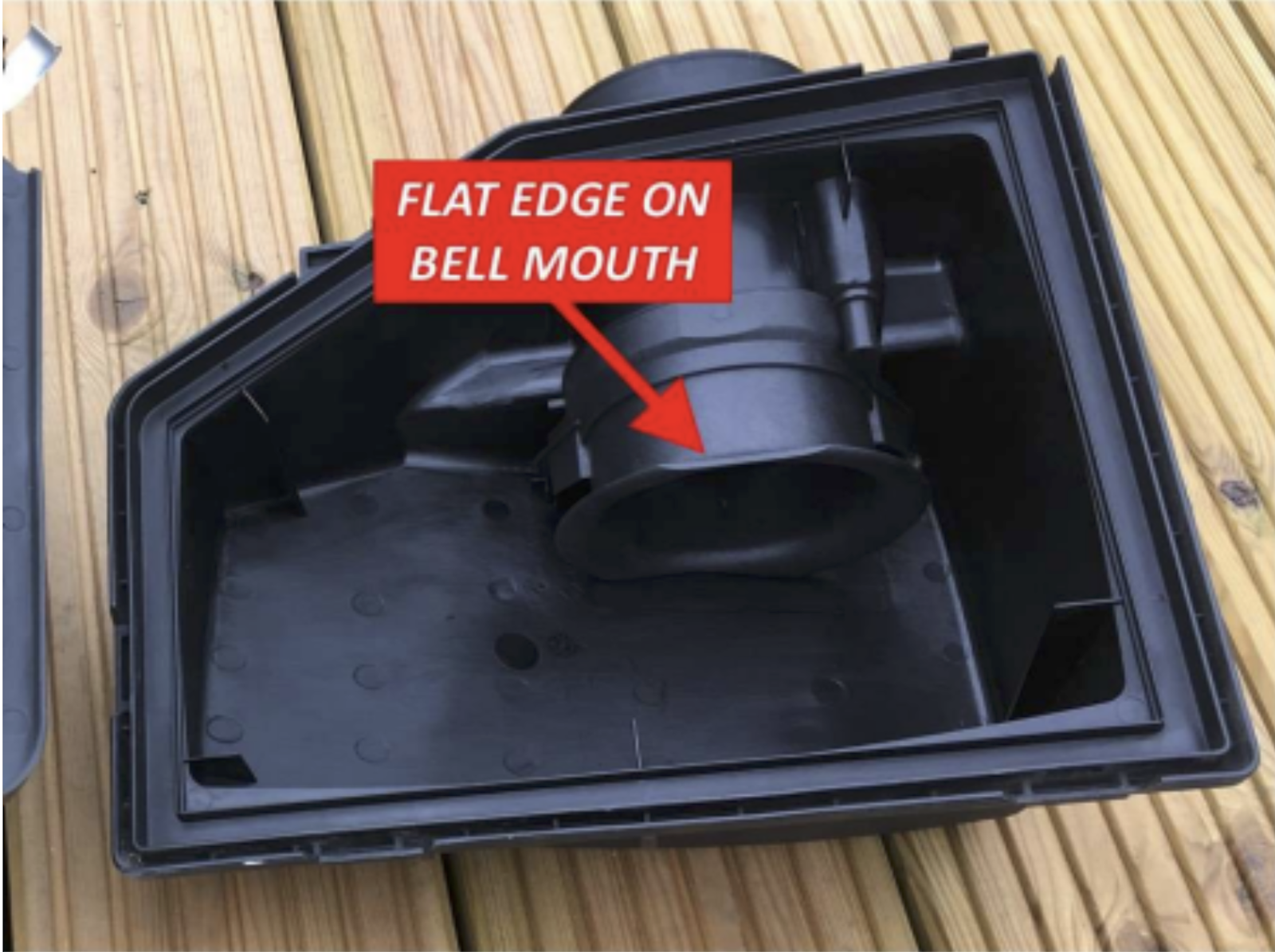
The one we were just looking at is on the right, and from this angle, you can see that the bellmouth for the outlet was so close to the filter that they actually had to put a flat on it to make room. That can’t be good, can it?
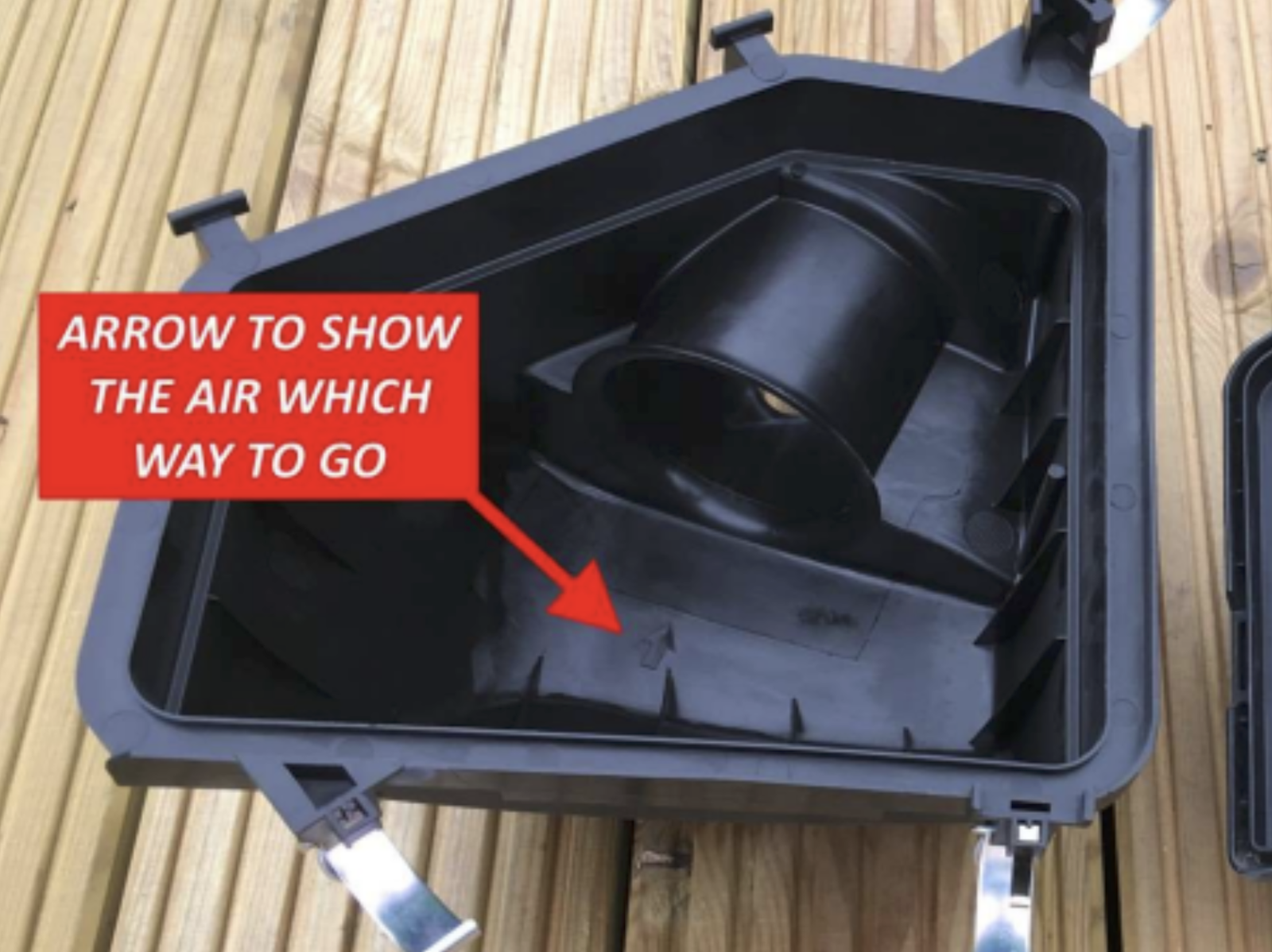
You can tell they were worried about the odd positioning of the outlet on the other one because they moulded in a little arrow to show the air which way to go:
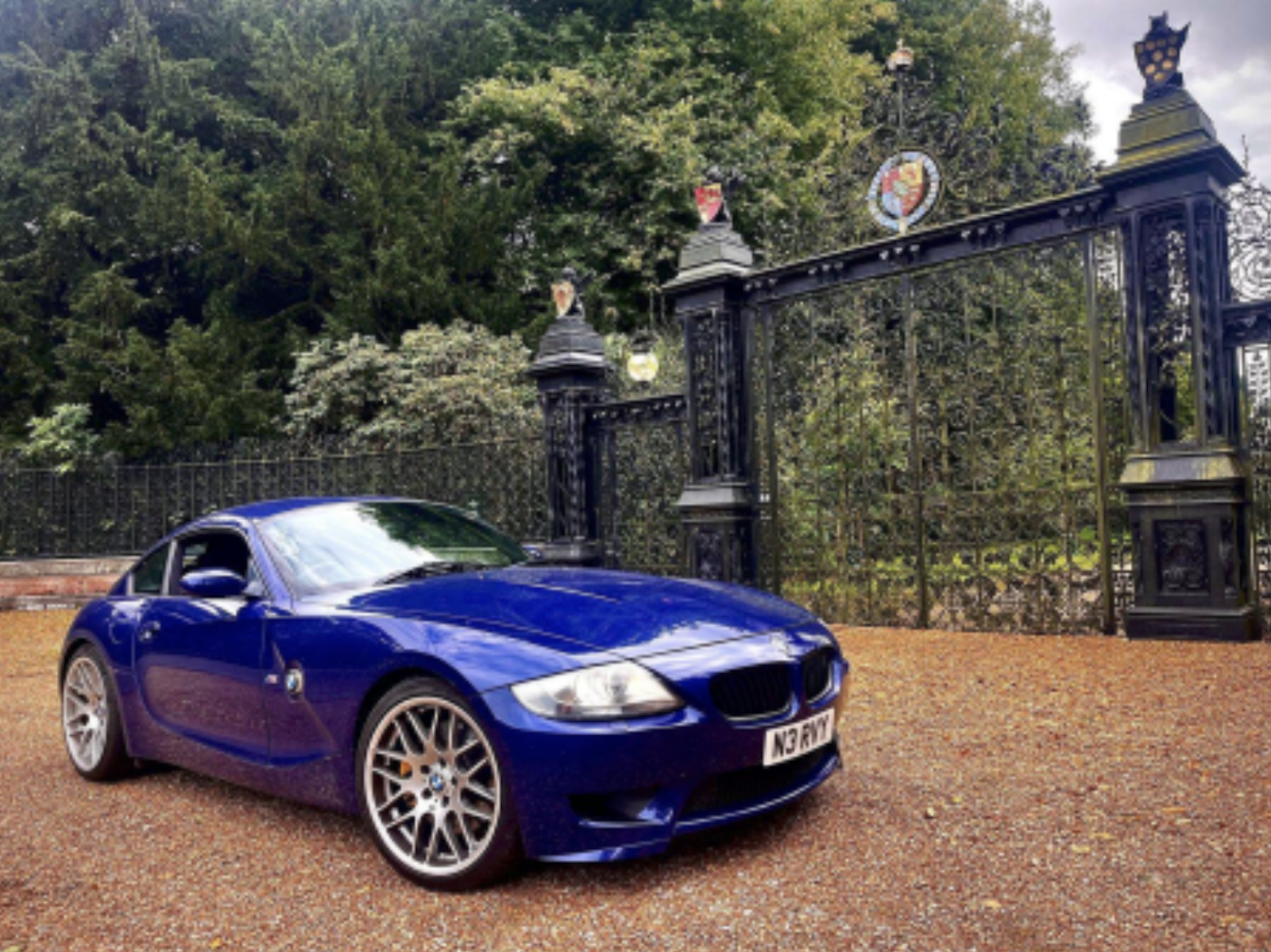
So what cheap, terrible economy cars did these air boxes come from? The first one is from this 2007 BMW E86 Z4 M Coupe. It has the glorious 8,000 rpm S54 making 338bhp from 3.2 litres of naturally aspirated straight six. This was Engine of the Year in 2001, and held the 3.0-4.0 title until 2006. So, despite how it looks, we can assume that the airbox works quite well.
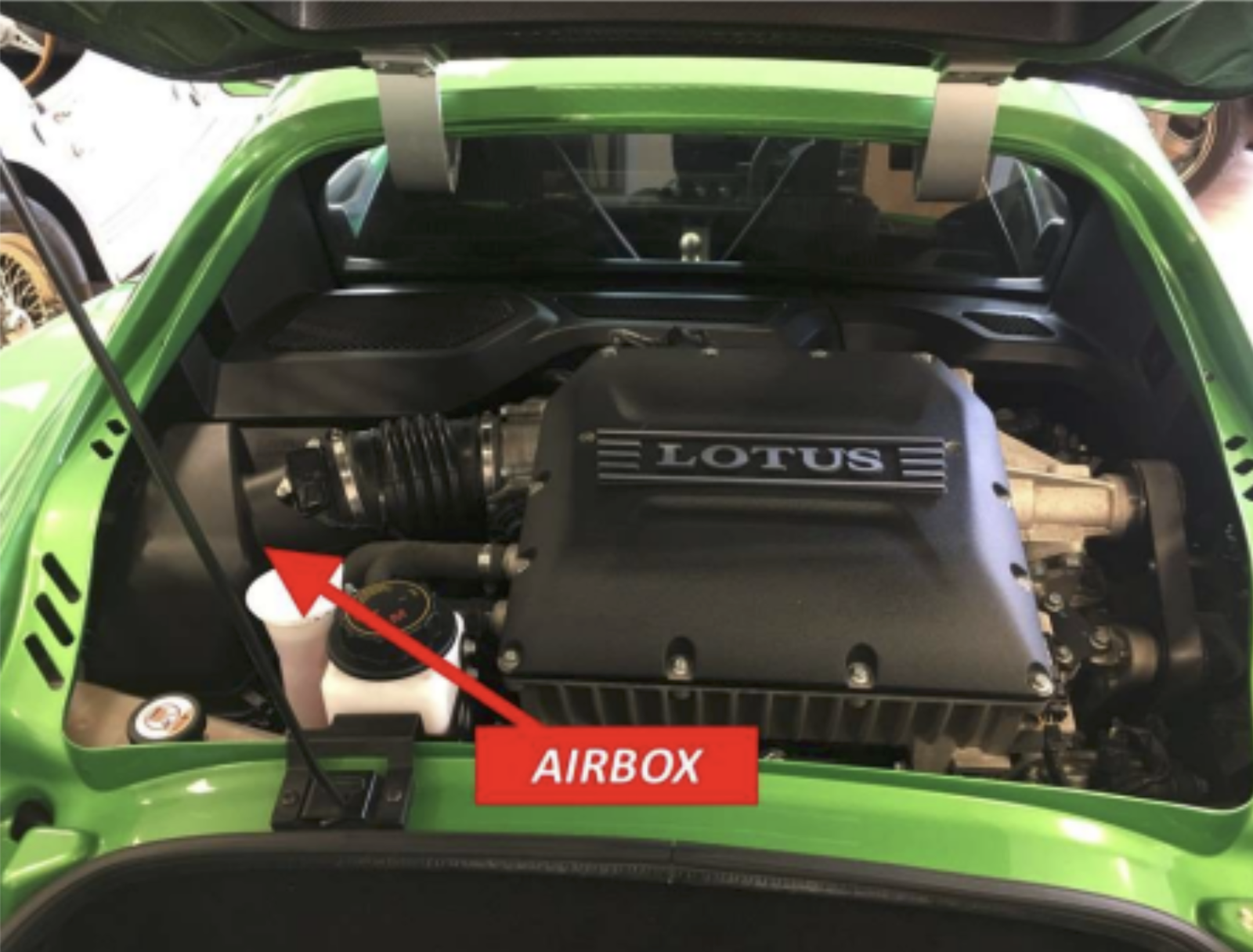
The other air box is from the 400bhp version of the Lotus Evora/Exige/3-Eleven, and was the first airbox I designed after moving from Lotus Engineering (the engineering consultancy that helps other OEMs) to Lotus Cars (the car maker). Most of my airboxes have a little arrow in them to show the air which way to go; I’m not really sure why I do it. I got asked what it was once in a design review and had to pretend it was an EU-mandated recycling mark. There’s another airbox out there that I wasn’t allowed to put a Lotus badge on, so it says Lotus inside it, but in braille.
So what’s going on here with the weird sideways-and-in-the-way exit tube? It’s all about reducing the pressure drop through the panel filter, and for that, you need a nice even flow over the entire surface of the filter, spreading the air out, slowing it down, and letting it get through the millions of tiny holes. The best way to do this is to have a long, tapered inlet pointing straight at the filter, and a long tapering outlet also pointing straight at the filter.
But that won’t fit in a car. So what we do is blow the air in sideways at the bottom, and suck it out at the top in a position and direction that makes the air spread all over the surface of the filter. Place the inlet and outlet so they line up nicely, and all the air wants to go through just the bit of the filter that’s on the direct route, which effectively acts like a much smaller filter. This gives you a much higher pressure drop, which adds pumping losses/reduces power, even if you have a huge air filter element.
So we play with the position of the outlet in the air box top, doing iterative steps of analysis and flow bench tests until we hit the targets. Or preferably get to the point where we’re well above the targets, and further tweaks don’t make improvements, because this is power and/or efficiency for free.
After doing this a bunch of times, I find it’s always best to try to visualize internal air flows as being sucked along, rather than blown through a system, and that works for exhaust systems too. I’ve worked with some fantastic analysis engineers, and they’ll talk you through the CFD (Computational Fluid Dynamics) results, helping you visualise the streams of airflow, so you can work together to make improvements that compromise the rest of the system the least.
There is a lot more going on with airbox design than just the air flow; the walls all have slight double curvature to make them stiffer without having to add ribs, to keep weight down, and avoid nasty resonance. You avoid any flat-ish faces that reflect up the outlet to avoid weird resonances at the Mass Air Flow sensor (it took weeks to work out what was going horribly wrong on that particular development engine). The flow at the MAF sensor also has to be laminar and also increase in a nice, repeatable way from idle all the way up to peak flow, which is what the expensively tooled internal bell-mouth is for. The data from the MAF sensor is critical for controlling the engine, so getting a nice, reliable signal really helps. The BMW even has a mesh of thin steel blades before the MAF tube to help smooth out the flow.
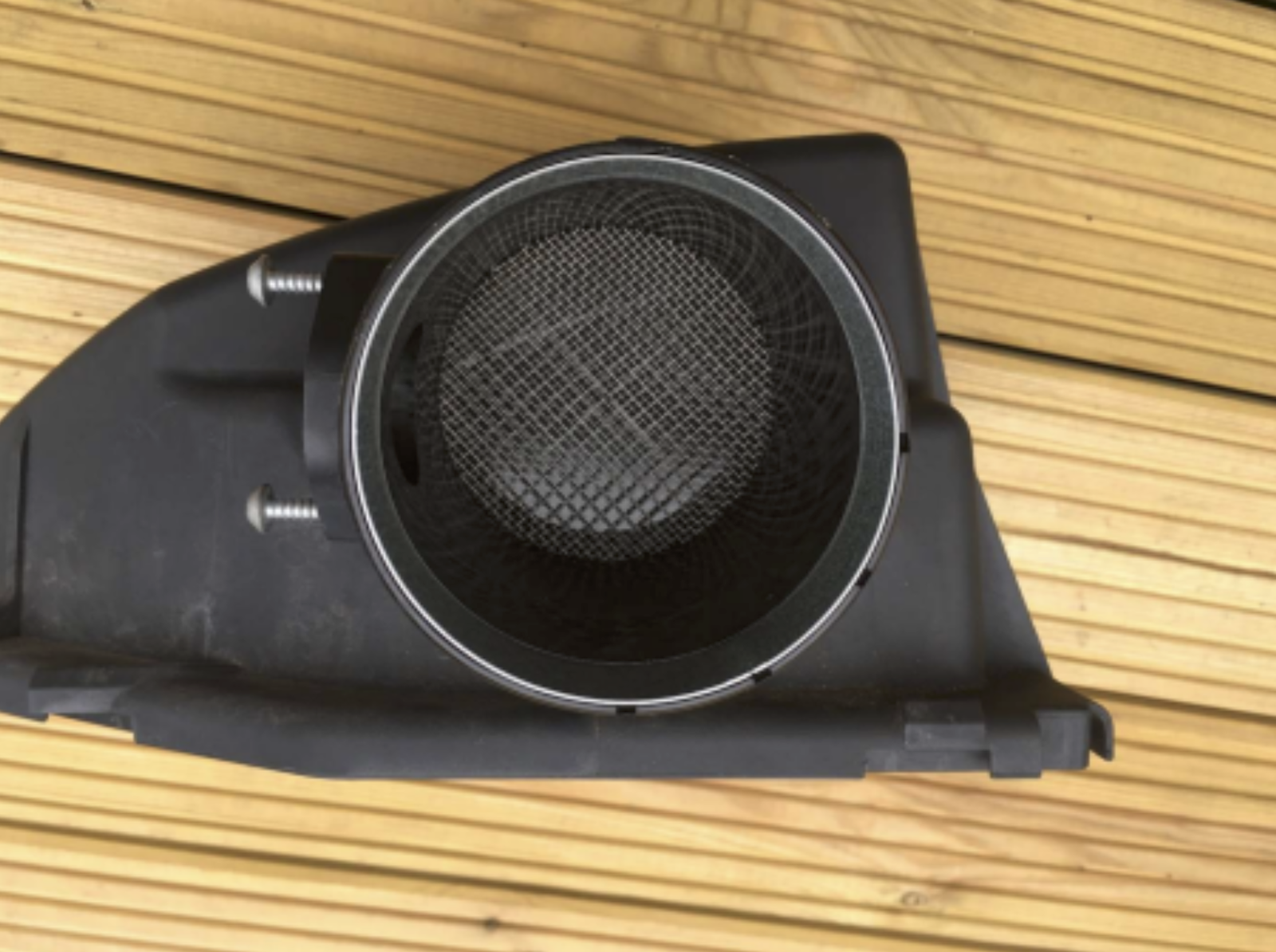
All of this in a package that fits in the car, allows the air filter to be removed easily for service (yep, we do check for this, and even model the filter removal envelope so no one puts a fuel hose or something in the way), and also includes as many useful brackets moulded in for free as you can get away with. You have to design the whole thing with all of these criteria in your head, as well as the tooling design for the injection moulding machine that will make it.
And then, when you think you’re finished, someone does a pass-by sound test in a car with the production bodywork instead of the prototype body, and you suddenly have to make it quieter by a couple of decibels and annoy the toolmaker by adding a load of ribs to their shiny new tool anyway.
All that effort, and grief, and testing to make something that flows nice cool air brilliantly with a stable MAF signal, while being easy to service, acting as a bracket for cooling hoses and wiring harnesses, and cheap and light and quiet, and then the first owner rips it all out and puts in a cone filter.
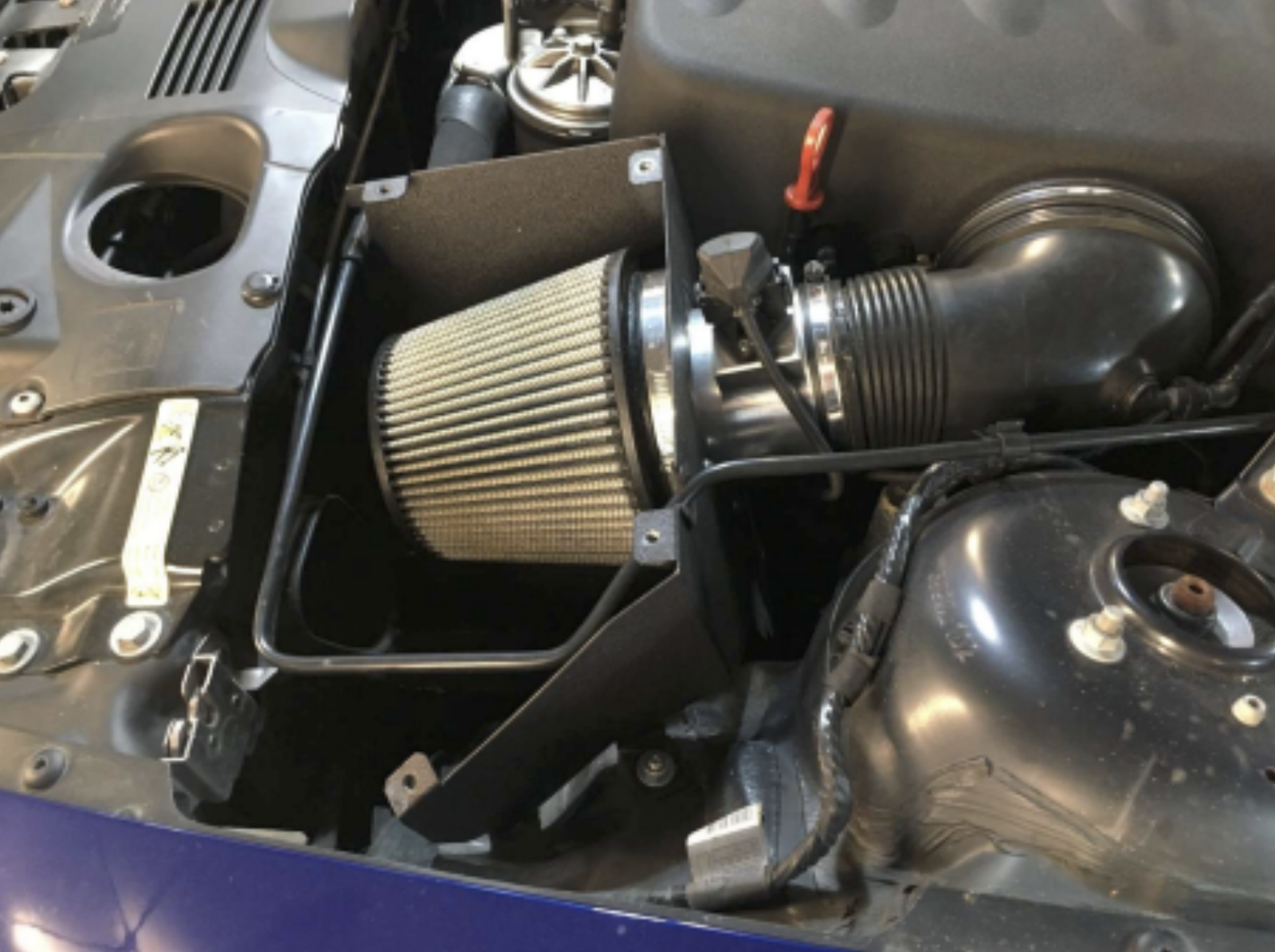
The Z4M does sound epic now, though; I’m very conflicted.
Story images except where noted: Dave Larkman
Top graphic images: Dave Larkman; BMW





Yeah… I know airboxes are designed by grown ups to meet all sorts of standards and things.
But I took the airbox out of my E36 and replaced it with a cone filter on the end of a piece of stainless steel piping because it makes fun noises.
I also replaced the dome light bulbs with pink LEDs.
Are either of these mods useful? No. Do they make me smile? Hell yes.
If there is a more useful car mod than one that makes you smile I can’t think of what it is.
Nothing I’ve done to my GT86 has been a technical improvement. Even the wider wheels just got the stock skiddy tyres on them.
It’s all good as long as your smiles aren’t coming at the expense of others. Pink lights? Nobody’s going to frown on that. A noisier, possibly more polluting car? That’s another matter.
Hey, an increase in output of greenhouse gasses is good for me!
The pollutants are unburned hydrocarbons and soot. I dunno how your people feel about breathing benzene and soot but such emissions are quite harmful to your food source.
Get out of here with logic! This is the internet!
Sarcasm aside, you have an excellent point. And to be honest, we have been secretly pushing green projects because you humans are too destructive and can’t stick with sanity
Thank you. I spent my childhood in 1970’s smogbowl LA and I much prefer a world with air not like that.
Hey, its our planet. (By that I mean its the lizard people’s, not humanity’s)
So you’re the 0.001% too?
That tracks.
Since 2000 BCE!
Hmmm….
“The Great Pyramid of Giza is the largest of the Egyptian pyramids and the most famous landmark of the Giza pyramid complex on the Giza Plateau in Giza, Egypt. It is the oldest of the Seven Wonders of the Ancient World, and the only wonder that has remained largely intact. The Great Pyramid served as the tomb of Egyptian Pharaoh Khufu (“Cheops”), who ruled during the Fourth Dynasty of the Old Kingdom. It was built c. 2600 BC over a period of about 26 years.”
Damn! There goes that theory…
Sorry about the confusion. I am a late arrival. Lizard people have been here much longer.
Whew! Thanks, I feel better now.
Yeah. Getting stuck in traffic behind a late 60s classic reminds me of what LA was like back then. Times a million.
I don’t miss that at all.
I get reminded of those days whenever there’s a wildfire upwind. Its a pretty good simulation for youngs who never had to experience an actual LA smogbowl.
Except when the vehicle is bought by someone who has to pass smog at a proper smog shop instead of their buddy. The PO installed one of those “vortex generator” intake blocks and a cone-like filter, any of which will fail a proper smog. I fortunately found a simiar engined vehicle locally where I could obtain the proper intake box, tubes, and fittings. Easily passes smog at 198k miles.
As a non-Californian, why does a cone filter impact smog testing? Is it actually changing airflow enough that it’s messing with emissions and the car can’t compensate?
I’m also not Californian, but often fitting a cone filter means disconnecting the crankcase breather system intake hoses. This means crank case gasses get vented to the atmosphere rather than burned.
It’s not that the car can’t compensate, it’s that with hoses disconnected it can’t process those hydrocarbon emissions properly.
IIRC crankcase recycling was one of the very first emissions systems to be required because it was found those blow by gasses were responsible for up to half the hydrocarbons output. Just dumping them into the air is going to be horrible for emissions.
In California the entire stock intake (and exhaust) system must be intact to pass the visual inspection before you even get to the sniff test. Of course parts can be replaced, but with stock components.
More please!
My 1988 Toyota Corolla Alltrac / 4wd Wagon has a completely over engineered intake in front of the airbox the air enters from behind the headlight but then there is a large plenum container just in front of the wheels that captures any water that might get sucked into the intake it will flow along the pipe and then gravilty will make the water fall into this 5l container sitting below the intake pipe that has a small drain at the bottom. I’ve never seen this on another car. It seems completely over the top for a small wagon that would barely go offroad and adds about 10kgs and expense to the car.
Wrong! Everyone knows a cone filter sucking in hot engine air is the best. That’s why Autozone sells them.
I did rip out the OEM filter box on my Mazda 3 for a cone filter, BUT CorkSport designed both their heat shield and their new air box to use the ducting from said OEM box. The larger filter eliminates the power drop at 5k RPM and the car pulls hard all the way to redline now. They basically copied Mazda’s homework and modified it to allow a bigger filter…. which reminds me, I need to clean that this weekend.
That said, they are probably one of the exceptions that proves the rule.
Is there a Min/Max on the number of acorns a chipmunk can store in an airbox?
That’s a question for the Golf Now Gopher.
It’s a minimum of 15 cubic inches of acorns while still being able to make peak power. We can game the test by splitting the acorns and wedging them in the corners away from the filter.
Lots of old ones looked strange too. Like flexible clothes dryer tube connected to the air cleaner lid. Often times with the flexible exhaust pipe looking metal tube to preheat the intake charge – ahhh malaise era junk.
Aside from forced induction setups, the airbox cold air intake stuff does not do too much – but does amplify the sound. Which is cool too.
I remember my DOHC Neon with CAI and exhaust sounded ‘cool’ but ran 15.6 with the ‘mods’ and 15.7 without. Same trap speed, but sounded nice.
The big Crane cams, different ECU, long tube and other goods actually made the difference 13.8!
I still use the Iceman intake system on my endurance roadracing 1998-ish neon. Currently running a 2.4L with Crower stage 1 cams and a few other tricks.
Nice! Some people saw the good traits of the neon like quick and good auto-x car etc. and some saw it for the disposable car for what it was.
I got caught up in the Modern Performance era and spent a lot of $ there 🙂
I swapped RT rear discs and sway bars, did the cams and supporting mods.. was a fun car. Still have it now rust free in WI, 60k miles 2 door green. I rip it around in summer, not many in mint shape with a wings west kit lookin god like this any longer – great cheap ass cars!
I bet the 2.4 is a ripper
I remember paying a lot for an Iceman too – sweet sound tho
I’ve been with the neon for a while. I was known as ACR MAN on neons.org back in the day. I owned one of the ex-Galeana ACRs and raced it in SCCA Showroom Stock 1998-2003. I got into endurance racing a neon with the 24 Hours of LeMons in 2009. These days, we race with Lucky Dog Racing League.
Actually it seems to me to be an excellent platter for shower spaghetti. Funny thing my autocorrect now suggests spaghetti every time I write shower.
Don’t forget weather considerations. There are concerns on choking off the intake in certain dust/snow/speed combinations. It was quite a shocker when I first started testing to see a truck literally stutter and die on a simulated 70 mph run with dry billowing snow. the entire engine bay was packed with snow (you’d be surprised , despite the heat generation, 70 mph wind at -30 will lead to all sorts of snow accumulation). airbox prefilter was completely blocked off, throttle wide open
Former Saabaru Owner? And that is why you block off the radiator in cold weather. I can tell you horror stories for trying to keep radiator temps up in the interior of Alaska in the winter.
Yes, cardboard in front of radiators was common.
Horror is s-l–o-w-l-y driving down from the hills, above the inversion, in a manual Subaru Forrester (no seat heaters). And, frequently pumping the brakes to keep them ‘warm’, pushing the clutch through what felt like stiff molasses, when needing to stop/shift. In the dark. Hoping to avoid hitting a moose. Seriously. -49F that ‘morning’.
As you’d know, downtown Fairbanks could be 20F colder than above the inversion. Those were the days (2009-2019), with no garage. I learned that seat foam would freeze and be hard… And my small Monitor heater couldn’t keep my dry cabin warm in Jan and Feb.
Very common. I lived there from 78 to 89 and got to enjoy the couple of weeks of -65. I lived on top of Chena Ridge and the inversion was above the top of the ridge for the -65. My heater core froze up on my 79 Toy P/U and it took 8.5 hours of idling with a blanket on the hood and the heat on recirc to thaw out the core. Square tires are always fun. They had a brutal winter this year. 30 days of -40 over the course of the season, and I don’t think they have made it above 50 degrees yet in the “Spring”.
Dealing with -65F and carburetors. You win!
Coworker who preferred his diesel F-250 (late 1990s) said that if he didn’t have a heated garage, he’d leave his truck idling 24/7 during the really cold days to avoid the diesel from ‘freezing’ or turning to jelly, which would keep his truck from starting.
My Forrester would sort of warm up if you let it idle for 20-30 minutes. Autostart for the win!
My place was near Moose Mountain (off of Murphy Dome/Spinach Creek). Fairbanks and the Borough experienced sleet during the week of Thanksgiving (I think 2010). When I left my cabin the morning after, and reached the paved Spinach Creek, I could see a car off the road in the ditch both higher up the hill and down lower from me. I turned around and stayed home for a couple of days. I remember that even with Blizzaks and feathering the clutch, all four wheels would spin trying to go uphill from a stop. Only one time did I start to slide down hill while trying to drive up…
For 36 hours in February one year (maybe 2013), we had a chinook that brought +40F temps, melting all the snow in town. When the cold returned, treacherous icy roads remained until April/May; much worse that the usual snowpack. They put out some pea gravel at intersections, but I still didn’t trust that others would (be able to) stop at their red light.
Friends there have talked about this winter returning to the low temps from the past. I was fine with winter, and found solutions to the limited daylight, but I don’t miss the extreme cold. Mixed emotions about my time there and about leaving.
Cheers
I filled my car up on time at -40 and had just enough moisture in the tank to freeze up the fuel pump 2 blocks from the station. Had the pleasure of walking back to the station (was friends with the owner) and getting a capful of gas. Walked back to the car carrying the capful of gas without gloves on, poured the gas into the carb, drove back to the station and left it to have the fuel pump replaced.
Famaliar with the Moose Mt area, had friends that lived out that way.
Luckily it only rained once in the winter when I lived there. So I went out on a 3-wheeler on Farmers Loop by McGrath Rd and got up as fast as it would go and then flicked the back end around and did 3 360’s down the road. Those Pineapple Express storms are not good.
Miss the area at times, but then realize that I can ride my bicycles year round and have world class DH skiing here in Colorado. Plus the sun is actually warm in the winter.
Crazy stuff! Seems you still have the use of your fingers. Repair work no fun even with heated garages. I wouldn’t want to work inside like that as I doubt there was much fresh air pulled in to exhaust gasoline and other fumes.
3-wheelers aren’t known to be all that stable; happy you’re able to laugh about those spins today. lol
“The odds are good that the goods are odd.”
I’m really glad that I no longer have a carburetor on anything I own.
I sold my 2008 Forrester with 120k miles as I didn’t want to deal with a possible winter breakdown with no heat waiting for someone to come rescue me outside in the hills. Cell phone service was still spotty in many places.
In late April 10 years ago, I was anxious to finally ride my motorcycle (2008 Suzuki V-Strom 650). As many paved roads were clear that spring, I thought it had warmed up enough with my gear to get out. But learned that parts of the Steese still had wide patches of snow on the northside at various places, like overlooks. I slowed down and had some fun with it keeping both feet on the ‘ground’ in first gear. The 3-4″ of snow felt and acted much like sticky mud. My knobby tires allowed me to be one-time silly. Won’t do that again.
Agree about missing some things from my time there. Glad you found an easier winter facsimile in CO. I tried cross-country skiing a few times, after taking lessons at Birch Hill, and making my way slowly around UAF trails. My knees never liked keeping my feet parallel so prefer hiking, winter or summer. DH definitely not something I’d ever try. Summer 2008 before landing in Fairbanks in 2009, I looked around for work in the Ft Collins and Denver area – beautiful mountain scenery from my bike, amazing hiking and camping, etc. – but the Great Recession seemed to have already tempered things. Sadly, as I really liked Ft Collins.
Cheers for reviving a bunch of AK memories, of Fairbanks area plus Denali and parts between and away.
Wishing you the best in CO.
Yes, an 05 linear
Nice. I had an 05 Aero, made it to 225k almost all at Stage 2. It gave its life when a driver turned in front of me. Fun car in the snow.
whaddup homies
I saw a similar thing happen in the real world back in 2007. We had a 2007 Ram 2500 Cummins 5.9L common-rail truck which we found to have a collapsed air filter element. The filter had clearly been very wet, and it had collapsed into a bowl or cone shape. We deduced that the filter must have gotten wet with snow in the wintertime, when I drove it west on I-90 across southern Minnesota in a snowstorm. (thanks, boss, for making me do that) The crosswind was strong and was basically blowing directly at the right front headlight, behind which was the engine air intake. That airbox must have been PACKED with snow! The Cummins didn’t miss a beat though.
So should we use the intake tornado or not? I hear it provides more power and mileage.
Sure, why not? Unless it doesn’t work.
Are there lawyers involved? I don’t want to mess with lawyers.
Unrelated: the placebo effect in medicine is an effect that measurably improves the patient’s actual symptoms, despite the doctors knowing it’s bunk. When applied to car tuning the placebo effect isn’t real, it only seems real if you really, really believe it is.
We should probably use a different term, like wilful-self-delusion, or an-inability-to-collect-or-understand-data, so that people don’t mistakenly think some new doodad or some stickers is as measurably effective as not being given the medicine.
I am a sufferer of WSD. and probably ITCUD. Epic article, thanks Dave!
Me too. If it wasn’t for the WSD I wouldn’t even get out of bed in the morning.
In all seriousness, thanks for these articles you’re doing. They’re very informative and a pleasure to read.
That’s very kind, thank you.
Seconded. Please write as often as you are inspired and have time. Entertaining, informative and pleasant isn’t always an easy target and you’ve hit two bullseyes.
Now I’m wondering which of the three was a miss…
Thanks for the tip, *I* must have missed one!
Can you explain the purpose of those small carbon filters inside the airbox.
I’m purplexed.
There is a thing called a shed test, where your shiny new car design gets locked in a shed and the authorities sniff at it for leaky hydrocarbons. The carbon filters (or sometimes just some pads on the side of the intake system) absorb any hydrocarbons that might be evaporating out of the inlet system.
The test limits are now so tight that you can fail testing from a particularly stinky bit of plastic interior trim. The limits are so tight that I’ve been told some EVs (which are exempt from testing because they don’t have fuel in them) would fail it.
Thank you for this, I never realized that was something I wanted to know.
This may explain the check engine light I experienced recently. My OBD reader said the code was for an evaporative system leak. Usually those are associated with bad gas caps. I bought a replacement gas cap, cleared the code, and the light still came back on. The car seemed fine, so I figured I’d keep driving with the light on until there were more serious issues.
A couple months later, I was washing my car and checked filters and fluids afterward. I opened the airbox and noticed the rubber gasket of the air filter was all mangled from not being inserted correctly. Odd, because I carefully change filters myself, but I thought nothing of it. I reseated the filter and closed things up. Lo and behold, the check engine light turned off after a couple trips. I figured out what happened. When getting a flat tire replaced, the shop did their “courtesy” inspection which included sending me a pic of my air filter. I was annoyed because I didn’t want them touching the rest of my car. My concerns were validated, as they sloppily put the air filter back in, which must have caused hydrocarbon leaks as you mentioned and hence the CEL. I’m not much of a wrencher, so I figured the evaporative leak was from the fuel filler end. I didn’t know evaporative leaks can come from the air intake too. Now I know, thanks to your article.
On some engines there are sensors that measure the pressure inside the crankcase. They are supposed to detect if a breather hose is leaking, but I guess a mangled airbox seal might set one off.
this reminds me of the interesting changes Toyota/TRD made to the airbox for the TRD supercharger they did for Scion and the 2.4l and what was or wasn’t changed, like it still kept the same inlet location and mounting points, so many of the aftermarket intakes could still bolt on, but weren’t safely plug-and-play anymore like they could on a stock motor.
My 1st gen Legacy had the airbox get its air from inside the right fender, through a vertical U-shaped tube that had a cut in the bottom of the U add sat inside a second box (I imagine to shed water). It seemed obviously well thought out to me, so I tried to keep as much of it as possible when I added a NACA duct into the side of the lower bumper. I removed the front half of the U and ran a hose up to the box and connected it to the remaining section. It made more noise and seemed to help in hot weather, but I’m not sure how much it actually did vs feeling like it did something. Ramming through snow banks, it would get jammed up with snow and start hesitating, but it was easy to clear out. I did lose water fording capability, though.
I still haven’t figured out where the intake on my Geo Tracker is. It seems to be going into the left fender, but I haven’t figured out where it goes from there! It’s probably something similar to that Legacy, though, I suppose
Possibly. It seemed well designed for resistance to water and dust ingress. IIRC, the actual intake was about the height of the top of the headlights, then it dropped into the first box where it could drain water or drop out large solid particles before going back up and through the inner fender to the airbox. To pull water in, you’d have to have water up past the headlights within the fender well, which was partially covered and would have to be ingested, fill the first box past the drain in the U pipe, then pull it into the main airbox, past the filter, into the engine a good few feet away and at an incline. I can testify that it could go at least 100 feet with a bow wave at hood height without water ingestion.
As a Lotus engineer, can you give the skinny on what the snorkel on the Elise airbox was supposed to do besides be infuriating to work around when you’re changing the filter?
It guides the air into the airbox from the outside where there isn’t a hot engine.
The Evora 400 snorkel isn’t touched during a filter change, because you take the top half of the box off. The tube to the throttle can be a bit awkward though…
Yeah, the one time I replaced the air filter on my Elise I had a bear of a time trying to get the filter housing halves lined up properly while ensuring the filter element itself hadn’t accidentally shifted out of position. Not to mention the hassle of having to remove a wheel and wheel well liner to get to the aforementioned air box. Still, it was really cool since once the wheel well liner had been removed I was treated to a strip of masking tape with the name “Colin” written on it; presumably one of the nice chaps that had assembled the car.
I didn’t do the Elise airbox, but having suffered changing the filter on my S1 I was determined not to make the same mistakes on any of my designs.
The filter I pulled out of my Elise was full of dead bees and almost black from dirt. I strongly suspect that none of the three garages I paid to service that car had ever actually changed the filter.
My Europa has a K&N panel filter that I want to replace with standard, but I’ve been putting it off for years because it’s such a pain in the arse to get to.
So… Do cone filters actually perform better or just make better whoosh sounds?
(which, arguably, is a performance enhancement)
some do perform better, most don’t and it’s just the whoosh sounds.
the ones that do will have legitimate testing results for what changes and cost a bit more because of it.
They almost always just sound better. Any car with fuel injection made since like 1985 already probably has a cold air intake system of some variety. Usually one (though not always) that’s actually sealed against engine bay temperatures in some way instead of (as the most infamous example I can think of, the 996/997 Carrera “cold air intakes”) a thin piece of carbon fiber or plastic that sorta sits between the engine block and the filter element.
The main exception is when the factory air filter element is undersized or just pushing against what is adequate for the engine (the 3rd generation Trans Am one is a good example for this).
More noise is pretty easy to generate, and if that helps someone enjoy their car more then that’s reason enough to do it. I’ve even fitted cone filters to my own cars a couple of times, although once it was because I’d added a turbo and ran out of space.
Obviously it depends hugely on the quality and intent of the OEM system, but when we’re really trying it is hard to improve on a carefully optimised complex system. I saw some proper a-b-a testing on aftermarket systems for a particular installation once, and mostly they were worse, and no improvements were greater than the error on the engine dyno.
But the aftermarket does have the advantage of not having to worry about noise, or cost.
There are OEM cone filters out there, I’ve got an article outlined on that…
“There are OEM cone filters out there, I’ve got an article outlined on that…”
Oh, yeah, that’ll be of some interest!! Staying tuned; I daresay there are plenty of us out there who’d read that, based on many of the comments already posted here…
Please discuss the OEM Honda S2000 cone filter (and I think 90s Integras had them too)
Awesome read. I tripped recently on a walk and fell down the YouTube fluid dynamics rabbit hole to find myself studying ducted cooling systems. I hadn’t yet realized the same principles of expanding the air before a high-drag element (in this case the air filter; in cooling systems the radiator, intercooler, or other heat exchanger) applied to intakes.
I’d be stoked to see an article from you about ram-air intake systems sometime. I’ve seen aftermarket ones show up for a number of cars and have always wondered how/if they work and why.
I’ve never worked on a ram-air system, sadly. Without a bunch of clever people backing me up with analysis and testing I’m a bit lost.
I did once work on a project where the air intake that had been carefully designed into the bodywork had less flow area than the throttle. Pretty much the opposite of ram air. It got cancelled, which saved a series of long arguments with the people styling it.
Do you know how they would test a ram air system? You can’t just throw a fan on it to replicate the effect on driving, I would imagine, so I wonder if a dyno would really pick up what it could do and I would think CFD modeling would get pretty complex. That’s assuming a ram air system that wasn’t just appearance, of course.
Given ram-air data to replicate it’s possible to build a dyno rig. You wouldn’t be able to use that power figure for certification though.
Ram air only really works at high speed, which isn’t a great feature for a road car.
That’s what I always expected. A lot of old muscle cars had some kind of marketing version of it, but I assumed it was more that it was getting colder, perhaps less turbulent outside air than being down to any true ram effect.
When I got into bikes in the 90’s all the race reps had “ram air” intakes. The ones on my RVF400 were blocked off and entirely functionless, the ones on my ZX7R were carefully sealed to the airbox, so might have made a difference.
If I still had the bike I could fit a TMAP sensor and do a before-and-after run, if I could find somewhere safe to do 160mph…
Sure you can! It’s called a wind tunnel. Some even go supersonic.
Right! Dur. I got stuck on the idea of measuring power, but even if you couldn’t use a running full sized vehicle, you could figure out the available air pressure and determine it from there.
My dad was an aerospace/nuclear engineer at least partly responsible for some of the ultimate ram air systems including the bypass doors for the SR71’s J58 engines. His fortes were thermodynamics and fluid flow.
Unfortunately while he may have been a great engineer he was not the best communicator. He never managed to convert his engineerspeak to regular human or even sciencespeak. Even as a chemistry graduate student taking thermodynamics I couldn’t understand his engineering gibberish. I had a suspicion the reason for that was he had a poor recollection of first principles since when I’d ask him the mechanisms behind the equations he’d get defensive and blustery.
You OTOH are doing a good job of translating engineerspeak to regular human. I also appreciate you don’t bullshit an answer but fess up when you don’t know. Keep up the good work.
I see honesty as a form of laziness. Making stuff up is way more work.
Plus you never know when you’ll have an expert in the audience.
Many years ago in grad school I presented at a conference in Colorado. I went out with several other grad students but since the conference was open to the public my dad drove out to watch me present. We had planned to drive back together, camping along the way in his new Dodge Caravan.
The close of the conference was to be a public lecture on renewable energy by the professor who had invited us. I and my dad attended. What this professor didn’t know was my dad had conducted an extensive feasibility study on renewable energy in the 70’s for his company who was looking to cash in on the boom. So when this professor started spouting the same tired old propaganda my dad started heckling him with facts. I was mortified. He tried to continue but with my dad ruthlessly tore apart every one of his talking points. I wanted to disappear in my seat, expecting some kind of fallout. Academic egos and politics can be brutal.
At the after party the professor came up to my dad and enthusiastically thanked him for being the first real critic of his talk in the many years he had given it. They spent the rest of the night discussing the truth rather than the hype behind alternative energy.
Sometimes having an expert in the audience is just the ticket you need for a memorable evening.
Most scientists welcome discussions and challenges to their work.
That’s why politicians cast so much doubt on their work, since even considering that they are wrong is often out of a modern politician’s wheelhouse.
ACTUAL scientists yes. Charlatans and salespeople posing as scientists not so much.
I used to be a factory tour guide at Lotus’ Hethel site. One day on a tour I casually mentioned that the chassis was aluminium extrusions glued together, as normal, and one of the guys on the tour put his hand up…
He was one of the adhesive engineers who’d worked on the chassis, he gave us a talk on the difference between glue and adhesives, plus a few facts about the bond strength and testing.
That job would have got boring really quickly without the questions, and occasionally corrections, from the audience.
OOoo. You’re the guy to ask! I knew a lot of thought went into air box design, and thought discarding was a mistake,detrimental to performance. Couple questions; I have seen in some older examples, that expelling rain and leaf debris were considered. Has anyone used a dimpled(golf ball) surface? Or are the aerodynamics of that nonsense?
You have to drain out rainwater, and there is analysis done to track the route of water in the system. Sometimes there are ribs in the intake pipe to guide water to a drain.
Dimpled surfaces might help where you have high flow speeds, but that tends to be inside pipes where it’s hard to add significant features because the tooling usually has to come out in the same direction as the air travels, or it’s blow-moulded so the tooling is on the outside.
Yeah, a dimpled surface would need to be molded in halves. Many years ago I came across an article about polishing intake manifolds, that mentioned Too smooth is detrimental. May have been in regard to fuel/air separation.
I’ve read that, too. I think the rougher surface creates vortices that better mix the fuel and air and prevent fuel from possibly sticking to the sides, but it’s been a long time.
If I were to have an alternative life in a STEM field it would be fluid dynamics. Lurve that stuff, I did go too deep on a resonate tuning bender in my 20s but we recovered.
I always loved the post-analysis feedback. They are the only people who get to know your designs as well as you do.
So does this air filter design suck? Or maybe it blows
The engine sucks. The filter makes it suck less. On the other end, the engine also blows and the muffler makes it blow harder.
That’s the answer I wish I’d written.
Thank you. I’ve done a bit with filters, but for water.
I find it’s always best to try to visualize internal air flows as being sucked along
I too often visualize being sucked along. Or blown for that matter.
Thanks for an excellent job of exposing the “Boy Racers” and their stupid aftermarket air filters! Worst I’ve seen were the bodgers who replaced Buell’s lovely torque boosting Heimholz effect airbox with a chrome dog dish and lose their Buell’s enjoyable midrange torque.
On my ’96 4.6 V8 T’Bird, the real restriction was in the inlet to the airbox, not the airbox itself. I built a new low restriction, somewhat ram air feed using a lot of the original parts and a large rubber plumbing clamp.
Part of the 160 upgrade on the 120bhp S1 Elise was a bigger entrance hole cut in to the airbox. Before my time there, but I bought the old development car, and the airbox was clearly hand cut.
IIRC this car had a roughly 4″ intake duct necked down to about 2″ in one place. Removed the 2″ flow restirictor and straightened the convoluted air path. All pre-filter box.
+1 on this. With the 4 most recent naturally aspirated engines I’ve had I pulled off the inlet snorkel and swiss-cheesed the airbox (upstream of the filter obviously) – no “placebo effect” or butt-dyno nonsense – I always got a verifiable bump in MPG and noticeably better low-end / throttle response (yes sucking in hot air but cold air mostly matters for top end on a modified engine IME). My current daily is a Mazda turbo – I’m leaving that stock because MPG and power is great as-is, and I figure modern turbo intake design is probably best not messed with (at least by me). Also had a Golf TDI, left that stock as well.
The stock filter box on the FR-S really just goes straight through in back as far as I can tell. Maybe it does have one of those baffles, but it goes pretty much straight in from what I remember.
The Bug, on the other hand, wears a K&N atop the Solex carb, because like Hell am I dealing with an oil bath air cleaner.
The FRS (and GT86 – I have one of those!) does have a nice straight inlet in to a long narrow filter, but then sucks the air out at 90 degrees to that.
It’s a simpler way to do the same thing, if you have the space in the car.
I need to clean the MAF sensor on my ’20 86 this weekend, I’ll take a look and see if it has any baffles. The filter box might be slightly different on my car vs your FR-S since the intake manifold was updated from 2017 and it uses a different size filter as well.
That’s a beeeautiful Z4! In that blue, with those wheels. How exactly does the airbox change the sound of the car? I only thought you affect that through mufflers and exhaust manifolds.
Also I wonder why there aren’t any EV sound tuners, you could theoretically rip off the sound deadening from around the drive unit and get Formula E-ish sounds.
I painted my office in that color, specifically because of the Z4M Coupe. I was in love with that car in that color back then. Still might be.
That Z4 is probably the best car I’ve ever briefly owned a share of.
The airbox and intake tubing have carefully calculated resonances to cancel out/enhance the pulses from the inlet valves opening and closing. Just like with the exhaust system.
When the after market intake went in to the Z4 it got quite loud when the throttle was wide open. Great noise though. No way could an OEM get away with that much noise and not fail a pass by noise emissions test, which is why they sometimes plumb the intake noise into the cabin instead.
THANK YOU! I have been so without understanding of who thought it was a good idea to intentionally direct intake noise to the cabin. I was baffled about being used as a baffle.