


The highway bus and the transit bus are important parts of modern transportation systems. These buses get you the final mile to your destination, or to an entirely different city. Yet, despite the fact that buses are run hard each and every day, many older examples don’t have some parts that you might take for granted in your car. For much of transit history, it was very common for a bus to have no fuel gauge of any kind. Technically, this makes for a plot hole in perhaps the biggest movie centered around a bus, Speed, but it also makes a ton of sense.
The fact that many buses don’t have fuel gauges is something that the average passenger would never notice or even be concerned with. Buses usually have a lot of instruments, switches, and buttons, and it’s not like you’re going to be staring at the dashboard while boarding, anyway. But if you’re one of the weirdos who like to buy buses once they retire from service, like I am, you might be in for an amusing awakening. I didn’t even discover the lack of fuel gauges in buses until I bought my Nova Bus RTS-06 in 2021.


But once people learn that it was common for buses to come without fuel gauges, the number one question I get is “why?” Regular diesel transit buses would be lucky to get better than a few miles per gallon, while intercity buses may travel hundreds of miles on their routes. You’d think that knowing how much fuel is in the tank is vitally important. After all, driving your car would suck if you had no idea how much gas you had.

While I had a good idea why old buses don’t have fuel gauges, I wanted to ask the people who live, eat, and breathe buses. So, this year, when I went to the Illinois Railway Museum’s annual Bus Day, I asked the guys who drive and work on buses for a living why most old buses didn’t have a way to indicate fuel levels. The reason actually makes sense.
Yesterday, I wrote about the “holy grail” of buses in America, the GMC Scenicruiser. When this bus hit the road in 1954, it changed the highway bus market. Within short order, highway buses with big windows, upper decks, ample storage, and powerful diesel engines became the norm in America. Bus design has evolved since then; the American highway buses of today don’t have a stepped deck, for example. But the innovations set by Greyhound and General Motors in the 1950s can still be seen today.

Brilliant engineering has gone into both transit buses and highway buses. Over the decades, bus innovations have included monocoque construction, air suspensions, articulation systems, powerful diesel engines, and even the air nozzles above every seat. Bus manufacturers created buses that kneeled for easier boarding, deployed wheelchair ramps, or had low floors.
Yet, most drivers of these buses didn’t see one invention: the fuel gauge.
The Bus From Speed

Let’s return to the Sandra Bullock and Keanu Reeves action flick, Speed, for a moment here. I’ll try to keep the spoilers down here in case you haven’t seen this 32-year-old movie.
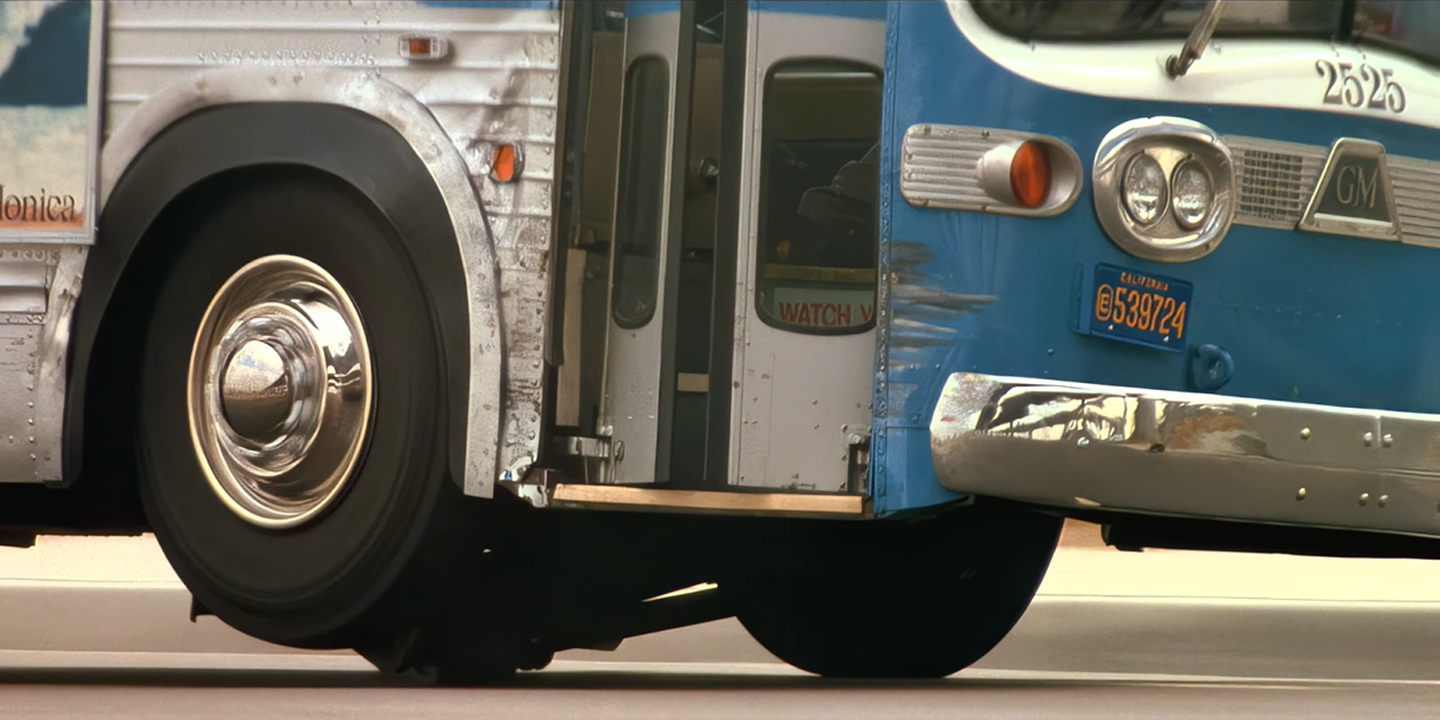
In the film, there’s an explosive device on a GM New Look bus, and that bomb is set to blow if the bus falls below 50 mph. The New Look in the film, which has become so famous that it might as well be a character on its own, is seen driving on two wheels, performing a huge jump, and somehow managing to plow through Los Angeles traffic at, well, speed.
Now, I’m not here to litigate whether a New Look can round a corner above 50 mph on two wheels or whether it could have jumped the freeway gap. There are already lots of YouTube videos and articles online about that stuff. It’s also well-known by now that there was a lot of movie magic going on in the film. At least ten different buses were supplied for the film and modified for practical effects. The bus that got on two wheels, for example, did so thanks to a hydraulic ram and counterweights that lifted the bus through the turn. You can even see the ram deploy during the scene when the bus is on two wheels:
The bus jump was real, but it involved a highly lightened bus with a custom shock-absorbing rig for the stunt driver, plus special ramps for the jump. The stunt bus was destroyed on landing.
Even the scenes when Keanu Reeves and, later, Sandra Bullock, get under the bus had some magic going on. A real New Look doesn’t have nearly enough ground clearance for those scenes to have taken place, so that bus was lifted and given an access hatch.

But the part that really stuck with me was the speedometer and the fuel gauge. The speedometer is a genius plot device. It essentially works like a countdown timer does in other movies, but it shows speed rather than time.
Later in the movie, Reeves puts a screwdriver through the coach’s fuel tank, causing a leak that is shown on the coach’s fuel gauge in real time. The fuel gauge then becomes a countdown timer-like plot device, and the characters have to race against time to get off the bus before it runs out of fuel. Check it out:

Weirdly, despite all of the breakdowns on this film by so many different people, this one has been largely ignored. First, there’s the speedometer. I have seen nearly 100 different New Look dashboards, and none of them had the kind of speedometer shown in Speed. Here’s a look at the dashboard from a different angle, as shown in the film:

In real life, these buses had fully round gauges. They were totally function over form, and probably wouldn’t have looked so nice on-screen. Something interesting about the instrument cluster in the Speed bus is that it has a temperature gauge that doesn’t have a needle.
Then there’s the fuel gauge, which is depicted as being right next to the speedometer in the film. This one is another oddity. Most of these buses didn’t have fuel gauges at all. The most basic New Look dashboards indicated only speed and air system pressure, nothing else. Here’s an example image:

Here’s another version of the two-dial instrument cluster:

Buses Often Didn’t Have Fuel Gauges
If a bus operator wanted to, they could order their bus with gauges to show engine temperature, battery voltage, and engine oil pressure in small gauges on top of the cluster. But, notably, a fuel gauge was not included on the main instrument cluster stack. Here’s what a New Look with a more detailed instrument cluster looks like:

It wasn’t just the New Look. GM’s Scenicruiser and RTS-II buses were like this. In fact, it was commonplace for the buses from any manufacturer to come without fuel gauges. Even my 2002 Nova Bus RTS-06 (below) doesn’t have a fuel gauge, and instead, all I get is a warning light that comes on when the tank gets low.

But why? How is it that buses, even those made well into the 2000s, don’t have fuel gauges?
Why Buses Often Don’t Have Fuel Gauges
As the bus experts at the Illinois Railway Museum told me, it was simply because they were not needed. Unlike your car, buses run on rigid routes with known mileage counts. Transit buses and highway buses then have fuel tanks with capacities over 100 gallons. Even at three miles per gallon, a transit bus is not going to run out of fuel before it’s done with its route for the day. Then, when it comes into the depot, it’s going to get its fluids topped off anyway.

It was a similar deal with highway buses. Even though those buses are traveling great distances, the bus company knows how far it’s going to go and generally how long a tank of fuel will last. A fuel gauge isn’t needed because fuel stops are generally already calculated. In the modern day, bus fleets have management software and data reporting straight from the bus to help them with fuel planning.
Well, that is how it’s supposed to work, anyway. The lack of fuel gauges can be disastrous in a dysfunctional bus line. Back in 2018, the Montreal Gazette reported that buses in Montréal were running out of fuel daily. What happened? Société de transport de Montréal eliminated much of its bus maintenance workforce. Since there was now nobody to refuel the buses at the end of each day, the transit line moved to a policy of refilling the buses only when they ran low. The drivers had to guess how much fuel they had left, even though they didn’t have fuel gauges to use.

The buses talked about in that article were Nova Bus LFS units, which also remain in use in Chicago. An example of which is pictured above.
I’ll note that while it was common for buses not to have fuel gauges, it wasn’t an absolute. Many manufacturers still had fuel gauges as options for the fleets that wanted them. Some operators added their own aftermarket gauges. If you’re looking at an old GM New Look bus, for example, you’ll sometimes find a fuel gauge living on the switch panel next to the driver. Some buses may also have fuel gauges next to the tank itself, but not inside of the bus. Here’s the cluster from my RTS; note the tiny light to warn me about fuel:

But for many fleets, fuel gauges were unnecessary luxuries that added cost and an additional failure point. That has changed a bit in the modern day. Today, buses that don’t have fuel gauges might at least have a low fuel level light, and designs that use digital dashboards often do have fuel gauges. But there are still a lot of buses that don’t have fuel gauges that remain in operation, and for the most part, that’s fine.
One of the exceptions to the rule is the school bus, as you’ll find fuel gauges in those. Many school buses are built on derivatives of commercial truck platforms. Likewise, while school buses generally run defined routes, they also venture outside of these routes for field trips, sporting events, and so on. Some churches also use school buses for their functions.

Of course, all of this means that a major plot device of Speed, that fuel gauge, would be unlikely in real life. As it is, the likelihood of a person being able to punch a regular screwdriver into a bus fuel tank is also very unlikely. The gauges in the film are real, and in some shots you can see more of the whole dashboard. But it appears to be more of that Hollywood movie magic at work.
So, if you happen to buy a decommissioned bus or peer at the instrument cluster of a bus and wonder why there isn’t a fuel gauge, now you know. For the most part, it’s just not needed, and it largely goes back to how rigid a life the average bus lives.
Top graphic images: 20th Century Studios


Really?!?!? You rank Speed over The Big Bus?!?
While I’m not sure if it was just our fleet that did it, I noticed fuel gauges showed up whenever DEF was introduced, as they all have DEF gauges as well.
But we HAVE had techs change an injection pump on the older units, chasing a no-start, and they didn’t check to see if it had any fuel in it. It is my policy to always push a “crank, no-start” to the fuel pump and try that first.
Our EV buses (we’re up to 200 now!) have both fuel and battery gauges.
Why the fuel gauge you ask? They carry diesel onboard for the auxiliary heater. It was a way to maximize range in the winter. You need a LOT of heat when you’re opening the doors every 3-5 minutes in -30 weather.
Well, that’s one way to make a diesel-electric hybrid. 😉
I saw this in a movie about a bus that had to run routes around the city, keeping its fuel tank full, and if its fuel level dropped, it would explode. I think it was called The Bus That Couldn’t Run out of Fuel.
I know that the GO buses around here all have a sticker on the dash that gives a maximum safe trip distance (1100km if I remember correctly).
The Piper J-3 Cub airplane I used to fly ad it’s fuel tank in front of the windscreen cowl like a Ford Model A. The fuel gauge consisted of a floating cork in the tank with a wire on top that protrudes through the top of the fuel cap visible to the pilot in the cockpit. Simple, cheap and light weight.
You mean something in a major action movie wasn’t true? Hollywood lied to me??? How could that possibly be? My entire outlook on life has been shattered.
Just read through all of the comments. Not a single “pop quiz” reference. Not sure how I feel about that.
Some fuel gauges are evil. I had to rent a Fiat Ducato van in Italy and even though its gauge showed just less than an eighth of a tank left, it ran out of fuel about 5 km short of the Milan Malpensa airport when we were flying back to the US. Fortunately, we had allowed a bit of time and whatever roadside assistance showed up quickly after I walked about half a click to a call box on the E62 Autostrada and had diesel to pump into it. And the guy knew that there was a little manual pump lever to reprime the fuel pump. We made our flight.
My ’72 Bavaria had a broken sender in its tank I once ran it out of fuel a couple of miles from my future in-law’s home after a dinner. I had AAA then and they got there in about 30 minutes, so it was more embarrassing than awful.
My Cessna 150 had a fuel gauge, but I always used a marked stick to measure what was actually in the tanks before every takeoff.
My earlier motorcycles had a “reserve valve” that you could flip when the engine went abnormally quiet in the normal position. My current scooter has a fuel gauge in the instrument cluster that seems to be pretty accurate and a low fuel light illuminates when I have about 40 miles of fuel left.
Motorcycles used to never have fuel gauges, except for maybe a Goldwing. BMW Airheads of a certain vintage did have a 2 stage reserve. The gas tank on late 70s models straddled the spine tube and had two petcocks so putting the first on reserve was look for a gas station, and hitting reserve on the second was find gas now.
I also don’t recall Bobcat loaders having a usable fuel gauge and mini excavators had a sight glass.
Speed was the first R-rated film I ever saw. Definitely a very mild and unwhelming exposure to said rating, but when you’re 8 years old it’s the coolest thing ever. I should watch it again.
Maybe probably better not. You cannot step into the same river twice.
I didn’t see Speed all the way through until a few years ago and I would actually say it holds up pretty well. The fact that a lot of the stunts are practical and not 90s CGI probably helps with that.
Our family car was an MGTD and the fuel gauge was a stick.
First it was just a stick, then someone, I think my mom, marked it in gallons by putting a gallon in, marking the stick, put another gallon in, mark the stick and so on.
I think my uncle marked the other side of the stick in miles until empty , because he thought that made more sense.
Do busses have a way to poke a stick in the fuel tank?
Growing up it seemed like there were lots of tractors and trucks without fuel gauges and I don’t think any of the motorcycles had them.
People seem freak out without fuel gauges or speedometers
Your mom was pretty clever!
My first job after college was working at a sheet metal shop. My job was to convert the drawings from NovaBus for the LFS and prepare shop orders as the program was starting production. We got all the spares work for the GM newlook and old MCI (Novabud ended up with those rights).
Fun fact, the ventilation ducts that run along the floor/wall junction on the newlook were never to drawing during the entire history of the bus (we had the original oak form tools and the drawings for them).
When I worked for a city transit company we had our own fueling area for gas, diesel, electric, and propane. If you are fueling at the depot you fuel up at regular intervals so no fuel gauge necessary. Our small gas buses had them as did our electric, which we never used in winter, as well as propane. As for the bus having many gadgets I’m surprised our Autopian aircraft expert thinks that is a thing when airplanes have many more gauges and yes they have fuel gauges.
It’s hard for me to gauge how much this information affects my appreciation of “Speed.”
On the one hand, I’m gutted to learn that it wasn’t technically accurate. On the other hand, jumping the road gap was a small clue. On the other other hand, it’s still a fun movie.
The bus had an air suspension….of disbelief!
Of the bingo card of plot holes in this movie, fuel gauge wasn’t on mine
I’ll admit it. I’ve never seen ‘Speed’.
Or ‘Fast and Furious’.
Or ‘Gone in 60 seconds’.
But I have seen ‘The Blues Brothers’. And I’m happy with that.
My wife owns it on VHS. Or DVD. Or both, maybe. We do have a combination VCR/DVD player connected to our dumb TV.
We must be related
You’re missing out! Gone in 60 Seconds is one of the best movies ever. (The real one, not that shit with Nicolas Cage and the lips)
I did not know there was more than one version.
The original is objectively a terrible movie, but subjectively a brilliant one, more so if you like cars and 1970s style.
Explains why they didn’t give you a Member badge here.
I love cars, trucks, driving, and even wrenching. I just don’t watch much TV, movies, or videos. I prefer listening to the radio or my iPod.
Speed is a legit well-done action movie. I think it holds up pretty well…worth checking out.
I watched the shit out of speed, it was one of the few VHS tapes that was at my grandma’s house. no joke, I would watch, rewind and immediately watch it again, lol.
looking back it was probably the first hint that I was bi, because I could probably stare at both/either Bullock and Reeves read the phonebook all day and not get bored.
I imagine both of them are on a lot of people’s “hall pass” lists.
I think you mean The Bus That Couldn’t Slow Down
Is that the one that was pretty similar to Speed II, except on a bus instead of a ship?
So, what about commercial jets? Do they have fuel gauges?
Yes as do all aircraft
I certainly feel better about my flight tonight.
planes might have to do a go around, or divert to totally different airports. How much fuel they burn can vary a lot based on wind/weather.
Also, if they do run out of fuel, they can’t just pull to the side of the road and wait for a service truck with a jerry can to show up.
Amazing. I honestly thought I was about to read about the jump again. Thank you for putting an entirely new perspective on this movie.
“this 32-year-old movie.”
What? No. Shut up. It cannot possibly be that old. And neither am I. The 80s were only 20 years ago and that’s the way it will be FOREVER.
1999 was 10 years ago
Space 1999 was 50 years ago.
Of all the gaping plot holes in Speed, this is the one you’re picking on?
Look, I love Speed. The first time I saw it in the theater I thought it was one of the best action films I’d ever seen.
However. Payne’s scheme is so flawed as to be laughable. Consider the massvie effort Jack has to go through just to get on the bus. If he got to it and stops it before it gets to 50, the bomb never sets and Payne doesn’t get his money. If Jack doesn’t get on the bus after it gets to 50, and it slows at some point, it explodes, and Payne doesn’t get his money. If Jack does manage to get to the bus, and somehow gets on it once the bomb is armed, but can’t keep it above 50, it explodes and Payne doesn’t get his money.
I mean if Payne’s just a psycho and wants to kill some people, then I guess it doesn’t really matter. But he could have just exploded the bus to do that, he doesn’t need Jack. As an extortion tool however, bomb-set-a-certain-speed is a terrible method to ensure you get paid.
All that being said, the movie is great at what it does. So many good set pieces within it.
All of the other major plot holes have been covered already. I was amazed that, maybe I’m the only one who was bugged by the fuel gauge. lol
LOL – having driven a bunch of Fishbowls in many different configurations back in my grad school bus driver days, I can confirm this. Details of 30 years ago are getting hazy, but I am pretty sure the only ones in the fleet that had fuel gauges were the couple of “Suburban” models that had coach seats, 3spd automatics, and were used for highway trips. Those were some FANCY Fishbowls – they even had A/C, which the regular transit bus versions we had very much lacked. Aluminum sweatboxes in the IL summer.
The real issue with Speed is that MOST Fishbowls either can’t do 50mph at all or can BARELY do 50mph on the dead flat foot to the floor. That includes all of them with 1-speed (just a torque converter bypass to direct drive), and most of the 2-spd automatics. The rareish 3spd automatics or really rare 4spd manuals could do 60, maybe 65 for the 6V92TA turbodiesels. We called the old 1-speeds in the fleet “no-speeds” – they couldn’t get to 40! Which is perfectly fine for a transit bus used exclusively on city streets (though I assume they were usually delivered new on flatbeds). The 2-speeds that were by far the most popular option MIGHT get to 50 eventually if they had a good motor and a properly setup governor (and were a lot better off the line), but staying above 50 up any sort of slight hill? Yeah, nope – BOOM! Of course, these things were all built to order with a zillion combinations of hardware, so who knows. But they definitely got slower as they got old and gray. So we will have to assume that the bus from Speed was a rare late production 6v92TA equipped model with a 3spd auto, since we didn’t get to see Sandra Bullock rowing her own.
The no speeds also lacked power steering – that was fun (felt like 100 turns lock to lock, and still heavy as hell until you were moving)… I avoided driving the transit buses as much as possible, I was just an occasional relief driver on those. Boooooooring just driving in a big circle around campus. I did drive the Suburbans a fair bit though, usually club trips into Chicago for the day when there weren’t enough people going to bother taking a full-size coach. They were a lot handier in the city than a full size, 102IN wide MCI or GM Buffalo coach.
Huh, a one speed with torque converter makes sense in that application, that’s a lot less crap to break and maintain.
That was pretty much the formula for them. If it could break and wasn’t necessary, most transit buses just didn’t have it. So, if manual steering with a ridiculous gear ratio got the job done, so be it. Better than having power steering go out and leaving a bus stranded with passengers’ schedules thrown off. If the bus was never going to leave the city streets, then simple torque converter drive and no additional gears was perfectly adequate and about as bulletproof as possible.
Air conditioning was kind of up for debate, probably into the early 1970s. I can remember the local bus company in South Bend, Indiana near where I grew up was on kind of a slow drip sort of fleet renewal. In the early 70s, they were still cycling out the last few of their old, pre-New Look fleet. The New Looks were a combination of air-conditioned and non-air-conditioned buses. Then the non-air-conditioned New Looks were shuffled out in favor of incoming AM/General buses with A/C. (AM/General built the buses just down the road in neighboring Mishawaka, so of course the local bus company got a “good deal” on them…)
And of course, the AM/General buses turned out to be steaming piles of garbage that literally broke. (Structural cracking was the hallmark of their failure.) They had a notably short run, and started disappearing even before any new buses joined the fleet. I think a few non-A/C New Looks got pulled from standby and put in regular service for a while, and then I’m not sure what else happened. Some good used A/C-equipped New Looks might have been brought in from elsewhere. They never bought any new RTS buses, even though to the south, Indianapolis was trying them out. Neoplans started showing up in South Bend in the 80s as the real replacement for the AM/Generals
Indianapolis had a huge fleet of air-conditioned New Looks (A/C was essential in Indianapolis summers.). They outlasted both AM/Generals and RTSes (RTSs? RTSeseseses?) Eventually, a combination of Orion and MAN-based bendy buses took over. And then the bendy buses went away in favor of more Orions. Indianapolis may have had one of the largest nearly all-Orion fleets in the US. Nearly all Orion, because there were still some New Looks and maybe an RTS or two hanging around into the late 90s before some newer low-floor buses started coming in. I can’t remember the manufacturer of those, though.
Fine when diesel was cheap, but really inefficient. Seriously bulletproof for sure though.
The fuel gauge on my K3500 has been broken the whole 12 years I’ve had it. I just stab the trip odometer when I fill it up and start looking for a diesel pump at 400 miles. And at this point a bank, to take out a loan.
None of my motorcycles has a fuel gauge, that’s what I do. (I don’t count the Zero’s state-of-charge meter.)
Well, the bus also has its front wheels cross-eyed (pointing in completely different directions) at the airport tarmac after driving through something, but I’m glad the fuel gauge is the unlikely one to kill the plot 😛
I get that they aren’t necessary in most situations, but it seems like the cost of adding one would be trivial (a rounding error?). I have a hard time believing a fuel gauge would increase the MSRP. And if it breaks, it doesn’t matter anyway for the majority of users that don’t need it.
I’ll try to keep the spoilers down here in case you haven’t seen this 32-year-old movie.
Feel free to spoil away. I think the statute of limitations on movie spoilers is 3 months.
You would be surprised the lengths a bus operator will go to to save a buck. And also how much even seemingly trivial things like a fuel gauge can cost for a bus. It’s a gauge, a BUNCH of wiring to the middle of the bus, and a sender. All of which would be seriously heavy-duty. Wouldn’t be surprised if it was $500 or more even back then. And then figure that these were often bought 100s at a time and it adds up to real money for something that they didn’t care about. And while I am not 100% sure of this, I suspect that in commercial use subject to Federal inspections, if it’s there it has to work properly. So some potential hassle saved by just not having it at all.
We have an actual bus mechanic lurking here – maybe he can weigh in. But that sticks in my mind from back in the day that if it’s there it better be working if the Feds are giving you a roadside proctology exam. Which they do on occasion.
That would make sense about inspections. I didn’t think of that.
It would be interesting to know exactly how much these things cost. If it really is $500+, I can see where leaving it out is the right decision.
I suspect most bus fleet operators would also prefer to just fuel-up on a regular schedule and not have worry about the tank ever getting too low, than have a fuel gauge which can potentially fail and give a misleading reading — leading to confusion out on a route. Just fuel on schedule and everything will go smoothly. Gauge, and any questions surrounding it, not necessary.
Exactly. The transit buses got filled up every day whether they needed it or not, just part of the pre-trip, and of course the motor pool had it’s own diesel pump. The coaches going out on the road needed fuel gauges, and I always had a university credit card with me – not that I ever had to use it, I never drove THAT far due to being a part timer.
Agreed. Eliminates the ‘there’s enough in the tank for tomorrow’ guys when you don’t show what actually in the tank.
Fuel up every night. It’s a mad rush to fill buses at each depot between 8pm and 4am. I do not envy the folks required to work that shift.
Also, a transit agency would NEVER order 80 double-decker buses with fuel tanks smaller than the rest of the fleet, not tell the route planners that, and have buses running out of fuel all over the city. That would be a colossal fuck-up and definitely would NEVER happen.
Record scratch SFX
Narrator: “Of course they did.”
I JUST said they didn’t!
Never underestimate the capability of a municipal agency or municipal contractor to make staggeringly boneheaded decisions in the face of stark, logical reality… 😛
Olo!
The wiring is trivial, it would get plumbed to whichever multiplex module is closest to the tank. The gauge would get programmed into the LIN network that runs the gauges.
Not massive costs per se, but it adds up fast over a triple digit unit order.
As far as inspections, up here in Ontario, Canada, buses need a FULL safety inspection every 6 months (12 months for commercial trucks). Rules are the same for any safety, if it’s on there, it has to work. This would indeed include the fuel gauge.
LOL – not in a Fishbowl. Multiplex? Modules? Programming? Yeah, right. 🙂 Lots of ironmongery (aluminummongery?). And lots of individual wiring running around the place.
This is more what you’d have been dealing with (a PD4106, but same idea): https://www.facebook.com/photo?fbid=122114023298744922&set=gm.5381088805449578&idorvanity=1615667231991773
Somewhere in that rat’s nest is your fuel gauge sender wiring. It has a short. And it’s buried in the bowels of the bus somewhere. Happy hunting! Oh, and because the bus is 30 years old and is on it’s third owner and a bunch of hacks have been at it, nothing REALLY matches the factory diagrams anymore. Good luck! And that was back then when I was driving them, now some of them are 60+ years old. And God help you if it’s been converted to an RV and an entire HOUSE of systems has been glommed onto it. I helped a buddy sort out some electrical issues on his GM Buffalo <shudder>.
The good old days weren’t always all that good – I will take modern multiplexed electrical systems every time, even if it means replacing a footwell module or some such occasionally.
I am reasonably sure the US is the same for DOT inspections.
Buses are built to order. You say how many units you want, you agree on specs, and they build em and send em to you.
You can option anything you want, but Feature A may be more worthwhile than Feature B when you have a budget and need to fit 200 buses into said budget.