


The highway bus and the transit bus are important parts of modern transportation systems. These buses get you the final mile to your destination, or to an entirely different city. Yet, despite the fact that buses are run hard each and every day, many older examples don’t have some parts that you might take for granted in your car. For much of transit history, it was very common for a bus to have no fuel gauge of any kind. Technically, this makes for a plot hole in perhaps the biggest movie centered around a bus, Speed, but it also makes a ton of sense.
The fact that many buses don’t have fuel gauges is something that the average passenger would never notice or even be concerned with. Buses usually have a lot of instruments, switches, and buttons, and it’s not like you’re going to be staring at the dashboard while boarding, anyway. But if you’re one of the weirdos who like to buy buses once they retire from service, like I am, you might be in for an amusing awakening. I didn’t even discover the lack of fuel gauges in buses until I bought my Nova Bus RTS-06 in 2021.


But once people learn that it was common for buses to come without fuel gauges, the number one question I get is “why?” Regular diesel transit buses would be lucky to get better than a few miles per gallon, while intercity buses may travel hundreds of miles on their routes. You’d think that knowing how much fuel is in the tank is vitally important. After all, driving your car would suck if you had no idea how much gas you had.

While I had a good idea why old buses don’t have fuel gauges, I wanted to ask the people who live, eat, and breathe buses. So, this year, when I went to the Illinois Railway Museum’s annual Bus Day, I asked the guys who drive and work on buses for a living why most old buses didn’t have a way to indicate fuel levels. The reason actually makes sense.
Yesterday, I wrote about the “holy grail” of buses in America, the GMC Scenicruiser. When this bus hit the road in 1954, it changed the highway bus market. Within short order, highway buses with big windows, upper decks, ample storage, and powerful diesel engines became the norm in America. Bus design has evolved since then; the American highway buses of today don’t have a stepped deck, for example. But the innovations set by Greyhound and General Motors in the 1950s can still be seen today.

Brilliant engineering has gone into both transit buses and highway buses. Over the decades, bus innovations have included monocoque construction, air suspensions, articulation systems, powerful diesel engines, and even the air nozzles above every seat. Bus manufacturers created buses that kneeled for easier boarding, deployed wheelchair ramps, or had low floors.
Yet, most drivers of these buses didn’t see one invention: the fuel gauge.
The Bus From Speed

Let’s return to the Sandra Bullock and Keanu Reeves action flick, Speed, for a moment here. I’ll try to keep the spoilers down here in case you haven’t seen this 32-year-old movie.
In the film, there’s an explosive device on a GM New Look bus, and that bomb is set to blow if the bus falls below 50 mph. The New Look in the film, which has become so famous that it might as well be a character on its own, is seen driving on two wheels, performing a huge jump, and somehow managing to plow through Los Angeles traffic at, well, speed.
Now, I’m not here to litigate whether a New Look can round a corner above 50 mph on two wheels or whether it could have jumped the freeway gap. There are already lots of YouTube videos and articles online about that stuff. It’s also well-known by now that there was a lot of movie magic going on in the film. At least ten different buses were supplied for the film and modified for practical effects. The bus that got on two wheels, for example, did so thanks to a hydraulic ram and counterweights that lifted the bus through the turn. You can even see the ram deploy during the scene when the bus is on two wheels:
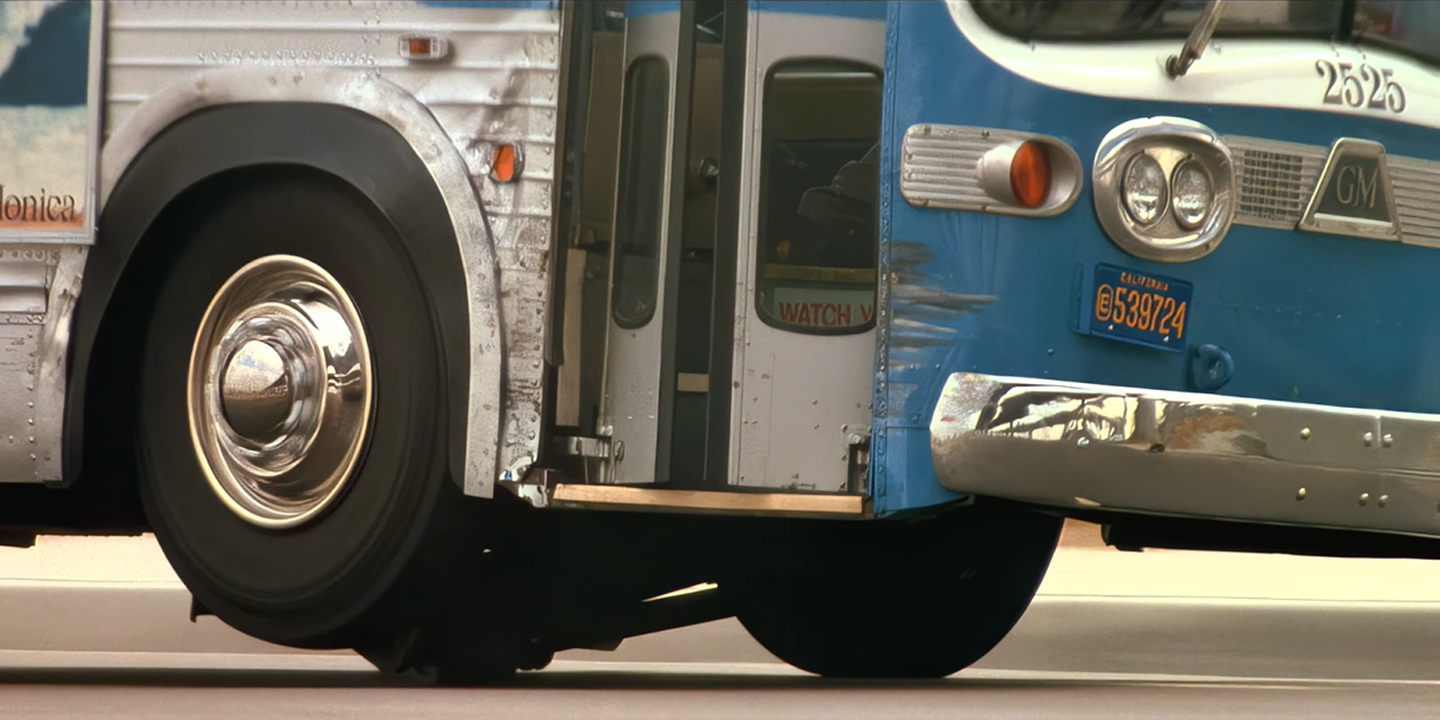
The bus jump was real, but it involved a highly lightened bus with a custom shock-absorbing rig for the stunt driver, plus special ramps for the jump. The stunt bus was destroyed on landing.
Even the scenes when Keanu Reeves and, later, Sandra Bullock, get under the bus had some magic going on. A real New Look doesn’t have nearly enough ground clearance for those scenes to have taken place, so that bus was lifted and given an access hatch.

But the part that really stuck with me was the speedometer and the fuel gauge. The speedometer is a genius plot device. It essentially works like a countdown timer does in other movies, but it shows speed rather than time.
Later in the movie, Reeves puts a screwdriver through the coach’s fuel tank, causing a leak that is shown on the coach’s fuel gauge in real time. The fuel gauge then becomes a countdown timer-like plot device, and the characters have to race against time to get off the bus before it runs out of fuel. Check it out:

Weirdly, despite all of the breakdowns on this film by so many different people, this one has been largely ignored. First, there’s the speedometer. I have seen nearly 100 different New Look dashboards, and none of them had the kind of speedometer shown in Speed. Here’s a look at the dashboard from a different angle, as shown in the film:

In real life, these buses had fully round gauges. They were totally function over form, and probably wouldn’t have looked so nice on-screen. Something interesting about the instrument cluster in the Speed bus is that it has a temperature gauge that doesn’t have a needle.
Then there’s the fuel gauge, which is depicted as being right next to the speedometer in the film. This one is another oddity. Most of these buses didn’t have fuel gauges at all. The most basic New Look dashboards indicated only speed and air system pressure, nothing else. Here’s an example image:

Here’s another version of the two-dial instrument cluster:

Buses Often Didn’t Have Fuel Gauges
If a bus operator wanted to, they could order their bus with gauges to show engine temperature, battery voltage, and engine oil pressure in small gauges on top of the cluster. But, notably, a fuel gauge was not included on the main instrument cluster stack. Here’s what a New Look with a more detailed instrument cluster looks like:

It wasn’t just the New Look. GM’s Scenicruiser and RTS-II buses were like this. In fact, it was commonplace for the buses from any manufacturer to come without fuel gauges. Even my 2002 Nova Bus RTS-06 (below) doesn’t have a fuel gauge, and instead, all I get is a warning light that comes on when the tank gets low.

But why? How is it that buses, even those made well into the 2000s, don’t have fuel gauges?
Why Buses Often Don’t Have Fuel Gauges
As the bus experts at the Illinois Railway Museum told me, it was simply because they were not needed. Unlike your car, buses run on rigid routes with known mileage counts. Transit buses and highway buses then have fuel tanks with capacities over 100 gallons. Even at three miles per gallon, a transit bus is not going to run out of fuel before it’s done with its route for the day. Then, when it comes into the depot, it’s going to get its fluids topped off anyway.

It was a similar deal with highway buses. Even though those buses are traveling great distances, the bus company knows how far it’s going to go and generally how long a tank of fuel will last. A fuel gauge isn’t needed because fuel stops are generally already calculated. In the modern day, bus fleets have management software and data reporting straight from the bus to help them with fuel planning.
Well, that is how it’s supposed to work, anyway. The lack of fuel gauges can be disastrous in a dysfunctional bus line. Back in 2018, the Montreal Gazette reported that buses in Montréal were running out of fuel daily. What happened? Société de transport de Montréal eliminated much of its bus maintenance workforce. Since there was now nobody to refuel the buses at the end of each day, the transit line moved to a policy of refilling the buses only when they ran low. The drivers had to guess how much fuel they had left, even though they didn’t have fuel gauges to use.

The buses talked about in that article were Nova Bus LFS units, which also remain in use in Chicago. An example of which is pictured above.
I’ll note that while it was common for buses not to have fuel gauges, it wasn’t an absolute. Many manufacturers still had fuel gauges as options for the fleets that wanted them. Some operators added their own aftermarket gauges. If you’re looking at an old GM New Look bus, for example, you’ll sometimes find a fuel gauge living on the switch panel next to the driver. Some buses may also have fuel gauges next to the tank itself, but not inside of the bus. Here’s the cluster from my RTS; note the tiny light to warn me about fuel:

But for many fleets, fuel gauges were unnecessary luxuries that added cost and an additional failure point. That has changed a bit in the modern day. Today, buses that don’t have fuel gauges might at least have a low fuel level light, and designs that use digital dashboards often do have fuel gauges. But there are still a lot of buses that don’t have fuel gauges that remain in operation, and for the most part, that’s fine.
One of the exceptions to the rule is the school bus, as you’ll find fuel gauges in those. Many school buses are built on derivatives of commercial truck platforms. Likewise, while school buses generally run defined routes, they also venture outside of these routes for field trips, sporting events, and so on. Some churches also use school buses for their functions.

Of course, all of this means that a major plot device of Speed, that fuel gauge, would be unlikely in real life. As it is, the likelihood of a person being able to punch a regular screwdriver into a bus fuel tank is also very unlikely. The gauges in the film are real, and in some shots you can see more of the whole dashboard. But it appears to be more of that Hollywood movie magic at work.
So, if you happen to buy a decommissioned bus or peer at the instrument cluster of a bus and wonder why there isn’t a fuel gauge, now you know. For the most part, it’s just not needed, and it largely goes back to how rigid a life the average bus lives.
Top graphic images: 20th Century Studios


So those gauges are incorrect to the bus, but now the question is, what are they from? That’s a fairly distinctive speedometer in design, and a 70mph range suggests it was from some bus or heavy truck that wasn’t capable of going very fast. The lack of an odometer is a little odd, it might have been a “generic” replacement from JC Whitney or something the prop department used.
I tried a reverse image search, but everything that came up was screenshots from the movie.
I feel like my question yesterday is responsible for this article, and I’m ok w that. But again, I thought you were selling the RTS? What’s up with it? I now have outdoor gated storage 10 minutes from downtown Madison, btw, just sayin.
A museum is interested in it. They just haven’t found the time to pick it up yet.