

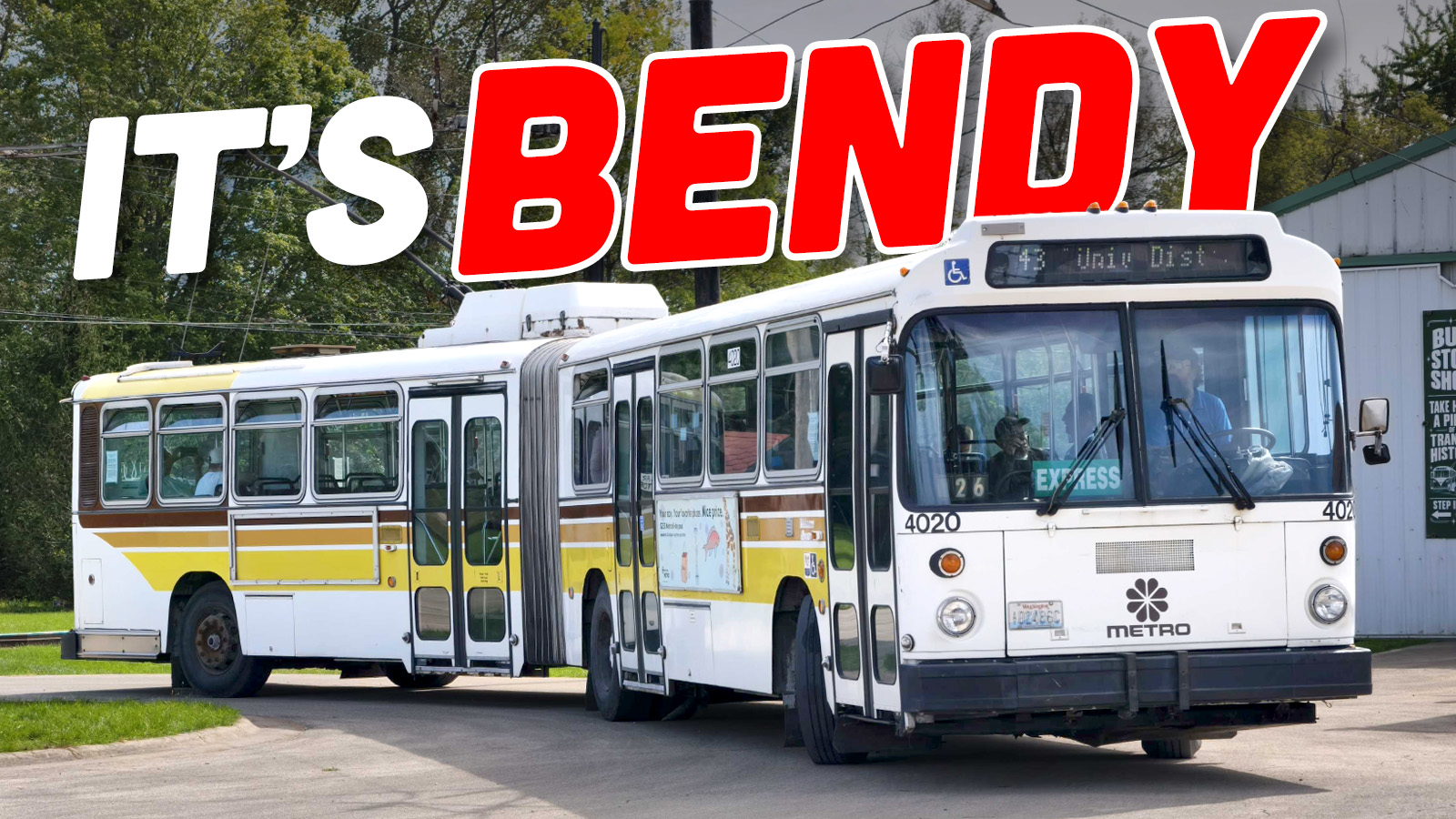
Every day, countless people around the world board a bus to travel to a destination. These buses come in all shapes and sizes, from comfortable coaches to towering double-deckers. One of the best ways to increase a coach’s passenger capacity without adding height is to build the bus in at least two sections, adding a pivot point near the middle. The articulated bus is a common sight everywhere, but how they actually work, especially when they have a rear engine, is far more clever and interesting than you might think. A lot of these buses put brilliant engineering in plain sight.
America’s largest train museum, the Illinois Railway Museum (IRM), hosts a special event each year to celebrate the transit bus, one of the greatest forms of public transportation that does not ride on rails. IRM is home to America’s largest collection of preserved buses, and most of the over three dozen trolley buses and motor buses in the museum’s hands do run and drive. This vast collection makes IRM the only railroad museum in America with a regular bus service. You might think it’s weird for a train museum to preserve so many buses across three warehouse-sized barns, but buses and trains complement each other in functional public transportation systems. One helps the other.


I have not missed a single Bus Day since I started coming to the Illinois Railway Museum in 2022. This year’s Bus Day was the 11th running of the event, and in my experience, each Bus Day has been better than the last. This time, for example, there was a practical buffet of 13 buses to ride throughout the whole day.

One of those buses was King County Metro No. 4020, a 1987 MAN SG-T310 articulated trolley bus. This unit usually gets to stretch its legs on every Bus Day, and it’s a favorite among visitors because everyone loves a fun “bendy bus.” As my wife published posts about our Bus Day at IRM, some followers and readers asked a curious question: Just how do articulated buses actually work?
The answer to that question is more exciting than it would seem at first glance. Yes, a lot of bendy buses work exactly how you probably think they do. But others require quite a bit of clever engineering that you might not notice until after you read this.

Over A Century Of Bending
Let’s start at the beginning: the dawn of the articulated bus, because it’s important to see where we’ve come from before I show you where we are now.
The articulated bus came early on in the development of the transit bus. Some of the first known internal combustion buses were built in the mid-1890s, and while those units were small, they wouldn’t be for long. As technology progressed, builders figured out how to stuff more people in a single bus. This was great for efficiency. It was cheaper and more practical to stuff one bus full of people than it was to run multiple smaller buses. Mechanics had fewer buses to work on, the transit district had fewer drivers to hire, and there were fewer engines to fuel.
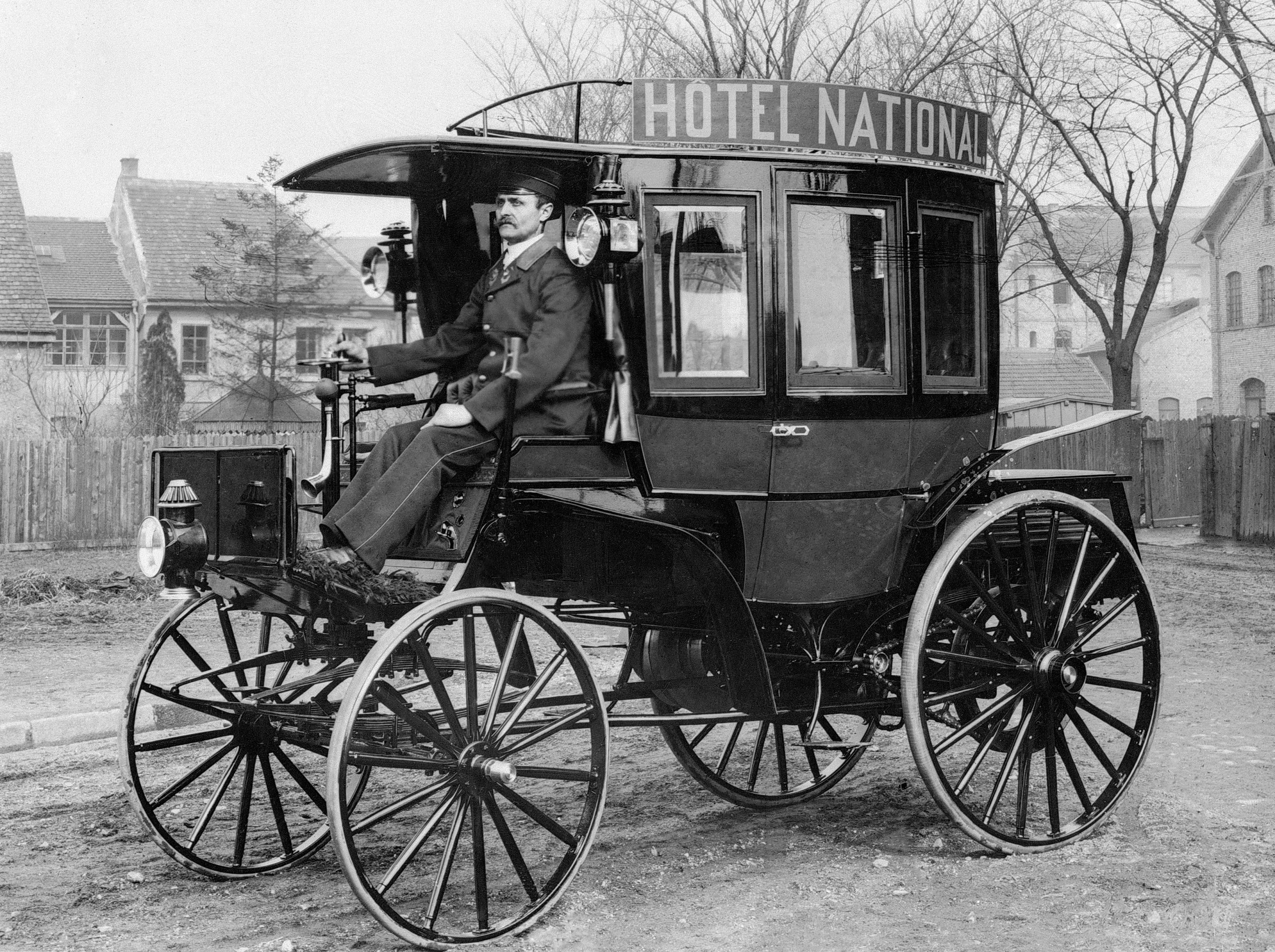
However, a rigid bus can only get so long before making it any longer leads to diminishing returns. Super-long buses can carry more people, but have a harder time navigating city streets. Building up may also not be possible, as a double-decker bus might interfere with overhead infrastructure or fail to fit into tunnels.
The solution was simple. Builders began assembling buses in two distinct sections. The second section of the bus would connect to the rear end of the coach’s front section through an articulating joint. The earliest example of an articulated bus I could find is this Dutch Ford Model T, which was built in the early 1920s. Check out how the interior of the rear section is paired with the front using an accordion-like central section:

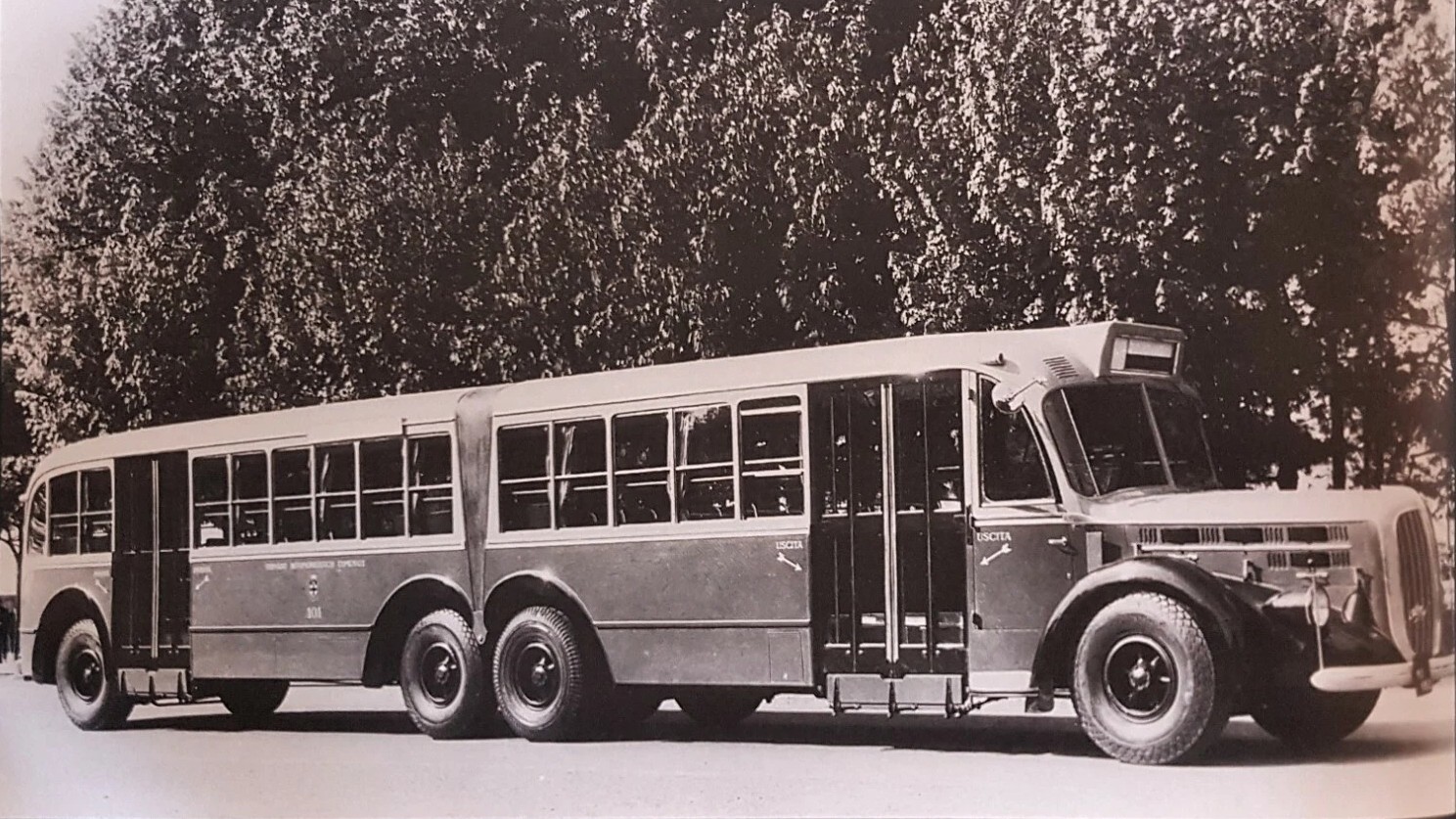
This wasn’t the only way to do it. An even simpler method to increase bus capacity was to make a single-unit bus or truck tow a trailer that had seats in it. A good example of this type of bus is the Officine Meccaniche bus truck from 1930, which is pictured below.
The interior of the trailer was not connected to the main unit in any way. As a result, the trailer had its own entry doors. Often, buses like this had a conductor to signal to the driver when the bus was ready to get underway.

As it happens, I’ve written about articulated buses before, and my story is a good primer:
Of course, I cannot talk about towed buses without talking about the very fun trailer bus. Those weirdos are little more than tarted-up semi-trailers with seats and windows. But they aren’t really articulated buses, so I will talk about those buses on a different day.
Articulated bus history starts getting really interesting in the late 1930s. Over in Italy, Alfa Romeo produced the pioneering 1937 Alfa Romeo 110 AM-Macchi. This bus, which Curbside Classic said carried up to 180 seated and standing passengers, had a novel way of articulation. Unlike today’s articulated buses, which articulate horizontally and vertically like a trailer, the Alfa Romeo had only vertical articulation. Having the center section articulate up allowed the bus to drive up grades without getting stuck.
In 1938, the city of Baltimore put America’s first articulated bus into service. The Twin Coach Super-Twin was similar to the Alfa Romeo in that it articulated only vertically. To permit sharp turns, Twin Coach, like Alfa Romeo, designed a rear-wheel steering system. While extremely weird, there was some logic to this. Per Twin Coach, because its bus articulated only vertically, the bus floor is straight from front to rear.
The Twin Coach’s articulation was more of a transitional technology. After World War II, bus builders largely switched to the more modern articulation system that we know of today. Here’s America’s first fully articulated highway bus, the 1946 Kaiser built for the Santa Fe Trail Transportation Company.

How To Make A Bus Articulate
Today, there are generally four ways to achieve an articulated bus. Two concepts that I explained earlier, the trailer bus and the bus that tows a trailer, remain in operation today. Trailer buses can still be found in Cuba, and they’re glorious in their simplicity:

Meanwhile, over in Munich, Germany, the Münchner Verkehrsgesellschaft runs the Busanhänger (bus train), which is a bus that tows a separate trailer that is also a bus. These were built in just 2022 by Sono Motors:

Here in America, you’ll generally find two kinds of articulated buses. The first, and older type, is the puller. In puller designs, the front section of the bus is a complete vehicle. The engine will usually be located towards the rear of the front section and under the floor. Only the rearmost axle of the front section (typically the middle axle of the whole bus) is powered.
A great example of this design is the Crown-Ikarus 286, a bus jointly developed by the Crown Coach Corporation of America and the Ikarus Body and Vehicle Factory of Hungary:
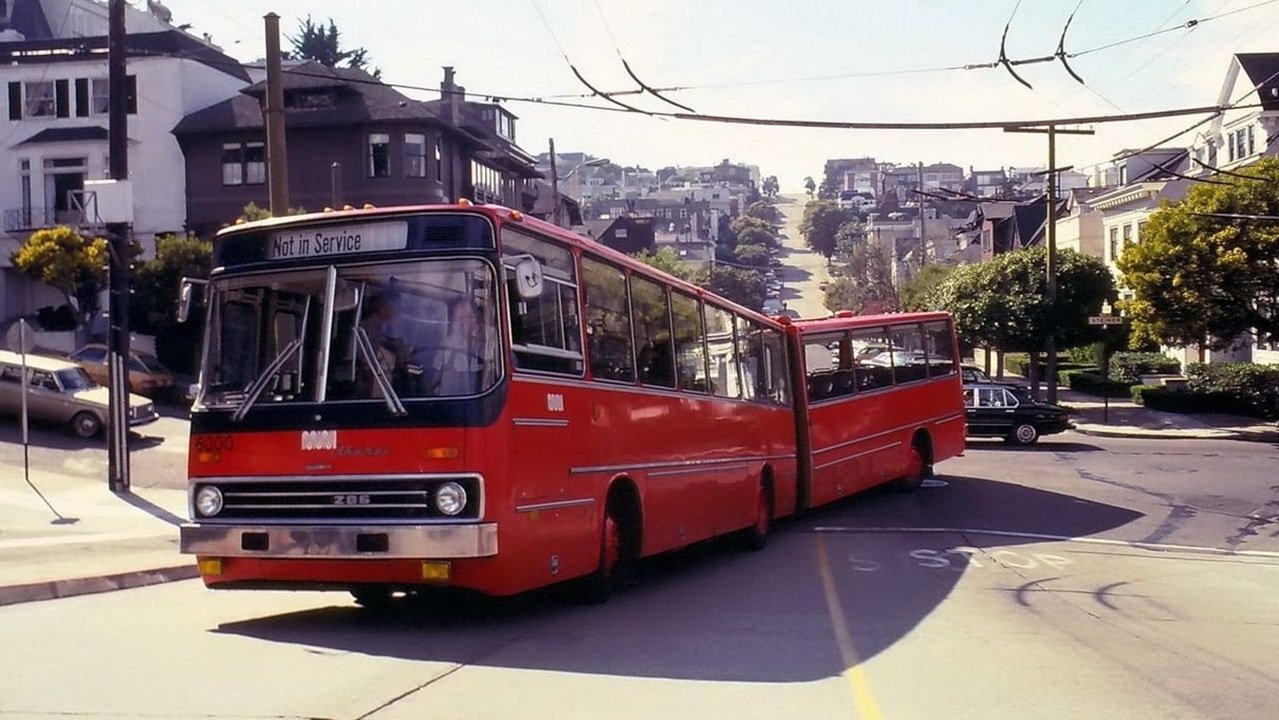
Built from 1980 to 1986, these buses feature a Cummins 855 cubic-inch NHHTC straight-six mounted under the floor near the rear axle of the bus. That engine drives the rear wheels through either an Allison HT740 automatic or a Voith D864.2 automatic, both featuring four speeds.
Puller buses usually connect to their rear sections through a somewhat complex articulation joint.

This unit consists of a front and rear subframe that connect to the front section and the rear section, respectively. They meet in the middle, where they ride on a ring of bearings. These bearings allow the front and rear sections to turn relative to each other. In other words, it functions like a joint. In a puller configuration, the rear section of the bus straightens itself out as the front section pulls the bus forward. It’s like a semi-truck trailer, but with a few extra steps. These joints tend to be made out of materials like welded steel or cast iron.
From here, a bus builder will place a turntable on top of the articulation joint, bellows to seal the bending path between the two bus sections, and flexible cabling to provide power to the rear of the bus.

The benefit of the puller bus is that it’s technically a simpler design. The rearmost axle isn’t powered, and the articulation joint needs fewer components to get its job done. Anecdotally, some bus drivers I’ve spoken to prefer puller buses in snowy situations, since the powered axle is ahead of the articulation joint. Articulated buses also have a limited amount of vertical flexibility, permitting them to climb city streets.
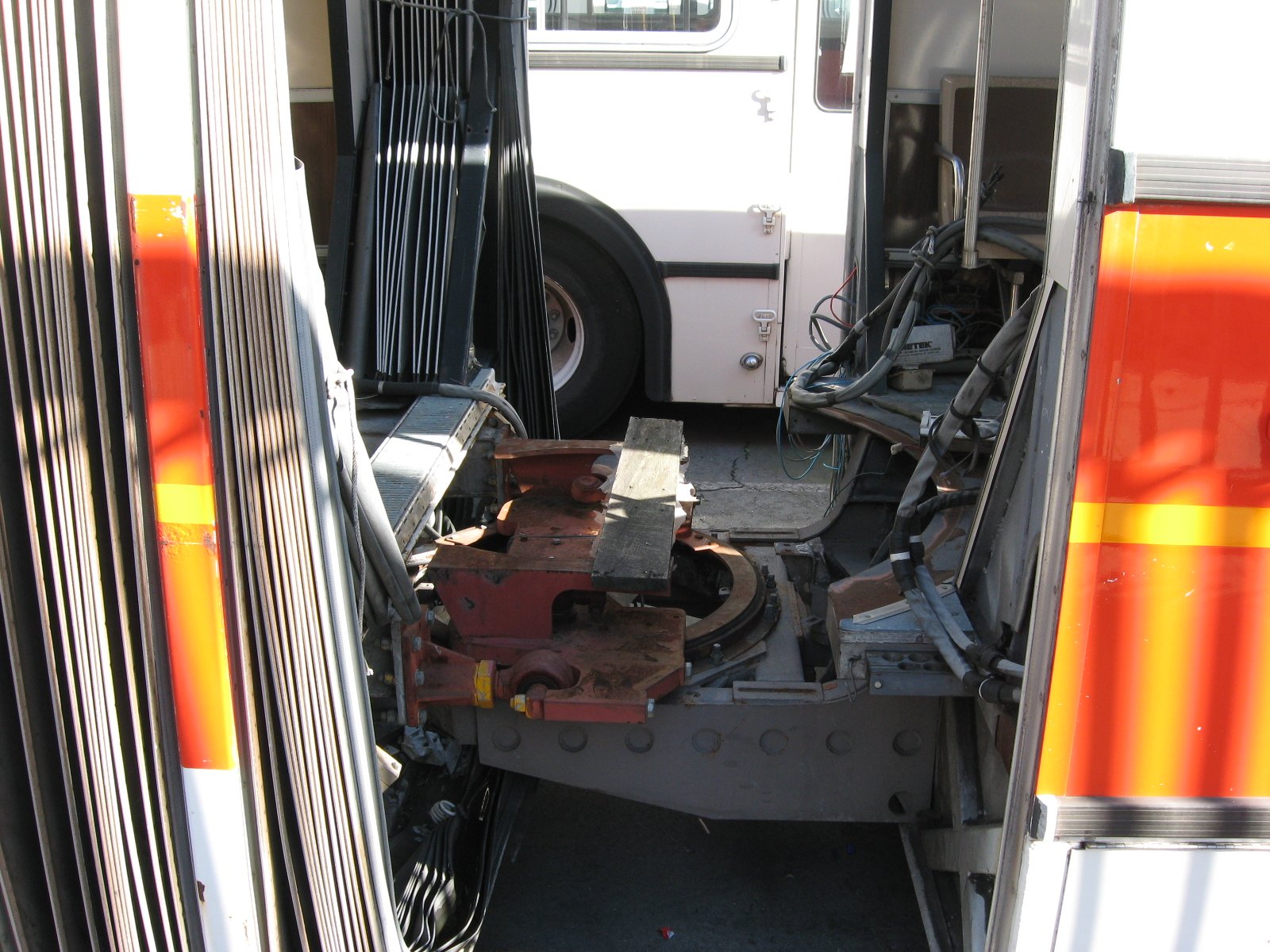
However, puller-type articulated buses have one main drawback, and it’s that, generally, the floor cannot be lower than the engine that lives right in the middle of the bus. Some puller-type articulated buses manage to have a low floor by moving the engine to a side of the bus and having the lower floor go around the engine.
The Van Hool AG300 has this design, and while it has a low floor, the large engine takes up a vast amount of space that could be used for seating. Check it out:

How A Rear-Engine Articulated Bus Works
The preferred solution to this problem is to place the engine at the very rear of the bus, where it won’t gobble up valuable passenger volume. Yes, a rear-engine bendy bus!
Here’s where the engineering gets really fun. In a rear-engine articulated bus, the front section of the bus now becomes the “trailer,” and the powered rear section of the bus pushes the whole bus forward. Transit departments all across America have buses like this, and you’ve likely ridden on at least one. You can usually tell that you’re on a rear-engine articulated bus because you’ll find the engine’s exhaust and vents right there at the rear.

If you’re experienced in towing a trailer of any kind, you know that having the trailer overpower the tow vehicle is a bad idea. That’s a great way to jackknife your whole rig. Yet, articulated transit buses easily glide through their cities without crumpling into an L-shaped mess.
How rear-engine articulated buses achieve this has a lot to do with the articulation joint. Much of the core design of a pusher bus articulated joint is the same. You still have the two plates meeting at a circular bearing in the middle. But now, there’s more.

One of the biggest additions to the articulation joint of a pusher bus is a set of dampers. The dampers provide hydraulic resistance, slowing down the rotation speed of the sections. Newer joint designs feature semi-active dampers that utilize an array of sensors and a control unit. The bus tracks its speed, steering angle, and articulation angle.
This image shows the anatomy of a pusher bus articulation system from HÜBNER GmbH & Co. KG, a popular German producer of articulation systems:
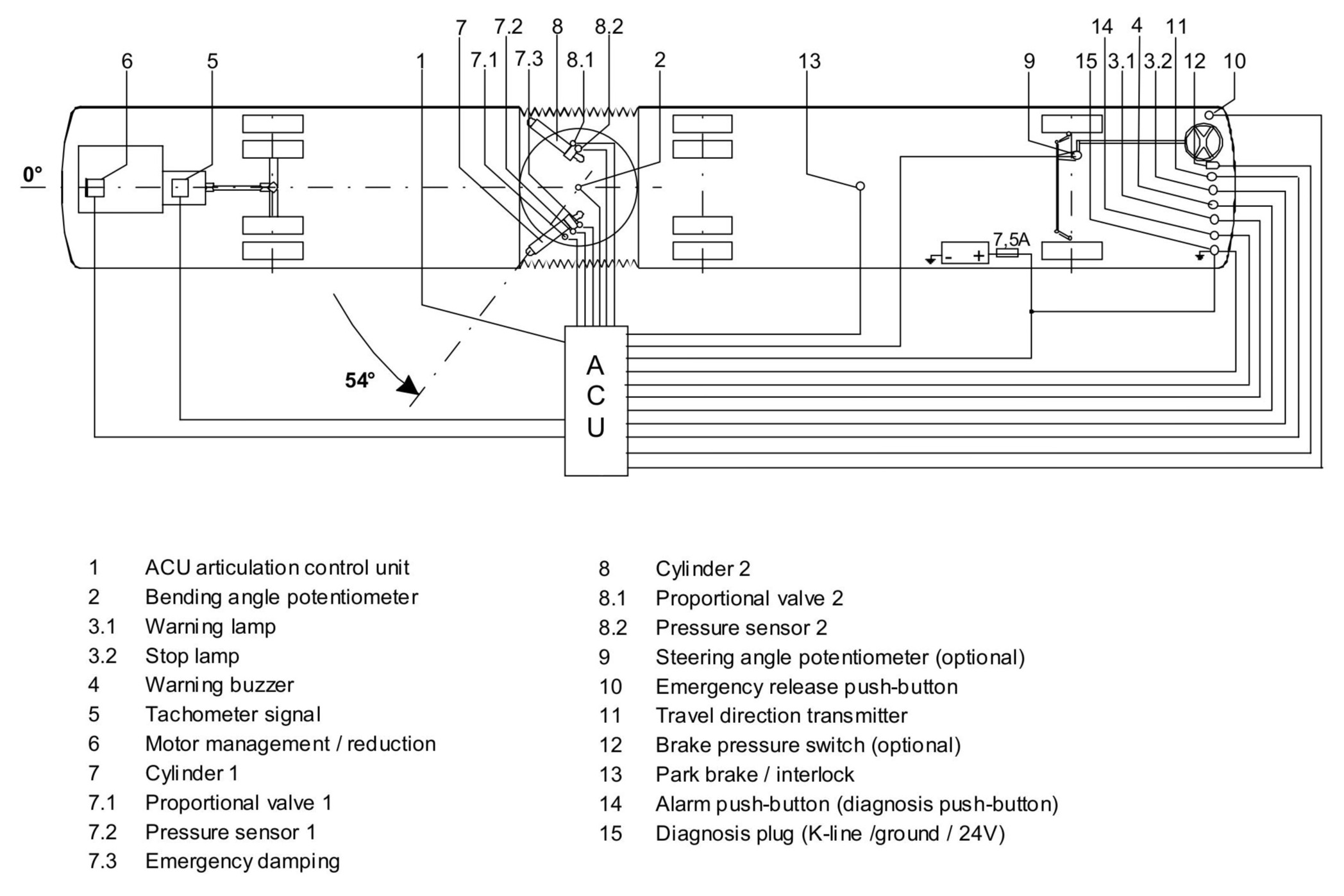
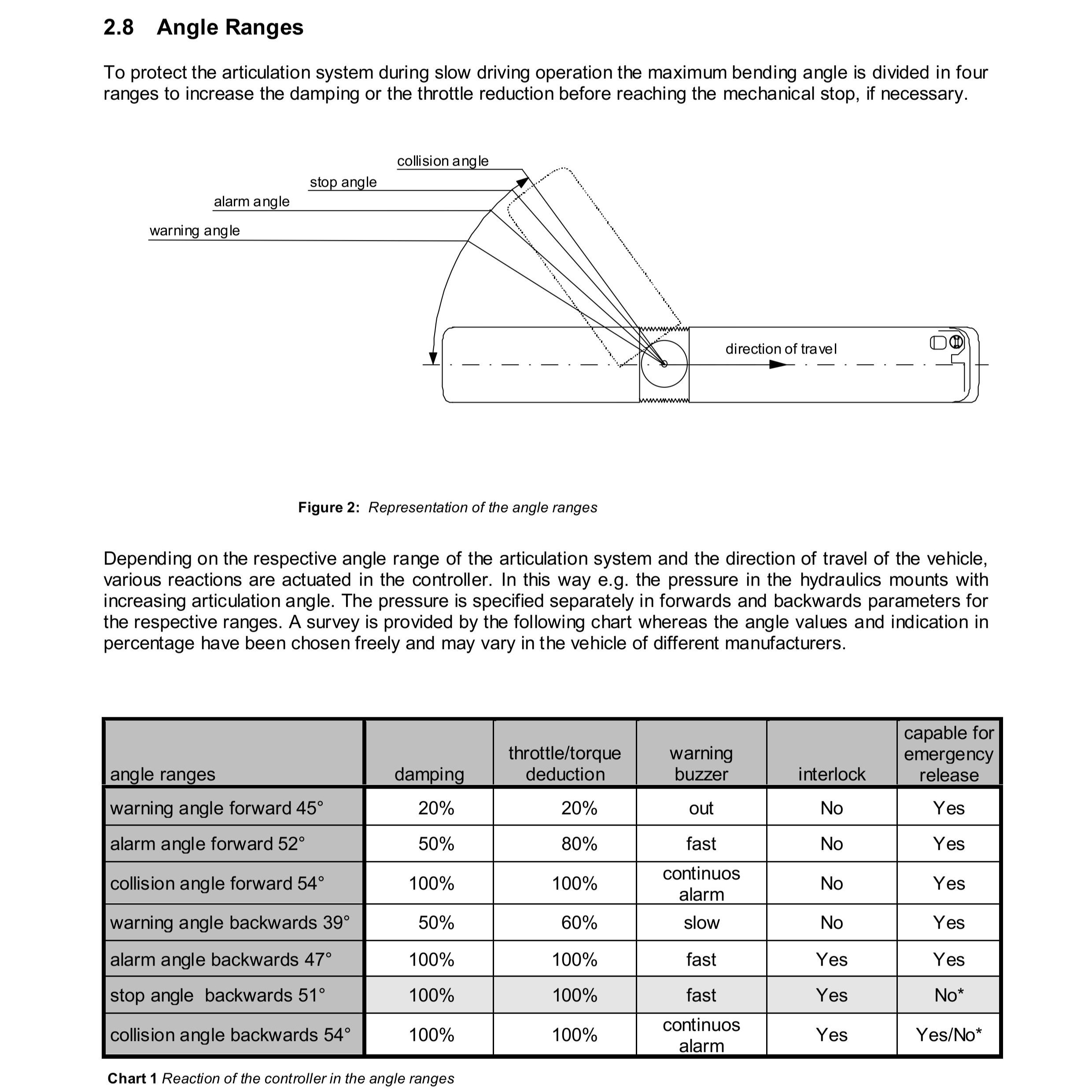
If the control unit detects that the bus might become unstable, the dampers can become firmer to further restrict movement. If the control unit fails, the articulation joint still has passive damping, and if the driver turns sharply enough, there are bump stops at the end of the articulation joint’s travel. Likewise, the articulation system can work in tandem with the drive-by-wire system to cut throttle when things are getting a bit too spicy. Having the active system allows the joint to be stiff during high-speed driving, and more relaxed in low-speed cornering.
Here’s an example of how a HÜBNER system intervenes based on bending angle:
Pusher buses then use similar copolymer-based bellows and flexible power systems as a puller bus does. Some of these systems are designed to be universal, so they could be installed on just about any articulated bus, no matter if it’s a diesel, a hybrid, natural gas, electric, hydrogen, or something else.
There are even articulated buses out there that have two articulation joints, essentially creating a long snake of a three-section unit. These buses (example below) tend to be rare and are often used more like trackless trams, as their sheer length limits their maneuverability.

As for how driving an articulated bus is different from a rigid bus, the Massachusetts Bay Transportation Authority has a neat video explainer from a driver (click here if you do not see the embed):
A lot of this technology has been around for a long time. HÜBNER says it’s been making articulated bus bellows since 1952. JOST, another German maker of commercial vehicle parts, says it made its first ball bearing turntables in 1952.
Meanwhile, FG Fahrzeugwerkstätten Falkenried GmbH claims to have invented the damper system for today’s low-floor articulated buses in 1975. One of the first rear-engine articulated buses to use this technology was the 1978 Mercedes-Benz O 305 G:

All of this history and engineering is essentially hiding in plain sight, or right under your feet. When you’re riding these buses, you can’t see the articulation joint hard at work to keep the bus comfortable and under control. You might not have even noticed that many “bendy” buses have rear-mounted powertrains.
For decades, the articulated bus has proven itself to be the right kind of bus for when a transit district wants to increase available passenger volume but without deploying more buses. Articulated buses also work on the routes where a tall double-decker bus just won’t work. Of course, they’re also a subject of curiosity for transit enthusiasts, too.
The next time you’re on a bus during your morning commute, think about the century of advancements that led to that bus ride. It all started with wooden carriages slowly getting people to their destinations. Now, the buses of today are marvels. Also, be sure to thank your bus driver and the mechanics, because without them, your commute wouldn’t go nearly as smoothly as it does.
Top Graphic Image: Author


Some of the bigger King County Metro articulated busses have seats directly on the articulation joint, riding those is a trip
Something tells me that Mercedes frequently visits the /r/BitchImABus subreddit. And then when she gets bored, she saunters over to /r/BitchImATrain subreddit.
Content ideas aplenty.
Why do we have bendy buses? Because someone once told the MTA to get bent.
Big industrial-spec Slinky?
You won’t believe what I would believe: Not what you think.
😉
Hmmm, I do believe this calls for The Autopian to do an in-depth analysis of the articulated bus fight scene from Shang-Chi!