


Many of automotive history’s weirdest engines were created to solve specific problems. Sometimes, engineers have to come up with creative ways to get around technological limitations of the era, or to fulfill the design requirements of a mission. During World War II, the United States military needed a powerful engine to mount into a medium tank, and there wasn’t enough time to build one from scratch. A pair of Chrysler engineers came up with a wild solution that was essentially five straight-six gasoline engines mashed into a single star-shaped monster. This is the Chrysler A57, and it’s a marvel of engineering despite technically being a parts-bin special.
The Chrysler A57 joins a long list of hopelessly complicated engines with a specific reason to exist. Some of them are creations of inventive engineers during World War II. Across the Atlantic Ocean, the British Admiralty wanted fast boats to best German power, but found that existing diesels were too weak. The solution was ridiculous, even by modern standards. The Napier Deltic and its 36 pistons, 18 cylinders, and three blocks were a massive triangle of power.


The British kept it weird after the war. When the Rootes Group wanted to fit a diesel engine into a compact space under a truck cab, its engineers embarked on the journey that led to the unique opposed-piston Commer TS3 two-stroke diesel, which has cylinders containing two pistons each. For many people, the best part about the TS3 is that it sounds like no other engine ever made. Weird engine projects continue into the modern day. I recently wrote about the Knob Engines Birotary, which seeks to be the ultimate light aircraft engine. That circular engine features three cylinders, a rotating block, and a stationary head.

Of the engines I’ve covered in my series on weird ways to power a vehicle, the Chrysler A57 (above) might be the closest to being considered “conventional.” It’s not a diesel, and it doesn’t have multiple pistons in the same cylinder punching at each other. Yet, it’s still impressive all the same because it’s an example of what engineers can do when crunched for time and resources.
Medium Tank, M4

The story of the Chrysler A57 starts with perhaps the most iconic tank in American history, the “Medium Tank, M4,” which was better known to most people as the M4 Sherman. John Delaney, the Curator of the Imperial War Museums, describes what led to the Sherman:
So, what was the Sherman for? I mean, this is the first common misconception, in that when it was designed it wasn’t designed to be a tank to fight other tanks. In the 1930s the Americans were looking at developing a tank which they called the M2A1. Initial versions were equipped with a massive number of machine guns, nine machine guns in all, which again points to that tanks were not for fighting other tanks. So, you had two very distinct sorts of armoured vehicles. A tank to take on enemy infantry and anti-tank guns, so it was an infantry support vehicle, and a tank destroyer which had a higher velocity gun, was more manoeuvrable, and was there to take on the enemy tank forces. But of course, this sort of rather fell apart as soon as war began.
[…]
So as a stopgap, while the war’s still going on, the M3 Medium Tank is developed which it becomes known as the Lee/Grant. But the problems with that were the tank was very high, even higher than the Sherman which had a reputation for being quite a high battle tank. And also, because the 75 mm gun was in the hull front, it had a very limited angle of traverse. For all those reasons it was realised that another tank was going to be needed, so another team of designers were looking at ways to use the chassis and the running gear of the M3 and how to place a much bigger turret on top which could take that 75 mm gun. And that is how we get to this, the M4 Sherman, which rolls off the production line for the first time in February 1942 while the M2A1 is still being manufactured. So, again that points to the fact that this doctrinal hangup was still there and in fact it was still there until 1944.”

By now America is at war with Japan and Germany and there’s a need for thousands of these new tanks. Roosevelt wanted 45,000 tanks per annum, which led to a series of decisions that the ease of production, simplicity of production, rate of production, would all trump things like battlefield survivability and firepower. If the tank was made simple enough and upgradeable enough, those problems, when they were encountered, could be overcome. What was needed was a mass of tanks. Tanks that were reliable, tanks that would stay in combat, tanks that could be upgraded. Initially the first type of Sherman was the M4A1, which had a cast hull and the R-975 radial engine. And it was almost immediately realised when they were producing these that the engine was too complicated and the casting of a hull in one piece was also a very difficult manufacturing process. So, a variety of variants and subvariants were going to be needed, five main variants and there were subvariants of those across 10 main manufacturing plants across the United States.
The Continental R-975 Whirlwind 9-cylinder radial that powered the M4A1 made healthy power numbers, but it wasn’t exactly meant for ground vehicles. Wright Aeronautical designed the radial to power aircraft, and the engine had a successful career providing thrust to over 50 models of aircraft. R-975s have powered everything from the Ford Tri-Motor and the Lockheed Model 12 Electra Junior to the Cessna DC-6 and even a Goodyear blimp.

In 1939, Continental Motors began building the R-975 under license. Previously, R-670s were used in light tanks with success, so the R-975 seemed like a natural fit for a medium tank. The R-975s did prove to be reliable in the A1, but were complicated to work on, and since aircraft engines were needed for the planes that supported the war effort, there was a chance that the military would not have as many R-975s as it wanted.
The Army would turn to the automotive industry in search of a solution. One of the many variants of the M4 included the M4A3, which was powered by the ridiculous Ford GAA 18-liter V8. Another version, the M4A2, utilized twin GM 6-71 diesel engines.
Five Engines In One

But the Army didn’t rely on just a few designs, and reached far and wide. In July 1941, it also reached out to Chrysler for an engine that it could use in a new variant of the M4. The military put one tight constraint on Chrysler, and it was that it needed that engine basically right away. This meant that Chrysler did not have nearly enough time to build an engine from scratch.
According to Mac’s Motor City Garage, Chrysler Executive Engineer Harry Woolson and Engine Design head Mel Carpentier had a creative idea. They could dramatically reduce development time by building a tank engine that was more or less multiple automotive engines stacked on top of each other. This way, the tank engine could even use existing tooling.

The men chose a 250.6 cubic-inch L-head straight-six as the base engine. This engine was found in cars like the Chrysler Royal, and was good for about 115 horsepower in that application.
To create what Chrysler called the A57 Multibank, the development team took five of these engines and bolted them around a central cast iron crankcase in a sort of quasi-radial pattern. The Old Machine Press continues with how complex these engines were:
The A57 engine was mounted in the rear of the tank, and the crankshaft output flanges faced the front of the tank. The A57 retained the five crankshafts of the five six-cylinder engines. A drive gear was coupled to the crankshaft of each engine bank. These five drive gears meshed with a single, central gear (all gears had herringbone teeth). The central gear drove the output shaft of the power plant. The output shaft went through the radiator and drove the cooling fan and clutch, which was attached to a drive shaft and then transmission.
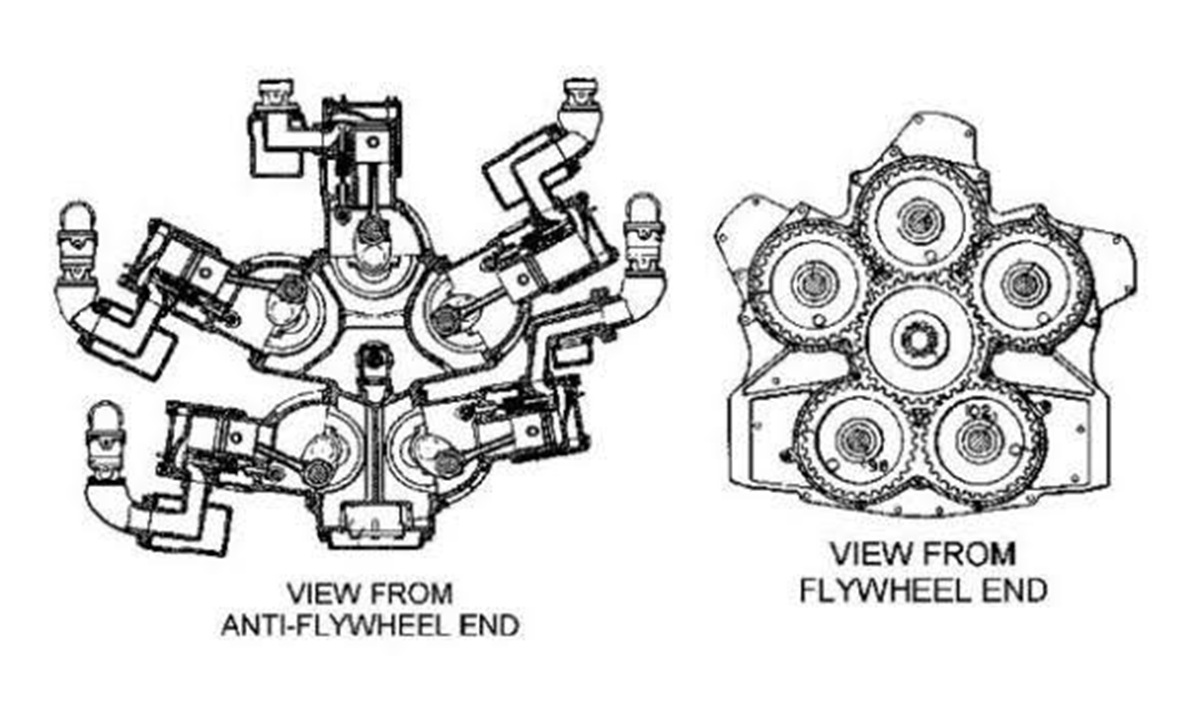
The A57 was originally equipped with five belt-driven water pumps. However, the belts would often break because of the alternating loads on the crankshaft pulleys. The design was changed to a single water pump with five outlets (one for each engine bank). This single water pump was driven by an accessory shaft from the central drive gear located on the opposite end of the central crankcase. Also at the rear of the tank, each engine bank had its own ignition coil and distributor that was gear-driven from the camshaft.

The first production engines had a single-barrel carburetor mounted directly on the intake manifold for each of the five engine sections. The different pipe lengths and contours leading from the air cleaner to the carburetors resulted in unequal fuel distribution. Metal vanes were added to direct airflow, and ultimately the five carburetors (each connected to its respective engine with a downpipe) were relocated in the same plane above the engine. This change simplified throttle linkages, the air cleaner arrangement, and maintenance. The A57 Multibank had two oil pumps located in the central crankcase. One oil pump was a scavenge pump to transfer oil to a remote reservoir. The second pump was pressure pump that took oil from the reservoir and delivered high-pressure oil to all five engine sections.

According to the United States War Department, these downdraft carburetors were T-Series units from Carter, and they had built-in governors.
The result was a 30-cylinder, 20.5-liter beast of an engine. Every metric about this engine was pretty silly. It needed eight gallons of 10W-30 oil and 32 gallons of coolant. It was expected that a gallon of oil would burn off every 100 miles. When running, a healthy A57 was good for 50 psi to 60 psi of oil pressure. The A57 fed from a 160-gallon fuel tank, which would give an M4A4 endurance for eight hours running at 20 mph. For those of you doing the math, that’s 1 mpg.

Then there’s the weight. Since it was a lump of cast iron, the War Department said that the A57 – which was also called the “Chrysler Tank Engine” in military documentation – weighed a whopping 5,375 pounds with a cooling system and all accessories. Even the engine’s comically huge cooling fan was cast iron.
The War Department described the A57 as a “Power Unit” in maintenance documentation, and treated it as five separate, but connected engines. Now, you’re probably wondering what the firing order looks like on a five-engine engine with 30 cylinders, and, well, it’s about as chaotic as you’d expect. From the War Department:

Horsepower output was healthy. Each A57 Multibank was good for 445 horsepower gross at 2,400 RPM. Now, you might wonder why this engine isn’t making five times the horsepower as a single one of its banks, and there’s an explanation for that.
In passenger cars, the 250.6 engine had a compression ratio of 7.0:1. In the tank, however, compression was dropped to 6.2:1 to allow the engine to run well enough, even when it drank low-quality 72-octane gasoline. Add in losses from transmitting five engines’ worth of power through gears to the output shaft, and you arrive at 445 HP. There are some sources that quote lower numbers; however, the military says that these were good for 445 HP. I suspect the difference in reporting comes from gross horsepower numbers versus lower net horsepower numbers.

More juicy details from the War Department notes that each piston had four rings. Two upper rings prevented exhaust gases from getting into the crankcase, while the lower rings controlled the amount of oil left on the cylinder walls during the engine’s strokes. On a healthy A57, each cylinder is good for between 80 psi and 85 psi of compression.

Fitting the A57 into the rear of a Sherman was another endeavor. The hull of the tank had to be extended by 11 inches to fit the brute. In the tank, the gearset of the engine faced the front of the tank, while the distributor was in the rear. Heavier-duty bogies had to be designed to carry the A57’s extra girth.
A Workhorse Of The M4A4

As the Sherman Tank Site claims, the Army enjoyed the ample power of the A57s at first, but they had some teething issues. One was overheating caused by grease and dirt getting into the radiator through a defective seal, reducing cooling performance. The aforementioned belt-driven water pumps were another issue, as were complaints about a tight engine bay and other complaints about generator failures.
Chrysler worked hard to fix these issues, from upgrading the cooling system to moving to a gear-driven water pump. Relocating the generator outside of the engine compartment was enough to keep it from failing. Once Chrysler fixed all of the issues, the A57 began averaging about 240 hours of runtime between major failures. This, reportedly, made it the second-most reliable Sherman engine right behind the Ford GAA, which had an equipment failure rate of about one incident per 255 hours.

Production began in 1942, and the M4A4 would go on to have a bit of a weird service record. According to the Army, 21 variants of the Sherman were built, but it preferred the M4A3 with its Ford GAA V8. Here in America, the A57-equipped tanks were largely used for training. Most examples would be shipped overseas to England and other Allied countries under the Lend-Lease Act. A total of around 109 M3A4 Lees and 7,499 M4A4 Shermans were built by November 1943.
Some of the lingering issues involved piston ring and exhaust valve failures. But by 1944, Chrysler worked out enough issues that the A57 allegedly became the most reliable engine of the M4 fleet. The A57 was just one of the engines that helped make the Sherman a legend. From the U.S. Army:
The M4 Sherman Tank was a staple of World War II in Allied inventories. Supplied to Free France, Britain, and the Soviet Union through the Lend-Lease program, the tank was relatively cheap and plentiful. Almost 50,000 Sherman tanks were produced over the course of the war with a large number of variants and modifications made by its respective operators. The M4 saw three gun mounts across its more than 20 variants, including 75MM, 76MM, and 105MM barrels.
Due to the vast number of modifications available and the ease of upgrading components, the Sherman continued to see active combat well after the end of World War II. It was not until 2018 that the last M4 variant was removed from service in Paraguay, marking the end of the Sherman’s 76-year operational history. This makes the Sherman the longest operated tank in history.
A Legend
While the A57 may not have been the most common engine in the Sherman, there are ways you can see one today. The Imperial War Museums in England has one, and the Wheels of Liberation Collection in Pennsylvania has a functional A57. Two more examples can be found at The Tank Museum in England and the Museum Nederlandse Cavalerie. The Walter P. Chrysler Museum also had an A57, but, sadly, that museum is not around anymore. (Click here if you do not see the video embedded above.)
The Chrysler A57 is a prime example of what engineers were able to accomplish during World War II. The era saw advancements in turbines, warbirds, microwaves, printed circuits, the Jeep, super glue, and even better healthcare. Then there was Chrysler, which managed to create a mind-boggling engine in under a year.
From the car enthusiast perspective, the Sherman was just a fascinating machine. How many other vehicles can say they’ve been powered by an aircraft radial, twin diesels, a colossal Ford V8, a Caterpillar multi-fuel engine, and five Chrysler straight-sixes bolted into a single monolith? I cannot think of a single car or truck with such a wild variety.
Top graphic images: Bring A Trailer; public domain


The great variation of what was considered an M4 (or M4 derived) tank through the war was impressive and led to a massive mix of parts – even upfitting the M3 with parts from the M4 (or other tanks) just to keep things moving.
I love this kind of “good enough” engineering that ends up being brilliant. Boss says “You don’t have time to come up with a brand new engine, you need to make tanks NOW!” “Uh crapcrapcrapcrap…. let’s just kitbash these I6 engines we can spit out by the millions together into some unholy abomination and hope it kinda works?” Boss- “BRILLIANT!” And the kicker is, it was brilliant!
Same story for the De Havilland Mosquito- they needed a new fast bomber, but had no aluminum to make it out of, and no spare welders even if they did. But it turns out they did have some wood, and a bunch of cabinet makers who weren’t being actively employed in the war effort, so they knocked together a wooden plane and it too was brilliant!
Oh wow! I’d heard about this. I own a 1948 Plymouth SuperDeluxe that uses one of those straight 65 engines. Its hilarious to see all of those stuck together like that.
Thinking about an engine swap?