


There’s nothing quite like the beauty and ceremony of watching a damn good film. The laughs that pour in after seeing that Ricky Bobby sold the rights to his windshield visibility, the collective gasp when Brody realizes they’re gonna need a bigger boat, or the thrill the first time you saw Anakin and Obi Wan barrel roll over a Venator into the Battle of Coruscant. Don’t just take it from me, mindless internet blogger #862, take it from the patron saint of cinema, Nicole Kidman.
Good filmmaking should appeal to everyone far and wide, but a way to gain a much deeper appreciation is to watch the behind-the-scenes featurettes that show all the incredible people who make the magic happen, as well as the insane amounts of technology that made it all possible.


Arguably, one of the most important innovations for the film industry in the last 40 or so years is the camera car, quite literally a car designed to carry a camera and operator (or more than one of each) to capture car-to-car action over much greater distances and at higher speeds than camera dollies and tracks or swinging booms could ever hope to. Unbeknownst to me, the Porsche Cayenne has been instrumental in pushing camera car technology further than ever. And whaddyaknow, there’s even a new episode of Galpin’s “My Porsche Story” ready to tell you all about it:
The Crane is Seriously Revolutionary Tech
After years of practicing both photography and cinematography and my brief foray into the crazy world that is the film industry, I’ve learned a lot about what makes a shot work, and sometimes, the hard truth is that it’s not just imagination and talent, but access to some very expensive, highly specialized gear. In my opinion, a drone is the lowest rung on that ladder of super fancy film tech, as you can get one for the relatively low price of $500, and getting your commercial pilot’s license for it is honestly pretty easy. But what happens if you’re willing to spend tens or hundreds of thousands on tech?

The first film I worked on was The Fabelmans, and one day saw us filming at Pierce College for shots of the main character, Sammy, and his friends riding bikes down a city street, and it was my first exposure to a camera car. Production used a low-profile electric buggy that was able to speed by the boys to start the shot before quickly slowing down in front of them to get reaction shots as their crush walks on by.
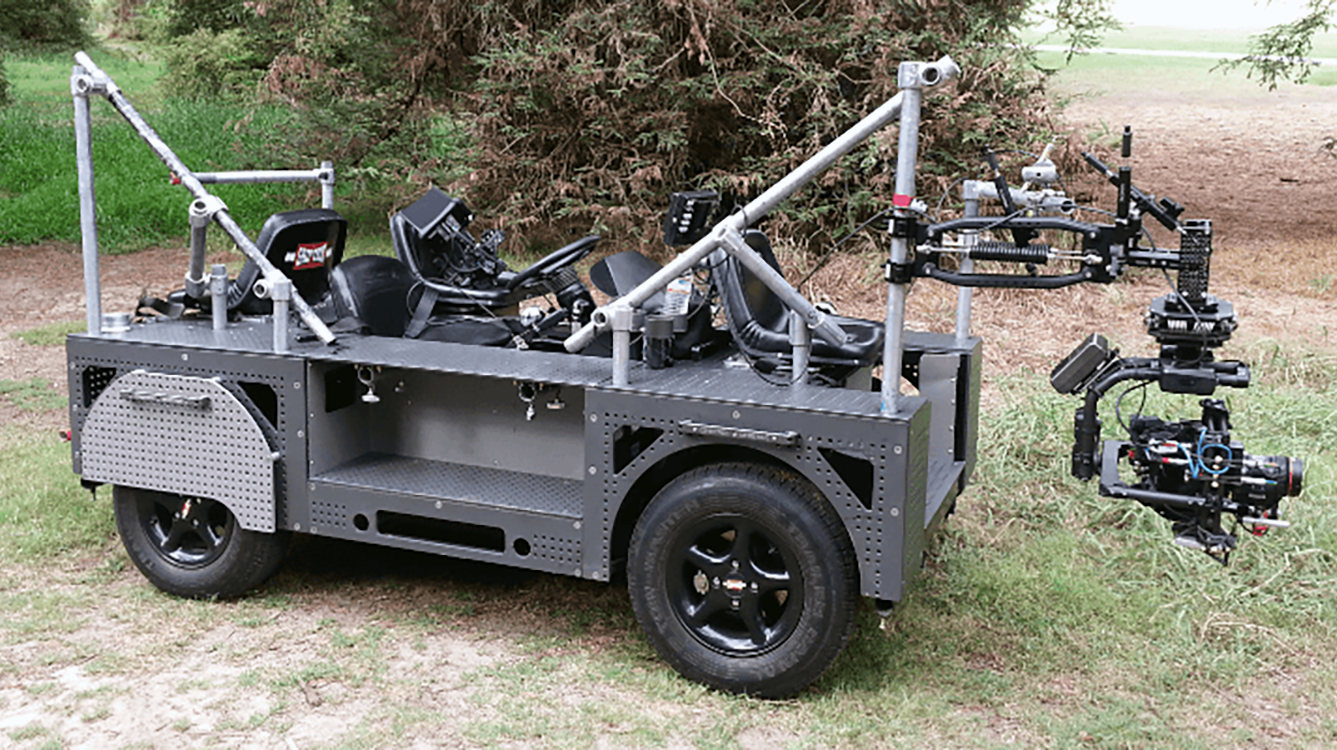
An electric drivetrain made perfect sense here because the torque lets the driver blast by the kids effortlessly, and the propulsion is silent, which is absolutely critical for clean sound on an isolated set. While that was an incredibly cool camera car in its own right and perfectly suited to the shot’s needs, full-size cars are a lot faster and a lot more dynamic, so you’re gonna need something a lot beefier to get those shots.

“When you put a crane on the roof of a car, it creates so many more angles that you weren’t able to get before,” said Jon Chabot, who runs Chase Car Inc. with his brother, Marshall. “You can go high and go low. You can go close to the trees. You can go over the embankment or a guard rail.” In essence, you can put the camera anywhere.

When shooting rollers of Torch and our lovely readers going down the Vegas Strip during our incredible road trip in the $800 Copart taxi, camera position was limited to wherever Matt could safely drive and how far I was able to extend my arms from the car. It works, the shot above is lovely, but imagine being able to swing up and over the cab, or push in closer and pull farther away, all while operating the camera remotely. That’s what camera cars with massive cranes and remote-controlled heads that can boom in and out up to 20 feet can do, making it possible to effectively get any shot you can imagine, and in any direction. Not only is it insanely dynamic, it’s much more time efficient – and if there’s any place where time truly is money, it’s a film set.

In the before times, you’d maybe set a crane on the side of the road and film a pass, call cut, reposition, and do it again, spending a whole day getting b-roll shots of cars in traffic, but not anymore. “They go from using just a black arm or something and […] they’d schedule their whole day,” Jon said. “[With the camera car], We’ve got it all shot in two hours.” Time matters in an industry where every minute is so extensively and expensively itemized.
But all that is just about the beauty of a camera car in general. What is it about the Cayenne that rocks?
How A Car Named After a Pepper Changed It All
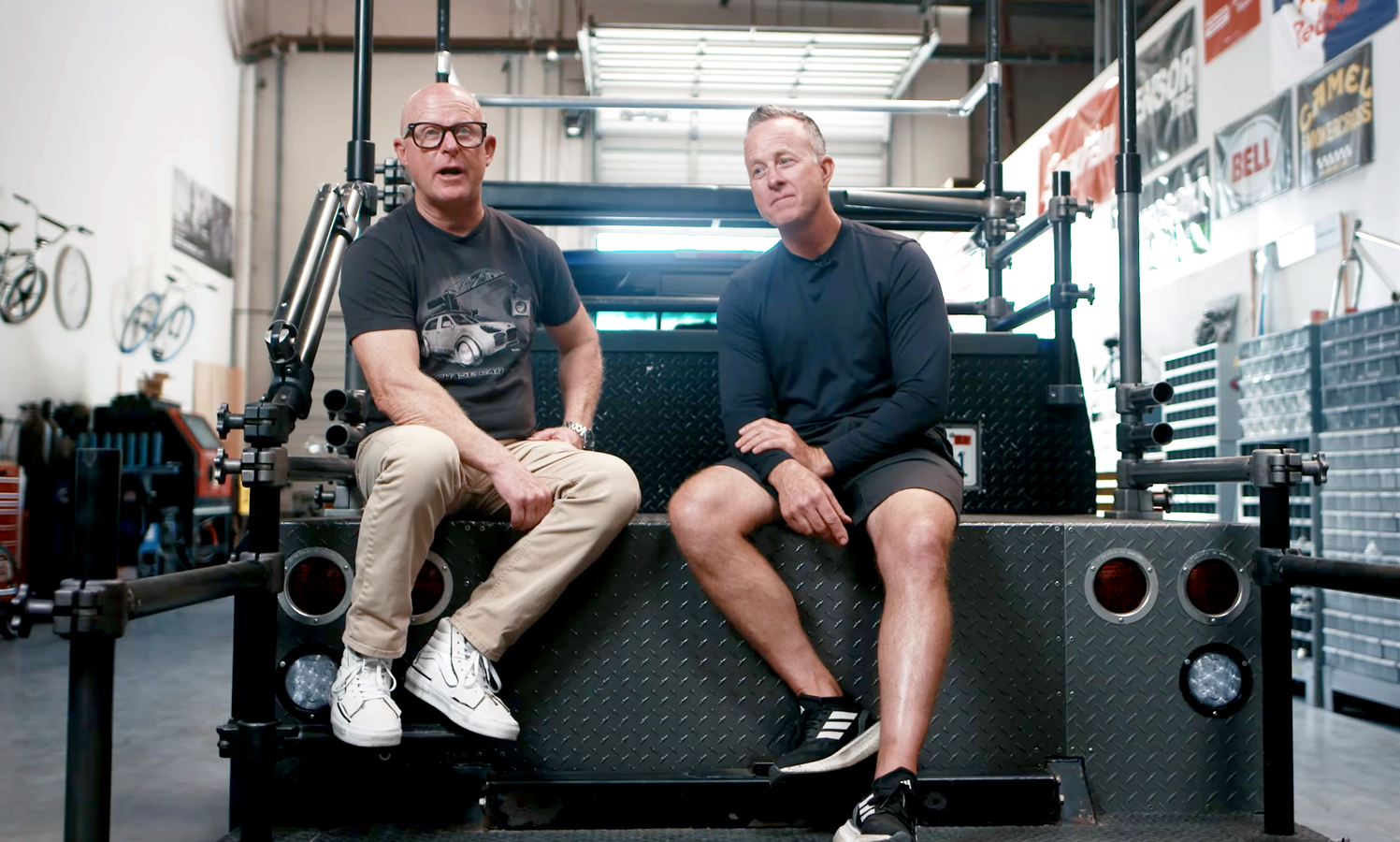
As Marshall and Jon of Chase Car Inc. explain in the video, they often used trucks before the Cayenne came along, which makes perfect sense on the surface. Cinema cameras weigh a lot, so do cranes, and a bunch of people used to have to walk around to manually manipulate the cranes, so why not use a vehicle whose sole purpose on this earth is to lug shit around? Well, size for starters.

“Yeah, a truck’s big, but it’s cumbersome and it’s slow,” Marshall said. “On narrow roads, you can’t really go stuffing it in next to another picture car because you just run out of room.”
I know I struggle parking big trucks in parking spots around town, so I can’t imagine having to worry about precision driving one with a massive, 16-foot, thousand-pound arm on top of it. And speaking of weight, here’s more from Jon about other camera cars:
“You had to constantly change the springs cause it would just ruin them. You’re constantly looking for different springs, and nobody has made anything that really fits that application that was sprung that hard. You ended up just driving something that was sacked out, the ride was terrible, and it just destroyed the vehicle because the thing would sit mainly on the bump stops.” The Cayenne’s answer to that question? Active suspension.
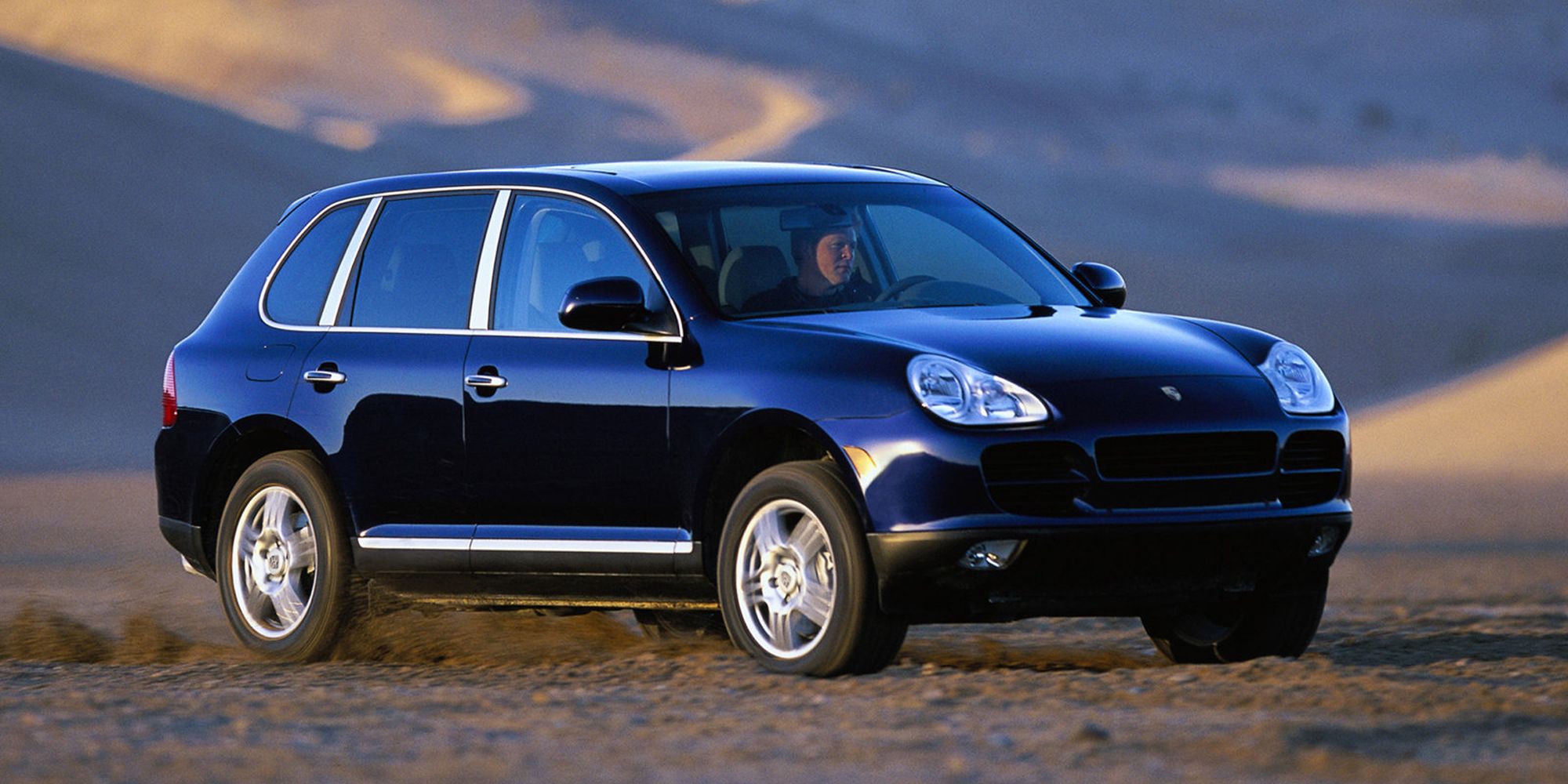
“You put that crane up there, it’s 1000 pounds, and you put six people inside the camera car, so now you’re talking a thousand pounds of people,” Marshall said. “Another 2000 pounds, then the active suspension just automatically puts the car back at its proper ride height.”
That same active suspension is what makes the car so adaptable as well, allowing it to eat some rough terrain when raised, or it can drop down and lower its center of gravity before hitting the tracks.
“You can just kinda haul into the corner and not have as much body roll. I mean, there’s still a ton of body roll, but [active suspension] will alleviate a lot of stuff,” Marshall said.
The Cayenne obviously isn’t the only sports SUV in the market that could do this, but others just don’t do quite as well. According to Jon, the Mercedes ML series (which was the Cayenne’s main competitor back in the day) isn’t as good in the mud, and the BMW simply isn’t as strong as the Cayenne, which has a full frame like a light truck instead of a unibody construction. Interestingly enough, even newer Cayenne’s don’t pass the test due to less room in the cabin for the camera crew, thanks to a smaller trunk and a steeper sloping roof line.

.jpg?t=163122206990)
And, while Jon admits that the Cayenne isn’t perfect in every use case, it’s still the right one for pretty much every use case.
“Of course you can’t beat a Raptor or a TRX with a crane on it out in the whoops, but the problem is everybody hates renting those things because […] it’s terrible on the street,” Jon said. “The Cayenne can go do a little bit of that work, and then it can come back out on the street, and it’s it’s comfortable and it gets that done. It’s the whole thing.”
When I asked them if there’s anything they could change about it for a future, dream camera car kind of build, Jon straight up said there’s nothing, purely because they have yet to find a single task that the car isn’t up for. I mean, these guys filmed a frickin’ Red Bull F1 car carving it through downtown San Francisco. Can you imagine a truck doing that?
There’s always a right tool for the right job, and sometimes that’s just an operator holding a camera, a tripod parked on a sidewalk, an FPV drone giving you nausea as it flips all over the place, and sometimes, it’s people like Jon and Marshall bringing their car to set. If that is the case, just look for the two in their first gen, matte black Cayenne, and take solace that your piece is gonna have some damn good looking shots put to screen.
“If I could buy a brand new ‘04 turbo Cayenne every year, I would probably buy one,” Jon said. “There’s nothing to replace it.”
To learn more about them and show love to our people at Galpin, you should really watch the video, linked again here. It’s worth it.
Big thanks again to Marshall and Jon for speaking with me and fsharing their cool rig. I’m unspeakably jealous of your toys.
Top graphic image: Galpin Media


Of course there’s the Huracam.
https://petapixel.com/2018/04/30/watch-the-worlds-fastest-camera-car-in-action/
The video is kind of painful at the beginning, but when they actually drive the Lamborghini at high speed and zoom the gimbal all the way out, it’s hard to believe how steady the shot is.
If you had hired 6 of me, the human poundage would have been 1320 pounds/600 kilos. But I’m an Emmy award winning photographer, so my mass would have been worth it. 🙂
All that said. the stuff you can do with drones these days blows away what we could with multi-million-dollar helicopters. At least in tight spaces. None of my drones flies faster than 40 mph. But it can fly in spaces where you can’t take a JetRanger or AS350. And I say all this as a guy who loves every second in a full-sized helicopter. I even charter them on vacation.
OTH, there was a stolen Hellcat car chase out of Houston about a year ago that was outrunning a Texas DPS AS350 on I-10 until the car ran out of fuel. But the FLIR gyrozoom kept the car in sight. I love flying in AS350s. Bell 407s are very cool as well.
The right tool for the right job.
The BBC used Citroën DS, CX and XM breaks as camera cars. Camera with sitting operator on the roof. The hydroupneumatic suspension resulted in smooth shots.
GMC Motorhomes have been used too, a very low chassis with an adjustable air suspension in the back. No body, but the chassis is very distinctive.
I want to know more about those tandem axle 70s/80s camera rigs! They aren’t BIG trucks (F-700/800) that would have been available with tandems. Look like custom 3/4 or one tons? Extra tag axle for extra weight? Or are they using the front 4×4 drivetrain only with some kind of lower frame in the back to get the CG down?
I remember several years ago you used to see a lot of camera crews using the w163 ml55 amg’s.
That was an interesting read.
I find it really hard to believe that the 2004 Cayenne is the only vehicle that can do a job like this.
I imagine there must be at least a few other big SUVs with air suspensions that can do what the Cayenne does.
A new Lincoln Navigator has much more power (450HP) than any 2004 Cayenne and if you equip them with the heavy duty tow package which includes an adaptive suspension that adjusts ride height (somehow achieving that without using an air suspension), I bet that would do the job.
And for something closer to the same size as the old Cayenne, there is stuff like the Lincoln Aviator. Equip it with the heavy tow package with the air suspension and it will likely do the same job. And it too has way more power (400hp) than any 2004 Cayenne had.
The Cadillac Escalade IQ and Lyriq could probably do the job as well… not to mention options from Land Rover, Stellantis, Toyota or Nissan.
Part of what they were saying is that it’s also just the image of having a Porsche, and I can attest to that thinking in my own life as a photographer. My fun daily camera is a Fujifilm Xpro3, and while it’s an incredible camera capable of pro work and Fuji definitely has pro lenses, clients won’t take me seriously if I show up with just that to shoot their national campaign. They want the look of a professional, so that means a full-frame Sony camera with a big white 70-200 2.8 on the end of it.
Plus, I’d venture to say rides like the Lincoln and Caddy are nowhere near as adaptable as the Cayenne and would struggle with track stuff in particular. Speculation on my end here though
Carmela Soprano changed the way I say ‘Porsche Cayenne’ forever
Well done Griffin! That was an interesting and fun read. I’ll have to catch the vids when I leave the salt mines
No mention of Range Rover? I wonder how that would stack up as I figure it has similar capabilities as the Cayenne, including active suspension, a powerful engine, good offroad capability but still good on road, large enough inside? I thought Top Gear used Range Rovers a lot, at least Ben Collins mentioned them for a lot of their shoots. Neither the Cayenne or Range Rover would be high on the reliability/repair cost list of winners though…
Maybe there are worries about a Land Rover platform not being reliable enough? But at the same time, I asked them about if maintenance costs are ever a concern when swapping to a German-made performance SUV vs a big American truck and they said that’s just the cost of doing business, so they don’t even think about it.
At that level, monetary cost of repair (parts+service) is less of a concern than predictability in failure rates. Maybe the Porsche is expensive to maintain but it tends to fail in predictable ways, whereas the Land Rover invents new and exciting ways to fail that render it too difficult to predict?
This makes a lot of sense. If you can replace a water pump every 60k miles, even if the service is expensive, it’s cheaper in terms of downtime (hundreds of crew on standby, location rental fees, etc) than a component that “should be lifetime” and can randomly either last forever or fail brand-new.
As a former Cayenne 957 owner, the interoperability between the Cayenne/Toureg/Q7 makes parts easier to obtain and (sometimes) cheaper.
Thanks for the insight, I understand why they chose the Cayenne over most any other option, (and I personally prefer the Cayenne over the Range Rover), it just seems like the range rover was the only other vehicle that might fit this niche use case and it wasnt mentioned at all. Like another commenter said, perhaps its more that the Porsche will fail, but in consistent ways that can be planned around with lots of (expensive) routine maintenance, while the Rover is just a roll of the dice with every drive?
A Cayenne is better than an RR in quality though. They are probably one of the few German cars that can survive the extreme climate in the Middle East. Porsche also has a lot of high mileage cars too.
A Cayenne naturally aspirated V8 doesn’t have as much issues as an RR. More reliable too, and the air suspension is not a fatal problem unlike the RR. Plus, it can go offroad just as well.
I hope to get a 1st or 2nd gen naturally aspirated V8 Cayenne into my dream car collection. Have been impressed with Porsche’s quality.
Top Gear/Grand Tour used to use Range Rovers without a crane, just a camera operator hanging out of the back.
Because they could keep the tailgate closed and still film, it entailed a lot less health and safety etc. than a vehicle with a fully open rear door, where everyone inside would have to have safety straps etc.
Although, if they’re going to the extent of strapping a massive crane to a Cayenne, I’m sure someone could develop a split tail gate for one too.
Talking about Nicole Kidman, my favourite automotive Nicole Kidman scene: https://youtu.be/o3h6A_uTGrc?si=Y9bDCDvTcpDp6fGJ
KIDMAN AND THE ICEMAN!!!
I’m starting to believe the current trend on the Internet that says civilization peaked in the early 2000’s.
Yup…2002 through 2012 or so was quite nice. 2018 may have been the last of it.
Well – that is the era “The Matrix” emulated… Personally I feel peak car reliability is 1995 to 2010 or so. OBDII but pre-forced induction and IT integration.
Look no further than the song Grindin and Simon Says for further proof of that theory.
Civilisation peaked sometime around your early teens. Just at the time you were getting more freedom to go out into the world, but before you really had to worry about things like taxes or rent. That was also the best era for music.
Of course, this means it was different for everyone, but your friends (who are probably about the same age as you) will agree with you.
Ok, that’s a generalisation, but I bet we could take a good guess at people’s ages based on the time period they think was ‘peak’.
Obviously though, it was the 90’s.
I see what you mean and would generally agree. Like you, I had my early teens on the early 90’s.
Hovewer, I sincerely believe the world was generally better before social media, u fill more or less 2005 or 2006. Basement trolls stayed on the basement, friendships were less about splitting hairs and more about finding common ground, and more importantly, outrage wasn’t monetized.
I do wonder, do we get a cottage industry of Cayenne specialists in a handful of filming-friendly cities, or at some point does the industry move on to something else as the supply of first-gen Cayennes dries up? Range Rover Sport feels a bit like the current offering most suited to fill in (quick and sturdy in some capacities), but I don’t know if I’d want to trust one for work.
The fact that they aren’t happy with current-gen anything, Cayenne’s included, makes me think they’ll do all they can to keep Gen1s alive as long as possible. That or maybe they start doing their own bespoke bodywork on new rides?
All the camera cranes love mid 2000s vag products. It seems like Land Rover Discovery had a moment as follow cars. I suspect the Chinese will start attaching cranes to su7 or the like and that will probably be the next benchmark.
The modern big Bronco may suit as well.
Several years ago I watched one of these go around and around the block in downtown San Diego (East Village), shooting footage of some new Hyundais or Kias, probably for a TV commercial. Very cool to watch while sitting on a restaurant patio having my breakfast.
I’ve also seen some of these black Cayenne camera rigs in San Diego. Once was going up and down the big hill at Torrey Pines, filming stuff for the newly introduced GMC Sierra. I’ve also seen them banging around San Fran at 3am around the Moscone center chasing a then new Hyundai Sonata (that was my first sighting of that big redesign)
Your first movie was working for Spielberg?! Jesus, man. Who directed your second, Orson Welles?
I know I could look it up but you know you’ve been lucky and we’re impressed so we’re square here.
Close second to Orson Welles! Second was Sam Raimi. Surely those names are always uttered in the same sentence, right?
Wow again, so now I’ve had to check the IMDB and not only did you get to work for Sam Raimi, you got to work on a Marvel movie–AND STAR WARS! We’re lucky to have you here. Mad props.
Thanks, AssMatt! Had a great run, but being around here is definitely more my speed.
Although I will say: holding a real-life lightsaber, seeing an X-Wing in person, and being on a sound stage when the Volume LED screens put a ship into lightspeed was pretty frickin awesome.
Pretty damn certain the Cayenne is not body on frame…
yeah save me before i go down a rabbit hole here- i thought the ML was BOF
As posted by Ultradrive a few comments down, it was a ‘uniframe’ setup like the XJ
“Engineers first looked at the traditional solution for an off-roader, which is body-on-frame construction. Porsche’s other option was a unibody. The engineers saw advantages in both and thus, decided to make the Cayenne and the Touareg utilize a unibody with an integral frame structure. Porsche found this setup to be the best for rigidity and the reliability of components.”
I think that is pretty arguably still 100% a unibody. Front and rear suspension are still connected via subframes, “frame rails” are an integral part of the structure with no isolation.
It’s just a VERY strong unibody.
Should’ve fact checked that one, my bad.
A body on frame Cayenne would be pretty darn cool though!
And why do we get a picture of a X3 instead of a X5? 🙂
My Porsche guy in Manhattan Beach maintains the Cayenne camera cars (or at least the local ones). Got to see one up close and personal one day. It looks like something straight out of a Mad Max movie. He said the same thing: there isn’t another vehicle that can take that kind of punishment like the 1st-gen Cayennes.
My ’04 S has 150K and feels like new. As Ppnw said, they really over-engineered these things. The “unibody” is actually a “frame within a unibody” design. Supposed to combine the best of both worlds. The thing feels unbreakable.
https://www.theautopian.com/porsche-made-a-hardcore-off-road-suv-with-big-v8-power-a-big-tow-rating-and-just-three-had-manuals-holy-grails/
It’s such a shame how at the time they got saddled in popular imagination with the trophy wife Porsche stigma. But, like the Miata, enthusiasts knew.
Yeah, plus the fact that the design was, uh, “polarizing” at the time. I think it’s aged very well though. Enthusiasts are definitely catching on to how good they are. When we bought ours, we needed a bigger car to tote around the doggo and we had an air-cooled 911, so the Cayenne was a natural choice. It has genuinely exceeded any expectations I’ve had of it, and it’s been my longest-owned car by a long shot (will be 12 years next year). I cannot see me getting rid of it anytime soon, if ever. The Porsche Tax is real though when it comes to parts and service. The good thing is that they are actually pretty DIY friendly, and a great excuse to finally get a proper torque wrench. Changing the plugs and coils on the Cayenne was much more enjoyable than on the Stelvio, even though there are twice as many.
Great story – you’re like what Porsche pitches in its advertising, but for real.
And the plugs are probably super easy when compared with the 911’s, right? 😉
There’s at least three in NYC. Saw three of them doing a single take on fifth avenue a couple of years ago.
Suspension has been a consideration for years. Claude Lelouch filmed C’etait un Rendezvous with his Mercedes 450SEL 6.9 instead of a Ferrari because the Mercedes’ air suspension made it a smoother camera platform. Hydropneumatic Citroëns were also used as camera cars for the same reason
Citroens like this one;
https://www.youtube.com/watch?v=EQA9FiqKct8&t=347s
I was about to say the same. A Citroen DS was the perfect camera platform car in its day. Hydrodynamic suspension plus the rigidity of its revolutionary-for-the-time safety cell construction pulled it all together.
And yet some of the best racing footage was shot for John Frankenheimer’s 1966 movie “Grand Prix.”
Much of it was shot from from a lightly modified (bodywork removed, camera mounts added) Ford GT40.
My kind of camera car!
And didn’t McQueen later reuse that rig for Le Mans (which also has outstanding footage, perhaps to make up for its even more stripped down plotting).
I think so. Pretty sure a similarly outfitted Porsche 917 was used as well.
I think the McQueen film has exactly the right amount of plot. Any more would just mess it up.
This is true – you watch Le Mans for the racing and McQueen staring stoically at things, that’s it. I challenge anyone to name even 1 other character.
I still need to watch that one, especially after the F1 movie which clearly took it’s shot inspirations from GP. My hand has hovered over the “buy now” button on a Blu-ray combo on Amazon for a year now and idk why I don’t just send it.
You definitely do! The plot was on the hokey (and predictable) side, but the racing sequences were amazing, especially in those pre-CGI and pre-AI days.
I’d say you should see both. The drawbacks are similar, but the cinematography was spectacular. What’s more, both Garner and McQueen knew what racing was all about, and never let the films go over the edge.
The Porsche 908/2 spyder that was used as the camera car for LeMans completed 282 laps in the race despite having to pit many times to change film. I think a roll of film would just barely last a lap
If it had been an actual entry it would have placed sixth.
I love the first gen Cayenne. Porsche were really aware of how good it needed to be for the “sacrilege” of an Porsche SUV to be well received.
It was completely over-engineered in the best way. People are doing amazing things with them these days and they seem pretty bulletproof.
Cool story. Don’t know what they are talking about “full frame instead of unibody”. The Cayenne has always been a unibody vehicle sharing a platform with the Touareg. The first two generations were unique to the Touareg/Cayenne/Q7, but they moved on to the MLB architecture.