

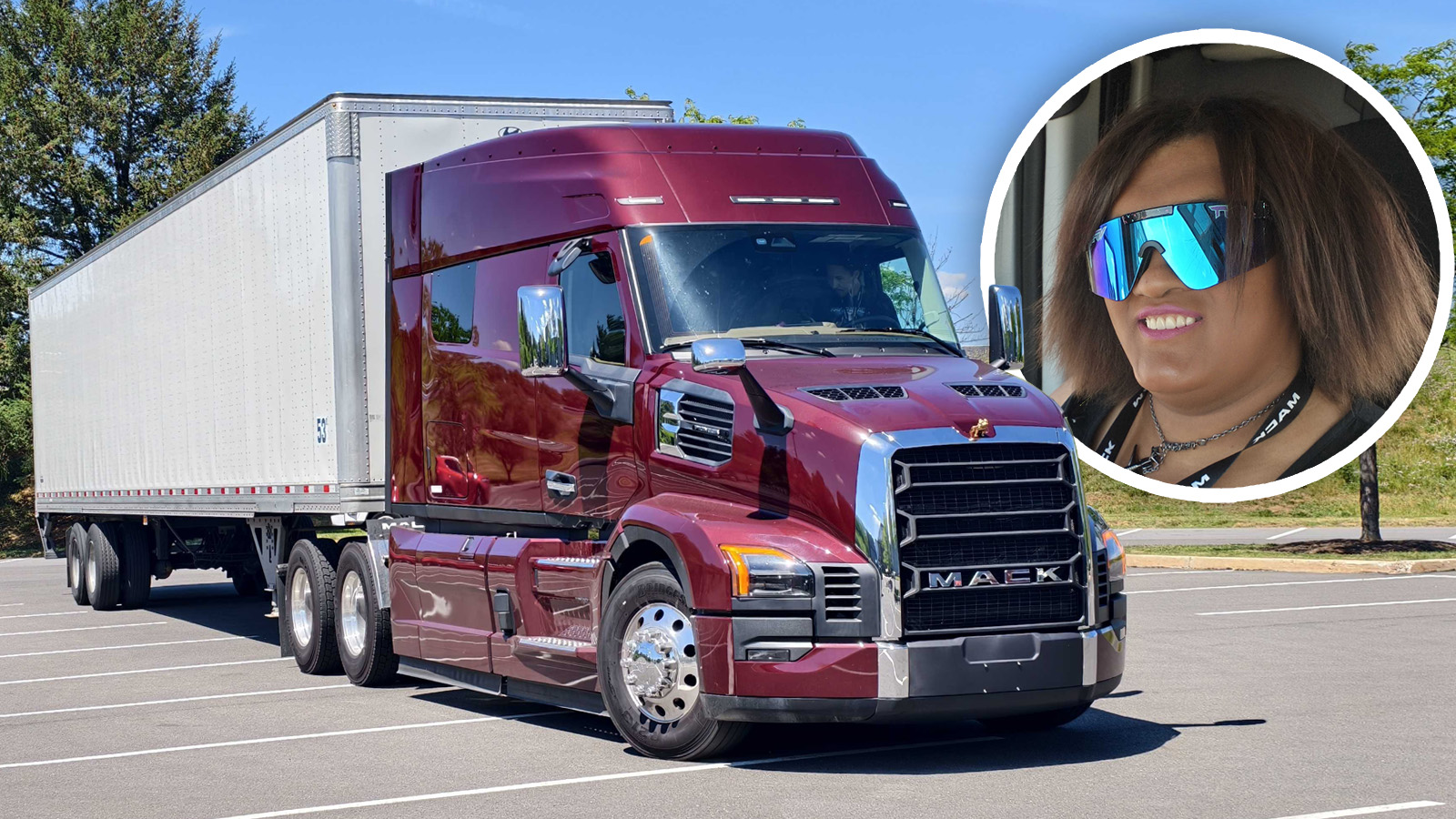
There are roughly three million semi-tractors registered in America at any given moment. These big rigs are a critical part of the backbone of modern society, yet the closest most people will ever get to one is on the highway. I have long wondered what it would be like to take the wheel of tens of thousands of pounds of American logistics muscle. Now, I have achieved my dream by taking Mack’s latest bulldog big rigs around a test track, and I’m totally in love. I’d now rather drive a semi-truck over any sports car.
The modern semi-tractors that we share the road with are marvels of engineering. Every inch of their bodies serves a practical purpose, and everything beneath the paint has been optimized to make the best of a load while providing drivers with a comfortable office to work from. An over-the-road driver can easily clock in more than 100,000 miles behind the wheel in a year, so these rigs have to be reliable, durable, and fatigue-reducing.


Yet, they’re also massive beasts, with the average semi-trailer setup coming in at around 70 feet long and up to 80,000 pounds. In some cases, like Michigan, you can even see rigs weighing twice that. Aside from having wheels and a drivetrain, your car is as similar to a semi-tractor as a Cessna 172 is similar to a Space Shuttle.

The heroes who drive these rigs have to know what they’re doing and maintain a Commercial Driver’s License. This would normally lock a regular person like me from ever getting behind the wheel of one of these trucks, but I recently got a unique opportunity to play with some Mack Anthem semis on a private track. While I didn’t get to haul a trailer, I did get to scoot around an oval track, do a hillclimb, avoid some obstacles, and even win two drag races. I still haven’t stopped smiling.
(Full Disclosure: Mack Trucks invited me out to Allentown, Pennsylvania, to check out its Experience Center as well as take a ride and drive in its latest rigs. Mack paid for my travel, lodging in a vintage hotel, and food that included a crab omelette, the best breakfast I’ve ever had.)
As I’ve mentioned in a handful of recent articles, one of the dreams that drives my enthusiasm for vehicles is the desire to take command of as many different types of them as possible. Before Father Time takes my license away, I want to have operated innumerable cars, motorcycles, trucks, planes, boats, trains, and everything else. I want to fly a Boeing 747, drive a large ship, drive a garbage truck, race a Smart around the Nürburgring, pick something up with a crane, and more.

I have made great progress. In my time since starting this writing career, I have operated two school buses, a transit bus, a Cessna 172, an Extra EA-330 (above), an Alco RSD-5, a Sea-Doo Switch, a Sea-Doo RXP-X 325, and more cars, pickup trucks, and motorcycles than I can reliably remember. Yet, somehow, despite writing so many articles about them, I have never even sat in the driver’s seat of a semi-tractor.
This is especially weird for me because I spent some considerable time riding shotgun in my dad’s Freightliners when I was a kid. My dad used to be so much into trucking that he even included the previous iteration of me in the name of his business: Streeter & Son Trucking Co. He drove a little bit of everything from local and regional freight, tankers, and over-the-road. One of my earliest memories was riding in the cab of his black Mack as we crossed a bridge in the New York City area.
I had to rectify this oversight, and the lovely folks of Mack Trucks gave me just that opportunity.

Mack Takes Aim At Long-Haul Trucking
Last year, Mack Trucks, a subsidiary of Volvo Group, had its biggest launch in a long time. The new Mack Pioneer long-haul truck and Mack Anthem regional-haul truck are Mack’s first ground-up designs in years, and both have an important mission. You, like me, might have noticed lots of Freightliners, Volvos, and the like dominating in over-the-road roles, while Macks are often used for vocational duty. Indeed, Mack held only a two percent share of the Class 8 OTR market in 2025. Mack wants to change that, and is doing so by pulling out all of the stops.
Just in time for its 125th anniversary in 2025, Mack came out swinging. The Anthem and Pioneer began development in 2017, and according to Blake Routh, Mack’s senior product manager, the trucks were designed around the driver first. Long-haul rigs are basically a home away from home, so the comfort has to be just right or else drivers won’t want to be in the cab.

Mack put a lot of work into the cab. The Pioneer and the Anthem feature cabs that are nine inches wider than previous-generation models. That extra space is filled with seats with wider and taller frames. In a first for Mack, those seats also have integrated armrests.
Those armrests might sound like a tiny detail to a car owner, but they can be a big deal in a truck. In a semi, the seats ride on air, which helps separate the sometimes harsh movements of the cab from the butts of the driver and passenger. But this also means that the seats move up and down, which could be uncomfortable if you’re resting your arm on the door’s armrest, which doesn’t move with the seat. By adding two armrests to the seats, your arms can now move with the seat.

There are other niceties, too, like seat heating, ventilation, and massage. Then there’s the sleeper, which towers as high as 76 inches. Truck sleepers are like mini RVs, and what’s in the back of the big Mack is no different. What’s new this time around is an all-electric auxiliary power unit (APU). Normally, truck APUs tend to be small diesel engines that work like an RV’s generator, providing electricity and climate control when the truck is parked. Mack designed an APU that feeds from six massive AGM batteries, which are said to be able to provide frosty air-conditioning for eight hours in triple-digit temps.
Then there’s all of the driving tech, like blind spot monitoring, automatic emergency braking, adaptive cruise control, traffic stop and go, lane-keeping assist, oversteer guidance, pedestrian detection, airbags, and more.

Mack then went hardcore on aerodynamics outside, giving the Pioneer and Anthem lots of neat touches. The aero-optimized hood features a reinforced fiberglass plastic grille with metal-formed mesh. The fenders are low and sweeping with integrated headlights.
The windshield has a rake as aggressive as the rest of the roof. Even Mack’s iconic bulldog hood ornament has been tweaked for better aero.

One of my favorite tricks with the exterior is the headlights. One of the potential issues with LED lighting is snow buildup, since LEDs don’t naturally get warm enough to melt the slush. In the past, headlights had wires embedded in the lenses, which looked a bit ungainly. For these new lights, Mack’s headlight warming system blows hot air onto the lenses.

The Pièce de resistance of the new truck’s aero design is Mack’s first-ever implementation of digital mirrors. By installing cameras on the exterior, Mack is able to cut its physical mirrors down to half their size, which yields a one percent fuel efficiency advantage. Mack says that the new design is eight percent more fuel-efficient than previous trucks.
Power comes from a Mack MP13 12.8-liter straight-six diesel with 395 to 515 HP and 1,550 to 1,950 lb-ft of torque on tap. This engine is bolted to a 12-speed automated-manual mDRIVE transmission. Mack says this powertrain is three percent more efficient than before, making the Pioneer up to 11 percent more efficient than Mack’s previous-generation trucks. Sadly, for those of you who like manuals, a shift-your-own transmission is not available.
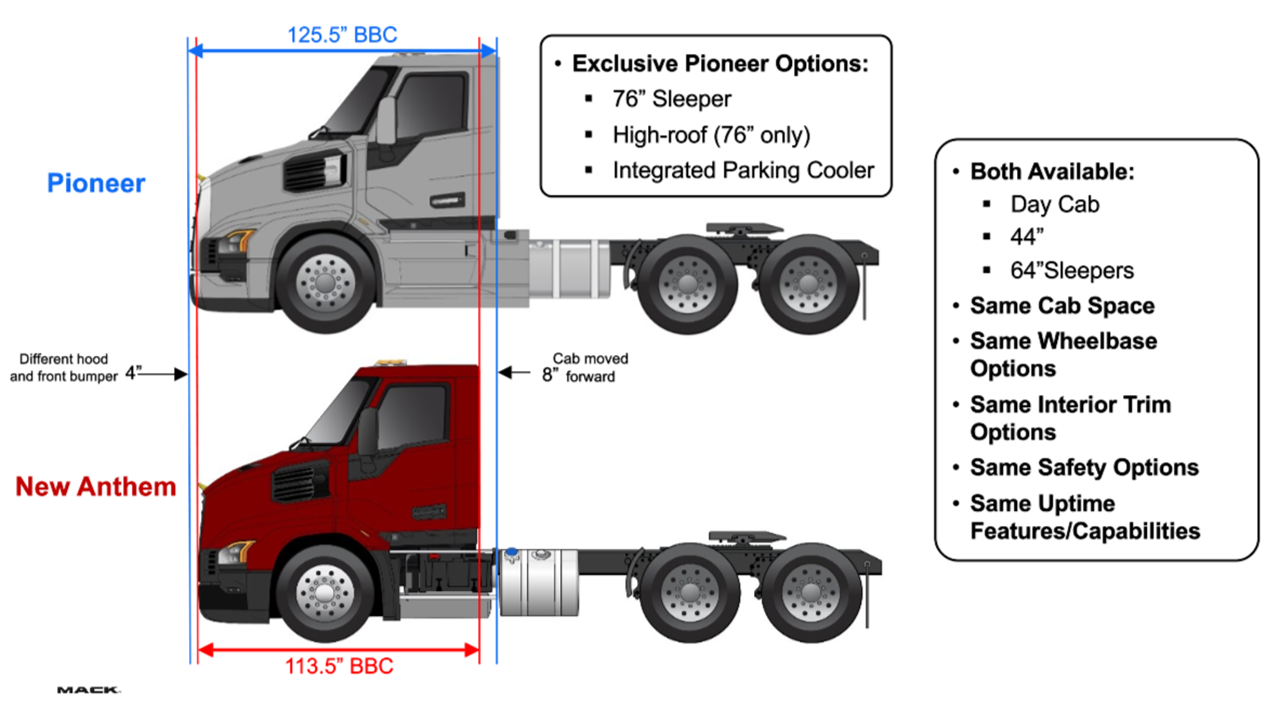
The Pioneer and the Anthem are essentially the same truck. They’re both available with the same wheelbases, the same engine tunes, and the same cab. Their interiors are even the same. Instead, their differences are more subtle. For example, only the Pioneer gets the 76-inch high roof sleeper and APU options. The Pioneer also has a 125.5-inch bumper to back of cab compared to the Anthem’s 113.5 inches. How did Mack achieve that with trucks that are otherwise the same? The Anthem’s cab is set eight inches forward, and that truck’s distinctive hood and bumper shave off another four inches.
These changes in the bumper and hood mean that the Anthem has an up to 10 percent efficiency improvement compared to the Pioneer’s up to 11 percent gains. These gains are a big deal. Mack doesn’t mention actual fuel economy, but let’s say that you have a truck that burns 15,000 gallons of fuel a year. An 11 percent gain in efficiency means saving 1,650 gallons of fuel per year. That adds up quickly, especially if you’re running a fleet.
Two Trucks, One Goal

Since these trucks are largely the same, you’d probably wonder why Mack split one truck into two models. Well, the Anthem is pitched as the one for visibility and maneuverability, as the short, steeply raked hood increases what you can see. The Anthem is also said to be the one for payload. Meanwhile, the Pioneer is pitched as the one for serviceability, comfort, and fuel economy. While the Pioneer is the dedicated long-haul truck of the pair, Mack does say the new Anthem could be used for the job, too.
These trucks come during a rough period in trucking. Much like RV sales, big rig sales skyrocketed in the immediate aftermath of the COVID-19 pandemic. Then, sales entered a slump. In 2022, the trucking industry moved 309,615 Class 8 units. In 2024, that number was 330,168 units. Last year, the industry moved 208,155 units.
What gives? The government was a huge part. Tariffs mean that the raw materials to build trucks are more expensive, and parts that aren’t built within our borders are more expensive on top of that. Then, the U.S. Environmental Protection Agency got an overhaul, and some fleets waited to see what was going to happen with NOx and fuel efficiency standards. Inflation has also held some outfits back from ordering new rigs.

If all of that wasn’t enough, freight demand and rates have also generally been lower in recent times on top of higher prices for fuel and insurance. Many trucking companies have been struggling just to stay open, forget trying to buy new equipment. Many smaller trucking companies simply haven’t been able to survive.
Perhaps, then, it’s unsurprising to learn that, like the average American car, the average semi-truck is getting older, too. Volvo says that the average age of a Class 8 tractor in America is between 8 years old and 9 years old, and is getting older as operators are hanging onto them for longer. Many of those who are shopping for a Class 8 truck are buying used rather than new.
Yet, to Mack and its parent, Volvo, now is the perfect time to launch new flagship trucks. Those who held onto their rigs through the pandemic may enter the market as their trucks well exceed a million miles. Volvo and Mack want to be the destinations for those shoppers. As such, the Mack Pioneer and Anthem, which can cost over $200,000 for high-end versions, were designed as part of a $2 billion investment project for Volvo and Mack.
So then, how are they like?
Not Your Father’s Semi

Mack started our day at the Experience Center with a tour of the on-site museum. While the museum is on Mack’s property, it is funded and run by a separate non-profit educational organization staffed by Mack historians and experts. I’ll cover the museum in a different piece, but what you should know is that it’s incredible. There’s a little bit of everything in there, from some of the earliest and rarest Mack trucks to a preserved dyno chamber that was used to durability test real trucks.
After the museum, I climbed into the cab of a Pioneer, and a driver took me for a ride down the highway. What immediately blew my mind was how quiet the cab was. Back in the day, it was hard to hold a regular conversation in the cab of my dad’s old Freightliner because we were bombarded with engine noise and wind noise. Here? It was barely louder than the interior of a car.

The ride quality was also another standout. Mack says that it redesigned its air suspension for the Pioneer and Anthem. Combine that with the air seats, and I felt rather comfortable sitting on thrones in the cab. Again, it’s a far cry from what I used to ride in, and honestly, way more comfortable than the Recaro air seat that’s in my bus.
I won’t say that it rides like a car, because it doesn’t. You’re still very much in a big truck, and the ride is rougher than pretty much any passenger vehicle I can think of. Hit a pothole big enough and the whole truck will shake around the air seats. But between the quieter cab and the supple seats, I can see some truckers putting down some serious miles in these things.

I was also impressed with the digital mirrors and the blind spot monitors. The monitors caught a pedestrian walking up the side of the trailer, and the digital mirrors gave a pretty clear view of what was on the side of the truck. Normally, I’m not someone for adding more screens into a vehicle, but I like these. As a bonus, if the screens ever fail, the truck still has real-deal physical mirrors.
The ride in the Pioneer was only about 30 minutes long, and I had a blast. But even better was moseying over to Mack’s test track, where a trio of Anthems awaited.
Like A Kid In A Candy Store

Mack’s test track includes a three-quarter-mile oval, a hillclimb section, a section with a tall drop-off, and a side area that features obstacles like a fake car, a cobblestone road, and railroad tracks. That side area is also just long enough to host a drag race. I challenged Erin Marquis from Jalopnik to a best-of-three drag race over there, where yours truly won. But you’ll have to read about the experience of drag-racing a semi at a later date.
Stepping into the Anthem was an entirely new experience. First, I dumped the air out of the driver’s seat to make it lower for me to get in. Then, I climbed up the steps, much like I’d get into a diesel-electric locomotive. Once inside, I commanded the seat to inflate itself, then I used a foot pedal to use the air system to make seemingly infinite adjustments to the steering wheel.

Once I was all settled in, I felt like I was in the flight deck of an airliner. There were switches as far as the eye could see and seemingly gauges within gauges. Yet, just getting the truck moving was fairly intuitive. I released the parking brake, then rotated the gear selector into Drive. Then, it was all ready to rock.
Setting off was entirely uneventful. I gave the throttle a hit of my size 10 slip-on, and the Anthem gradually left the station, with its straight-six singing the glorious tunes of diesel power. Each gear came by quickly, as the automated-manual went from first to second, to third, to fourth, to fifth, and so on. Each gear was short, and speed didn’t really start coming on until seventh gear was locked in. Of course, these trucks aren’t built for speed, so I wasn’t expecting to take off like a rocket. What was amusing was how quickly the transmission shifted. I swear that the big box in this big rig shifts faster than the automated-manuals bolted to my Smart Fortwos. That’s equal parts amazing and sad on the Smart’s part.

Once I got to Mack’s test track, I was let loose, provided that I didn’t exceed 50 mph. Alright, so I went exactly 50 mph. I was immediately amused by the Anthem’s cornering performance. It didn’t want to take turns in a hurry – it’s a towering truck, after all – but it did take the corners almost perfectly flat. I’m told that’s a part of Mack’s new suspension tuning, as customers didn’t like their rigs leaning over when turning.
On the course, I found it alarmingly easy to keep the big Mack under control. I had a flat-bottomed steering wheel in my hands, steering boosted enough that you could probably turn the thing with a single finger, and easy, predictable brakes. The compression brake, which is operated with a flick of the gear shifter stalk, is also neat, offering up to 630 HP of braking power for downgrades and stopping. Within minutes, I found myself getting rather comfortable, which I honestly didn’t expect.

Mack’s course for the journalists included going up a steep grade and stopping on a hill, showcasing the truck’s auto brake hold and the engine’s torque. Oh yeah, the truck was a torque monster, alright. The truck also had a handful of performance modes, from the smooth and easy-shifting Economy mode to Performance, which, like a car’s sport mode, lets the engine and transmission run wild.
We also intentionally drove off one of the steep curbs, which demonstrated the stability features baked into the truck. This test was relevant to me because, one time, I was run off the road while driving my transit bus. The steering wheel tried to rip itself out of my hands when I hit the curb. Here? The Anthem was entirely unbothered with its brief departure from the road.
Then, we came up to an emergency braking test, where, every single time, the truck stopped itself before the fake car without any intervention from me. Now, automatic emergency braking isn’t new, even in semis, but it still feels so weird to watch and feel a truck that’s nearly 20,000 pounds safely stop itself.

The rest of the demonstration involved driving over a cobblestone road, which I hit as fast as possible to generate maximum chaos, a simulated railroad track crossing, and a U-turn. The cobblestones indeed caused hilarious chaos, and the air seat softened the blow very well. We also got to test out Mack’s neat slow driving cruise control function, where you could tell the truck to drive a constant single-digit speed to ease fatigue while driving in super heavy traffic.
A few things blew my mind from the drive. The first was that the tech that some take for granted in cars works even better in modern big rigs. The pedestrian and blind spot detection systems seem genuinely helpful. I know of some car blind spot systems that don’t even illuminate for pedestrians! I think this tech is worthwhile if they prevent even a single death of a pedestrian or cyclist. The auto brake hold function was handy, as were the tricks of the cruise control.
The trucks even have a predictive cruise control. The onboard systems know what you’re loaded down to and use the satellite mapping of major highways to know when there’s a hill coming and the optimal gear to climb it in. Then, the truck will proactively shift into that predicted gear and climb the hill, aiming for the most efficiency. On the downslope, the truck will then know how to coast most effectively to save fuel.

Of course, the automated-manual transmission also meant that I didn’t have to do any double-clutching or master a 12-speed manual. I just had to get in and let the truck do all of the work. Even the compression braking system is automatic. Admittedly, I was somewhat sad about the lack of a manual, because I’ve long wanted to learn how to drive an old-school truck transmission.
A lot of what Mack put into these trucks isn’t particularly novel. Automatic transmissions have been in trucking for several decades. Volvo introduced its I-Shift automated-manual in 2001. Digital mirror cameras have also been around for a while, too. Of course, dramatic aero has been a thing for several decades, too. Mack claims a couple of industry firsts, including the industry’s first flat-bottom steering wheel and a patent-pending ELD mounting plate.
What’s big is that Mack, which is usually more known for vocational trucks, baked all of these features and more into a long-haul truck. Mack is clearly serious about upping its share of the long-haul Class 8 market, and from what I’ve been told, it’s working. The company hasn’t released sales data, but tells me that its order books are full and its factories are busy.
I Pulled The Horn So Many Times

For me, it’s a dream come true. I’ve always wanted to pilot a big rig ever since I was a kid, and now I did it. I even pulled the air horn! Driving a big truck is far more fun than any sports car, even my own Mazda MX-5 Miata ND. I’d rather drive a big Mack over many cars and pickup trucks. It’s just that fun. My only regret is not doing it sooner.
This event also gave me a better appreciation for our nation’s truckers. Each and every day and night, these people are commanding mammoth machines across America, delivering everything from cars to Amazon packages so all of us can continue to live a modern life. It takes some real skill to do that safely for millions of miles. So, hats off to the trucker, who maybe doesn’t get the praise they maybe should.
At any rate, I’m addicted. I can’t wait to figure out some way to get into the cab of a truck again. In the past, I said that I want to get a Class A license, but now I have to get it. I need to get my next big truck fix. I have to pull a trailer next time, too. This will be one of a handful of stories from the Mack event. I still have to tell you about the drag race!
Top graphic images: Mercedes Streeter





Mercedes mentioned air seats and how they bounce up and down in relation to the steering wheel. The entire cab also is suspended so there’s two levels of suspension.
I think steer by wire could have an interesting side benefit that a company could move away from a fixed steering wheel. With steer, brake, and accelerator by wire the driver could have all their main controls suspended along with the seat and get rid of the relative movement.
Growing up, I thought split shifting seemed like a lot, but my dad assured me it was actually simpler than it seemed. I never had enough interest to actually get good at it, but he was right. I bet you’d pick it up really easily if given the chance. You could probably ask around at the CDL schools and give it a whirl in exchange for a little write-up about the school.
Personally, I think those auto-manual transmissions are kind of cool. I’d love to try driving one of those one day. I’ve known a couple of people who drive them, but not own them.
Split shifting – a two speed rear frequently found in HD straight trucks – is harder to master than a crashbox.
OK, I know I’m being picky here, so massive apologies in advance, but this sort of thing bugs my weird brain. I had to read this a number of times before my brain could figure out what was meant. Again, apologies, but…
“…a semi-tractor is as similar to your car as a Cessna 172 is similar to a Space Shuttle.”
This is the classic analogy structure:
a : b :: c : d
In such structure, “a” and “c” should relate conceptually, and “b” and “d” should do the same.
Therefore, in this analogy, the semi-tractor relates/compares to the Cessna, while the car relates/compares to the Space Shuttle.
This is saying the semi-tractor is simple compared to the car (huh?), as the Cessna is simple compared to the Space Shuttle (obviously). Either that, or it’s saying the semi-tractor is much more complex than a car (obviously) as a Cessna is much more complex than the Space Shuttle (huh?).
I’m guessing that’s not what was meant.
Again, forgiveness is being asked for here, but it would have eaten me up inside if I didn’t write this out.
That definitely looks like a fun and comfortable ride though!
Let the flogging I know is coming commence!
Well, once you pointed it out I see what you mean…I’m guessing it should be:
“…your car is as similar to a semi-tractor as a Cessna 172 is similar to a Space Shuttle.”
Absolutely. My eye just got caught on this way too long because of the mixed up way it was written. I eventually got the intent, but there was some confusion along the way!
Dagnammit. There’s always one. I mean, you’re 100% correct, but now I can’t undo what I’ve seen. Good spotting!
Soory! I was quite confused, thinking “there’s absolutely no way it’s much simpler to drive a semi than my car!” before vacillating to “Oh, wait, was the Space Shuttle really that simple to fly???” Thanks for understanding!
You were in Allentown….I can’t believe you came out this way and didn’t even stop in for coffee (!) But seriously, glad you had the experience and also glad that Mack is still a vital force in the Lehigh Valley.
Yeah, Geez! I’d have had you over for steaks or a BBQ. I’m less than 10 miles from the Mack center. Very cool place.
Did you get the chance to drive an electric Class 8 while you were there.
Last year my department went out to our test facility and did a drive even with our onroad Class 8s. Both diesel and electric with fully loaded trailers. The diesel was easy to drive but the electric took it to another level. So much quieter and just a steady smooth torque curve without shifting gears every few seconds taking off.
I can see why the drivers that have them on city routes love their electric trucks.
I’ve seen some interviews with drivers testing the Tesla Semi on long, steep downhill grades. They all universally get their minds blown! The truck just maintains steady speed effortlessly, and the driver doesn’t need to worry about overheating brakes, downshifting, or a compression brake. On top of that, sometimes the battery SoC will increase if they’re traveling downhill for long enough.
Then, on the way back up, it effortlessly keeps up with traffic regardless of how steep the grade is.
Welcome to some of the many benefits of electrification!
I dunno, Mercedes. I mean, probably most people can learn how to drive one of these large tractor-trailers with enough training…but you probably possess a natural aptitude for driving large vehicles that most people do not.
Either way, this is neat!
Maneuvering the long trailer in traffic is much harder than a semi without a trailer (bobtailed). That, and – at least in a battered old Mack – you have to get used to the fact that NYC cabbies won’t cut you off.
Haha, for sure. My ex was a trucker and I used to spend time with him in the cab. In New England, no less. We didn’t go through NYC, but got pretty close.
Hey Mercedes, on the subject of using every mode of human transportation, have you ever sailed a traditional wooden boat? Leo Sampson has been running a Youtube series for years now chronicling his complete rebuild (and these days sailing) of a 100+ year old race-winning boat called Tally-Ho. He’ll be around the East Coast of the US soon and you might be able to catch him in port or possibly even go on a leg of his journey. The build is mind-boggling and Leo is a great guy, I’m sure it would be a good story.
There’s an overview video of the project here: https://www.youtube.com/watch?v=dLjNRI2KtbY
As a die hard long nose Pete and Kw fan, it pains me to admit this, but Volvo makes the best truck in the industry. That being said, the Vnl looks like it was styled by a drunk AI. It is seriously ugl. So having an option of the Mack, which is a Volvo in a slightly more attractive bulldog suit, is a godsend. Im seriously considering a Pioneer. The comfort, fuel efficiency, and tech is hard to ignore.
And now you understand why I miss working on big rigs so much. Buses pay my bills, but I miss trucks SO MUCH.
My fav test drive ever was an International Lonestar with a Cummins ISX and an 18 speed.
We suspected a flaky ECM, so we swapped out our test ECM. Which was a 600+hp tune with no speed governor.
We all took turns test driving that thing and menacing cars on the highway. You could draw it down to idle in top gear, then just mat the throttle and the whole chassis would twist and just take off.
Over 2000ft.lbs of torque when you’re bobtailing gets you moving in a hurry.
Love a good torque monster. Especially when you dust a tiny little brodozer and make them cry
My buddy’s big block Chevy is very good at that. Especially on the big road.
Over 2000ft-lbs of torque with 600HP will get anything moving in a hurry, empty or not. 🙂
My newest addition to the garage is a 2005 Monaco diesel-pusher motorhome that got upgraded to a 600HP ISX15 in its previous life. With that much horsepower behind the twist, it just never lets off. It takes “able to pass anything but a fuel pump” to a whole new level.
I know a lot of folks dunk on motorhomes and RVs, and with valid reasons. Build quality is all over the map depending on builders, and many motorhomes — even diesels — are underpowered. This particular one is a full “integral” coach — no separate chassis; just a full unitized structure with subframes front and rear for the suspension and engine/transmission cradle. Effectively built like a slightly scaled-down MCI/Eagle/Prevost. Stable, smooth-riding on a tag-axle setup like the big coaches, and quite capable of handling the power.
Great article, enjoyed it!
“I swear that the big box in this big rig shifts faster than the automated-manuals bolted to my Smart Fortwos. That’s equal parts amazing and sad on the Smart’s part.”
I have driven second gen Fortwos. That wasn’t a particular tall order to clear… 😛
I once had the chance to pilot a Volvo truck around their track in Sweden. I agree, it’s shockingly easy.
i have rarely seen the gold bulldog on the hood, designating it as 100% mack. usually its the silver meaning theres been tweaks. on another note, the next obvious step for you down this rabbit trail should be…
https://www.youtube.com/shorts/e2PkuoKkYEw
Honestly, I think you will see more gold bulldogs on newr macks. All the truck manufacturers are going to proprietary tech. Which makes mixed fleet ordering very difficult, which makes fleet managers want to homoginize their fleets. So mission successful i guess
I’ve currently got a Mack medium duty EV on my lot. The bulldog and grille letters are copper colored.
Great job lady, knew you had it in you! But be careful, today’s automated trucks make it seem too easy to drive. The laws of physics are still in full force, and the latests and greatest software won’t slow the new trucks down for the posted at 25MPH freeway interchange loop that should really be taken at 20. Or worse yet, the long downhill grades that can turn even a half loaded truck into a downhill rocket that even disc brakes can’t stop. So next time you get in a big truck, practice downshifts and remember that unfamiliar corners should be taken at least 5MPH slower than marked!
Hear hear! I learned(and currently drive) on the old dinosaur trucks, and I am thankful every day for it. When I do drive an auto, my driving was improved over the auto only drivers due to having an understanding of everything going on in the drivetrain. That, and im so used to having no driving assists so when I get a truck with them, they are truly drivers assists, not a dire necessity to keep the truck on the road.
There is a reason a few of these are converted to RVs. The power and towing alone.
Full-size pickup trucks: Let’s make it feel bigger, so you can’t see anything in front of you.
BigRigs: Let’s make it literally smaller, so you can have better visibility & better manoeuvrability.
I can see better out of my long hood pete than I can out of my boss’s f150.
I believe it. When my dad was semi-retired, he drove for a bus company for a few years. He moved up from vans to actual busses and said the busses were actually easier to drive because the visibility and mirrors were better.
I put a bubble mirror on the hood of my 389 to compensate for the ginormous forward blind spot. Now I can see the ground in front of my bumper. Combined with the high seat, I have visibility comparable to the new mack. Meanwhile the f150 is a pillbox. Makes me nervous
This is a strange thing. Light duty trucks are trying to look bigger while Class 6 to 8 trucks are doing a lot of work to increase sight lines.
That said – the last vocational truck we worked on we did spend a lot of time to make the hood more rounded for better aero and better sight lines. The dealers threw a fit – complaining that they needed a more horizontal hood and accessory stacks. a couple guys went on and on about how they were losing sales because we didn’t have 8 inch accessory exhaust stacks. (Stacks are completely for looks today – they are not functional at all). In the end we ended up making another hood option that was more square and horizontal – but they didn’t get bigger stacks as we were already at the maximum vehicle width.
I worked for a towing shop in college and would sometimes drive a Ford LN-9000 wrecker, with a Detroit 8V71 and an 18 speed road ranger. It had none of these amenities. Didn’t even have power steering or AC. That thing was a chore to drive.
Congratulations. Are you already looking at Schools in your area? Could make for some good articles and even if you can’t get The Autopian to pay for it you could right it off as an expense.
On the one hand I’m not surprised that they didn’t have at least one with a trailer hooked up with a full load, but on the other hand you were on a closed test track and as long as you aren’t trying to back it up to a dock, or move through traffic it would be pretty low risk.
Even if you did try to hit a dock I have to imagine on your first try you would do better than a lot of the drivers I see at the dock for the non-profit’s warehouse that I manage. Heck before I saw this article I was watching last night’s footage and was laughing at how many attempts it took to get to the dock of the lab animal food supplier across the way. I assume the drivers do carry a CDL but I do wonder how they managed that based on the inability of many to communicate in English.
It’s the return of the Mack
I haven’t decided if these look awesome and will age well, or if they look awesome and will be super dated in 5, 10, 20 years.
“(Full Disclosure: Mack Trucks invited me out to Allentown, Pennsylvania, to check out its Experience Center as well as take a ride and drive in its latest rigs. Mack paid for my travel, lodging in a vintage hotel, and food that included a crab omelette, the best breakfast I’ve ever had.)”
That alone sounds like a great reason for making the trip to ABE.
I imagine that ABE is a much more pleasant place than when I spent a summer working at Lehigh University in the mid-1970’s. The cement and steel factories were still spewing garbage into the air. That summer I was able to physically touch moon rocks (metal and rock dust) as it became my job to polish them for metallurgical studies. Unfortunately, I was also tending 1300C ovens in which simulated moon rocks were annealed before quenching.
When I was in the military, just out of bootcamp, I went to get me military driver’s license and they were out of humvees to test on. They said I could come back tomorrow or take the test on the 18-wheeler with the fuel tanker hitched up. Obviously, I jumped at the chance because when else are you going to drive a big rig? It was also an automatic which was a bummer, but hey, at least I got to do it. Congrats on living out your dream, too, Mercedes.
“The heroes who drive these rigs have to know what they’re doing and maintain a Commercial Driver’s License” hahaha. In theory they should know but there is a darker side of trucking. Some trucks and drivers are scary
True. I’m going to assume those are the minority, though, and focus on the heroes.
Based on some of the trucks I see at the Non-profit’s warehouse I manage there are a lot of drivers where I wonder if their CDL came from a box of Cracker Jacks.
You are correct but so is Mercedes, “The heroes”. the cheaters, liars, and ones rolling in dangerous rigs are not heroes.
I think you could say the same thing about every industry – most people are honest and upstanding, and a minority are… not (except for police where that’s reversed).
Most truckers I’ve met are quite nice, if a bit strange, although spending huge amounts of time driving alone with no human contact will do that to you!
More like three trucks one goal. One of the big deals about the New Anthem and Pioneer is they share the same cab with the Volvo VNL. Big deal since the old Mack cab was developed in the late 1980s
The APU is… cool I guess, but what really strikes me about this article is how anachronistic trucking companies are, with the exception of Tesla.
How is a bank of lead-acid batteries charged by running an entirely separate ICE an innovation? How difficult would it be to put a small Li-Ion battery in there instead that’s charged from regenerative braking? Like, I know that wouldn’t be easy, but it’s been decades since that was figured out for passenger cars. I mean, Tesla figured out regenerative braking and executed it flawlessly on their first commercial truck ever.
It’s just sad that the innovations which have allowed passenger cars to increase fuel economy and driver safety are implemented at such a glacial pace on the types of vehicles which could use it the most. It’s crazy to me how trucking companies put so much effort into managing braking on long, steep grades with compression brakes when all of that wasted energy could be charging a battery and providing a better braking experience at the same time, while improving fuel economy.
Although I have a huge problem with a lot of what Tesla does, I hope their Semi finally will push the trucking industry forward, much like the Model-S does. Not every truck should/can be electric, but at least some hybridization is much needed in the segment.
The point of this is that it doesn’t have a separate engine to charge the batteries standing in for the APU. It is charged by the standard alternator and with the duty cycle big rigs experience there is more than enough time to recharge the batteries between shut down periods.
As far as Tesla vs other MFGs their EV trucks also have regen braking.
Ohhh wow, I completely missed that detail! Thank you for the clarification.
I do realize other full EV trucks have regen braking, but as much as I am pro-EV, I realize full electric trucks can’t handle the long-haul stuff so easily right now.
Hence, why I cannot understand why hybridization isn’t a thing. The options are either expensive and limited-range full EV trucks, or dinosaurs that are pure ICE.
I’m not sure what you’re proposing actually saves that much money. Tesla truck = full EV, relatively straightforward… battery powered AC is required and already there. There’s no such thing as adding just a little bit of regenerative braking… to actually contribute anything to the stopping power, or make a serious dent in the fuel consumption use you’re gonna need a BIG e-machine and a much bigger battery, both of which add cost, complexity, and weight. Volvo’s solution takes the bank of lead acid batteries that are already fitted to these trucks, expands it a bit, and then leverages the alternator already there to charge them, and then when the engine’s off there’s enough juice to power aux systems and AC in the truck, allowing comfort without idling.
Lithium-ion batteries would save some size and weight but it’s probably negligible in a truck this big, and would add hundreds in cost (so probably thousands to the sell price) and would be far harder to service on the road. Bad lead acid battery? Stop at literally any gas station or truck stop.
Long haul trucking stands to gain very little in terms of efficiency from hybridization, and big diesel engines are expensive to hybridize, and their emissions systems don’t lend themselves to frequent on/off cycling. EV trucks still may make a lot of sense for fleets and city operation but it’s probably going to be at least a couple decades before they replace combustion trucks in these long-haul applications (and if we get better H2 production/storage options it may replace diesel as a long-haul combustion fuel source).
You make some valid points, especially about on/off cycling on heavy-duty diesel engines, although I don’t think that is an unsurmountable problem to solve.
However I would love to hear what maintenance you think Li-Ion batteries need.
Frankly, Toyota (with their hybrids) and Tesla (with their EVs) proved that what manufacturers once considered unacceptable trade-offs are no big deal when executed properly. Remember how everyone assumed Toyota hybrids would chew through starter motors and then they just… didn’t because Toyota designed starters to handle more frequent usage?
Trucking companies appear to be inherently overly cautious and conservative and are therefore reluctant to make big changes to push the industry forward.
Methinks you don’t understand how Toyota Hybrids work. The don’t have traditional brushed DC, gear engaged starters at all. They have an AC starter/generator which is part of the drive system.
Umm, I do and chose a very bad example lol. I was conflating Toyota hybrids with non-hybrid cars that have start-stop systems.
Now in the early days Honda was afraid of troubles with their hybrid system so they did include a traditional starter as a back up. Part of the normal maintenance of those cars was to pull the HV battery disconnect and then start the vehicle to “exercise” that old school starter motor.
That’s fascinating! Was that on the original insight hybrid, which could also be had with a manual transmission?
I have always had a fascination with those incredibly slow, strange-looking (for a Honda), and efficient cars.
Yes the Insight was that way and I think they kept it in all of their IMA style hybrids. The plus is when the battery dies, which it will, you just pull the disconnect and drive on as a regular ICE vehicle, albeit with a hit to power and MPG.
Having driven one of those hybrid Civics, I can’t imagine it taking an additional hit to power. I had to get out and push to merge on an LA Freeway.
Commercial fleets are very conservative. They are spending $200K on a vehicle and every day it isn’t rolling down the road costs them about $1500 in lost revenue. While they want to reduce their cost per mile they also don’t want to take risks. As an example there are plenty of fleets filling their trucks with 15W-40 at the first oil change instead of running the 10W-30 the engine is designed to run on that also reduces their fuel consumption.
When it comes to batteries – yes Li-Ion would make a lot of sense for trucks. The typical Class 8 truck has 3 to 4 large AGM batteries for starting and running accessories. This electric APU (accessory power unit) requires an additional 6 AGM batteries. That is a lot of lead acid batteries and a lot of weight. But AGM batteries are also simple, cheap, and can be purchased just about anywhere so if one fails the truck can be back on the road in a flash. It also helps that they are universal and can be used in a Paccar, Volvo, Traton, or Daimler product. Most large trucking companies run mixed fleets and want to simplify maintenance and part management.
But Li-Ion batteries are far less delicate and failure-prone than lead-acid batteries. Years ago, Tesla started using 12v Li-Ion batteries in the Models 3 and Y in place of traditional lead-acid ones, and they basically never fail, lasting for hundreds of thousands of miles and well over a decade.
I’m not even sure the upfront cost would be more than lead-acid batteries as those things are expensive and aren’t getting any cheaper, whereas Li-Ion battery costs have been decreasing rapidly.
It seems like a lot of people are assuming that Li-Ion batteries fail and need to be replaced as frequently as lead-acid ones, but that just isn’t the case.
You are underestimating the conservative nature of fleet managers. See my mention of engine oil. Same with coolant. A large fleet that I will not name refused our attempts to switch them to extend life coolant for more than a decade. The math behind the change made sense – It was changing from what they were comfortable with that was the problem.
You are also underestimating the cost of a failure. As I said above – every day a truck is down is about $1,500 in lost revenue. If it talks a week to order in an swap a custom Li-Ion battery that is more than $10K lost. A single failure can wipe years of savings for the fleet.
I think we will eventually switch to lithium batteries but it will be like the RV and campervan market. They will be 12V batteries bundled into the shape of a lead acid battery – each with their own BMS.
Even that causes problems though because lithium batteries need to be heated below freezing. An EV has a huge propulsion battery to take care of that internal battery heater but a small stand alone 12V does not. You could end up with a dead truck pretty quick in a Minnesota winter.
Li-Ion batteries will absolutely fail in a fleet / long haul application. As you said, it will probably be less often than a lead acid, but it’s going to happen on some trucks at some point, and there just isn’t enough of a benefit to justify the cost of not being able to grab a replacement almost anywhere. If the couple of cubic feet and 200 lbs of weight savings was really meaningful, you’d see it done already, but until the industry standardizes on a Li-Ion battery that can be easily purchased and replaced (something that will probably happen at some point) I don’t see why a trucking company would want this feature. Toyota stuck with NiMh batteries in their hybrids for a long time because they were cheap and there wasn’t much benefit in that application to move to Li-Ion.
As Li-Ion batteries continue to fall in price you might see more of them replace lead acid, but you’re probably not going to see an industry with a very conservative customer base be the first to do it.
These trucks make me jealous as I work for a competitor company and our products are light years behind the competition at this point it is kind of sad. Also glad you drove one of these as your first experience in a semi vs ours haha.
Side note I completely agree driving a semi bob-tail is much easier then it looks pretty much just like driving a giant car.
You either work for Paccar, or International. Paccar has fell somewhat behind freightliner andVolvo, but last time I was in an international I was shocked how bad it was. Cornbinder has fallen far from the Eagle II days
I work for…..(Company gestapo KGP secret agents have kidnapped this peon and so silenced any further comments)
But seriously yeah kind of easy to guess which company hah
Blink twice if you are being tortured!
And driving one was torture. Bad ride, horrible stock seats, rattled like dried peas in a can. Hopefully you can make a difference there and improve the rig. Fleet drivers in penny pinching fleets need it. Luckily my boss wouldn’t touch them with a 10 foot pole
Oh the company has been talking about cutting cost even more but keeping quality up. It doesn’t matter home much we complain when that is the mindset of the company and no way we will compete with the competition.
Seriously?!?! Wow. I thought 22 guage wiring behind the dash of a semi was a cost cut too far. Quality is so sub par as it is, I dont see how it can be cut further. Wow. Im just… yeah, I think they are circling the drain (which is par for the course for that company) and only staying afloat through fleet sales and rentals. Which is sad. The trucks are attractive looking and well thought out inside. It’s like they have designers come up with something great, and then the bean counters ruin it
I rent class 6 from Ryder several times per year. I’m always happy when I see a diamond road come around to the pickup area, I find that they ride better than the Freighshakers that make up most of their fleet. The in-dash CMS is also appreciated vs the add-on systems in the Shakers.
Problem is Freightliner has coasted on the m2, and it has become an antiquated pos. In class 8, the Cascadias are king. Almost as good as a Volvo VNL, but so much easier to get serviced.
TRATON FTW!