

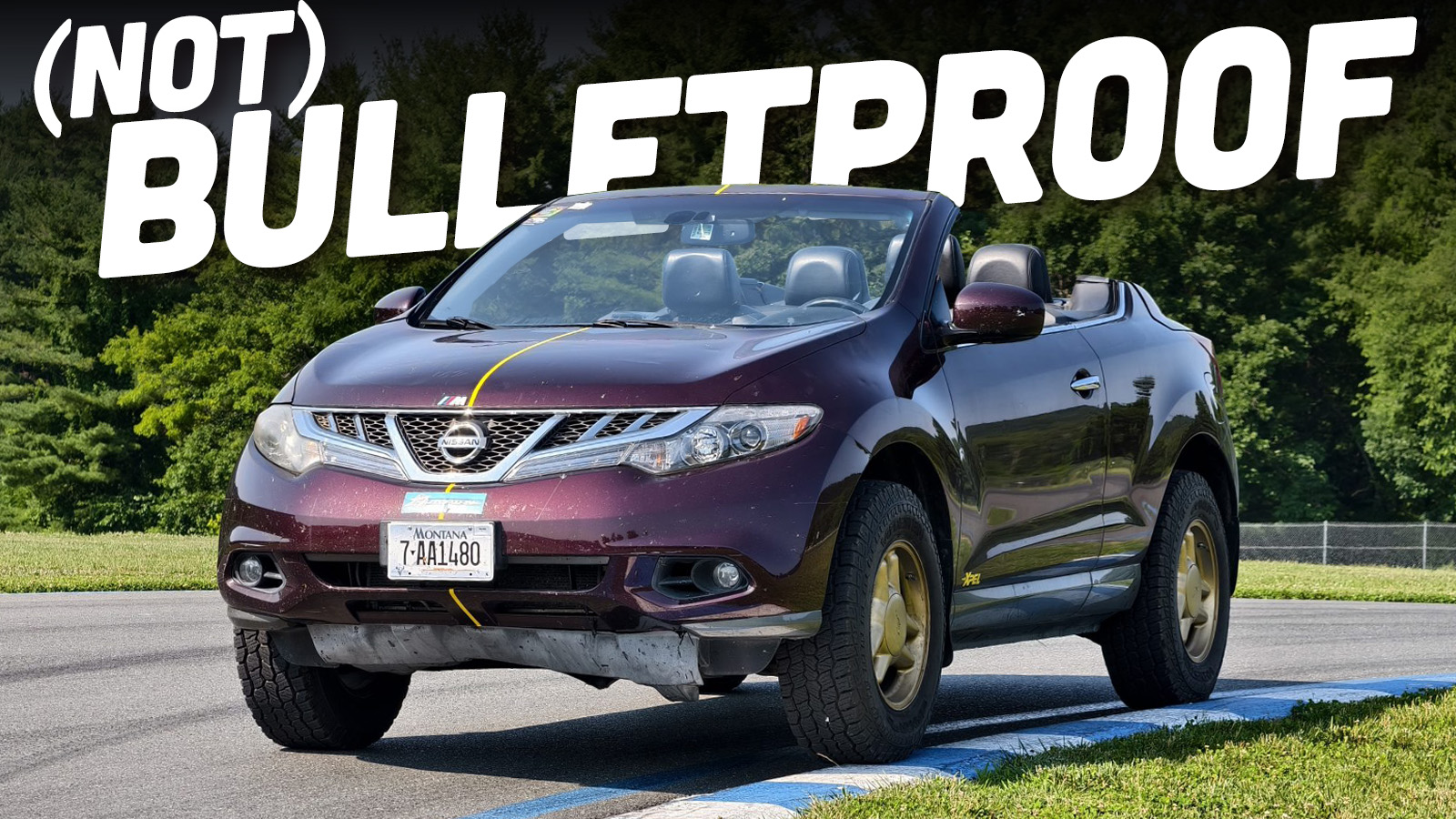
The Nissan Murano CrossCabriolet was perhaps the most misunderstood vehicle that Nissan ever sold. It was big, it was complicated, it was expensive, and its massive hydraulically-opening convertible top had a failure rate that would make a Volkswagen timing chain blush. Yet, after driving one some 8,000 miles across and around America for the past seven months, I’m convinced it’s actually one of the greatest cars on the planet. Well, except for one issue that has me panicked. Somehow, against all odds, the roof remains functional. Instead, a new issue with the transmission has me in a bit of a funk.
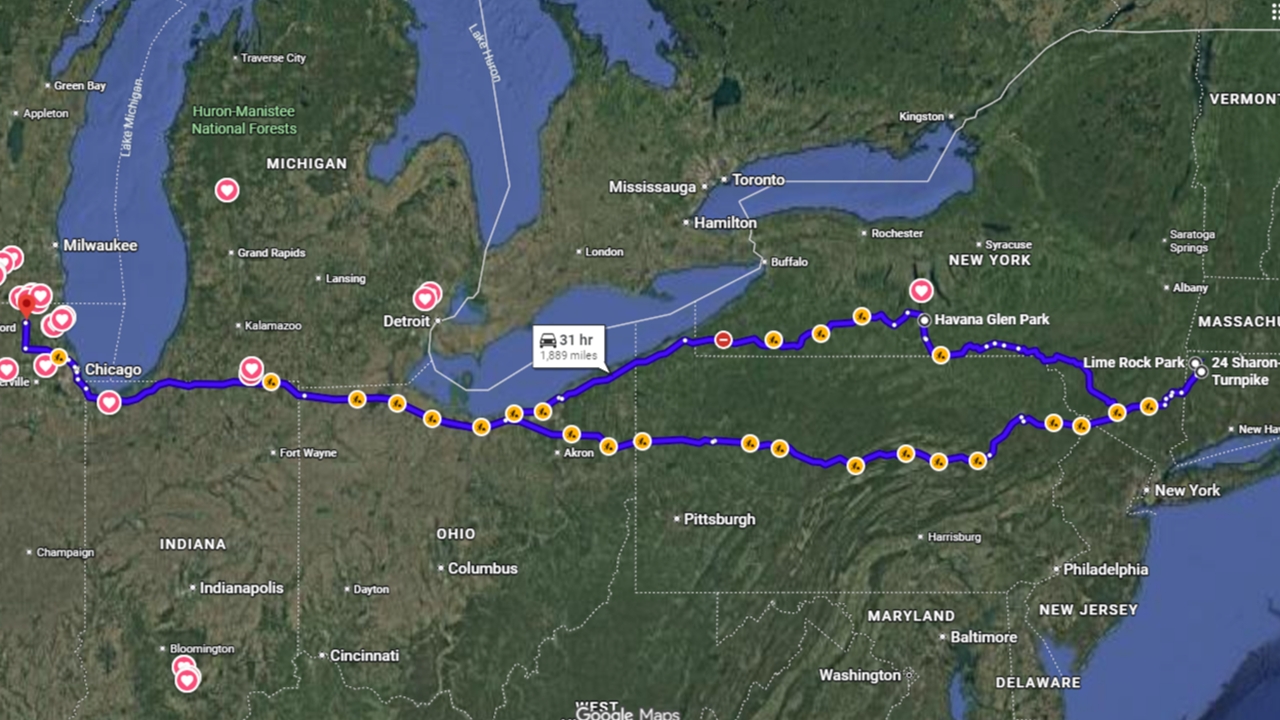
Last week, Matt, Jason, David, and I made a trek out east for some regular-octane fun. First, we paid a visit to Watkins Glen International in New York to watch an Autopian Member absolutely send it in a Lamborghini on a race weekend. Then, we beat it on over to Connecticut to host the Autopian’s 1rd Members Only Track Day at Lime Rock Park. I was away from home for a whole week, and my base of operations was the Autopian’s Nissan Murano CrossCabriolet, which I put about 2,000 miles on in the week alone.


This car has far exceeded our expectations. Remember, the Nissan Murano CrossCabriolet is already a sketchy starting point for a build with its famously unreliable convertible roof and its iffy CVT. Then, we threw on a lift kit, Ford Mustang wheels, XPEL PPF, and oversized Vredestein Pinza AT tires just for good measure. Back when I took possession of the CrossCab back in December, Jason told me that the roof probably had two total cycles left in it. The guys at our partner company, Galpin, were seemingly taking bets on when the CVT would fail during my 4,050-mile trek across America. Basically nobody expected the CrossCab to make it.

Yet, I believed in this car. I didn’t just limit myself to using the roof twice, but I have entirely ignored Jason’s warning and put the roof down every single time I get behind the wheel. I’ve lowered the roof in temperatures as low as 27 degrees Fahrenheit and as hot as 100 degrees. Somehow, the roof still works, even though it’s definitely injured. The drivetrain has also been shockingly reliable. I’ve even been able to score 20 mpg out of the CrossCab despite the huge tires and fueling it only on regular gas.
Weirdly, the CrossCab’s become perhaps the third-most reliable “daily” vehicle in my fleet aside from the Mazda Miata and the Volkswagen Jetta Sportwagen TDI. It’s only third place because my heart still stops every time I press the roof button. I still expect the roof to fail on me at the worst possible time. But for now, I have a working theory that, so long as the roof gets regular exercise, it won’t break. Also, the roof fabric is getting pretty messed up, and even if the roof mechanism keeps working, I’ll have to tackle the top fabric itself one day.

The CrossCab has also taken my abuse in stride. I have now taken it off-roading in Sedona, to the Oppocross Rallycross in Michigan, around the autocross course at Lime Rock Park, and across the country, hitting the west coast, the south coast, the Great Lakes, and now the east coast. I haven’t even taken a single one of my own cars to all of those coasts! It’s not like I’ve been easy on the CrossCab, either. I’ve taken it on Jeep trails and jumped it twice – the landing after the second jump was so hard that I blew both front shocks at the same time.
Yes, I have used and abused this thing, yet I have also fallen so hard for it. It doesn’t matter where I go, the CrossCab always gathers a small crowd. Everyone wants to know the same thing: “Is that custom?” I could go to a gas station in the literal middle of nowhere and at least four people will ask me that question. Everyone wants to take a picture, and everyone loves it. My fleet has everything from a rotary-powered motorcycle to multiple Japanese Kei cars. No other vehicle even comes close to getting the same attention. The CrossCab has even ended up on some car-spotter Facebook groups.

This has been a bit of a revelation. I’m in love with a Nissan! Not just any Nissan, either, but one with a CVT and a roof that threatens to quit every single day. I should run as far away from this thing as possible. Yet, I keep gravitating towards it. I can’t even remember when the last time was that I drove my own cars 8,000 miles in six months, yet I’ve been happy to do it in the CrossCab.
There’s a very good chance that the CrossCab will become an official member of my fleet soon, which means it’s the perfect time for the CrossCab to break in a way that has me scared.
My First Time Deep In America’s East Coast

My Watkins Glen and Lime Rock trip began after I punched the clock after writing for the whole day on Thursday, June 25. I dropped the roof, pointed the hood towards New York, and punched it. Everything was dreamy. I got to watch a Boeing 757 land at O’Hare from my open top and had an unimpeded view of the Chicago skyline. I didn’t even have an address for where in New York I was supposed to be going, but life was good.
I made it to a town just outside of Cleveland that night, and shut down my drive at around 3 am. The CrossCab performed beautifully, returning 20 mpg and giving me zero issues. The next day, I snaked my way through the rest of Ohio, through parts of Pennsylvania, and into New York. Amusingly, despite leaving several hours late on Thursday, I was the first to get to camp at Havana Glen Park on Friday.

The CrossCab then brought plenty of smiles through our time at Watkins Glen. Even Matt’s kid got to take a ride in it!

The car and I were riding high for sure. After the Watkins Glen portion of the trip concluded, Matt took his kid back home while Jason and Otto marched towards our Vrbo in Connecticut.
Me? I was having withdrawals from not being able to swim much this summer. So I drove up the eastern side of Seneca Lake to Lodi Point, where I got in a deeply refreshing swim in the deep, clear waters of the lake.

This meant that I’d also be all by myself when I rolled toward the Vrbo. But I didn’t care. The CrossCab had never failed me, and I had no expectation for it to fail me then, either. I mean, we didn’t even get the CrossCab a spare tire, so I’ve been driving it with little backup in case of a tire failure.
The CrossCab Finally Skips A Beat
Sadly, my trust in the CrossCab would be eroded on the drive to the Vrbo. At some point in the 300-mile drive to Connecticut, I found myself driving through the Catskills on New York State Route 17. There were many grades, but they weren’t particularly steep, so I didn’t think much about them. I spent much of my time keeping up with a Mercedes-Benz C-Class and a GLC that were having a bit of a spirited drive in the mountains.

I was having a blast right up until I came to one particular grade. Cruise control couldn’t maintain the speed that I set, which was a bit weird because it never had that problem before. The CrossCab would fall 5 mph to 10 mph below the speed I set, then the cruise control would rev the engine to no more than 3,600 RPM. But then again, it had been a very long time since I climbed a mountain in the CrossCab, maybe it was normal?
As the cruise control continued to fall behind pace, I turned it off and assumed manual control. When I put my foot down, the engine went no higher than 3,600 RPM. Huh. I then welded my foot to the floor, sending the pedal through the kickdown switch. It made no difference. Getting into a slight panic now, I slapped the overdrive button on the gearshift. The O/D Off light came on, but nothing changed.

Thankfully, the CrossCab was still able to accelerate to 80 mph on flat ground in this state, so I backed off the throttle and settled into a much slower cruise for the few miles I had left before I got to my exit. Once I got off the highway, the CrossCab had demonstrated that something was horribly wrong. When I stopped at the red light at the end of the ramp, I smelled the distinct aroma of hot gear oil. Oh no. When that light turned green, a horrible whine erupted from the CVT and the CrossCab moved with great lethargy. Somehow, I overheated the transmission.
Not wanting to do any further damage, I pulled into a grocery store’s parking lot, put the CrossCab in park, and let the system cool itself for a while before shutting the engine down.
Heat Is The Enemy Of A Nissan CVT

As I waited for things to get cooler, I hit the Internet. Apparently, the transmission went into overheat protection mode. When the transmission gets too hot, the computer limits max RPM and the transmission’s response to throttle. It’s not really a limp mode, exactly. The mode doesn’t trigger any error light, and as I noted, you can still drive up to 80 mph in protection mode. But the idea is that the transmission will limit itself in an attempt to halt the rise in temperature.
A Nissan Technical Bulletin from 2016 says:
A Continuously Variable Transmission (CVT) is designed to go into fluid temperature protection logic mode (“fail-safe mode”) if the CVT fluid temperature rises above a certain threshold. If the CVT goes into fail-safe mode, engine performance is reduced. Customers may report this condition as “low power” or “reduced engine performance”.
[…]
While the CVT is designed to go into fail-safe mode if the fluid temperature rises above the threshold, the following conditions may cause the CVT to go into fail-safe mode prematurely during normal vehicle operation:
1. Overfilled CVT fluid level.
2. Incorrect type of transmission fluid – Use Genuine NISSAN CVT Fluid NS-2 or NS-3* (or equivalent).
3. Incorrect coolant/water mix.
This bulletin doesn’t include the Murano, but from what I’ve been able to find, the CVT in the Murano uses the same logic. Another bulletin that’s specific for the Rogue and the Sentra had more interesting details:
The vehicle speed is, or was, reduced by the CVT fail-safe (reduced vehicle speed) after continuous operation under the following conditions:
– High RPM and/or high speed driving. (4000 RPM or more, and/or 65 MPH or more for 1.0 – 1.5 hrs or more).
– Driving in ambient temperature of 96 degrees or higher.
– Climbing steep or extended hills for 6 miles or more.
– Whine or rattle type noise occurring during reduced engine performance (vehicle speed decrease).
What’s also interesting is that, through parameters CVT-A and CVT-B, the transmission’s control module has the ability to track how many times the transmission’s been overheated and thus, its fluid degraded through high heat.
In my case, it was about 80 degrees outside, but I was definitely doing high-speed, high-RPM driving over the course of multiple hours and climbing long-ish hills. Of course, you cannot forget to factor in the oversized tires, too.
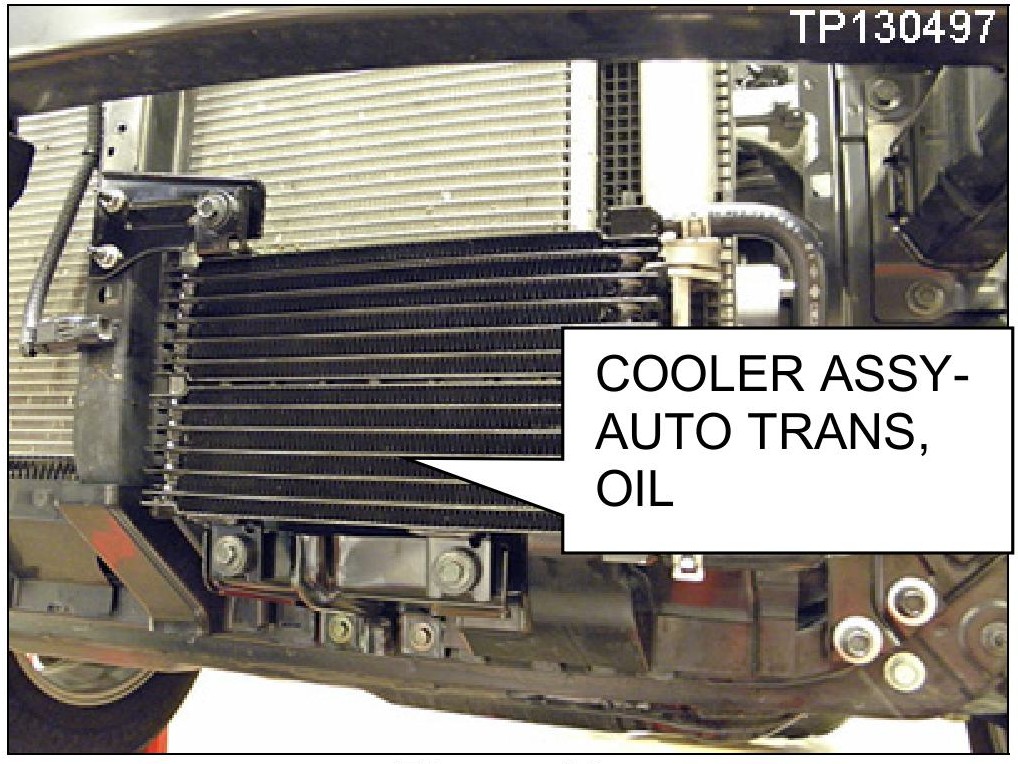
Nissan’s solutions to CVT overheating include checking CVT fluid levels, changing the fluid, and making sure that the engine’s cooling system doesn’t have more than a 55 percent ethylene glycol mix in it. The engine’s cooling system also contributes to the transmission’s cooling, and if there’s too much ethylene glycol in the system, the transmission’s cooling ability will be diminished. Another solution noted by Nissan’s bulletins is the installation of a transmission cooler (above). Apparently, if the CVT-A count is greater than 24, Nissan recommends replacing the entire CVT in some models. Nissan doesn’t say when the overheat protection kicks in, but it seems to activate at temperatures above 230 degrees Fahrenheit.
After digging around forums for a while, I’ve found that many Nissan CVT owners change their fluid frequently (between 15,000 miles and 30,000 miles), and they also install an upgraded transmission cooler.
Sadly, I wasn’t in a position to do any hardcore diagnostics. I didn’t even bring my advanced scanner, so I couldn’t even monitor the temperatures live. What I was able to do was check CVT levels. If the CVT dipstick is to be believed, the Murano might be overfilled. Nissan says that’s one of the causes of overheat protection mode coming on. The good news is that the fluid was a sort of dark amber, didn’t smell bad, and, at least, there wasn’t any glitter on the stick.
I Still Had To Get It Home
The CVT also operated perfectly once it cooled down, like the overheat event never happened. I would end up overheating the transmission a second time during our track day. In that case, the engine was revving high, but there wasn’t a lot of forward speed. I shut it down the moment I heard the telltale whine.
Sadly, that wouldn’t be the end of my CVT woes. As luck would have it, I drove home from our track day right on the hottest day of last week’s heatwave. It was cool enough when I left at four in the morning, and I enjoyed snapping quick pictures of the area surrounding Cornwall, Connecticut.

I also got to see a great sunrise! In fact, it was chilly enough that morning that I contemplated turning on the heat.
But the heatwave eventually came in hot and heavy. As I approached the western side of Pennsylvania, I watched the temperature readout march past 80 degrees onto 85 and then to 90. As I rolled into Ohio, the gauge clicked past 95 degrees before racing to 101 degrees and staying there. Driving in this heat sucks so much. Once you get to 100 degrees, the wind blowing at you no longer makes you feel cool-ish. Instead, it’s like you’re in a convection oven because it’s just more heat.

I also started thinking about the part of the bulletin that noted that continuous operation in temperatures of 96 and above can trigger the overheat protection in some Nissan models. Again, the huge tires probably weren’t helping. I didn’t really know what to do here. It was going to be blazing hot for the whole day with little reprieve the next day – was I supposed to just park and wait it out? Do I attempt to flush the CVT fluid in some random part of Ohio in dangerous temperatures? Do I make a go of it at night?
I hated all of these options as it probably meant wrenching in the worst possible conditions in addition to being a day where I wouldn’t be able to get home or work. I already had one of those days earlier in June when I got stuck in Portland after Operation Frodo.
I decided to drive exactly the speed limit and take frequent breaks. From what I can tell, the transmission spent the entire heatwave portion of the drive either on the edge of overheat protection or slightly in it. Periodically letting it cool down did seem to help, but driving right back into the heat was clearly hard on the car. I made sure to keep the revs under 3,000 for the whole drive from Ohio to Illinois.

Thankfully, the CrossCab did get me home with only a few hiccups. There were times when I tested how far the CrossCab could rev, and it wouldn’t go above 4,000 RPM. Acceleration from tollbooths was also slow. That drive made me feel like I aged 10 years in the span of only 15 hours. I kept waiting for the transmission to blow up or to go into actual limp mode. It never happened, but the worry was still there. It was early evening when I got home and finally saw temperatures fall below 100. I took side streets for the final miles to get home, and little by little, the transmission came back around. It’s now back to operating exactly as it always has. No whining, no hesitation, and no delays.
What Do I Do Now?
… But I won’t let that fool me. That transmission fluid got cooked. So, my first plan of action is to do a couple of transmission flushes and get some fresh NS-3-grade fluid in there. Then, I’ll install an OBD monitor so I can keep track of transmission temperatures. I also want to check the CVT-A and CVT-B values. Maybe I might even do the upgraded transmission cooler. But I’m also afraid that’s not going to be enough. I’m scared that this is the beginning of the end of the line for our once-trusty Jatco CVT. Am I about to spend hundreds of dollars just to end up stranded on the side of the road somewhere? That’s my greatest fear, especially as I’m about to become the actual owner of this thing. Check out the transmission fluid!

But I also don’t want to give up on the CrossCab. This car and I have been through so many adventures together that I’ve grown quite attached to it. I’ve been having so much fun with the CrossCab that it’s regularly been my first choice of cars to joyride in this summer. I want to take it to the Northernmost Point, the Southernmost Point, and parts of America I’ve never been to. I want to take it on a Gambler 500 and to some car shows. I even found a CrossCab roof specialist in a Chicago suburb.
But what’s going to happen to that transmission will probably determine the future. I expected to have to fix the roof at some point, but both the roof and the transmission? That’s too much for me. So, I’m in a bit of a funk. I’m worried that the transmission is toasted, or will probably fail in the near future. Somehow, it survived off-roading. It survived a rallycross, but a road trip on pavement is what does it in?
I’m not sure what to do. Is my plan to at least try to save the transmission solid? Should we, as in the Autopian as a whole, run as far away as possible? What would you do here? Help put my mind at ease!
Top graphic image: Mercedes Streeter


Oh man, that’s not good.
I’d definitely start with a fluid flush and filter change. That may resolve it, or could be a short-term bandage. Given the extra load with the larger and heavier wheels and your heavy right foot I’d expect to do fluid changes every 20-30K miles, frankly.
If it does get to the point of needing the transmisison replaced, explore the option of having the ZF 9-speed from the 2022+ Pathfinder put in instead of another Jatco. I don’t believe they changed the engine much if at all to run the geared transmission instead of the CVT, but reports have been almost universally positive about the new setup.