

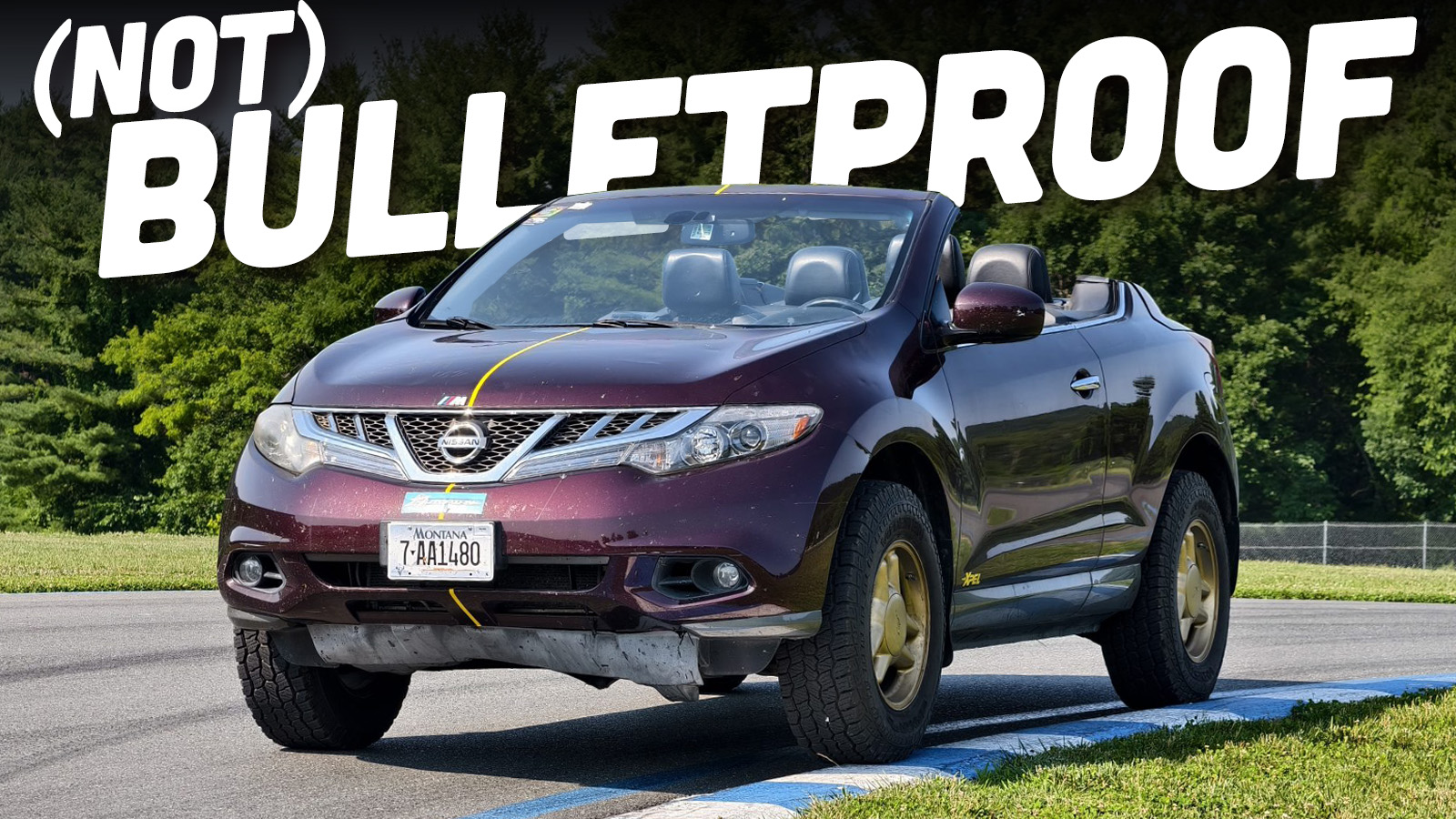
The Nissan Murano CrossCabriolet was perhaps the most misunderstood vehicle that Nissan ever sold. It was big, it was complicated, it was expensive, and its massive hydraulically-opening convertible top had a failure rate that would make a Volkswagen timing chain blush. Yet, after driving one some 8,000 miles across and around America for the past seven months, I’m convinced it’s actually one of the greatest cars on the planet. Well, except for one issue that has me panicked. Somehow, against all odds, the roof remains functional. Instead, a new issue with the transmission has me in a bit of a funk.
Last week, Matt, Jason, David, and I made a trek out east for some regular-octane fun. First, we paid a visit to Watkins Glen International in New York to watch an Autopian Member absolutely send it in a Lamborghini on a race weekend. Then, we beat it on over to Connecticut to host the Autopian’s 1rd Members Only Track Day at Lime Rock Park. I was away from home for a whole week, and my base of operations was the Autopian’s Nissan Murano CrossCabriolet, which I put about 2,000 miles on in the week alone.


This car has far exceeded our expectations. Remember, the Nissan Murano CrossCabriolet is already a sketchy starting point for a build with its famously unreliable convertible roof and its iffy CVT. Then, we threw on a lift kit, Ford Mustang wheels, XPEL PPF, and oversized Vredestein Pinza AT tires just for good measure. Back when I took possession of the CrossCab back in December, Jason told me that the roof probably had two total cycles left in it. The guys at our partner company, Galpin, were seemingly taking bets on when the CVT would fail during my 4,050-mile trek across America. Basically nobody expected the CrossCab to make it.

Yet, I believed in this car. I didn’t just limit myself to using the roof twice, but I have entirely ignored Jason’s warning and put the roof down every single time I get behind the wheel. I’ve lowered the roof in temperatures as low as 27 degrees Fahrenheit and as hot as 100 degrees. Somehow, the roof still works, even though it’s definitely injured. The drivetrain has also been shockingly reliable. I’ve even been able to score 20 mpg out of the CrossCab despite the huge tires and fueling it only on regular gas.
Weirdly, the CrossCab’s become perhaps the third-most reliable “daily” vehicle in my fleet aside from the Mazda Miata and the Volkswagen Jetta Sportwagen TDI. It’s only third place because my heart still stops every time I press the roof button. I still expect the roof to fail on me at the worst possible time. But for now, I have a working theory that, so long as the roof gets regular exercise, it won’t break. Also, the roof fabric is getting pretty messed up, and even if the roof mechanism keeps working, I’ll have to tackle the top fabric itself one day.

The CrossCab has also taken my abuse in stride. I have now taken it off-roading in Sedona, to the Oppocross Rallycross in Michigan, around the autocross course at Lime Rock Park, and across the country, hitting the west coast, the south coast, the Great Lakes, and now the east coast. I haven’t even taken a single one of my own cars to all of those coasts! It’s not like I’ve been easy on the CrossCab, either. I’ve taken it on Jeep trails and jumped it twice – the landing after the second jump was so hard that I blew both front shocks at the same time.
Yes, I have used and abused this thing, yet I have also fallen so hard for it. It doesn’t matter where I go, the CrossCab always gathers a small crowd. Everyone wants to know the same thing: “Is that custom?” I could go to a gas station in the literal middle of nowhere and at least four people will ask me that question. Everyone wants to take a picture, and everyone loves it. My fleet has everything from a rotary-powered motorcycle to multiple Japanese Kei cars. No other vehicle even comes close to getting the same attention. The CrossCab has even ended up on some car-spotter Facebook groups.

This has been a bit of a revelation. I’m in love with a Nissan! Not just any Nissan, either, but one with a CVT and a roof that threatens to quit every single day. I should run as far away from this thing as possible. Yet, I keep gravitating towards it. I can’t even remember when the last time was that I drove my own cars 8,000 miles in six months, yet I’ve been happy to do it in the CrossCab.
There’s a very good chance that the CrossCab will become an official member of my fleet soon, which means it’s the perfect time for the CrossCab to break in a way that has me scared.
My First Time Deep In America’s East Coast

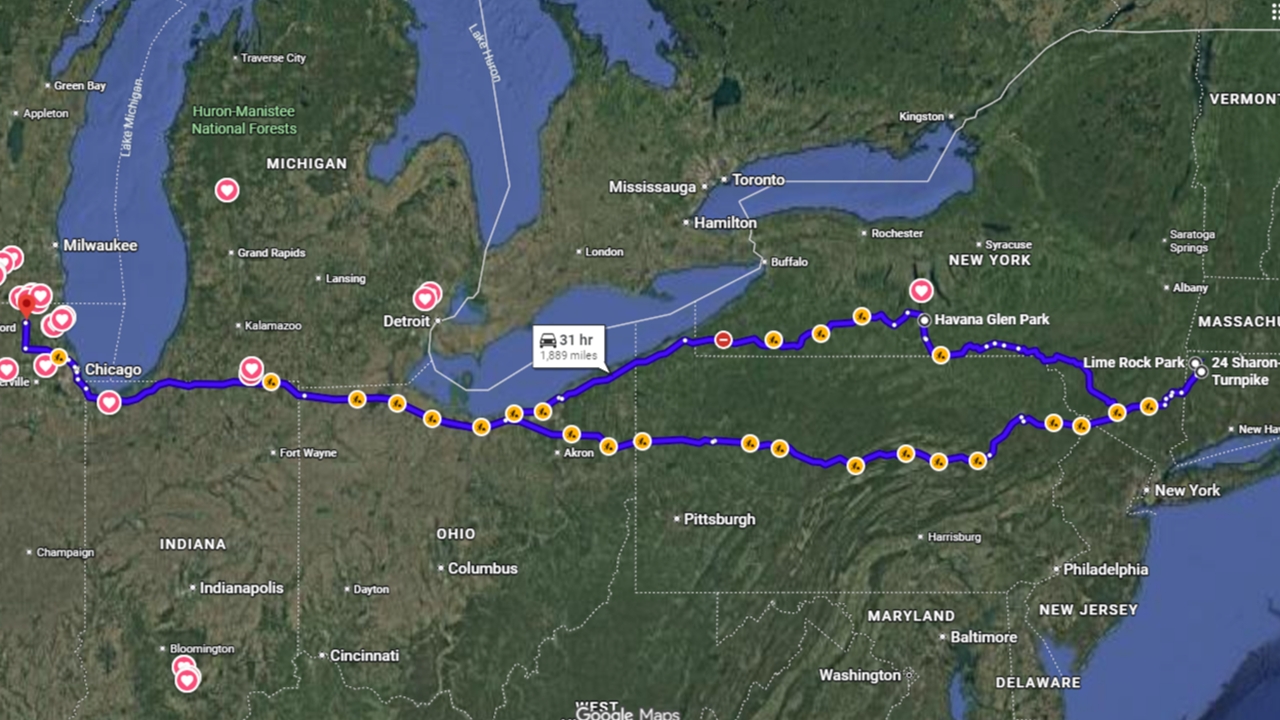
My Watkins Glen and Lime Rock trip began after I punched the clock after writing for the whole day on Thursday, June 25. I dropped the roof, pointed the hood towards New York, and punched it. Everything was dreamy. I got to watch a Boeing 757 land at O’Hare from my open top and had an unimpeded view of the Chicago skyline. I didn’t even have an address for where in New York I was supposed to be going, but life was good.
I made it to a town just outside of Cleveland that night, and shut down my drive at around 3 am. The CrossCab performed beautifully, returning 20 mpg and giving me zero issues. The next day, I snaked my way through the rest of Ohio, through parts of Pennsylvania, and into New York. Amusingly, despite leaving several hours late on Thursday, I was the first to get to camp at Havana Glen Park on Friday.

The CrossCab then brought plenty of smiles through our time at Watkins Glen. Even Matt’s kid got to take a ride in it!

The car and I were riding high for sure. After the Watkins Glen portion of the trip concluded, Matt took his kid back home while Jason and Otto marched towards our Vrbo in Connecticut.
Me? I was having withdrawals from not being able to swim much this summer. So I drove up the eastern side of Seneca Lake to Lodi Point, where I got in a deeply refreshing swim in the deep, clear waters of the lake.

This meant that I’d also be all by myself when I rolled toward the Vrbo. But I didn’t care. The CrossCab had never failed me, and I had no expectation for it to fail me then, either. I mean, we didn’t even get the CrossCab a spare tire, so I’ve been driving it with little backup in case of a tire failure.
The CrossCab Finally Skips A Beat
Sadly, my trust in the CrossCab would be eroded on the drive to the Vrbo. At some point in the 300-mile drive to Connecticut, I found myself driving through the Catskills on New York State Route 17. There were many grades, but they weren’t particularly steep, so I didn’t think much about them. I spent much of my time keeping up with a Mercedes-Benz C-Class and a GLC that were having a bit of a spirited drive in the mountains.

I was having a blast right up until I came to one particular grade. Cruise control couldn’t maintain the speed that I set, which was a bit weird because it never had that problem before. The CrossCab would fall 5 mph to 10 mph below the speed I set, then the cruise control would rev the engine to no more than 3,600 RPM. But then again, it had been a very long time since I climbed a mountain in the CrossCab, maybe it was normal?
As the cruise control continued to fall behind pace, I turned it off and assumed manual control. When I put my foot down, the engine went no higher than 3,600 RPM. Huh. I then welded my foot to the floor, sending the pedal through the kickdown switch. It made no difference. Getting into a slight panic now, I slapped the overdrive button on the gearshift. The O/D Off light came on, but nothing changed.

Thankfully, the CrossCab was still able to accelerate to 80 mph on flat ground in this state, so I backed off the throttle and settled into a much slower cruise for the few miles I had left before I got to my exit. Once I got off the highway, the CrossCab had demonstrated that something was horribly wrong. When I stopped at the red light at the end of the ramp, I smelled the distinct aroma of hot gear oil. Oh no. When that light turned green, a horrible whine erupted from the CVT and the CrossCab moved with great lethargy. Somehow, I overheated the transmission.
Not wanting to do any further damage, I pulled into a grocery store’s parking lot, put the CrossCab in park, and let the system cool itself for a while before shutting the engine down.
Heat Is The Enemy Of A Nissan CVT

As I waited for things to get cooler, I hit the Internet. Apparently, the transmission went into overheat protection mode. When the transmission gets too hot, the computer limits max RPM and the transmission’s response to throttle. It’s not really a limp mode, exactly. The mode doesn’t trigger any error light, and as I noted, you can still drive up to 80 mph in protection mode. But the idea is that the transmission will limit itself in an attempt to halt the rise in temperature.
A Nissan Technical Bulletin from 2016 says:
A Continuously Variable Transmission (CVT) is designed to go into fluid temperature protection logic mode (“fail-safe mode”) if the CVT fluid temperature rises above a certain threshold. If the CVT goes into fail-safe mode, engine performance is reduced. Customers may report this condition as “low power” or “reduced engine performance”.
[…]
While the CVT is designed to go into fail-safe mode if the fluid temperature rises above the threshold, the following conditions may cause the CVT to go into fail-safe mode prematurely during normal vehicle operation:
1. Overfilled CVT fluid level.
2. Incorrect type of transmission fluid – Use Genuine NISSAN CVT Fluid NS-2 or NS-3* (or equivalent).
3. Incorrect coolant/water mix.
This bulletin doesn’t include the Murano, but from what I’ve been able to find, the CVT in the Murano uses the same logic. Another bulletin that’s specific for the Rogue and the Sentra had more interesting details:
The vehicle speed is, or was, reduced by the CVT fail-safe (reduced vehicle speed) after continuous operation under the following conditions:
– High RPM and/or high speed driving. (4000 RPM or more, and/or 65 MPH or more for 1.0 – 1.5 hrs or more).
– Driving in ambient temperature of 96 degrees or higher.
– Climbing steep or extended hills for 6 miles or more.
– Whine or rattle type noise occurring during reduced engine performance (vehicle speed decrease).
What’s also interesting is that, through parameters CVT-A and CVT-B, the transmission’s control module has the ability to track how many times the transmission’s been overheated and thus, its fluid degraded through high heat.
In my case, it was about 80 degrees outside, but I was definitely doing high-speed, high-RPM driving over the course of multiple hours and climbing long-ish hills. Of course, you cannot forget to factor in the oversized tires, too.
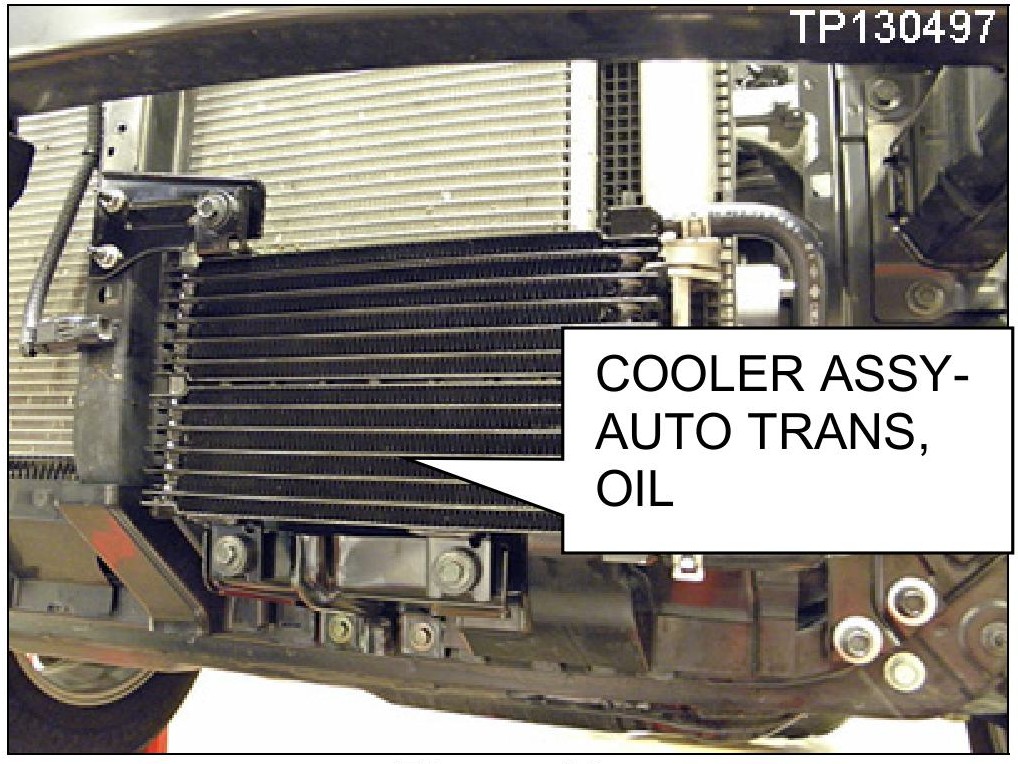
Nissan’s solutions to CVT overheating include checking CVT fluid levels, changing the fluid, and making sure that the engine’s cooling system doesn’t have more than a 55 percent ethylene glycol mix in it. The engine’s cooling system also contributes to the transmission’s cooling, and if there’s too much ethylene glycol in the system, the transmission’s cooling ability will be diminished. Another solution noted by Nissan’s bulletins is the installation of a transmission cooler (above). Apparently, if the CVT-A count is greater than 24, Nissan recommends replacing the entire CVT in some models. Nissan doesn’t say when the overheat protection kicks in, but it seems to activate at temperatures above 230 degrees Fahrenheit.
After digging around forums for a while, I’ve found that many Nissan CVT owners change their fluid frequently (between 15,000 miles and 30,000 miles), and they also install an upgraded transmission cooler.
Sadly, I wasn’t in a position to do any hardcore diagnostics. I didn’t even bring my advanced scanner, so I couldn’t even monitor the temperatures live. What I was able to do was check CVT levels. If the CVT dipstick is to be believed, the Murano might be overfilled. Nissan says that’s one of the causes of overheat protection mode coming on. The good news is that the fluid was a sort of dark amber, didn’t smell bad, and, at least, there wasn’t any glitter on the stick.
I Still Had To Get It Home
The CVT also operated perfectly once it cooled down, like the overheat event never happened. I would end up overheating the transmission a second time during our track day. In that case, the engine was revving high, but there wasn’t a lot of forward speed. I shut it down the moment I heard the telltale whine.
Sadly, that wouldn’t be the end of my CVT woes. As luck would have it, I drove home from our track day right on the hottest day of last week’s heatwave. It was cool enough when I left at four in the morning, and I enjoyed snapping quick pictures of the area surrounding Cornwall, Connecticut.

I also got to see a great sunrise! In fact, it was chilly enough that morning that I contemplated turning on the heat.
But the heatwave eventually came in hot and heavy. As I approached the western side of Pennsylvania, I watched the temperature readout march past 80 degrees onto 85 and then to 90. As I rolled into Ohio, the gauge clicked past 95 degrees before racing to 101 degrees and staying there. Driving in this heat sucks so much. Once you get to 100 degrees, the wind blowing at you no longer makes you feel cool-ish. Instead, it’s like you’re in a convection oven because it’s just more heat.

I also started thinking about the part of the bulletin that noted that continuous operation in temperatures of 96 and above can trigger the overheat protection in some Nissan models. Again, the huge tires probably weren’t helping. I didn’t really know what to do here. It was going to be blazing hot for the whole day with little reprieve the next day – was I supposed to just park and wait it out? Do I attempt to flush the CVT fluid in some random part of Ohio in dangerous temperatures? Do I make a go of it at night?
I hated all of these options as it probably meant wrenching in the worst possible conditions in addition to being a day where I wouldn’t be able to get home or work. I already had one of those days earlier in June when I got stuck in Portland after Operation Frodo.
I decided to drive exactly the speed limit and take frequent breaks. From what I can tell, the transmission spent the entire heatwave portion of the drive either on the edge of overheat protection or slightly in it. Periodically letting it cool down did seem to help, but driving right back into the heat was clearly hard on the car. I made sure to keep the revs under 3,000 for the whole drive from Ohio to Illinois.

Thankfully, the CrossCab did get me home with only a few hiccups. There were times when I tested how far the CrossCab could rev, and it wouldn’t go above 4,000 RPM. Acceleration from tollbooths was also slow. That drive made me feel like I aged 10 years in the span of only 15 hours. I kept waiting for the transmission to blow up or to go into actual limp mode. It never happened, but the worry was still there. It was early evening when I got home and finally saw temperatures fall below 100. I took side streets for the final miles to get home, and little by little, the transmission came back around. It’s now back to operating exactly as it always has. No whining, no hesitation, and no delays.
What Do I Do Now?
… But I won’t let that fool me. That transmission fluid got cooked. So, my first plan of action is to do a couple of transmission flushes and get some fresh NS-3-grade fluid in there. Then, I’ll install an OBD monitor so I can keep track of transmission temperatures. I also want to check the CVT-A and CVT-B values. Maybe I might even do the upgraded transmission cooler. But I’m also afraid that’s not going to be enough. I’m scared that this is the beginning of the end of the line for our once-trusty Jatco CVT. Am I about to spend hundreds of dollars just to end up stranded on the side of the road somewhere? That’s my greatest fear, especially as I’m about to become the actual owner of this thing. Check out the transmission fluid!

But I also don’t want to give up on the CrossCab. This car and I have been through so many adventures together that I’ve grown quite attached to it. I’ve been having so much fun with the CrossCab that it’s regularly been my first choice of cars to joyride in this summer. I want to take it to the Northernmost Point, the Southernmost Point, and parts of America I’ve never been to. I want to take it on a Gambler 500 and to some car shows. I even found a CrossCab roof specialist in a Chicago suburb.
But what’s going to happen to that transmission will probably determine the future. I expected to have to fix the roof at some point, but both the roof and the transmission? That’s too much for me. So, I’m in a bit of a funk. I’m worried that the transmission is toasted, or will probably fail in the near future. Somehow, it survived off-roading. It survived a rallycross, but a road trip on pavement is what does it in?
I’m not sure what to do. Is my plan to at least try to save the transmission solid? Should we, as in the Autopian as a whole, run as far away as possible? What would you do here? Help put my mind at ease!
Top graphic image: Mercedes Streeter



I can’t believe this thing hasn’t kicked the bucket yet. Tough little POS!
I trust a jatco cvt as far as I can throw it.
Please, please, please stop featuring this abomination.
I say MOAR CrossCab content~
My parents had a Rogue that suddenly started having issues. They were living in AZ and regularly driving up to Vegas, which gives you the combo of heat and elevation changes.
They did that drive a number of times before the problems, and then once they started happening they were in the same perplexed state – no lights but it isn’t making it up the hills.
This was back in maybe 2010, and after a number of dealer visits where they couldn’t replicate the issue they were ready to do a new transmission under warranty. At the last minute there was a tech bulletin that told them to lower the fluid level a small amount, and with that the problem never occurred again. Well, they also didn’t keep it for much longer at that point….
jeez. Once you had any issue, you should have drained/filled the CVT immediately. I would wager 90% of automatic transmission failures (CVT included) are due to failure to change the fluid. I’m not going to bother googling it, but there was a website forever ago that showed the lubrication effectiveness of ATF when it was new, when it was overheated once, overheated twice, etc. Basically, if ATF is good for… say..100k miles (just for math sake), if you overheat your fluid ONCE, it is only good for 50k miles. If you overheat it twice, it is only good for 25k miles, it just kept splitting roughly in half. And when it loses it’s ability to lubricate/remove heat from components, that’s when expensive failures happen.
I do have to wonder, after the abuse the transmission took driving in the mountains, you took it to the track? Why?
It was expected to be there and do things. I definitely delivered on that demand!
My wife and I owned two Nissan Quests, an ’11 and a ’17. The early JF011 cvt’s were regarded as the not so good ones and I managed 164K miles out of it with out a single fluid change. I am convinced that it would have gone double that with 30K interval fluid changes. Our ’17 got to 170K before we traded both for two Outlanders and I changed the fluid on that one every 30K or so like a good owner is supposed too. Your Murano has the exact same powertrain as the Quests do. They are actually alot better than the enthusiast community gives them credit for. I mean, not so long ago, 100K miles was the most you could get from most transmissions even when maintained back in the 70’s…
The Jatco units are improved and now in their 3rd-generation. They have improved the cooling systems on them and most importantly they have improved the fluids, especially by going to NS3, the blue CVT fluid.
The NS2 just wasn’t up to the task of lubricating, cooling and lasting 100K miles. NS3 will but smart owners will still change it at 30K.
I was expecting a certain member to come defend her honor. Jatco?? Are you out there?
I imagine they’re in the car now, on their way to Mercedes’ place just to show her how it’s done.
What modern vehicle still has a kickdown switch, or a kickdown at all? And on a CVT? Pretty sure those went the way of the DoDo long before this vehicle was spawned. It’s all computer controlled nowadays.
This has one! As do Smarts, weirdly. Normally, the kickdown switch in the Murano sends the revs to near-redline, resulting in only slightly faster movement.
It could just be a detent that you feel near the end of accelerator pedal travel. On an electronic throttle control system, you typically have two independent accel pedal position sensors inside the pedal assembly – there’s no need for a switch when the ECU is monitoring voltage from two pedal position sensors.
Most modern vehicles have an Acceleration Pedal Position Sensor, which will tell the powertrain control module to change the driving behavior if the pedal is floored, similar to a kick down switch.
If it does an explode, it’s time for DT and/or SWG to visit and swap it out with you. Or perhaps the swap event is the next member meetup.
I am absolutely shocked that a favorite transmission beloved by most has not left a comment here.
Perhaps it needed to cool down.
> I’m about to become the actual owner of this thing.
Did i miss an announcement?
I’d say replace the transmission. You love the car, and for all their faults (and their owners’) Nissans of that vintage are pretty durable cars.
Subjected my ol’ Sorento with the 6-speed auto to cross-country towing a few years ago. Hours of revving north of 4,000, 5,000 RPM sailing down the highway.
Transmission temperature was a concern after some issue on sand but it likely was partially my fault keeping it in 1st.
Turns out it was a complete non-issue when the ambient temperature is zero Fahrenheit. The reading barely moved from typical operating temp even flooring it up an incline. (It would increase some more on the warmer, second day but still not by much.)
That was a solid transmission that saw many hours crawling – shame the AWD coupler is (mostly) non-serviceable – that haul was the last straw before that part started acting up.
I’m curious if it did overheat for you previously but you didn’t notice because you were doing lower RPM activities like off-roading or cruising on a relatively flat highway.
I’m not familiar with CVTs, but could you follow the steps of a failing conventional automatic and change the fluid more often to buy some time?
I don’t think it did. When it’s in the overheated state, acceleration is pretty glacial and revs build slowly. I think what saved the transmission on the previous big trip was the fact that it happened in the middle of winter.
Ahh, makes sense. I guess the hot outside temperature is a really big factor here. That sucks that it was so good to you for so long that it allowed you to get attached, now it’s acting up. Cars can be real dicks sometimes.
https://www.theautopian.com/we-protected-half-of-our-100000-mile-nissan-murano-crosscabriolet-and-now-were-going-to-torture-it/
Bizness Comma Nunya
1 year ago
Whatever you are going to do to torture it. Swap the CVT fluid first
(sorry, I know I’m being a turd.)
Changing the CVT fluid in that thing is a waste of money. Trust me I have been down that road with a Murano of similar vintage with a malfunctioning CVT.
Sometimes it helps, sometimes issues are too great to fix with just fluid. But I’ve seen nissan CVTs over 200k when people actually change the fluid between 40-60k. But a defect is a defect, same goes for traditional autos.
Admittedly, I half expected that our boys from California swapped the fluid before sending me out on a 4,000-mile road trip. I bet you can imagine my face when I found out that wasn’t the case. 🙂
If you swap it, especially with this mileage and use, use Lucas CVT instead of the Nissan stuff. People seem to use this as a way to limp their CVTs further than the OEM fluid allows. But, your experience may vary.
https://www.lucasoil.com/product/synthetic-multi-vehicle-fluid/
Before you diss this advice, go read some reviews on it with people having Nissan CVT issues and tried this stuff. Can’t fix them all, but it seems to alleviate some issues for people.
I thought DT’s rule on taking possession of any vehicle was swap all fluids immediately!
I suspect he ignores that rule for company cars. Ha. 🙂
I’d go with a few drain and fill cycles. I’m skeptical of flushes stirring up old crap, but a few drain and fills will help clean it out. Beyond that, stay positive and see what it does. I had some weird issues on both my automatic 998 mini city and my school bus (at545) and after a few drain and fills cycles (on the mini, that’s just engine oil), both returned to their expected performance and I never had problems again
My Juke started experiencing the symptoms you described at around 78,000 miles. It was still under the CPO warranty, so I had it serviced at the local Nissan dealership. When It started doing it again less than 5000 miles later I knew it was time to trade it in.
If it looks like it’s cooked, do a one-way trip to Alaska and fling it off that one cliff
Send it out in style!
Fluid changes, yes, bigger cooler, nah. I’d only do that, or spend other real money, if you had a solid fluid service history. People always say preventative fluid changes are needed with these. It seems you are just experiencing known Jatco CVT problems, like so many, and full transmission failure is possible/likely.
An extra cooler (air) out front would certainly help. My 04 Impala cop car had one until the transmission lines rotted out. It was impossible to find replacement lines that included the extra cooler so I removed it. There’s also an air cooler for the power steering fluid. They didn’t mess around on the cop package…
Sounds like you were just too hard on an old, semi-abused car. Some cars need more TLC than others, as they age.
Imagine the fun of doing a 5-speed swap!
That, as well as engineering a manual system for the top, would be the dream! Alas, I have neither the time nor the wrenching prowess to pull either off. Knowing me, I’ll have a manual transmission sitting in my living room for so long I’ll forget why I even bought it.
This was my immediate first thought. Im sure Nissan sold this engine with a manual transmission in something, somewhere in the world, and youve got Ebay motors and a ton of shade tree wrenching knowledge to tap into…. SWAP IT!
Sigh. I envy anyone who can check their transmission fluid with a good old dipstick. Look at the fluid, smell it, feel for grit. I miss the positive feedback.
I feel like the Nissan Murano CrossCabriolet was understood the appropriate amount….
I sold the CVT2, 3, 7 and 8. They are actually great transmissions, but not very happy when you overload them or change the vehicle dynamics. A certain OEM I sold them to grudgingly admitted they were the lowest warranty cost transmission in their history. The controllers were rock solid. When you change anything in the dynamics of the car (lift, tire size, wheel size, etc.) you need to recalibrate the TCU. I am surprised you went as far as you did without self-protections kicking in. The death sentence for these is slipping the belt. Actually, that has a CVT3, so it has a “pull chain” rather than a “push belt” CVT. Regardless, slipping is the beginning of death so most failsafe issues surround it ensuring you don’t slip.
I’ve read multiple claims that a Nissan CVT that’s near death will start slipping (identifiable through watching the tach “yo-yo” up and down without a corresponding change in speed). This one isn’t doing that at all. It’s just slow to accelerate when hot, and it whines when it’s super hot.