


For modern car design, aerodynamics are important. Incredibly important, even. Why else would carmakers spend so much time making aerodynamically-sound flush door handles that are overcomplicated garbage otherwise? Or those tiny fins and vortex generators molded into taillight lenses or all of the time and effort spent in wind tunnels fine-tuning and refining, all so a car can be as slippery as possible through the wind? A car with a low coefficient of drag is a more efficient car, and a more efficient car goes further on a drop of gas or a battery cell. And that means more range, which, for electric cars especially, is the kind of magic number car buyers love to look at.
Now that you’re thinking about that, reach over to your nightstand and find in your big stack of Field and Stream and Oui magazines the latest issue of the Journal of Fluid Mechanics, the May 7, 2026 issue, which has a paper from Associate Professor Aiko Yakeno of the Institute of Fluid Science, Tohoku University. This paper is interesting because it knocks on its ass over 80 years of accepted aerodynamics beliefs, specifically the idea that smoother is always better.


Yakeno and his team found that by applying “microscopic, irregular roughness (DMR) to the surface of a streamlined model” they were able to reduce air resistance by a staggering 43.6%! Let’s repeat that number, but in bold, just because that’s a freaking massive improvement: 43.6%!
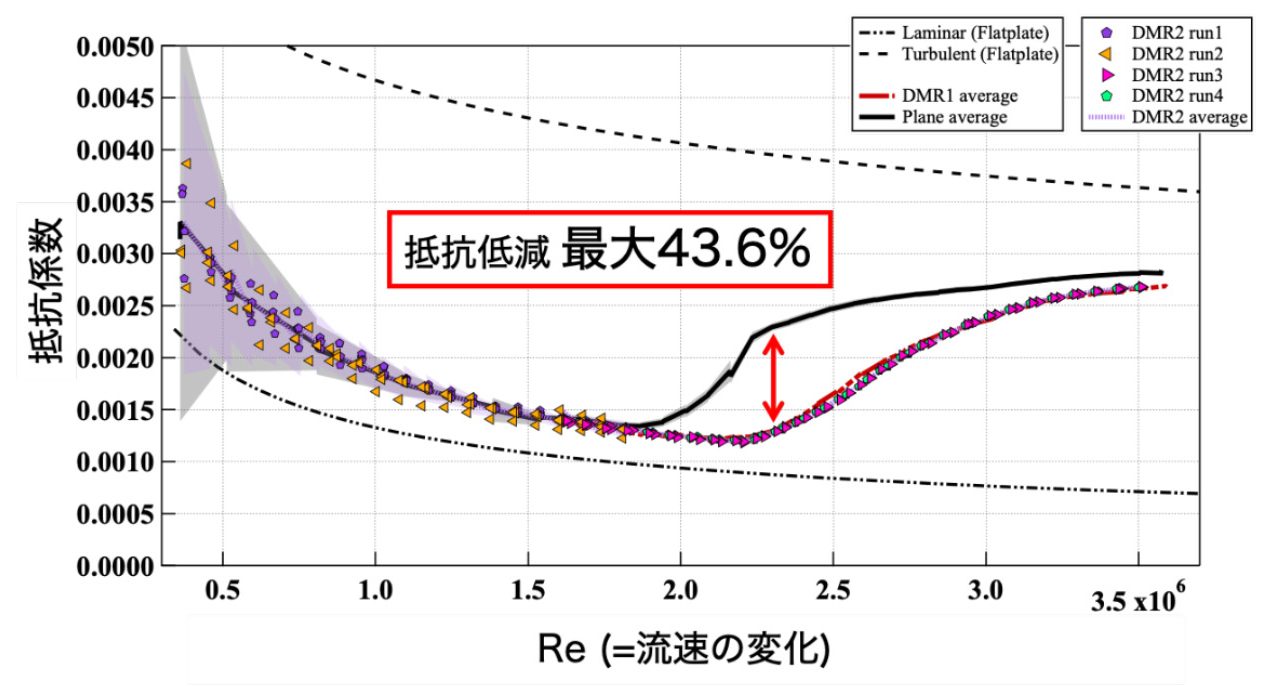
That’s right, the researchers found that a specifically roughened surface had dramatically less air resistance than a completely smooth surface, and this effect seems to be different than other observed surface-level effects, like the shark skin-inspired surface systems that use uniformly-shaped “denticles” to reduce drag. The microscopic roughness approach led to a “suppression of wall friction resistance itself,” which differs from other drag-reducing methodologies.
Part of what makes this study so interesting has to do with how the results were measured. Unlike most conventional wind tunnel tests that require support rods to hold up the models to be tested, which creates all sorts of turbulence, the team used a “1m Magnetic Support Balance (MSBS)” system that levitates the aero testing models with magnetic fields, and looks a bit like magic in photos:

See that rocket-like object hovering in the middle of the tunnel there? It’s actually levitating there, held in place by magnetic fields. This method allowed the researchers to take the precision measurements necessary to conclude the level of drag reduction happening with their microscopically-roughened surfaces.
So what could this mean for cars? The initial applications of this potential breakthrough seem to be targeted to the aerospace industry, but I don’t see any reason why this wouldn’t end up in automotive design. After all a 40+% improvement in drag is huge, especially for electric vehicles. So what could the application of these methods look like in cars?
If we look at how the surface roughening process is described in the paper, we can get some idea:
Note 1. DMR (Distributed Micro-Roughness): A surface texture characterized by the irregular distribution of random micron-sized fine irregularities across the entire surface. In this study, two types were used: a convex pattern using 38-53 μm glass beads and a concave pattern using sandblasting. Unlike the “turbulence-promoting roughness” that has been a problem in conventional roughness research, DMR is a new concept of surface texture that delays transitions and reduces frictional resistance under specific conditions.
So, based on this, a car body with these roughening methods employed would likely look pretty much like any other car, but there could be a sort of…matte effect to the surfacing? (That’s why I put that Kia EV4 in the topshot: it’s matte.) I’m just speculating here, but I suspect that while this surface roughening is likely too small and subtle to feel with your hand, it would affect how light plays upon the surfaces of the car, and I’d suspect the effect would be to diffuse the light, leaving a decidedly non-shiny appearance.
That seems a small price to pay for such a potentially dramatic decrease in drag, though. Besides, I bet some matte finish-looking cars could be pretty cool. They might even look a little velvety? And I bet when they get wet or icy the visual differences would be even more pronounced!
Some of you may be thinking that this sounds similar to the golf ball dimples experiment famously undertaken by the MythBusters crew, where they managed to make a car more fuel efficient via the application of golf ball-like dimples:
This is actually a very different effect to what is going on in the Tohoku study. Golf ball dimpling helps to reduce drag and increase lift due to a boundary layer effect, which is not the same thing that is happening in the study using microscopically roughened surfaces.
We’re likely years away from any automotive application of this research, but it’s fun to start thinking about it now.
Top graphic images: Tohoku University; DepositPhotos.com; Kia


Krylon is about to be all over this.
I don’t think it’s accurate to say that this isn’t a boundary layer effect. Reading the paper it seems like they are shifting the boundary layer properties to reduce skin drag. The dimpling on golf balls and such increases skin friction drag to reduce flow separation.
There’s a few reasons I don’t think this will have any application in cars. First, in the figure posted above (number ya figures!) the maximum difference is at around Re 2.25×10^6 and begins around 2×10^6. Cars at highways speeds, I believe, are less than 1.5×10^6.
Second, due to the shape of a car (which is not a wing, like what was tested) the effects of delaying flow separation might be more important than skin friction. IDK. Not my field, but I do know a car is not an airfoil. Except for the GM Sunraycer.
I agree.
Well, in fairness to Torch, he didn’t say that this experiment isn’t a boundary layer effect, he said that it was (1) different from the dimple experiment which (2) involved “a” boundary layer effect. Both assertions are true. Technically. But he didn’t bother to state how it was different, which was a bit disappointing and forced me to read the paper.
They are both boundary layer effects, but the dimples use local turbulence to promote adhesion of boundary layers and this experiment specifically states that this is not the mechanism at work, but rather that DMR reduces local turbulence within the boundary layers to promote smooth laminar flow.
This sounds like something F1 should play with and if it’s promising it can trickle down to regular cars. Too lazy to do the math but the speed on the straights should move the Reynolds number in the right direction
This would have to be a difficult (expensive) post-paint process that I can’t imagine having a worthwhile benefit for cars that spend their time at much slower speeds that vary a lot and have a much higher starting drag. Cars are also constantly encountering changes of wind direction and turbulence from other vehicles and structures that would likely effect how well this works. Then there’s the practical matter of having to contend with variable environments, ablative forces, washing schedules, polishing, paint repair, etc. that would all affect the longevity and efficacy. Paint work is already expensive enough (not that I’d expect a paint shop to replicate this feature)!
I expect patches of rough being on plastic parts. Tail lights, the trim around the windows and windshields the mounting of the mirror, the headlights, etc. These are areas that might be in the critical range of Re and casting a plastic part with some roughness isn’t hard.
This isn’t just rough like the flip side of ABS or a leather grain effect, it’s microscopic and, presumably, consistent. Assuming they make it, how does material change with the varying temperatures affect the variability of the finish? Those parts are still all subject to environmental conditions from temporary rain, dust, and snow to permanent effects of sand blasting and bugs and then they only make up a small portion of the surface. How does this interact with smooth surfaces—is the effect largely negated? Is it worth it to have a couple square feet of area at best to hopefully achieve this improvement in a narrow frame under ideal conditions? This just seems like something I’d read in Popular Mechanics back in the day where some small lab observation under ideal conditions that barely apply to the subject of the article is blown into a major discovery that will change the world. I’d bet people could improve their mileage a lot more than this could ever do just by driving with a lighter foot on the throttle.
Yeah the tooling scrap rate would go through the roof, increasing cost. It’d be worse than lego.
but they’ll happily upsell you on their Magic Paint that is even better than factory!
I’m not driving around looking like a plucked chicken for a couple of mpg.
If your car gets 2 mpg’s better economy after a 43% improvement this means your car must improve from 4.65 mpg to 6.65 mpg.
What on earth are you driving, a dump truck?
The entire car isn’t going to become 43% more efficient. Drag was reduced by 43% in a controlled study.
Like Bjorn said it’s not a 43% improvement in mpg, it’s a 43% reduction in drag. There’s more to mpg than just drag. Plus the bumpy skin car sounds gross.
The article clarifies that the coating looks more like a matte finish than whatever hideous eel scales you imagine. I was simply pointing out the math behind your comment.
Re. the improvement in mpg versus drag conundrum – the vast majority of your vehicle’s energy at highway speeds is expended punching a hole through the atmosphere. The remaining energy losses are negligible.
Doesn’t change my answer, that’s the wrong math. 43% improvement in drag at specific speeds does not translate to 43% improvement in mpg. The old rule of thumb is up to 5% in mpg for every 10% reduction in drag, but that’s the maximum in a perfect world at the ideal speed. Realistically, the average improvement with sharkskin paint could be no where near that. Maybe more than 2 mpg if you only drive on the highway, but no way is it 43% more.
How bout an unplucked chicken?
I would totally drive a car that looked like a Rhode Island Red.
Me too! With Whorehouse Red interior, of course! I had a friend in high school who painted his shitbox Chevy Citation to look like a cow
i wonder if we will see a return to plastic body panels. i’m not sure how else you can get the surface prepped perfectly for this “DMR” effect. you can rough the metal bodywork but as soon as you apply paint it will smooth the bumps. i’m not sure if you could lazer etch or hand sand or maybe sandblast dimples into the paint. it would need to be 3d printed with the surface applied. Also, how practical is it to keep the surface clean? as soon as you create voids in the body dirt will go there and it will be IMPOSSIBLE to clean the pores. you would effectively have mud pimples on your car body and nobody wants that it would be gross and look gross.
but for racing where it is potentially ecenomical to scrap the whole body to recieve a 43 percent arodynamic improvement?? hell yeah!
I mentioned this elsewhere, but based on the surface profile and scale of the finish they are looking at, it would be impossible to mold into plastic, or certainly not cost effective. It is by nature a subtractive process, because creating a uniform convex or concave surface like this through normal production means is not viable at this microscopic of a scale. There’s a ton of other unknowns about how this would scale in any way, but it’s an incredibly interesting discovery regardless of those, and I hope it get researched across a broader range of scenarios.
hmmmm
This is why the Citroen 2CV is really the fastest, most aerodynamically optimized car in existence.
because housepaint? lol
so…the mud on my car is a feature and not a bug?
I somehow believe I heard this exact thing years and years ago – dirty cars actually got better MPG.
I couldn’t tell you where, but it’s always been in the back of my mind, to the point where when Jason said microscopic irregularities improved aero, I went “I knew that” in the back of my head.
Did I read it in a magazine? Heard someone say it as a joke and took it seriously? Mandela effect?
Yes, but the bugs on your car slow you down.
The very narrow conditions band in testing is quite interesting, but something that anyone wouldn’t think of without an engineering background (I’m not gatekeeping, I’ve studied some aero stuff in college for engineering, it’s just weird) is that things absolutely do not scale in an intuitive way.
High level, Reynolds Number is a formula used to compare expected (and often/always not exact) behavior between scales, both in fluid velocity and artifact size. The more extreme the difference in scale, even with identical reynolds numbers, the less likely an equivalent behavior is. Put another way, the air particles don’t change in size, everything else does, and while macroscopic fluid behavior generally scales by understood and calculable values, microscopic surface behavior often does not.
Put another way, F1 teams use models that are 60% scale to their real cars, which in aero terms is a very close gap, and they have never-ending correlation issues of testing and sims not matching real world performance. Recently some F1 teams were still stuck with *gasp* 50% model wind tunnels, and it was widely considered to be a substantial hinderance.
I have seen more than a handful of good students flunk out of engineering school because of fluid mechanics.
Fortunately as a mechanical engineer, I only had to dabble, my friends in aerospace on the other hand, far stronger soldiers than I.
It’s important to point out this is a 44% reduction what what’s in all reality a very ideal aerodynamic shape. It’s a case where the shape itself is offering diminishing influence on the aerodynamic drag and hence other effects like the surface finish are a bigger piece of the pie.
In other words, a glossy brick wall is going to be functionally identically aerodynamic to one with this surface finish.
So what does this mean? In terms of a car we’d very likely be looking at single digit improvements and my gut instinct is it’s likely not even a whole number. It may be more significant in something like an airplane where they are much closer to an ideal shape or have such high operating costs that relatively minor improvements result in meaningful cost reductions.
Another, possibly more relevant application, Intake plenums and manifolds interior surface. Mentioned it to the Lotus engineer.
what speeds were those improvements at? if it’s faster than cars are going to mostly be going, then it’s not going to make as big a difference?
So if these microscopic imperfections reduce drag by 40%, I wonder what will happen when I make macroscopic imperfections with my hammer?
Hammer, schmammer; you want speed holes!
I also have a drill. I’ll be the fastest and most efficient guy at the Autopian track day!
Edit: I failed to mention it’s a hammer drill!
Lightning holes! So the lightning can pass right through. Duh!
eager to hear your findings.
You get the Mythbusters golfball dimpled car.
Fuzzy F1 cars coming in 2030
Excuse my ignorance but I don’t see how the aerodynamics in a wind tunnel kept pristine from any impurities does an actual exact measurement that can be applied to real world situation with impurities, cross winds, down drafts, updraft from a road surface etc.
Just read that report yesterday! I assumed the low radar signature paint used on military aircraft already incorporated something similar. The interesting finding was that random spacing was effective, so possibly as simple as adding micro glass beads to a clear coat would work. Extra sparkly! Don’t wax!
I’m pretty sure that like…five F1 teams just picked up their phones. “Yes, can you get a copy of that research to our paint supplier please…”
Time to spray bed liner paint on my car
Wait, you can do that to a car? I thought you needed a Jeep or a truck to Rhino line the outside.
why should they have all the fun!
You can rhinoline your house if you want
Given how many animals are in it, I might want to.
There was a….Mazda, I think, a Mazda 6 Sedan or something like that, at a local cruise night with bedliner paint on it. I didn’t realize until I got close.
A friend in the old Scion club did this to his xB, in an unfortunate yellow oclor that triggered SpongeBob SquarePants memes. It was after some kid side-swiped it with a bicycle.
Was it very durable? Yes, but it was also very heavy; added a bunch of weight to the poor thing that was already underpowered.
Time for plastidip to make a comeback!
Ah, so Mercedes-Benz doesn’t have low quality, orange peel paint, its actually an aerodynamically optimized premium finish.
Just like that vinyl is premium vegan leather, and that hard, shiny plastic is piano finish
Back when I was designing bottle tops we managed to convince our customers that matte finish plastics looked premium and upmarket, because then we could save money not hand polishing all the tooling.
Wait. My hybrid car is determined to do 65mpg on the current tank.
Are you suggesting that if, instead of smooth body panels, I had rough ones I could get 93mpg?
that would only make sense if 100% of your energy was spent overcoming aero drag on the body
So you’d have to calculate which percentage of fuel consumption is aero drag and then with this you’d get a ~40% increase on that part.
In other words, if your car does 10mpg, and 20% of that is related to aerodynamics, a 40% increase in aerodynamic efficiency means your fuel consumption is now 10.8mpg instead of 14mpg?
Park it outside on your next hail storm
No. Drag was reduced by 43% using a single surfaced object. That does not mean a car will get 43% better fuel economy.
So all the cars with the sanded primer finish were on to something?
So would your 300 mile EV drop a huge amount of efficiency in the rain? Assuming the rain fills in those voids? that would be interesting.
Well, at speed the water would just “fly off”?
I’d say 10mph
I noticed a big hit in MPG when it was raining, while driving my 2000 Insight. It makes sense. Imagine driving into a wall of water at 60mph; it would almost stop and definitely break tons of things. Now imagine air with lots of water droplets. It slows things down.
On top of that I think there’s some suction happening between the tire tread and the ground when wet, as the water gets sucked up into the grooves through capillary action.
MythBuster’s proved this years ago with the dimples on a car like a golfball
it’s mentioned in the article, that’s a different effect.
They didn’t really
If the roughness is microscopic wouldn’t painting the surface fill in the tiny abrasions and ruin the effect? Perhaps it would be possible to apply the effect as part of the paint process. Or cast all body panels in colored plastic with the rough pattern imprinted. Otherwise, we’re all driving bare finish cars.
At the sort of size mentioned, in the sub-100 micron range, it would be an absolute requirement for it to be a post-paint process. Plastic molding with that level of surface finish is effectively impossible (at best wayyyy too cost prohibitive) and the quotes very heavily suggest that a very specific media blast is required to remove material in a very specific way. Paint being additive makes attempting to add that finish similarly impossible. If this does in fact work, and in aerodynamics scaling highly is a massive if, it would be a cost-added process at a minimum. Likely worthwhile though
Sounds like what we need is a force field that can hold the form of the drag reducing pattern and adapt as needed for pattern changes due to speed, etc. That shouldn’t cost too much. Think I can live with more drag.
Yeah, I was thinking if it was a spray on texture that would be really easy to apply but would pretty easily be worn down by wear and tear.
Heck, if the variations are this small, I wonder if they wouldn’t be eroded smooth just by actually driving through the air.
Or cast all body panels in colored plastic with the rough pattern imprinted.
Hell yeah Saturn’s back baby!
Well since they have to wetsand the paint I am guessing not
That gain seems to be in a particular band of operation conditions.
I’d be curious to know what air speeds it’s mose pronounced at, and if the surface can be tuned to higher or lower speeds. Shark-skin swimsuits work okay as long as you don’t swim faster than a shark.
But, alas, lunch hour is over, so no research time left.
What is the airspeed velocity of a swallow? And is it relevant?
Yeah this strikes me as a solution that was tailored around either a model, simulation, or trial and error around finding a one-off or narrow band where something like this could work. Aero never scales linearly, and the 30-60 micron media blast size is indicating this is operating somewhere in the nebulous transition from micro to macro scale effects. I mentioned this elsewhere in the comments, but working on a single test artifact at static parameters has absolutely no guarantee of a similar (or any) effect across a broader range of speeds, or on larger or differently shaped test artifacts.
Is this like golf ball dimples?
I *think* what they are saying is that this is on a much much smaller scale than golf ball dimples, which would be the “traditional” methods they are talking about.
I think it’s still all about creating turbulence to reduce the size of the foundry layer, but I’m not sure why it’s more/less effective under “certain conditions”.
It’s exactly golf ball dimples but on a smaller scale.
he mentions it at the end, it’s a different effect.
Is it like airflow holes in leather seats?