


For modern car design, aerodynamics are important. Incredibly important, even. Why else would carmakers spend so much time making aerodynamically-sound flush door handles that are overcomplicated garbage otherwise? Or those tiny fins and vortex generators molded into taillight lenses or all of the time and effort spent in wind tunnels fine-tuning and refining, all so a car can be as slippery as possible through the wind? A car with a low coefficient of drag is a more efficient car, and a more efficient car goes further on a drop of gas or a battery cell. And that means more range, which, for electric cars especially, is the kind of magic number car buyers love to look at.
Now that you’re thinking about that, reach over to your nightstand and find in your big stack of Field and Stream and Oui magazines the latest issue of the Journal of Fluid Mechanics, the May 7, 2026 issue, which has a paper from Associate Professor Aiko Yakeno of the Institute of Fluid Science, Tohoku University. This paper is interesting because it knocks on its ass over 80 years of accepted aerodynamics beliefs, specifically the idea that smoother is always better.


Yakeno and his team found that by applying “microscopic, irregular roughness (DMR) to the surface of a streamlined model” they were able to reduce air resistance by a staggering 43.6%! Let’s repeat that number, but in bold, just because that’s a freaking massive improvement: 43.6%!
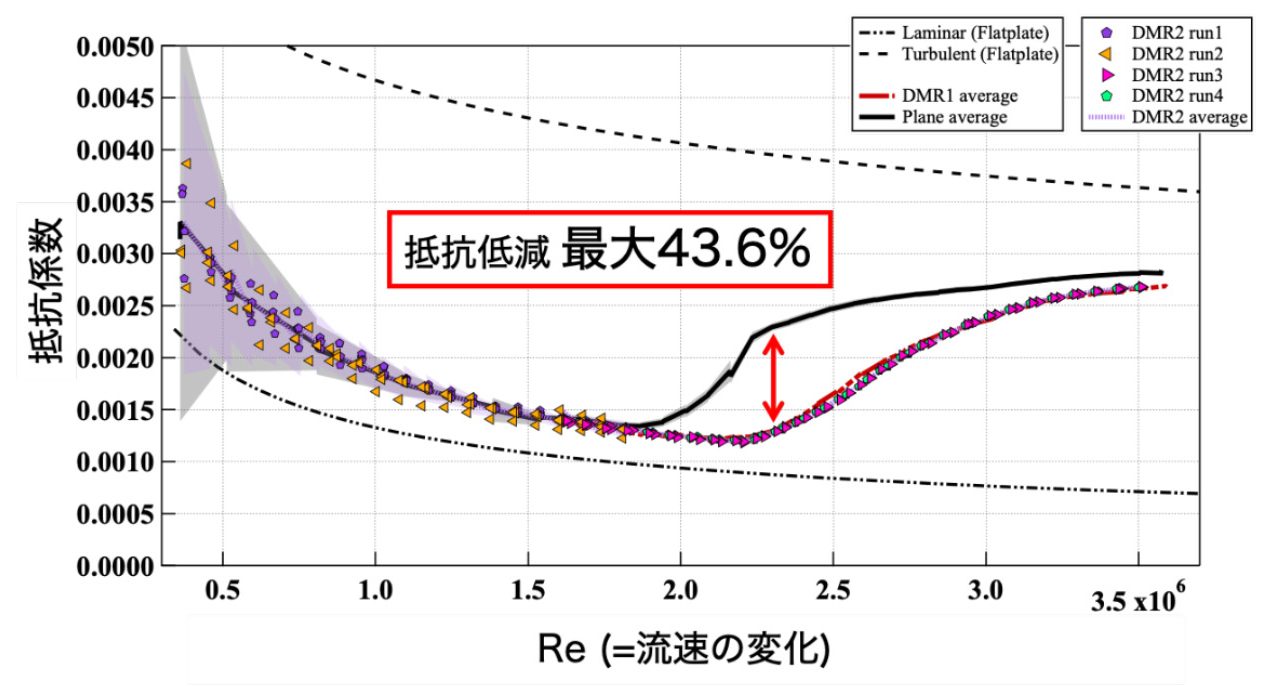
That’s right, the researchers found that a specifically roughened surface had dramatically less air resistance than a completely smooth surface, and this effect seems to be different than other observed surface-level effects, like the shark skin-inspired surface systems that use uniformly-shaped “denticles” to reduce drag. The microscopic roughness approach led to a “suppression of wall friction resistance itself,” which differs from other drag-reducing methodologies.
Part of what makes this study so interesting has to do with how the results were measured. Unlike most conventional wind tunnel tests that require support rods to hold up the models to be tested, which creates all sorts of turbulence, the team used a “1m Magnetic Support Balance (MSBS)” system that levitates the aero testing models with magnetic fields, and looks a bit like magic in photos:

See that rocket-like object hovering in the middle of the tunnel there? It’s actually levitating there, held in place by magnetic fields. This method allowed the researchers to take the precision measurements necessary to conclude the level of drag reduction happening with their microscopically-roughened surfaces.
So what could this mean for cars? The initial applications of this potential breakthrough seem to be targeted to the aerospace industry, but I don’t see any reason why this wouldn’t end up in automotive design. After all a 40+% improvement in drag is huge, especially for electric vehicles. So what could the application of these methods look like in cars?
If we look at how the surface roughening process is described in the paper, we can get some idea:
Note 1. DMR (Distributed Micro-Roughness): A surface texture characterized by the irregular distribution of random micron-sized fine irregularities across the entire surface. In this study, two types were used: a convex pattern using 38-53 μm glass beads and a concave pattern using sandblasting. Unlike the “turbulence-promoting roughness” that has been a problem in conventional roughness research, DMR is a new concept of surface texture that delays transitions and reduces frictional resistance under specific conditions.
So, based on this, a car body with these roughening methods employed would likely look pretty much like any other car, but there could be a sort of…matte effect to the surfacing? (That’s why I put that Kia EV4 in the topshot: it’s matte.) I’m just speculating here, but I suspect that while this surface roughening is likely too small and subtle to feel with your hand, it would affect how light plays upon the surfaces of the car, and I’d suspect the effect would be to diffuse the light, leaving a decidedly non-shiny appearance.
That seems a small price to pay for such a potentially dramatic decrease in drag, though. Besides, I bet some matte finish-looking cars could be pretty cool. They might even look a little velvety? And I bet when they get wet or icy the visual differences would be even more pronounced!
Some of you may be thinking that this sounds similar to the golf ball dimples experiment famously undertaken by the MythBusters crew, where they managed to make a car more fuel efficient via the application of golf ball-like dimples:
This is actually a very different effect to what is going on in the Tohoku study. Golf ball dimpling helps to reduce drag and increase lift due to a boundary layer effect, which is not the same thing that is happening in the study using microscopically roughened surfaces.
We’re likely years away from any automotive application of this research, but it’s fun to start thinking about it now.
Top graphic images: Tohoku University; DepositPhotos.com; Kia


Fun fact: those supports have a name – it is called a sting. And it isn’t just for support; you usually mount a force balance inside to measure aerodynamic loads directly. Some are even mechanized to move within the flow so you can get multiple datapoints for different AoA, speeds, etc. since shutting down the flow and changing config can be a costly, multi-hour affair. Anecdotally, I worked in the Propulsion Wind Tunnel 16T facility on Arnold AFB for a couple years, and one day during an outage, we calculated for fun that we burned about $7/second just in power and water costs. Wind tunnels are expensive so every second counts!
I’m not sure how their magnetic system works to get aero loads, maybe a pressure-sensitive paint and calculate back from that, I dunno… but hopefully they’d have some way to do so.
THIS ^^^ is why I love The Autopian
I suspect it’s through measuring current draw. It takes a certain amount of power to levitate and hold the test article in position. That amount of power would go up as the force on the test article increases, I.e. from higher drag.
I could see that, but that level of electrical engineering is beyond me to tackle as a mech/aero guy.
That said, a cursory look back at the picture of the tunnel shows red and blueish light arrays along the test section, which is a hallmark of PSP tech. I’d guess they use that both because you cannot put a force balance in, and because putting in pressure taps would be similarly burdensome.
Oui Magazine? A true gentleman, this Torchinsky.
Hasnt this more or less been proven in other ways, akin to the “golf ball” effect?
*Drives car through golf ball sized hail storm*
Well, obligatory: Aerodynamics are a thin excuse for the flush/motorized handles. Automakers do that because they want to.
As for the micro-roughness…wouldn’t that make the aerodynamics of a car very dependent on a specific surface finish? What if it gets dirty, worn, or damaged?
It sounds like a cool hack for getting better numbers in a clean testing environment that wouldn’t apply to real-world performance.
“shark skin-inspired surface systems that use uniformly-shaped denticles”
I mean, all you have to do is get a Fuel Shark! I am so impressed w/ mine and can’t believe how much fuel I save! It’s so amazing and unbelievably awesome!
When the blue light is on, I know I’m saving at the pump!
– I thought of the silly shark fin mobile antenna on aging BMWs 😀
So, vinyl tops? Richard Petty tried that once in the ‘60s IIRC. The top blew off during qualifying I think.
Petty was influenced by Chapman in that one. Lol
I thought this was already a known thing. It’s why there are dimples on a golf ball.
See the second to last paragraph.
Okay, so the matte paint car wash difficulties will need to be figured out. And also, can I have blocky chunkers if I use that paint?
If the Ioniq 5 people are to be trusted, it seems some of them with the matte finish take their cars through normal car washes without any issue. Others have them look blotchy.
“Yakeno and his team found that by applying “microscopic, irregular roughness (DMR) to the surface of a streamlined model” they were able to reduce air resistance by a staggering 43.6%! Let’s repeat that number, but in bold, just because that’s a freaking massive improvement: 43.6%!”
Yet another reason on a long list why NOT to wash the car this weekend…or ever.
I always heard stories about either an airforce or lockheed retiree I can’t remember which that was able to get his Corvette sprayed in the RAM paint. Ive heard rumors Kelly Johnson had one too. Alleged made it slightly faster but it just looked like dull black car.
RAM paint would be a horrible idea. It literally rusts in open air thanks to the high iron content. If even true, more likely they got a matte paint that was the same color as contemporary RAM.
Sharks have known this for a while. But if we can apply it to improve efficiency just a little, that’s good. Even small gains become large when applied across the whole fleet.
so if a car has orange peel it’s more efficient?
That’s why Lambos are so fast lol!
Research was sponsored by Maaco, which, coincidentally has updated their pricing to include a new max aero paint package.
Now I’m wondering if matte finish cars have different aerodynamic properties/efficiency from glossy ones. I know it would be negligible, but I bet there’s a difference.
It’s sort of like when the clear coat peels off.
“Some of you may be thinking that this sounds similar to the golf ball dimples experiment famously undertaken by the MythBusters crew”
Get out of my head, Torch.
I only skimmed this post until I saw the Mythbusters reference and was satisfied. Thank god!
Just wanted to point out that Aiko Yakeno is a lady professor, you may want to check the pronouns in the article
https://scholar.google.com/citations?user=a1btb-IAAAAJ&hl=en
Showed up to say the same thing.
Or, and just hear me out as I channel Toecutter for a minute, maybe we more sensibly size vehicles to reduce frontal area…
Noooo must have bigger Texas sized truck to hang my bull balls from!
As soon as I finished the article, I had to scroll the comments looking for Toecutter.
What if I enjoy full frontal nu…
oh, nevermind.
Cars? Maybe. Bicycles? Definitely. Every year they have to make last year’s bike obsolete so they can sell a new one this year. Marginal gains baby!
They’ve gotta sit at the desk instead of sitting on the bike, and having an upgrade to earn money for allows them to feel like it’s not time wasted.
Wow 43.6% improvement… but only between like 15-25mph when drag isn’t particularly significant force on your car.
Reynolds at 60 mph is around 7×10^6 and this design looks like it re merges with the baseline past 3.5 x10^6. Hard to say without data at those Re.
Bingo, oh those devilish details, and cherry picking one section of the plot. Seems like hail damage is possibly still the way to go. Or a really short car like a Smart car.
Hail damage for the win. Golf ball for free!
Thank you for actually looking at the plot and seeing where this would be applicable… Is also worth pointing out that skin friction, which is what this addresses, is only a small portion of the overall drag on a vehicle. The biggest contribution is the difference in pressure between the low pressure wake behind the vehicle and the high pressure “bow wave” in front of it
Great point.
Second devilish detail:
Your car’s surface is already micro-roughened. While the paint may be a glossy shine, as soon as dust clings to the surface, you have a ready-made micro roughness surface with a matte finish.
Although dust can range from nanometer scale (0.1um) up to almost 500um before falling out of the air, most air quality measures are <2.5 (PM2.5) and <10um (PM10) (not based on prevalence in the air, but based on sizes hazardous to humans). So, basically, as long as you drive or clean off the bulk dirt, your car probably gets a pretty good “Distributed Micro-Roughness”: “a convex pattern using 38-53 μm glass beads and a concave pattern using sandblasting.”
I’d like to see these same tests with a realistic surface that has just been covered with a clearly defined size of dust, and ultimately, just exposed to outside air for a while; and with a smooth versus microroughened underlying surface.
I expect the difference will be minimal once the dust covers/fills in the designed roughness.
However it would be interesting to see if the dusty surface better matches the smooth one, or the designed DMR surface here.
/See, I keep my car dirty for aerodynamic reasons.
So, the good splattering of mud and dust on the Bolt, and the caked on mud globs on the Jeep need to stay?
This would be an interesting study. I’ll let my buddy who has never washed his car in years know that he’s been ahead of us all in aero improvements.
Jeez. The gross misunderstanding in this comments section of a 43% reduction of drag on one surface and it’s impact on a vehicles fuel economy is concerning.
Forty-three percent is crazy good when you consider that at freeway speed, aerodynamic drag is 70-80% of the energy soak your engine is trying to defeat.
Or, looked at another way: the you’d only save 13bhp from what you need your engine to make when you’re cruising at 70mph.
but don’t cars need a surprisingly low (to me at least) amount of horsepower to cruise at steady state? Just saying that dropping 13 of those would be a significant improvement (if this actually worked).
A Corolla takes 25hp and an F-350 takes 75 iirc
Yes. It takes just a fraction of the engine’s maximum output to maintain steady highway speeds. That fraction goes up exponentially with the speed though, which is why just modest speed reductions yield big economy improvements.
Imagine if, for instance, a BMW i3 REX’s engine output was sufficient to not just extend the range of the car once the battery expended, but sufficient to maintain cruising speed indefinitely?
Or looked at another other way, my 47 miles of EV range could be 60. That would be major.
Okay, so let’s add the microscopic roughening to golf balls!!! Hello 500 yard drives. Why do I think Aiko Yakeno is about to cash a big check from Titleist?
This is old news to golf balls.
The jury on carb intake flanges for 2-stroke engines has been out for more than half a century, and will probably outlive it. Should it be polished or rough, should the flow ride on polished walls, or on the boundary layer… hasn’t this been a thing forever?
Ok, not really a big discovery.
All this is 100+ year old knowledge. What is happening is that this rougher surface causes the transition around 2100 instead of 3000, which isn’t unexpected.
For a complex shape, like a plane or a car, the Re is not a constant. There will be some areas where the Re is below 3000 at highway speeds and you might see some of dull areas added to cars and planes to make this turbulent instead of laminar flow. However, this will be for specific areas based on complex testing and analysis. Painting the entire card suede will increase the surface roughness of the car and increase drag on any area that has a Re over 4000 or so.
If you look at a car made since around 2010, you can find tiny triangle shapes hidden on it. A great place to look is the outside corner of your taillight and on the door by the mirrors. These tiny little things are not style, but function. They make vortices that hold the air against the car longer so it punches a smaller hole int he air. Basically, they act like the dimples on the Mythbuster car, only without making the car look silly. I expect you will find rough patches on cars around 2035 based on this discovery and you might see around 5% lower drag as a result.
Re is in the millions. Check the units on the figures.
But otherwise, yeah, drag considerations are different on a car than an aircraft wing.
The millions must be wrong. This is clearly a transition to turbulent and that is int he 1000s I suspect it might be a log scale in the bottom.
The paper uses the definition of Rn as a function of length. This is the typical definition used in plane aerodynamics and ship hydrodynamics, as opposed to the common textbook definition which uses diameter (normally pipe diameter). Transition happens at 10^6 (order of magnitude) when you use this definition
Ah, I’m used to piping.
Plus, skin friction is only a small fraction of aerodynamic drag anyway, the majority is the difference in static pressure front to rear… This may help minimize the low pressure wake slightly, but it won’t be a 43% reduction
Skin friction would likely go up with roughness based on what I know. The big thing I see is that when you are in the laminar region, you can predict the drag, and when you are in the turbulent region, you can predict the drag. Some small areas that force the flow to go from laminar to turbulent at a specific place to make everything more predictable might be very useful.
While I can appreciate that this is a “different effect” than the dimples on golf balls and the MythBuster’s car, I think it is hard to differentiate the 2. It has been decades since I watched that episode (though it is my favorite) but it may have included the tailgate down vs tailgate up MPG question which I believe equates to the same as dimples on a golf ball. They both “trap” air into a pocket that makes it easier for other air to travel around.
The other thing I “think” I remember from that episode is the myth that a dirty car gets better MPG than a clean car. I don’t remember if they tested that or just took it to the extreme with the dimples but I would argue that a dirty car would in fact be the same effect as DMR (irregular microscopic roughness), just likely on a larger scale, due to the irregular nature of a dirty car. I think in this scenario, air is not trapped per se, I think it doesn’t have an easy path (due to the surface irregularities) to get trapped or hold on to the surface and that is how the car ends up with less drag.
If you look at a modern car (say 2010 or later), you will find tiny triangles or fins if you know where to look for them. These are vortex shedders that act to hold the air up agains the car longer. A common place is between the door and the mirror which sucks the air being blow off the mirror back closer to the car side or on the tail lights to suck the air back behind the car. Aerodynamics on cars have advanced a ton since Mythbusters.
Saw a older civic the other day with CT vortex generators stuck across the trailing edge of the roof, a few choice other choice spots and the rear fenders. Got a Popular Mechanics vibe from the thing.
Cars maybe.
Pickup trucks and SUVs however….
There’s a lot of details you don’t realize. A 2000 Ranger has a drag coefficient of 0.49 A new F-150 has a 0.39 coefficient. Sure the much bigger frontal area offsets this, but still, Ford did a lot of work there to make a pickup a more slippery.
Where you really see it is actually where you hear it. 70 mph in an old school pickup is loud with lots of wind. It’s 10x quieter in a modern pickup. When you are making noise with the air, you are wasting energy.
It’s still as you point out a giant brick of pedestrian smashing frontal area when compared to a car though. It’s just a somewhat rounded brick compared to the older, squarer giant bricks.
The old Ranger looks more rounded than the new F-150. The little details are more important than overall shape.
But yeah, still a giant frontal area on the F-150 so the 20% reduction in drag coefficient is more than offset by the bigger frontal area.
The details on Aero are not as obvious as you would think. The P-51 was faster than the Spitfire with the same engine. History books will tell you it’s because the wing was more advanced or the radiator. These details are all true, but that isn’t the smoking gun.
The P-51 is a bit of a coke bottle shape on the side, just where the Spitfire is a bit plump. It’s not a huge difference, but it’s there. The propeller produces vortices that that line up with the slight narrowing of the P-51. This allows this swirl to just miss the side of the P-51 at this once place it hits with the Spitfire. From what I’ve seen, this makes more difference to the performance than all the other things everyone knows about with the P-51.
So back to this “breakthrough”. Someone will use it to do a transition from laminar to turbulent flow in a critical location of a vehicle that will reduce that local drag effect or cause the air to stick to the vehicle a little better and thus reduce drag. By 42%? No, but with all the other little tricks of the trade, enough to make it worth the effort.
Well it all comes down to MPG doesn’t it? Which vehicle will do the job on the least amount of energy. If that job is towing 20,000 lbs of trailer there is only one answer but if the job is getting one worker with only a briefcase as cargo to the office as comfortably as possible strictly on well paved roads then the answer is probably a car regardless of how slippery the giant truck/SUV is.
It comes down to money. Say you drive 10k miles a year. You need a truck occasionally. If you only drive a 20 mpg vehicle you use 500 gallons of gas. While a 40 mpg vehicle is 250 gallons. Maybe $1000 a year difference is fuel. Is that worth getting a second car or renting a truck when you need it? That’s a question for each owner. Now is the truck is 10 mpg, the math changes. The manufacturers know this and thus do what they can to get 20 instead of 10 mpg
“You need a truck occasionally”
I think one would have to need a truck more than occasionally to overcome the other shortcomings of such giant vehicles, at least for sub/urban drivers. Lower fuel economy is but one such shortcoming. Parking, visibility, maneuverability and crash injury liability are four I can think of.
For me the usefullness of a giant truck or SUV would be overshadowed by it’s inability to fit in a standard garage or on a short driveway without spilling out onto the sidewalk. If I lived in a city that probably wouldn’t be an option but then it’d be street parking and I can’t imagine finding a spot to fit, or getting into a tight parking spot in a crew cab F150 is easy.
If however one is actually living the rural construction/cowboy/military badass/RVnomad life of a truck commercial where truck stuff is a daily, more power to them.
To each their own.
There’s someone around me that daily’s a Viper GTS. His fuel economy for daily driving must be horrible (10 or less). For driving around town, I expect the Viper isn’t as comfortable riding as my old Camry and I expect the clutch is a lot stiffer too. I also expect, I could fit more groceries in my Camry too.
However, I absolutely see the appeal of daily driving a Viper. Sure, it might cost an extra $200/month in gas (or it might not depending on driving habits) and I’m sure the insurance is a lot higher. But… I think if I had a Viper, I would daily it more days than my Camry.
Now back to trucks. Trucks have an appeal on how they drive to a lot of people. There are likely a lot more people that would rather drive a F150 around than the sort of car I would pick first *. Sure it costs them more for gas and insurance, but if they like driving it, then they like driving it.
*. I would likely not pick a Viper as the first choice on a DD. I would lean towards something like a 4C, Cayman, or Elise. Which when it comes to how much crap you can put in them after a run to Costco would get thumped by a Viper.
Not me. I wouldn’t be able to look a kid in the face driving a Viper or an F350 knowing my 10 mpg DD is my having fun at their expense.
As an occasional weekend driver and garage queen maybe but only if I had plenty of covered parking for it.
(That and a 50 mpg Camry is going to be much more comfortable than either a Viper or a truck for the daily grind of a commute.)
If you don’t drive a lot, the impact on the kid is going to be a significant percentage of nothing. Say you drove 20k/ year. A 50 mpg vehicle vs a 10 mpg is 1600 gallons of gas. But if you drive 2k/year, then it’s only 160 gallons of gas, which is not world changing.
That being said, there’s a saying I’ve heard that goes “horses for courses”. Most commutes are boring. The Viper I see drives just like I do on the same roads. I assume he has just the same amount of fun I have, which is to say none at all. My boring Camry is fit for my boring drive.
Racking my brain, the only car I can think of that would make my drive interesting would be a Lotus 7. But interesting as in “will I fit in the car today?” or “will I need someone to disassemble the car to get me out?” or “Crap is it going to rain?” doesn’t sound like fun.
2k a year is 38 miles a week which I think falls under weekend toy. And I’d argue 160 gallons of gas a year can be quite world changing. Ask anyone who has to work a farm or just get through life without it.
FWIW I used to commute in a Triumph TR3. If you want to make your commute interesting, well that’s your car. You get to experience sounds and smells you forgot existed, extremes of hot and cold, wet and dry all at the same time. Your clothes will have stains you’ll never quite get out. And when the battery dies because of course it will you’ll either have to get some friends to help you push start it or if you’re feeling very brave you can try to start it with the hand crank.
The good news is last time I checked they were still surprisingly cheap, as are some other old British sports cars. Sure you’ll have to put work into it, probably a lot of work but that’s all part of the experience isn’t it?
If that’s not your bag I know a guy who can build you a WW2 Jeep from eBay parts.
Lotus 7s, especially the “LoCost” homemade things can be cheap as hell.
I’m like you, I would do weird and tiny (if I can fit in it) for a DD before a pickup. But I disagree that under 200 gallons of gasoline is life changing. The real problem is the longer distance drivers.
My big thing is people that get a capability that they can’t use. “I don’t want a 38 mpg minivan because I plan on towing a boat. So that’s why I have a 17 mpg body on frame SUV.”
“Do you own a boat?”
“Not yet, I can’t afford to get one because all my money is going to payments and gasoline.”
It’s hard to keep your mouth sealed there.
To you 200 gallons of gas may not be life changing. To an African or east Asian motorcycle taxi driver it’s their whole livelihood. To a family it’s the difference between motoring stuff home and carrying it on foot through the mud. I’d call that life changing.
Those motorcycles can get up to 120 mpg BTW so that energy literally goes a LOT further; 24,000 miles vs just 2000 in a Viper. And the motorcycle can move an entire family plus stuff vs just one plump American heading into the office.