


For modern car design, aerodynamics are important. Incredibly important, even. Why else would carmakers spend so much time making aerodynamically-sound flush door handles that are overcomplicated garbage otherwise? Or those tiny fins and vortex generators molded into taillight lenses or all of the time and effort spent in wind tunnels fine-tuning and refining, all so a car can be as slippery as possible through the wind? A car with a low coefficient of drag is a more efficient car, and a more efficient car goes further on a drop of gas or a battery cell. And that means more range, which, for electric cars especially, is the kind of magic number car buyers love to look at.
Now that you’re thinking about that, reach over to your nightstand and find in your big stack of Field and Stream and Oui magazines the latest issue of the Journal of Fluid Mechanics, the May 7, 2026 issue, which has a paper from Associate Professor Aiko Yakeno of the Institute of Fluid Science, Tohoku University. This paper is interesting because it knocks on its ass over 80 years of accepted aerodynamics beliefs, specifically the idea that smoother is always better.


Yakeno and his team found that by applying “microscopic, irregular roughness (DMR) to the surface of a streamlined model” they were able to reduce air resistance by a staggering 43.6%! Let’s repeat that number, but in bold, just because that’s a freaking massive improvement: 43.6%!
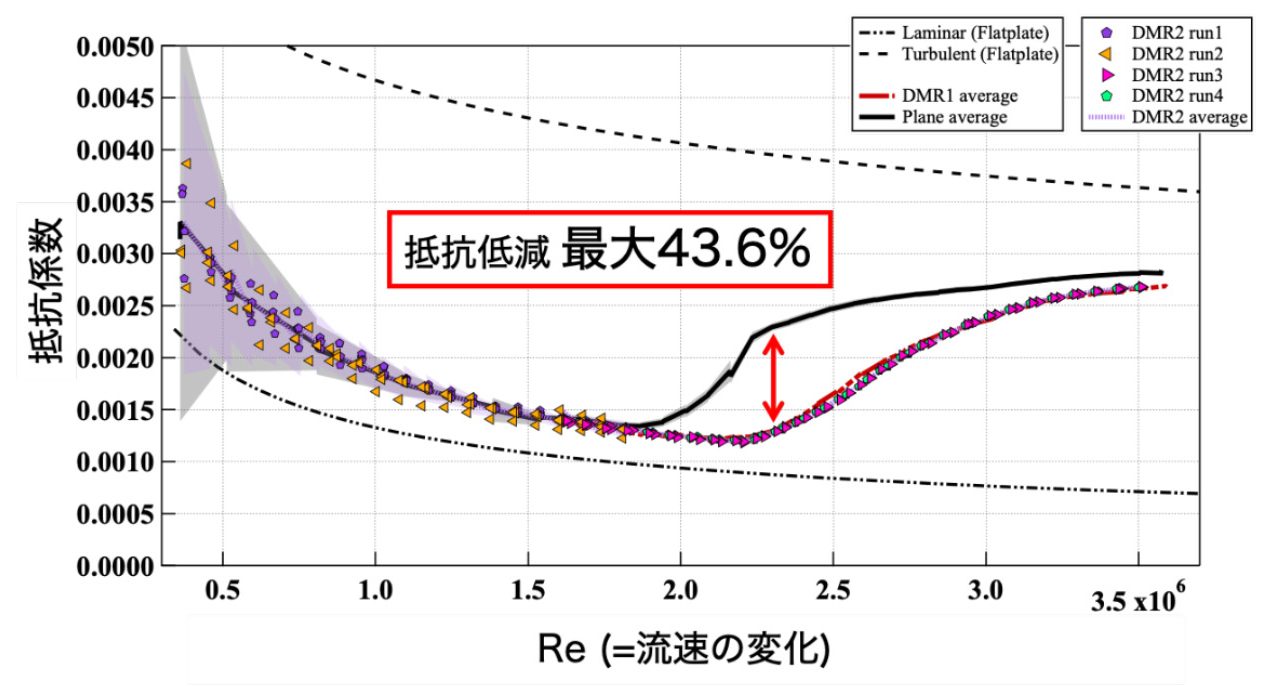
That’s right, the researchers found that a specifically roughened surface had dramatically less air resistance than a completely smooth surface, and this effect seems to be different than other observed surface-level effects, like the shark skin-inspired surface systems that use uniformly-shaped “denticles” to reduce drag. The microscopic roughness approach led to a “suppression of wall friction resistance itself,” which differs from other drag-reducing methodologies.
Part of what makes this study so interesting has to do with how the results were measured. Unlike most conventional wind tunnel tests that require support rods to hold up the models to be tested, which creates all sorts of turbulence, the team used a “1m Magnetic Support Balance (MSBS)” system that levitates the aero testing models with magnetic fields, and looks a bit like magic in photos:
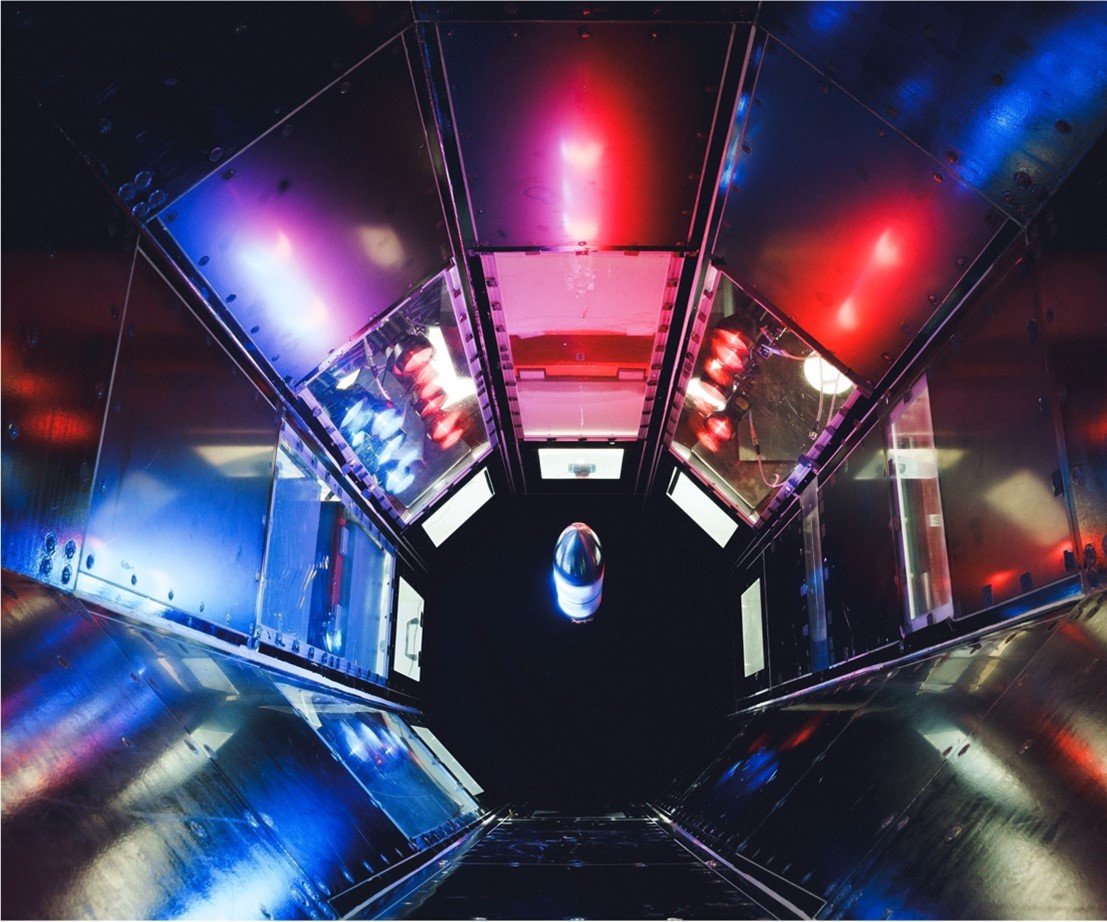
See that rocket-like object hovering in the middle of the tunnel there? It’s actually levitating there, held in place by magnetic fields. This method allowed the researchers to take the precision measurements necessary to conclude the level of drag reduction happening with their microscopically-roughened surfaces.
So what could this mean for cars? The initial applications of this potential breakthrough seem to be targeted to the aerospace industry, but I don’t see any reason why this wouldn’t end up in automotive design. After all a 40+% improvement in drag is huge, especially for electric vehicles. So what could the application of these methods look like in cars?
If we look at how the surface roughening process is described in the paper, we can get some idea:
Note 1. DMR (Distributed Micro-Roughness): A surface texture characterized by the irregular distribution of random micron-sized fine irregularities across the entire surface. In this study, two types were used: a convex pattern using 38-53 μm glass beads and a concave pattern using sandblasting. Unlike the “turbulence-promoting roughness” that has been a problem in conventional roughness research, DMR is a new concept of surface texture that delays transitions and reduces frictional resistance under specific conditions.
So, based on this, a car body with these roughening methods employed would likely look pretty much like any other car, but there could be a sort of…matte effect to the surfacing? (That’s why I put that Kia EV4 in the topshot: it’s matte.) I’m just speculating here, but I suspect that while this surface roughening is likely too small and subtle to feel with your hand, it would affect how light plays upon the surfaces of the car, and I’d suspect the effect would be to diffuse the light, leaving a decidedly non-shiny appearance.
That seems a small price to pay for such a potentially dramatic decrease in drag, though. Besides, I bet some matte finish-looking cars could be pretty cool. They might even look a little velvety? And I bet when they get wet or icy the visual differences would be even more pronounced!
Some of you may be thinking that this sounds similar to the golf ball dimples experiment famously undertaken by the MythBusters crew, where they managed to make a car more fuel efficient via the application of golf ball-like dimples:
This is actually a very different effect to what is going on in the Tohoku study. Golf ball dimpling helps to reduce drag and increase lift due to a boundary layer effect, which is not the same thing that is happening in the study using microscopically roughened surfaces.
We’re likely years away from any automotive application of this research, but it’s fun to start thinking about it now.
Top graphic images: Tohoku University; DepositPhotos.com; Kia



So you’re saying that MAACO orange-peel paint job is actually beneficial?
HA! That’s a good one.
You know, this makes total sense. As my cats have gotten older and the clear coat faded and wore off, leaving just the tough paint underneath, I swore that the gas mileage got slightly better.
Either that, or I started driving more carefully to keep stuff from breaking…
“As my cats have gotten older[…]” I was expecting some type of ridiculous joke about housecats and the zoomies.
You should look into getting your cats repainted,they will thank you.
The paper is quite impressive, but I think it’s extremely important to explain that this 40+% drop isn’t interesting for car-related applications at all, for two reasons:
1. Aerodynamic drag has two main components: skin friction and pressure drag. The reduction described in the paper is for the skin friction drag. In the geometry of the paper, 75-80% of total drag is skin friction, and the remaining 20-25% is pressure drag.
On cars, this proportion is quite the opposite: most of the drag is caused by pressure, and only a small part by friction. Reducing 40+% friction drag would reduce 5-10% total drag depending of the actual shape (which is still quite impressive!), but:
2. The reduction of 40+% is for a quite specific Reynolds number range around 2.3×10^6. For a 5 meter car, that Reynolds number is equivalent to 25 km/h (about 15 mph), which is a completely irrelevant speed from an aerodynamics standpoint (in car design). At 100 km/h (about 60 mph), the Reynolds number would be about 10^7 (fully turbulent), and there’s no way to apply the principles described in the paper there.
One last thing: this may be very, very interesting for wind energy, drones, small boats, autonomous underwater vehicles, among many other applications! I do research on ship hydrodynamics and renewables and it’s been a long time since I hadn’t seen such a promising thing in this topic. Thanks Jason!
Also, let’s think about real world application… “irregular distribution of random micron-sized fine irregularities across the entire surface”. Micron-sized irregularities says to me the surface would have to be perfectly clean, and would have to be kept perfectly clean at all times for this to be applicable. No dust, no pollen, no oil and rubber road grime. Also, wax or ceramic coating would obviously be a no-no. So, would it need a deep clean washing and rinsing with demineralized water every day?
All advantages completely lost after first application of wax.
“under specific conditions”
I suspect that small phrase is carrying a lot of weight here. Like golf-ball dimples, people tend to think stuff like this is an aero cure-all when it’s really a hack for very specific situations.
I wonder if such a surface treatment could be applied strategically to certain areas of a car’s body. No need to coat the whole thing if it’s cost/labour prohibitive, or, as mentioned below, plastic molding is a challenge.
Per the study the glass beads were 38-53μm (microns) in diameter; compare a human hair at 70μm. 320-grit sandpaper has a particle size of 46μm. The surface is no doubt noticeably textured.
Something else I found interesting in the study is that “the facility has been extensively utilised for measuring aerodynamic forces on blunt objects”. This implies that sticking an appropriate scale model of a Honda Acty in the thing is entirely possible!
It is lovebug season here in FL. So the insects that are splattered all over my front end and windshield are helping my fuel economy? Excellent!
I was in the Florida panhandle once for a week while those things were around. And I mean around everything, everywhere. I mentioned the bugs all over my rental to someone from the company I was visiting, and he said, “oh yeah, those are f*ckbugs.”
“Lovebug” is the kinder, gentler term for them, but yeah. They are a mess!
I’ve heard F&K bugs, because everywhere you see F you see K
This is all well and good if the vehicle is clean, but with the aerodynamic features being so tiny, how does normal soiling say from air pollution affect the results?
And how does one maintain it? I don’t imagine a coating like this would play very well with wax, much less polishing compound.
I suspect it’ll be very useful in aircraft, where the majority of the operation happens far above the dust and grime of the Earth, paint appearance doesn’t matter to the end user and any extra maintenance would be totally worth it for the fuel efficiency, but I’m a little skeptical of its application on cars, where the end user cares quite a bit about keeping it pretty.
Or, thinking the other way, does a thin layer of pollen, dust, etc. actually show a similar effect?
I believe other studies have shown that clean cars get better mileage so there must be something about the roughness in this study that differs from just normal dirt/dust.
Stop washing your cars, everyone!
I imediately thought of the legendary Mythbusters golf ball car experiment, so thanks for clarifying 🙂
I always liked non shiny cars, and have from my architectural studies long ago developed a love for matte graphite paint, which is definately going on one of the cars at some point. And now I have another excuse to do it. Great!
– AND yet another reason to never wash your car with the regular old shiny paint 😉