

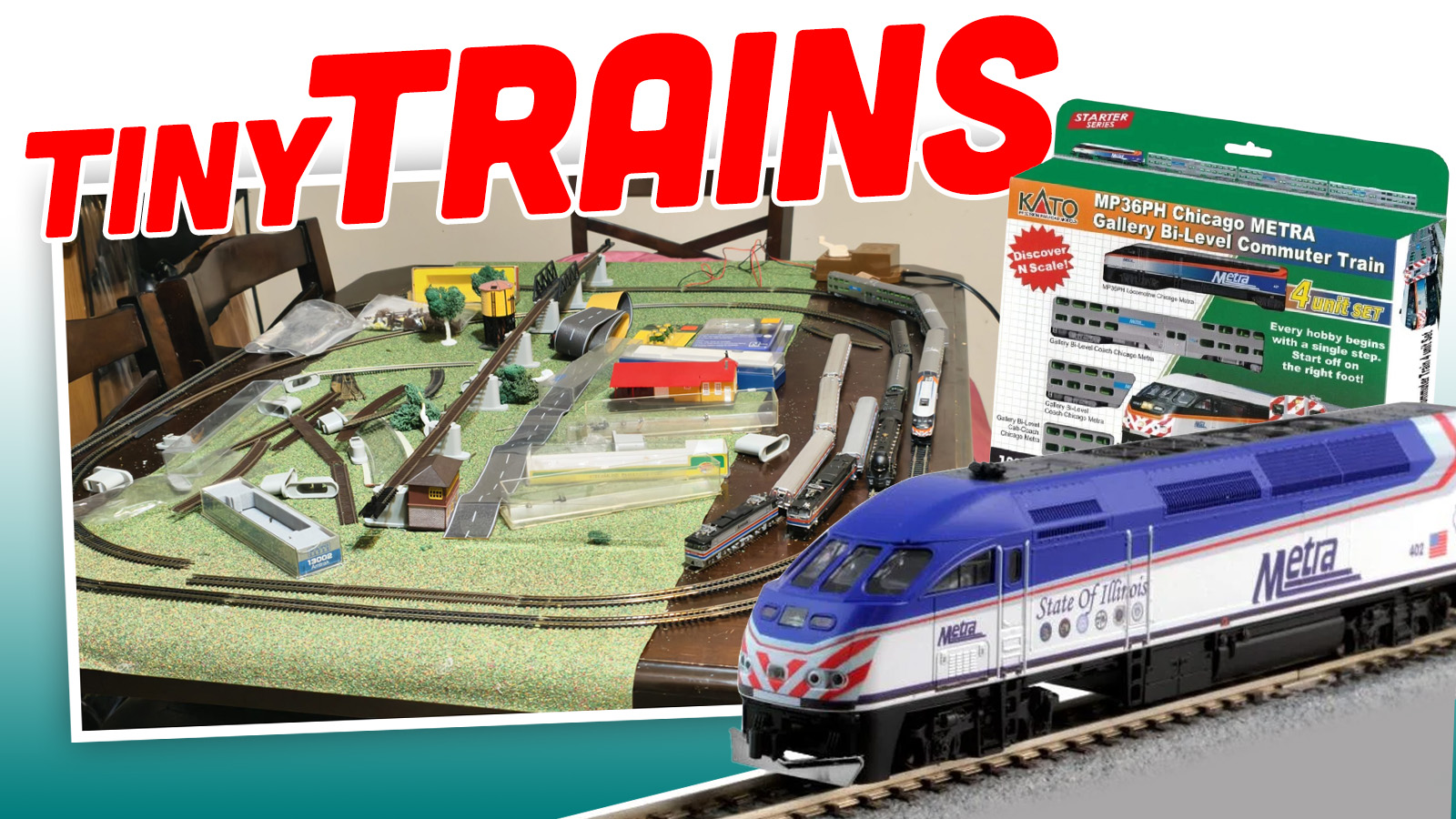
Like any lifelong railfan, I’ve been addicted to trains since I was a kid. I can prattle on all day about my favorite Chicago Metra locomotive, or about how Chicago became the rail capital of America. Usually, I just use The Autopian as my outlet for the thoughts rattling around in my brain. Recently, I finally took my enthusiasm down to the small scale. In doing so, I’ve discovered that tiny trains are gloriously fun, but also ludicrously expensive. I think I’ve spent more on scale trains than I have on my last car repair.
I don’t know when the exact moment was that I fell in love with trains, but I do know it happened in my childhood. One of my favorite things to do as a kid was to watch Wisconsin Central freight trains passing through Lake County, Illinois. The images of those red and yellow locomotives remain burned into my memory more than two decades later. Nowadays, I find myself going to that same depot in Antioch, only now the trains are emblazoned with Canadian National logos.


As a kid, I had this dream of having a giant table with a scale replica of parts of Chicago and its surrounding areas on it. In my head, I’d have the Sears Tower as the centerpiece, O’Hare nearby, and lots of HO Scale trains buzzing around. I pictured this layout having functional street lights and red lights, moving cars, and those Wisconsin Central trains, but tiny.

My dream never happened. The closest I came to it was an HO Scale Santa Fe locomotive pulling some cars around an oval track sitting on the carpet of my bedroom. I had some great fun with that train. I remember putting Matchbox cars in the boxcar and in the gondola car, then seeing how the train performed with the extra weight. I also remember tying things to the caboose to see if the train could pull it. I think I also messed around with the switch to the point where I made the poor locomotive drift, causing sparks as it slid sideways.
Then, I grew up.
At some point, likely before I even became a teenager, the trainset was either discarded or given away. I then started paying attention to other things, like powersports, ships, aviation, and video games. I never forgot about my love of trains; only now, I was making skins for locomotives in Microsoft Train Simulator (below), on top of being obsessed with the Boeing 747, the CRJ-700, the RMS Titanic, and countless hours in driving games. I also never stopped wanting that train table, but it stopped being a goal or even something I had planned.

Now, so much time has passed. It’s been at least 24 years since I had that train set, and about equally as long since I even attempted to work toward that dream of a train set. But my recent years getting involved in real trains have reignited that old desire.
Taking My Train Obsession Down Some Sizes
If you’ve read my work for long enough, you know that I have been writing about the Illinois Railway Museum (IRM) pretty extensively since 2022. I seemingly write more about IRM than train magazines do. It’s gotten to the point where the museum’s volunteers know me by name and ask me what I’m going to write about after that visit. I guess I’m that predictable.
One of the parts of IRM that I haven’t given much attention to is the museum’s model train display.

Nestled near the entrance of the museum is a large room full of train sets of all scales. There’s a beautiful HO Scale layout in the middle of the room, and it’s flanked by N Scale, O Scale, and even ridiculously tiny T Scale train sets. Over the past four years, IRM’s model trains, as well as some model train events I’ve gone to locally in Illinois, have been filling my head with ideas.

Coincidentally, my wife also has a thing for model trains. She actually built a fully-functional model train layout as a kid, then her parents destroyed it when she moved out. Yet, for us, model trains have always been something to enjoy from a distance. Our apartment was just too small to accommodate a train. We always thought that it would happen “someday,” likely when we moved into a house.

However, since I just spent $23,000 on fixing my teeth, with another $15,000 bill due a year from now, our house plans got delayed just a little longer. At the same time, we also did a major summer cleaning, which saw us donate tons of stuff that we haven’t used in years. We cleaned out so much stuff that I was finally able to move my car part projects from the dining room table back to my actual workbench. However, ironically, my wife and I have gotten so used to eating at our little tables in the living room that we never started using the kitchen table again.
That’s when my wife had a brilliant idea. If we’re not going to use the kitchen table to eat, and we aren’t going to sell it, why not use it for trains? I knew I loved this woman. Using the table to support a train layout actually makes some sense. It’s not exactly a high-quality table, nor is it valuable or a family heirloom. I got it from Big Lots when I moved into my first apartment. It also has easily removable legs, making it portable for when we do move.
Model Trains Are Tiny, But Awesome
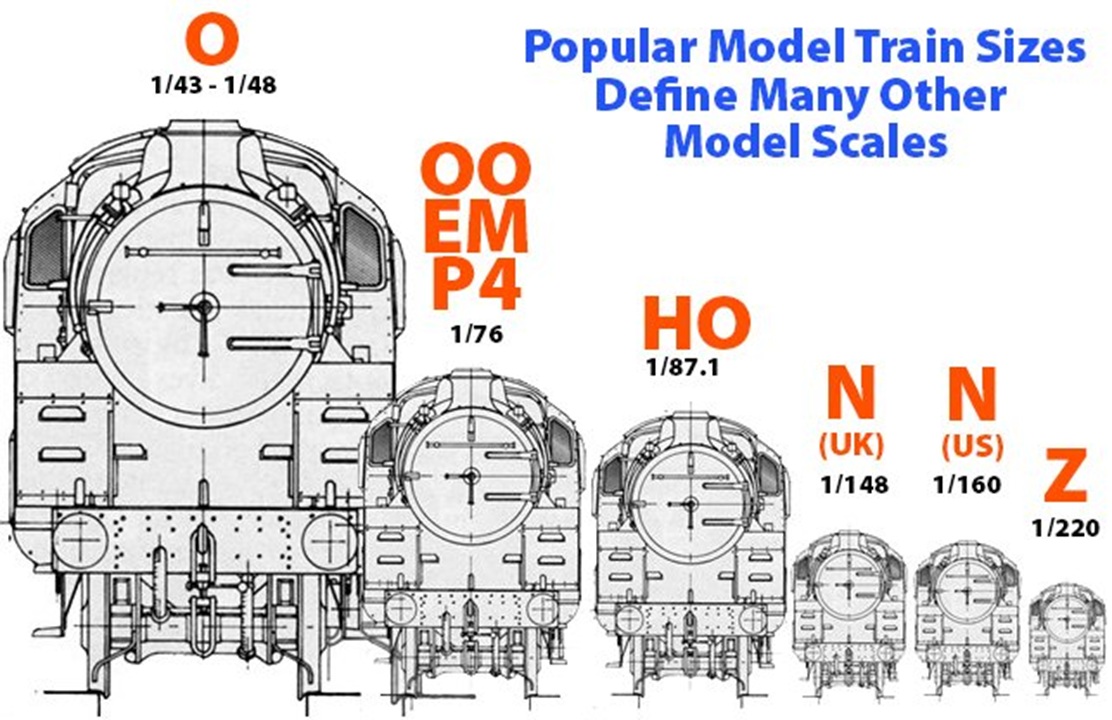
First was choosing a scale. The most popular scale is HO (1:87), but it’s a touch big if you’re limited on space. The second-most popular pick is N Scale (1:160), which is roughly half the size of HO. You can go smaller, but you’ll find the biggest selection of rolling stock, scenery, and other bits in HO or N. A kitchen table for four is still a small space, so in order to have something a bit more exciting than a tight loop, we chose N Scale.
Sheryl then went nuts. IRM’s volunteers and visitors often donate old model train pieces to the museum, and they’re resold to the public to support the museum’s mission. We love giving back to IRM, so Sheryl brought home a ton of track and other odds and ends from IRM’s model train store. I’m pretty sure all of the track you see here isn’t worth more than $25.

At first, I thought this model railroading thing was going to be cheap, but that faded away very quickly. When it came time to buy rolling stock, IRM’s train store wasn’t much help, as most of its equipment was either broken or not N Scale. So, we took to eBay and local hobby stores.
Sheryl’s favorite locomotive as a kid, and as an adult, is the Norfolk and Western Class J. As a kid, she had one of these in HO Scale from Bachmann Trains, so she wanted her favorite train back. We were stunned at the price. That locomotive will set you back $519 today. A working one on eBay is about half that.

Sheryl rolled the dice and spent $49 on this example. It’s in excellent physical condition, but did not pass my bench testing. Older Bachmann locomotives used nylon gears. This was an affordable solution to keep costs down, but terrible for longevity. Over time, the gears shrink, then eventually crack or shatter. When this happens, the locomotive jams up. Sure enough, that’s what happened here.

This is a well-known issue, and while people have brought some of these locomotives back, I’ve been told that it’s generally considered to be “fatal.”
Another issue that this locomotive has is a broken wire on the rear truck. Since the locomotive gets power from the truck, the wire will need to be soldered back on before the locomotive can even travel further than an inch. I can handle that without a problem. I will see if a hobby shop can help me fix the gears, however. Otherwise, it’ll be parked as eye candy on our layout.
Sheryl has since purchased three more used locomotives. None of them were over $75, but all of them are broken in some way.
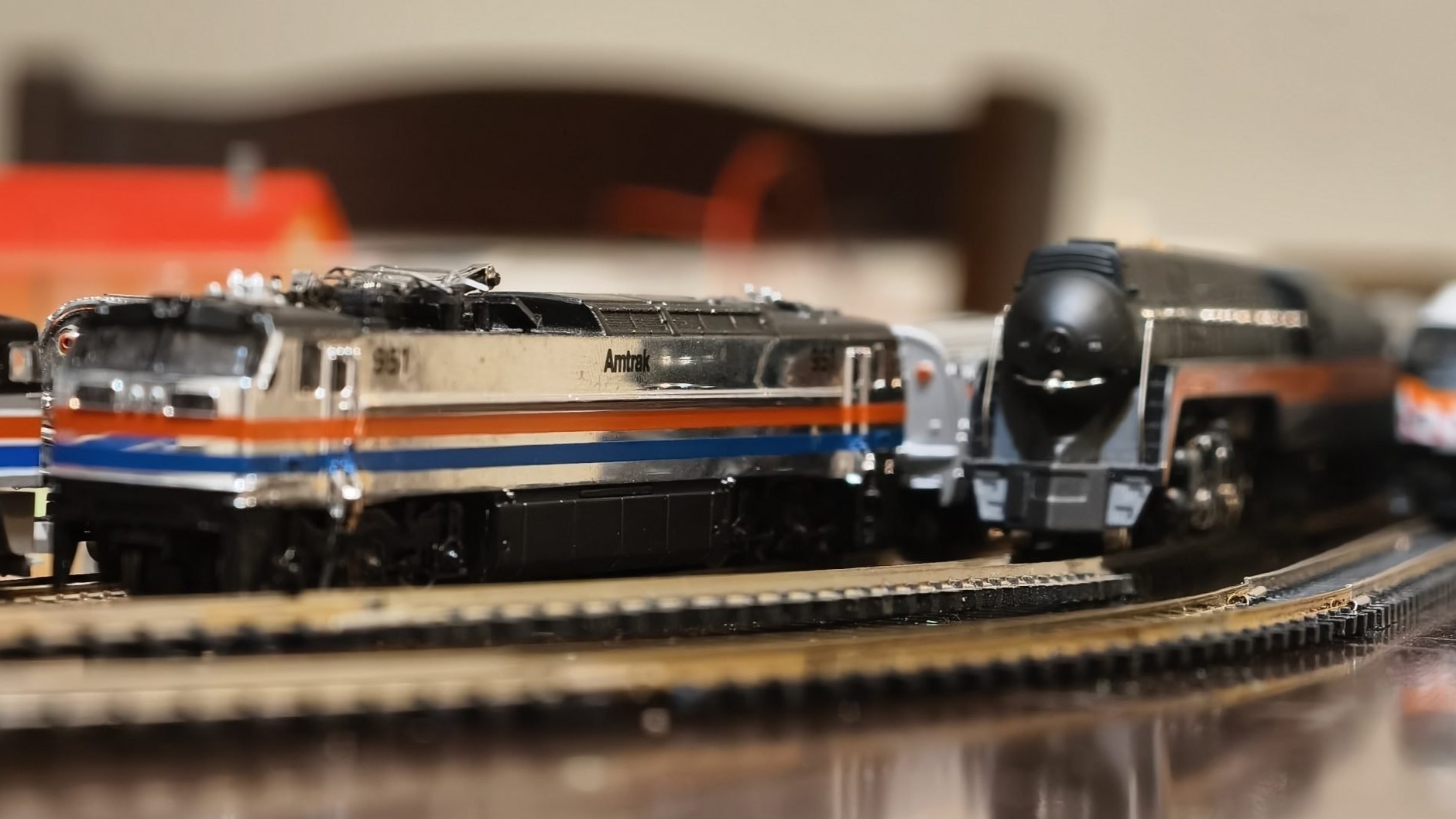
One of her favorites is this Kato Seibu Class E851 (below), which is painted in a fantasy Amtrak livery. She then paired it with some used passenger cars from eBay. Even this semi-broken locomotive, with its missing coupler and loose center truck, was still $75.

To Sheryl’s credit, all three of the extra locomotives run quite well, and their damage will not be difficult to fix. Only the Class J is incapable of pulling a train right now.
Still, after seeing Sheryl’s fleet of well-used trains, I decided to get just one starter train, but in new condition. I am obsessed with Chicagoland’s commuter rail line, Metra (Metropolitan Rail), so I decided to get Kato’s Metra starter set. It has an MPI MP36PH locomotive, a common sight in Metra’s fleet, two bi-level gallery cars, and a cab car. These four tiny pieces? $170 after tax and shipping from eBay. Apparently, that’s cheaper than getting it directly from Kato, which wants $235.

That was the “cheap” one. Had we gone HO scale, replicating this train would have cost me more than $600. Yet, even for the affordable interpretation of Metra’s common rolling stock, the details blew me away.

Look at all of the extremely tiny parts of the locomotive.

Each car has an interior and can be wired to light up inside. The cab car is lighted, so that it can be used in reverse, just like the real deal.

As crazy as the price seems to be, the money does seem to pay for something tangible. I’ve been told that Kato is not a flagship brand when it comes to visuals, just one known for great reliability and precision on the mechanical side of things. Well, color me a fan.

The Cash Adds Up Fast
Adding everything up you see on the table here, you’re looking at about $600 or so, which is more than I spent to do the front wheel bearings on my wife’s Volkswagen Jetta. Mind you, everything on this table, but the track bed (off-screen) and my Metra consist, is used. Had we purchased all of this new, we would be in at least double. I mean, a new J Class alone is $519.

Ultimately, we will be going new for some parts, anyway. The track we have does work, but isn’t super reliable, even after cleaning. Before we secure the track down and start building up, I want to make sure the trains can complete laps without stuttering. I also want to upgrade our crappy power supply to something better.

Out of curiosity, I asked the proprietor of a local model train store how much he spent on his layout, which wasn’t much bigger than our kitchen table. He chuckled and said, “tens of thousands.” His business partner pointed to a layout with easily twice as much, if not more, detail, and said his was going into the six figures.

Everything in this hobby is expensive, from rolling stock and buildings to just basic materials to make the layout look like more than just a train circling a bare table. There are a lot of bits with price tags that start in the three-digit range, and it’s just going to be one of the very many expensive bits you’re going to have on your layout.

The minuscule tractors above? $10! I mean, yes, that’s not a lot of money in the grand scheme of things, but I’ve come from a world of buying standard Hot Wheels cars for around a buck, or maybe a nice Hot Wheels car for about the same price as these tractors. These things are so small, they can park on a fingernail!
But, thankfully, as the kind gents running the store told me, beginners rarely spend that much money on their first layout. His advice was just to get a basic trainset going. It doesn’t matter if it’s rough. Just get it running. Then, enjoy it for a while, and then upgrade it over time. There’s no need to blow crazy money right away. He pointed me to an example layout in his store that was done on a tight budget – under $1,000, as I recall:

Low-Stakes Fun
So, that’s the advice we’ve taken. We’re just getting the layout running, then we’ll build from there. Our general plan is to have some sort of elevated line and a pair of tracks for my Metra and Sheryl’s Amtrak. We’re sort of going by trial and error as we go, which is fine. It’s fun figuring out what happens next!
I also love it because, at least thus far, it’s a low-stakes hobby that’s great for a couple. It’s not like cars or motorcycles where you’re changing oil, paying for insurance, paying for repairs, and paying for storage. And if something breaks, it’s not the end of the world. It’s especially fun because I love hearing what ideas Sheryl has for the layout. I don’t really modify my cars or anything, so that back and forth doesn’t really happen there.
But truth be told, we have no idea what we’re doing. It’s been over 20 years since we last touched model trains, and it feels like we’ve gotten into a new frontier. We’ve watched a million YouTube videos and talked to real experts, so we’re not totally blind. But I can confidently say I know my way around a carburetor more than I know how to build a model train. So, if you have some advice, please send it our way!
Top graphic images: Author; KatoUSA.com; TonysTrains.com


I inherited my dad’s Lionel set…all pre-war and still in their original boxes. I thought I’d hit the lottery, but quickly learned that kids would get these sets, get bored, put them away, and store them for decades and decades…like my dad did. I also learned that hardly anyone wants a Lionel set. It took a while, but eventually every part of it found a good, happy home.
I remember when selling a classic ’51 Chevy 5-window cab PU, I thought I should put the money in a model railroad. Cheaper and less trouble, Well….I bought a couple of handpainted Alaska Railroad pieces, but never did engage the fantasy. We had a fabulous, large model “everything” store close by that closed. Sigh.
And now my wife has taken over the basement for her art studio – where I could have put up a permanent layout.
I did once visit a place in the hills of Bavaria that makes train stuff. I’ll have to find it. Where I once was thinking HO, the N gauge makes more sense.
Do your layout on a sheet of plywood so you and Sheryl can have your own, and you can use the table as a table when needed.
When I was a kid, we had a great big HO layout that covered the entire ping pong table and unfortunately for this train obsessed kid, only came out for Christmas. It was so wide that on end it barely fit through a doorway. When not in use, it was stored strapped to the ceiling of the garage.
There was(is?) a store in Fort Lauderdale called Discount Trains and the windows were tinted 0% and it would ominously have an open sign on at 11pm. Never was brave enough to see what kind of trains they were offering.
Hi Mercedes,
A couple of weeks ago, I got the opportunity to visit the CN training Centre in Winnipeg. There is another one in Homewood, Illinois.
We only got to spend about 2 hours inside the facility, but it was one of the greatest things ever.
We got to:
1) See every generation of control equipment up close.
2) Drive a freaking train simulator. The lab that they use to train engineers.
3) Virtual Reality Training on fall protection.
4) A safety training rig that they created to help people realize the forces that might hit them when they have to ride on a car ladder.
5) Their conductor training layout. This is a room that has a 100′ long HO scale railway, with hills, switches, signals, etc. They use it to train the conductors on how to spot/unspot cars and how to break apart the trains as required.
6) The fire fighting lab. This was 5 or 6 full size train cars carefully placed as in an accident configuration, with a propane burner for the tanker car. They bring firefighters in to train in real world scenarios.
7) They also had memorials to those that have died since they changed to their new safety system and a wall honouring those that have gone 30 years without a lost time injury.
Beg your way into a visit. You will not regret it. I would love to see your take on this for a story.
When I lived in Chicago a few years ago we’d go to the Chicago Botanical Garden for their Wonderland Express exhibit in the winter. It’s a very impressive model train showcase and worth checking out if you’re in the Chicagoland area.
One more tip to keep it affordable: Lots. On Ebay market place or even swap meets you will find boxes of model train stuff for sale. The trick is to find a box with a few things you need low ball it go thru it, then sell off what you don’t want. About 6-7 years ago, I was broke but wanted something to do one winter, so I bought big lots of stuff from Craigslist, eBay, etc ( I think I started with 100 bucks and kept rolling it over)., pulled everything out, cleaned it, kept what I wanted, and sold the rest by breaking it up into more marketable groups. I actually was cash flow positive for like 8 months doing this and added to my collection. but when I got a new position at work, I was too busy to take the time and went back to just buying what I wanted used.
My tip for making this work is to make sure anything you buy has at least a couple of things in it that sell for a reasonable price on Ebay. Also if bidding don’t go over your price for it. If you think you can cash out at 50 bucks, don’t bid more than 40.
I used to be really into HO scale model trains as a kid. My dad even built me 10×4 foot table for it. I’ve got a couple locomotives, freight and passenger cars, and a whole little town (complete with a KFC!). It’s been sitting in boxes since we moved when I was a teenager.
Twenty years later, my new house has enough space for me to set everything back up again, though I’ll be condensing my layout. Ideally, I’d like to permanently affix everything to a tabletop that can be moved if needed.
N makes more sense these days with space concerns. My step father had a big N setup in the basement. More stuff in same space even if a bit more of a pain finding stuff over HO.
can the slot car set be very far behind? For most of us the only way we ever get to owning a GT40 or a Ferrari or some vintage open wheel Formula 1 cars. As a kid we had a Strombecker with the LeMans start. The best fantasy a 12 year old boy from Wisconsin could ever have. Uh oh, Mercedes you may have rekindled an ancient desire and I have the dang space.
With ADHD I go thru many hobbies. Model trains I always come back to. It’s reasonably affordable if you go used and DC. New gets pricey quick. I haven’t bought much new in a while. I had a 4×8 with a 18 x 32″ extension of one corner as a kid. Got the track laid and wired before I graduated high school. Then it sat until my parents needed room and I took the track and parts to my house. I built a little N scale micro layout about 12 years ago I still have it. I also built a N track module and a little HO scale module, but not sure what happened to those. Before Christmas, I want to redo the little N scale micro as the scenery is rough. Also want to get my little LGB set running well enough to use for seasonal display outdoors. Then as the kids move out I really want to build an N scale shelf layout of 1990’s New London CT and an HO of transition-era Maine railroads. No room right now.
I think the 80’s and 90’s might have been peak affordable model railroading. Enough volume that stuff was reasonably priced, and the tech was good enough that stuff looked pretty good. DCC is great and at least one of my future layouts will use it but it did add cost to everything.
Concerning costs. I always remember HO being the cheapest and most popular scale in the USA. Seems to still be the case.
When I was about 8 to 10 my brother and I got train sets. I picked O scale and he picked HO. My dad made tables in the basement for us. Mine was a sheet and a half of plywood and I had an inner and outer loop and then a siding where I had a model sawmill that my log car could dump into. Spent a few years doing the landscaping out of paper mache and building model houses out of kits. Then I lost interest in trains and got into balsa wood airplane kits and the train set was taken down, the table cut down to 8 x 4 and raised into a workbench for models. Later in my twenties my mom told each of us that the old toys had to go so we picked up everything on a trip home for Christmas and then sold it on Ebay. (Still had the box and old controller for the starter kit)
A bit later my family bought a HO train set for my uncle for christmas and set it up around their christmas tree when they were at work. My uncle was notoriously hard to buy for and had once mentioned that he always wanted a train set when he was a kid but they could afford one. Well basic set really kicked things off. He got the train bug and spent about 6 years building out a massive layout in their basement. One sheet of plywood became 2, became 3… until he had about 10 sheets with a control opening in the center. He must have spent more than $10K on this back 30 years ago. Then he moved on to another hobby, that trains got packed back into their boxes and went on the shelf. When he passed my aunt took them all down to the train store he bought it all from and sold it to them.
Regarding costs, I was in Obletter’s toy store in Munich last month looking for some Hot Wheels sized souvenirs, and found their train section before the car section. Holy crap! 26 euros for HO scale cars and trucks! Fairly large selection for a toy store, though.
On a side note, I mentioned in the comments of a different story that you and Sheryl should plan a trip to Munich. You would love the Deutsches Museum and associated transportation museum.
Maybe some of the decorations and doo dads could be 3d printed, assuming one has access to a 3d printer. Like the tractor
Yeah, that is a popular way to create a lot of the stuff. Buildings and incidental vehicles are the most popular. The model train shop near me has a few 3D printers and will make stuff for a pretty reasonable price.
Was just cruising down to see if someone else suggested it before I did. A basic 3D printer setup is fairly affordable, and can be surprisingly precise if you’re willing to do some fine-tuning. I wouldn’t try to run nylon on a budget printer, but you could absolutely get it up and running on PETG/ABS/ASA.
Western PA Model RR Museum in Gibsonia PA will be running it’s Holiday Show starting in early November. A 40×100′ HO scale layout set in Western PA, 1952.
https://wpmrm.org/
The Kamin (formerly Carnegie) Science Center is Pittsburgh hosts the Great Miniature RR and Village year-round. A massive O scale layout showing all 4 seasons in mid-30’s Western PA.
https://kaminsciencecenter.org/exhibits/miniature-railroad/
Aaack, you’ve hit on one of my other distractions, aside from cars!
A few observations:
I, too enjoyed Microsoft Train Simulator, especially during a part of my life when doing anything with model trains was impossible. Unfortunately, keeping such an old piece of software running even back when Windows 7 came out was challenging (I was one of the people who helped originally document how to do it!) and then it just got even more creaky over time. Open Rails tries to carry on its future, but it’s kind of stuck in development hell at this point. Oh, and the main forum for MSTS was often dominated by some rather toxic personalities. And payware for MSTS was often overpriced, making it also a costly hobby. (And it’s worse with Railworks/Train Simulator 20xx these days…) I still own a RailDriver replica locomotive control console for train simulators… I need to stop playing in American and Euro Truck Simulator long enough to haul it out again…
I collected specifically Spanish N scale trains over several summers in Madrid… This kept me from getting too deep into N scale spending. Although I probably still came away with a large percentage of Ibertren’s catalog…
My working scale is O. I still have all the Lionel semi-scale trains that I collected along with my father in the 80s, when Lionel started to turn from toys to more scale-like offerings. Modern stuff can be highly accurate, but also very pricey. And you definitely need a nice basement with a house on top to have space for a good-sized setup.
Have you discovered DCC yet? Modern electronic control plus sound is a lot of fun. Yes, there are tiny sound boards and speakers for N scale! Many older locomotives can be “upgraded” — but you’ll want to learn to solder, and have a good soldering station with a very fine-tipped iron, and really good magnification.
A lot of model railroaders are getting into 3D printing. You can print various scenery objects, parts, and track alignment jigs cheaply, which can help. Of course, it’s also a whole other hobby in itself. Newer printers are capable of fine resolution with far less noticeable layer lines, so the output can look really good. Also, the good news is that 3D printers are getting a lot more user-friendly and coming down in cost for their capabilities. Small and mid-sized printers are perfectly capable for N and HO scales. O will push you into the larger end, but they’re still not as costly as they were just a couple of years ago. And once you have a 3D printer, you’ll end up finding all kinds of useful things to print. Get a printer that can handle things like ABS, PETG, and other high-strength materials that are useful since you can also print replacements for some broken plastic car parts — small trim and interior bits are within 3D printing capability, and TPU (flexible, vinyl/rubber-like filament) can be used to print replacements for small flexible boots / covers / flaps — many of the originals were molded in TPU to begin with.
A while back I got into antique outboard motors (AOMCI is awesome) and associated antique boats.
I restored a 1955 Evinrude Big Twin 25HP for a 1957 Herter’s Mark III Runabout. Got the motor for a sweetheart deal of $100 for motor, tank, and controls. I put about $500 into the restoration (mechanically it was great, mostly cosmetic)
They very briefly made toys to match these motors and power little boats.
Wanna guess what a fully restored, or original version of those goes for?
https://www.ebay.com/itm/257544452794
https://www.ebay.com/itm/327089546748
https://www.ebay.com/itm/226094779160
https://www.ebay.com/itm/326136698867
OMG – that is awesome! I had these lol. https://www.ebay.com/sch/i.html?_nkw=137561598841&_sacat=0&_from=R40&_trksid=p2332490.m570.l1313
I like model train shows and swap meets. It especially works well in HO, where you can discover the ultra-reliable, but still affordable Athearn Blue Box models. There’s also plenty of N to find, and even some O-27 to find if you want some Lionel to put out for the holidays. Chicagoland usually has a few a year (which they advertise downstate) so it should help build out the fleet on a budget. If nothing else, head there and pick up some flyers for upcoming shows elsewhere, and plan some road trips.
I sadly live in something of a Local Hobby Shop desert after our train stores both closed down. I have to drive nearly an hour away to get to one, so the train shows are especially important.
Blue box were great I was a teen in the 90’s and almost all my locomotives were Blue Box or Life Like Proto 2000 at the time.
I have far more Blue Box locos than I probably need. Sure, they aren’t exactly the most detailed (and in the case of their older EMD GP/SD shells, not super accurately proportioned,) but you can take one out of the box after decades, put it on your track, and it will probably move. Simply overbuilt. It’s just hard to add DCC but that’s not a problem here. And they’re cheap to acquire, even now.
My biggest fun came after finding a HO scale train to Tyco slot car crossing track at Sears one year after Christmas. I coupled that track with my small HO circle track and the new Tyco Daredevil Jump set I got just a few days prior.
Spent HOURS trying to jump the Firebirds over the fladbed car that I had strategically placed between two other pieces of rolling stock. Bounced those two cars off the Olympia Beer boxcar more times than I could count.
Dammit, now I want to go find them again.
Great buys at estate sales, though the models might be of older trains and the scale and/or make might not match your desires.
One of the only upsides to life in 2026 is that 3d printing can help with the heavy lifting. Find some young student to replicate the plastic gear you need and they can print it in some reinforced filament that should last a while. Also, I bet there is (or should be) a budding community of people who 3d print or sell files for scale items to add to the layout. Then you can just bust out modeling paints and do the details in any color of your choice. I’m into RC scale Rockcrawlers and Etsy has tons of people selling stuff. Jerry cans, Hi-Lift jacks, traction boards and entire garage layouts and lifts to “work” on your crawler. It’s great.
Hendersonville NC has a historic train station that has been given over to a model railway club and they have a very good layout that takes up most of the building. It’s open to the public for free on Satuday mornings. That area has some good rail history too – Hendersonville is at the top of Saluda Grade, which was the steepest standard-gauge mainline railway grade in the United States.
Thanks for this! I just moved to Charlotte and just added this to my list of things to see!
Welcome to the area!
Welcome to the dark side. 🙂
I got sucked into N scale by some friends more than 30 years ago. Haven’t been in years but it looks like the monthly show/flea market in Wheaton is still going on.
Great Midwest Train Show Information
You should be able to find some good deals there on used items. No shipping costs/hassle and you can actually see and touch what you are getting.
If you are sticking with old school DC power and not going with DCC (digital command control) you can definitely find good deals on quality older locomotives that are harder to convert to DCC.
For locomotive brands, there are some exceptions, but in general:
Good-
Kato
Atlas
Proto 2000 (the good stuff from LifeLike)
OK-
Bachmann Spectrum
Bad-
Old LifeLike
Most Bachmann
This guy has done a listing and review of pretty much everything
N Scale Locomotive Encyclopedia (North American Prototypes)
Other than that, my biggest piece of advice is to check the weight of your freight and passenger cars. Most N scale stuff is either too light or too heavy and if you fix that things run so much better.
Weight | National Model Railroad Association
You have to visit Miniaturwunderland in Hamburg.
I second this. As a model train enthusiast you just have to go to Hamburg … The Miniaturwunderland is the largest model train “set” in the world with 18000 sq-ft of display (!) area, a quarter of a million figurines, 1231 trains and 10 miles of track. All housed in a historic warehouse complex next to the Elbphilharmonie.
https://www.miniatur-wunderland.com/