


When Beau told us it was time to auction off a big chunk of his car collection, I’ll admit that I was a little peeved. Why wasn’t I consulted? Isn’t a major part of my job to manage certain holdings like the car collection and Beau’s orbital assets, including the only operating steakhouse in geosynchronous orbit? It turns out that, no, not only is that not even close to part of my job, I seem to have made up Beau’s orbiting steakhouse, which I had been calling the International Steak Station. I have zero authority over any aspect of Beau’s car collection. That’s probably for the best. But what I do have are lots of opinions and feelings about many cars in Beau’s collection, including the one I want to talk about today: the Barris T Buggy.
Beau has so many incredible cars in his collection, but I tend to gravitate to the weirder ones — the ones with perhaps less mainstream cachet, but metric gobs of charm. I’m talking about the microcars, the late-1800s Bollées, that dilapidated DKW Schnellaster at the back of the warehouse that I made into the mascot for our podcast – that sort of thing. And for this episode of Should I Sell It, remembering that the antecedent of the “I” there is Beau, not me, we’re discussing one of these stranger, charming cars: a Volkswagen-based, fiberglass-bodied dune buggy designed by none other than Kustom Kar legend George Barris.


Even if you don’t know who George Barris is, you know who George Barris is. He’s one of the most famous designers and builders of custom cars, and unless you’ve spent the entirety of your life encased in carbonite, I know you’ve at least seen one of his vehicles, the famous 1960s-era Batmobile. Most of Barris’ cars were like that – one-off customs (or, kustoms, as he liked to stylize it) that were made for movies or television shows or model kit companies or something like that.
The Barris T Buggy is a little different, in the sense that it may be the closest Barris came to making a production car, because 12 of these things were built. I know a dozen isn’t much of a production run, but it’s a lot more than one — about 12 times more, if my math serves, and that’s something.
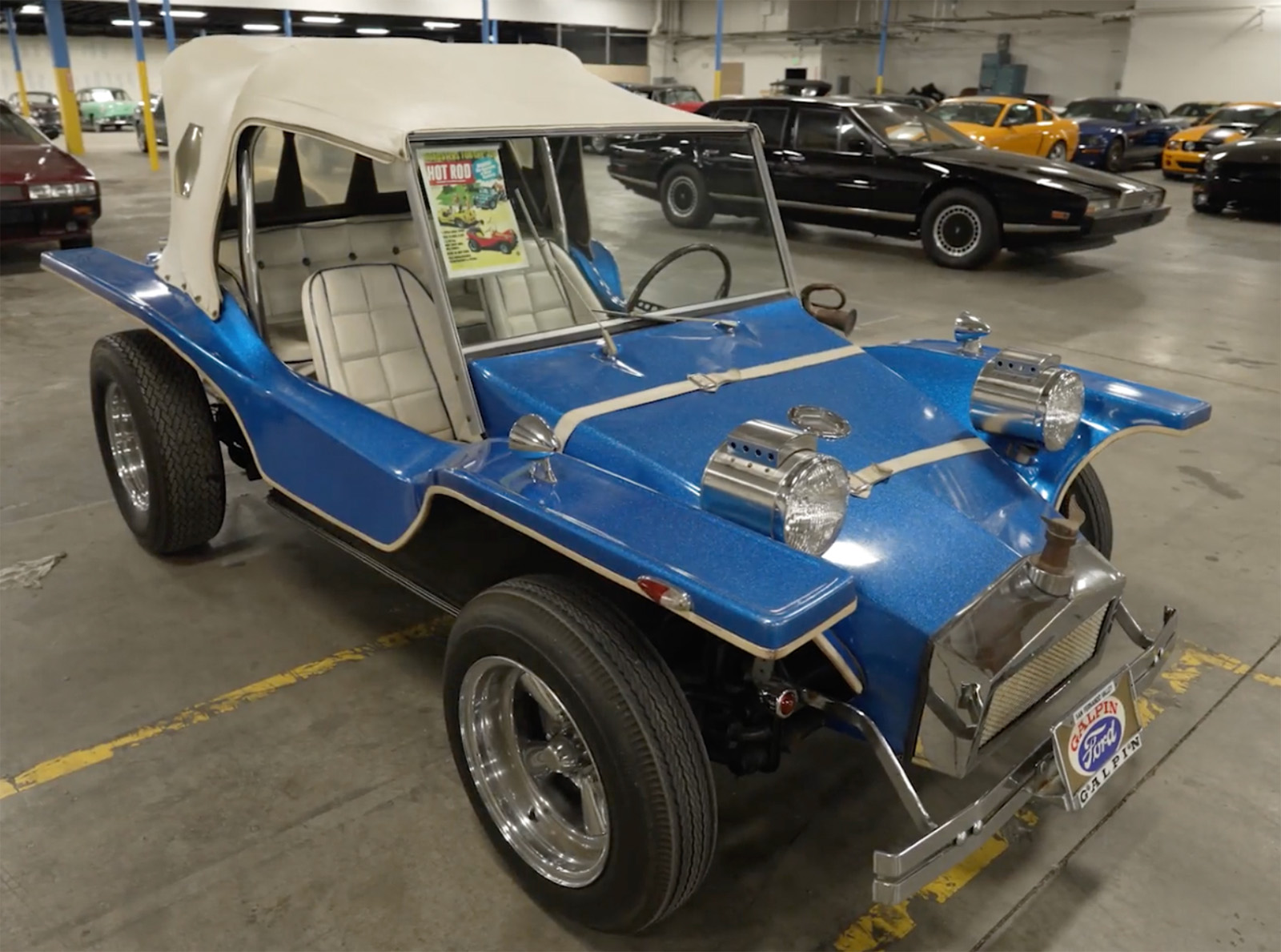
So what is the T Buggy, exactly? Underneath everything, it’s a Volkswagen Beetle. Well, sort of. It’s a Volkswagen Beetle chassis, shortened, with a fiberglass body plopped on. If this sounds familiar, that’s because it is: This is the fundamental Dune Buggy formula as defined by the legendary Bruce Meyers, designer of the first true VW-based dune buggy, the Meyers Manx.

The Manx was introduced in 1965, and soon spawned a massive host of imitators, creating a whole new industry of VW-based kit cars of many types, from overt Manx knock-0ffs to replica vintage cars to custom sports cars and vans and everything in between.
In 1970, when Barris designed the T Buggy, the dune buggy craze was at its height; there were all kinds of buggies out there, and the time was ripe for a Barris-flavored Kustom take on the genre: enter the T Buggy.
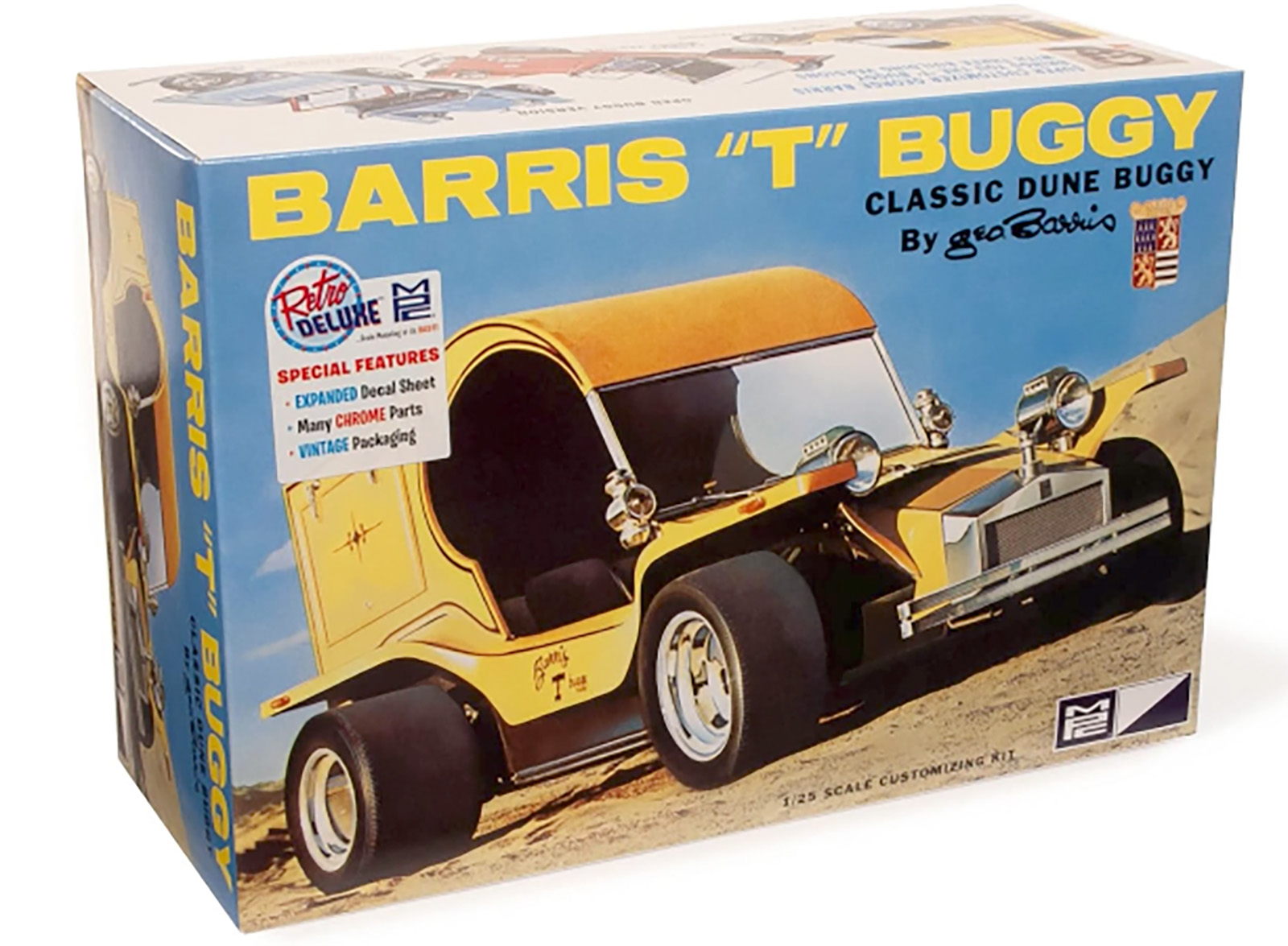
You could get a T Buggy in two main forms: model and real car. As I mentioned, there were only 12 actual cars made, but there were plenty of model kits sold, because the T Buggy was such a fun-looking machine — a strange and unholy hybrid of dune buggy aesthetics re-written with a cartoonified vocabulary of Ford Model T details.
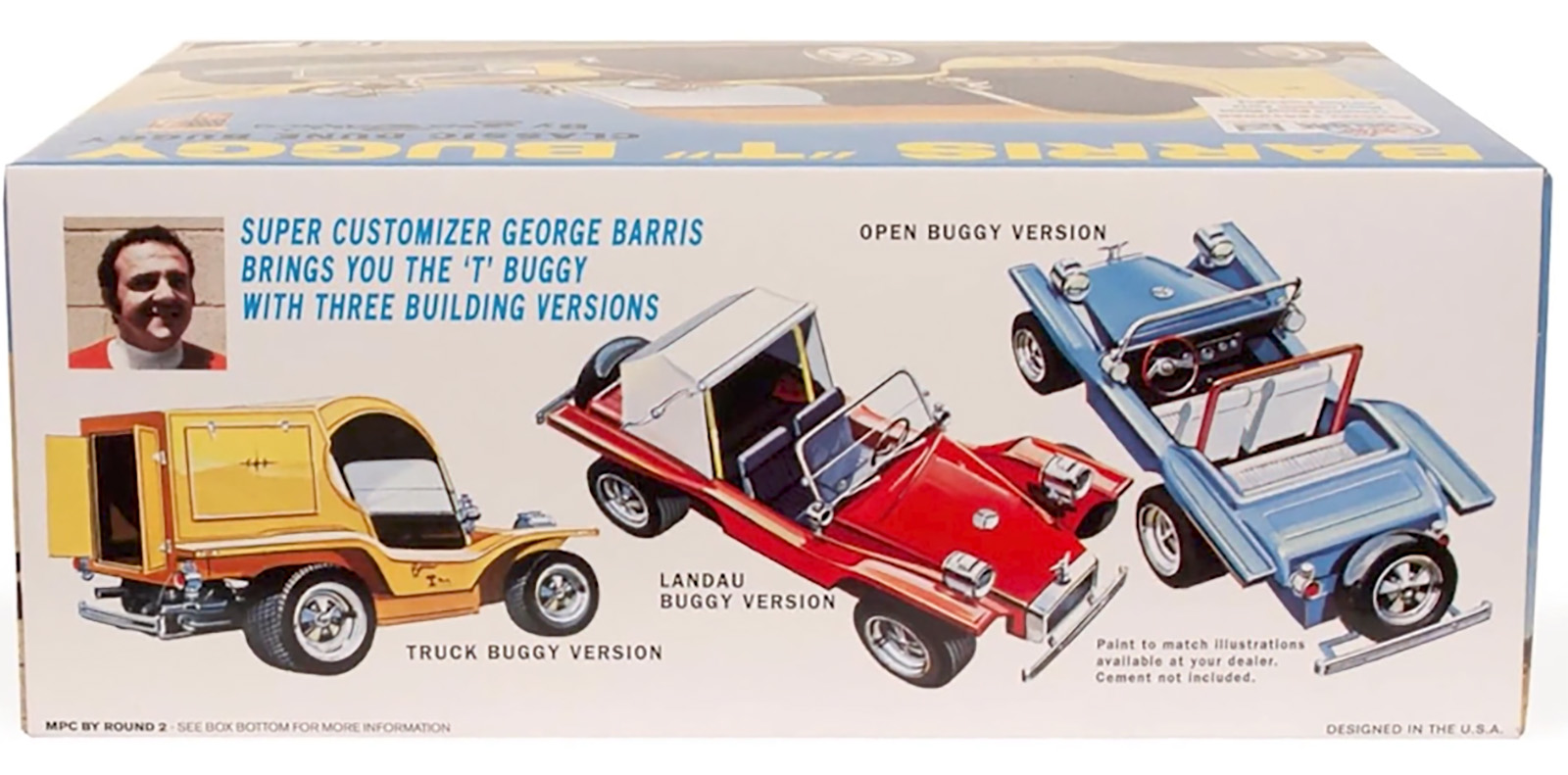
There were three main variants of the T Buggy made: a truck (based on the C-cab Ford trucks, popular in the kustom scene), a Landau version, and an open buggy version. Based on surviving cars, I think there were more truck variants than the others; Beau’s car is an open-topped one.
Beau’s T Buggy is interesting in a number of ways, not the least of which was that this very car was featured on the cover of the September 1970 issue of Hot Rod:

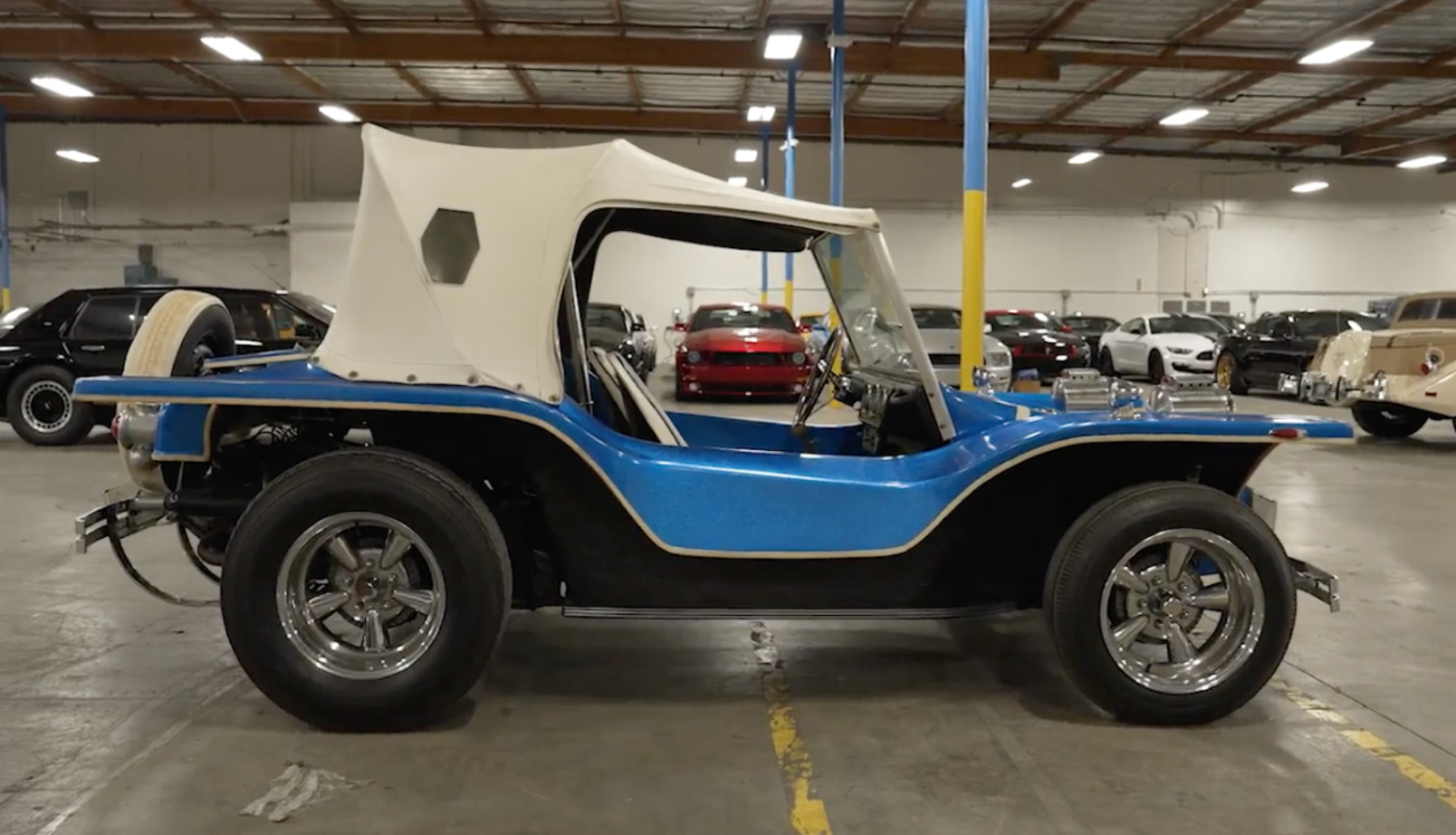
Beau’s car is also interesting because instead of the expected Beetle engine, it has a VW Type 3 engine, the flatter-profile, slightly more powerful unit used in the VW Squarebacks and Fastbacks:
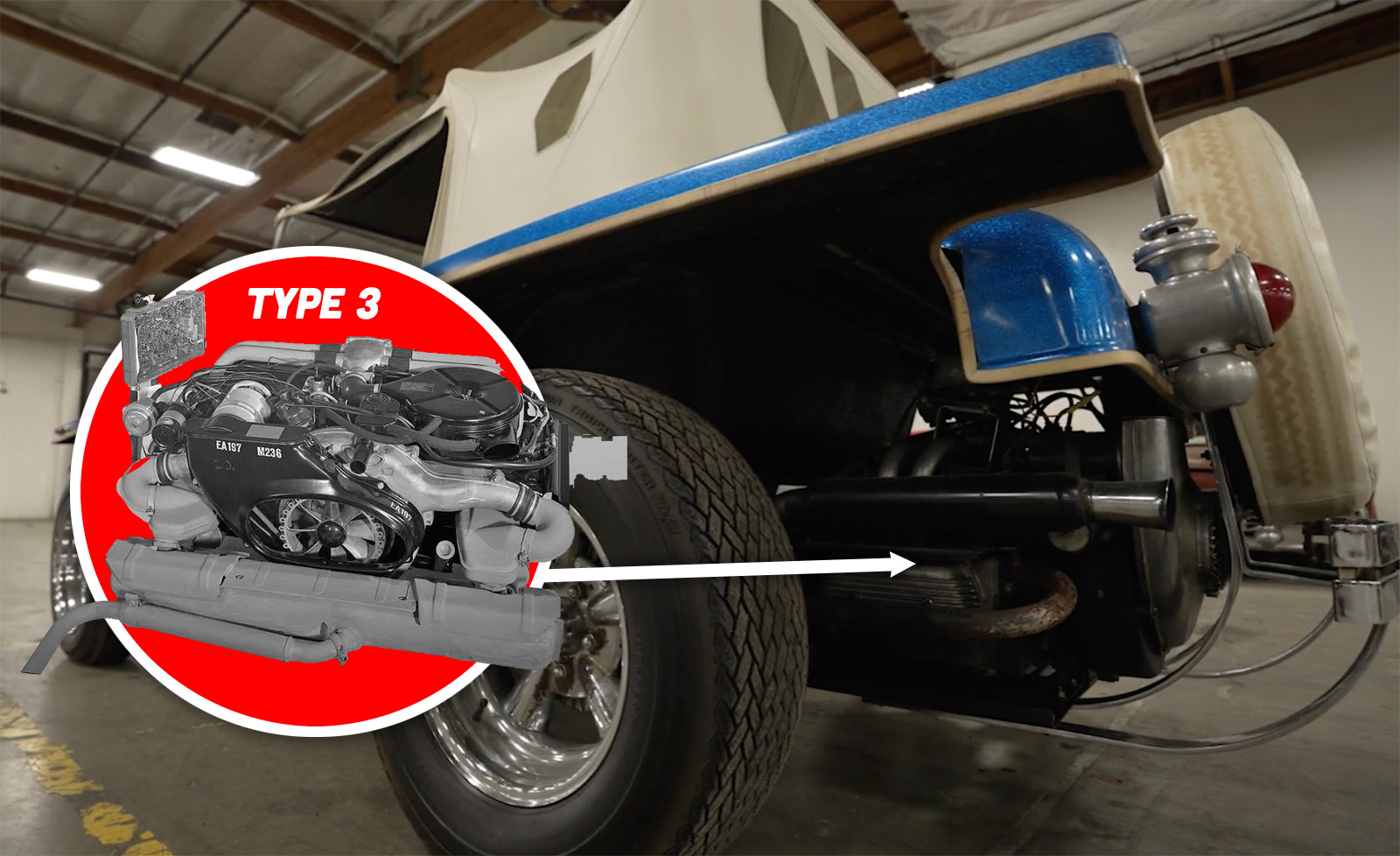
Those engines weren’t particularly common in dune buggies, mostly because Beetle-style Type 1 engines were ubiquitous back in the day. It’s an interesting choice, though, and likely puts out 5-10 more horsepower than a similarly set up Type 1 engine!
That picture up there shows some other good details like that taillight that looks like an old kerosene taillight, like you’d see on an early Ford Model T. All of the details on the car are Model T-inspired. There’s the little stumpy radiator grille up front (despite there being no radiator on the car), there’s the headlights that are made to look like old acetylene headlamps, too:
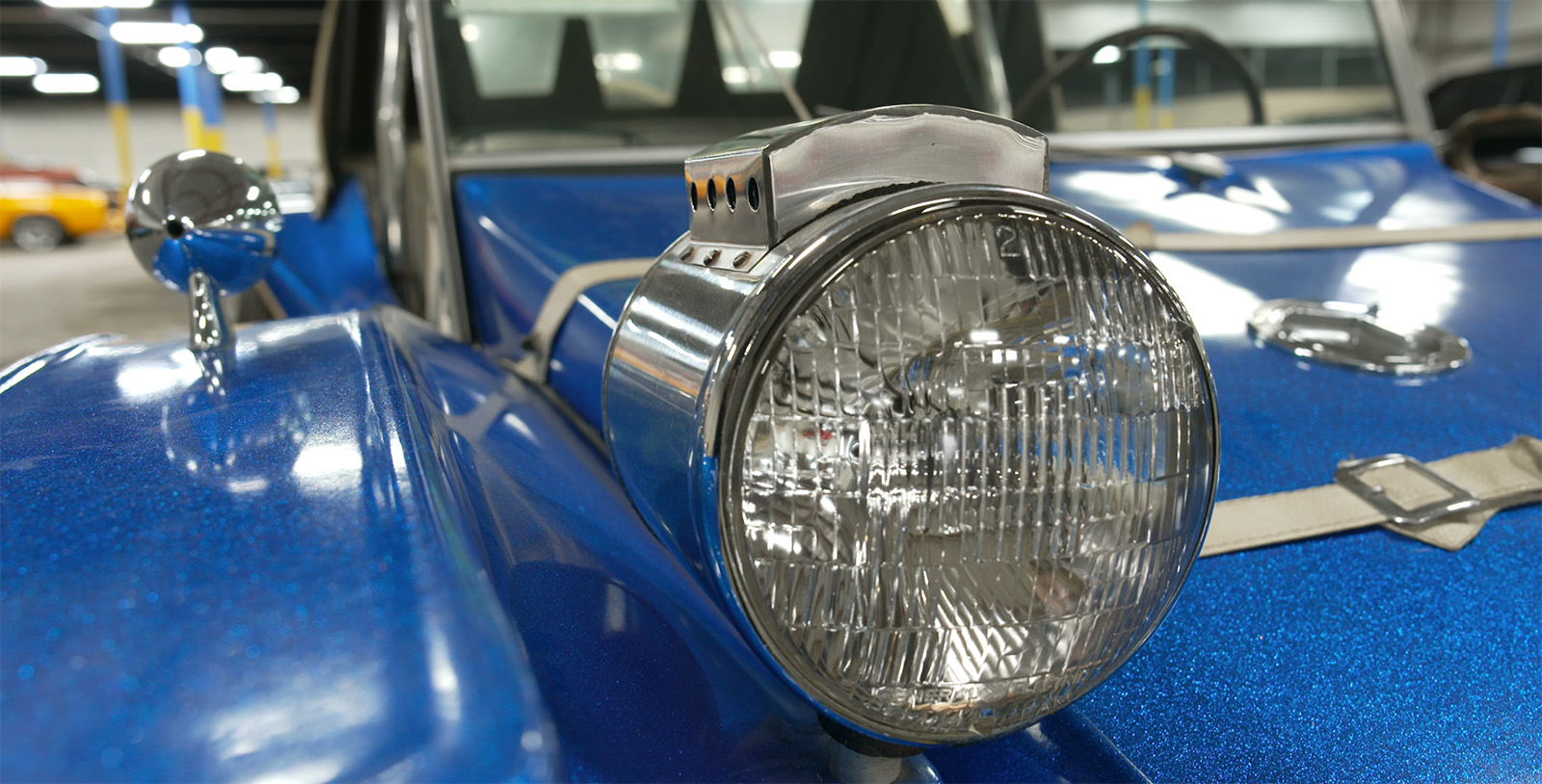
It’s a deeply strange combination of aesthetics and styles, metalflake mid-late ’60s dune buggy and spindly, old-school Model T, but Barris makes it work, with humor and charm.
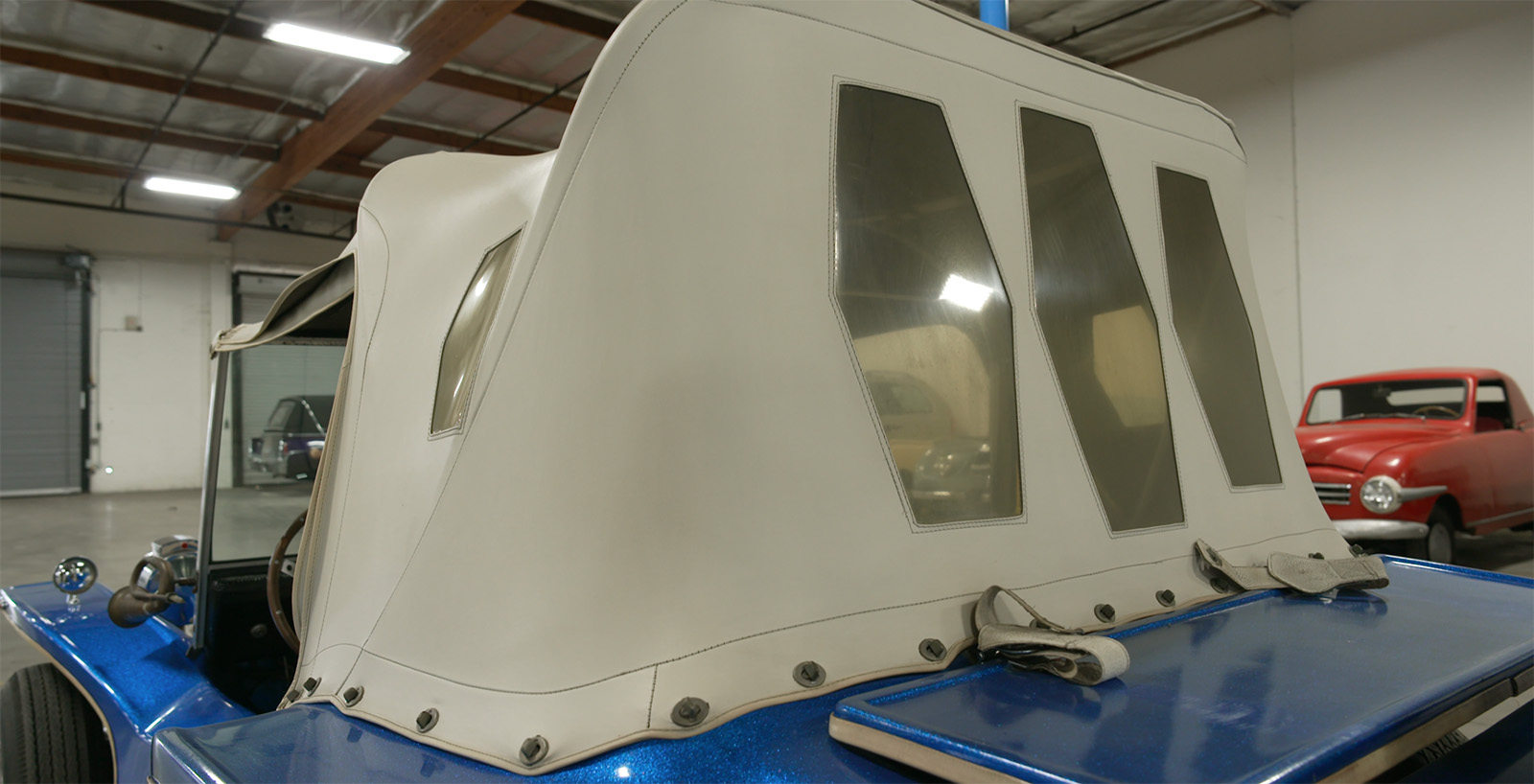
There are other strange details that aren’t strictly Model T-inspired, but also somehow work, like these hexagon-themed windows in the canvas roof. 
The horn also has a very Dr.Seussian look to it, which works with the overall feel of the car.
Also interesting is how the car’s status as a magazine cover model was commemorated; a simple Dymo-style adhesive label was used, but someone made a metal frame for the label:
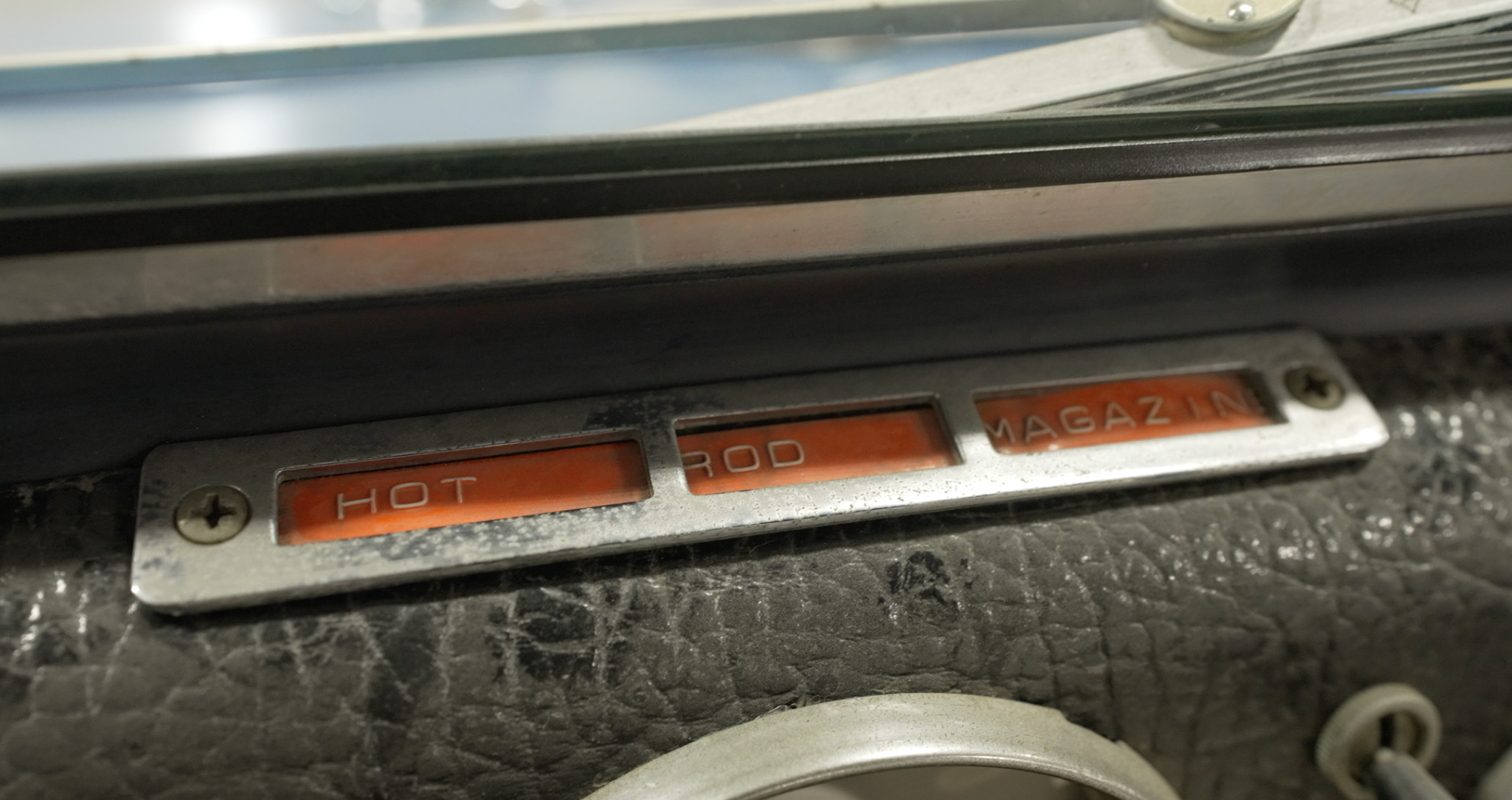
That’s a lot of effort for one of those basic labels, but I love it. Also, George Barris’ signature is next to it on the dash!
I know Beau was close with George Barris, so this car does hold some sentimental value for Beau, who showed Barris the car, as it was the first Barris car of any kind Beau was able to acquire. So it has a personal story for Beau, as well as some actual Hot Rod provenance, and is just a fun, whimsical thing, no matter how you look at it.
Are those enough reasons to keep it? Or should it go to a new home? Tell us what you think!
[Ed Note: This is part of The Autopian’s new series Should I Sell It, in which Galpin’s CEO Beau Boeckmann decides which of his 100 amazing Holy Grail cars to sell at his RM Sotheby’s auction in November. Expect to learn more about these amazing machines weekly here at The Autopian and on YouTube. -DT].


I think this is a pretty easy sell call as it has no particular connection to his family or history.
As much as it would be cool for him to keep all these cars he’s not the Sultan of Brunei and my recommendations for keep/sell would be to keep some with particular family/sentimental value and perhaps a few particular favorites/rarities he want to drive or keep as investments and sell the rest.
Cool quirky car with an interesting history.
Another difficult question you’d definitely need the right buyer with a suitable home.
The back window of the top reminded me of My Mother the Car’s 1928 Porter.
https://mystarcollectorcar.com/july-2022-28-porter-what-ever-happened-to-my-mother-the-car/
I’d keep it if for no other reason than with so few real kits out there (though I bet there’s many, many clones,) and with its provenance, it’ll go to someone who won’t drive it. If you can find the right owner who’ll take it out and put miles on it, maybe it’s a different story.
I was way more interested in EJ Potter’s “Chevy bike” and I was not disappointed!
E.J. Potter’s “Whizzer” Drag Bike – Museum of American Speed
I think this is kind of an odd series. We don’t know how much Beau cherishes it, we don’t know about his desire for cash, we don’t know how much he wants to free up storage space, etc.
There’s a part of me that’s jealous of car collectors, as I don’t have the money or space to become one. There’s also a part of me that’s angry at car collectors, because most such collections just sit, and maybe the owner walks through the warehouse now and again and thinks “Huh, that’s a neat car.”
The decision to keep or sell isn’t up to me. Beau should do whatever he wants.
I know Barris was legendary, but to use the automotive parlance of the late 1990s, he was really one of the earliest “riceboys” tarting up cars to make them look much more exciting than they were. In the 2000s we’d make fun of those guys, but now I’m seeing a resurgence in interest in circa year 2000 tuner culture (Mighty Car Mods sure loves “Sex Spec” cars) so I guess the passage of time changes perceptions.
He definitely had skills at sheet metal, but even 40 years ago I thought his stuff was kinda gaudy looking. But I also didnt grow up in the 60s.
I’m going through something vaguely similar, as I’ve been at my house for 30 years and have accumulated a lot of stuff. Stuff that my son won’t want or need when he moves to Europe with his French wife in a few years. I’ll recycle what I can, give away some, sell some, and throw a whole lot of stuff away.
Yes, this whole series–while fun and interesting–can be handily addressed by my father’s adage: “When in doubt, throw it out.”
“Manx knock-0ffs…“
I’m trying to decipher if Torch is sending us coded messages asking for help…
Careful, Flock cameras might think it’s stolen as a result of being unable to distinguish letters and numbers properly. Soon we’ll being seeing a bodycam of Torch’s arrest on Only Fanbelts.
I…would pay for this.
“Sir, is that grandfather clock stolen?”
Lines like this are why I always click on Torch articles.